
What Social Science Says About Cancel Culture
Cancel culture is a modern form of digital ostracism where individuals or entities face public backlash, humiliation, and a withdrawal of support following a perceived moral transgression. Social science research indicates that while some demographic groups view this phenomenon as a necessary tool for social accountability, the practice primarily relies on stigmatic shaming that causes severe psychological distress, induces lasting career damage, and creates a pervasive chilling effect on public discourse and workplace communication.
The Evolution and Definition of a Digital Phenomenon
The phrase "cancel culture" has moved rapidly from the margins of internet subcultures to the center of global political, sociological, and cultural debate. While the act of holding public figures accountable is not a historical novelty, the digital landscape has fundamentally altered the scale, speed, and permanence of public shaming. In the past, public shame was typically localized and temporary; today, the architecture of the internet ensures that digital footprints make public humiliation global, searchable, and effectively permanent 1.
Sociologists, psychologists, and communication scholars generally define cancel culture through a convergence of three core components. First, it involves the public shaming of unacceptable behavior, often facilitated by the anonymity and reach of digital platforms. Second, it relies on the collective withdrawal of support, attention, or financial backing. Third, it is driven by a motivation to ensure the target experiences tangible, severe consequences, such as social banishment, loss of revenue, or termination of employment 2.
Scholars emphasize that cancel culture must be distinguished from traditional boycotts and standard online criticism. Traditional boycotts typically rely on voluntary, decentralized consumer actions that demand sustained participation and coordinated sacrifice, such as labor-led boycotts where participants abstain from a product to enact economic pressure 3. In contrast, cancel culture seeks comprehensive social exclusion. It extends beyond the mere withdrawal of personal support to active demands for professional dismissal, the deplatforming of individuals across their entire career output, and the enlistment of institutional power to punish the target - often irrespective of whether the campaigners actually consume the target's work themselves 3.
This phenomenon represents a significant shift in the contemporary "platform society." Social media platforms are no longer just communication tools; they are spaces where social norms are rigorously policed, and where intentionally created information - including manipulated facts or "fake news" - can be weaponized to guide public opinion, construct polarized echo chambers, and facilitate the immediate cancellation of those who fall outside of ideological conformism 2.
The Ideological Divide: Accountability Versus Punishment
Public perception of cancel culture is deeply fractured. Surveys indicate that the way an individual interprets online shaming is largely dictated by their political ideology, age, and educational background. A comprehensive survey of U.S. adults revealed that 58% of the public believes that calling out others on social media is a way to hold people accountable for their actions, while 38% view it as a cruel mechanism used to punish people who do not deserve it 4.
This divide is heavily partisan. Research demonstrates that 75% of Democrats and Democratic-leaning individuals view online call-outs as a form of accountability, whereas 56% of Republicans view them as unjust punishment 4.
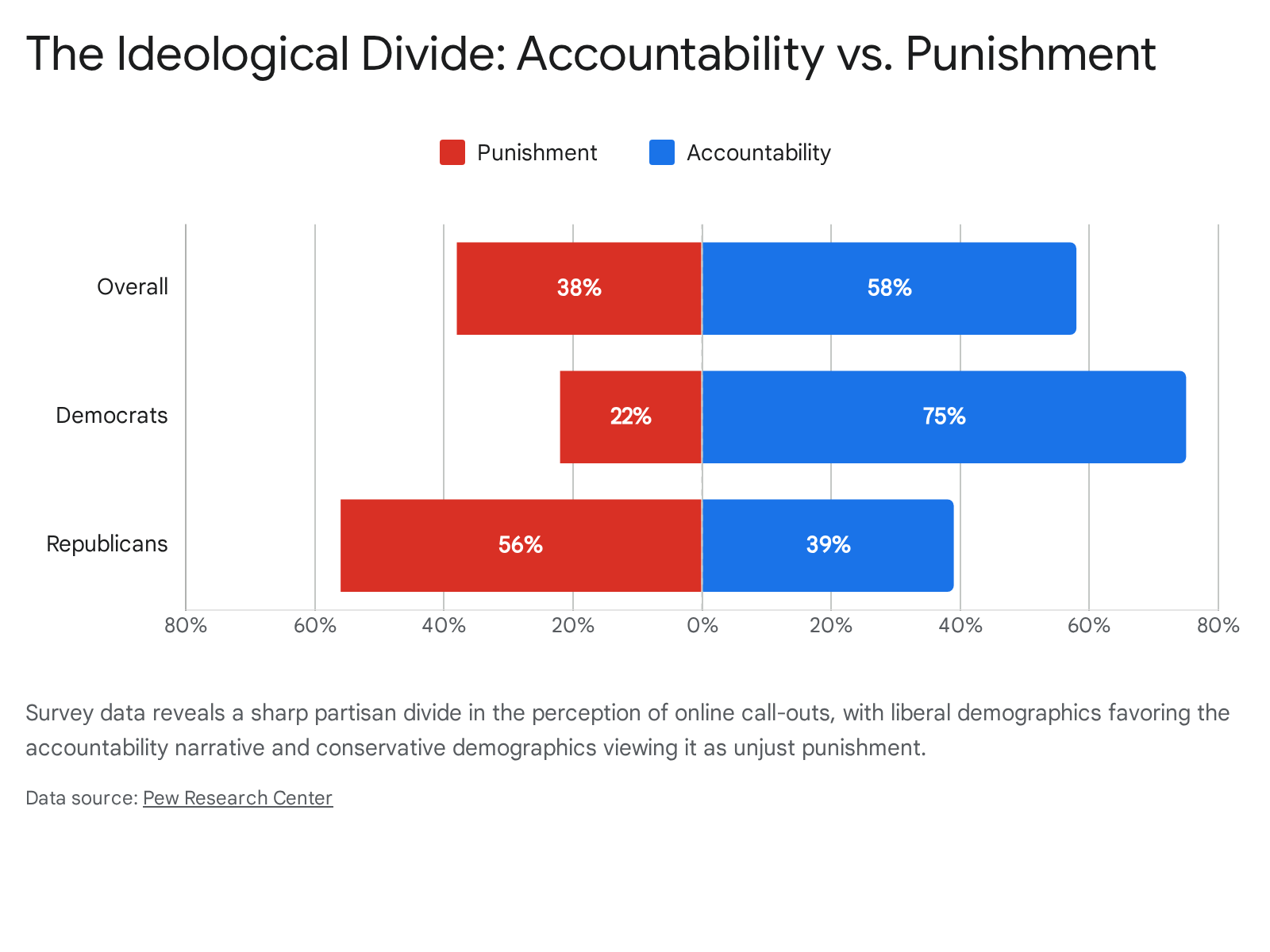
Within these groups, education levels also play a role; Democrats with at least a bachelor's degree are more likely to see the practice as accountability, while conservative Republicans are the group most likely to define it as an attack on traditional values or outright censorship 4.
When asked to explain their perspectives, the public generally falls into distinct thematic arguments regarding the utility and morality of digital shaming.
| Core Argument Theme | The "Accountability" Perspective | The "Punishment" Perspective |
|---|---|---|
| Helpfulness vs. Judgment | Views the call-out as a necessary "teaching moment" that helps offenders learn from their mistakes and improve 4. | Argues that the digital mob rushes to judge without considering the original poster's context, intent, or background 4. |
| Productive Behavior | Believes the threat of public backlash ensures people consider the consequences of their words, creating a safer digital space 4. | Claims the behavior solves nothing, creates a highly toxic environment, and fosters division rather than genuine reconciliation 4. |
| Free Speech vs. Safety | Emphasizes that online speech can cause real harm to marginalized groups, making intervention an imperative 4. | Focuses heavily on First Amendment rights, warning against the dangers of self-censorship and retaliation for holding minority opinions 4. |
| Agendas and Motives | Sees the practice as an essential, grassroots tool to expose systemic social ills like racism, misogyny, or misinformation 4. | Views call-outs as "virtue signaling" or orchestrated attempts to marginalize certain voices and enforce ideological purity 4. |
| Action vs. Inaction | Argues that silence equals approval; therefore, speaking up against offensive content is a moral obligation 4. | Suggests that offended users should simply unfollow, block, or ignore the content rather than organizing public harassment campaigns 4. |
The Psychology of the Digital Mob: Why Do People Cancel?
If online shaming is documented to be highly destructive, why is it so prevalent? Social science points to several interlocking psychological, emotional, and sociological drivers that fuel digital outrage, suggesting that the mob operates less as a precise instrument of justice and more as an unregulated mechanism of social policing.
Social Policing, Status Seeking, and Moral Grandstanding
At its sociological core, public shaming is a mechanism for enforcing societal norms. People who participate in online shaming rarely perceive themselves as bullies or harassers. Instead, they view their activities as a vital contribution to society, acting as digital vigilantes who deter deviance and foster group solidarity 56. A fundamental underpinning of this behavior is the belief that all involved share a collective moral standard, putting the onus on the community to uphold that standard by punishing transgressors 6.
However, participation is heavily driven by personal psychological needs. Researchers have identified a concept labeled "moral grandstanding" (often colloquially referred to as virtue signaling). By publicly condemning someone else's behavior, individuals seek to elevate their own social status and signal their moral credibility to their in-group 5. This pursuit of status is highly correlated with political hostility. Observational data collected across 30 countries and six continents involving over 15,000 respondents indicates that individuals who exhibit higher status-seeking motivations are more likely to be hostile online 7. This behavior is exacerbated in less democratic and more economically unequal societies, suggesting that online political hostility and cancel culture are deeply intertwined with broader, offline socioeconomic tensions and systemic frustrations 7.
The Trauma Troll Hypothesis
Clinical psychology offers a more sobering perspective on the drivers of cancel culture: much of the hostility observed is not rooted in simple malice or ideological purity, but in unprocessed emotional trauma. Experts refer to this dynamic as the "trauma troll" phenomenon, noting that the internet is crowded with dysregulated individuals experiencing displaced grief, threat biology, and severe anxiety 8.
For these individuals, participating in a collective shaming event provides a temporary, albeit artificial, sense of control and stability. Because they lack safe outlets for their anger, neutral content is frequently misread as a personal attack, and minor disputes trigger major, disproportionate outrage. The target of the cancellation simply becomes a proxy for the perpetrator's unresolved psychological pain 8. While clinicians emphasize that naming this mechanism does not excuse the devastating impact on targets, they argue that failing to understand the trauma-driven nature of digital harassment prevents platforms and society from developing effective interventions, reducing complex clinical realities to theatrical character problems 8.
Platform Affordances and Reduced Moral Sensitivity
The medium of communication itself plays a massive role in facilitating cancel culture. Social media platforms are architecturally designed to reward attention, engagement, and emotional arousal, and algorithms frequently prioritize outrage-driven virality over user protection 910.
Furthermore, the digital environment actively alters human psychology. A multi-study analysis comprising experimental simulations and self-rated questionnaires revealed that social media usage significantly reduces users' "moral sensitivity." Because interactions are mediated through screens and stripped of vital non-verbal cues, individuals perceive a much lower "moral intensity" in their hostile comments 10. This emotional detachment - combined with the anonymity and physical distance provided by the internet - makes everyday users far more likely to participate in devastating public shaming than they would ever be in a face-to-face setting, where the immediate visible distress of the victim would naturally trigger empathy 1011.
Stigmatic vs. Reintegrative Shaming
To understand why cancel culture is uniquely damaging to societal cohesion, sociologists draw a critical distinction between two distinct types of social correction: stigmatic shaming and reintegrative shaming 12.
| Concept | Stigmatic (Punitive) Shaming | Reintegrative Shaming |
|---|---|---|
| Core Philosophy | Labels the individual as inherently "bad," fusing the offensive act with the person's core identity 12. | Deplores the specific act, but maintains that the offender is a valuable person who can be redeemed 12. |
| Social Mechanism | Relies on degradation, shunning, public humiliation, identity politics, and "twitter mobs" 12. | Relies on "walls of accountability," social movements encouraging moral reflection, and restorative justice 12. |
| Desired Outcome | Complete social, professional, and cultural elimination of the target 12. | Rehabilitation, learning, and eventual acceptance back into the broader community 12. |
| Psychological Impact | Induces severe alienation, trauma, loss of identity, and potentially suicidal ideation 112. | Encourages compliance with norms, maintains self-worth, and motivates the individual to improve 12. |
Research indicates that cancel culture relies almost exclusively on stigmatic shaming. It leaves virtually no room for due process, proportional punishment, or eventual forgiveness, effectively branding the target as irredeemable for the rest of their life 512.
The Psychological Toll on the Canceled
The human brain evolved to manage small-group social dynamics; it is fundamentally not wired to process the sheer volume of vitriol, hatred, and surveillance generated by a viral digital cancellation. When a person is targeted by thousands of strangers, the psychological and physiological consequences are profound, measurable, and often permanent.
Digital Ostracism and the Neurobiology of Pain
Ostracism - the act of being excluded, ignored, or banished - is recognized by psychologists as a fundamental threat to basic human needs, specifically the needs for belonging, self-esteem, control, and meaningful existence 1314. Neuroscientific research has shown that the brain processes social exclusion similarly to physical pain; the same neural pathways that light up when a person is physically injured become highly active when they are ostracized 13.
In the context of "cyber-ostracism," this neurological damage is often amplified by the 24/7 nature of the internet. Unlike a physical environment from which a victim can physically escape, digital shaming penetrates personal spaces, following the victim into their home and onto their personal devices. This constant barrage continuously retraumatizes the individual at all hours of the day 1516. Studies indicate that survivors of online harassment report a spectrum of detrimental mental health consequences, including severe emotional dysregulation, insomnia, panic attacks, depression, and significant suicidal ideation 151718.
Furthermore, the isolation is not just digital. Once shamed, victims frequently face profound real-world social alienation, being expelled from their industry networks, friend circles, and community organizations, leading to long-term post-traumatic stress and a pervasive loss of identity 118. The fear of association causes former allies to distance themselves, creating a complete vacuum of social support precisely when the victim is most psychologically vulnerable 118.
The "Pressure for Perfect Conduct" and Surveillance
The psychological weight of cancel culture extends far beyond those who are actively canceled; it profoundly affects the millions of internet users who observe the mob and alter their behavior in fear. Qualitative studies exploring the individual impacts of cancel culture have identified a phenomenon termed the "Pressure for Perfect Conduct" (PPC). Participants report feeling an intense, omnipresent anxiety to avoid making any mistakes, expressing controversial opinions, or deviating from perceived moral orthodoxies, lest they be detected and destroyed by the digital public 19.
This claustrophobic, panoptic pressure forces individuals into a state of constant self-surveillance. Under the watchful eyes of the digital mob, internet users feel that their private thoughts, past mistakes, and off-the-cuff remarks could at any moment be weaponized to ruin their lives. This leads to a severe restriction of authentic expression and a deep-seated fear of social interaction 19. High-sensitivity individuals and perfectionists are particularly vulnerable to this pressure. Because of their all-or-nothing thinking styles, they view the potential for public criticism not as a learning opportunity, but as a catastrophic failure of character, leading to prolonged rumination and shame spirals 20. Consequently, many individuals develop severe social anxiety, choosing to isolate themselves, cancel in-person plans, or entirely withdraw from digital spaces to protect their mental well-being 921.
Career Fallout: The Myth and Reality of the "Comeback"
One of the most fiercely debated aspects of cancel culture is its tangible impact on careers. Critics of the term often argue that cancellation is largely a myth, pointing to high-profile celebrities, politicians, or comedians who face intense public backlash only to return to lucrative careers, book deals, or sold-out tours shortly after 422.
It is true that for the ultra-famous, cancellation is rarely the end. High-profile figures can often engineer comebacks by leveraging independent digital platforms (such as YouTube, TikTok, or subscriber-based newsletters) to bypass traditional corporate gatekeepers and speak directly to their loyal audiences 22. However, focusing on celebrity resilience severely distorts the reality of the phenomenon. Empirical data suggests a much darker outcome for ordinary professionals, academics, and middle-management employees who lack the financial safety nets and massive platforms of the elite.
For the average professional, the career math is brutal. Because search engines preserve damaging content indefinitely, a viral controversy creates a permanent "digital scarlet letter" that destroys professional credibility 1.
| Career Sector | Documented Impact of Cancel Culture |
|---|---|
| General Workforce | 45% of canceled individuals lose their jobs permanently. For those who recover, the average career rehabilitation takes 18 months 2324. |
| Academia & Higher Ed | Over 400 academics faced institutional sanctions for protected speech since 2015, resulting in ~200 firings. 62% of canceled academics never regain tenure-track positions 32324. |
| Executive Leadership | Canceled executives suffer an average earnings loss of $1.2 million per year following a public shaming incident 24. |
| Human Resources | 28% of HR professionals report having terminated employees over their personal social media posts 24. |
The devastation is compounded by the fact that allegations do not need to be proven true to end a career; the mere threat of a viral public relations crisis is often enough to compel risk-averse employers to terminate the targeted individual immediately 125.
The Chilling Effect: Self-Censorship in the Workplace and Society
Perhaps the most widespread sociological and structural impact of cancel culture is not the active canceling of individuals, but the pervasive "chilling effect" it casts over public discourse, academic research, and corporate environments.
The Spiral of Silence and the "Fish-Out-of-Water"
Political scientist Pippa Norris applies the well-established "spiral of silence" theory to explain how cancel culture eviscerates robust intellectual debate. The theory posits that as mainstream values within a group solidify and become the predominant culture, individuals who hold dissenting views perceive a rising social threat. Driven by the deep-seated human fear of ostracism, these minority voices preemptively mute themselves. Over time, this creates a psychological ratchet effect that completely muffles contrarians and creates an illusion of total ideological uniformity 2627.
Norris's global research on academic freedom confirms the "fish-out-of-water" congruence thesis: perceptions of cancel culture and the pressure to self-censor depend almost entirely on how well an individual's personal values align with the dominant culture of their immediate environment. In predominantly liberal, post-industrial societies (such as the United States, the United Kingdom, and Sweden), right-wing scholars are the most likely to report a "chilly climate" and suppress their views. Conversely, in developing societies characterized by traditional moral cultures (such as Nigeria), it is left-wing scholars who report that cancel culture and silencing are worsening 2627. The fear of being targeted forces scholars to avoid researching controversial topics, directly stunting scientific and sociological advancement 28.
Workplace Communication and "Implicit Voice Theories"
This chilling effect has rapidly infiltrated the modern corporate workplace, stifling innovation and creating cultures of avoidance. A longitudinal study indicated that an astounding 76% of Americans report self-censoring in conversations due to fears of cancellation and social reprisal 323.
In the context of organizational behavior, this self-censorship is driven by "implicit voice theories." These are subconscious assumptions employees make that speaking up, challenging the status quo, offering dissenting opinions, or delivering bad news is inherently risky and inappropriate 3029. When employees witness a colleague being publicly shamed or fired for a misunderstood comment, they internalize the lesson that visibility equals vulnerability. Consequently, they retreat into silence.
This dynamic is wreaking havoc on corporate culture. According to the Society for Human Resource Management (SHRM) 2024 Civility Index, workplace incivility driven by political polarization has reached record highs. Nearly one-third (31%) of U.S. workers feel their workplace is entirely ineffective at promoting civil discourse, leading to deep disengagement, loss of productivity, and eroded morale 30.
Furthermore, the legal landscape in the United States exacerbates this fear. A common misconception among Americans is that the First Amendment protects their speech at work. In reality, the Constitution only restrains government censorship. Private-sector employees - who constitute nearly 90% of the workforce - operate under "at-will" employment laws. Employers possess the legal right to fire workers for almost any reason, including their off-duty speech, so long as it isn't based on a protected class like race or religion 2533. As a result, the line between personal and professional life has completely collapsed. A single careless social media post, taken out of context by a digital mob, can become an immediate corporate liability, prompting businesses to fire employees swiftly to protect their brand rather than defending their workers 25.
Global Contexts: Western Cancel Culture vs. China's Human Flesh Search Engine
While cancel culture is frequently discussed through a Western, Anglocentric lens, digital ostracism is a global phenomenon that takes on unique operational shapes depending on a region's cultural, legal, and political environment.
In China, a parallel phenomenon known as the "Human Flesh Search Engine" (renrou sousuo yinqing) predates mainstream Western cancel culture by several years. Originating around 2006 (famously sparked when users tracked down a woman who posted a video of herself crushing a kitten), this practice involves massive, crowdsourced investigations where millions of "netizens" hunt down the real-world identities, addresses, phone numbers, and employers of individuals deemed to have committed moral transgressions 3132.
While both Western cancel culture and the Human Flesh Search Engine rely on public shaming, outrage, and the destruction of digital privacy, sociologists note several distinct differences in how they operate:
| Feature | Western Cancel Culture | China's Human Flesh Search Engine |
|---|---|---|
| Primary Targets | Public figures, celebrities, academics, and private citizens who violate evolving cultural or progressive norms (e.g., race, gender, sexuality) 327. | Often targets corrupt local government officials, animal abusers, or individuals displaying extreme moral decadence 3233. |
| Sociopolitical Function | Operates as a tool for ideological enforcement, boundary setting, and consumer boycott within a capitalist media ecosystem 237. | Frequently acts as a form of grassroots digital vigilantism by the "little people" in a society where traditional avenues of justice or political protest are heavily restricted by the state 3233. |
| Historical Parallels | Often compared to Puritan public shunning or moral panics 3839. | Sociologists frequently draw connections to the Cultural Revolution, comparing modern netizens to the Red Guards using digital "big-character posters" to denounce enemies 32. |
| The Anonymity Paradox | Cancel campaigns are often led by named activists or influencers seeking social status, though anonymous mobs participate 25. | Fueled heavily by absolute anonymity; users hide behind aliases while stripping targets of all privacy, revealing highly sensitive personal data to the world 3240. |
The severity of digital ostracism is also influenced by cultural values. Linguistic studies analyzing global texts over two centuries suggest that as internet penetration increases, cultures generally shift toward individualism . However, in highly collectivist societies - or environments that prioritize group harmony over individual expression - the threat of social ostracism carries a uniquely devastating psychological weight. In these contexts, digital shaming is not just a career threat; it is an existential threat to an individual's place in society, making cyber-ostracism an exceptionally powerful tool for behavioral control 1334.
Coping, Recovery, and Organizational Resilience
As the digital landscape becomes increasingly polarized, psychologists, public relations experts, and organizational leaders are developing evidence-based strategies for individuals and brands to survive the era of online shaming and mitigate its psychological harms.
Psychological Resilience for Individuals
For individuals facing online hate, mental health professionals emphasize the critical importance of breaking the cycle of trauma and resisting the urge to spiral into self-isolation. * Emotional Regulation and Delayed Response: The brain naturally interprets intense online criticism as a physical threat, triggering the amygdala and a "fight or flight" response. Targets are strongly advised not to react impulsively or defend themselves immediately while highly emotional. Taking time away from the screen to process the emotional shift is critical to avoid escalating the conflict and feeding the trolls 4344. * Proactive Identity Management: Protecting a digital reputation requires proactive effort before a crisis occurs. Building a strong, consistent digital footprint over time acts as a "forensic anchor." When an individual's values and expertise are consistently documented, manufactured claims and false narratives generated by bad actors have far less power to dislodge their credibility 35. * Contextual Coping and Digital Detox: Interestingly, research on how humans cope with ostracism suggests that behavior changes based on the context of the exclusion. Individuals who are ostracized online often turn reflexively back to social media to seek validation and reconnection, a maladaptive strategy that can expose them to further harm 36. Psychologists recommend scheduling intentional "digital detoxes," prioritizing face-to-face interactions, and curating social feeds to maintain a sense of self-worth independent of platform algorithms 1047.
Corporate Crisis Management
For brands and organizations, the risk of employee activism, algorithmic amplification of misinformation, and borderless backlash means that crisis communication can no longer be an afterthought - it must be the core of their reputation strategy 48.
Public relations experts recommend a structured framework for handling social media backlash. First, organizations should attempt to take volatile conversations offline whenever possible. When a customer or activist raises a legitimate grievance, providing a direct, private channel for resolution prevents the issue from becoming a performative public spectacle 373839. Second, when an organization is genuinely at fault, avoiding corporate jargon and issuing swift, transparent, and empathetic apologies can defuse outrage. However, organizations are cautioned against engaging in hollow, performative remorse just to appease a mob, as modern consumers quickly detect inauthenticity 3740.
Finally, human resources and corporate leaders must resist the urge to immediately fire employees at the first sign of a digital controversy. While the instinct to protect the brand is strong, capitulating to online mobs without due process fosters a highly toxic workplace culture defined by fear, distrust, and silenced innovation 2533. Cultivating an environment of procedural and interpersonal justice, where employees feel supported even in the face of external pressure, is the most effective way to prevent self-censorship and maintain organizational health 2941.
Bottom line
Social science reveals that while cancel culture is often defended as a democratic tool for accountability, its operational mechanisms rely heavily on punitive, stigmatic shaming driven by status-seeking and trauma-induced hostility. The psychological toll on targeted individuals is severe, mirroring the neurobiological response to physical pain, and the professional consequences - particularly for ordinary workers without elite safety nets - are frequently permanent. Ultimately, the most profound and far-reaching impact of online shaming is the widespread chilling effect it generates, driving a vast majority of the public to self-censor, stifling innovation in the workplace, and eviscerating robust discourse in democratic societies.