
Why Outrage Spreads Faster Than Good News Online
Outrage spreads faster than good news because human brains are evolutionarily hardwired to prioritize potential threats over positive information, a survival mechanism known as negativity bias. Social media algorithms purposefully exploit this biological instinct by rewarding moral indignation with increased visibility and engagement. This creates a powerful neurological feedback loop that trains users to prioritize anger and tribal signaling over accuracy or joy.
The Evolutionary Roots of Negativity Bias
To understand why a furious rant goes viral while a heartwarming story struggles to gain traction, we have to look far past the invention of the smartphone and into the evolutionary history of the human brain. For hundreds of thousands of years, human survival depended on a psychological phenomenon known as the negativity bias. Our ancestors who paid hyper-focused attention to negative cues - a rustling in the bushes, a threatening gesture from a rival, or a violation of tribal norms - were far more likely to survive and pass on their genes than those who were preoccupied with beautiful sunsets. Because of this, the human brain remains hardwired to focus on perceived threats and adversarial framings 1.
When we encounter positive information, it is generally processed as useful but not urgent. When we encounter negative information, our brains treat it as critical for survival. The fight-or-flight system is immediately engaged, releasing stress hormones like cortisol and adrenaline that sharpen our focus and speed up our reaction times 1. Neuroscientists have shown that our brains do not adequately distinguish between offline physical threats and online social anger; we mirror the emotion either way, making digital environments that highlight fear or anger uniquely capable of seizing our attention 13.
The Role of Physiological Arousal
Not all negative emotions perform equally well on the internet, however. The virality of content is heavily dependent on a psychological concept called physiological arousal. In a landmark analysis of thousands of New York Times articles, researchers discovered that the virality of content is not just about whether an emotion is positive or negative, but whether it is activating or deactivating 23.
Emotions classified as low-arousal, such as sadness or calmness, tend to make us passive. When people feel sad, they typically withdraw to process the emotion. Consequently, sad content rarely goes viral because it does not compel the user to take immediate action 34. Conversely, high-arousal emotions like awe, anger, fear, and anxiety elevate our heart rate and compel us to act. While positive high-arousal emotions, like awe at a breathtaking scientific discovery or a heartwarming rescue, can and do go viral, negative high-arousal emotions like anger and moral outrage are uniquely potent. They demand immediate resolution or expression. When we read something that makes our blood boil, sitting still feels physically uncomfortable. Hitting the retweet or share button offers immediate, frictionless relief and a sense of taking action 25.
The MAD Model of Moral Contagion
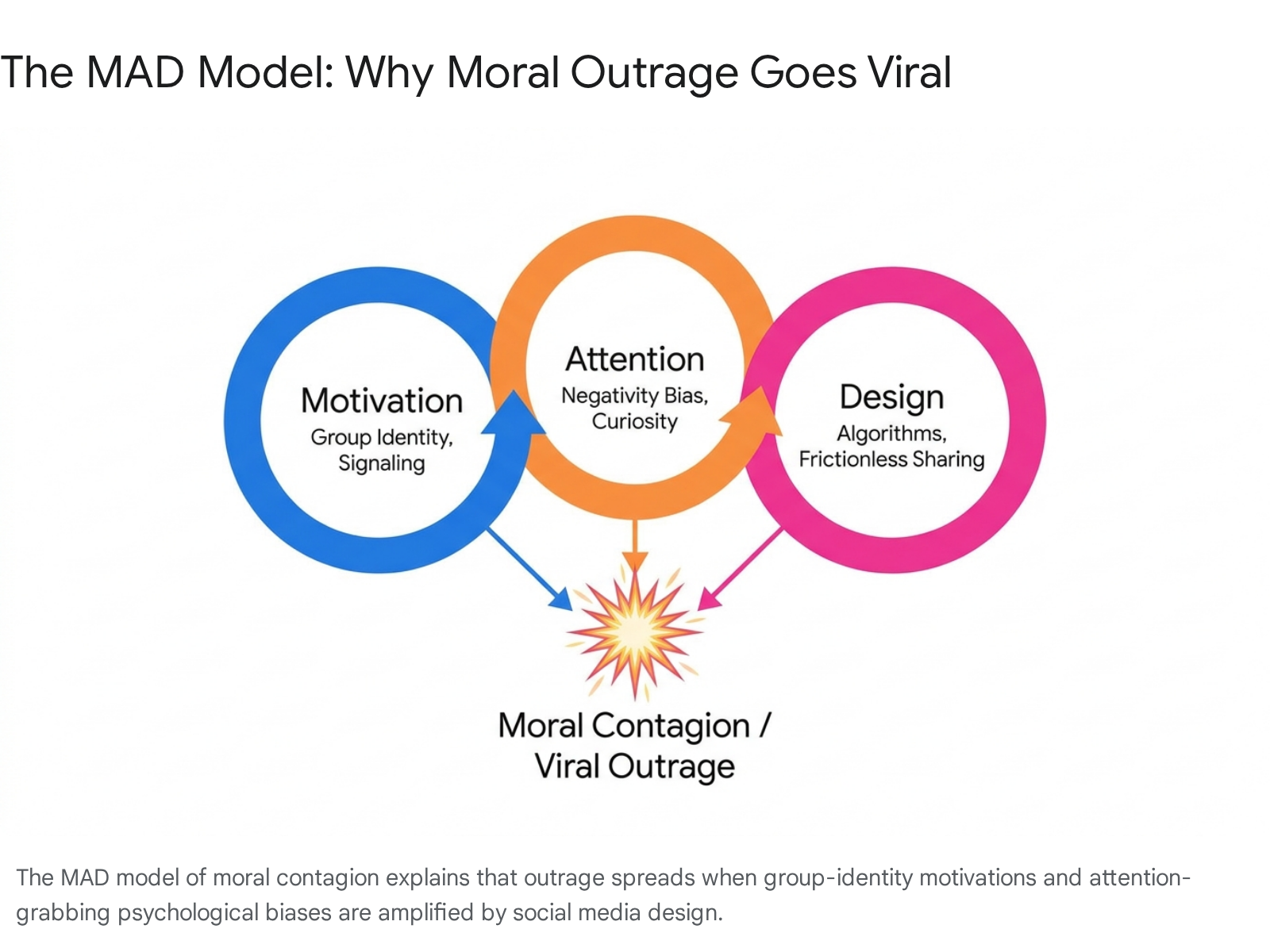
Behavioral scientists use a specific framework to explain why the internet is dominated by anger: the MAD model of moral contagion. Developed by researchers to explain how moralized content spreads through online networks, the MAD model identifies three interlocking pillars: Motivation, Attention, and Design 678.
Motivation and Tribal Signaling
Humans are inherently social creatures, and we have a deep psychological need to belong to an in-group. Much of our behavior online is driven by the subconscious motivation to signal our moral identity to our peers. Sharing an outrageous post isn't necessarily about transferring information; it is a form of tribal signaling. When you share a post expressing disgust at a politician or a rival group, you are broadcasting your values and demonstrating loyalty to your community 611.
Outrage offers a cheap, rapid way to reinforce in-group solidarity. The more strongly a user identifies with a specific political or cultural faction, the more motivated they are to share content that portrays the out-group negatively. This dynamic allows outrage to serve as a vehicle for projecting moral superiority and deriving self-worth through adversarial posturing 17.
Attention and the Curiosity Gap
The second pillar of the MAD model relates to how moral-emotional content naturally captures our attention. Words associated with outrage, disgust, and moral violations jump out at us as we scroll. Research has quantified this effect, showing that each additional negative moral-emotional word in a social media post about a contentious issue is associated with a 24 percent increase in reposts 9.
Content creators and marketers have weaponized this attention capture through rage bait, which is content deliberately crafted to provoke hate, fear, and fury to harvest clicks and engagement 310. The attention economy demands that publishers compete for limited human focus, and moral outrage has proven to be the most reliable magnet. This is often coupled with the curiosity gap, a tactic where a headline or video teases just enough shocking information to make the user feel an overwhelming need to click and resolve the suspense 1415.
Design and Algorithmic Amplification
The final piece of the MAD model is the architecture of social media itself. Platforms are not passive bulletin boards; they actively shape what we see through complex ranking algorithms. These algorithms are programmed with one primary directive: keep users engaged so they can be served more advertisements 1111.
Because algorithms measure success through engagement metrics such as likes, comments, shares, and watch time, they blindly optimize for the very content that triggers our evolutionary biases. The platform does not know that a post is making society angrier; it only registers that the post is generating a massive amount of interaction 717. A 2024 algorithmic audit revealed that Twitter's engagement-based ranking significantly amplified emotionally charged, out-group hostile content far beyond what users would encounter in a chronological feed 11. When human psychological biases interact with engagement-maximizing algorithms, the result is an ecosystem that drastically overrepresents toxic and outrageous content 1118.
Neurological Feedback Loops and Learning
Perhaps the most insidious aspect of online outrage is that it is structurally addictive, altering user behavior over time through subconscious conditioning. A comprehensive study conducted by researchers at Yale University analyzed 12.7 million tweets from over 7,000 users during various real-world controversial events to track how expressions of moral outrage changed 1213.
They discovered clear evidence of reinforcement learning. When a user expressed outrage online and received positive social feedback in the form of likes, retweets, and supportive comments, the brain's dopamine reward system was activated. This neurochemical reward closely resembles other compulsive behaviors and addictions 614. Just as a gambler learns to pull a slot machine lever for a payout, the social media user learns that expressing moral outrage yields a payout of social validation and increased visibility. As a result, the user becomes significantly more likely to express outrage in future posts 1315.
Alongside reinforcement learning, users also engage in norm learning. People subconsciously adjust their outrage expressions to match what they infer is normal among their peers through observation. In highly ideological networks where outrage is common, users simply conform to the baseline level of fury, often over-perceiving the actual anger of others and artificially inflating their own hostility to fit in 61516.
The Radicalization of Moderates
Crucially, the Yale study revealed a counterintuitive finding about who is most influenced by this algorithmic training. While politically extreme users naturally express higher volumes of outrage, it is actually users in politically moderate networks who are most sensitive to social feedback 1213.
Because moderates do not typically default to extreme outrage, a sudden surge in likes and retweets when they do post something angry acts as a massive behavioral reward. Over time, this positive feedback loop teaches otherwise moderate individuals to adopt increasingly radical, outraged tones. Researchers believe this mechanism significantly contributes to global political polarization, as algorithms slowly train the center to mimic the extremes 13.
The Lifecycle of a Viral Outrage Event
What does an outrage event actually look like in real time? Author and researcher Mark Manson proposed a widely cited timeline detailing the lifecycle of outrage, demonstrating how narratives predictably evolve to capture maximum attention before burning out 2417.
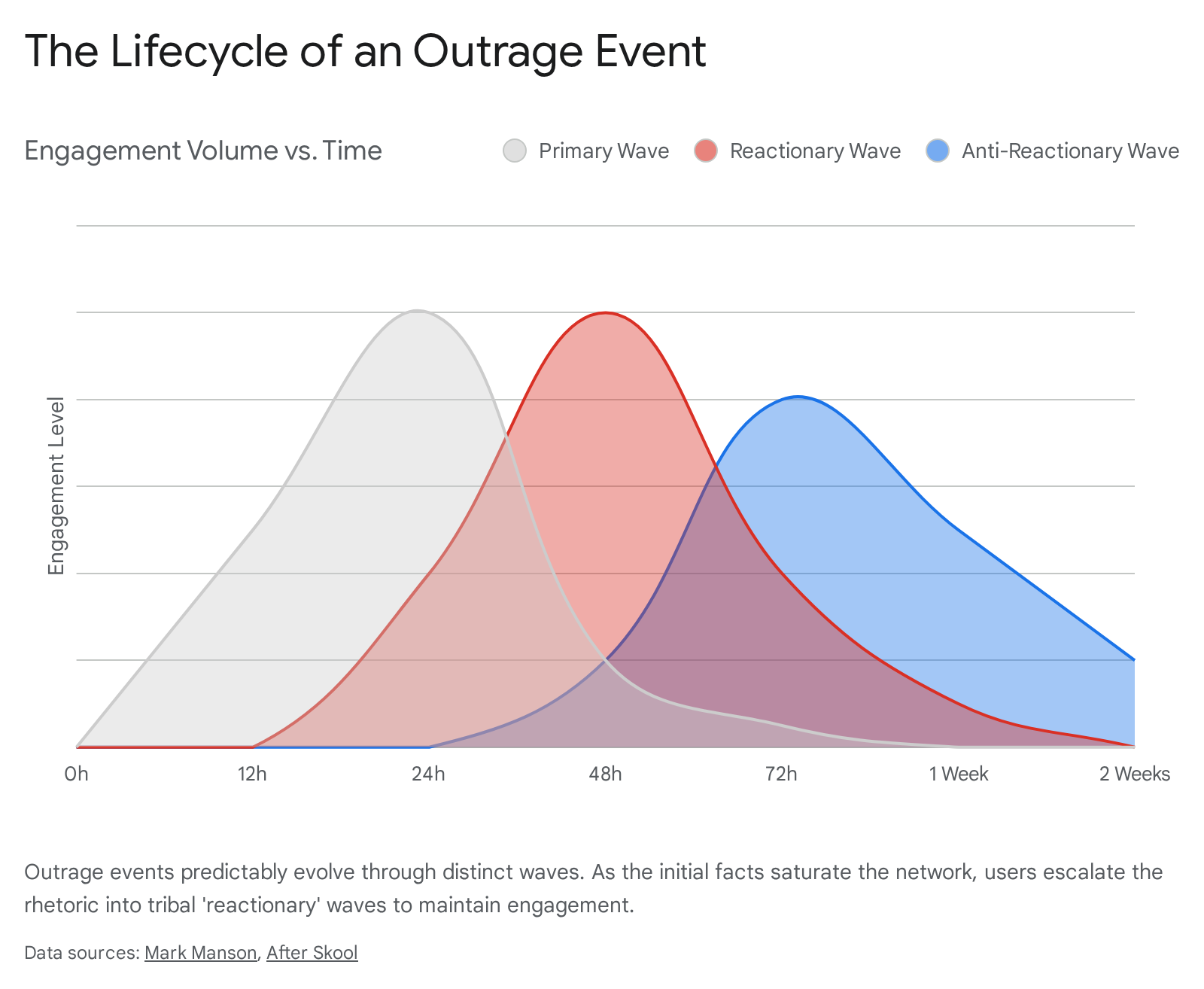
The cycle begins at Moment Zero with a significant event, followed by the Primary Viral Wave during the first 24 hours. In this phase, journalists, influencers, and commentators scramble to disseminate the news, often before the facts are fully understood. There is a gold rush for engagement, and anyone who posts a hot take that resonates sees their follower counts explode. This initial wave is generally united by a shared sense of shock or a desire to understand what happened, establishing the basic, conventional wisdom of the event 24.
The second phase is the Reactionary Viral Wave, occurring between 24 and 48 hours. As the primary facts saturate the network, there is no longer any engagement to be gained by simply restating the news. To keep attention, influencers and users must push the rhetoric further. The event becomes a Rorschach test for pre-existing grievances. Various political and cultural tribes hijack the event to claim it proves their worldview, blowing everyone apart into tribal camps. Words like traitor, criminal, and racist lose their meaning as the discourse fractures into hostile, defensive echo chambers 2417.
The final phase is the Anti-Reactionary Wave and Exhaustion, taking hold from 48 to 72 hours and beyond. Eventually, contrarians and moderate voices step in, criticizing the initial overreactions or pointing out factual errors in the early reporting. This sparks a tertiary wave of outrage directed at the media or the initial mob as misinformation is revealed. After one to two weeks, the event hits peak saturation. The public's emotional energy is depleted, the algorithm detects dropping engagement rates, and the entire ecosystem moves on to the next crisis 24.
Online Outrage Versus Offline Gossip
Humans have always engaged in gossip, moral condemnation, and tribal bickering. However, the speed, ferocity, and structure of digital outrage are fundamentally different from offline interactions. Psychologists identify several structural differences between face-to-face communication and online interaction that explain why the internet feels so uniquely hostile 1819.
When we speak face-to-face, empathy is naturally invoked. We see the other person's facial expressions and body language, and anticipating their reaction often keeps us from being unnecessarily cruel 7. The digital world strips away this friction, replacing nuanced human interaction with broadcast mechanics.
| Dimension | Offline Gossip and Interaction | Online Social Media Outrage |
|---|---|---|
| Pacing and Spread | Moves slowly, restricted by physical proximity and real-time conversation. | Instantaneous, capable of reaching millions in minutes via algorithmic amplification. |
| Nonverbal Cues | Rich in body language, tone, and facial expressions that naturally invoke empathy. | Text or edited video, stripping away context and blunting human empathy. |
| Anonymity and Stakes | Identifiable; speakers face immediate social consequences for lying or excessive cruelty. | High degree of anonymity and emotional distance, leading to the "online disinhibition effect." |
| Network Ties | Shared predominantly among "strong ties" (close friends, family, known colleagues). | Spread efficiently through "weak ties" (strangers and loose acquaintances). |
| Information Decay | Stories alter or fade through memory degradation and word-of-mouth limitations. | Digital permanence; posts can be archived, screenshotted, and weaponized years later. |
(Data derived from analyses of social communication structures and network ties 7181928.)
Global Similarities and Cultural Differences
The mechanics of viral anger are not uniquely Western. A massive analysis of 70 million posts on Weibo, China's equivalent of X/Twitter, confirmed that anger is the most contagious sentiment in the digital world, spreading much faster and broader than joy or sadness across casual connections 4.
However, what triggers the outrage differs significantly by culture. Comparative research found that while US Twitter users most frequently direct their online firestorms at politics and government targets, Chinese Weibo users are more likely to target media platforms, entertainment figures, and corporate social responsibility failures 2829. Despite the different targets, the underlying mechanism - the mobilization of a unified, angry crowd driven by platform engagement metrics - remains identical across borders.
Misinformation Rides the Outrage Wave
One of the most dangerous side effects of the internet's preference for outrage is its impact on the truth. Outrage and misinformation are deeply intertwined, as false narratives are not constrained by reality and can be engineered specifically to trigger emotional triggers.
A landmark 12-year study by MIT researchers analyzed 126,000 news stories shared by three million people on Twitter. The findings were staggering: false information reached 1,500 people six times faster than accurate news. Furthermore, the most viral fake stories routinely reached over 10,000 people, while accurate reporting rarely passed 1,000 11. The researchers noted that fake news fabricators specifically engineer their headlines to trigger maximum emotional arousal, whereas accurate reporting, constrained by nuance and fact, is often inherently less engaging.
Recent studies published in Science demonstrate precisely how misinformation exploits moral outrage to spread. Posts containing misinformation consistently evoke more anger and disgust than trustworthy information 2021. When users are placed in a state of high physiological arousal and moral indignation, their willingness to fact-check plummets. Outrage puts users in an impulsive-sharing mode, making them far more likely to share a misleading post without ever reading the attached article, simply to signal their moral allegiance to their tribe 2022.
Does Outrage Actually Inspire Real-World Action?
Given that outrage is highly effective at raising awareness, many activists and digital advocates argue it is a necessary tool for social justice. But does digital virality translate into tangible, real-world impact?
A massive 2025 study analyzed over 1.2 million social media posts linked to nearly 25,000 petitions on Change.org. The researchers sought to understand if expressions of moral outrage online led to effortful offline action, measured by the likelihood of a user actually taking the time to sign the linked petition 23.
The results revealed a fascinating double dissociation. Posts laden with moral outrage were highly successful at generating virality, receiving significantly more likes, retweets, and passive engagement 923. However, this outrage did not translate to an increase in petition signatures. In fact, when controlling for virality, outrage was actually associated with fewer signatures. Conversely, posts that used language emphasizing prosocial intent, group agency, and unity were far more effective at driving actual petition signatures, even though those posts garnered less viral attention 23. This data suggests that while outrage is an excellent tool for capturing attention and signaling performative virtue, it often fails to mobilize the effortful, systemic action required for real change.
Algorithmic Evolution and Micro-Virality
Social media platforms frequently update their algorithms, but the fundamental mechanics of emotional contagion remain effective. Historically, algorithms on platforms like Facebook and Twitter relied heavily on the social graph, showing users what their friends and followers engaged with. Today, platforms like TikTok dominate using an interest graph, which serves content based entirely on past viewing behavior, regardless of who a user follows 3424.
In 2025 and 2026, TikTok's algorithm shifted heavily toward prioritizing meaningful engagement over passive consumption. Specifically, the platform began demanding exceptionally high video completion rates - often 70 percent or higher for a video to go viral - and prioritized comments, saves, and session-based viewing over simple likes 363738. The algorithm now groups users who like the same highly specific content into niches, driving a phenomenon termed micro-virality 3437.
However, this algorithmic shift has not solved the emotional manipulation problem; it has merely evolved it. Because content creators know they must keep a viewer hooked for the entire duration of a 60- to 90-second video to satisfy the algorithm, they increasingly rely on high-arousal emotional hooks in the first three seconds 3438. Outrage, controversy, and the curiosity gap remain the most effective psychological tools to prevent a user from swiping away 14.
Interventions to Break the Outrage Cycle
The outrage machine is built on billions of dollars of technological infrastructure and millions of years of evolutionary biology, making it incredibly difficult to dismantle. However, behavioral scientists and psychologists have identified evidence-based interventions that can help users break the cycle at the individual and community levels.
The most immediate intervention is implementing a deliberate pause. Because outrage drives impulsive sharing, simply introducing friction can dramatically reduce the spread of toxic content. Research shows that prompting users to consider the accuracy of a post before sharing it significantly reduces the transmission of misinformation. One study found that a single text message prompting people to think about accuracy led to measurably more discerning sharing behavior 11.
At a deeper psychological level, cognitive behavioral interventions show immense promise. A study by Indiana University researchers found that brief, one-shot cognitive behavioral therapy interventions can successfully train social media users to recognize distorted thinking - negative, rigid, and extreme language - in social feeds. After learning to identify this moral-emotional bait, users drastically reduced how much they liked and interacted with the distorted content, starving the algorithm of the engagement it craves 25.
Finally, widespread digital literacy education is increasingly viewed as an essential psychological defense. Educational initiatives that teach users how algorithms profit from their anger, how to spot rage bait, and how to consciously curate their feeds by unfollowing hostile accounts can help build resilience against algorithmic manipulation 402642.
Bottom line
Outrage spreads faster than good news because it exploits a fundamental vulnerability in human psychology: our evolutionary imperative to pay attention to threats and signal tribal loyalty. Social media algorithms, designed purely to maximize engagement and ad revenue, act as an accelerant, relentlessly amplifying the high-arousal emotions that keep users scrolling and reacting. While digital outrage can rapidly raise awareness of an issue, the evidence clearly demonstrates it is far more effective at spreading misinformation, deepening political polarization, and generating performative virality than it is at driving meaningful, real-world solutions.