Psychology and management of online envy and social comparison
Introduction to the Modern Crisis of Digital Envy
The human psyche is fundamentally wired for social comparison, an evolutionary mechanism that historically allowed individuals to gauge their social standing, navigate complex group dynamics, and ensure survival within small, localized tribal structures. In these ancestral environments, assessing one's abilities or resources against peers provided crucial data for cooperation and status negotiation. However, the advent of digital communication - and more recently, the meteoric rise of algorithmically curated short-form video platforms - has hijacked this innate psychological architecture. By presenting an unceasing, globally sourced, and mathematically optimized stream of curated social benchmarks, modern digital environments exploit human cognitive vulnerabilities, transforming an adaptive self-evaluation tool into a pervasive, automated engine for psychological distress 12.
The resulting phenomenon, frequently identified in contemporary cyberpsychology as "digital envy," has become a central focus of behavioral research. Current empirical data demonstrates that the transition from traditional, face-to-face social comparison to digital comparison entails profound psychological consequences, largely driven by the unprecedented volume, the rigid quantification of status, and the sophisticated algorithmic curation of online interactions 123. Furthermore, the specific architecture of these digital platforms heavily dictates the user experience, with highly distinct mental health outcomes emerging when individuals engage in passive content consumption versus active interpersonal exchange 45.
To comprehensively understand the etiology of digital envy and to formulate effective, evidence-based interventions, it is necessary to examine the foundational theories of human social comparison, dissect the cognitive architecture of algorithmic feeds like the "For You" page, and analyze how deeply ingrained cultural dimensions - specifically the spectrum of individualism versus collectivism - shape both vulnerability and coping mechanisms 67. Ultimately, mitigating the adverse effects of digital comparison requires a multi-tiered psychological approach, employing sophisticated cognitive defusion strategies and behavioral digital pruning to restore psychological flexibility, user agency, and emotional well-being 910.
The Theoretical Baseline: Festinger's Framework and the Nuances of Envy
Leon Festinger's Social Comparison Theory
Leon Festinger's Social Comparison Theory (1954) posits that human beings possess an inherent, powerful drive to evaluate their own opinions, abilities, and self-worth 8910. In the absence of objective, non-social metrics, individuals rely on comparing themselves to others to reduce uncertainty and to learn how to define the self within a societal context. Festinger's foundational framework categorizes this evaluation behavior into two primary directional vectors: upward and downward comparison 810.
Upward comparison occurs when individuals measure themselves against targets perceived as superior in ability, status, physical attractiveness, or lifestyle 8. While upward comparison can occasionally serve as an inspirational catalyst for growth, it is predominantly associated with negative psychological outcomes, including diminished self-esteem, acute relative deprivation, and profound feelings of inadequacy 51112. Conversely, downward comparison involves evaluating oneself against those perceived as inferior, less successful, or less fortunate. This downward vector is typically employed as a defensive, self-enhancing strategy to protect a fragile ego, temporarily elevating subjective well-being and self-evaluation by confirming one's relative superiority 811.
Modern cyberpsychology extends Festinger's mid-century theory by critically delineating between "ability comparison" and "opinion comparison" within the digital sphere 9. Ability comparison is inherently competitive and judgmental, focusing on determining superiority or inferiority in performance, wealth, or social status. On social media, ability comparison consistently correlates with negative psycho-emotional outcomes 9. Opinion comparison, however, is information-based and centers on identifying similarities or differences in values, beliefs, and ideas. Longitudinal studies tracking college freshmen demonstrate that opinion comparison on social media can actually be highly adaptive; it facilitates social adjustment, helps individuals identify peer norms, and aids in healthy identity formation without triggering the intense feelings of inferiority associated with ability comparison 9.
The Psychological Distinction: Benign Envy, Malicious Envy, and Jealousy
While the terms "envy" and "jealousy" are frequently conflated in vernacular usage and popular media, rigorous psychological literature draws a strict, theoretical boundary between them. Jealousy is a tripartite emotional state characterized by the fear of losing an existing relationship, resource, or status to a third-party rival 16. It is fundamentally rooted in possessiveness, suspicion, and the fear of loss. Envy, by contrast, is a dyadic emotion that arises when an individual lacks a desired attribute, achievement, or possession that is currently enjoyed by another person 1613. Social media platforms are primarily incubators for envy, rather than jealousy, as they continuously expose users to the acquisitions, physical attributes, and experiential highlights of a vast network of peers and strangers 11814.
Envy itself is not a monolithic construct; rather, it bifurcates into two distinct psychological experiences based on the user's cognitive appraisals of deservedness and control: benign envy and malicious envy 1615.
Benign envy is triggered when the envier perceives the target's advantage as justified and deserved, often recognizing that the target has demonstrated "authentic pride" derived from genuine effort, skill, or accomplishment 16. The psychological outcome of benign envy is assimilative and motivational. It generates constructive action tendencies aimed at self-improvement, compelling the envier to level up their own performance, invest more effort into their goals, or pursue similar achievements 161815.
Malicious envy emerges when the target's advantage is perceived as unearned or undeserved, or when the target displays "hubristic pride" - characterized by arrogance, smugness, or overt boasting. Malicious envy is a heavily contrastive, destructive emotion 16. Its primary action tendency is not focused on self-improvement, but rather on a desire to pull the envied person down, resulting in hostility, social undermining, and the experience of schadenfreude (pleasure derived from another's misfortune or failure) 1615.
Digital environments, characterized by heavily filtered realities and algorithmically amplified displays of extreme success or physical perfection, frequently strip away the context of the effort required to achieve such states. This makes the success of others appear not only effortless but, occasionally, inherently unfair 18. This specific dynamic heavily skews digital social comparison toward the frequent generation of malicious envy, driving maladaptive coping behaviors such as compulsive checking or covert digital hostility 1816.
The Architecture of Comparison: Traditional Face-to-Face versus Digital
The transition from physical, in-person environments to digital ecosystems represents a paradigm shift in the fundamental mechanics governing human social comparison. Traditional, face-to-face interactions offer rich, multi-sensory contextual cues, natural temporal and geographic constraints, and bidirectional reciprocity, which collectively serve to buffer the frequency and intensity of social comparison 123.
During the global COVID-19 pandemic, large-scale experience sampling studies provided a unique "natural experiment" to evaluate these differing modalities. A comprehensive Austrian study tracking participants over a four-week lockdown period utilized Mixed-Effects Random Forest (MERF) analysis to determine that face-to-face communication remained the single strongest positive predictor of mental health 23. Crucially, face-to-face interactions significantly outperformed all forms of digital communication, including high-fidelity video conferencing, highlighting that the psychological benefits of in-person exchange cannot be fully replicated digitally 23.
Digital social comparison, conversely, operates under entirely different structural laws defined by specific technological affordances. Digital platforms physically separate the presentation of the self from the material reality of the user, enabling unprecedented levels of curation and manipulation 17. Users engage in persistent impression management to construct idealized digital personas, creating a comparison environment that is biased entirely toward exceptional outcomes and peak experiences 1723.
Furthermore, the introduction of quantified metrics - such as likes, views, share ratios, and follower counts - translates abstract social status into highly visible, objective, numerical rankings. In physical societies, social hierarchies often benefit from a degree of blurriness and qualitative ambiguity, which protects individual egos 1819. Social media's quantified metrics erase this ambiguity, replacing subjective evaluation with rigid, inescapable status hierarchies that drastically amplify competitive anxiety and social performance pressure 118.
The following table synthesizes the distinct mechanisms and psychological implications governing traditional versus digital social comparison:
Table 1: Mechanisms of Traditional Face-to-Face vs. Digital Social Comparison
| Dimension | Traditional Face-to-Face Comparison | Digital Social Comparison (Social Media) | Primary Psychological Implication |
|---|---|---|---|
| Volume & Frequency | Constrained by physical proximity, available time, and immediate geographic social circles 123. | Unconstrained, featuring infinite scroll mechanisms, global reach, and 24/7 continuous availability 12627. | Constant exposure overwhelms human cognitive filtering, normalizing upward comparisons and significantly increasing baseline anxiety 126. |
| Curation Level | Spontaneous and holistic; encompasses both highlights and mundane, everyday realities with limited impression management 120. | Highly curated, staged, and filtered; biased almost entirely toward peak experiences, wealth, and physical highlights 12329. | Creates an artificial, mathematically unreachable baseline for "normalcy," triggering severe relative deprivation and malicious envy 2329. |
| Quantification & Metrics | Qualitative and ambiguous; based on subtle social cues, tone, and implicit communal standing 1819. | Highly quantified via explicit, gamified metrics (e.g., exact like counts, views, follower ratios) 11819. | Replaces subjective self-evaluation with rigid, inescapable status hierarchies, amplifying competitive anxiety and self-worth deficits 118. |
| Permanence & Ephemerality | Transitory; reliant on human memory, inherently ephemeral and naturally fading over time 220. | Dichotomous extremes: permanent archiving (timeline posts) or engineered strict ephemerality (24-hour stories) 82030. | Both extremes induce unique stress; permanence forces rigid identity consistency, while ephemerality demands relentless content generation 83021. |
| Algorithmic Role | Non-existent; interactions governed by physical laws, serendipity, and natural social network overlaps 12. | Heavily mediated; predictive AI optimizes for engagement by prioritizing sensational, highly emotive, or envy-inducing content 11827. | Strips user agency, creating automated feedback loops that trap individuals in personalized information cocoons of upward comparison 222. |
The Paradox of Engineered Ephemerality
A critical nuance in the architecture of digital comparison is the complex interplay between permanence and ephemerality. Initially, platforms introduced ephemeral features - such as Instagram Stories or Snapchat snaps that vanish after 24 hours - to reduce the intense self-presentational pressure associated with permanent, highly curated grid posts 820. The prevailing industry hypothesis was that disappearing content would foster authentic, spontaneous, and low-stakes communication 20.
However, recent empirical data from 2023 reveals a striking paradox. Studies demonstrate that the perceived ephemerality of Instagram Stories is actually negatively correlated with psychological well-being; users engaging heavily with ephemeral stories exhibit higher rates of social comparison and body image concerns than those engaging with permanent posts 821. The psychological mechanism driving this counterintuitive outcome lies in the illusion of spontaneity. Because stories are culturally framed as "unfiltered" glimpses into everyday, mundane life, users perceive the content as highly authentic 2021. Therefore, when an influencer or peer presents a flawless, idealized moment or an exceptionally luxurious lifestyle under the guise of an effortless, spontaneous "story," the viewer is much more likely to internalize the comparison. They perceive their own everyday reality as vastly inferior to the supposedly "unfiltered" reality of the target, leading to acute spikes in malicious envy and self-deprecation 2021.
Algorithmic Engines of Envy: Short-Form Video and Quantified Metrics
The escalation of digital envy over recent years correlates directly with a fundamental evolution in social media infrastructure: the transition from chronological "social graphs" (e.g., early iterations of Facebook, where users saw content strictly from accepted friends) to AI-driven "interest graphs" (e.g., TikTok's "For You Page" and Instagram Reels) 22623. This architectural shift from user-directed curation to opaque, algorithmic curation has fundamentally altered the volume, intensity, and target distance of social comparison 1224.
The "For You" Page and Algorithmic Vulnerability
Platforms like TikTok and Instagram utilize highly advanced predictive recommendation models that parse thousands of implicit behavioral signals - such as micro-dwell time, video replays, screen touches, and hesitation metrics - to deliver an endless, frictionless stream of hyper-personalized content 2. In 2023, the average user spent roughly 95 minutes per day on TikTok, a dramatic increase facilitated by infinite scroll mechanisms that deliberately eliminate natural cognitive stopping points 226. The psychological toll of this design is measurable; a systematic review found that up to 6.4% of college-age users currently meet the clinical criteria for TikTok addiction 2. Furthermore, a Weill Cornell Medicine study published in JAMA (2025) indicated that addictive use patterns of algorithm-driven short-form video are linked to a risk ratio of 2.14 for suicide-related outcomes among youth 26.
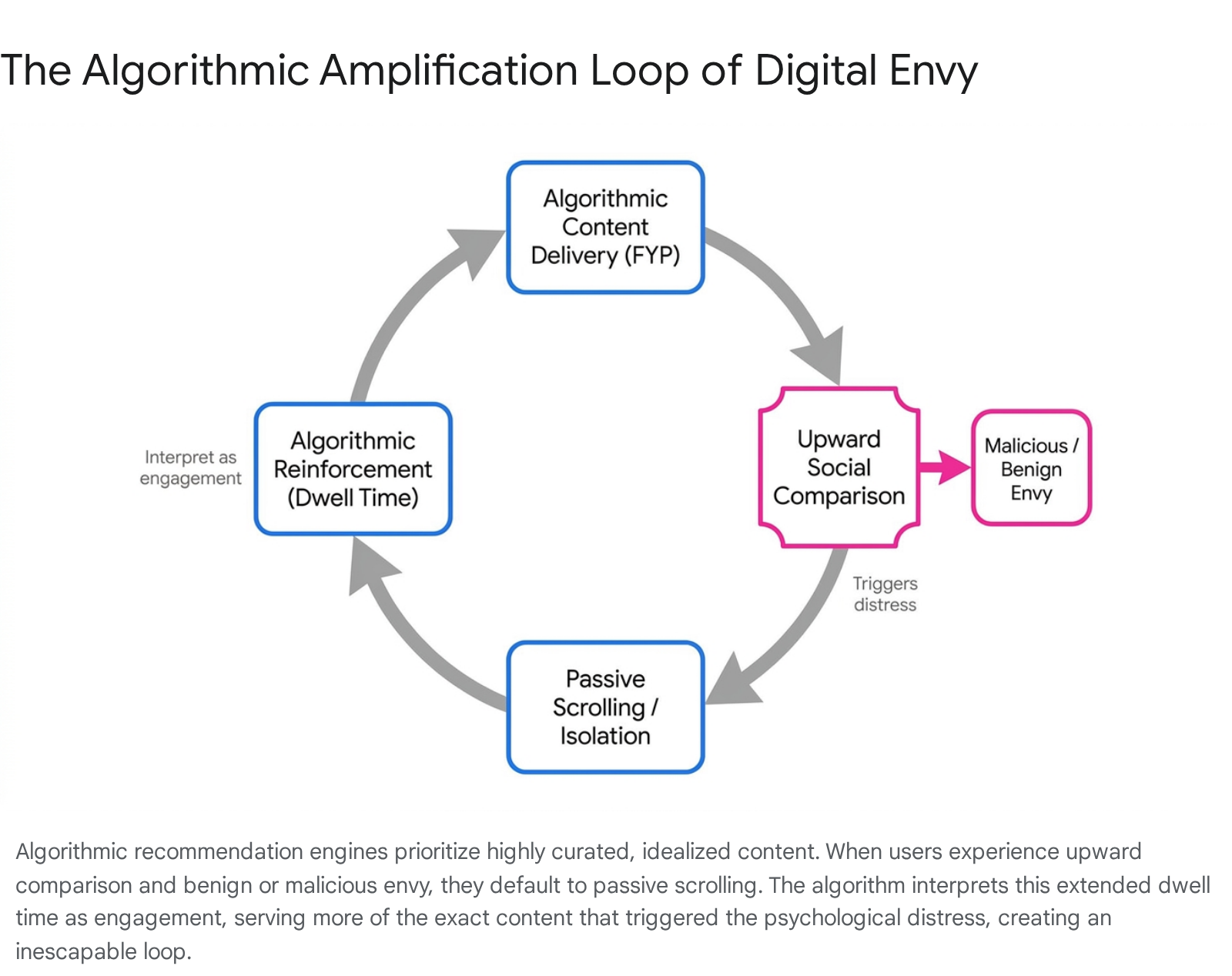
The algorithmic feed, particularly TikTok's "For You Page" (FYP), functions as a highly effective, automated envy engine. Research published in Computers in Human Behavior indicates that these algorithms are optimized solely to maximize engagement, frequently achieving this by exploiting the negativity bias and intrinsic social comparison tendencies of the human brain 1827. When a user is exposed to algorithmically selected videos of idealized lifestyles, extreme beauty standards, or exceptional wealth, it instantly triggers upward social comparison. While the psychological outcome for the user is often malicious envy and diminished self-worth, the behavioral outcome is an inability to look away 1827. The user continues to scroll in a state of agitated, comparative absorption 1827. The algorithm, devoid of emotional context or ethical constraints, registers this extended dwell time simply as "high engagement" and subsequently saturates the user's feed with even more of the exact comparison-triggering content, reinforcing the distress 1827.
Furthermore, these algorithms frequently construct localized "information cocoons" or "filter bubbles" that heavily distort a user's perception of baseline reality 222. For adolescents in particular, algorithms often detect deep-seated desires for validation and feed them continuous streams of highly specific, anxiety-inducing media, such as "study motivation videos" or "body image content" under hashtags like #fitspiration 2225. Because users only see exceptional outliers heavily endorsed by quantified metrics (often amassing millions of likes and views), they falsely conclude that these extreme, statistically rare outliers actually represent the societal norm. This cognitive distortion significantly widens the perceived gap between the self and the rest of the world, deepening feelings of inadequacy 22236.
Instagram Reels vs. Stories: The Virality Vector
Recent digital marketing analytics from 2023 and 2024 highlight the sheer dominance of algorithm-driven video formats. Data indicates that short-form video, specifically Instagram Reels, generates up to six times the reach of traditional posts or ephemeral Instagram Stories 3738. This discrepancy is vital for understanding modern social comparison. Unlike Stories, which are typically restricted to an individual's existing, curated follower network (usually comprised of real-life friends, family, and acquaintances), Reels are algorithmically pushed out to the broader, global public ecosystem 38.
This dynamic exponentially expands the "comparison distance." According to the related attributes similarity hypothesis, people historically compared themselves to targets who were within a reasonable range of their own abilities and social standing 10. However, short-form video algorithms routinely force users into direct, visceral comparison with global elites, viral sensations, and highly optimized professional influencers. By constantly evaluating oneself against the top 0.1% of global attractiveness, wealth, or talent, users face a dramatic increase in the frequency of upward, ability-based social comparisons, making the generation of malicious envy almost inevitable 11039.
Divergent Outcomes: Passive vs. Active Social Media Usage
A critical consensus emerging in modern cyberpsychology is that tracking total "screen time" alone is an insufficient and often misleading metric for predicting psychological harm; rather, the specific mode of digital engagement is the paramount variable determining mental health outcomes. Research robustly draws a sharp dichotomy between the psychological consequences of active versus passive social media usage 452627.
Active Usage: Communion and Reciprocity
Active usage involves direct, intentional participation in the digital ecosystem. Behaviors categorized as active include posting original content, commenting thoughtfully on friends' updates, sending direct messages, and engaging in reciprocal, bidirectional communication 426. Active use inherently aligns with the core human psychological needs for relatedness, communion, and social validation. Multiple comprehensive meta-analyses published between 2023 and 2025 indicate that active usage is generally associated with increased social capital, heightened feelings of connectedness, and enhanced subjective well-being 42728. When users actively communicate, they are participating in a grounded social exchange that mimics traditional interaction, which actively mitigates the isolating, comparative effects of digital platforms 4.
Passive Usage: The Engine of Envy
Passive usage is defined as monitoring the online lives of others without engaging in direct exchange - a behavior most often characterized by silent, endless scrolling through algorithmic feeds or auto-playing videos 452629. In contrast to active use, passive consumption is overwhelmingly correlated with negative mental health outcomes. Empirical evidence tightly links high passive usage to increased depressive symptoms, social anxiety, poor sleep latency, and significantly higher perceived stress 45262930.
The primary mediator linking passive usage to these depressive outcomes is upward social comparison 51011. During prolonged passive scrolling, the user is reduced to an isolated, silent spectator of an endless parade of curated successes. Lacking the reciprocal interaction that normally grounds human reality, the user internalizes the highly curated content as accurate, everyday representations of others' lives 523.
This dynamic creates what clinical psychologists refer to as a "vicious cycle." Passive scrolling induces upward comparison and generates depressive symptoms. Consequently, individuals currently experiencing depressive symptoms suffer from depleted cognitive resources and are subsequently more likely to engage in low-effort passive scrolling to self-evaluate against others, thereby further deepening their psychological deficit 53929. The thematic flavor of this envy changes by platform: high passive usage on platforms like LinkedIn frequently drives intense "ambition envy" and severe career anxiety, while passive use of TikTok correlates heavily with procrastinatory behavior, daytime dysfunction, and acute lifestyle envy 2630.
It is important to note the emergence of person-specific effects in recent media research. A massive study tracking the daily habits of adolescents found that while passive use is generally harmful, the intensity varies wildly depending on individual susceptibility. Valkenburg et al. (2021) demonstrated that for 88% of adolescents, social media use had no effect or only a small effect on self-esteem, while 4% experienced positive effects, and a highly vulnerable 8% experienced severe negative effects 31. This highlights that while passive scrolling is the primary vector for digital envy, individual baseline psychological health heavily dictates the severity of the outcome.
Cross-Cultural Dynamics: Individualistic vs. Collectivist Envy
The cognitive mechanisms of social comparison and the subsequent experience of envy are not universally identical; they are deeply inflected by cultural context. Studies exploring user behavior across geographically diverse regions reveal that macro-level cultural orientations - specifically where a society falls on the spectrum of individualism versus collectivism - profoundly shape both how social media is consumed and how digital envy is processed and mitigated 6324849.
Collectivist Cultures (Middle East, Asia, South America)
Collectivist societies, such as those predominantly found in China, India, and regions of the Middle East, traditionally prioritize group harmony, social cohesion, familial interdependence, and modesty over individual assertion or self-promotion 6484933. In these cultures, the concept of the self is defined interdependently, inextricably linked to the success and well-being of the broader group or community 6.
On social media platforms, research indicates that users from collectivist cultures display a notably higher propensity for upward social comparison 3334. Because their cultural framework emphasizes aligning with societal benchmarks and respecting hierarchical success, users frequently look up to and compare themselves to higher achievers 33. However, this intensive upward comparison often conflicts painfully with the modern, algorithmic influx of hyper-individualized wealth and lifestyle content imported from global platforms, creating unique cultural friction and distress 64934. A recent study focusing on 391 young adults in Jordan (Middle East) utilized the Uses and Gratifications Theory (UGT) to demonstrate that "cultural restraint" negatively moderates the relationship between social media use and subjective happiness, meaning high cultural expectations of modesty exacerbate the distress caused by the conspicuous consumption typical of social media 3435.
Furthermore, when confronted with digital envy, individuals in collectivist cultures are generally less likely to utilize "self-enhancement" strategies. Self-enhancement involves posting boastful or highly curated content to artificially level up one's own perceived status. In collectivist settings, such behavior violates deeply held cultural norms of modesty and risks disrupting group harmony or attracting negative attention 7. Instead, users in these regions may internalize the envy, leading to higher rates of social media fatigue and internalized subjective distress 34.
Individualistic Cultures (North America, Western Europe)
In stark contrast, individualistic cultures place a high premium on personal autonomy, self-expression, and the celebration of individual achievement 64849. To maintain a positive self-image and assert their unique status, users from individualist backgrounds frequently engage in downward social comparison with acquaintances, ensuring they feel superior to their immediate network 33.
When individualistic users do experience the sting of malicious envy triggered by an upward comparison on social networks, they are highly likely to employ self-enhancement strategies as a primary coping mechanism 7. They will actively and aggressively curate their own profiles, posting posed, highly attractive images or broadcasting professional milestones to artificially "level up" and restore their sense of equity with the envied target 7.
Interestingly, comparative research looking at user behaviors in Germany (highly individualistic) versus Hong Kong (highly collectivistic) found that while self-enhancement is culturally bound, certain behavioral coping mechanisms are universal. Regardless of cultural background, users universally resort to "gossiping" (attempting to level down the envied other via social undermining or private disparagement) and "discontinuous intention" (temporarily logging off, deleting the app, or avoiding the platform entirely) to mitigate the painful, immediate effects of digital envy 7.
Defusing Digital Envy: Cognitive and Behavioral Strategies
Addressing the pervasive psychological toll of algorithmic social comparison requires robust, strategic interventions at both the cognitive (internal emotional processing) and behavioral (external action and platform interaction) levels. Emerging empirical evidence from clinical psychology and media literacy studies highlights several highly effective methodologies to neutralize malicious envy, interrupt algorithmic dopamine loops, and restore user psychological flexibility 91336.
Table 2: Evidence-Based Defusion Strategies for Digital Envy
| Strategy Category | Specific Intervention Technique | Psychological Mechanism of Action | Empirical Efficacy & Clinical Outcome |
|---|---|---|---|
| Cognitive | Cognitive Defusion (ACT) | Detaches user identity from passing digital thoughts. Involves observing thoughts neutrally (e.g., "I notice I am having the thought that I am inferior") rather than accepting them as literal truths 937. | Highly effective for treating tech-induced anxiety and depression. Weakens the power of algorithmic triggers, significantly increasing psychological flexibility and reducing the believability of malicious envy 937. |
| Cognitive | Social Savoring & Gratitude | Actively reframes upward comparison by attempting to experience genuine joy for another's happiness, consciously focusing on shared humanity rather than competitive deficits 1039. | Meta-analyses of 27 studies confirm that dedicated gratitude interventions significantly reduce the frequency and emotional intensity of envy within 2-4 weeks of consistent practice 1039. |
| Cognitive / Interpersonal | Revealing Failures (For Creators) | A strategy for high-status users: deliberately sharing the failures, rejections, and struggles encountered on the path to success alongside the ultimate highlights 38. | Experimental field studies prove that revealing failures significantly mitigates observers' malicious envy, increases benign, motivational envy, and drastically reduces perceptions of hubristic pride 38. |
| Behavioral | Curative Unfollowing / Digital Pruning | Proactively managing the algorithmic feed by ruthlessly unfollowing, muting, or blocking accounts that consistently trigger upward comparison, body dysmorphia, and insecurity 10393157. | Acts as a reflective media literacy intervention. Reduces the environmental density of comparison triggers, leading to rapid, measurable drops in depressive symptoms and loneliness within weeks 103931. |
| Behavioral | Shifting to Active Usage | A deliberate transition away from passive, infinite scrolling (consumption) toward active platform use (commenting, direct messaging, intentional content creation) 41057. | Replaces isolating, silent comparison with reciprocal human communion. Consistently shown to significantly improve subjective well-being, mood, and social capital metrics 41027. |
| Behavioral | UX Friction and Usage Limits | Introducing user experience (UX) nudges - such as mandatory breathing exercises before an app opens - or setting strict, OS-level temporal limits to disrupt the infinite scroll loop 395739. | Forces a cognitive break, interrupting mindless passive consumption. While long-term adherence varies, it immediately increases usage awareness and curtails procrastinatory scrolling sessions 39. |
The Mechanics of Cognitive Defusion
Derived from Acceptance and Commitment Therapy (ACT), cognitive defusion is recognized as a paramount clinical skill for navigating toxic algorithmic environments. When a user experiences an envy-inducing post, a process known as cognitive fusion typically occurs: the user accepts the generated thought ("I am not successful enough," or "My life is a failure") as absolute, unassailable reality 9. This fused thought then dictates their emotional state and drives maladaptive behavior, such as retreating from friends, deleting personal projects, or engaging in hostile gossiping 940.
Cognitive defusion trains the user to create psychological distance from the screen and their subsequent thoughts 9. Techniques include "mindful watching" (observing thoughts flow into and out of the mind without attempting to fight or control them), "just noticing" (applying clinical labels like, "I see my mind is catastrophizing about my career again"), or even repeating a negative comparative thought out loud in a silly voice until it loses its semantic meaning and threat level . By recognizing that digital environments are engineered specifically to produce these feelings of inadequacy, users can acknowledge the presence of envy without acting upon it, fundamentally changing their relationship to their inner experiences 937.
Curative Unfollowing and System Disruption
On a purely behavioral level, "curative unfollowing" (often termed "digital pruning" in media literacy literature) is one of the most effective and immediate interventions available to the average user. Users must be educated to recognize that pausing to scrutinize an envy-inducing post - even if the emotion felt is negative - trains the platform's machine-learning algorithm to deliver more of that specific trigger 3931.
By aggressively utilizing "mute" or "unfollow" features, users manually overwrite the algorithm's assumptions, actively clearing their personal information cocoon of toxic benchmarks and unattainable standards 103157. Studies show that reducing passive exposure and intentionally curating out comparison triggers can yield significant improvements in well-being, loneliness, and depression within a mere two weeks of implementation 10.
Furthermore, interpersonal interventions hold immense promise for changing the culture of social platforms from the top down. Experimental field studies from Harvard Business School demonstrate that highly successful individuals and influencers can proactively regulate the envy of their peers and audiences by adopting a specific interpersonal emotional regulation strategy: revealing their failures 38. When high-achieving individuals openly share the setbacks, rejections, and mundane struggles encountered on their path to success, it humanizes the achievement. This transparency shatters the illusion of effortless perfection, mitigates the observer's malicious envy, and fosters benign, motivational envy, transforming a potentially toxic digital interaction into one of genuine inspiration 38.
Conclusion
The psychology of digital envy represents a profound and volatile collision between ancient, evolutionary survival mechanisms and sophisticated, profit-driven modern technology. Algorithmic architectures, infinite scroll interfaces, and the explosive proliferation of short-form video platforms systematically exploit innate human tendencies for upward social comparison. By flooding the psyche with quantified, highly curated, and context-free highlights from a global pool of exceptional outliers, modern social media transforms the natural, adaptive desire for self-evaluation into a persistent, damaging cycle of malicious envy and passive isolation.
Understanding the deep structural differences between traditional, face-to-face comparison and digital comparison - and recognizing the stark psychological divergence between active communion and passive platform scrolling - is absolutely crucial for identifying how these tools compromise mental health. Furthermore, recognizing how varying cultural frameworks, from individualistic self-enhancement to collectivist restraint, dictate our response to these digital stressors allows for more nuanced, culturally competent global interventions.
Ultimately, reclaiming psychological well-being in the digital age requires users to actively reject the role of passive consumers within algorithmic feeds. By transitioning to active architects of their digital environments - through the rigorous application of cognitive defusion, intentional digital pruning, and a steadfast commitment to active, reciprocal human engagement - individuals can successfully dismantle the automated machinery of digital envy and restore their psychological flexibility.