
What Happens When AI Data Centers Connect to the Grid
Connecting an artificial intelligence data center to the power grid triggers an immense, continuous electrical draw that routinely overwhelms local infrastructure and delays new grid connections by years. This unprecedented demand forces utilities to rapidly upgrade transmission lines and procure expensive peak power, frequently shifting billions of dollars in infrastructure costs onto everyday residential ratepayers. Simultaneously, the extreme heat generated by these high-density facilities requires millions of gallons of water for cooling, sparking fierce community resistance over resource depletion, grid stability, and noise pollution.
The Dawn of the Gigabit Campus
For roughly a decade, the relationship between the digital economy and the electrical grid existed in a state of fragile equilibrium. As global consumers and enterprises transitioned to cloud computing between 2014 and 2018, remarkable efficiency gains in server design and facility management effectively canceled out the rising demand for electricity 12. During that period, data center electricity consumption in the United States remained relatively flat at approximately 60 terawatt-hours (TWh) per year 1.
The advent of generative artificial intelligence abruptly shattered that truce. By 2023, data centers consumed 176 TWh in the United States, representing roughly 4.4% of the nation's total electricity use - an amount equivalent to the power consumed by 16 million homes 123. On a global scale, data centers accounted for around 415 TWh in 2024, representing about 1.5% of total worldwide electricity demand 446. The trajectory is steepening exponentially. The International Energy Agency (IEA) projects that global data center consumption will more than double to approximately 945 TWh by 2030, a figure roughly equivalent to the entire annual electricity consumption of Japan 446. In the United States, analysts project data center power demand could consume up to 12% of total national electricity generation by 2028 137.
The core driver of this unprecedented surge is the fundamental architectural difference between traditional cloud computing and artificial intelligence workloads. Traditional web searches, email hosting, and database management rely on Central Processing Units (CPUs), which are versatile but process information sequentially. A traditional CPU chip draws roughly 150 to 250 watts of power 45. Artificial intelligence, however, requires massive parallel processing to train mathematical models on billions of data points. This is accomplished using Graphics Processing Units (GPUs) or specialized neural processing units (NPUs). A modern AI-specific GPU draws between 700 and 1,200 watts per chip, and next-generation chips are expected to push past these limits 45.
When these chips are networked together into massive clusters containing tens of thousands of processors, the power demand scales exponentially. A single generative AI query can consume ten times the power of a traditional web search 76. Furthermore, AI workloads operate with distinct lifecycle demands that grid operators must accommodate. Training a large AI model requires 25 to 50 megawatts (MW) of continuous power sustained 24 hours a day for weeks or months at a time 4. Once trained, the "inference" phase - where the model answers user prompts - also requires constant, unwavering baseload demand 45. While a traditional office building or retail center has predictable peaks and troughs in power usage, an AI data center runs at maximum capacity almost constantly. This creates an unwavering baseload demand profile that the century-old electrical grid was never designed to support, turning global data center maps into energy battlegrounds 67.
The Physical Reality: Heat, Weight, and Liquid
The electrical draw of an AI data center is only the first half of the thermodynamic equation. According to the laws of physics, nearly all the electricity consumed by a microprocessor is ultimately converted into heat 11. Removing that heat has become one of the most pressing engineering constraints in the artificial intelligence industry, forcing a complete architectural redesign of the modern data center.
The Limits of Air Cooling and the Shift to Liquid
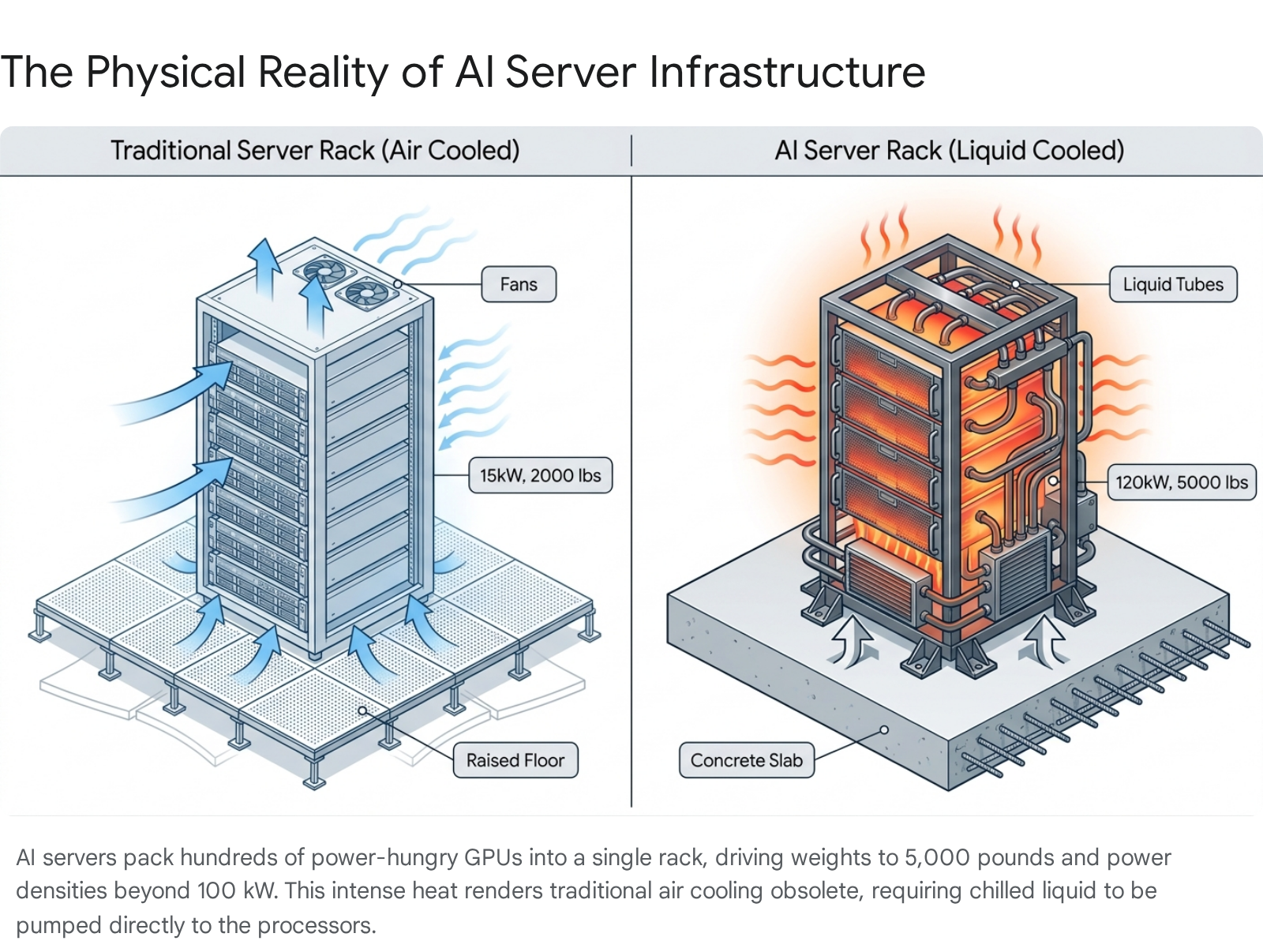
For decades, traditional data centers operated much like giant, precision-controlled refrigerators. Facilities utilized computer room air conditioning (CRAC) units and arranged server racks into "hot aisles" and "cold aisles," using heavy-duty fans to push chilled air across the equipment 12. However, air is fundamentally an insulator; it is a remarkably poor conductor of heat 13.
The metric used to measure this intensity is "rack density" - the amount of power consumed by a single standard server cabinet. As AI servers pack hundreds of GPUs into a single rack, the power density has skyrocketed. When rack densities exceed 25 to 30 kilowatts (kW), traditional air cooling reaches its absolute physical limits 12. The sheer volume of air required to cool a densely packed rack of GPUs would require fans so large and loud that they would consume more power than the servers themselves. If a high-power processor gets too hot, its internal safety mechanisms initiate "thermal throttling." The chip automatically reduces its clock speed and power consumption to prevent the silicon from melting. This self-preservation tactic severely degrades computational performance, delaying billion-dollar AI training runs and disrupting carefully calculated facility economics 1314.
| Era and Workload | Average Power per Rack | Cooling Architecture | Timeline |
|---|---|---|---|
| Traditional Enterprise | 5 to 15 kW | Pure air cooling (CRAC units) | 2000 - 2020 |
| Cloud Maturity | 15 to 30 kW | Optimized hot/cold aisle air cooling | 2020 - 2023 |
| AI Emergence | 30 to 100 kW | Transition to liquid cooling | 2023 - 2024 |
| AI Standard | 100 to 140 kW | Direct-to-chip liquid cooling | 2024 - 2025 |
| Future State | 200 to 350+ kW | Immersion cooling or advanced hybrid | 2026+ |
Data synthesized from industry historical tracking and density projections 128.
To survive this thermal bottleneck, the industry has rapidly pivoted to liquid cooling. Liquid is approximately 3,000 times more efficient at absorbing and transferring heat than air 9. Modern AI data centers utilize direct-to-chip cooling, where chilled fluid is circulated through microscopic cold plates attached directly to the GPUs and CPUs 9. For the most extreme densities approaching 150 kW and beyond, engineers are developing immersion cooling systems, where entire server boards are submerged in non-conductive dielectric fluids 129. This allows chips to operate continuously in "boost mode" without overheating, but it fundamentally alters the plumbing and mechanical requirements of the facility 14.
The Heavy Toll on Physical Infrastructure
The shift to dense GPU clusters and liquid cooling systems introduces an unexpected variable that is dictating where AI can be built: massive physical weight. A standard 42U server rack typically weighs between 1,500 and 2,500 pounds, a load easily supported by the raised floors common in legacy data centers 17.
In stark contrast, an AI server rack - packed with hundreds of GPUs, dense memory arrays, copper wiring, and liquid cooling equipment - can easily exceed 4,000 to 5,000 pounds 1718. Legacy data centers with raised floors typically possess a static load limit of around 1,250 pounds per square foot 18. Consequently, retrofitting older buildings for AI is often economically and structurally unfeasible. Industry experts note that attempting to retrofit a legacy facility often requires essentially bulldozing the building and starting from scratch 18. Furthermore, modern AI racks have grown from six feet to nine feet in height, creating insurmountable problems with doorframes and freight elevators in older multi-story buildings 18. This physical limitation is driving a massive wave of new, purpose-built construction directly on concrete slabs, escalating the demand for raw land and entirely new grid interconnections 1719.
The Water-Energy Nexus
The immense heat generated by AI data centers necessitates equally immense water resources, creating a direct tension between corporate decarbonization goals and local water stewardship. Data center water consumption is categorized into two distinct footprints that operators must balance: direct and indirect 20.
Direct Consumption: The Thirst of Evaporative Cooling
Direct consumption occurs on-site at the facility. To dissipate the heat carried away by liquid cooling loops or traditional air conditioning systems, most large data centers utilize evaporative cooling towers. In this system, warm air is pushed through water-soaked pads; as the water evaporates, it cools the surrounding air. However, this highly effective thermal process means that approximately 80% of the water drawn into the facility is permanently lost to the atmosphere as vapor, never returning to the local municipal watershed 2010.
The volume of freshwater required is staggering. A single large data center can consume up to 5 million gallons of water per day, an amount roughly equivalent to the daily residential water usage of a town of 10,000 to 50,000 people 2011. In 2024, a single Google data center in Council Bluffs, Iowa, consumed 1.3 billion gallons of potable water, akin to the water needs of a large university 10. Nationwide, the 5,426 data centers operating in the United States consume billions of gallons annually, tapping into surface water and underground aquifers 11.
The explosive growth of AI is dramatically exacerbating this trend. Academic research indicates that AI queries are remarkably water-intensive. Generating a 100-word response from a large language model can consume roughly half a liter of fresh water 20. Some studies project that AI systems alone could be responsible for up to 765 billion liters of water consumption annually, placing immense strain on drought-prone regions and fundamentally threatening global freshwater supplies 20.
Indirect Consumption: The Hidden Footprint
While on-site water usage draws the most community scrutiny and headlines, the indirect water consumption required to run a data center is actually much larger. The electricity generation required to power the grid - particularly thermoelectric power plants like coal, natural gas, and nuclear facilities - requires vast amounts of water for steam generation and cooling 1111.
The IEA estimates that indirect consumption accounts for roughly 60% of the total data center water footprint 20. In 2023, a federal report estimated that the indirect water consumption footprint for US data centers was a staggering 211 billion gallons, compared to roughly 17 billion gallons used for direct on-site cooling 1111. On a national average, data center energy consumption translates to an indirect water consumption rate of 4.52 liters per kilowatt-hour (kWh) 2.
This dynamic creates an inherent paradox for data center operators and regulators. A facility can choose to use closed-loop refrigerant systems to virtually eliminate direct on-site water usage. However, doing so drastically increases the facility's electricity demand because the chillers require massive amounts of power. This spike in power usage in turn spikes the indirect water consumption at the power plant level, while simultaneously driving up carbon emissions 1120. Navigating this zero-sum game between water conservation and energy efficiency - often measured as Water Usage Effectiveness (WUE) versus Power Usage Effectiveness (PUE) - is one of the industry's most contested environmental hurdles 11.
The Financial Shockwave: Who Pays for the Power?
When a multi-gigawatt AI data center connects to the local grid, the financial shockwaves are often felt first by residential electricity customers. In regions hosting heavy data center buildouts, local utility bills have steadily climbed, prompting intense legal and legislative debate over how the costs of the AI boom should be allocated.
The Broken Socialized Cost Model
The utility sector has historically operated on a socialized cost model. When a regulated utility builds new infrastructure - such as high-voltage transmission lines, substations, or power plants - the capital costs are distributed across all ratepayers in that region 712. Because electricity is an essential service shielded from pure market competition, Public Utility Commissions (PUCs) regulate these rates based on the "cost causation" principle, ensuring consumers pay relative to the infrastructure required to serve them 13.
For a century, this model worked under the assumption of steady, predictable load growth. In the past, adding a large factory or a traditional data center could actually lower consumer rates; the new industrial customer paid into the fixed-cost system, spreading the cost of the physical poles and wires over a much larger pool of kilowatt-hours sold 714.
The unprecedented speed, scale, and density of AI data center deployment have effectively broken this business model. Because AI loads are massive and materialize faster than grid planners anticipated, they trigger acute regional grid congestion 712. To build the billion-dollar transmission lines required to deliver power to a new AI campus, utilities raise base rates for everyone. Consequently, everyday households are effectively subsidizing the power-hungry digital economy of the world's most profitable technology companies 712.
The Capacity Market Crisis
Beyond direct infrastructure costs, AI data centers drive up the actual price of electricity in wholesale markets. This phenomenon is most evident in the PJM Interconnection, the massive regional transmission organization that coordinates the movement of wholesale electricity across 13 states, including major data center hubs in Virginia, Maryland, Pennsylvania, and Ohio 17.
Electricity grids must maintain a reserve margin - excess generation capacity that can be called upon during peak demand (e.g., a sweltering summer afternoon) to prevent rolling blackouts. Grid operators secure this reliability through "capacity markets," essentially paying power plant owners a premium fee to guarantee their plants will be available to generate power on peak demand days up to three years in the future 715.
Because AI data centers draw maximum power 24 hours a day, 7 days a week, they rapidly consume the grid's reserve margins. With supply tightening and demand exploding, the price for capacity skyrockets. In a recent PJM capacity auction, prices rose by a staggering 833% 7. An independent monitor determined that data center load growth was responsible for approximately three-quarters of that historic price jump 7.
These wholesale spikes inevitably trickle down to retail electric bills. Analysts estimate that data center growth in the PJM region contributed to projected residential bill increases of approximately $18 per month in western Maryland and $16 per month in Ohio, with the average household in the region paying $122 more per month for total utility costs compared to 2020 17. A separate report examining a cluster of new Amazon data centers in Mississippi estimated that residential customers had already seen their rates increase by $10.60 per month to subsidize local grid investments 16.
Legislative and Regulatory Pushback
Regulators and consumer advocates are beginning to react to residential outrage. Utilities and state legislatures are actively exploring mechanisms to shield everyday ratepayers from the immense capital expenditures required by tech giants.
- Ohio: In 2024, the utility AEP Ohio proposed a new tariff requiring data centers and crypto mining firms with loads over 25 MW to sign 10-year financial commitments. They must pay a minimum charge covering 90% of their forecasted demand, ensuring everyday consumers are not left holding the bag for stranded infrastructure costs if a tech company abandons a project 14.
- Texas: Lawmakers introduced Senate Bill 6, aiming to require large energy users connecting to the ERCOT grid after 2025 to pay retail transmission charges based on their peak demand. The bill also compels large loads to provide definitive proof of financial commitment before grid upgrades commence 1314.
- Georgia: The Public Service Commission updated rules in early 2025 to ensure new large-energy users pay the specific costs required to serve them. This regulatory ring-fencing facilitated a stipulated agreement that actually lowered rates slightly for residential customers, protecting them from the costs tied to new generation and transmission projects 28.
The Interconnection Queue Bottleneck
Even when technology companies are willing to pay billions of dollars for electricity, they face an insurmountable bureaucratic and physical wall: the interconnection queue.
Before a massive load like an AI data center or a new power plant can physically connect to the high-voltage grid, the regional grid operator must perform a series of exhaustive technical studies. These include feasibility assessments, system impact studies, and facilities engineering estimates to ensure the new connection will not destabilize the network, overload existing lines, or cause cascading blackouts across state lines 291731.
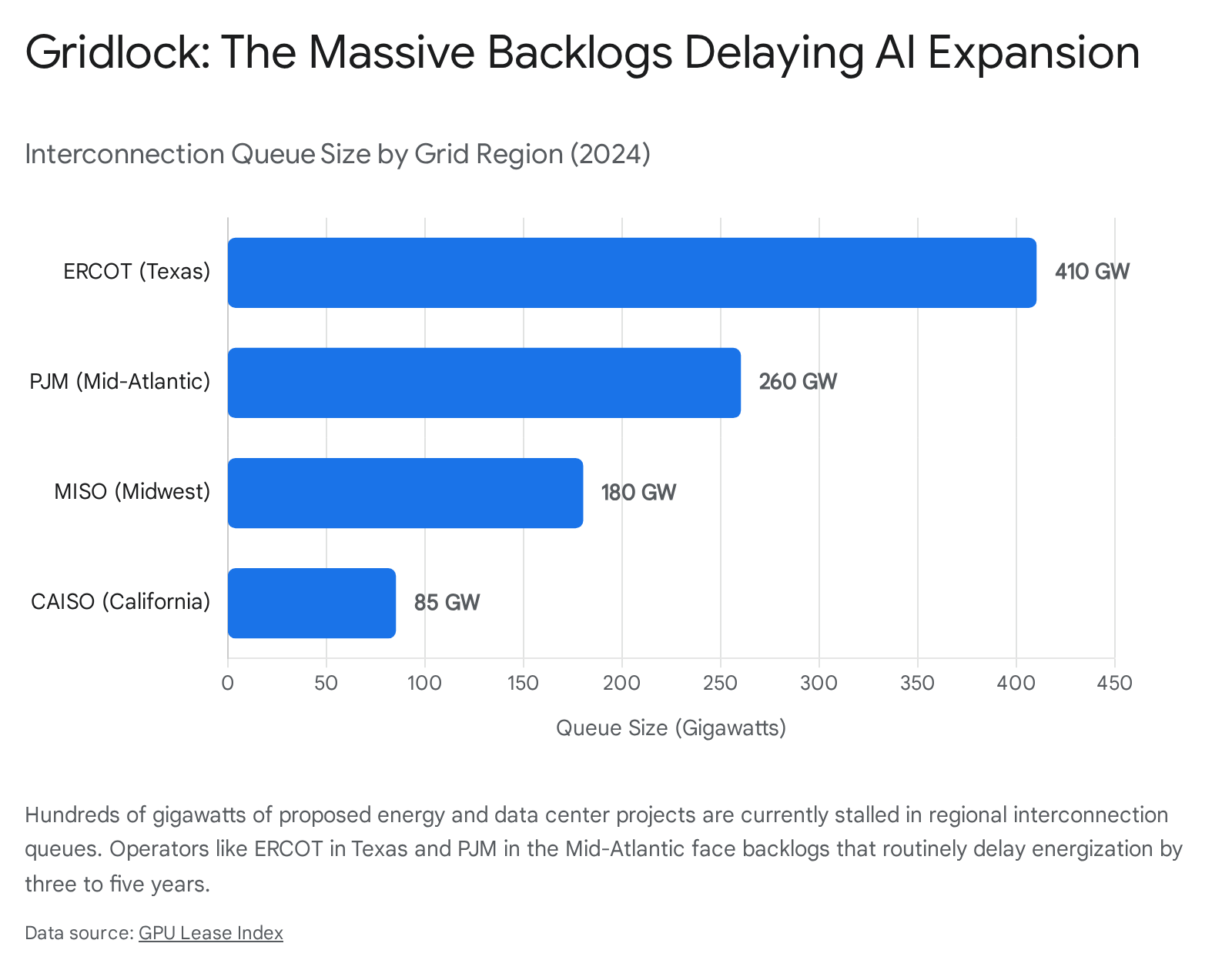
Historically, this sequential process was manageable. Today, the queues are paralyzed by sheer volume. According to the Lawrence Berkeley National Laboratory (LBNL), there are nearly 12,000 projects representing over 2,500 GW of generation and storage capacity actively seeking grid interconnection in the United States. This backlog effectively exceeds the entire installed capacity of the current US electricity system 1731.
Gridlock Across the Major Operators
The wait times and financial requirements for grid interconnection vary by region, but all present severe delays that threaten the highly publicized timelines of the AI revolution.
| Grid Operator (ISO/Region) | Queue Size | Average Timeline to Connect | Status & Market Dynamics |
|---|---|---|---|
| ERCOT (Texas) | 410 GW | 18-24 months (Batch Zero) to multi-year | Severely congested; 87% of queue driven by data centers 29. |
| PJM (Mid-Atlantic) | 260 GW | 3 to 5 years | Transitioning to a cluster-study reform approach; high baseline capacity prices 1529. |
| CAISO (California) | 85 GW | 3 to 4 years (Historically 9.2 yrs in 2024) | Reformed to prioritize projects near existing transmission capacity 2932. |
| MISO (Midwest) | 180 GW | 2 to 4 years | Growing backlog with heavy thermal and renewable mix 29. |
The situation is particularly acute at the individual utility level. Dominion Energy, which operates the transmission system serving the world's densest concentration of data centers in Northern Virginia, recently reported staggering figures to regulators. The utility has 25 GW of large load requests already in progress with assigned connection dates prior to 2032. For context, this exceeds Dominion's all-time peak demand 33. Beyond that, by the end of 2025, the utility was reviewing another 45 GW of requests, bringing the total "in-process" large load queue to 70 GW - a figure roughly equal to the average daily demand of California, Alberta, New York, and New England combined 33. Dominion notes they are receiving 2 to 3 GW of newly requested load every single month, strictly from data center customers 33.
Global Flashpoints: Moratoriums and Pushback
The physical and electrical realities of AI data centers have ignited intense resistance at both the geopolitical and local community levels. As these facilities encroach on residential communities and threaten national grid stability, the data center has been transformed from an invisible piece of internet infrastructure into the most contested land use in the digital economy 1.
The European Congestion Crisis
Nowhere is the friction between digitization and physical grid reality more apparent than in Europe. In Ireland, a combination of low corporate tax rates, favorable data privacy laws, and a naturally cool climate led to a historic decade-long data center boom 18. By 2023, data centers consumed 21% of Ireland's total metered electricity, officially surpassing the electricity consumption of all the country's urban homes combined 183519. In 2024, that figure rose to 22%, with projections suggesting data centers could consume over 30% of national electricity within a few years 1835. Fearing widespread blackouts and recognizing that this trajectory would inevitably derail national climate targets, the state-owned energy company EirGrid implemented a de facto moratorium on new data center connections in the Dublin area, effectively freezing new development until 2028 37.
The Netherlands is facing a nearly identical crisis. The Dutch provinces of North Holland and South Holland - historically central nodes in the European digital economy - have exhausted their grid capacity, with grid operators officially declaring no room left for large-scale commercial growth 38. Financial analysts warn that this stagnation threatens to cost the Dutch economy billions of euros as technology firms relocate to regions with available power 39. The inability of Amsterdam to integrate new massive power loads has stunted domestic AI ambitions and forced the global tech industry to scramble for alternative European sites, pushing development toward Spain and Nordic countries 3820.
The Singapore Compromise
In land-scarce Asia, Singapore recognized the existential threat of unchecked data center growth early. In 2019, when data centers already consumed 7% of the city-state's total electricity, the government instituted a strict moratorium on all new data center construction to protect domestic resources 4142.
When Singapore lifted the ban in 2022, it did so under arguably the strictest sustainability parameters in the world. The current capacity allocation program (DC-CFA2) limits new builds to operators who can definitively secure at least 50% of their power from advanced green energy pathways - such as biomethane, low-carbon ammonia, or hydrogen fuel cells - and achieve an incredibly strict Power Usage Effectiveness (PUE) rating of 1.25 4142. Because the barrier to entry in Singapore is now exceptionally high, Chinese and American hyperscalers are aggressively pivoting their data center pipelines to neighboring Malaysia (specifically Johor) and Indonesia, jurisdictions that currently offer faster scaling capabilities and fewer regulatory hurdles 4243.
Community Backlash in the United States
In the United States, resistance is increasingly local, visceral, and highly organized. As data centers expand out of industrial parks and into residential areas, the physical byproducts of AI - specifically noise and land use - are triggering massive public outcry.
Data centers emit a constant, low-frequency hum from their massive evaporative cooling systems and chiller plants. In Prince William County, Virginia, residents living near data center clusters complain of the "Haymarket Hum," an inescapable industrial drone that routinely exceeds 60 decibels, vibrating windows and disrupting sleep 212246. Local homeowners emphasize that unlike highway traffic, industrial cooling noise is constant and pervasive 46.
This localized community resistance translates directly into severe financial and execution risk for technology companies. Researchers note that at least 188 local opposition groups are now active across 40 US states advocating against data center development 21. Since mid-2024, grassroots opposition, zoning battles, and resulting litigation have successfully blocked an estimated $18 billion and delayed an additional $46 billion in US data center projects 21. Polling indicates that a vast majority of Americans now oppose data center construction in their communities, viewing them as a direct threat to local water supplies, property values, and electrical reliability 23.
Untangling the Grid: Technologies and Solutions
Solving the AI energy crisis requires more than simply attempting to generate more electricity; it requires fundamentally rewiring how power is delivered, managed, and utilized. Because building new high-voltage transmission lines can take a decade due to environmental reviews, permitting, and right-of-way litigation, the industry is leaning heavily into technologies that can unlock existing grid capacity immediately.
Grid-Enhancing Technologies (GETs)
Grid-Enhancing Technologies (GETs) are an emerging suite of hardware and software tools designed to optimize the existing transmission system, essentially allowing grid operators to safely squeeze more power through the wires they already have. Two critical components include:
- Dynamic Line Rating (DLR): Traditional transmission lines are operated based on static, conservative seasonal assumptions about weather. When a power line gets too hot, it sags, risking contact with trees and causing outages. DLR uses real-time sensors to monitor wind speed, ambient temperature, and line tension. On cool or windy days, the sensors verify the lines are safe, allowing operators to push 30% to 50% more power through the exact same wires without risking failure 4824.
- Topology Optimization: Advanced AI and power flow control devices can intelligently route electricity around congested pathways, pushing power onto under-utilized lines elsewhere on the grid. This functions much like a digital navigation app automatically redirecting drivers around a localized traffic jam 3148.
Studies indicate that widespread deployment of GETs could resolve a significant portion of the interconnection queue bottleneck within months, rather than the years required to build new infrastructure 48. Recognizing this potential, the Federal Energy Regulatory Commission (FERC) issued Order 2023, requiring transmission providers to explicitly evaluate the use of alternative transmission technologies, including GETs, during the interconnection study process 1731.
Co-Location and Behind-the-Meter Generation
Because the public grid is fatally congested, major hyperscalers (such as Amazon, Google, Microsoft, and Meta) are increasingly attempting to abandon utility-provided power altogether. To guarantee timelines, they are pioneering "behind-the-meter" strategies, purchasing or partnering directly with power generators.
This strategy involves co-locating AI data centers directly adjacent to existing nuclear power plants, or building massive proprietary solar and battery storage farms specifically for the data campus 1929. By generating and consuming the power on the same campus, the data center bypasses the regional transmission grid entirely. This allows tech companies to avoid the multi-year interconnection queue, shield themselves from volatile wholesale capacity market prices, and ensure their AI training runs are not interrupted by public grid failures 2948.
Bottom line
The integration of AI data centers into the power grid represents a seismic shift in global energy consumption and infrastructure design. The exponential power demands and intense heat generated by artificial intelligence are exposing the physical limits of legacy electrical systems, resulting in years-long interconnection delays, localized water depletion, and surging utility rates for residential consumers. While Grid-Enhancing Technologies and co-located generation offer viable technical pathways to alleviate gridlock, it remains highly uncertain whether regulatory bodies can reform cost-allocation policies fast enough to protect everyday ratepayers from the immense infrastructure costs required to support the AI revolution.