
Psychology of storytelling and persuasion in public speaking
The efficacy of public speaking is traditionally evaluated through the clarity of its logical arguments and the robustness of its supporting empirical data. However, extensive research across cognitive psychology, neuroscience, and communication theory demonstrates that human information processing relies fundamentally on narrative frameworks. While data-driven presentations focus on the transmission of factual components and statistical probabilities, narrative storytelling constructs a sequential, causal, and character-driven scaffold. This structural approach significantly enhances audience retention, persuasion, and cognitive engagement 12.
The superiority of narrative structures over strictly data-driven communications stems from the evolutionary development of human cognition. The human brain is not naturally optimized to parse disconnected statistical figures, scatterplots, or raw data streams 23. Instead, it relies on autobiographical memory schemas and temporal-causal sequences to encode and retrieve information 2. When speakers organize their content into narratives, they leverage pre-existing neural pathways dedicated to social cognition, theory of mind, and emotional regulation. This physiological alignment lowers extraneous cognitive load and bypasses the inherent limitations of working memory, enabling the audience to process complex information with greater efficiency 54.
Neurobiological Mechanisms of Narrative Processing
The transition of information from a speaker to an audience is a complex neurophysiological event. Narrative storytelling acts as a catalyst for specific patterns of brain activation and neurochemical release that raw data presentation consistently fails to trigger.
Interpersonal Neural Synchronization
Recent advancements in functional magnetic resonance imaging (fMRI) and electroencephalography (EEG) have identified a phenomenon known as interpersonal neural synchronization (INS), or "neural coupling" 569. When a speaker delivers a compelling narrative, the neural activity patterns of the listeners begin to synchronize with those of the speaker, a process that reliably predicts the success of communication and subsequent comprehension 7.
Research into naturalistic storytelling reveals two primary forms of coupling: Listener-Listener (LL) coupling and Speaker-Listener (SL) coupling 8. When an audience is presented with a coherent narrative, LL coupling peaks at "lag 0," indicating that the entire audience is processing the narrative content synchronously across the cortical language network and the default mode network (DMN) 8.
SL coupling is asymmetric and time-lagged. The listener's brain activity echoes the speaker's brain activity with a delay ranging from 3 to 12 seconds, averaging approximately 6 seconds depending on the specific brain region 8. This dynamic forms the basis of the "herding hypothesis." In this model, the speaker acts as a shepherd, guiding the listeners' brains through a specific trajectory of neural states 8. The more accurately the audience mirrors the speaker's preceding brain activity, the tighter the listeners cluster together in their own neural alignment. This herding effect is localized in high-order processing areas, including the precuneus, posterior cingulate cortex (PCC), cuneus, and superior temporal gyrus 8. Conversely, data-heavy presentations lacking a continuous narrative thread frequently fail to establish this trajectory, leading to an immediate dispersal of listener attention and low LL similarity 8.
Functional Brain Activation and the Default Mode Network
Storytelling engages a distributed network of brain regions that extend far beyond basic auditory and language processing centers. The Default Mode Network (DMN), particularly the medial prefrontal cortex (mPFC), consistently activates during the moral and emotional evaluation of characters and narrative integration 91011.
Brain mapping studies utilizing fMRI demonstrate a clear dissociation in how the brain processes different narrative elements. When listeners evaluate a story's underlying conceptual model, regions such as the left hippocampus, angular gyrus, temporoparietal junction (TPJ), and bilateral posterior medial cortex engage heavily 12. The TPJ is particularly critical for processing character intentions, allowing listeners to adopt a character-oriented, mentalistic perspective rather than merely cataloging a sequence of events 916.
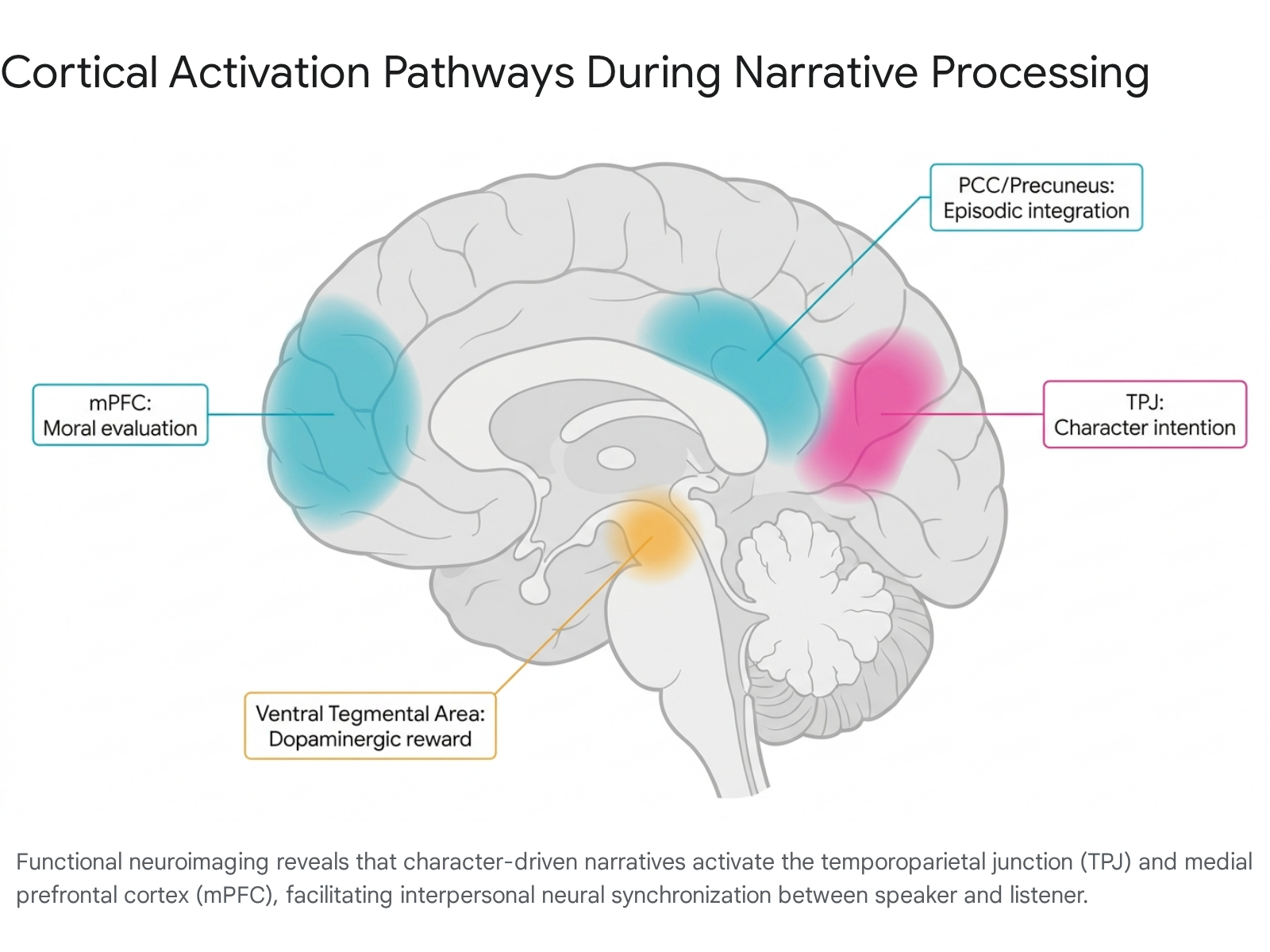
Experimental paradigms show that when participants are asked to convey short, headline-like stories across different modalities (speech, gesture, or drawing), brain networks associated with "theory of mind" - the ability to infer the thoughts, beliefs, and emotions of others - are strongly activated across all output forms 13. This underscores the intrinsic mentalistic nature of storytelling: audiences approach narratives by focusing on the mental states of the protagonist, establishing a level of psychological investment that abstract data cannot achieve 13.
The importance of structured narrative is further highlighted by studies contrasting typical episodic memory recall with the recall of disorganized, traumatic experiences. In populations with post-traumatic stress disorder (PTSD) or dissociative disorders, fMRI data indicates that traumatic memories often fail to activate the hippocampus or the PCC in the same semantic, associative manner that typical autobiographical or fictional narratives do 1415. Traumatic recall often correlates with hyperactivation in the amygdala and prefrontal dysfunction, lacking the cohesive semantic-to-neural mapping seen in narrative comprehension 1415. This suggests that the brain categorizes well-structured stories differently than fragmented data or unstructured experiential recall, heavily favoring the former for integrated conceptual understanding.
Neurochemical Modulation
The physiological impact of storytelling is mediated by a distinct cascade of neuromodulators and hormones. The strategic deployment of narrative tension, character vulnerability, and resolution systematically alters the neurochemical state of the audience.
Oxytocin, frequently associated with social bonding and attachment, is released when audiences identify with a character's struggles or experience a sense of connection with the speaker 161718. Oxytocin modulates neural circuits linked to social interactions, actively decreasing activity in the amygdala and thereby reducing fear and anxiety responses 161920. In public speaking, narratives that evoke empathy leverage this oxytocin release to lower audience resistance to new ideas and foster trust.
Furthermore, stories inherently contain elements of novelty, suspense, and resolution, which activate the central reward system. This is primarily achieved via dopamine release in the ventral tegmental area (VTA) and the nucleus accumbens 1719. This dopaminergic pathway is crucial for motivation, sustained attention, and memory encoding 21821. When a speaker delivers a narrative with a compelling arc, dopamine rewards the listener's predictive processing, ensuring higher engagement than a static presentation of statistics. Conversely, prolonged exposure to fragmented digital information without narrative context can desensitize dopaminergic pathways, contributing to digital cognitive fatigue 21.
During moments of narrative tension or conflict, cortisol is released, heightening the audience's physiological arousal and sharpening attentional focus 1722. The interplay between cortisol (facilitating attention) and oxytocin (facilitating empathy) is critical for transporting the listener fully into the narrative space.
Cognitive Load and Memory Retention
Beyond its emotional and neurobiological impact, storytelling operates as a highly efficient mechanism for cognitive load management.
Working Memory and Cognitive Load Theory
Cognitive Load Theory (CLT) posits that human working memory has a strictly limited capacity for processing novel information 423. Cognitive load is divided into three dimensions: intrinsic load (the inherent complexity of the subject matter), extraneous load (the effort required to process poorly designed or presented information), and germane load (the mental effort directed toward integrating new information into existing cognitive schemas) 324.
When presenters rely entirely on data-driven formats - a phenomenon often categorized as the "information dilution problem" - they inadvertently maximize extraneous load 5. Audiences are forced to simultaneously process raw statistics, interpret visualizations, and infer the underlying relationships without structural guidance. If the combined intrinsic and extraneous load exceeds the capacity of the working memory, it leads to cognitive fatigue, disorientation, and the eventual abandonment of the material 524.
Narratives compress cognitive load by acting as a cognitive scaffold 1. By packaging complex, abstract concepts into familiar chronological and causal frameworks, stories convert disjointed data points into cohesive semantic chunks. This format requires significantly less effort to process, freeing up working memory to focus on the germane load - the actual meaning, implications, and applications of the data being presented 124.
Subjective Workload Assessment
The measurement of this cognitive burden is frequently conducted using the NASA Task Load Index (NASA-TLX), a multidimensional assessment tool that evaluates mental demand, physical demand, temporal demand, performance, effort, and frustration 2526. Studies assessing user experience in digital storytelling and interactive data environments indicate that narrative-driven interfaces significantly reduce self-reported cognitive workload 2627.
For instance, in quantitative assessments of information-seeking tasks, participants utilizing well-designed, narrative-supported tools reported significantly lower mean mental demand scores on the NASA-TLX compared to those processing less optimally structured, data-heavy interfaces 23. The narrative structure aids in workflow fluency, allowing users to navigate complex information architectures without succumbing to the cognitive fatigue that typically accompanies raw data analysis 2728.
Empirical Recall and Decision Quality
The theoretical advantages of narrative structure are heavily supported by empirical retention and persuasion metrics. Research consistently demonstrates that audiences struggle to recall information presented in purely expository or statistical formats 22.
In controlled trials comparing narrative versus non-narrative formats, participants exposed to narrative structures recalled details with a 22% higher accuracy rate after a delay compared to those who received only statistical data 229. In educational and digital communication settings, narrative-driven content resulted in sustained recall rates up to 35% above established baselines 2.
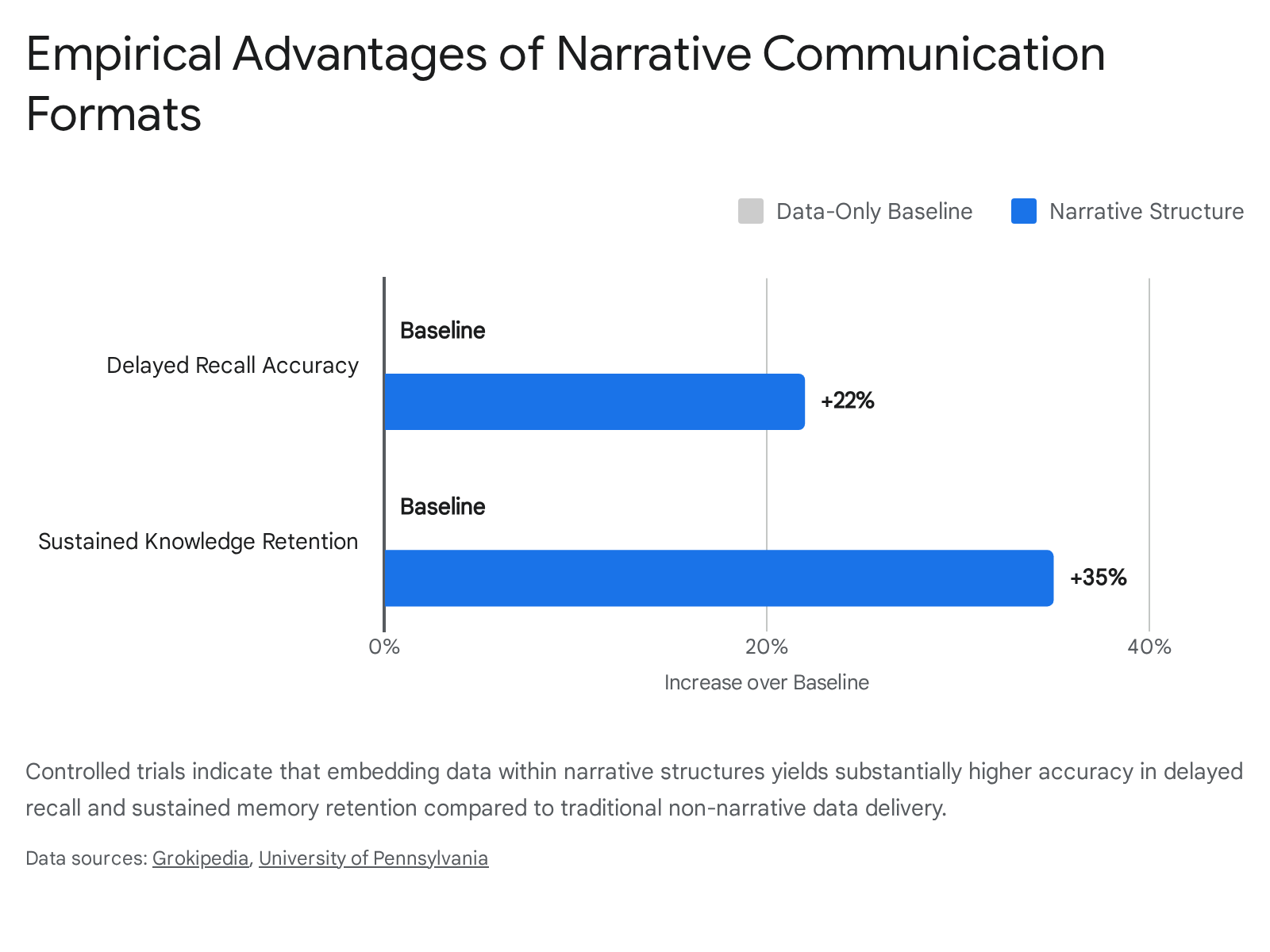
This superior encoding is directly linked to the narrative's ability to engage episodic memory networks alongside semantic processing 2.
Furthermore, storytelling significantly influences executive decision-making. A 2024 study published in Nature Communications Psychology demonstrated that story-based data presentations significantly improved the quality of decisions made by participants when compared to traditional data-heavy formats 5. Narrative structures enhance "narrative transportation" - a state where audiences become sufficiently immersed in a story to adopt the presenter's perspective, thereby increasing their willingness to act on recommendations 530.
It is important to note that the persuasive power of narrative is context-dependent. In specific scenarios involving acute public health emergencies, field experiments have indicated that didactic, non-narrative messaging may be more effective for immediate knowledge transfer regarding preventive measures, as highly emotional narratives can occasionally distract from urgent instructional protocols 31.
Cultural Paradigms in Narrative Structure
The psychology of storytelling is not monolithic. How an audience processes a presentation depends heavily on the specific structural paradigm the speaker employs. While Western audiences are highly accustomed to conflict-driven arcs, global communication increasingly requires an understanding of alternative narrative architectures.
Classical Western Rhetoric
The Western narrative tradition is deeply rooted in the Aristotelian trivium and the five canons of rhetoric: inventio (invention), dispositio (arrangement), elocutio (style), memoria (memory), and pronuntiatio/actio (delivery) 32. Aristotle's framework relies on the mobilization of logos (logic), ethos (credibility), and pathos (emotion) 3233.
Structurally, Western storytelling is dominated by models like Freytag's Pyramid and the Hero's Journey, which rely on a linear progression of exposition, rising action, climax, falling action, and resolution 343935. This model relies explicitly on antagonism, conflict, and the overcoming of obstacles to generate dopamine and cortisol responses 3439. In public speaking, this translates to presentations that frame a severe business problem (the antagonist) that must be defeated by a proposed strategy (the hero/climax).
Appositive Development
In contrast to the conflict-centric Western model, East Asian narrative traditions - particularly in Japanese, Chinese, and Korean contexts - often utilize the Kishōtenketsu structure 393637. Originating in classic Chinese four-line poetry during the Tang dynasty, the framework is divided into four acts 3936:
- Ki (Introduction): Establishes the setting and characters.
- Sho (Development): Expands upon the introduction without introducing major conflict.
- Ten (Twist): Introduces a new, seemingly unrelated element or perspective, rather than an escalation of prior tension.
- Ketsu (Conclusion): Synthesizes the disparate elements, bringing harmony and revealing the connection between the Sho and the Ten.
The psychology of Kishōtenketsu relies on apposition rather than opposition. Elements are placed side-by-side, creating cognitive engagement through juxtaposition and the audience's anticipation of harmony 3339. Because it does not rely on confrontation to drive the narrative forward, it fosters a contemplative aesthetic 39. Comparative research in cognitive psychology suggests this aligns with a holistic cognition system typical of Eastern mindsets, contrasting with the analytic, conflict-driven cognition dominant in the West 35. For public speakers operating in global or highly collaborative environments, applying Kishōtenketsu can prevent the alienation that sometimes occurs when complex organizational issues are aggressively framed as adversarial conflicts 39.
Circular and Episodic Traditions
Indigenous storytelling frameworks frequently employ circular and episodic structures 3839. Grounded in concepts of "spiralic temporality," circular storytelling rejects linear progression, recognizing time and events as continuous and interconnected, without absolute beginnings or definitive ends 4041. In these traditions, the storyteller and the listener engage in a collective sharing of experience where conflict is not the driving mechanism of the narrative 40.
In a public speaking context, applying circular storytelling involves returning to an opening theme at the conclusion, incorporating the transformation or lessons learned throughout the presentation 38. This technique enhances audience retention by providing memorable closure and reinforcing key messages without requiring a dramatic, linear climax 3847. It invites the audience into a shared, continuous experience of meaning-making that reflects ecological or organizational realities more accurately than linear progressions 4742.
| Narrative Paradigm | Core Mechanism | Cognitive Effect | Ideal Public Speaking Context |
|---|---|---|---|
| Western Linear (Three-Act) | Escalating tension, conflict, and resolution. | High cortisol and dopamine release; drives urgency and a clear problem-solving orientation. | Persuasive pitches, crisis management, competitive strategy briefings. |
| Kishōtenketsu (Four-Act) | Juxtaposition, contrast, and harmonious synthesis. | Appositive meaning-making; reduces adversarial processing; encourages holistic thinking. | Cross-cultural communication, collaborative problem solving, complex organizational change. |
| Circular / Episodic | Thematic return, spiralic temporality, continuous connections. | Reinforces long-term memory via thematic anchoring; promotes collective reflection and empathy. | Visionary keynotes, brand philosophy, long-term sustainability reporting. |
Audience Engagement and Narrational Complexity
As modern media environments become increasingly fragmented, public speakers face the challenge of holding attention in spaces where audiences are accustomed to rapid context switching and digital distraction.
Narrative Transportation
Narrative Transportation Theory details how deep immersion in a story alters physiological and psychological perceptions 22. When audiences are "transported," their cognitive resources are entirely devoted to processing the narrative world, which temporarily suppresses their critical faculties and counter-arguing behaviors 2243. A compelling narrative bypasses rational defenses, making the audience more receptive to new concepts, even those that challenge their existing beliefs 43. The efficacy of this transportation is dependent on character relatability, vivid imagery, and emotional authenticity, often outweighing the objective accuracy of the surrounding data in terms of immediate persuasion 2250.
Triadic Engagement with Narrational Complexity
While simple, linear stories are effective, audiences are increasingly capable of processing non-linear, fragmented information. The Triadic Engagement with Narrational Complexity (TENCo) model offers a framework for understanding how audiences navigate dense narratives 4445. The model divides engagement into three dimensions: cognitive (comprehension and inference-making), affective (emotional resonance), and appreciative (aesthetic evaluation) 4445.
The TENCo model draws a critical distinction between narrational complexity (formal disruptions in the timeline or structure) and complication (sheer informational density) 4445. When speakers introduce narrational complexity - such as nesting multiple case studies or presenting non-linear data sets - they demand executive functions related to divergent thinking and cognitive flexibility from the audience 44.
While high complication can overwhelm working memory, the deliberate use of narrative complexity can actually heighten immersion 44. By intentionally creating "knowledge gaps" and non-linear associations, the speaker invites the audience to actively participate in the sense-making process 43. This active participation shifts the listener from a passive recipient of data to a co-creator of meaning, deepening memory retention and emotional investment as they connect the narrative fragments 43.
Virtual Environments and Digital Communication
The accelerated shift toward digital collaboration platforms, webinars, and virtual keynotes has fundamentally altered the physical parameters of public speaking. This transition introduces specific cognitive barriers that narrative storytelling is uniquely equipped to mitigate.
Digital Fatigue and Latency
Virtual communication heavily strains the human cognitive apparatus. In face-to-face environments, communication relies on a continuous stream of non-verbal, spatial, and tactile cues 46. In videoconferencing, these cues are degraded or entirely absent. Camera placement disrupts natural eye contact, the visual field is artificially constrained, and technological latency disrupts the micro-coordination of speech 946.
While in-person conversational turn-taking features delays averaging 135 milliseconds, virtual platforms frequently introduce delays of nearly 487 milliseconds 9. These temporal distortions force the brain to expend constant, conscious effort to infer intentions and emotions, leading to what is clinically referred to as "Zoom fatigue" or digital cognitive overload 94647. The lack of sensory richness attenuates the naturally occurring interpersonal neural synchronization (INS) that typically binds a speaker and an audience, making attention far more fragile 9.
Narrative Coherence as a Cognitive Anchor
To counteract digital fatigue, public speakers must adjust their structural approach. When the brain cannot rely on micro-expressions or immediate acoustic feedback to track a speaker's intent, the underlying structure of the content becomes the primary anchor for attention.
Narrative coherence serves as a predictive framework. Because human cognition is heavily patterned around story arcs, a well-defined narrative allows the listener's brain to anticipate the direction of the presentation 446. This predictability lowers the extraneous cognitive load imposed by the virtual medium. By organizing data into a clear story, the speaker offloads the burden of continuous interpretation from the listener's working memory, allowing them to remain engaged despite the degraded sensory environment 4. Furthermore, incorporating gamified elements within these narratives has been shown to reduce the cognitive strain associated with digital learning environments, boosting confidence and motivation temporarily 448.
Applied Data Storytelling
Recognizing the psychological supremacy of narrative does not diminish the importance of empirical data; rather, it dictates how data must be packaged. Data storytelling bridges the gap between raw analytics and human decision-making by situating numbers within a human context 123.
Discovery Logic Versus Presentation Logic
A crucial insight from communication research is that the logic of discovery differs fundamentally from the logic of presentation 5. During the analysis phase, analysts must meticulously review all available data points, anomalies, and regression outputs to discover an insight. However, presenting that entire process to an audience guarantees information dilution 5. What is necessary for discovery is often irrelevant for decision-making. Effective data storytelling requires the strategic omission of extraneous data to preserve the narrative throughline, ensuring the audience is guided toward the conclusion rather than buried in the methodology 5.
The Value Problem Opportunity Framework
In corporate and technical public speaking, experts frequently utilize frameworks designed to merge empirical precision with narrative momentum. The Value-Problem-Opportunity (VPO) structure is one such framework, designed specifically to prevent cognitive overload in data-heavy briefings 5.
- Value: The speaker establishes a shared context and emotional baseline. This aligns with the exposition in classical rhetoric or the Ki in Kishōtenketsu, grounding the upcoming data in a recognizable human or organizational priority 5.
- Problem: The speaker introduces specific challenges. Instead of merely presenting a declining chart, the speaker contextualizes the data as an active antagonist affecting real stakeholders. This elevates cortisol and focuses attention 5.
- Opportunity: The speaker presents data-driven solutions as the path forward, providing a satisfying resolution that triggers dopaminergic reward pathways and encourages decisive action 5.
By structuring data within the VPO framework, speakers ensure that technical insights are rendered persuasive, actionable, and aligned with the psychological mechanisms that drive human engagement.