
Why Do We Remember Stories Better Than Facts
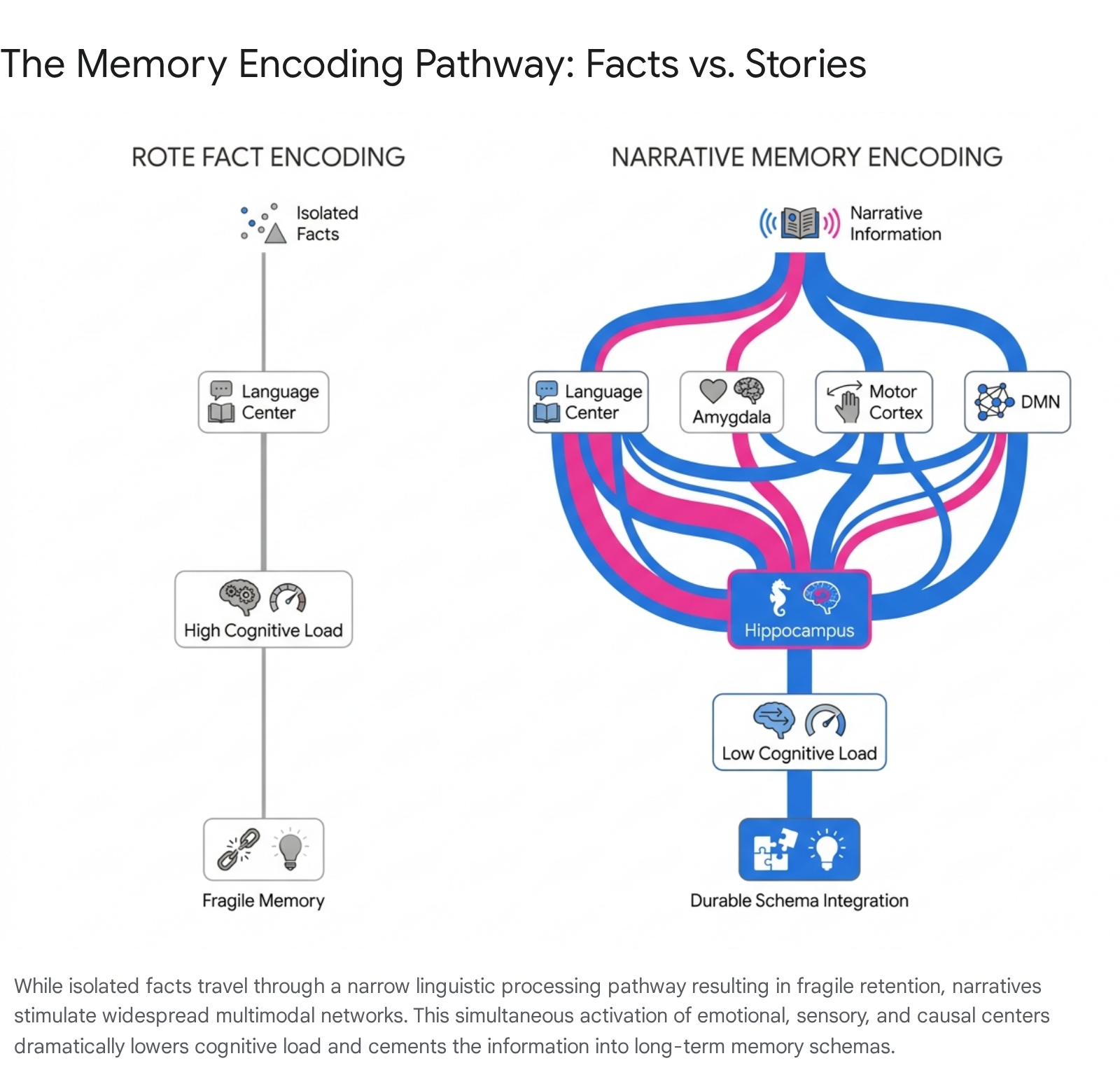
Stories drastically outperform rote memorization because narratives simultaneously activate widespread neural networks - spanning sensory processing, emotional resonance, and causal reasoning - which collectively reduce cognitive load. By anchoring isolated facts within a naturally cohesive cognitive schema, the brain effortlessly transitions short-term data into durable, easily retrievable long-term episodic memories. While rote learning forces the brain to rely on fragile linguistic pathways, narrative structures leverage the brain's evolutionary predisposition for spatial navigation, social understanding, and pattern recognition.
Consider the remarkably common experience of staring blankly at an audience during a high-stakes professional presentation, the sudden and frustrating inability to recall a crucial statistic during a final examination, or the universal embarrassment of forgetting a colleague's name mere seconds after a formal introduction. These everyday cognitive failures rarely stem from a lack of intelligence, a declining memory, or insufficient effort. Rather, they represent a fundamental mismatch between the type of information being presented and the brain's evolutionary hardware. The human brain was never designed to act as a digital hard drive, passively filing away spreadsheets, bulleted lists, and isolated data points. Instead, human cognition is fundamentally structured around meaning-making, environmental navigation, and pattern recognition. Understanding the deep neuroscience behind narrative memory - and recognizing exactly why the brain inherently prefers the arc of a story over the rigidity of a factual list - offers profound, actionable strategies. For the general reader, this science unlocks the ability to dramatically improve study habits, deliver highly persuasive and memorable presentations, and retain vital everyday information with minimal cognitive friction.
Debunking the Myth: Is Rote Memorization Really the Best Way to Learn?
For centuries, modern educational and professional systems have operated under a pervasive and damaging misconception: the belief that the rote memorization of isolated facts represents the most rigorous, effective, and fundamental method of human learning 123. This perspective often assumes that repetitive drilling - such as reciting multiplication tables, historical dates, scientific formulas, or quarterly earnings figures - acts as the primary and most robust foundation upon which higher-order critical thinking is subsequently built 14.
Cognitive neuroscience and educational psychology have thoroughly debunked the idea that rote repetition intrinsically deepens understanding or leads to long-term retention 42. While it is undoubtedly true that foundational content knowledge must be stored in long-term memory to free up limited working memory capacity for complex problem-solving 1, the specific mechanisms of that storage matter immensely. Relying purely on rote learning trains the brain to store information passively rather than processing it dynamically 2. Consequently, learners become dependent on fixed answers and struggle significantly to adapt their knowledge to novel, real-world applications - a cognitive deficit known as low adaptability or cognitive rigidity 2. When situations do not perfectly match the memorized knowledge, the rote learner is unable to think flexibly 2.
Recent developments in the science of learning highlight that the most durable cognitive encoding occurs not through mindless repetition, but through an evidence-based concept known as "desirable difficulty" 67. Introduced and refined by cognitive psychologists, desirable difficulty refers to intentional challenges strategically integrated into the learning process - such as active retrieval practice, spaced repetition, and interleaved practice 673. When an individual exerts significant cognitive effort to recall information, the act of retrieval itself physically strengthens the underlying neural pathways, making the memory far more robust and easily recallable in the future 63. Rote learning entirely bypasses this necessary productive struggle, providing a dangerous illusion of fluency that rapidly fades once the immediate need (such as passing a standardized test or delivering a quarterly report) has passed 29.
In the modern era of artificial intelligence and ubiquitous digital search, the reliance on rote learning is further complicated by cognitive offloading. Studies from 2024 and 2025 demonstrate that excessive reliance on AI tools or search engines for instant factual recall deprives the brain of the desirable difficulty required to build robust neural manifolds 3. Without engaging the brain's internal memory systems through effortful recall and narrative contextualization, users fail to develop the intuitive mastery and deep cognitive schemata required for high-level creative problem-solving 3.
Furthermore, rote facts typically lack a "causal structure," which is vital for long-term retention and analogical reasoning 456. Cognitive science dictates that the acquisition of facts is most useful when integrated into a hierarchical schema - a mental framework that organizes knowledge into meaningful, predictable patterns 13.
To conceptualize this, consider the real-world analogy of cognitive schema fit. A cognitive schema is akin to a meticulously organized, custom-built wardrobe equipped with specific hangers, specialized drawers, and clearly labeled shelves. When new information is presented within a narrative context, it arrives neatly folded and perfectly tailored to fit a specific, pre-existing shelf. The brain immediately knows where to place it and how to retrieve it. Rote facts, conversely, are like an unstructured, massive pile of laundry dumped indiscriminately onto the floor. They occupy massive amounts of space in working memory, but they lack the organizational architecture required to retrieve a specific item quickly when needed. Without schema fit, the cognitive load becomes overwhelming, and the brain simply discards the loose, unanchored information 11314.
What Happens in the Brain When We Hear a Story?
When an individual encounters raw data, numbers, or bulleted facts, functional neuroimaging reveals that metabolic brain activity is primarily restricted to the brain's language-processing centers, predominantly Broca's and Wernicke's areas, located in the left hemisphere 15161718. The brain successfully decodes the linguistic meaning of the words and processes the numerical values, but it does very little else. The engagement is shallow, and the neural footprint is incredibly narrow 16.
However, when that exact same factual information is embedded within a narrative structure, the brain experiences a widespread, multimodal phenomenon. A well-told narrative engages a vast, distributed network of neural regions, including those responsible for vivid sensory experiences, deep emotional processing, and complex social cognition 15161718.
When a story includes descriptive imagery or recounts physical movement, the brain's sensory and motor cortices ignite. Brain scans demonstrate that hearing action-oriented sentences primes the motor cortex to simulate the actions, generating a profound mind-body connection that makes the listener feel as though they are experiencing the event firsthand 1317. Concurrently, the temporal lobe acts as an intermediary, concatenating sentences into a cohesive representational model, rather than just processing simple semantics 19.
Moreover, stories force the brain to evaluate the intentions, goals, and motivations of characters. This naturally activates the medial prefrontal cortex and the temporoparietal junction, regions intricately associated with "Theory of Mind" - the human ability to attribute mental states, beliefs, and desires to others 131920. During successful storytelling, the brain waves of the listener actually begin to synchronize with the brain waves of the storyteller, a fascinating neurobiological phenomenon known as neural coupling, which facilitates deep understanding and interpersonal connection 16.
The most critical difference, however, lies in emotional engagement. Emotion drives human behavior and is the primary catalyst for memory consolidation. Character-driven narratives that elicit empathy, hope, fear, or suspense deeply stimulate the amygdala, the brain's primary emotional processing center 151719. The amygdala then interacts directly with the hippocampus - the brain's central memory hub - signaling that this incoming information is highly significant and must be retained 1419. Furthermore, compelling narratives trigger the release of oxytocin, a neurochemical that fosters trust and cooperation, alongside dopamine, which enhances motivation and reinforces the memory trace 141518.
To understand this mechanism, consider the real-world analogy of emotional salience. Emotional salience acts as the brain's neurochemical highlighter pen. When an individual reads a rote statistic or a plain list of facts, it is recorded in faint, standard gray ink. It is legible, but it easily fades into the background noise of daily cognitive input. However, a story soaked in emotional resonance triggers the amygdala to flood the hippocampus with dopamine. This highlights the narrative in bright, indelible fluorescent ink. It signals to the brain's archiving system that this specific memory is vital for future survival, social functioning, and decision-making, ensuring it is permanently stored and easily accessed 14.
Recent Breakthroughs in the Neuroscience of Narrative (2023 - 2026)
Recent advancements in cognitive neuroscience have provided unprecedented, granular insights into how narrative content alters physical brain connectivity and memory retrieval. Groundbreaking research from 2024 and 2025, led by Signy Sheldon and colleagues at McGill University and published in the Journal of Neuroscience and Trends in Cognitive Sciences, investigated how the specific type of storytelling dictates the exact memory networks utilized by the human brain 78910.
Sheldon's team utilized advanced functional magnetic resonance imaging (fMRI) combined with sophisticated natural language processing (NLP) algorithms to observe participants listening to stories that contained identical core events but differed significantly in their elaborative details 8910. The researchers discovered that the brain utilizes entirely different routing pathways depending on the narrative focus.
Conceptual narratives - stories that emphasized internal thoughts, feelings, and personal interpretations of the core events - triggered significantly stronger connectivity between the anterior hippocampus and the brain's Default Mode Network (DMN) 7811. The DMN is an extensive, interconnected network of brain regions that becomes highly active during self-referential thought, autobiographical memory recall, future planning, and deep meaning-making 711.
Conversely, perceptual narratives - stories that heavily emphasized concrete, external observations such as specific sights, sounds, and physical details - engaged entirely different neural pathways. These stories connected the hippocampus primarily to the parietal and lateral temporal regions, which are areas situated outside the standard Default Mode Network 78.
The most critical revelation from these 2025 studies is that the distinct conceptual and perceptual brain networks active during the initial listening and encoding phase accurately predicted how well individuals would later recall the core elements of the story 89. Memory, therefore, is not merely about raw data storage; it is fundamentally about interpretation and routing 7. Matching communication styles to a listener's preferred memory system can systematically sculpt memory formation, retention, and later retrieval 78.
Further supporting the systemic nature of brain routing, a landmark 2025 study from Ohio State University published in Network Neuroscience analyzed MRI scans from over 1,000 participants to map the brain's "connectivity fingerprints." The researchers proved that a brain region's underlying connectivity pattern can accurately predict its activation across 33 different mental tasks, confirming that structural connectivity inherently dictates cognitive function, from language processing to episodic memory formation 12.
Additionally, a massive 2025 study conducted by researchers at Princeton University and the Weizmann Institute utilized Large Language Models (LLMs) to generate naturalistic narrative stimuli for large-scale memory experiments. The researchers discovered that human recall and recognition performance scales linearly with narrative length; however, as narratives grow longer, the brain naturally transitions from recalling precise rote details to summarizing conceptual content 13. Fascinatingly, when researchers scrambled the chronological order of the narratives, recognition remained unaffected, but recall declined. Yet, when participants attempted to recall the scrambled stories, their brains automatically reconstructed the events into the original, logical narrative order, proving the brain's overwhelming biological mandate to impose causal contextual structure on incoming data 13.
The Myth of "22 Times More Memorable" vs. The Reality of Recall
In corporate boardrooms, marketing seminars, and educational workshops, a statistic frequently circulates claiming that "facts wrapped in stories are 22 times more memorable than facts alone." This highly precise number is routinely - and incorrectly - attributed to the late, eminent cognitive psychologist Jerome Bruner. Extensive reviews of Bruner's extensive body of work, including his foundational text Actual Minds, Possible Worlds, reveal absolutely no such quantified claim 2814. The exact "22x" multiplier appears to be a modern internet myth, born of a contemporary desire for catchy, authoritative-sounding statistics 1828.
However, while the exact mathematical precision of the 22x claim is dubious, the underlying reality it attempts to convey is heavily supported by rigorous empirical evidence 1828. A highly cited and widely replicated experiment conducted by Stanford University professors Chip Heath and Dr. Jennifer Aaker tested the memory recall of graduate students following a series of one-minute pitches 3031. In the study, students were tasked with persuading their peers on a specific topic. Unsurprisingly, 90% of the students relied heavily on traditional business metrics: facts, statistics, and logical arguments. Only 10% opted to utilize a human-centric narrative to make their point 3031.
After the presentations concluded, the audience was distracted and then unexpectedly tested on their memory of the pitches. The results were staggering. A mere 5% of the audience could recall a single individual statistic from the data-heavy presentations. In stark contrast, a massive 63% of the audience perfectly remembered the stories told by the minority of presenters 3031. Even more remarkably, the researchers found no correlation between the speaker's polish or presentation skills and the audience's recall of the story. A poorly delivered story consistently outperformed a highly polished presentation of raw data 30.
This massive disparity in retention highlights the unmatched power of causal structure in cognitive processing. Abstract causal models naturally organize human actions and structure our memory of events, representing not only associations between data points but specifically illuminating what causes what 5.
To grasp why this is so effective, consider the real-world analogy of causal structure. The causal structure of a narrative functions much like the full-color, completed picture on the front of a jigsaw puzzle box. Rote facts, statistics, and isolated data points represent the individual, scattered puzzle pieces. Attempting to force them together without a guiding picture is intensely frustrating, time-consuming, and cognitively taxing. A story provides the overarching picture immediately; it illustrates the "why" and "how," establishing the exact, logical relationships between the pieces. This causal structure dramatically reduces cognitive load, allowing the brain to effortlessly slot new information into its proper, meaningful place 45632.
To succinctly summarize the vast neurobiological differences between these two modes of information processing, the following table compares the encoding mechanisms of rote facts versus narrative stories.
| Cognitive Dimension | Processing Rote Facts | Processing Narrative Stories |
|---|---|---|
| Primary Brain Regions Activated | Language-processing centers exclusively (Broca's, Wernicke's) 161718. | Distributed multimodal network: Sensory/Motor cortices, Amygdala, Hippocampus, Default Mode Network (DMN) 13177. |
| Cognitive Load | High. Requires constant, effortful rehearsal, placing immense strain on limited working memory 115. | Low. Information is naturally organized via inherent causal structure and established schema fit 4514. |
| Emotional Salience & Neurochemistry | Minimal. Facts are treated as emotionally neutral data, reducing the hippocampus's prioritization of the memory 1418. | High. Character intentions and conflicts trigger the release of dopamine and oxytocin, biologically highlighting the memory 141518. |
| Empirical Retention Rate (Stanford Study) | Extremely Low. Only ~5% of an audience could recall an individual statistic shortly after presentation 3031. | Exceedingly High. ~63% of the audience accurately remembered the narrative presented to them 3031. |
| Adaptability & Knowledge Transfer | Rigid. Memorized isolated facts frequently fail to transfer to novel, real-world problem-solving scenarios 2. | Flexible. Causal mental models allow for analogical reasoning, deeper comprehension, and broad application across domains 4634. |
Is the Narrative Memory Advantage Universal?
If the human brain is indeed evolutionarily hardwired for narrative encoding, this memory advantage should manifest globally, entirely independent of Western educational paradigms, literacy rates, or written language. Anthropological, historical, and neuroscientific evidence overwhelmingly confirms that this is the case. Non-Western oral traditions have relied on advanced, narrative-based memory systems for tens of thousands of years. These systems function as highly engineered cognitive offloading mechanisms, allowing communities to encode vast, complex encyclopedias of survival, geographical, and cultural data without utilizing a single written word 163617.
Aboriginal Australian Songlines vs. The Method of Loci
The ancient Greeks and Romans are frequently credited in Western psychology with inventing the "Method of Loci" (commonly known as the Memory Palace) - a highly effective mnemonic device where information is attached to specific physical locations in a visualized, spatial environment 383918. However, the Indigenous peoples of Australia utilized a vastly superior, place-based memory technology known as "Songlines" at least 50,000 years prior to the emergence of ancient Greece 161819.
Songlines are both physical and narrative pathways woven intricately across the vast Australian landscape. Aboriginal elders successfully encoded incredibly complex, highly practical survival data - including detailed botany, animal behavior, safe water sources, and celestial navigation - into stories, songs, and dances attached to specific geological features such as rocks, trees, and waterholes 163618. Dr. Lynne Kelly, a leading researcher on Indigenous memory systems and the author of The Memory Code, notes that Songlines essentially serve as physical memory palaces, but with a critical evolutionary distinction: they are constantly walked, sung, and danced in the real world, rather than merely imagined in the mind 361842.
A compelling 2025 paper from Deakin University emphasizes that "Memory in Relation" within Aboriginal Australian psychology integrates locatedness, relatedness, embodiment, and orality to form a living map that connects people to place 161943. This is not merely a rote storage technique, but a dynamic, relational knowledge system 16. Recent empirical studies conducted at Monash University and the University of Melbourne rigorously tested this ancient Indigenous technology against standard Western memorization techniques. Medical students who were taught to use an Aboriginal narrative-walking technique were nearly three times more likely to perfectly recall complex, unordered lists of medical facts (in this case, butterfly names) compared to their baseline performance 1844. They significantly outperformed students using the traditional Greek Memory Palace, who only doubled their baseline performance, and vastly outperformed an unstructured control group that only saw a 50% improvement 18. The integration of physical movement, precise spatial location, and continuous narrative layering effectively prevented the "Chinese whisper" degradation effect, ensuring flawlessly accurate knowledge transfer across thousands of generations 3618.
The Griots of West Africa
In the western Sahel region of Africa, particularly among the deeply historical Mandinka and Bambara cultures, history is not recorded in books but carried dynamically in the minds of highly trained hereditary storytellers known as griots (or jeliw) 2046. Emerging during the 13th-century Mali Empire, griots serve as living archives, genealogists, musicians, and trusted cultural advisors to leadership 464748.
Griot storytelling is a masterpiece of multisensory memory encoding. They master vast, centuries-long genealogies and complex historical epics, such as the celebrated tale of Sunjata (the founder of the Mali Empire), transmitting them entirely orally from master to apprentice 204647. To ensure massive memory retention without the aid of writing, griots do not merely recite dry lists of ancestors or historical dates; they utilize an immersive narrative framework coupled with continuous musical accompaniment. Utilizing traditional stringed and percussive instruments like the 21-stringed kora or the wooden balafon, the rhythmic pacing, melodic motifs, and emotional crescendos act as powerful mnemonic anchors 204648. Modern neuroscience confirms that musical rhythm, when combined with narrative, significantly lowers the cognitive barrier for storing extensive sequential information, creating an unshakeable cognitive architecture for the history of entire empires 4648.
Native American Winter Counts
Prior to European colonization, many Indigenous communities of the Northern Great Plains of North America - such as the Lakota, Nakota, Blackfoot, and Kiowa - utilized a highly efficient visual-narrative memory system known as the "Winter Count" (waniyetu wówapi) to preserve their history 495021.
Because the traditional year was measured from the first snowfall to the next, the community's designated historian (the Winter Count keeper) would consult deeply with tribal elders to democratically select the single most significant event of that year 4950. This chosen event was then painted as a single, highly stylized pictograph on a buffalo hide, spiraling outward sequentially in a counter-clockwise direction from the center 4950. These pictographs were not a written language; they served as visual mnemonic cues for extensive, rich oral narratives. For instance, a drawing of a freezing crow falling from the sky did not simply translate to "it was cold"; it anchored the entire community's memory of the devastating winter of 1788/89. When the storyteller touched that symbol, it triggered the recall of specific survival tactics, tragic losses, environmental shifts, and profound historical context 5021.
Fascinatingly, modern climate scientists now use these Winter Counts as highly accurate historical climate archives. The Lakota recording of the harsh winter of 1788/89 aligns perfectly with European historical records of severe freezing that same year (which contributed to the French Revolution), and a recording of a loud meteor in 1833 perfectly matches the known Leonid meteor shower 21. By tying strict chronological history to specific, emotionally resonant visual stories, the Winter Count allowed the Lakota to flawlessly preserve centuries of complex historical and climatological data 5021.
Polynesian Wayfinding
The initial settlement of the Pacific Ocean islands is arguably the greatest maritime and navigational achievement in human history. Polynesians successfully navigated across millions of square miles of featureless open ocean to locate tiny, isolated islands without the use of compasses, sextants, astrolabes, or modern GPS 175222. This astounding feat was achieved through "wayfinding" - an astonishing miracle of rote-defying human memory and continuous, hyper-vigilant observation of the natural world 1754.
Wayfinders, such as the legendary 20th-century Micronesian master navigator Mau Piailug, memorized the exact rising and setting points of hundreds of specific stars. They memorized the precise cardinal flight paths of specific seabirds, and they learned to physically feel the subtle interference patterns of deep ocean swells bouncing off invisible islands hundreds of miles away 175254. This overwhelming amount of meteorological, oceanographic, and astronomical data was not memorized as dry, abstract mathematical tables. Instead, it was seamlessly encoded into complex ancient songs, chants, and mythological narratives passed orally from master to apprentice over decades of training 1754.
The sky and the ocean were divided into specific narrative quadrants (such as Hikina for the arriving Eastern horizon, and Komohana for the entering Western horizon) 22. By turning the night sky and the shifting ocean currents into an interactive, ongoing story, Polynesian navigators maintained pinpoint spatial awareness over weeks of travel in total darkness, proving that the human brain can process virtually infinite data streams when they are organized into a continuous, meaningful narrative 2254.
Can You Train Yourself to Turn Facts Into Stories?
The robust intersection of neuroscientific, anthropological, and psychological evidence makes a singular conclusion clear: to reliably remember complex information in the modern world, one must abandon the fragile strategy of rote repetition and actively adopt narrative mnemonics. Fortunately, cognitive psychology offers highly effective, easily trainable techniques to artificially synthesize causal structures and narrative arcs for otherwise unrelated, abstract facts 38235657.
The Story Method (Sentence Mnemonic)
The "Story Method" (sometimes referred to as the sentence mnemonic) is a foundational mnemonic link system that intentionally forces the brain to process disjointed information linearly, creatively, and narratively 5658. If an individual needs to remember an arbitrary, unconnected list of objects - such as an otter, a toolbox, beans, and a shell (which, in a specific phonetic memory system, actually represent the first eight digits of pi) - staring at the words repeatedly is a highly inefficient use of cognitive energy 56.
Instead, the learner is trained to construct a vivid, highly absurd narrative linking the items: "An otter jumps into a toolbox. Inside the toolbox are some beans. The otter throws the beans out, and they land in a shell" 56.
Why does this simple technique work so profoundly? First, it artificially imposes a temporal and causal structure (the otter's specific actions directly cause the beans to move), giving the brain a logical sequence to follow 4. Second, it creates highly vivid visual imagery, forcing the brain to engage the visual cortex alongside the language centers, providing multiple retrieval pathways 232425. Third, the sheer absurdity of the image introduces the emotion of surprise. Neuroscientists note that surprise is a incredibly powerful, well-documented memory enhancer, as it flags the event as an anomaly worthy of retention 33857.
Incorporating the Memory Palace (Method of Loci)
For longer, more complex lists or presentations, the Story Method can be seamlessly combined with a spatial Memory Palace 383957. To remember the biological taxonomy order (Kingdom, Phylum, Class, Order, Family, Genus, Species), a learner might imagine walking through their own home 38. At the front door, a King (Kingdom) is aggressively fighting with a metal file (Phylum). In the living room, a teacher is holding a Class while yelling "Order!" at the top of their lungs. At the kitchen table, an entire Family is watching a certified genius (Genus) closely inspect a rare, glowing alien species (Species).
By anchoring these absurd narrative vignettes to familiar, sequential spatial loci in a known environment, the learner essentially replicates a localized, internal version of the Aboriginal Songline 383957. The brain naturally remembers the layout of the house, and the narrative vignettes supply the data, completely eliminating the need for rote memorization.
Furthermore, leveraging narrative structures inherently boosts analogical reasoning. The 2024 development of the Analogical Reasoning on Narratives (ARN) dataset highlights that while Large Language Models (LLMs) struggle to detect deep, system-level analogies between stories that share no surface similarities, the human brain excels at this 34. By mapping characters, goals, and events functionally, human narrative memory allows us to transfer lessons from one domain to an entirely different one, proving that causal story structure is a uniquely powerful human cognitive strength 34.
Evidence-Backed Practical Takeaways for Everyday Life
Understanding the biological and historical mechanics of narrative memory is only half the battle; the true value of this science lies in its practical, daily application. By consciously leveraging the brain's innate preference for causal structure and emotional salience, individuals can drastically improve their everyday cognitive performance across a variety of professional and personal domains 15172326.
Improving Study Habits and Deep Comprehension
Students and lifelong learners frequently struggle with the "illusion of competence" - the false belief that they have learned and internalized a complex concept simply because they have passively re-read a textbook chapter multiple times or highlighted a block of text 69. This rote approach yields high short-term confidence but disastrous long-term retention.
To fix this, learners must transform passive reading into active, narrative generation. When learning a new concept, do not merely highlight definitions. Instead, build an acronym or a micro-story that forces the information into a logical sequence. For example, to remember the elements of Freytag's narrative plot pyramid (Setting, Problem, Rising Action, Climax, Turning Point, Falling Action, Resolution), educators have successfully taught students the mnemonic acronym "spra climt far" to act as a narrative trigger 27.
Better yet, students should practice elaborative encoding by attempting to teach the learned concept to an imaginary audience using a specific, relatable narrative metaphor 1428. If studying economics, do not just memorize the definition of inflation; tell a story about a specific baker trying to buy flour over a decade. This narrative generation introduces the "desirable difficulty" required to cement the memory engram, ensuring the knowledge is truly proceduralized rather than just temporarily held in working memory 3.
Giving Better, More Persuasive Presentations
In corporate, scientific, and academic settings, well-intentioned presenters often rely on slides overflowing with complex charts, raw data points, and dense bulleted lists. As definitively demonstrated by the Stanford University research, an audience will forget 95% of those statistics almost immediately upon leaving the room 143031.
To fix this, professionals must wrap critical data within a human-centric story. If attempting to secure venture capital funding for a new medical device, do not open the pitch with a dry slide on market-share percentages or total addressable market. Instead, open with the specific, emotional story of a single patient. Describe their daily struggle (the narrative conflict) and vividly detail how the device altered their life (the narrative resolution). Inject the hard data and statistics only as supporting evidence within that established narrative arc 143164. This approach satisfies the brain's craving for cognitive fluency, triggers oxytocin release (which biologically fosters audience trust and cooperation), and ensures the core message is exponentially more likely to be retained and acted upon by the stakeholders 151718.
Remembering Names and Faces
Meeting multiple people at a networking event or a dinner party usually results in immediate amnesia regarding their names. This occurs because a name (e.g., "Oliver" or "Catherine") is generally an abstract, low-imagery word with absolutely no schema fit to the stranger's face 1529. The brain perceives no causal link between the visual input of the face and the auditory input of the name.
To fix this, one must force an immediate, internal visual and narrative association the moment the introduction occurs. If you meet an "Oliver" who mentions he works in finance, instantly visualize him sitting inside a giant martini glass filled with olives, aggressively handing out dollar bills. If you meet a "Catherine," imagine her enthusiastically petting a giant cat 30. While the image is ridiculous and should certainly be kept to oneself, it is incredibly effective. It bypasses the fragile bottleneck of short-term auditory memory by instantly engaging the brain's visual and emotional processing centers, creating a durable, story-based memory trace that will survive long after the event ends 395730.
Bottom line
The human brain is not a biological filing cabinet; it is an incredibly sophisticated, evolutionarily refined meaning-making machine. Relying on the rote memorization of isolated facts actively fights against our fundamental neurology, resulting in high cognitive load, low adaptability, and rapid forgetting. By transforming raw information into interconnected stories - utilizing vivid imagery, spatial anchoring, emotional resonance, and causal structure - we can effortlessly engage vast, multimodal neural networks. From the survival epics encoded in Aboriginal Songlines and Native American Winter Counts to the delivery of modern boardroom presentations, leveraging the rigorous science of narrative memory allows us to learn faster, remember longer, and communicate with profound, lasting impact.