
The neural and evolutionary basis of narrative
Introduction
The scientific investigation of storytelling has undergone a profound paradigm shift over the past two decades, moving from abstract literary theory into the empirical domains of cognitive neuroscience and neurobiology. Historically, early neurobiological inquiries adopted highly reductionist frameworks, seeking to isolate specific neurotransmitters or highly localized brain regions - such as Broca's and Wernicke's areas - to explain the profound psychological impacts of storytelling. However, contemporary cognitive neuroscience has firmly established that narrative processing cannot be reduced to single molecules or isolated language centers. Instead, it relies on the dynamic, large-scale synchronization of complex brain networks, most notably the Default Mode Network (DMN), interacting in real-time with sensory, motor, and attention systems 12.
This comprehensive report provides an exhaustive analysis of the neurobiology of storytelling, prioritizing peer-reviewed consensus and rigorous methodological evaluation over pop-science reductions. It delineates the evolutionary psychology underlying narrative behavior, definitively deconstructs the collapse of early neurochemical reductionism (specifically regarding the oxytocin "moral molecule" hypothesis), and maps the real-time physiological mechanics of narrative comprehension across major large-scale brain networks. Furthermore, it evaluates the impact of cultural malleability on neural synchronization, examines the ecological validity of modern neuroimaging techniques such as functional Near-Infrared Spectroscopy (fNIRS), and explores unprecedented comparative research between human neural processing and artificial intelligence generative language models.
Ultimate vs. Proximate Causes: Distinguishing Evolutionary Psychology from Real-Time Mechanics
To systematically analyze the neuroscience of storytelling, a strict conceptual demarcation must be maintained between evolutionary psychology - the ultimate causes of why storytelling aided human survival and reproduction over millennia - and immediate physiological mechanics - the proximate causes detailing exactly what happens in the brain in real-time during narrative consumption. Conflating the two often leads to teleological fallacies, where the distant evolutionary benefit of a behavior is mistakenly presented as the direct, conscious trigger for real-time neural activity 34.
The Evolutionary Psychology of Narrative: Survival and Social Cohesion
From a Darwinian perspective, the ubiquity of storytelling across all known human societies strongly indicates an adaptive evolutionary function rather than a mere cognitive spandrel 34. Evolutionary psychologists posit that storytelling evolved as a critical mechanism for survival processing, cognitive offloading, and social cohesion 65.
The anatomical prerequisites for storytelling trace back deep into hominid history. Compared to other primates, the human larynx lacks a vocal membrane and air sacs, an evolutionary subtraction that resulted in a highly stable vocal source critical for the evolution of complex speech 6. As early hominids like Homo erectus mastered fire approximately 1.5 million years ago, the campfire provided a stable, illuminated environment conducive to extended periods of social interaction and knowledge transfer 6.
Before the advent of written language, narrative served as the primary vehicle for transmitting fitness-relevant information - such as the locations of predators, the navigation of complex social hierarchies, and the identification of free-riders - without requiring individuals to incur the severe, potentially fatal costs of first-hand experiential learning 49. This is evident in traditional hunter-gatherer societies, where "trickster" stories are frequently utilized to model the problems of free-riding and deceit, while other narratives involve the mimicry of animal behavior to teach survival strategies 4.
Recent empirical studies provide robust cognitive evidence for this evolutionary hypothesis by comparing narrative processing to "survival processing" - a gold-standard mnemonic device in psychology where subjects evaluate information based on its utility in a hypothetical survival scenario. Research conducted by Reysen and Fischer (2026) demonstrated that storytelling yields equivalent, and in cases of written narrative generation, superior retention rates compared to survival processing 10. These outcomes indicate that the human episodic memory system co-evolved with narrative structures to optimize the encoding of relational and item-specific information vital for ancestral survival. The human brain appears fundamentally wired to prioritize and retain information packaged within a chronological, cause-and-effect narrative framework 10.
Furthermore, storytelling played a pivotal role in group-level cooperation and the expansion of social networks. Anthropologist Robin Dunbar has famously compared human gossip and narrative sharing to the physical grooming that other primates engage in as a means of bonding 6. By collectively participating in the sharing of narratives, early humans reinforced shared norms and facilitated "mental time travel" - the capacity to collectively recall the past and simulate potential future scenarios 3. This social cohesion hypothesis argues that narratives expand the boundaries of the self, allowing massive groups of non-kin to align their goals, empathize with shared protagonists, and cooperate creatively at a scale unseen in any other species 97.
Real-Time Physiological Mechanics: Neural Coupling and Anticipation
In contrast to evolutionary adaptations sculpted over hundreds of thousands of years, the immediate physiological mechanics of storytelling involve rapid, transient shifts in neurochemistry and network-level brain activations. When an individual consumes a narrative, the brain is not consciously calculating survival probabilities; rather, it is engaging in a process of continuous prediction, cognitive simulation, and neural synchronization 58.
In real-time, narrative comprehension rapidly recruits the auditory and visual cortices for sensory processing, while the linguistic content is parsed by classical language networks, such as Broca's and Wernicke's areas 1314. Crucially, as the narrative deepens, the motor and sensory cortices activate in a mirrored response to the actions described within the text or speech 1516. For example, functional magnetic resonance imaging (fMRI) studies reveal that listening to action-oriented words stimulates specific regions of the primary motor cortex, effectively simulating the physical experience described in the story 617. This proximate mechanism - often mediated by the mirror neuron system and interconnected limbic structures - provides the biological basis for "narrative transportation," the immediate psychological sensation of being totally immersed or "lost" in a fictional world 5713.
A defining feature of this real-time processing is "speaker-listener neural coupling." Pioneering research by Uri Hasson and colleagues demonstrated that when an individual tells a story, and another actively listens and comprehends, their brains begin to synchronize spatially and temporally 8159. The listener's brain activity mirrors the sweeping neural patterns of the speaker's brain with a short lag of approximately one second 8. In highly engaging narratives, the listener's brain can even exhibit predictive anticipatory responses, firing before the speaker articulates the next concept 9. This synchronization is directly tied to comprehension; if the listener fails to understand the narrative, the neural coupling decouples, emphasizing that successful communication relies on the active, synchronized simulation of meaning across independent brains 89.
Deconstructing the "Moral Molecule": The Oxytocin Replication Crisis
To accurately understand the neurochemistry of narrative processing, the scientific community has had to actively confront and correct the pervasive pop-science oversimplifications that dominated the early 21st century. The most prominent and problematic of these is the characterization of the neuropeptide oxytocin as the "moral molecule" or "cuddle chemical," a narrative aggressively promoted by neuroeconomist Paul Zak and subsequently amplified by corporate marketing and media 10111222.
The Original Claims and the Rise of Neuro-Reductionism
The genesis of the oxytocin hype traces back to a highly influential 2005 paper published in Nature by Kosfeld, Heinrichs, Zak, Fischbacher, and Fehr, which claimed that the intranasal administration of oxytocin directly and causally increased trust in humans during economic investment games 13. Building upon this, Zak expanded his theories into the realm of narrative, asserting that compelling stories with a clear dramatic arc stimulate the endogenous synthesis of oxytocin in the bloodstream 241415.
According to Zak's framework, oxytocin functions as a simple, biological lever for morality and empathy. He hypothesized that narrative tension triggers oxytocin release, which in turn produces empathy for the characters, leading to post-narrative prosocial behaviors, such as donating money to a charity featured in a public service announcement 1415. Under this neuro-reductionist view, oxytocin was positioned as the primary physiological substrate for the "Golden Rule" and the master controller of narrative immersion 1214. Zak's later commercial frameworks even proposed that a combination of dopamine (for attention) and oxytocin (for emotional resonance) could be measured to perfectly predict consumer behavior and market success 22.
The Replication Crisis and Peer-Reviewed Critiques
Subsequent rigorous, peer-reviewed investigations have systematically dismantled this reductive view, revealing deep methodological flaws in the original studies and a widespread failure to replicate the foundational findings. The oxytocin narrative is now considered a prime example of the broader replication crisis in the behavioral sciences.
A landmark 2015 critical review by Nave, Camerer, and McCullough examined the cumulative evidence surrounding oxytocin and human trust. They concluded that the "simplest promising finding associating intranasal OT with higher trust [the 2005 Nature paper] has not replicated well," and that the plasma oxytocin evidence was fundamentally flawed due to the unreliability of measuring central nervous system neuropeptide activity via peripheral bodily fluids like blood 13.
Statistical critiques further undermined the foundational 2005 study. Analysts like Andy Field pointed out that the original Nature paper relied on an exceptionally small sample size (N=58, split between oxytocin and placebo groups), rendering its statistical power severely deficient and highly susceptible to false-positive results 27. When independent researchers attempted to replicate specific paradigms that purportedly proved oxytocin's trust-enhancing effects - such as the "Envelope Task," which measured trust based on how much confidential information a participant would reveal - they published multiple failed replications. These adequately powered studies definitively excluded a large effect of oxytocin on trust, suggesting the original findings were likely statistical anomalies 16.
Beyond methodological issues, advanced neurobiological research demonstrated that oxytocin's effects are highly context-dependent and far from universally "moral." Rather than promoting generalized prosociality or universal love, oxytocin facilitates parochial empathy 10. It enhances bonding, in-group favoritism, and conformity strictly toward one's own social circle, while simultaneously promoting defensive, non-cooperative, and even aggressive behaviors toward out-group members and strangers 1017. Therefore, calling oxytocin a "moral molecule" is a profound misnomer; its evolutionary function is rooted in protecting the immediate kin and social group, a drive that often necessitates hostility toward perceived outsiders 10.
Current scientific consensus categorically rejects the neuro-reductionist view that single brain chemicals act as isolated switches for complex social behaviors. Instead, researchers recognize that subjective affective experiences during storytelling emerge from complex, dynamic interactions across widely distributed macroscopic neural networks, modulated by baseline trait differences, cortisol fluctuations, and immediate environmental context 101831. The neuroscience of narrative has consequently shifted its focus from single molecules to large-scale network connectomics.
The Default Mode Network (DMN): The Engine of Narrative Simulation
Having moved past the reductionist focus on singular molecules, modern narrative neuroscience focuses heavily on the macroscopic architecture of the brain, particularly the Default Mode Network (DMN). Originally identified in the early 2000s as a "task-negative" network that activates during rest and deactivates during externally focused, attention-demanding tasks, the DMN has undergone a radical conceptual reevaluation. It is now recognized as the central hub for high-level semantic integration, social cognition, and complex narrative sensemaking 123219.
Integrating Episodic Memory and Mentalizing
The DMN comprises several highly interconnected anatomical nodes, prominently including the medial prefrontal cortex (mPFC), the posterior cingulate cortex (PCC), the precuneus, and the temporoparietal junction (TPJ) 234. These regions are heavily implicated in two distinct but overlapping cognitive processes essential for story comprehension:
- Episodic Memory Retrieval and Scene Construction: The DMN interacts closely with the hippocampus to construct rich, multimodal mental representations of story environments 171935. According to recent neuroimaging studies, when an individual listens to a story, the posterior cingulate cortex and precuneus integrate incoming linguistic data with the listener's prior episodic memories 1720. This allows the brain to map fictional narratives onto the architecture of lived experiences, facilitating "autonoetic awareness" - the ability to mentally place oneself in past, future, or fictional situations 17. Research indicates that the connectivity between the hippocampus and the DMN dictates whether a story is remembered conceptually (focusing on analytics and emotional responses) or perceptually (focusing on vivid sights and sounds) 3521.
- Theory of Mind (Mentalizing): To successfully navigate a narrative, the audience must continuously infer the hidden beliefs, motives, and emotional states of the characters. This capacity, known as episodic mindreading or mentalizing, is largely mediated by the TPJ and the mPFC 1322. Brain imaging reveals that narrative processing is an inherently character-driven mechanism; the DMN seamlessly builds predictive personality models of how characters will act, constantly updating these models based on narrative events 1734.
The "Internal Narrative" and Prediction-Error
Prominent neuroscientists, such as Vinod Menon (2023), have proposed that the primary function of the DMN is to integrate and broadcast memory, language, and semantic representations to create a coherent "internal narrative" that reflects our individual experiences and forms the core of human consciousness 223.
Recent fMRI research demonstrates that the DMN operates by accumulating information over long temporal receptive windows. Unlike early sensory cortices that respond instantly to phonetic shifts or sudden visual changes, the DMN integrates context over minutes, maintaining the overarching coherence of a plot 3224. Intriguingly, state-fluctuation pattern analyses indicate that DMN co-activations are most highly correlated with moments of narrative surprise and prediction error 32. When an unexpected plot twist occurs, the DMN rapidly communicates with the hippocampus and the reward system (nucleus accumbens) to update the situational model, overwriting previous assumptions with new narrative rules 3225.
Mapping the Dramatic Arc: Specific Narrative Phases and Neural Correlates
Since the 19th century, literary theorists have utilized Freytag's Pyramid to model the structure of dramatic narratives, breaking stories down into distinct phases: Exposition, Rising Action, Climax, Falling Action, and Resolution 26. Modern cognitive neuroscience has begun to map these classical structural phases onto measurable neurobiological correlates.
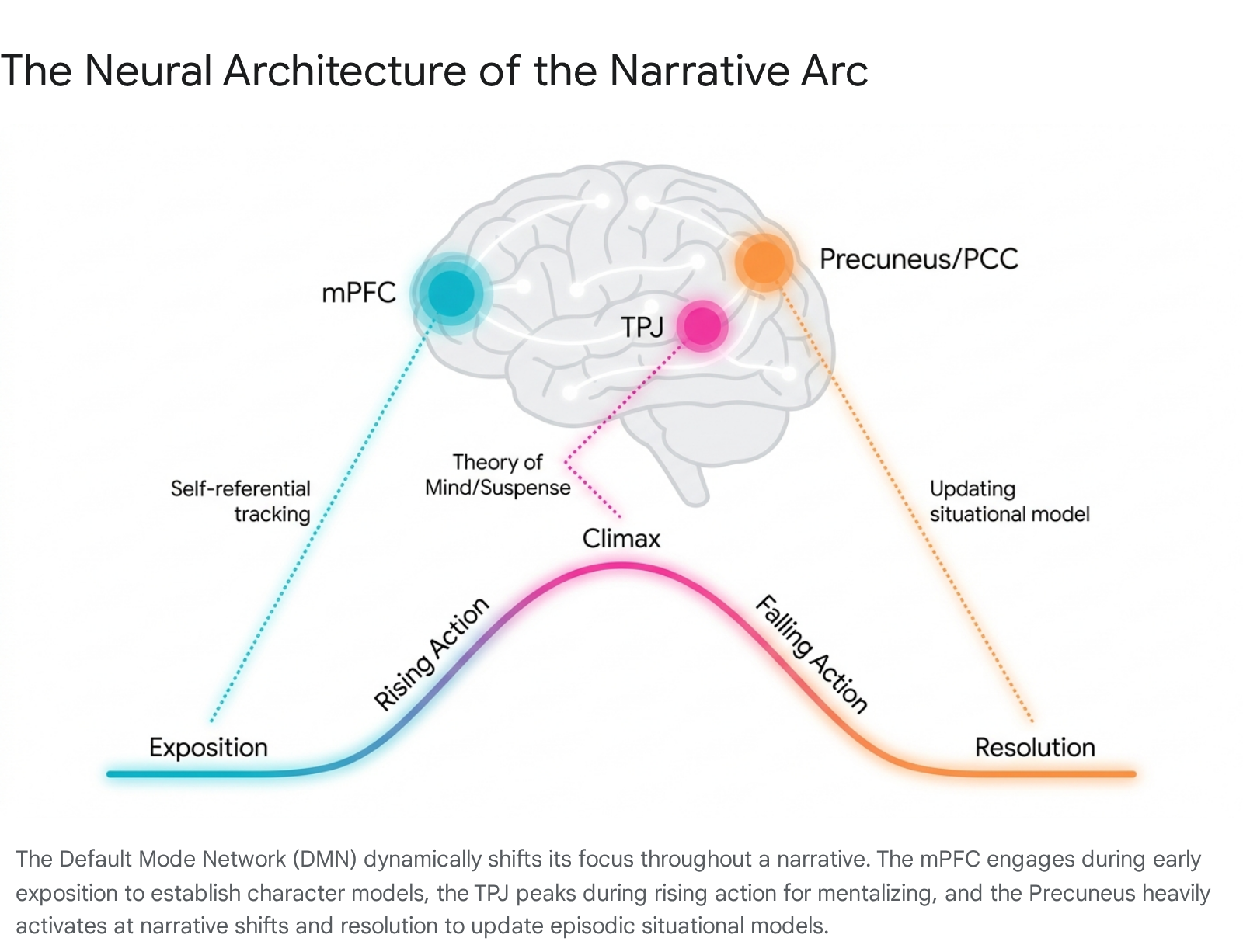
By employing dynamic Inter-Subject Correlation (dISC) - a data-driven analytical method that measures the synchronization of brain activity across multiple individuals consuming the exact same narrative - researchers have successfully isolated how specific narrative phases dictate collective neural states 142627. When a narrative is structurally sound, it forces independent brains to synchronize tightly; when the narrative breaks down or becomes incomprehensible, individual brain activity diverges into idiosyncratic patterns 127.
The following table synthesizes current neuroimaging findings, mapping traditional narrative phases to their established neurobiological and network-level correlates:
| Narrative Phase | Cognitive Function & Audience Engagement | Established Neurochemical & Network-Level Correlates |
|---|---|---|
| Exposition | Encoding the initial context, processing character introductions, and establishing the foundational mental situational model. | Moderate activation of the mPFC (establishing mentalizing baselines) and hippocampus. Early auditory/visual cortices process foundational sensory details and environmental mapping 131417. |
| Rising Action / Suspense | Heightened attention, threat anticipation, and tracking conflicting character motives. | High synchronization in the Dorsal Attention Network (DAN) and the Temporoparietal Junction (TPJ). Dopaminergic pathways engage to track predictive anticipation and reward expectation 11534. |
| Climax | Peak emotional arousal, maximal attentional capture, and total narrative transportation. | Peak Inter-Subject Correlation (ISC) across the entire sample population. Heavy activation of the amygdala, anterior insula, and sensory cortices. High cortisol release responding to acute dramatic tension 1152026. |
| Narrative Shifts (Event Boundaries) | Segmenting continuous information, traversing sudden shifts in time or location, and reassessing context. | Sharp, transient spikes in the right precuneus and posterior cingulate cortex (PCC). The brain actively purges outdated contextual information and vigorously updates the internal situational model 282930. |
| Resolution / Falling Action | Causal integration, semantic closure, and moral or conceptual evaluation of the complete story. | High DMN integration communicating with the Frontoparietal Control Network (FPN). Diminished DAN activity. The brain rests in an internally focused state to evaluate the overarching meaning and encode long-term memory 2426. |
This granular mapping demonstrates that traditional narrative structure is not an arbitrary cultural artifact, but rather an optimal sequence engineered to manipulate human attentional and memory networks. The rising action and climax force external sensory and attentional synchronization (driving ISC to its peak), while the resolution permits the DMN to take over, synthesizing the disparate data points into a cohesive, enduring conceptual memory 242627.
Cross-Cultural Narrative Neuroscience: Universal Synchronization vs. Cultural Malleability
A critical and ongoing debate in contemporary neuroscience is the extent to which narrative processing is biologically hardwired versus culturally conditioned. While the phenomenon of neural coupling suggests a universal physiological baseline for human communication, cross-cultural neuroimaging reveals substantial structural and functional malleability in brain networks, heavily dependent on non-Western versus Western cultural backgrounds.
Individualism vs. Collectivism in the Neural Connectome
The field of cultural neuroscience operates on the principle that the human brain acts as a "sponge that absorbs cultural information," structurally and functionally adapting its default pathways to align with the values of its social environment 47. Western cultures, which heavily emphasize individualism, autonomy, and analytical thinking, cultivate brains that default to object-centric processing. In these populations, fMRI studies reveal highly robust activity in the DMN - specifically the medial prefrontal cortex (mPFC) - during tasks involving self-referential narratives and focal object processing 4849.
Conversely, individuals from East Asian (collectivistic) cultures exhibit holistic cognitive biases. Their neural architecture allocates significantly more resources toward processing social context, relational backgrounds, and interpersonal interconnectedness 4931. This divergence is measurable even in basic perceptual tasks. Eye-tracking and fMRI studies show that when viewing a scene, Westerners spend more time fixating on focal objects and exhibit greater activation in object-processing regions of the ventral visual cortex. East Asians, however, focus more on the relationship between the focal object and its background, showing less isolated object-region activation 493132.
Strikingly, these cultural differences extend deeply into how narratives of the self and others are processed. When Chinese participants are asked to evaluate narratives or traits involving themselves and their mothers, there is massive neural overlap within the mPFC, indicating that their self-representation neural region does not differentiate strongly between the individual self and close family members 474933. Western participants show no such overlap; the "me" circuit hums exclusively for the self, highlighting a highly compartmentalized narrative identity 47.
These functional connectome fingerprints prove that cultural variables dramatically alter how stories are processed at the neurological level 33. A Western brain may process a protagonist's journey by analytically focusing on their internal psychological state and individual agency (recruiting intense object-processing regions and independent mPFC activation). In contrast, an East Asian brain processes the same narrative holistically, recruiting broader frontoparietal networks to evaluate the protagonist's shifting relationship with their surrounding context, family, and community 48313234. Therefore, while the fundamental mechanism of neural coupling during storytelling may be universal, the topographical distribution and focus of that coupling are deeply subjugated to cultural conditioning.
Evaluating Ecological Validity: From Sterile fMRI to Portable fNIRS
A persistent and valid critique of traditional narrative neuroscience is the issue of ecological validity - the degree to which highly constrained, sterile laboratory settings fail to represent the complexity and variability of real-world human behavior 183536.
The Limitations of Traditional fMRI
Historically, task-based fMRI studies utilized simplified, static stimuli - such as flashing grayscale faces, isolated sentences, or brief, contextless auditory cues - to prevent participant motion artifacts and maintain strict experimental control 1836. The inherent flaw in this methodology is the assumption that the neural architecture engaged by a sterile, repetitive laboratory task scales perfectly to dynamic, real-world cognitive environments 3537.
Real-world storytelling is deeply multimodal, continuous, and highly context-dependent. Studies have shown that naturalistic stimuli, such as a continuous 30-minute film or a live spoken narrative, invoke complex, cascading interactions between the DMN and sensory networks that simply do not appear when participants are shown isolated words 2737. Furthermore, the restrictive, claustrophobic, and loud environment of an MRI bore introduces profound psychological confounds, entirely stripping the storytelling experience of its natural social intimacy and shared physical environment 3538.
The Rise of Functional Near-Infrared Spectroscopy (fNIRS)
To bridge the gap between laboratory control and ecological validity, the neuroscience community has increasingly adopted Functional Near-Infrared Spectroscopy (fNIRS). fNIRS utilizes optical light applied to the scalp to measure changes in oxygenated and deoxygenated hemoglobin, offering a portable, highly motion-tolerant, and cost-effective alternative to fMRI 3940. While fNIRS sacrifices deep subcortical imaging and high spatial resolution, it allows researchers to measure cortical hemodynamics in naturalistic settings 394060.
Recent developments (2023 - 2025) have proven fNIRS to be highly capable of recording the neural correlates of narrative stimuli at the single-participant level with reliable sensitivity and consistency 414263. Because participants can wear an fNIRS cap while sitting comfortably in a natural setting, researchers can capture neural coupling and hyperscanning (simultaneously recording multiple interacting brains) during authentic, face-to-face storytelling. For instance, a 2024 study utilized fNIRS hyperscanning to evaluate STEM education, finding that storytelling-based teaching synchronized the inferior frontal gyrus (IFG) between teachers and students significantly more than traditional teaching methods, which directly correlated with improved learning outcomes 43.
Furthermore, fNIRS allows narrative neuroscience to reach populations previously excluded from fMRI research due to motion intolerance or medical contraindications. This includes infants, patients with neurodegenerative diseases, and critically brain-injured individuals (e.g., those with Disorders of Consciousness) 4144. Clinicians can now play naturalistic audio stories at the bedside while using fNIRS to detect hidden cognitive processing and evaluate potential consciousness in non-responsive patients, relying on the robust inter-subject correlations that narratives reliably produce in healthy cortices 44.
The AI Intersection: Human Brains and Large Language Models
Perhaps the most groundbreaking development in recent narrative neuroscience explores the intersection of human biological storytelling and Artificial Intelligence. As Large Language Models (LLMs) like GPT-4 and Llama have mastered the generation of syntactically flawless and compelling narratives, researchers have begun cross-analyzing AI computational architecture with human neural processing.
Mirrored Layer Processing
In landmark studies published between 2025 and 2026, researchers from Princeton University, Hebrew University, and Google Research mapped the high-precision electrocorticography data of human subjects listening to a spoken narrative against the internal processing layers of advanced LLMs 6645. The findings completely upended traditional, rule-based theories of linguistics. As the human brain processes spoken language, the transformation of incoming data unfolds over time in a sequence that remarkably parallels the tiered, hierarchical architecture of AI language models 6646.
Early human neural signals align perfectly with the early, superficial layers of AI processing, which track basic phonetic and simple word features. Conversely, later human brain responses - specifically peaking in high-level language hubs like Broca's area - align tightly with the deeper, contextual layers of the AI models, which integrate tone, deep semantics, and narrative arc 664547. Similarly, a 2026 study utilizing fNIRS demonstrated that AI prediction errors (when an LLM fails to accurately predict the next sequence of text) closely mirror the patterns of human surprise and prediction error within the human brain during story listening 25. This convergence indicates that both the biological human brain and artificial neural networks rely on continuous, fluid, statistical context-building to extract narrative meaning, rather than relying on rigid, pre-programmed linguistic building blocks 4648.
The Subconscious Neural Detection of AI Deepfakes
This fascinating intersection is further complicated by recent fNIRS and EEG studies analyzing how the human brain responds to AI-generated voices versus authentic human narrators. Behaviorally, humans are remarkably poor at consciously distinguishing high-quality "deepfake" AI speech from real human voices; in experimental settings, participants consistently fail to reliably identify the AI, even after receiving specialized training 4950.
However, neural recordings reveal a profound and somewhat unsettling divergence: the human auditory brain system subconsciously "tags" AI-generated speech differently than human speech 49. Even when the conscious mind is entirely deceived, the brain's lower-level auditory and temporal networks detect micro-acoustic anomalies - imperceptible flaws in the AI's rhythm, tone, or prosody 4951. As AI technology continues to synthesize highly familiar, emotionally resonant voices (such as a subject's own mother), fNIRS monitoring shows that these AI voices selectively trigger intense, multidimensional activation in the prefrontal and temporal cortices associated with cognitive conflict and memory processing 5152.
These findings suggest that human neurobiology is currently trapped in a rapid adaptation phase regarding synthetic narratives. Our physiological hardware correctly registers the subtle artificiality of AI storytelling, but our higher-order cognitive and decision-making systems have not yet learned how to translate those subconscious neurological cues into conscious behavioral awareness 4950.
Conclusion
The cognitive neuroscience of storytelling has matured exponentially, transitioning from an era of simplistic hormonal explanations into a highly sophisticated discipline centered on dynamic network connectivity, temporal processing, and cultural plasticity. The absolute refutation of the oxytocin "moral molecule" theory serves as a crucial milestone, reminding the scientific community that narrative transportation, empathy, and social trust are not chemically dictated switches. Rather, they are complex, context-dependent simulations processed by the Default Mode Network, heavily modulated by cultural paradigms, and utilized to continuously update our internal models of reality.
As the field pushes forward, the prioritization of ecological validity through technologies like fNIRS and hyperscanning ensures that researchers are measuring human cognition as it actually behaves in the wild, rather than in the sterile vacuum of a laboratory scanner. Simultaneously, the uncanny, structural alignment between the human brain's temporal processing of narratives and the layered architectures of generative AI suggests we are uncovering fundamental, universal mathematical principles of semantic integration. Storytelling, ultimately, is far more than an ancient cultural pastime; it is an evolutionarily refined cognitive software that successfully syncs the hardware of distributed human minds, and increasingly, the machines we build to mimic them.