
How Stories Change Our Minds
Narrative persuasion is the psychological process through which stories alter our attitudes, beliefs, and behaviors by mentally transporting us into a scenario, thereby bypassing our natural cognitive defenses against being influenced. While rigorous meta-analyses demonstrate that stories are highly effective for reducing stigma, increasing long-term memory retention, and bolstering weak arguments, recent evidence reveals they can inadvertently dilute the impact of overwhelmingly strong facts. Consequently, the most effective communication strategies do not simply abandon statistics for storytelling; rather, they embed curated, high-quality evidence within authentic, culturally relevant narratives to ensure that facts stick long after the audience finishes reading.
The Evolutionary and Psychological Roots of Storytelling
Storytelling is far more than a mechanism for entertainment; it is an evolutionary adaptation that has been a fundamental part of human culture for thousands of years. From ancient myths and folklore to modern novels and blockbuster films, narratives reach across historical and cultural boundaries to serve critical cognitive purposes 12. Evolutionary psychologists and scholars of bio-poetics argue that our attraction to storytelling is deeply rooted in our past, functioning as a cognitive tool that reinforces social norms, enhances human adaptability, and communicates vital information about survival, reproduction, and social intelligence 1.
Unlike abstract, didactic, or purely statistical communication, popular narratives engage with universal emotions and recognizable social structures. They provide a safe, simulated environment for human brains to process complex social dynamics and moral struggles 1. This evolutionary foundation explains why humans are inherently wired to organize experiences, time, and causal events into a narrative framework 3.
The Transportation-Imagery Model
To understand exactly how stories change minds in a modern context, researchers look to the psychological mechanisms triggered during narrative exposure. The foundational framework for understanding this phenomenon is the Transportation-Imagery Model, initially developed by psychologists Melanie Green and Timothy Brock in 2000 43.
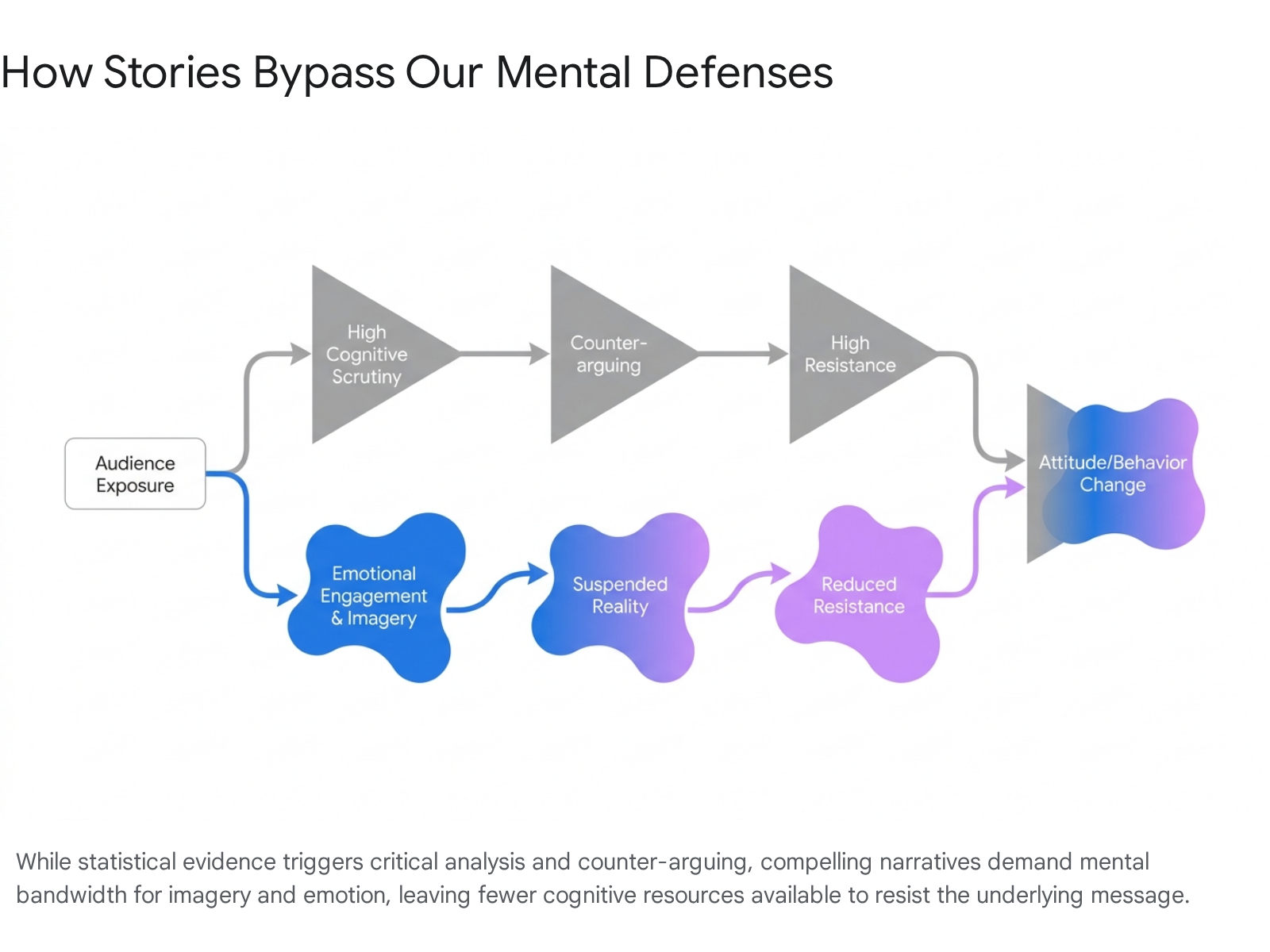
"Narrative transportation" refers to an experiential state of deep immersion. When a plot engages an audience member, their mental processes - specifically attention, emotion, and imagery - become entirely concentrated on the events occurring in the narrative 43. Much like physical travel, individuals who are fully transported into a story mentally "visit" the world created by the author and return changed by the experience, often bringing back new attitudes or beliefs 3.
This transportation results in a unique persuasive effect that operates differently from traditional dual-processing models of persuasion, such as the Elaboration Likelihood Model (ELM) 45. In traditional analytical processing, an audience member actively evaluates the strength of the arguments, scrutinizes the facts, and generates counterarguments if they disagree with the premise 56. However, when an individual is highly transported into a narrative, their cognitive effort is diverted away from analytical scrutiny. The mental bandwidth required to maintain the vivid imagination of the story world simply leaves fewer cognitive resources available to poke holes in the underlying arguments 56.
Identification and Parasocial Interaction
Beyond mere transportation, stories persuade through "identification" - the process of taking on a character's perspective, sharing their experiences, and relating to their emotions 710. Empathizing with a character allows the audience to bypass psychological reactance (the defensive feeling of being manipulated) 7.
Theoretical frameworks like the Entertainment Overcoming Resistance Model (EORM) focus heavily on how identification with characters works in harmony with narrative transportation to reduce counterarguing 8. When we empathize with a protagonist, the narrative creates a sense of "experiential closeness." Interestingly, research shows that perceived psychological similarity to a character is often a stronger driver of persuasion than objective demographic matching 3. If the audience feels psychologically aligned with the character's internal struggles, they are more likely to adopt the attitudes and beliefs the character discovers along their journey.
The Biological Debate: Does Oxytocin Drive Persuasion?
The physiological mechanisms behind narrative persuasion have generated significant scientific debate. Some researchers, most notably neuroscientist Paul Zak, argue that compelling narratives elicit the release of specific neurochemicals - chiefly oxytocin and dopamine - which drive attention and emotional commitment 8913.
According to this framework, often commercialized under the umbrella of "Immersion Neuroscience," analyzing the rhythm of the heart and other neurophysiologic outputs can predict with high accuracy whether a message will change behavior or mood 1314. Zak's research, which involved thousands of blood draws across diverse environments ranging from the Pentagon to the rainforests of Papua New Guinea, posits that a combination of psychological safety and highly engaging narratives literally changes the blood chemistry of the audience 131415. When dopamine focuses the brain's attention and oxytocin signals emotional resonance, the brain enters a state of "immersion" that deeply internalizes the message 13.
However, this biological perspective is highly contested within the broader scientific community. A comprehensive critical review by Nave, Camerer, and McCullough found severe flaws in the purported connection between oxytocin and human trust 10. The reviewers noted a widespread failure to replicate early findings regarding intranasal oxytocin, pointed out methodological flaws in how oxytocin is measured in peripheral bodily fluids (like blood plasma), and found inconsistent genetic evidence linking the hormone to human behavior 10. Consequently, while the psychological effects of narrative transportation are robustly documented, the specific claim that oxytocin is the primary "moral molecule" driving this persuasion remains a subject of intense scientific skepticism 1510.
Narratives vs. Statistics: What the Meta-Analyses Reveal
A common assumption in communication strategy is that a well-told story will always outperform dry statistics. However, an exhaustive look at recent meta-analyses reveals a much more complicated and nuanced reality 1112. The effectiveness of a story depends heavily on the context, the audience, and the outcome being measured.
The Illusion of Universal Superiority
In 2023, a massive meta-analysis by Jie Xu reviewed 50 studies encompassing 13,113 participants, directly comparing the effectiveness of narrative versus statistical evidence. The computation revealed an overall effect size of just 0.016, leading the researchers to conclude that there is no significant difference in overall persuasiveness between narrative and statistical evidence across general contexts 111219.
Yet, when researchers break down specific outcomes, a different picture emerges. A 2025 meta-analysis by Rahmani et al., which analyzed 377 findings from 77 experiments, confirmed that exposure to narrative entertainment causes audiences to significantly update their attitudes, beliefs, and behavioral intentions, and can lead to changes in actual real-world behaviors 4.
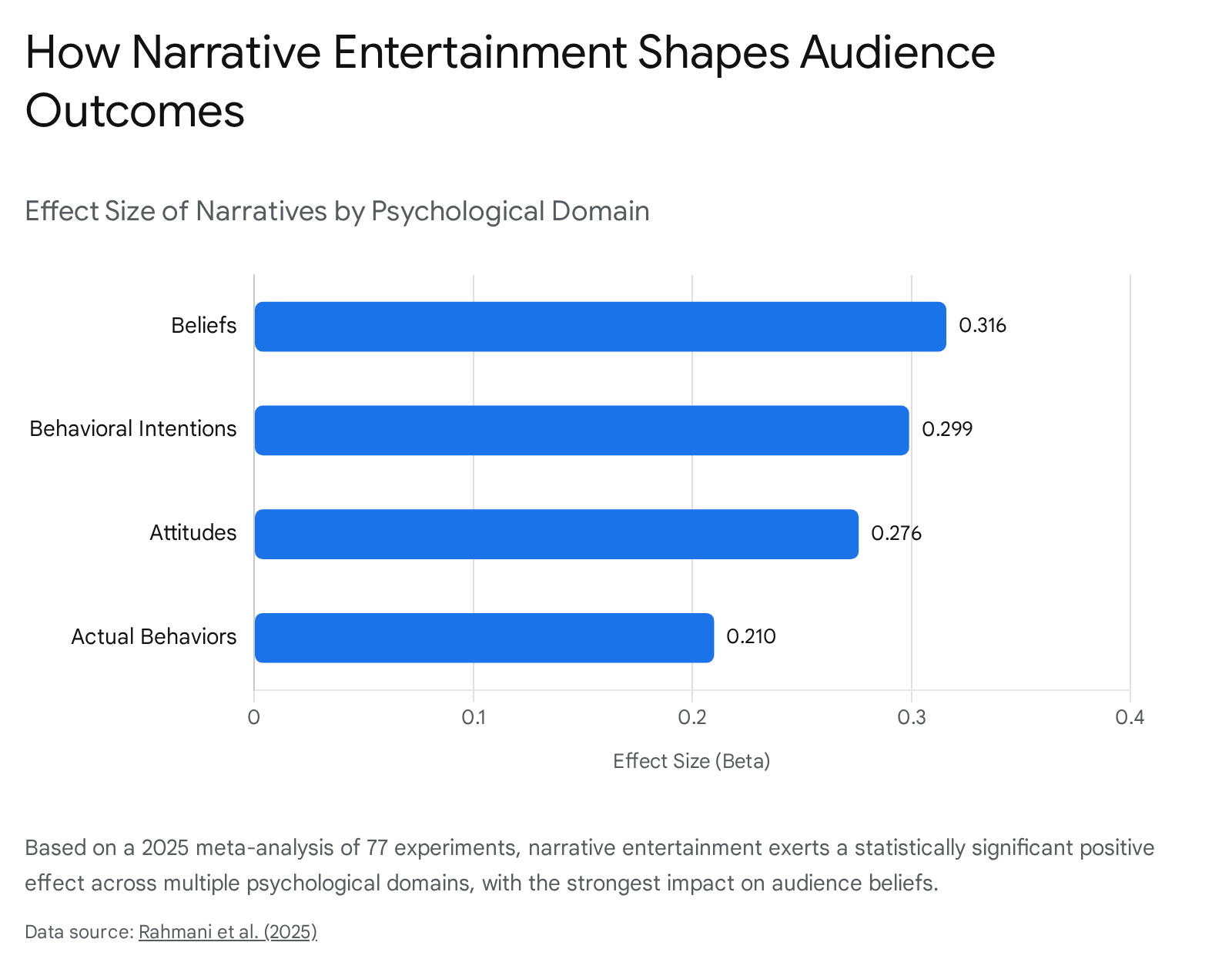
The Rahmani study highlighted that narratives are exceptionally powerful for reducing out-group stigma and prejudice - an area where cold statistics generally fail to foster empathy 4.
Comparing the Evidence: Key Meta-Analyses
To understand the boundaries of narrative persuasion, it is helpful to look at how different massive data sets categorize its efficacy.
| Author & Year | Scope & Sample Size | Key Findings on Narrative Persuasion |
|---|---|---|
| Rahmani et al. (2025) | 77 experiments (narrative entertainment) | Significant positive effects on attitudes, beliefs, intentions, and behaviors. Exceptionally effective for reducing out-group stigma. Long-term effects persist over time. 4 |
| Xu (2023) | 50 studies (13,113 participants) | No significant overall difference between stories and statistics. However, narratives are distinctly superior for health prevention behaviors and non-student samples. 1112 |
| Oschatz & Marker (2020) | 14 studies (measuring long-term effects) | Narratives outperformed non-narratives on attitudes and intentions (both immediate and delayed). No significant difference was found for altering underlying beliefs. 13 |
| Shen et al. (2015) | 25 health communication studies (N=9,330) | Small overall persuasive advantage. Audio/video narratives were significant; print narratives were not. Effective for prevention behaviors, ineffective for cessation behaviors. 1415 |
When Do Stories Work Best?
The moderating factors identified across these massive data sets dictate exactly when a communicator should reach for a story versus a statistic:
- Prevention vs. Cessation: In public health, narratives have a significant advantage over statistics when advocating for prevention behaviors (e.g., getting a mammogram or updating a vaccine). However, they are generally ineffective at persuading people to cease an addictive or established behavior, such as quitting smoking 11121415.
- Medium of Delivery: The format of the story matters deeply. Meta-analyses have shown that audio and video narratives generally produce significant persuasive effects, whereas print-based narratives sometimes struggle to exhibit a significant impact over traditional factual essays 1415.
- Intent to Persuade: The 2025 Rahmani meta-analysis found a fascinating equivalence: there is no significant difference in effect sizes between "education-first" narratives (stories deliberately engineered by policymakers or health officials to persuade) and "entertainment-first" narratives (popular movies, radio shows, or fiction that incidentally carry a message) 4. Both are highly effective, suggesting the audience's immersion in the plot matters far more than the author's hidden agenda.
The Dark Side: The "Dilution Effect" of Storytelling
While narrative transportation reduces counterarguing, this mechanism is a double-edged sword. Recent consumer psychology research by Rebecca Krause and Derek Rucker has uncovered a phenomenon known as the "dilution effect" in storytelling 616.
Because stories are highly engaging, they disrupt the brain's ability to critically evaluate facts. If a communicator is presenting a very weak argument, wrapping it in a narrative is highly beneficial. The story distracts the audience, and the enjoyment of the narrative pulls people away from generating negative thoughts, making the weak facts easier to swallow 1617.
However, if a communicator possesses incredibly strong, undeniable facts, putting them into a story can actually undermine persuasion. In experiments where participants evaluated products (such as a fictional phone brand called "Moonstone") based on factual attributes, those who received strong facts embedded in a narrative format were less persuaded than those who received the facts plainly 16. The storytelling diluted the strength of the evidence because the audience was too immersed in narrative enjoyment to process the undeniable logic of the strong arguments 16.
Therefore, stories do not just automatically bias a person to think positively; they fundamentally disrupt fact evaluation 16. If your facts are overwhelmingly strong and uncontroversial, a simple, analytical presentation may actually be superior to a story.
The Myth of the "Backfire Effect"
For years, science communicators and policymakers were haunted by the concept of the "backfire effect" - the idea that presenting people with corrective facts on deeply held, polarized beliefs would actually cause them to double down and believe their original, incorrect views even more strongly 1819. This concept entered the popular consciousness following a 2010 study by Brendan Nyhan and Jason Reifler, which found that correcting beliefs about the presence of weapons of mass destruction in Iraq caused certain partisans to hold their erroneous beliefs more tightly 182021.
However, the backfire effect has largely been proven to be a myth. In 2019, researchers Thomas Wood and Ethan Porter published "The Elusive Backfire Effect." They conducted massive experiments with over 10,000 participants testing 52 highly polarized issues chosen specifically because they were theoretically conducive to backfire 1829. They found absolutely no evidence of the effect on a single issue. The original researchers subsequently collaborated with Wood and Porter and conceded that factual backfire is exceptionally rare 1829. By and large, human beings do update their factual beliefs when presented with accurate corrections 181929.
If Facts Work, Why Do Misperceptions Persist?
The issue is not that facts backfire; the issue is that facts decay. While a well-presented statistic will successfully correct a misperception in the short term, that correction is often quickly forgotten or overwhelmed by louder, ongoing narratives in the cultural zeitgeist 18.
This is where storytelling becomes vital for truth-tellers. Facts alone arrive at the door and find it bolted; the story is how you get invited inside 18. Because stories increase retention and memory recall significantly compared to bare statistics (some research suggests up to 22 times more recall), narrative is the necessary vehicle to carry the truth so that it sticks long after the initial exposure 31822.
Evaluating Evidence Strength in Narratives
When audiences are presented with claims, their ability to assess the "evidence strength" - a combination of how helpful and relevant the evidence is - plays a major role in their ultimate judgment 23.
Research into misinformation and news assessment shows that providing individuals with "curated evidence" (a narrative expert summary explaining the context of a claim) significantly improves the aggregate accuracy of their veracity judgments by roughly 6% to 7% compared to when they are given uncurated, raw data or left entirely unsupported 23. When evidence strength is low, people rely on heuristics and simple biases, but strong, curated narrative evidence helps them engage in centralized, analytical processing 23.
Furthermore, scientific literacy heavily dictates how individuals interact with narrative evidence, particularly regarding conspiracies. A compelling story can easily override psychological resistance and foster belief in unverified theories 24. However, individuals with high scientific literacy remain sensitive to the strength of the evidence within the story; they can differentiate between a causal relationship and a mere correlation, attenuating the persuasive power of a false narrative 24. For those with low scientific literacy, the strength of the evidence matters very little if the story itself is engaging 24.
Cross-Cultural Nuances in Narrative Persuasion
Narrative persuasion is not a monolithic, universal mechanism; it is heavily moderated by cultural and demographic factors.
A 2024 meta-analysis encompassing 133 samples across 22 countries (N=29,338) explored how different cultural frameworks respond to varying persuasive appeals 12. The researchers found that affective appeals (messages heavily reliant on emotion and narrative) are significantly more effective in collectivistic societies 12. In contrast, individualistic societies are equally responsive to both affective and cognitive (analytical, fact-based) appeals 12.
Additionally, the way audiences process narrative transportation differs by culture. A comparative study between US and Chinese participants reading narratives about depression found that for American readers, narrative transportation was distinctly incompatible with counterarguing (if they were transported, they stopped evaluating the arguments critically) 33. However, for Chinese readers, this incompatibility was not present, suggesting that narrative immersion does not automatically turn off critical evaluation in all cultural contexts 33.
Identity and representation also matter deeply. Health communication meta-analyses focusing on marginalized groups, such as African American women, show that narratives are particularly effective when characters are culturally representative 252627. Personal anecdotes and lived accounts establish cultural connections and humanize abstract health risks far better than statistical evidence generated by dominant cultural institutions, which can often be perceived as disingenuous or irrelevant 2528.
Actionable Strategies for Strategic Storytelling
Based on the accumulated psychological data and meta-analyses, professionals in advocacy, marketing, and public health should adhere to several evidence-based guidelines when attempting to persuade through story:
- "Open Hot": The human brain naturally defaults to an idle state. A slow, polite introduction or a long backstory allows the audience's attention to drift. Instead, start persuasive communications with high emotional stakes or a vital moment of conflict to immediately spike attention and trigger neurochemical engagement 913.
- Embrace Imperfection: Highly polished, overly edited stories often fail to persuade because they trigger "persuasion knowledge" - the audience realizes they are being marketed to, which raises psychological reactance 522. Leaving in the struggles, awkward pauses, or genuine flaws increases authenticity. Real people and real processes are stronger assets than perfect corporate copy 223839.
- Use the "Curated Evidence" Approach: Do not rely on story alone, nor on facts alone. Weave clear, curated data into the narrative structure. Stories spark the emotional catalyst required for action, while the embedded data justifies the emotional decision to the analytical parts of the brain 232941.
- Avoid the Dilution Effect: Evaluate the strength of your facts before writing your narrative. If you possess undeniable, overwhelmingly strong data, present it cleanly and analytically. Do not let a highly engaging story distract the audience from the sheer weight of your evidence 616.
- Prioritize First-Person Voices: In spaces like climate change or health advocacy, manipulating the narrative voice can modulate impact. Studies show that first-person narratives significantly increase identification with the protagonist, which in turn bridges psychological distance and strengthens behavioral intentions better than third-person accounts 3031.
Bottom line
Narrative persuasion is a scientifically validated tool that changes attitudes and behaviors by transporting audiences into a story, thereby lowering their psychological resistance to the message. While stories are vastly superior to statistics for reducing stigma, increasing long-term memory retention, and bolstering weak arguments, they can inadvertently distract audiences from evaluating overwhelmingly strong facts. The most effective communication strategies do not choose between stories and statistics; they curate strong evidence inside authentic, culturally relevant narratives to ensure that facts do not just change minds momentarily, but stick long-term.