
Cognitive processing of rhetorical devices in public speaking
The efficacy of public speaking is traditionally analyzed through the disciplines of literary criticism, linguistics, and communication theory. However, the persuasive power of rhetorical devices - specifically anaphora, tricolon, antithesis, and chiasmus - is fundamentally rooted in cognitive science, psycholinguistics, and neurobiology. These linguistic structures operate not merely as decorative phonetic flourishes but as highly engineered syntactic patterns that systematically exploit the human brain's predictive processing capabilities, memory encoding limitations, and rhythmic synchronization pathways. By aligning linguistic input with the neurological constraints of human working memory and affective processing networks, rhetorical devices optimize message reception, minimize extraneous cognitive load, and significantly enhance the longevity and retrieval of memory traces.
Neural Mechanisms of Rhythmic and Syntactic Processing
The cognitive reception of oratorical devices relies on the brain's ability to process acoustic rhythm and abstract syntax as interrelated, mutually reinforcing streams of information. Emerging neuroimaging data reveals a profound overlap in the neural architectures responsible for decoding both musical rhythm and linguistic syntax, providing a biological basis for why highly rhythmic rhetorical speech is processed with greater efficiency and retention.
Predictive Processing and Cortical Prediction Errors
Contemporary neuroscience increasingly views the brain as a predictive engine. Predictive processing theorizes that the sensory cortex continuously generates top-down predictions regarding incoming sensory inputs, refining neuronal responses by highlighting prediction errors 12. Within this framework, key computational primitives such as stimulus adaptation, dendritic computation, and excitatory/inhibitory balances are central to how the brain infers the flow of sensory information based on learned regularities 12.
When listening to an orator, the brain processes both explicit and implicit signals. Early implicit preattentive signals precede the conscious detection of unexpected stimuli 2. When a speaker employs highly structured, predictable rhetorical devices, they provide a reliable top-down predictive model for the listener. This reduces the magnitude of prediction error signals - the mismatch between actual and predicted information 22. By minimizing the cognitive resources required to resolve bottom-up sensory prediction errors, the orator frees the listener's cognitive capacity. This surplus capacity can then be redirected toward deeper semantic analysis and emotional engagement with the message's core content.
Sensorimotor Networks in Syntactic Comprehension
A comprehensive activation likelihood estimate (ALE) meta-analysis of neuroimaging studies demonstrates that rhythmic processing and syntactic processing are mediated by shared neural resources 34. The overlapping neural substrates utilized during both musical rhythm (beat, meter) and linguistic syntax (merge movement, reanalysis) include the left inferior frontal gyrus (LIFG, particularly the pars opercularis), the left supplementary motor area (SMA), and the bilateral insula 3.
These regions constitute a sensorimotor network that governs temporal hierarchy processing and predictive coding. Specifically, musical rhythm engages a bilateral network encompassing the superior temporal gyri, temporoparietal junction, intraparietal lobule, and putamen, while syntax predominantly recruits the left sensorimotor network, including the posterior superior temporal gyrus and premotor cortex 3. When an orator utilizes rhythmic devices, the auditory input engages these motor and premotor areas even in the absence of overt physical movement 56. The mental rehearsal of rhythms, facilitated by the activation of Broca's area within the language network, allows the listener to organize syntactic patterns effectively, mirroring the cognitive processes used by musicians during improvisation 6.
Delta-Band Oscillations and Speech Stream Synchronization
The neurological efficiency of rhythmic rhetoric is further explicated by electrophysiological synchronization. During speech comprehension, delta-band neural oscillations (typically 1 - 4 Hz) in the auditory cortex synchronize to the envelope of the incoming speech stream 7. This phase-locking phenomenon is not merely an automatic reaction to acoustic features; it serves a functional purpose by implicitly aligning periods of high neural excitability with moments of high syntactic information content 7.
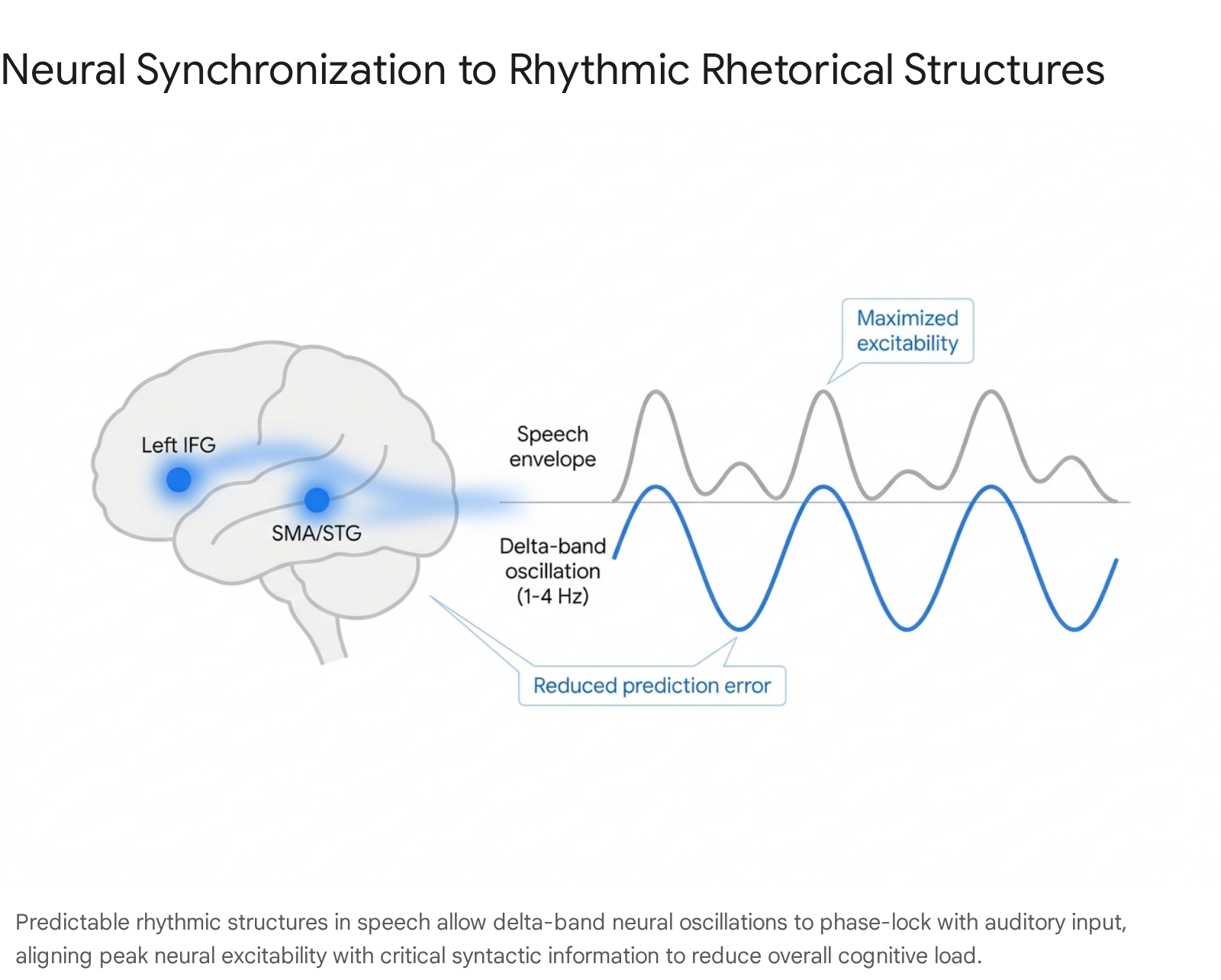
As a listener incrementally computes syntactic structure, each incoming word adds syntactic information, quantified as "syntactic surprisal" (the unexpectedness of a word's syntactic category) 7. Synchronization ensures that excitable neural phases are in optimal alignment with this syntactic information. Behavioral evidence confirms that detection responses to morphosyntactic violations increase with decreasing syntactic information content, a metric that significantly correlates with synchronized delta-band phase 7. Thus, the rhythmic patterns created by oratorical devices act as a sentence segmentation cue, guiding the syntactic parser through the processing of larger information units and implicitly aligning neural resources with the informativeness of the stimulus 78.
The Role of Prosody in Structural Disambiguation
Prosody - the melodic and rhythmic patterning in speech, including pitch, loudness, duration, and pauses - transmits critical information beyond the lexical items themselves 10. Brain imaging utilizing magnetoencephalography (MEG) and electroencephalography (EEG) demonstrates that prosodic boundaries affect neural markers of syntactic disambiguation, modulating evoked responses to assist in processing complex or "garden path" sentences 89.
The brain regions responsive to prosody are located on the lateral temporal surface bilaterally and in the frontal lobe, distinct from primary pitch-perception areas and general cognitive demand regions, but partially overlapping with the core language network and areas responsible for processing dynamic facial expressions 10. The right superior temporal region, particularly the planum temporale, responds more strongly to slow prosodic modulations and speech melody than the left hemisphere 10. When a speaker employs a rhetorical device, the temporal co-occurrence of acoustic prosodic cues and higher-level abstract linguistic features results in a syntactic representational gain, boosting the neural processing of the underlying meaning 9.
Cognitive Architecture of Specific Rhetorical Devices
While rhetorical devices collectively aim to increase message salience and persuasiveness, they operate by manipulating different variables within the human cognitive architecture. The distinct neuro-cognitive profiles of anaphora, tricolon, antithesis, and chiasmus dictate their respective impacts on working memory, spatial attention, and semantic encoding.
Anaphora, Syntactic Priming, and Memory Access
Anaphora constitutes the repetition of a word or phrase at the beginning of successive phrases, clauses, or lines 1311. Cognitively, anaphora functions through a mechanism analogous to syntactic priming and structural expectation. When a grammatical structure is parsed, the neural pathways utilized for that specific operation remain residually active. Upon immediate repetition of the initial phrase, the brain bypasses the need to compute the syntactic relationship de novo, as the structural template is already primed within the left inferior frontal gyrus (LIFG) 12.
In neuro-linguistic processing, anaphora engages distributed semantic hub regions, including the left angular gyrus, anterior temporal lobe (ATL), and posterior cingulate cortex 13. Studies examining backward anaphora and related dependencies demonstrate that repeated structural cues evoke multiple representations that must be integrated, relying heavily on brain regions related to spatial attention and perceptual integration, such as the precuneus 17. Eye-tracking experiments comparing the processing of subject-verb agreement to reflexive anaphors reveal that while agreement resolution displays clear intrusion effects from illicit noun phrases, reflexives show no such intrusion effect from illicit antecedents 18. This indicates that the memory retrieval mechanism for anaphora relies primarily on syntactic information to guide antecedent retrieval, in contrast to the mixed morphological and syntactic cues used in other dependencies 18. By rendering the beginning of the sentence highly predictable, anaphora shifts the listener's attentional resources aggressively toward the novel, variable information at the end of the clause, facilitating emotional and semantic buildup 19.
Cognitive Limits and Semantic Satiation
While anaphora and epiphora (repetition at the end of clauses) are potent tools for emphasis, their deployment carries inherent cognitive risks, specifically the onset of semantic satiation. Coined by Leon Jakobovits James in 1962, semantic satiation is a psychological phenomenon wherein rapid or prolonged repetition causes a word or phrase to temporarily lose its meaning, causing the listener to perceive the speech as repeated, meaningless sounds 14.
Prior to 1962, this phenomenon was observed under various nomenclatures, including verbal transformation, reactive inhibition, cortical inhibition, and lapse of meaning 14. From a neurobiological perspective, rapid repetition causes both the peripheral sensorimotor activity and central neural activation to fire continuously, inducing reactive inhibition. This results in a reduction in the intensity of the neural activity with each subsequent repetition 14. Some studies propose that the true locus of this phenomenon may be presemantic rather than semantic adaptation 14. In practical oratory, if a speaker fails to balance the repetitive anchor of an anaphora with sufficiently varied and semantically robust concluding clauses, the audience will experience cognitive fatigue, and the rhetorical device will cease to convey conceptual meaning, devolving into mere phonetic noise 1421.
Tricolon and Cognitive Information Processing Limitations
The tricolon is a rhetorical figure characterized by the repetition of a parallel grammatical construction exactly three times (e.g., "Life, Liberty and the pursuit of Happiness") 151617. The elements need not be of identical length; frequently, the third element is longer or heavier, a technique related to gradatio or climax 1116. The efficacy of the tricolon is inextricably linked to the limits of human working memory.
According to the Cognitive Information Processing (CIP) theory, originally formulated via the Atkinson-Shiffrin multi-store model (1968), human memory processing involves three distinct stages: sensory memory, short-term (working) memory, and long-term memory 1819. Environmental stimuli enter sensory memory for mere seconds before being filtered by attention into short-term memory, which functions as a computational workbench 18. While early psychological models by George Miller (1956) posited that short-term memory could hold seven items (plus or minus two), contemporary cognitive science suggests that the optimal limit for immediate, un-rehearsed conceptual chunking is considerably lower 19.
The tricolon aligns perfectly with this cognitive limitation, packaging complex, multi-faceted arguments into a single, highly digestible tripartite chunk. The number three provides a psychological sense of completeness, wholeness, and roundness 16. When the third element is structurally extended, it creates a slight prediction error that spikes arousal and signals the conclusion of the thematic unit. This specific pattern aids in moving the information from maintenance rehearsal (simple repetition) into elaborative rehearsal, actively connecting the new tripartite structure to existing knowledge bases and facilitating transfer into permanent long-term storage 18.
Antithesis and Contrastive Syntactic Parsing
Antithesis involves the direct opposition or contrast of ideas or words within a balanced or parallel grammatical construction 111527. Cognitively, antithesis forces the brain to engage in rapid contrastive prediction.
Functional magnetic resonance imaging (fMRI) studies utilizing multi-voxel pattern analysis (MVPA) have demonstrated that the brain is capable of actively distinguishing between closely related, abstract grammatical patterns even when the propositional meaning and vocabulary are normalized 20. When discriminating complex syntactic relations, the union of language-relevant areas in the left hemisphere - specifically the anterior and posterior regions of BA22, BA44/45, and BA47 - yields classification accuracy significantly above chance 20. The activation of BA47, a region heavily implicated in semantic processing, supports the claim that contrasting syntactic constructions are distinguished semantically at a fundamental neurological level 20.
Antithesis reduces overall cognitive load by presenting a simplified binary framework. Instead of requiring the listener to evaluate a concept across an ambiguous, continuous spectrum, antithesis creates a discrete, localized boundary (e.g., "Ask not what your country can do for you - ask what you can do for your country") 2721. This binary opposition simplifies semantic mapping, allowing the brain to process complex philosophical or political differences utilizing the rapid, low-latency pathways typically reserved for basic perceptual discrimination.
Chiasmus, Structural Inversion, and Dual-Task Processing
Chiasmus, and its strict lexical variant antimetabole, involves the reversed repetition of grammatical structures to form an A-B-B-A pattern 131122. While simple chiasmus reverses grammatical structure, antimetabole executes precise reversals of identical vocabulary elements 1722. This represents one of the most cognitively demanding primary rhetorical devices.
To process a chiasmus successfully, the listener's working memory must actively hold the initial clause (A-B) within the "phonological loop" while simultaneously receiving the subsequent clause, recognizing the structural inversion, and computing the synthesized meaning of the reversed (B-A) relationship 23. This necessitates continuous dual-tasking within the prefrontal cortex. The neurobiological basis of dual-task performance requires higher-order cognitive control to integrate distinct streams of information simultaneously 24.
During tasks requiring the judgment of structural dependencies and syntactic rules, fMRI mapping indicates that Broca's area demonstrates heightened, sustained activity 25. When processing impossible grammatical rules, activity in this region diminishes, suggesting Broca's area is naturally predisposed for specific rule-bound syntactic sorting 25. The cognitive "extra work" required to resolve the syntactic inversion of a chiasmus mimics a puzzle-solving mechanism 26. According to the graded salience hypothesis, readers use distinct cognitive processes for literal versus metaphorical meanings; unfamiliar or inverted figurative language requires the brain to pause and compute the non-literal intent 26. When the listener successfully maps the reversed syntax onto the underlying semantics, the cognitive resolution triggers a mild dopaminergic reward response. This localized "aha" moment ensures the phrase is embedded deeply into long-term memory 26.
Comparative Matrix of Rhetorical Mechanisms
The following table synthesizes the distinct structural parameters, primary neural correlates, and cognitive processing effects of the four primary rhetorical devices.
| Rhetorical Device | Structural Pattern | Primary Neural Correlates | Cognitive Function & Processing Effect |
|---|---|---|---|
| Anaphora | Repetition at the beginning of successive phrases (A-x, A-y, A-z). | Left IFG, Posterior MTG, SMA, Angular Gyrus 31213 | Decreases syntactic processing load via structural priming; aggressively shifts attention to novel end-clause semantics. |
| Tricolon | Three parallel elements, often ascending in length (A, B, C). | Prefrontal Cortex, Hippocampus (encoding) 161819 | Optimizes working memory chunking limits; creates an expectation of conceptual completeness to aid elaborative rehearsal. |
| Antithesis | Juxtaposition of opposing ideas in parallel syntax (A vs. B). | BA47, Anterior & Posterior BA22 20 | Simplifies semantic evaluation by enforcing a binary heuristic, reducing ambiguous cognitive load and enabling rapid discrimination. |
| Chiasmus / Antimetabole | Reversed repetition of grammatical structure or words (A-B-B-A). | Broca's Area (BA44/45), Phonological Loop 2325 | Demands high working-memory retention for dual-task syntactic resolution, enhancing deep semantic encoding via cognitive puzzle-solving. |
Emotional Arousal, Valence, and Memory Encoding
The overarching objective of oratorical rhetoric is not merely to be heard, but to be retained. For a message to successfully transition from short-term working memory into permanent long-term storage, it must undergo robust encoding 1819. Rhetorical devices facilitate this transition both through their structural predictability and by systematically modulating the audience's emotional arousal and valence.
Dual-Process Models of Episodic Memory
The Levels of Processing (LOP) model asserts that memory retention depends entirely on the depth of mental engagement during the initial encoding phase 35. Processing occurs along a continuous scale: shallow sensory/structural analysis (encoding physical qualities), intermediate phonological analysis, and deep semantic analysis 35. Shallow processing yields rapid memory decay, whereas deep, elaborative processing yields durable memory traces 1835.
Rhetorical devices artificially enforce deep processing. Dual-process conceptions of episodic memory distinguish between recollective retrieval (mental reinstatement of contextual features) and nonrecollective retrieval (feelings of familiarity without specific context) 2728. Empirical research evaluating the effects of emotion on recall demonstrates that valenced words (both positive and negative) increase reconstruction and nonrecollective retrieval relative to neutral words 2728. Positive valence generally increases recollective retrieval compared to negative valence, establishing that emotional valence acts as a conceptual gist that fundamentally alters memory accuracy 2728.
Augmented Elaboration Likelihood and Attention
The Augmented Elaboration Likelihood Model (A-ELM) posits that the linguistic presentation of information dictates audience attention, which in turn acts as a significant mediator for affective (feelings) and cognitive (thoughts) elaborations 29. Under this framework, higher levels of captured attention directly result in deeper cognitive elaboration.
The A-ELM framework suggests that nonnarrative evidence and the use of tropes or figures of speech attract significantly more attention in low-involvement situations compared to literal texts 29. By framing an argument within an unexpected metaphorical antithesis or a structurally striking tricolon, the orator forces the listener to resolve a syntactic or semantic anomaly. This shifts the processing modality from automatic, shallow observation to effortful, deep cognitive engagement 1929.
Arousal-Mediated Recall Enhancement
Beyond valence and structural depth, emotional arousal is a primary driver of memory consolidation. Prevailing neurobiological theories propose that events inducing heightened arousal trigger the release of norepinephrine in the amygdala 30. The amygdala subsequently interacts directly with memory-related regions, most prominently the hippocampus, to prioritize the encoding of motivationally significant experiences - such as potential threats or rewards 30.
Human fMRI studies corroborate that the emotional enhancement of memory is strongly associated with increased amygdala-hippocampal connectivity 30. Experimental paradigms utilizing lexical decision tasks and free recall consistently demonstrate that emotionally arousing words yield higher repetition priming magnitudes than neutral stimuli 31. For instance, studies show faster reaction times and greater priming for highly-arousing taboo words relative to neutral words, while low-arousing negative words show no difference in priming magnitude 31.
Furthermore, emotional arousal amplifies the effects of long-term memory in guiding spatial attention, modulating the processing of high versus low salient stimuli 32. Consequently, when a rhetorical device builds an emotional crescendo, the resulting spike in affective arousal physically alters the encoding priority of the information in the hippocampus 3032. High-arousal rhetorical moments bypass slower, purely logical evaluation networks, embedding durable memory traces that are deeply grounded in the physiological experience of the speech 3042.
Audience Skepticism and the Persuasion Knowledge Model
While the cognitive mechanics of rhetoric are highly effective in controlled environments, they do not operate unilaterally upon passive subjects. Human audiences possess sophisticated meta-cognitive defense mechanisms. When an orator's deployment of rhetorical devices crosses the threshold from perceived authenticity into calculated manipulation, the audience's reception strategy shifts dramatically, often neutralizing the persuasive intent.
The Change-of-Meaning Principle
The Persuasion Knowledge Model (PKM), developed by Friestad and Wright (1994), provides the foundational theoretical framework for understanding audience resistance 334445. According to PKM, targets of persuasion are not passive receptacles; they are active participants who continuously develop and refine intuitive theories about the tactics marketing agents and speakers use to influence them 4445. This persuasion knowledge encompasses beliefs about marketers' motives, the appropriateness of specific tactics, and the psychological mediators of persuasion 44.
Persuasion knowledge develops throughout an individual's lifetime via cultural learning and observation 45. A core tenet of the PKM is the "change-of-meaning" principle. When an audience initially encounters a message, they may process it at face value. However, once the listener recognizes an agent's action as a deliberate persuasion tactic - such as a heavily dramatized anaphora or a statistically hollow tricolon - their perception of the entire episode changes 3345. The listener reclassifies the utterance from an authentic expression of reality into a calculated "persuasion attempt" 3345.
Cognitive Reactance and Rhetorical Coping Behaviors
Once a persuasion attempt is identified, the cognitive processing of the speech alters fundamentally. The audience shifts their cognitive resources away from the deep semantic encoding of the topic knowledge and redirects them toward scrutinizing the agent knowledge - specifically, evaluating the speaker's motives, competence, and credibility (ethos) 444534.
This recognition often manifests in distinct coping behaviors: skepticism, reactance, and inertia 35. Skepticism concentrates on ethos and logos, prompting the listener to doubt the credibility of the evidence and the logic of the argument 35. Reactance is an active, negative defensive reaction aimed at preserving individual autonomy against perceived manipulation or coercion 35. Inertia occurs when the target simply withdraws attention from the message entirely 35.
Ethical Constraints and Cross-Source Fusion
The distinction between ethical persuasion and manipulation lies in the speaker's intentions, transparency, and the balance of rhetorical appeals 4849. Ethical persuasion utilizes ethos (credibility), pathos (emotion), and logos (logic) in balanced proportions, inviting open dialogue and critical thinking 3449. Manipulation, conversely, often overloads a single channel - typically pathos (Emotional Overload) - to bypass rational thought and exploit audience vulnerabilities 4849.
Recent studies in propaganda and disinformation emphasize the concept of "cross-source fusion," wherein structural rhetorical forms (repetition, emotional tone, moral framing) are utilized to simulate legitimacy without overt deception 50. Because cognitive biases lead individuals to prioritize emotional tone and structural familiarity over factual accuracy, rhetorical form can engineer belief independently of factual truth 50. However, if an audience detects this imbalance - if they perceive that rhetorical devices are being used to mask a lack of substantive evidence (Fake Ethos) - the resulting cognitive dissonance triggers high skepticism, destroying the speaker's credibility and rendering the speech ineffective 4836. Therefore, the successful application of rhetorical devices requires precise calibration to enhance the logical argument without triggering the audience's persuasion knowledge alarms 49.
Cross-Cultural Psycholinguistics and Universal Constraints
Historically, cognitive science and psycholinguistics have struggled with the "WEIRD" challenge - the disproportionate reliance on Western, Educated, Industrialized, Rich, and Democratic populations to establish universal laws of human cognition 3738. To accurately ascertain how rhetorical devices function cognitively, it is necessary to delineate which mechanisms are biologically universal and which are culturally constructed paradigms of persuasion.
The WEIRD Challenge in Cognitive Science
For decades, the "Newtonian principle" pervaded cognitive research, assuming that findings derived from WEIRD subjects could be extrapolated to illuminate universal features of the human psychological nature 3738. However, cross-cultural studies consistently demonstrate that human behavior exhibits a complex pattern of within-group similarity and between-group difference 38.
Linguistic typology and cross-linguistic studies are essential to separating universal mechanisms from language-specific artifacts 3940. Different languages and cultures place varying demands on structural uniqueness, memory, and speech planning 39. Therefore, the cognitive science of culture requires researchers to hypothesize explicitly whether a given cognitive feature or rhetorical preference emerges from universal neurobiology or group-specific environments 3741.
Classical Chinese Rhetorical Traditions
Rhetorical traditions outside the Greco-Roman lineage emphasize vastly different communicative functions, reflecting distinct epistemologies. Classical Chinese rhetoric, which emerged around 500 B.C.E., is deeply rooted in the philosophical texts of the Shang and Zhou dynasties 4243. Rather than prioritizing aggressive persuasion or purely logical dialectics, the traditions established by Confucius, Mencius, and Xunzi characterize rhetoric through a humanistic lens, emphasizing the moral character of the speaker, the rectification of names (proper language use based on social hierarchy), and the pursuit of societal harmony 4243.
In ancient Chinese contexts, persuasion was termed shui, explanation as ming, and argumentation as bian 43. Daoist rhetoric, represented by Laozi and Zhuangzi, introduced the core concept of wuwei (non-action), seeking equilibrium and avoiding overexertion or aggressive interference in communication 42. Consequently, Chinese rhetorical practices value hanxu (implicitness) and rely heavily on parallelism 44. Chinese poets and orators frequently juxtapose contrasting natural and moral images in successive lines, relying on the audience's shared cultural schemas and cognitive models to decode the deeper, unspoken truths without resorting to blunt argumentative force 4445.
Arabic Rhetoric and Syntactical Stylistics
The Arabic rhetorical tradition (al-balagha) provides another distinct paradigm, characterized by a highly systematic categorization of linguistic embellishments ('ilm al-badi) and syntactical styling ('ilm al-ma'ani) 46. The tradition is historically intertwined with the study of the Qur'an, which is noted for its unparalleled frequency of rhetorical features, including dense alliteration, cadenced assonance, and complex allegorical analogies 47.
Arabic syntax naturally utilizes coordinating conjunctions (e.g., wa, thumma) resulting in a high frequency of polysyndeton, which is considered standard grammar rather than a distinct rhetorical choice 15. However, Arabic orators frequently employ parataxis and dense semantic parallelism to achieve aesthetic balance and emotional force 1548. Devices such as explicit and implicit reference, semantic ambiguity, and highly structured antithesis are utilized at frequencies much higher than in typical Western discourse 154648. These structures demand complex cognitive inferences from the listener, synthesizing multiple overlapping meanings simultaneously 48.
Reconciling Cultural Variance with Cognitive Universality
Despite profound differences in aesthetic preference and structural typology, the underlying cognitive bottlenecks governing speech reception remain universal 3949. Whether processing an English tricolon, a Chinese implicit parallel, or an Arabic paratactic antithesis, all human brains are subject to identical working memory capacity limits 19.
Furthermore, the necessity for delta-band phase-locking in auditory processing 7, the reliance on the left sensorimotor network for syntactic parsing 3, and the interaction between the amygdala and hippocampus during emotional encoding 30 are biological constants. Cross-linguistic research indicates that languages draw on the same mental and neural machinery; differences in rhetorical structure reflect a cultural cost-benefit trade-off among universal mechanisms for learning, perception, attention, and motor planning 39. The aesthetic forms of rhetoric are deeply cultural, but the neurological mechanics of how those forms capture attention, ease syntactic processing, and imprint upon memory operate on universal biological principles 394149.
Applied Rhetorical Analysis: Nelson Mandela
The synthesis of these universal cognitive mechanisms and ethical constraints is vividly demonstrated in the oratory of Nelson Mandela, particularly his pivotal 1964 "I am Prepared to Die" speech delivered during the Rivonia Trial 50.
Facing capital punishment, Mandela required a rhetorical strategy that could bypass the immediate hostility of the courtroom and encode his political philosophy deeply into the global public consciousness. His speech is recognized for its passionate, resolute, and defiant tone, centered on universal themes of freedom, equality, and justice 50.
To achieve this, Mandela utilized dense anaphoric repetition to construct a sense of inevitability and urgency 50. By repeatedly opening clauses with standard, predictable markers (e.g., "I salute...", "I pay tribute..."), he effectively primed his audience's syntactic processing pathways 1951. This reduced the audience's cognitive load, allowing their working memory resources to focus entirely on the substantive moral weight of his conclusion: "It is an ideal for which I am prepared to die" 50.
Furthermore, his speeches heavily feature inductive reasoning, metaphors (e.g., "a long and lonely night"), and parallel tricolons (e.g., "let there be justice, peace, work, bread, and water for all") 5067. This structural parallelism created rhythmic synchrony, chunking complex socio-political demands into easily encoded units 67. Crucially, Mandela successfully navigated the constraints of the Persuasion Knowledge Model. He balanced pathos and logos meticulously, ensuring that his high-arousal emotional appeals were anchored in substantive historical context and logical argumentation 194967. By maintaining high transparency and ethical alignment, he engaged the affective encoding pathways of his audience without triggering the defensive reactance associated with manipulative persuasion.
Conclusion
Rhetorical devices are highly evolved linguistic tools that interface directly with the biological constraints and functional capabilities of human neurocognition. Rhythmic and repetitive structures, such as anaphora and the tricolon, exploit neural oscillation phase-locking and the chunking limitations of the Atkinson-Shiffrin working memory model. These devices reduce syntactic processing load and prediction errors, facilitating robust semantic encoding. Conversely, structural manipulations like antithesis and chiasmus force cognitive dual-tasking within Broca's area and enable rapid contrastive prediction, resulting in deeper, effortful processing that firmly anchors concepts in long-term memory.
While the aesthetic presentation and density of these devices vary significantly across cultural paradigms - ranging from the emotive, paratactic repetition of Arabic oratory to the implicit, harmony-driven parallelism of classical Chinese traditions - the underlying neurological processing mechanisms remain a human universal. However, the efficacy of these cognitive tools is definitively bounded by the audience's meta-cognitive persuasion knowledge. If the rhetorical manipulation becomes overt or lacks logical substance, defensive cognitive reactance neutralizes the mnemonic and emotional benefits. Ultimately, memorable public speaking is achieved when an orator implicitly aligns their linguistic structures with the audience's neural architecture, seamlessly marrying structural predictability with profound emotional and semantic depth.