
Nonverbal communication in public speaking and audience persuasion
The efficacy of public speaking and audience persuasion relies heavily on mechanisms that extend beyond lexical choices and syntactic structures. Historically, verbal content has been privileged in rhetorical analysis, yet contemporary research demonstrates that human communication is inherently multimodal 123. Foundational anthropological research by Ray Birdwhistell, who pioneered the field of kinesics in the 1950s, established that visible bodily movements, facial expressions, and posture convey 65 to 70 percent of the information within a conversational interaction 234. While popular culture frequently misattributes a rigid "93 percent rule" to nonverbal dominance, modern empirical assessments agree that the majority of communicative meaning, particularly emotional resonance and credibility, is carried through nonverbal channels 589.
Nonverbal communication acts as a structured semiotic system that operates concurrently with verbal discourse to shape audience perception, facilitate cognitive processing, and drive attitude change 310. This report examines the current literature on nonverbal communication in public speaking and persuasion, detailing the neurobiological underpinnings of interpersonal influence, the structural typologies of kinesics and proxemics, the role of paralanguage, cross-cultural variances, and the evolving dynamics of nonverbal cues in virtual and computer-mediated environments.
Neurobiological Mechanisms of Persuasion
Understanding how a speaker's nonverbal cues influence an audience requires an examination of the underlying neurobiological and neurochemical pathways. Recent advancements in functional magnetic resonance imaging (fMRI) and electroencephalography (EEG) have elucidated the neural architecture that dictates how audiences process persuasive stimuli and how speakers physiologically embody the act of persuasion.
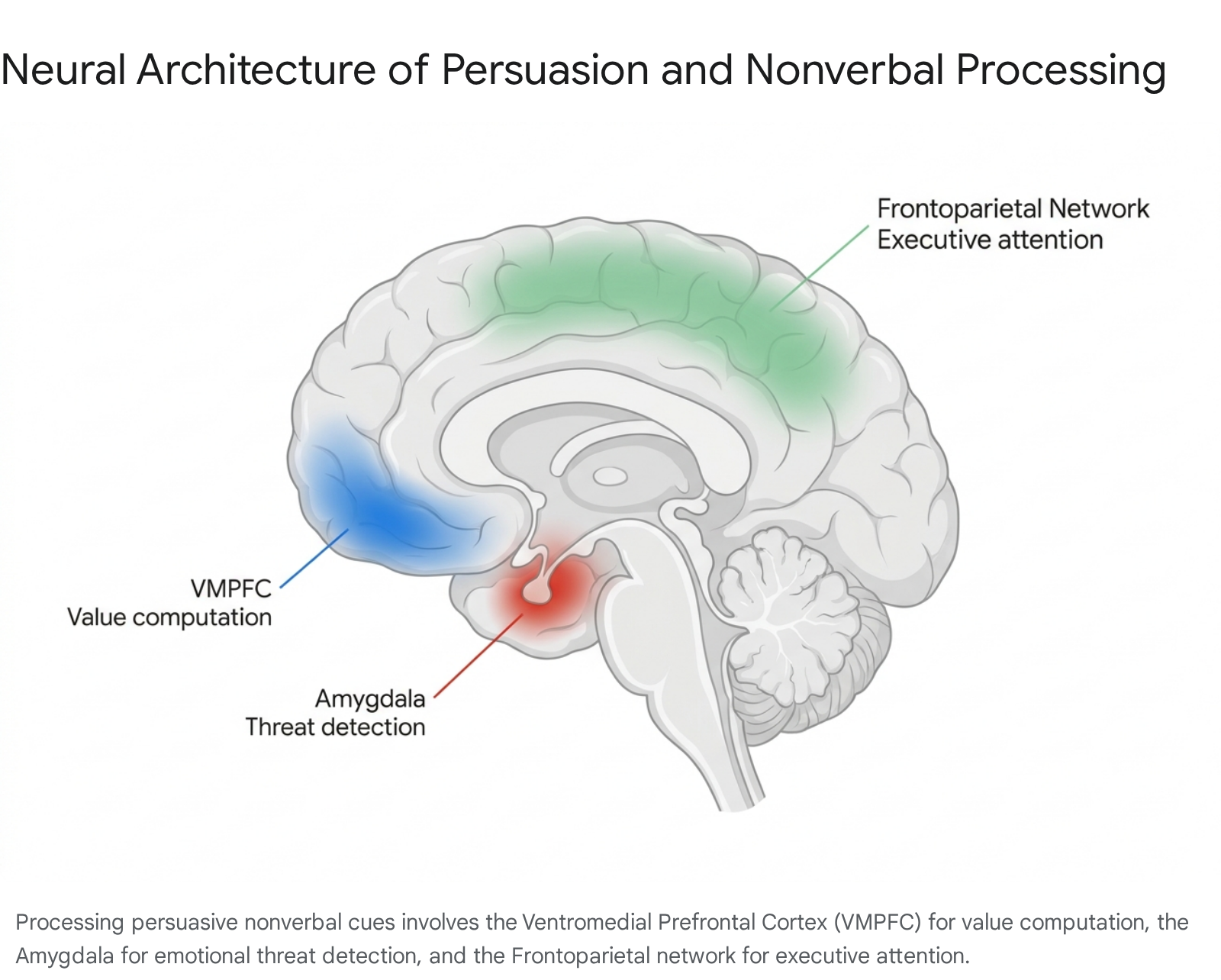
Research in this domain shifts the focus from purely psychological constructs to quantifiable neurological phenomena 116.
Cortical Networks and Inter-Brain Synchronization
The processing of persuasive messages depends heavily on the alignment between a recipient's intrinsic brain connectivity and the nature of the message. Individuals exhibit varying predispositions, broadly categorized into the Need for Affect (NFA) and the Need for Cognition (NFC) 7. Task-based and resting-state fMRI studies indicate that key regions within the frontoparietal network - an area central to attention, decision-making, and executive function - play pivotal roles in processing persuasive messages based on these motivational orientations 7. When nonverbal affective cues align with an audience member's predisposition, researchers observe greater neural engagement. Furthermore, persuasion heavily recruits the ventromedial prefrontal cortex (VMPFC), a region associated with self-related processing and value computation. Increased neural reactivity in the VMPFC during persuasive messaging scales directly with subsequent, message-consistent behavior change, highlighting how nonverbal framing that increases self-relevance translates into persuasive impact 8.
During live communicative interactions, persuasion relies on "neural synchrony" between the speaker and the audience. Using EEG hyperscanning, researchers have tracked phase-specific neural alignment during persuasive dialogues 9. Inter-brain dynamics measured across frontal, temporo-parietal, and parieto-occipital regions show that early stages of persuasion are characterized by high inter-brain dissimilarity, particularly in the delta and gamma bands, reflecting divergent cognitive processing between the persuader and the persuadee 9. However, as the interaction moves toward a conclusion, convergence increases significantly in the alpha band, demonstrating that effective persuasion culminates in neuro-rhythmic alignment 9.
Brain wave analysis also reveals hemispheric asymmetries based on the communicative role. Persuaders consistently show higher delta and theta band activity, particularly in the right frontal regions, alongside lower alpha band values compared to receivers 10. Specifically, delta activity is significantly higher in the frontal brain regions of persuaders compared to the temporal and parieto-occipital regions of receivers. This neural signature indicates that the act of persuading requires a significantly greater top-down attentional effort, strategic cognitive load, and deliberate emotional regulation than the act of receiving 910.
Endocrine Responses and the Autonomic Nervous System
Public speaking represents a high-stakes social evaluation environment, which the human brain frequently processes as a survival threat. The amygdala, an almond-shaped structure in the limbic system, acts as the primary threat detection center 111213. The amygdala cannot easily distinguish between a physical predator and a critical audience, and thus routinely triggers the sympathetic nervous system's fight-or-flight response during public speaking events, resulting in the release of stress hormones such as cortisol, epinephrine, and norepinephrine 1113.
However, intentional nonverbal communication can manually override this threat response. Deep, diaphragmatic breathing activates the vagus nerve, which runs from the brainstem to the abdomen. This signals the parasympathetic nervous system to initiate a "rest and digest" state, subsequently lowering cortisol levels, switching brain chemistry away from threat detection, and stabilizing the speaker's vocal and physical presentation 1314.
For the audience, positive nonverbal cues from the speaker trigger a cascade of neurochemical rewards. Genuine smiling, open posture, and sustained eye contact stimulate the audience's mirror neuron systems 1113. This empathetic mirroring releases oxytocin, a neuropeptide produced in the hypothalamus that is associated with social bonding, empathy, and trust. Research demonstrates that distrust is mediated by the amygdala, while trust is mediated by the prefrontal cortex in conjunction with oxytocinergic pathways 1213. Simultaneously, engaging nonverbal delivery combined with narrative structures stimulates the release of dopamine, a neurotransmitter that assigns salience to stimuli and solidifies long-term memory retention of the presented material 111415. Thus, the speaker's physiological state and physical movements directly manipulate the audience's neurochemistry, establishing trust and ensuring the message is retained.
Kinesics and Physical Modalities
Kinesics, a term introduced by anthropologist Ray Birdwhistell, refers to the study of hand, arm, body, and face movements as an integrated system of communication 31617. Borrowing heavily from structural linguistics, Birdwhistell proposed that bodily movements operate similarly to spoken language. He theorized that kinesic communication is composed of foundational units called "kinemes" (analogous to phonemes), which combine to form "kinemorphs" and complex expressions of meaning 410. While words carry the declarative semantic content, the continuous stream of kinesic data transmits information regarding social status, emotional intent, and contextual framing 210.
Gestural Typologies
Not all gestures impact an audience equally. Communication research categorizes gestures into distinct functional classes that either detract from or amplify a speaker's persuasive power 161718. Table 1 outlines the primary kinesic categories observed in public speaking contexts.
| Kinesic Category | Definition | Impact on Public Speaking and Persuasion |
|---|---|---|
| Illustrators | Movements that visually depict or emphasize spoken content (e.g., indicating the size of an object, outlining a shape, pointing to a specific location). | Highly positive. Boosts perceived competence and aids audience comprehension by providing dual-coding (visual and verbal) of information 161926. |
| Emblems | Gestures with specific, culturally agreed-upon meanings that can replace words entirely (e.g., thumbs-up, peace sign, head nod). | Variable. Effective for signaling universally understood concepts within a homogenous group, but highly prone to cross-cultural misinterpretation 161826. |
| Adaptors | Subconscious touching behaviors meant to release tension or anxiety (e.g., hair twirling, scratching, pen clicking, adjusting clothing). | Negative. Distracts the audience, diminishes perceived credibility, and signals a lack of control, nervousness, or discomfort 3161726. |
| Affect Displays | Body movements, primarily facial, that display internal emotional states (e.g., frowning, smiling, open-mouthed surprise). | Positive. Essential for conveying empathy and passion; triggers audience mirror neurons and emotional resonance 316. |
| Regulators | Movements that control the flow and turn-taking of interaction (e.g., raising a hand to pause someone, leaning forward to indicate a desire to speak). | Positive/Contextual. Crucial in dyadic communication, negotiations, or interactive presentations to manage audience participation 316. |
Recent empirical studies utilizing artificial intelligence to track multimodal communication highlight the distinct persuasive power of illustrators. In an exhaustive analysis of 2,184 TED Talks, researchers at the University of British Columbia used multimodal AI to isolate over 200,000 hand movements into 10-second clips, subsequently correlating these movements with audience engagement metrics 19. The data confirmed that purposeful "illustrators" had the strongest effect on persuasiveness, making speakers appear more knowledgeable and improving audience retention of the material. Conversely, "highlighters" (simple pointing motions), random hand movements, or the complete absence of gestures had little to no persuasive impact 19. The research demonstrates that gestures must be semantically linked to the speech to effectively manipulate audience perception.
Furthermore, research investigating multimodal dialogue highlights a "division of labor" between speech and manual co-speech gestures. In problem-solving interactions, speakers naturally distribute effort across both modalities to minimize overall cognitive exertion 20. When verbal descriptions become highly complex, speakers instinctively offload communicative effort onto kinesic channels, utilizing spatial gestures to clarify abstract concepts 20.
Facial Expressions and Oculesics
While kinesics covers the entire body, "oculesics" specifically addresses eye behavior 172621. The face and eyes serve as the primary focal points of human communication, acting as the nexus for gathering visual data and transmitting intent. Maintaining direct eye contact signals attentiveness, sincerity, and confidence, fundamentally increasing the speaker's perceived credibility and sociability 2232. Eye contact allows a speaker to continuously gauge if an audience is engaged, confused, or bored, enabling real-time modulation of the message 26.
Facial expressions, studied extensively by psychologists such as Paul Ekman, reveal a high degree of universality for basic emotions, including happiness, sadness, anger, fear, disgust, and surprise 2223. These expressions offer continuous, dynamic feedback between the speaker and the audience. Furthermore, microexpressions - involuntary, fleeting facial movements lasting only fractions of a second - often betray a speaker's genuine underlying feelings 24. If a speaker's verbal message contradicts their nonverbal affect, the audience will almost universally default to trusting the nonverbal cue, as it is processed by the brain as a more authentic indicator of intent 24.
Proxemics and Spatial Dynamics
A speaker's physical footprint and positioning within a given environment significantly influence audience perception. The study of spatial distance during communication is termed "proxemics," a theoretical framework developed by anthropologist Edward T. Hall in the 1960s 182425. Proxemics operates on the premise that human beings maintain invisible "bubbles" of personal space, the invasion or manipulation of which profoundly alters communication dynamics 2124.
Hall divided human interaction into four distinct horizontal spatial zones, outlined in Table 2.
| Proxemic Zone | Distance | Characteristics and Public Speaking Application |
|---|---|---|
| Intimate Distance | 0 to 18 inches | Reserved for highly personal relationships, physical affection, or intense confrontation. Completely inappropriate for standard public speaking contexts 242526. |
| Personal Distance | 1.5 to 4 feet | Used for close acquaintances and informal interactions. Can be utilized in small seminar settings or dyadic negotiations 242526. |
| Social Distance | 4 to 12 feet | The standard distance for formal business interactions, job interviews, and small group presentations. Allows for professional engagement without implying intimacy 2426. |
| Public Distance | 12 to 25+ feet | The typical distance for formal public speeches, lectures, and large presentations. At this range, speakers must rely on exaggerated kinesic gestures, elevated vocal volume, and distinct posture to bridge the physical gap 242526. |
Proxemics also extends beyond horizontal distance to encompass vertical space and physical orientation. A speaker standing on a raised stage or behind a heavy wooden podium asserts authority, territoriality, and formality, but risks creating psychological distance. Conversely, stepping away from a podium and moving closer to the audience level signals egalitarianism, transparency, and a desire for intimacy 2426. Proper utilization of these spatial dimensions allows a speaker to physically embody the tone of their message.
Paralanguage and Prosodic Features
While written texts rely on punctuation and typographical formatting to convey tone, spoken language utilizes "paralanguage" (or vocalics) - the non-lexical elements of the voice that accompany speech 172627. Paralanguage dictates how a message is delivered rather than what is said, encompassing variables such as pitch, rhythm, tempo, volume, intonation, and voice quality 262728.
Vocalic Attributes and Speaker Credibility
A speaker's vocal quality directly impacts audience attributions of competence and character. Meta-analyses of speaker persuasiveness show that greater perceived competence and composure are consistently associated with vocal pleasantness, fluency, and pitch variety 29. A monotone delivery limits engagement and induces cognitive fatigue, whereas dynamic shifts in pitch and volume help maintain audience attention, emphasize key arguments, and demonstrate passion 2426.
Different vocal characteristics trigger specific psychological inferences. For instance, a lower pitch generally conveys authority, seriousness, and maturity, while ending statements with an upward pitch inflection (upspeak) frequently conveys submission, questioning, or a lack of confidence 40. Additionally, variations in speaking rate can dictate the perceived urgency of a topic. Rapid speech may imply excitement or anxiety, while a deliberate, slower cadence conveys gravity and deliberate thought 17.
Prosody as a Syntactic and Structural Marker
Beyond emotional and attitudinal expression, prosody serves a crucial linguistic function by marking syntactic boundaries. The melodic and rhythmic aspects of speech assist audiences in parsing complex sentences and maintaining comprehension in real time 30423132. In Autosegmental-Metrical theory, prosodic boundaries are categorized by Intermediate Phrases (ip) and Intonational Phrases (IP), which roughly correspond to syntactic phrases and independent clauses 4232.
Speakers unconsciously deploy phonetic boundary features, such as final syllable lengthening and falling fundamental frequency (f0) boundary tones, to signal the end of a thought or a major constituent unit 303132. In cases of syntactic ambiguity - such as determining whether a relative clause attaches to the first or second noun in a sentence - prosodic boundaries dictate the audience's interpretation. A prosodic boundary marked by a falling tone and phrase-final lengthening followed by a pause explicitly guides the listener's parsing mechanism 32.
Furthermore, discourse markers used extensively in lectures and public speaking (e.g., "so," "now," "well") rely heavily on prosodic isolation. These markers are typically preceded or followed by a distinct pause and uttered with a specific intonation contour to shift topics, signal transitions, or manage discourse structure 33. A speaker who fails to align prosodic boundaries with their syntactic structure risks inducing cognitive overload in the audience, as listeners are forced to expend greater effort determining where one concept ends and another begins.
Neurological evidence supports a "blending hypothesis" regarding prosody. While purely linguistic prosody activates cortical areas associated with language processing (e.g., the Superior Temporal Gyrus), affective prosody simultaneously recruits subcortical structures like the amygdala 34. This indicates that the melodic contour of speech operates as an integrated system, delivering structural grammar and emotional resonance simultaneously 34.
Cross-Cultural Variations in Nonverbal Cues
While certain physiological phenomena - such as the neurological processing of oxytocin or the display of Ekman's basic universal emotions - are biological constants, the interpretation of kinesic, proxemic, and paralinguistic cues is deeply enculturated. Nonverbal behaviors that convey competence, respect, and credibility in one region may be interpreted as aggressive, disrespectful, or entirely incomprehensible in another 474835. As communication increasingly occurs in globalized contexts, cross-cultural nonverbal literacy is a prerequisite for effective persuasion.
High-Context Versus Low-Context Frameworks
The interpretation of nonverbal cues is heavily mediated by a culture's reliance on explicit versus implicit communication, a paradigm defined by Edward T. Hall as high-context versus low-context cultures 4748. * High-Context Cultures (e.g., Japan, South Korea, China, numerous Middle Eastern nations, and parts of Latin America and Africa): Communication relies heavily on implicit, unspoken cues, shared social history, and rigid societal hierarchies. In these environments, nonverbal signals such as silence, subtle shifts in posture, and spatial distance carry immense weight. Direct verbal confrontation is frequently avoided to preserve group harmony and individual "face" 474850. * Low-Context Cultures (e.g., the United States, Germany, Scandinavia, Australia): Communication prioritizes explicit, direct, and unambiguous verbal expression. Nonverbal cues are utilized to augment and emphasize the verbal message but are not expected to carry the primary burden of meaning. Directness, individual confidence, expansive gestures, and clear articulation are highly valued 474835.
Regional Interpretations of Specific Cues
Cross-cultural miscommunication in international business, diplomacy, and public speaking frequently stems from a failure to adapt gestural, spatial, and oculesic norms to the local audience. Table 3 outlines key regional variations in nonverbal norms.
| Nonverbal Modality | Western / Low-Context Norms (e.g., USA, Northern Europe, Australia) | Eastern / High-Context Norms (e.g., Asia, Middle East, Latin America, Africa) |
|---|---|---|
| Eye Contact (Oculesics) | Direct, sustained eye contact is seen as a sign of confidence, honesty, and attentiveness. A lack of eye contact implies deception, weakness, or insecurity 224751. | Prolonged direct eye contact can be perceived as aggressive, confrontational, or deeply disrespectful, particularly toward elders or hierarchical superiors. Averting the gaze demonstrates deference and politeness 222347. |
| Emblematic Gestures | The "Thumbs Up" and the "OK" sign (thumb and forefinger forming a circle) broadly represent approval, agreement, and satisfaction 22473637. | The "Thumbs Up" and "OK" signs are highly offensive, often vulgar insults in parts of the Middle East, South America, and specific European nations (e.g., Greece, Turkey) 222351363738. |
| Haptics (Touch) & Greetings | Firm, brief handshakes signal authority, equality, and professionalism 2336. | In Japan, bowing replaces physical contact. In many Islamic cultures, cross-gender touch is strictly forbidden. In several African nations, a softer, limp handshake is the respectful standard 2336. |
| Proxemics & Personal Space | Preference for a larger personal "bubble." Classified as Medium to Low contact cultures 212351. | Latin American, Southern European, and Middle Eastern cultures prefer closer physical proximity (High contact cultures). Standing too far away signals coldness or arrogance 212351. |
| Facial Affect & Silence | Open, expansive displays of emotion are encouraged; smiles broadly denote friendliness. Silence is often perceived as awkward or indicating a lack of preparation 225138. | Restraint in emotional display is favored to maintain harmony. A smile may indicate politeness, but can also mask discomfort, embarrassment, or confusion (e.g., in East Asia). Silence indicates thoughtfulness and respect 22485138. |
Failure to navigate these cultural fault lines can lead to ethnocentrism - the unconscious belief that one's own cultural communication style is inherently superior or standard. Ethnocentric assumptions inevitably damage a speaker's credibility in transnational environments, causing unintentional offense and obstructing the persuasive goal of the presentation 48. Furthermore, recent psychological studies indicate that nonverbal patterns, such as the frequency and amplitude of gestures, are deeply tied to racial and cultural identity. For example, research examining cross-cultural differences between Black and White speakers in the United States found that Black speakers utilized larger and more frequent gestures, and that audiences rated speakers as more "natural" when their gesture frequency aligned with the cultural expectations of their specific demographic 39.
Virtual Environments and Mediated Communication
The rapid proliferation of remote work, accelerated heavily by the COVID-19 pandemic, has shifted a massive volume of public speaking, education, and corporate presentation into two-dimensional virtual environments (e.g., Zoom, Microsoft Teams, Webex). This computer-mediated communication fundamentally alters the transmission of nonverbal cues, introducing novel physiological and psychological challenges to persuasion and audience engagement.
Cognitive Load and Videoconferencing Fatigue
Virtual communication invariably strips away subtle kinesic and proxemic data that humans rely on for seamless interaction. Research indicates that the lack of complete, high-fidelity nonverbal feedback channels dramatically increases both a speaker's and listener's "cognitive load" 4057415942. In an offline, face-to-face setting, the human brain processes body language, spatial positioning, and ambient cues subconsciously. In a virtual setting, users must consciously exert immense mental effort to interpret degraded, delayed, or missing signals, leading to rapid cognitive drain and the phenomenon colloquially termed "Zoom fatigue" 40574159.
Furthermore, virtual platforms force a state of "hyper-gaze." In traditional, in-person environments, eye contact fluctuates naturally; attendees look at their notes, the speaker, or their surroundings. On a standard video grid, participants are subjected to an unnatural amount of continuous, mutual gaze from multiple faces simultaneously. The human nervous system evolutionarily interprets close, sustained staring as a hyper-arousing threat state - a precursor to mating or combat 5942. Comparative neuroimaging studies using functional near-infrared spectroscopy (fNIRS) and EEG reveal that in-person interactions yield significantly higher signal strength, better facial expression processing, and greater "cross-brain synchrony" than live virtual interactions, confirming that the human brain is quantifiably less engaged when nonverbal context is flattened onto a screen 561.
Ocular Fixation and Camera Framing
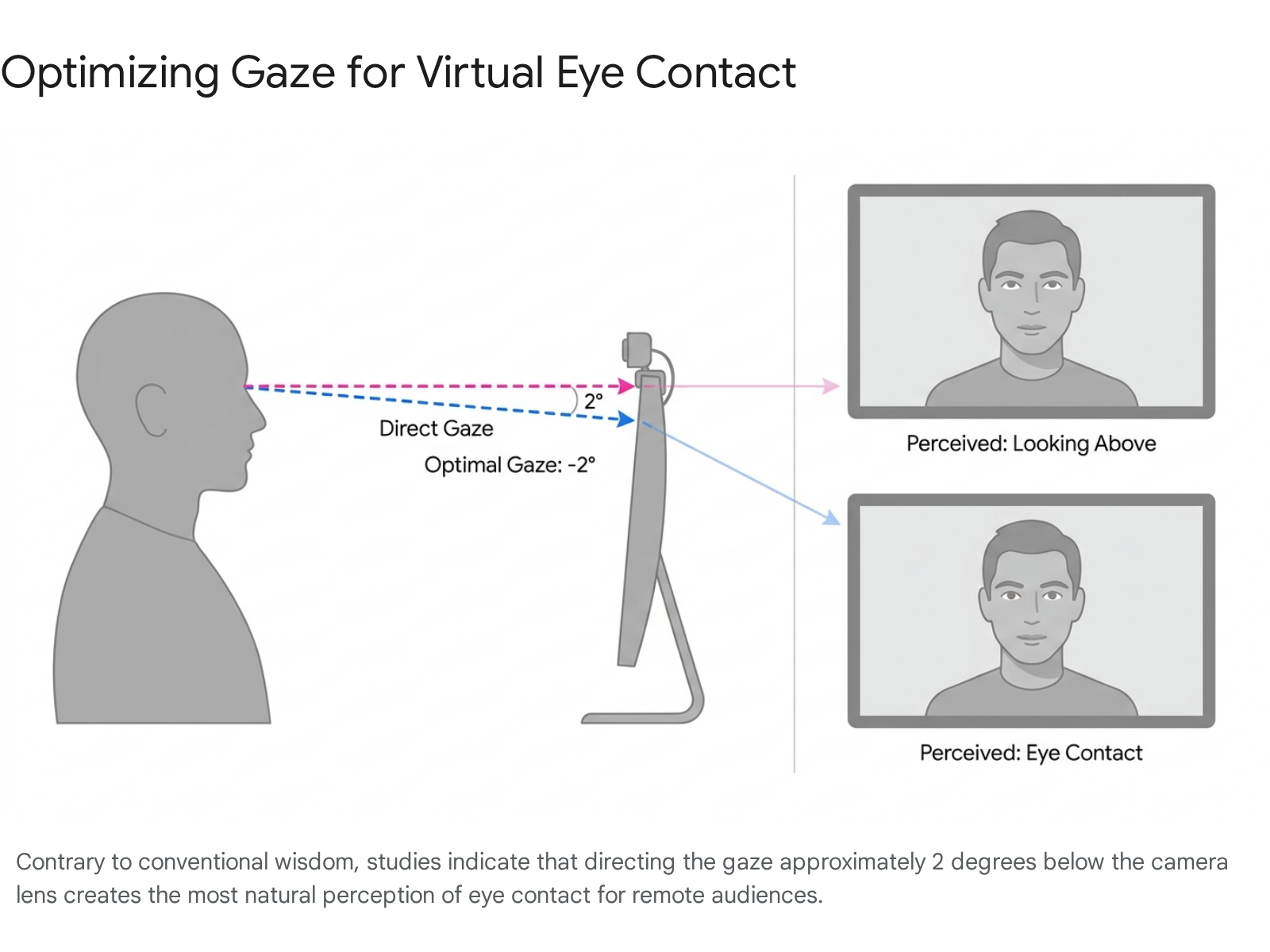
Simulating effective eye contact in a virtual environment presents a physical contradiction. If a speaker looks at the faces of their audience on the screen to read their reactions, they appear to be looking down or away from the perspective of the remote viewer. Conversely, if the speaker looks directly into the camera lens, they successfully simulate eye contact for the audience but completely lose the ability to monitor the audience's facial expressions and nonverbal feedback 594243.
Recent psychophysical studies and eye-tracking research have challenged the conventional wisdom that a speaker should look directly into the dead center of the camera lens to simulate perfect eye contact. Empirical testing measuring the perception of eye contact along the vertical axis shows that to convey an optimal impression of eye contact, the speaker should actually direct their gaze approximately 2 degrees below the center of the camera lens 4445.
Beyond gaze mechanics, virtual environments require strict attention to environmental framing and artifacts. Poor lighting (particularly backlighting that places the face in shadow), cluttered backgrounds, and inappropriate camera angles (e.g., positioning the camera below eye level, which distorts facial proportions) introduce visual noise that competes with the speaker's message, significantly detracting from source credibility 4243.
Virtual Reality (VR) Training and Audience Simulation
To combat public speaking anxiety (PSA) and systematically train nonverbal delivery, researchers and clinicians are increasingly turning to Virtual Reality (VR) technologies. Immersive VR environments allow speakers to practice their delivery before simulated, programmable avatars. Studies demonstrate that manipulating the nonverbal feedback of these virtual audiences drastically impacts the psychological and physiological state of the speaker 4647484950.
A supportive virtual audience (programmed to nod in agreement, maintain eye contact, and display open postures) enhances speaker self-esteem, lowers physiological arousal, and translates to improved subsequent real-world performance 4647. Conversely, unsupportive avatars (programmed to frown, look away, shake their heads, or engage with mobile phones) induce high stress, triggering the amygdala's threat response and mirroring the negative physiological effects of real-world audience rejection 4647. Furthermore, research into the application of facial filters during video conferences suggests that projecting a highly familiar face (e.g., the face of a close friend) onto an audience member effectively mitigates oral presentation anxiety and lowers heart rate compared to presenting to unfamiliar faces or animated characters 48.
Quantitative Assessments and Effect Sizes
Within the psychological and communication sciences, meta-analyses provide robust, aggregate benchmarks for quantifying the precise persuasive impact of nonverbal components across thousands of studies. When evaluating effect sizes, researchers typically rely on Cohen's d (measuring the standardized mean difference between experimental and control groups) and Pearson's r (measuring correlational strength between variables). Standard statistical guidelines suggest that a Pearson's r of .10 indicates a small effect, .30 is a medium effect, and .50 is a large effect. For Cohen's d, 0.20 is considered small, 0.50 is medium, and 0.80 is large 51525354.
Nonverbal cues play a heavily quantified role in determining "source credibility" - a primary, established driver of attitude change and persuasion. A prominent meta-analysis investigating source effects on persuasion found that source manipulations (which rely heavily on nonverbal displays of confidence, vocal stability, eye contact, and posture) account for an average of 9 percent of the total explained variance in persuasion outcomes across studies 5575. More specifically, manipulations of speaker expertise - often signaled through precise kinesic illustrators, vocal fluency, and an authoritative pitch - demonstrate the greatest effect on persuasion, accounting for up to 16 percent of the explained variance 5575.
Experimental designs exploring multimodal interaction also support the dominance of nonverbal signals in persuasion. Laboratory experiments comparing audio-only speeches, video speeches without gestures, and video speeches with active gestural emphasis confirm that while verbal content dictates the logical, cognitive core of a message, the addition of manual gestures and vocal emphasis significantly improves audience ratings of the speaker's liveliness, power, and overall charisma 5677. This aligns with observational data that, when verbal and nonverbal channels contradict one another (e.g., a speaker says they are confident while displaying adaptors like fidgeting), receivers allocate the vast majority of their trust and emotional valence to the nonverbal signal 327857.
Additionally, research evaluating the "Third-Person Effect" versus the "First-Person Effect" in mass communication indicates that audiences generally assume they are impervious to persuasion (believing advertising affects "third persons" more than themselves). However, meta-analyses reveal a reliable First-Person Effect for highly desirable, pro-social messaging (like public service announcements), suggesting that when speakers utilize positive affective nonverbal cues, audiences are more willing to consciously accept and report the persuasive impact on themselves 58.
Conclusion
Current research categorically establishes that nonverbal communication is not merely a peripheral accessory to verbal discourse, but a fundamental, co-constitutive element of public speaking effectiveness and audience persuasion. Neurobiologically, a speaker's nonverbal affect drives inter-brain synchronization, manages audience threat-detection via the amygdala, and facilitates trust and long-term memory encoding through the regulation of oxytocin and dopamine. Structurally, the strategic deployment of kinesic illustrators, sustained oculesic engagement, and varied paralinguistic prosody consistently predict higher attributions of speaker competence, credibility, and message retention.
However, the efficacy of these nonverbal signals remains highly context-dependent. Cross-cultural applications require strict adaptation to the high- or low-context norms of the audience, as gestures, eye contact, and spatial behaviors hold vastly different, and sometimes contradictory, semantic meanings globally. Furthermore, the rapid migration of public speaking to virtual platforms necessitates an evolution in nonverbal delivery to counteract increased cognitive load, screen fatigue, and the physical limitations of camera-mediated eye contact. Ultimately, mastering the silent, multimodal language of the body and voice is an indispensable prerequisite for achieving lasting persuasive impact in any communicative arena.