
How College Size Shapes Your Experience
The size of a college fundamentally dictates its academic and social ecosystem, with massive universities offering unmatched raw resources, immense research funding, and a highly autonomous environment. Conversely, small colleges consistently yield higher rates of faculty mentorship, superior per-capita doctoral degree production, and more responsive professional alumni networks. Deciding between the two ultimately depends on whether a student requires structured, relational support or thrives as an independent navigator of vast opportunities.
The Academic Core: Teaching, Learning Styles, and Class Size
When prospective students weigh big universities against small colleges, the most immediate difference they anticipate is the classroom environment. The data confirms that this structural difference profoundly impacts how students engage with their education. In the United States, roughly 18.4 million students are enrolled in colleges and universities, navigating an academic landscape that has been irrevocably altered by pandemic-era remote learning and a heightened demand for in-person connection 12.
Small liberal arts colleges are typically characterized by multidisciplinary study, low student numbers, and small class sizes. These environments prioritize undergraduate teaching over massive institutional research outputs. According to a sweeping survey of 100,000 students across U.S. institutions by Times Higher Education, students at liberal arts colleges are generally more satisfied with the quality of teaching at their institution 3. On a scale of 0 to 10 measuring opportunities to interact with faculty, liberal arts students gave their institutions an average score of 9.16, compared to 8.57 for students at non-liberal arts institutions 3. Furthermore, students in these smaller cohorts were significantly more likely to report that their university fully supported critical thinking and making complex connections across disciplines 3.
Faculty Interaction and the Mentorship Gap
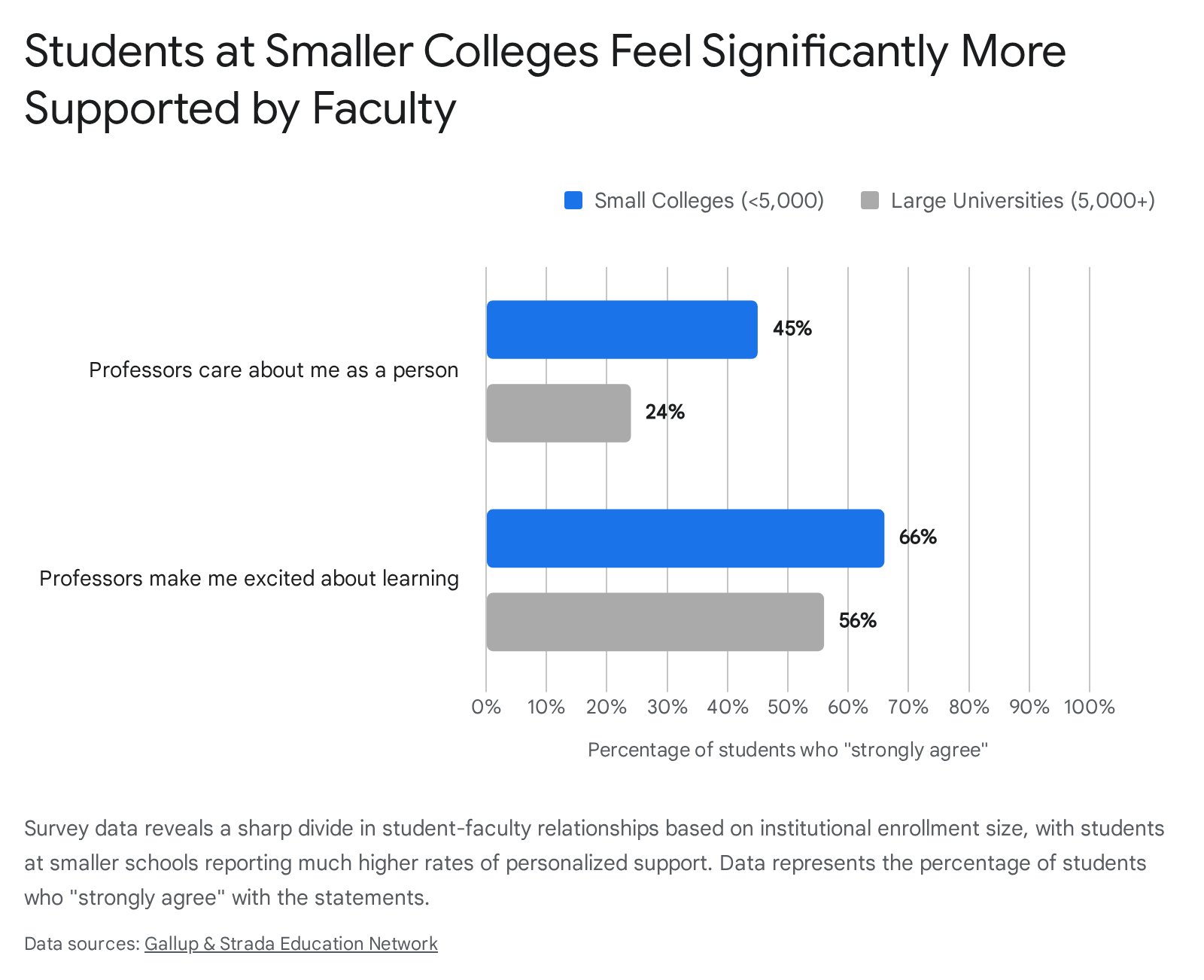
This satisfaction is deeply rooted in the psychological support students feel from their instructors. A joint survey by Gallup and the Strada Education Network found a striking divergence in student experiences based entirely on institutional enrollment size. Among students at colleges with fewer than 5,000 students, nearly half (45%) "strongly agreed" that their professors cared about them as people 4. At institutions with an enrollment of 5,000 or more, that number plummeted to just 24% 4.
The dynamic of large university classes - where introductory courses are frequently taught in giant lecture halls by graduate teaching assistants to manage enrollment volume - requires a specific type of learner to succeed 55. At a massive state university, undergraduates may not have meaningful contact with senior, tenure-track professors until their junior or senior year 5. This requires students to be highly self-motivated and capable of absorbing material independently without continuous supervision 6.
Learning Styles: Who Thrives Where?
Educational researchers have found that institutional size interacts directly with cognitive learning preferences. Studies utilizing the VARK model and Learning Style Inventories show that a substantial portion of college students thrive on "constructive" and "enactive" learning - methods that require critical dialogue, synthesis, and hands-on experiential activity 89. Students who rely on constructive learning often exhibit poor abilities to retain information in passive, large-scale lecture environments and require interventions that promote critical thinking 8.
Conversely, students who test as "self-supportive" learners - exhibiting characteristics like high self-discipline, a preference for autonomy, and the ability to learn effectively through independent reading or multimodal digital content - are highly suited to the large university model 9711. Furthermore, in modern post-pandemic hybrid environments, e-learners actively prefer independent projects and high flexibility, which large universities are better equipped to scale through sophisticated Learning Management Systems 1112. However, curriculum designers caution that ignoring diverse learning styles by defaulting exclusively to large auditory lectures can severely hinder student motivation and comprehension 913.
The Global Adoption of the Small College Model
The pedagogical advantages of small, intensive learning communities have not gone unnoticed on the global stage. Historically, the "liberal arts college" was a uniquely American phenomenon, with over 1,100 private four-year colleges serving under 3,000 students currently operating in the U.S. 14. Recently, however, higher education systems across Europe and Asia have begun actively replicating this model to foster entrepreneurial and critical thinking skills 158.
Prominent global examples include Yale-NUS in Singapore, Ashoka University in India, and NYU Abu Dhabi in the United Arab Emirates 159. These institutions deliberately engineer small class sizes, residential campus life, and delayed major declarations - an anomaly in regions like China and Japan where students typically enter universities with narrowly defined, hyper-specialized trajectories . By forcing multidisciplinary study and intensive faculty engagement, these international liberal arts programs aim to create graduates uniquely positioned for complex, dynamic labor markets 15.
The Honors College Compromise
For students who desire the intimacy of a small college but are drawn to the resources or lower tuition of a large state university, the "honors college" has emerged as a popular compromise. An honors college operates as a separate academic entity within a larger public university, offering an intensified, rigorous curriculum designed to challenge top students 10.
Honors students typically gain access to accelerated general education courses, smaller seminar-style classes, priority registration, and dedicated thesis advisors 10. Proponents of this model argue that it provides a liberal arts education with the massive resources and reduced price tag of a public institution 11.
Cost Benefits vs. Ecosystem Realities
While honors colleges offer exceptional value, researchers point out that they cannot entirely replicate the small college ecosystem. At an institution like Kenyon College or Swarthmore, the entire physical and administrative infrastructure - from the college president to the career center - is dedicated exclusively to a small cohort of undergraduates 11. In contrast, honors students at massive state universities represent a tiny fraction of the overall student body 10.
This creates systemic vulnerabilities. When large public universities face budget constraints, niche programs that benefit only a few students are often the first to see reductions in perks or scholarship funding 10. Furthermore, despite taking specific honors seminars, these students must still navigate the broader university for the majority of their major-specific coursework, meaning they will inevitably find themselves in massive lecture halls 21. Critics also note that the "special resources" touted by honors programs sometimes amount to little more than separate dormitories and a list of competitive scholarships, lacking the holistic, institution-wide mentorship found at a standalone liberal arts college 21.
Research Production and the Doctoral Pipeline
When measuring raw scientific output and total research dollars, large universities are the undisputed heavyweights. The scale of their operations is staggering.
The Aggregate Advantage of Large Research Institutions
According to the National Science Foundation (NSF), total higher education research and development (R&D) expenditures reached $117.7 billion in fiscal year 2024, representing an 8.1% increase from the previous year 1213. The vast majority of this funding flows into "R1" doctoral universities - institutions classified as having "very high research activity" 1415. The federal government is the primary engine of this enterprise, supplying over $64 billion to universities, with the Department of Health and Human Services (HHS) alone distributing $35.5 billion to support life sciences, biological, and biomedical research 12.
Unsurprisingly, because of these massive facilities and deep funding pools, the highest absolute number of doctoral degrees are awarded to students who complete their undergraduate education at R1 universities or foreign institutions 1516.
The Per-Capita PhD Production Phenomenon
However, if a prospective undergraduate's ultimate goal is to earn a PhD, the data reveals a fascinating counter-narrative. When adjusted for enrollment size, a student is statistically more likely to go on to earn a doctorate in science and engineering (S&E) if they attend a small, baccalaureate-focused arts and sciences college than if they attend an R1 research university 141516.
Institutions like Carleton College, Swarthmore College, Oberlin College, and Reed College consistently rank at the absolute top of the nation for the proportion of their alumni who earn doctorates 27. St. Olaf College, for instance, saw 338 of its graduates earn PhDs between 2018 and 2022, heavily concentrated in the life sciences, chemistry, and mathematics 27.
The mechanism behind this paradox is rooted directly in institutional structure. At large R1 universities, primary investigators rely heavily on graduate students and post-doctoral researchers to run their labs 5. Undergraduates must compete fiercely for limited auxiliary roles, often performing basic data entry or dishwashing. At small liberal arts colleges, there are virtually no graduate students. The faculty are still required to conduct research, meaning they must rely entirely on 19- and 20-year-old undergraduates to operate equipment, co-author papers, and present at national conferences. This direct, uninterrupted access to primary investigators yields profound, long-term experiential learning and incredibly strong, highly personalized letters of recommendation for graduate school admissions 411.
Extracurricular Ecosystems and Campus Social Life
The size of an institution dramatically alters its social ecosystem, influencing everything from the sheer variety of clubs to how easily a student can attain a leadership role. Colleges can generally be grouped into these two categories, and their social climates are entirely distinct 6.
Volume vs. Accessibility in Student Leadership
Large universities essentially function as small cities. They offer unparalleled variety: hundreds of specialized clubs, massive Greek life systems, and Division I athletics that serve as unifying cultural events for tens of thousands of people 5617. If a student has a highly niche interest - whether it is a specific cultural affinity group or an obscure intramural sport - they are overwhelmingly more likely to find a dedicated community for it on a campus of 40,000 people 5.
However, this sheer volume comes with intense competition. Securing a leadership position in student government, a premier consulting club, or a competitive a cappella group at a massive university can be as rigorous as applying for a corporate job. The high population density can sometimes result in students feeling like "small fish in a big ocean" 5.
At small colleges, the absolute variety of extracurriculars is narrower, but accessibility is much higher 5. A smaller student body gives individuals significantly more influence to start their own organizations from scratch, manage campus-wide events, and step into leadership roles early in their academic careers 17. While a small college might lack a sprawling football stadium, wide participation in local traditions often creates a highly cohesive, tightly knit community 56.
Civic Engagement and High-Impact Practices
Data from the National Survey of Student Engagement (NSSE), which collects responses from hundreds of thousands of students annually, shows that both institutional models play a stable and meaningful role in developing civic engagement 18. In 2024, 57% of first-year students and 60% of seniors reported that their institution contributed "very much" or "quite a bit" to their civic development, while similar margins reported frequently engaging in discussions with people holding different political views 18.
Voting data aligns with this engagement; according to the National Study of Learning, Voting, and Engagement (NSLVE), 53% of eligible college students voted in the 2024 elections, significantly outpacing the 47% turnout rate of the general 18-29 youth demographic 19.
When evaluating "High-Impact Practices" (HIPs) - activities like service-learning, internships, and undergraduate research that are empirically linked to student retention and success - institutional focus matters deeply 2021. NSSE data indicates that smaller colleges frequently orchestrate these experiences directly into the curriculum to ensure high participation, whereas large universities require students to proactively seek them out 2223.
Post-Pandemic Shifts in Campus Engagement
Regardless of size, universities are currently dealing with a student body that is actively craving social connection while simultaneously changing how they utilize physical campus space. Following the isolation of the COVID-19 pandemic, a 2024 Hanover Research survey of admitted students revealed a nearly 10-percentage-point increase in students seeking traditional, full-time, in-person, four-year undergraduate experiences compared to 2023 24. Tellingly, 27% of applicants rejected a college specifically because it lacked the campus social life they wanted, and 13% declined due to a lack of preferred extracurricular activities 24.
Simultaneously, spatial utilization has evolved. A meta-analysis of over 100,000 students by Degree Analytics revealed that time spent in physical academic spaces dropped by 22% post-pandemic, driven by the permanent integration of hybrid learning models and asynchronous online assignments 12. Conversely, time spent on campus during the weekends surged by 92%, and the average duration in residential spaces rose by 10.4% 12. This indicates that students increasingly view the physical campus less as an exclusive site for academic instruction and more as a vital hub for residential and social connection.
Psychological Fit: Introversion, Extroversion, and Belonging
Because the social ecosystems of large and small colleges are so divergent, they cater differently to distinct psychological profiles. Peer-reviewed studies examining the relationship between student personality traits and college satisfaction reveal profound correlations.
Extraversion and the Large Campus
A massive study of 4,753 first-year students across North American universities found that extroverted individuals are statistically more likely to enroll in large universities 25. Extroverts thrive on high environmental stimulation, vast social networks, and the constant, energetic activity of a sprawling campus 2627.
Furthermore, the data shows that the positive association between extraversion and a student's "sense of belonging" is significantly stronger at large schools 25. Extroverts draw upon vast social support networks to cope with academic stress; they actively seek out new peer groups, join multiple organizations, and extract life satisfaction from high-frequency social interactions, effectively shrinking a massive university into a manageable community 27.
Introversion and the Need for Structured Support
In contrast, introverted students face unique hurdles in large-scale environments. Introverts naturally experience higher rates of social anxiety and are more easily drained by continuous outward stimulation 2526. In qualitative studies, introverted university students report that navigating massive lecture halls, forced group discussions, and highly competitive social scenes leads to exhaustion, distance from the learning material, and deep feelings of isolation 28.
Small colleges often provide a safer, less overwhelming environment for introverted students. Because the social networks are smaller and interactions occur routinely with familiar faces, introverts do not have to expend as much energy constantly introducing themselves or fighting for visibility 526. The structured intimacy of a small college allows them to build confidence gradually, process information reflectively, and achieve person-environment congruence without radically altering their inherent personality 2629.
The Mental Health Infrastructure Crisis
Perhaps the most critical operational difference between big universities and small colleges today is how they manage the ongoing, severe deterioration of student mental health. By nearly every clinical metric, the psychological well-being of young adults is a pressing national concern.
Recent survey data, including the massive Healthy Minds Study spanning hundreds of institutions, indicates that over 60% of college students meet the criteria for at least one mental health problem, representing a 50% increase since 2013 303132. A 2024 Wiley survey corroborated these findings, noting that 59% of students are dealing with anxiety, 58% with burnout, and 43% with depression 33. The Thriving College Student Index found that while overall stress dropped slightly from the pandemic peak, 65% of students still report being highly stressed, and 57% feel overwhelmed 45.
Surging Demand and the Clinical Load Index
This explosion in demand has broken traditional campus counseling center models. Wait times for mental health appointments routinely stretch from several weeks to as long as 18 months, leaving highly vulnerable students in prolonged distress 3046.
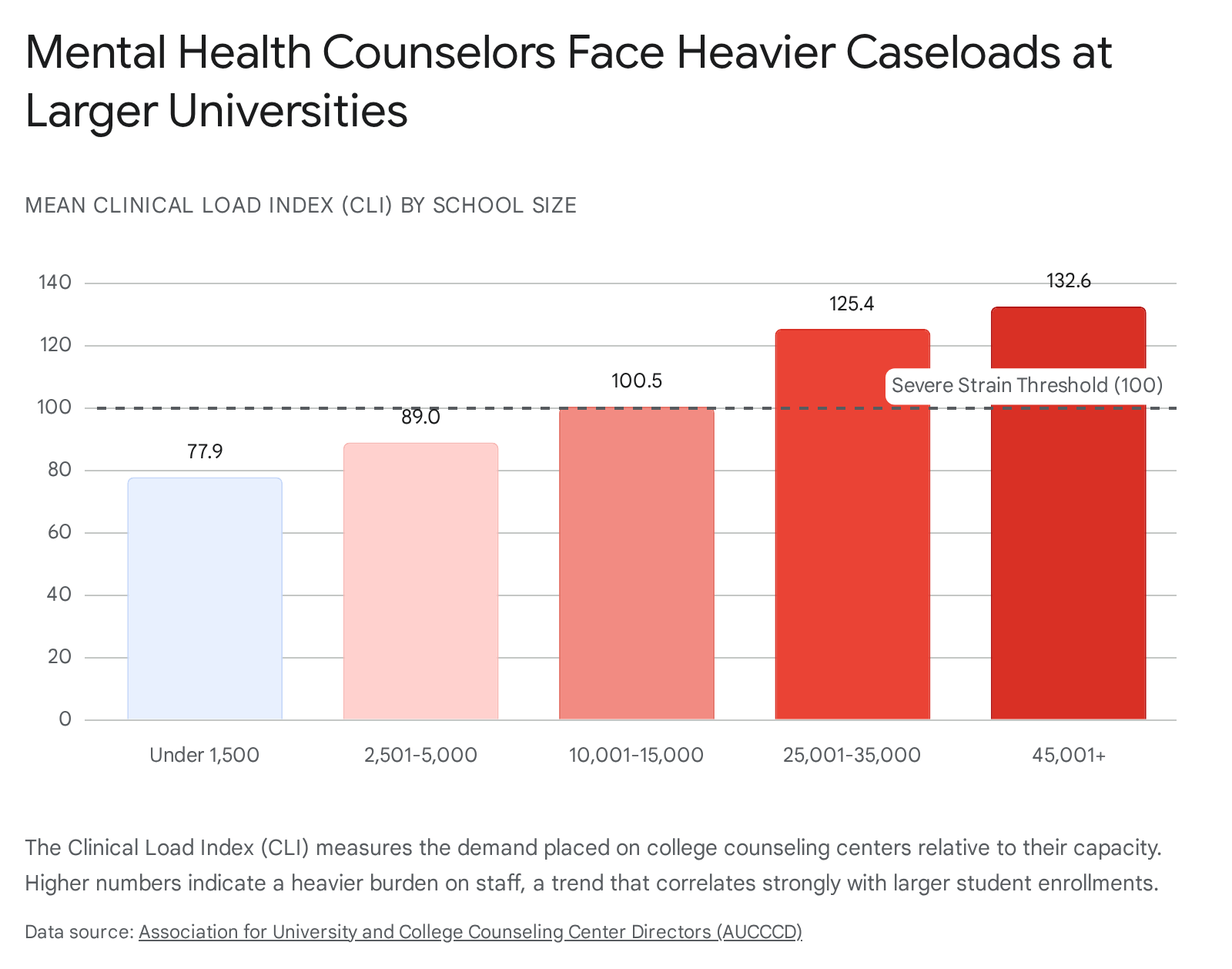
The burden on the psychiatric system changes drastically depending on the size of the school. According to the 2023-2024 Annual Survey Report by the Association for University and College Counseling Center Directors (AUCCCD), clinical staffing models are heavily dictated by enrollment 34. The "Clinical Load Index" (CLI) - a metric used to evaluate true clinical demand versus a counseling center's actual capacity - rises sharply as universities get larger 34.
Large University Solutions vs. Small College Safety Nets
To combat these scaling issues, large institutions are rethinking care delivery. Universities with over 10,000 students are increasingly utilizing "embedded counselors" - therapists stationed directly within specific academic colleges (e.g., the College of Engineering) or specific residence halls to decentralize care and lower barriers to access 34. They are also heavily leaning into peer-led support programs, group therapy, and third-party telehealth platforms like TimelyCare, which can offer next-day virtual counseling to bypass long campus waitlists 303235.
Small colleges, operating with fewer absolute financial resources, cannot typically afford large, highly specialized psychiatric staffs or expensive digital ecosystems. Instead, they rely heavily on their tight-knit communities as an early-warning system. Because faculty, residence life staff, and administrators at small colleges interact with the same students frequently, they are structurally better positioned to notice sudden behavioral changes, identify students in distress early, and manually intervene before a psychiatric crisis escalates 1732. However, when severe psychopathology requires highly specialized clinical intervention, small colleges may have to refer students off-campus, which can present barriers for students lacking transportation or off-campus insurance 36.
Financial Realities: Tuition, Discounting, and Student Debt
The structural differences between big universities and small colleges are mirrored by their financial models. The vast majority of large institutions are public, state-funded universities, while the majority of small liberal arts colleges are private, tuition-dependent nonprofits 1437. This dichotomy directly influences the sticker price, institutional discounting, and the debt burden graduates carry into the workforce.
Sticker Price vs. Institutional Aid
For the 2024-2025 academic year, the College Board reports that the average published in-state tuition and fees for a public four-year university was $11,610 38. In stark contrast, the average published tuition and fees for a private nonprofit four-year college reached $43,350 38.
However, looking solely at the "sticker price" is deeply misleading. To remain competitive and ensure class diversity, private colleges engage in massive tuition discounting. Over the last decade, institutional grant aid - money provided directly by the college that does not need to be repaid - grew by 24%, reaching a total of $85.1 billion in the 2024-2025 academic year 39. Depending on a family's specific income bracket and a student's academic profile, this robust discounting can occasionally make the "net price" of a private small college comparable to or even cheaper than a public state university 38.
Debt Outcomes Across Sectors
Despite high institutional discounting, the structural cost differences ultimately result in varying debt burdens. In the United States, student loan debt totals over $1.83 trillion, with federal loans representing roughly 90.9% of that total 4041.
When analyzing the Class of 2024, approximately 47% of bachelor's degree recipients who graduated from four-year public and private nonprofit colleges left with student loan debt, averaging $29,560 per borrower 3955. However, outcomes differ by sector:
| Institution Type | 6-Year Graduation Rate (2016 Cohort) | Average Student Debt (Class of 2024) | Percentage of Graduates with Debt |
|---|---|---|---|
| Public 4-Year University | 63.5% | $27,420 | 47% |
| Private Nonprofit College | 68.7% | $34,420 | 49% |
| For-Profit Institution | 33.6% | Data Varies Heavily | 82.7% (Federal loans only) |
(Sources: 415542)
While students at private colleges take on marginally higher debt loads and borrow at slightly higher rates, they also benefit from notably higher six-year graduation rates (68.7% vs 63.5%) 5542. Graduating on time is one of the most critical factors in managing student debt; an extra year or two spent navigating bottlenecked degree requirements at a crowded public university can easily negate the upfront tuition savings 3842.
The Post-Graduation Advantage: Outcomes and Alumni Networks
The ultimate return on investment for any college degree is successfully launching into the labor market. Institutional size plays a surprisingly pivotal role in early career networking and long-term alumni engagement.
Job Market Realities for Recent Graduates
According to comprehensive 2024 survey data from the National Association of Colleges and Employers (NACE), the Class of 2024 faced a noticeably tougher job market than the post-pandemic hiring booms experienced by the Classes of 2022 and 2023 4358. Graduates submitted more job applications on average than their recent predecessors, yet garnered fewer job offers before walking across the graduation stage 4358.
In a tightening labor market, experiential learning is critical. NACE data shows that over two-thirds of the Class of 2024 engaged in an internship, and those who secured paid internships significantly outperformed their peers in pre-graduation job offers and starting salaries 43. Career centers at both large and small institutions are adapting; 2024 benchmark data shows career center budgets grew by 21% over the last two years, with nearly 60% of staff now utilizing AI assistive tools to help scale student services 5844.
Why Small Alumni Networks Dominate LinkedIn
When the job market is tight, leveraging a strong alumni network is vital. Logic dictates that a massive state university with 500,000 living alumni would offer the best networking opportunities simply due to volume. However, a 2024 data analysis by LinkedIn ranking the top 50 U.S. colleges for "Network Strength" - measuring how effectively connections lead to recruiter outreach and higher job seniority - yielded a surprising result: small colleges absolutely dominated the top spots 45.
Institutions like Babson College, Washington and Lee University, Dartmouth College, and Claremont McKenna College proved to have the most powerful, responsive professional networks 45.
Career strategists attribute this counter-intuitive reality to "instant credibility" and higher social cohesion 46. At a massive state university, sharing an alma mater with a stranger on LinkedIn does not guarantee a shared foundational experience. At a small college with an enrollment of 2,000, two alumni separated by a decade likely had the exact same professors, ate in the same single dining hall, and participated in the exact same localized campus traditions 46. This shared emotional bond translates directly into professional action; career experts note that alumni from tight-knit small colleges are 3 to 5 times more likely to respond to cold networking outreach than random connections, completely bypassing the "bystander effect" that plagues massive alumni networks 4662.
Philanthropy and Long-Term Alumni Engagement
The strength of these small networks is also reflected in philanthropic behavior. Data from the Council for Advancement and Support of Education (CASE) shows that total charitable giving to U.S. colleges reached $61.5 billion in fiscal year 2024, with alumni contributing $12.9 billion 47.
However, universities are facing a generational shift. A 2024 national alumni survey by Ruffalo Noel Levitz revealed that while 68% of college graduates make charitable donations, only 27% give to their alma mater, and that number plummets to just 13% for recent graduates 48. Student loan debt is a massive deterrent, with 59% of recent alumni citing it as a primary reason they withhold donations 48.
Instead of writing checks, younger alumni are seeking "experiential" engagement - volunteering, mentoring current students, and participating in career development 49. CASE data indicates that experiential engagement drops off slightly as alumni build families in their 30s, but philanthropic giving rises steadily each decade post-graduation 49. Smaller colleges, which inherently prioritize interpersonal communication and deep student-faculty mentorship, are structurally advantaged in maintaining these non-monetary, experiential bonds with young alumni long after they leave campus 1449.
Bottom line
The data demonstrates that neither the massive research university nor the intimate liberal arts college is universally superior; they are distinct ecosystems optimized for different outcomes. Large universities excel at providing a staggering breadth of academic majors, cutting-edge R1 research facilities, and diverse, highly autonomous social scenes that reward independent, extraverted learners. Conversely, small colleges consistently deliver superior per-capita doctoral degree production, significantly higher rates of faculty mentorship, and fiercely loyal, highly responsive professional alumni networks. What remains uncertain is how larger public institutions will permanently solve scaling challenges related to the mental health crisis, but understanding how size currently shapes these resources is the crucial first step in finding a student's ideal psychological and academic fit.