
Liberal Arts vs Research University: Which to Choose
Research universities prioritize the creation of new knowledge, offering vast academic resources, massive alumni networks, and cutting-edge facilities, but often rely on large lecture halls and graduate teaching assistants for introductory courses. Liberal arts colleges provide an intimate, undergraduate-focused environment where tenured professors teach smaller classes and directly mentor students. The right choice depends entirely on whether a student thrives through the independent navigation of a sprawling institutional ecosystem or through the structured, highly personalized mentorship of a tight-knit academic community.
Structural Foundations: Defining the Institutional Models
When prospective students - ranging from high school seniors to adult learners returning to education - evaluate their higher education options, the choice between a liberal arts college and a research university is often the most consequential fork in the road 121. While both award accredited bachelor's degrees, their operating models, financial structures, and campus cultures are fundamentally different.
The American higher education landscape classifies institutions primarily through the Carnegie Classification of Institutions of Higher Education, managed by the American Council on Education, which categorizes colleges based on the types of degrees awarded and the scale of their research activity 2. Research universities, particularly those classified as R1 (very high research activity) or R2 (high research activity), are designed to operate at a massive scale 3. They serve tens of thousands of students across multiple specialized schools, such as colleges of engineering, business, nursing, and education, which exist alongside a core college of arts and sciences 13. In the fall of 2024, college enrollment totaled approximately 19.28 million undergraduate students nationwide, with the vast majority absorbed by large public and private research institutions 4.
Liberal arts colleges, classified primarily as Baccalaureate Colleges, are significantly smaller. They typically enroll fewer than 5,000 students and focus almost exclusively on undergraduate education across the humanities, social sciences, and natural sciences 15. A liberal arts education does not mean studying only the arts; it refers to a broad-based, interdisciplinary curriculum designed to expose students to a wide array of academic pursuits before they commit to a specific vocational path 25.
| Institutional Feature | Liberal Arts Colleges (Baccalaureate) | Research Universities (R1/R2) |
|---|---|---|
| Primary Institutional Mission | Undergraduate teaching and holistic intellectual development. | Knowledge creation, research, and graduate/professional training. |
| Average Undergraduate Scale | Small (typically 1,000 to 5,000 students). | Large (frequently 15,000 to 50,000+ students). |
| Degree Offerings | Primarily Bachelor's (B.A., B.S.). | Bachelor's, Master's, Ph.D., and Professional (M.D., J.D.). |
| Curricular Structure | Broad, interdisciplinary general education requirements. | Highly specialized majors, dedicated pre-professional tracks. |
| Academic Advising | Proactive, individualized coaching with low student caseloads. | Student-initiated guidance navigating complex bureaucratic systems. |
Because research institutions carry significantly larger student populations, academic advisors and career coaches carry heavy caseloads 6. Students at large universities must often take the initiative to seek out guidance, navigate complex bureaucracies, and advocate for themselves 15. Liberal arts colleges generally feature lower advisor-to-student ratios, allowing staff to engage more proactively with students on an individual basis to tailor their academic and professional trajectories 16. However, the sheer scale of a research university offers unmatched variety. These institutions provide a wider swath of specialized courses, diverse pre-professional tracks, and massive global alumni networks that can be highly leveraged for corporate recruiting 15.
The Classroom Experience and Pedagogical Dynamics
The most immediate difference students experience between these two models is class size and faculty interaction. According to data tracked by the Integrated Postsecondary Education Data System (IPEDS) and institutional Common Data Sets, selective liberal arts colleges frequently boast student-to-faculty ratios between 7:1 and 12:1 178. Major research universities typically range from 15:1 to well over 20:1 189.
More importantly, the nature of the instructor varies dramatically. At research universities, a significant percentage of introductory classes and laboratory sessions are led by teaching assistants (TAs) - usually graduate students pursuing their master's or doctoral degrees 3. Across the United States, colleges and universities employ over 115,000 teaching assistants, representing nearly 4% of the higher education workforce 10. TAs are especially prevalent in science, technology, engineering, and mathematics (STEM) fields. One institutional survey indicated that up to 91% of all biology labs and 70% of life and physical science labs at research universities are taught by TAs rather than full-time faculty 10.
In contrast, because most liberal arts colleges do not house massive graduate programs, classes and laboratories are taught directly by professors 25. This structural reality fundamentally alters the pedagogical dynamic. Faculty at liberal arts colleges are rewarded primarily for their excellence in teaching, whereas faculty at research universities are often evaluated, tenured, and compensated based on their research output, grant acquisition, and publication records 1513.
How Learning Styles Intersect with Campus Scale
The structural differences between liberal arts colleges and research universities also interact significantly with individual student learning styles. Educational psychologists frequently utilize frameworks like the VARK model - Visual, Auditory, Reading/Writing, and Kinesthetic - to understand how students best absorb and process information 1112.
Research indicates that students who lean heavily toward kinesthetic or participative learning styles often thrive in the smaller, discussion-based seminars characteristic of liberal arts colleges 161718. Because liberal arts classrooms rarely exceed twenty students, there is a structural demand for active participation, debate, and hands-on experiential learning 19. Large lecture halls at research universities, which can seat hundreds of students, inherently favor auditory and visual learners who excel at absorbing passive lectures and taking independent notes 2917.
Interestingly, this dynamic also influences how students adapt to digital and blended learning environments. Studies exploring learning styles in computer-based and online learning environments have suggested that liberal arts students are sometimes more susceptible to uneasiness resulting from remote teaching 12. The highly interpersonal, localized nature of their preferred learning style does not always translate seamlessly to asynchronous video lectures, a format that massive research universities have deployed with great efficiency to manage their massive undergraduate enrollments 12.
The Undergraduate Research Ecosystem
A pervasive misconception in higher education is that "research universities" are inherently superior environments for undergraduates to conduct research. The reality is highly nuanced and depends heavily on a student's assertiveness, their field of study, and the specific architecture of the institution's laboratories.
Navigating Large-Scale Laboratories
Research universities are home to world-renowned faculty, multimillion-dollar federal grant funding, and state-of-the-art laboratory facilities 21. For students pursuing STEM degrees, these institutions offer the theoretical chance to participate in groundbreaking, potentially Nobel-caliber discoveries alongside leading global experts 2.
However, the primary focus of these principal investigators (PIs) is usually their doctoral students and postdoctoral researchers, whose full-time job is to generate data and publish papers 12. In this hierarchical environment, undergraduates are often relegated to assistant roles - washing glassware, running basic data entry, or performing repetitive assays - and they must compete fiercely against thousands of their peers simply to secure a spot in a working lab 12. Research universities do offer honors colleges and specific undergraduate research programs to simulate a more intimate experience, but access to these programs is highly selective 519.
The Liberal Arts Mentorship Advantage
At liberal arts colleges, faculty are still required to publish original scholarship and maintain active research agendas, but they lack an army of graduate students and postdocs to staff their projects 2519. Therefore, they rely entirely on undergraduate students to assist in the laboratory, run experiments, and co-author papers 213. This dynamic frequently results in highly individualized, hands-on research experiences for undergrads at liberal arts colleges, giving them authentic exposure to the scientific method and primary literature much earlier in their academic careers 113.
Recent empirical data highlights how critical this exposure is. Participating in undergraduate research is categorized as a "high-impact practice" that drastically improves college completion rates. A large-scale propensity score matching study utilizing data from over 120,000 students across six public universities found that students who participated in undergraduate research were twice as likely to graduate in four years and over ten times as likely to graduate in six years 14. Furthermore, the study demonstrated a compensatory effect: participating in research effectively cut four-year graduation equity gaps in half for marginalized, low-income, and first-generation students, and completely closed these gaps at the six-year mark 14.
Feeding the PhD Pipeline
The depth of faculty mentorship at liberal arts colleges translates directly into remarkable outcomes for graduate school admissions. When adjusting for institutional size, top liberal arts colleges produce future PhD candidates at staggering rates, often outpacing the most prestigious research universities in proportional output.
According to National Science Foundation (NSF) data on the baccalaureate origins of doctorate recipients, top liberal arts colleges have historically generated PhD candidates at a rate two and a half times greater than that of top research universities 1516. Even in raw, unadjusted numbers, tiny liberal arts colleges frequently compete with massive state and Ivy League institutions in producing future scholars.
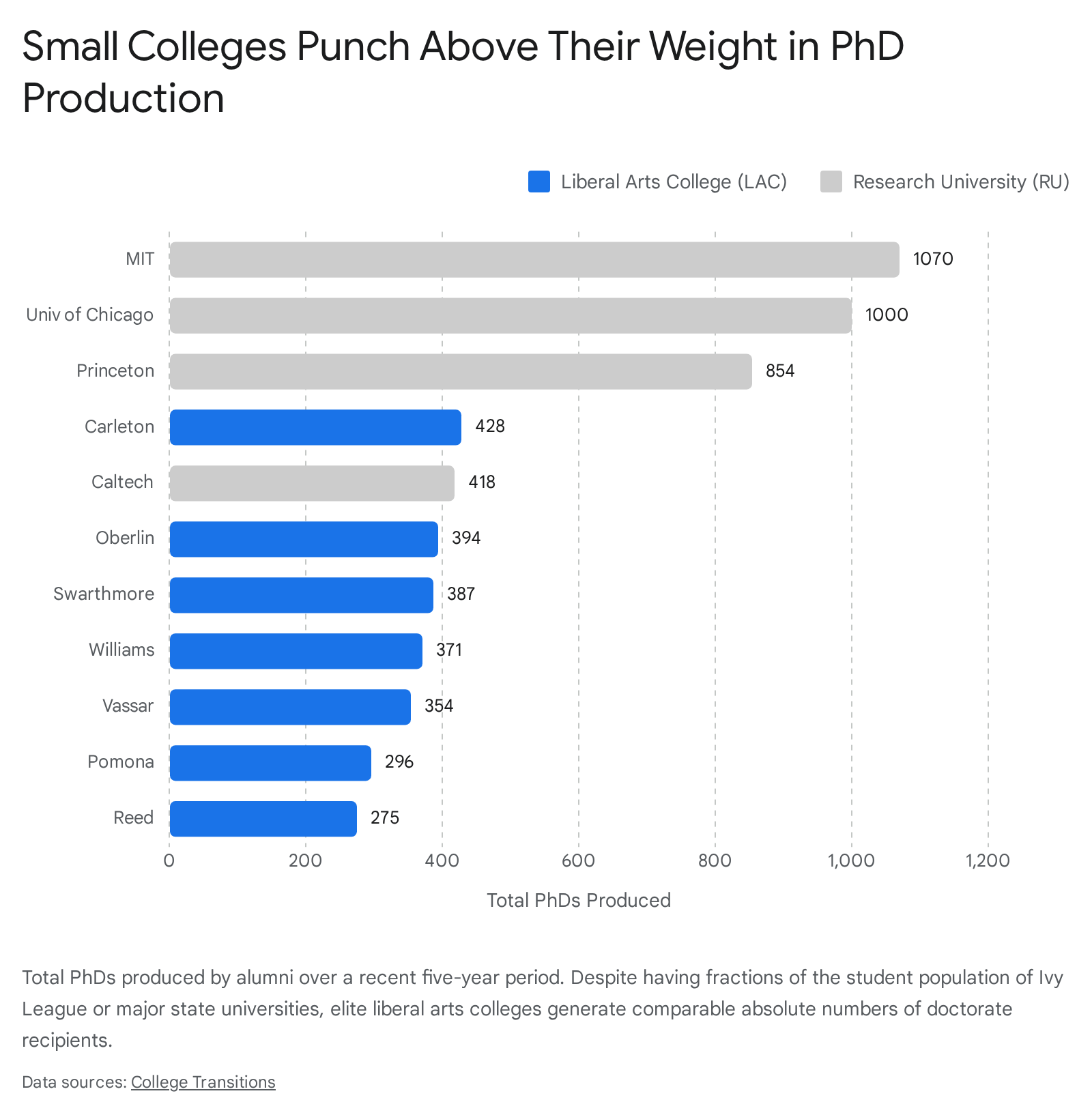
The catalyst for this outsized production appears to be direct faculty engagement. When surveyed, 58% of liberal arts graduates who successfully pursued a PhD attributed their decision directly to an intervention or experience concerning their undergraduate institution - such as a specific faculty mentor encouraging them to apply - compared to only 48% of research university graduates 15. In essence, liberal arts colleges serve as highly effective incubators for the academic workforce, leveraging intimacy to build intellectual confidence.
Student Well-being, Mentorship, and Campus Belonging
Beyond academic outcomes, a growing body of higher education research demonstrates that "campus belonging" is a measurable factor in student success, heavily influencing retention, graduation rates, and emotional resilience 1718. At a sprawling research university with tens of thousands of undergraduates, it is exceptionally easy for a student to feel isolated or lost in the crowd. Liberal arts colleges, by design, cultivate tight-knit residential communities where students frequently interact with the same peers and professors across multiple contexts 21.
The Gallup-Lumina Insights on Engagement
The profound impact of faculty relationships on long-term well-being and career success has been extensively documented by the Gallup-Purdue Index (now the Gallup Alumni Survey) and subsequent Lumina Foundation studies 192021. This research measures higher education outcomes not just by early-career salary, but by long-term workplace engagement, alumni attachment, and overall life satisfaction 1922.
The data reveals a stark reality regarding mentorship. Graduates who strongly agreed that they had a professor who "cared about them as a person" were nearly twice as likely to be engaged at work later in life 2023. Furthermore, those who had a mentor actively encouraging their goals and dreams were more than twice (2.2x) as likely to be highly engaged in their careers 20. Unfortunately, these transformative experiences remain the exception rather than the rule. Recent findings from the 2024 State of Higher Education study indicate that while 81% of alumni had a professor who made them excited about learning, only about 40% actually had a mentor who encouraged them to pursue their goals 21. Given their structurally low student-to-faculty ratios, liberal arts colleges are uniquely positioned to facilitate these critical mentor relationships 15.
The lack of connection and support has severe consequences for retention. An estimated 41.9 million U.S. adults have started college but "stopped out" before completing their degree, an increase from 40.4 million the previous year 31. When currently enrolled students consider dropping out, emotional stress and mental health concerns are overwhelmingly the primary drivers. Approximately 70% of students who have recently considered stopping out cite emotional stress as a primary reason, a figure that has more than doubled since 2020 31.
Furthermore, these challenges are not distributed equally. The Gallup-Lumina data highlights significant demographic disparities, noting that women and students of color are less likely to feel cared for, mentored, and respected at their colleges, reporting a lower overall sense of belonging compared to their white and male counterparts 24.
Does Campus Size Dictate Belonging?
While it is tempting to conclude that smaller schools automatically guarantee a stronger sense of belonging, the academic literature is contested. A robust study analyzing sixth and seventh-grade students in Switzerland explored the effects of school size on the sense of belonging 25. The researchers found that while an initial correlation existed, once they controlled for the micro-environment of the classroom, the overall effect of school size became statistically insignificant 25.
Translated to higher education, this suggests that the "school-size effect" might be somewhat of an illusion. A student who successfully embeds themselves in a tight-knit club, a dedicated research lab, or an honors program within a massive state university can experience the exact same level of belonging and mentorship as a student at a 2,000-person private college 1925. The difference is that at a liberal arts college, that intimate environment is the default structural reality; at a research university, it is an environment the student must actively seek out and build for themselves 15.
Measuring the Return on Investment (ROI)
The debate between the utility of a liberal arts college and a research university is inextricably tied to the broader cultural debate over the value of STEM (Science, Technology, Engineering, and Mathematics) versus the humanities. Critics often argue that liberal arts degrees lack the specialized vocational focus necessary for modern labor markets, pointing to the undeniably higher starting salaries commanded by engineering, computer science, and business graduates, who are heavily concentrated at research universities 126.
The financial stakes have never been higher. According to the State of Higher Education report, 52% of student loan borrowers have delayed one or more major life events - such as buying a house or starting a family - because of their educational debt 21. Consequently, students are increasingly prioritizing options that offer direct links to employment, driving a surge of interest in career-oriented programs, certificates, and apprenticeships 27.
Graduation Rates and Timelines
When calculating ROI, the likelihood of actually finishing the degree on time is a paramount, yet often overlooked, variable. According to IPEDS data for the 2015 cohort, bachelor's degree-seeking students attending four-year private nonprofit institutions (a category that heavily features liberal arts colleges) graduated at a higher rate within 150% of normal completion time (68.8%) compared to their peers at public institutions (63.3%) and vastly outperformed those at for-profit institutions (30.0%) 28. Navigating the bureaucracy of a massive public research university can sometimes lead to scheduling conflicts and course unavailability, extending the time to graduation and thereby increasing the total cost of the degree.
Starting vs. Mid-Career Earning Trajectories
While it is true that technical degrees generally yield higher initial salaries, analyzing salary data over a longitudinal horizon reveals a more complex picture for humanities and social science majors. According to labor market analytics utilizing human resources data, students who graduate with liberal arts degrees from small liberal arts colleges actually earn higher salaries on average than students who graduate with the exact same degrees from large research universities 37.
This "liberal arts college premium" is attributed to the fact that LAC graduates tend to develop superior soft skills. Because small, discussion-based classes demand active participation, critical thinking, qualitative research, and persuasive communication, these graduates are highly adaptable 5937. These competencies translate remarkably well into lucrative sectors as careers progress. Mid-career liberal arts graduates frequently land in finance, management consulting, and market research 3738.
| Industry Sector | Typical Roles for Liberal Arts Graduates | Estimated Median Annual Salary |
|---|---|---|
| Finance | Financial Analyst, Compliance Specialist, Market Researcher | $65,000 - $85,000 |
| Consulting | Management Consultant, Business Analyst, Strategy Associate | $70,000 - $95,000 |
| Non-profit / Education | Program Coordinator, Humanitarian Services, Educator | $40,000 - $50,000 |
| Technology | Digital Marketing Specialist, Human-Centered Design | $60,000 - $90,000 |
Data derived from recent industry salary surveys for mid-career liberal arts graduates 3738.
Furthermore, analysis of the U.S. Department of Education's College Scorecard data reveals interesting patterns regarding university prestige and earning variability. When analyzing mid-career salaries, graduates from elite, top-tier research universities show the highest overall earnings, but they also exhibit the greatest variability 39. A degree from an Ivy League research university might propel a graduate to the top echelons of Wall Street, pulling the institutional average drastically up, but the variance is wide 3929. Conversely, mid-career graduates from state research universities tend to have a much tighter range of earnings, indicating highly predictable and consistent, albeit slightly lower, career outcomes 39.
To bridge the perceived skills gap, many institutions are hybridizing their approaches. Large research universities are creating "honors colleges" to simulate the intimate liberal arts experience for top students, while liberal arts colleges are heavily integrating STEM disciplines - such as data science, human-centered computing, and engineering - into their curricula to boost their graduates' technical credibility in the digital economy 52630.
The Enrollment Cliff and Financial Sustainability
Students evaluating smaller liberal arts colleges today must consider a highly uncomfortable, yet critical reality: the institutional financial health of the college itself. The American higher education sector is currently navigating an unprecedented "enrollment cliff." This crisis is driven by demographic declines in the birth rate roughly two decades ago, compounding economic inflation, and shifting public perceptions regarding the value of a traditional four-year degree 212742.
While massive public research universities and elite, heavily endowed private universities are largely insulated from this demographic shock, small, tuition-dependent liberal arts colleges are under immense, sometimes existential, pressure 4331.
The Accelerating Wave of Closures and Mergers
The pace of institutional closures in the United States has accelerated dramatically. Between 2016 and 2025, approximately 138 nonprofit colleges closed or merged, indicating a sharp departure from historical norms 32. Since March 2020 alone, over 48 public or private nonprofit colleges have closed or announced planned closures, and another 40 have merged with larger institutions, displacing tens of thousands of students 3133.
These vulnerable institutions often share similar patterns of decline: shrinking applicant pools lead to massive tuition discounting (offering steep scholarships to attract students), which results in operating deficits, deferred maintenance on campus infrastructure, and ultimately, an irreversible financial spiral 3247.
| Notable Recent Closures & Mergers | Year | Outcome / Reason |
|---|---|---|
| University of the Arts (PA) | 2024 | Abrupt closure due to severe financial difficulties and bankruptcy 34. |
| Birmingham-Southern College (AL) | 2024 | Closed after 168 years due to insurmountable financial losses 34. |
| Mills College (CA) | 2023 | Merged with Northeastern University after declaring a financial emergency 4734. |
| Anna Maria College (MA) | 2026 | Scheduled closure; board could not project resources to sustain operations 3149. |
| Queens University of Charlotte (NC) | 2026 | Acquired by Elon University to ensure long-term sustainability 3349. |
Often, the only path to survival for a struggling liberal arts college is to be absorbed by a larger research university. The merger of Mills College, a historic women's liberal arts college in California, with the massive research-focused Northeastern University is a prime example of this trend 4734. While the merger saved the campus, critics argued it fundamentally erased the unique identity and mission of the smaller college 47.
However, closure is not always inevitable. Some liberal arts colleges have successfully executed radical turnarounds. Hampshire College in Massachusetts, facing an existential threat in 2019 that reduced its incoming class to just 13 students, managed to secure over $40 million in new funding by 2024 47. They achieved this by completely revamping their curriculum to focus on pressing global issues like climate change and racial injustice, proving that distinct, mission-driven liberal arts models can still attract vital support 47.
Prospective students looking at smaller, lesser-known liberal arts colleges must proactively scrutinize the institution's endowment size, recent enrollment trends, and financial stability. A college closure mid-degree can be devastating, resulting in lost credits, disrupted financial aid, and immense emotional turmoil 3133.
The Global Evolution of Liberal Arts
Historically, the residential liberal arts college has been a uniquely American phenomenon. For centuries, higher education in Europe and Asia has been organized around highly specialized, professional, and utilitarian university models, where students apply directly to a specific faculty (e.g., law or medicine) straight out of secondary school 353637.
However, a quiet but powerful global shift is underway. Educational leaders and policymakers worldwide have recognized that the rigid, specialized tracks of traditional global universities may not adequately prepare students for the fast-paced, unpredictable 21st-century economy, heavily shaped by the Fourth Industrial Revolution and artificial intelligence 373839. This new economy demands cognitive agility, creative problem-solving, and cross-cultural communication - the exact skills the liberal arts are designed to foster 3738.
The Rise of Programs in Asia and the Yale-NUS Split
As a result, new liberal arts models have exploded globally. There are now over 200 liberal arts programs operating in 58 countries outside the United States, with Asia holding the largest share of this growth 3539. China, India, and Japan have seen the establishment of prominent programs aimed at improving critical thinking and creativity among their future workforces 3538.
This international expansion, however, is fraught with challenges. The most high-profile setback occurred with Yale-NUS, a pioneering liberal arts college established in 2011 as a joint venture between Yale University and the National University of Singapore (NUS) 40. Despite incredible academic success, high selectivity, and graduates who were highly sought after by international employers and doctoral programs, NUS abruptly announced in 2021 that Yale-NUS would be dissolved and merged into a broader honors program by 2025 565741.
Higher education analysts attribute the closure of Yale-NUS to a complex mix of financial unsustainability and political friction. The Singaporean government was reportedly spending three times as much per student at Yale-NUS compared to the rest of the NUS system 57. Furthermore, the college experienced ongoing tensions over academic freedom and student political activism in a tightly regulated state, highlighting the unique difficulties of transplanting the liberal arts ethos - which inherently encourages dissent, debate, and open inquiry - into diverse global political climates 5641.
Emerging Markets in Latin America and Africa
While the traditional centers of global education grapple with shifting political landscapes, the Global South is actively reimagining the liberal arts to solve local challenges. In countries like Morocco and Ghana, universities are building new models of liberal arts education that are deeply rooted in their local contexts 37. Rather than merely importing Western curricula, these programs focus on experiential learning aimed at local problems, such as climate resilience and public health in Africa 37.
In Latin America, economic factors are driving new hybrid educational models. While the region is seeing overall GDP growth, currency fluctuations - such as the recent devaluation of the Brazilian real - are pushing students to seek more affordable, flexible education options 42. This has led to a surge in 2+2 transfer pathways, where students begin their liberal arts or foundational coursework at local Latin American institutions before transferring to U.S. universities to complete their degrees, balancing the desire for international credentials with financial reality 60.
Bottom line
The decision between a liberal arts college and a research university represents a choice between two distinct educational philosophies and operational realities. Research universities offer unparalleled access to cutting-edge facilities, a vast array of specialized majors, and sprawling global networks, but they demand a high degree of student independence to navigate large classes often led by teaching assistants. Liberal arts colleges provide an intimate, highly structured environment with profound faculty mentorship and a proven track record of preparing students for doctoral programs, though many smaller institutions currently face severe financial headwinds that demand careful scrutiny by applicants. Ultimately, the optimal choice depends on whether a student requires the vast, self-directed resources of a global knowledge hub or the intentional, high-touch support of a small academic community.