
Virtual vs In-Person College Tours: Which Tells You More
While in-person campus visits provide irreplaceable sensory context and unscripted community observations, high-fidelity virtual tours often reveal just as much about institutional priorities while providing undeniable admissions advantages at colleges that track digital engagement. The ultimate answer depends entirely on the student's specific phase in the college search, their geographical barriers, and the selectivity tier of the target institution. The modern tension between exorbitant travel costs and the fear of committing to a four-year academic home sight-unseen has forced families to fundamentally reconsider the value and purpose of the traditional campus tour.
The Post-Pandemic Reality of Campus Exploration
The college admissions landscape has undergone a profound transformation, permanently altering how prospective students interact with higher education institutions. A decade ago, the campus visit was a highly ritualized rite of passage, often requiring significant financial investment, cross-country flights, and days absent from high school. Today, the process of exploring a university is heavily digitized, driven by the sheer volume of applications and the evolving expectations of a highly connected, yet deeply anxious, generation of applicants.
For the high school Class of 2026, the application environment is characterized by intense competition and unprecedented application volumes. According to recent data from the Common Application, the 2024 - 2025 cycle saw over 1.49 million unique first-year applicants submitting more than 6.7 million total applications to hundreds of member schools 12. This represents a continuing year-over-year increase, largely fueled by the proliferation of test-optional policies, which removed perceived barriers and triggered an 83% surge in total applications since 2020 without a corresponding expansion in freshman class sizes 1. The average student now submits nearly seven applications, with a staggering 40% of applicants submitting ten or more 13.
In this saturated environment, the fundamental mechanics of college discovery have shifted. Students are overwhelmed by the prospect of researching, visiting, and applying to a double-digit list of schools. A comprehensive Niche survey of nearly 2,400 high school juniors revealed deep, systemic stress signals regarding the admissions process, indicating that this cohort is facing one of the harshest pre-college climates in recent history 23. Affordability remains the primary concern, with 57% of juniors ranking financial aid applications as their top challenge, while 44% view the sheer volume of applications as a major source of anxiety - a dramatic spike over previous years 3. Furthermore, roughly one in five juniors report never meeting with their school counselors due to overburdened secondary school systems where the national average caseload is 376 students per counselor 3.
Consequently, the digital campus tour has transitioned from a pandemic-era emergency measure into a core pillar of enrollment strategy. A 2024 review of higher-education recruitment practices observed that virtually every university now offers comprehensive digital exploration options 6. Institutions that treat virtual tours as a mere checkbox are rapidly losing ground to those building immersive, informative, and multilingual 360-degree experiences 6. The debate between virtual and in-person visits is no longer a binary choice; rather, it is an analysis of how each medium serves distinct functions in a student's highly strategic journey toward college enrollment.
Do virtual tours count for demonstrated interest?
The short answer is yes - but with critical caveats that depend entirely on an institution's selectivity tier and specific enrollment management strategy.
Demonstrated interest refers to the measurable ways a prospective student shows a college that they are genuinely excited about attending 4. For enrollment managers, tracking this interest is not an exercise in vanity; it is a vital forecasting metric used to predict "yield" - the percentage of admitted students who ultimately choose to enroll 456. A high yield rate stabilizes tuition revenue, prevents housing shortages, and bolsters institutional prestige in national rankings. Over the past decade, average yield rates for four-year not-for-profit colleges have slipped to roughly 30%, meaning fewer than one in three admitted students actually arrive on campus 5. At many private universities, the yield rate hovers around 24%, forcing colleges to admit five times as many students as they intend to enroll 5. To mitigate this unpredictability, universities deploy sophisticated Customer Relationship Management (CRM) software, such as Slate, to rigorously track student engagement 5.
However, not all colleges consider demonstrated interest in their application review. According to the National Association for College Admission Counseling (NACAC) State of College Admission reports, approximately 16% of institutions consider demonstrated interest a "considerably important" or "moderately important" factor, a figure that has held relatively steady in recent years but remains highly concentrated within specific institutional types 107.
At highly selective institutions and large public flagships, demonstrated interest is actively ignored 489. Most Ivy League institutions, elite liberal arts colleges, and massive public state universities state explicitly that they do not consider an applicant's level of interest 89. Schools with acceptance rates below 20% already enjoy exceptionally high yield rates because they are viewed as "reach" or "dream" schools by the majority of their applicant pool 10. For these institutions, receiving a completed application - especially an Early Decision application - is all the interest they need to see 811. Emory University, for instance, formally notes that the act of filling out an entire application and securing letters of recommendation is not a flippant decision, and therefore the institution does not factor additional demonstrated interest into its holistic review process 11. Furthermore, some highly selective colleges actually view excessive, manufactured interest as a negative factor, interpreting frequent, unnecessary contact as a lack of self-awareness regarding the applicant's competitiveness or as an indicator of desperation 10.
Conversely, demonstrated interest is most crucial at mid-sized, private universities and regional colleges with acceptance rates hovering between 40% and 70% 510. These institutions face the highest risk of "melt" - where students accept an offer but ultimately fail to attend - and use engagement tracking as a decisive tie-breaker between academically similar candidates 512. Institutions like American University, Syracuse University, and Tulane University have historically placed significant weight on engagement metrics 317. In a major shift reflecting the changing landscape, Washington University in St. Louis formally announced that it would begin considering demonstrated interest as part of its application review process for the high school Class of 2026 and beyond 1213. This policy change coincided with WashU's introduction of an Early Action application option, indicating a strategic overhaul of their enrollment modeling 121319.
At schools that track engagement, virtual tours and digital interactions unequivocally count. Modern CRM systems log a vast array of digital touchpoints. When a student registers for a virtual tour using the exact email address associated with their Common Application, the software creates a permanent digital footprint 6912. Admissions algorithms quietly track whether the student attended the live virtual session, how long they lingered on specific webpages, whether they opened follow-up marketing emails, and how quickly they accessed their applicant portal after submission 52014. In fact, participating in a highly curated virtual event - such as a live webinar where a student asks a thoughtful, specific question in the chat - can sometimes yield a higher interest score than a passive, unregistered walk through the physical campus 69. If an applicant visits a physical campus but fails to formally register with the admissions office or fill out an inquiry card, the visit effectively never happened in the eyes of the algorithm 614. Therefore, strategic digital engagement provides a highly efficient, mathematically measurable mechanism for demonstrating intent without the financial burden of a physical flight.
Investigating Misconceptions: The Penalty Myth and "Unfiltered" Realities
The college search process is fraught with persistent myths that drive families to make suboptimal, anxiety-driven decisions regarding campus visits. Debunking these misconceptions is critical for executing an effective college research strategy.
The Sight-Unseen Penalty Myth
One of the most pervasive fears among applicants is that selective colleges will actively penalize candidates who only visit virtually, assuming the student is treating the institution as a mere backup option. This fear is largely unfounded and fails to account for the sophisticated nature of modern holistic admissions. Admissions offices at top-tier universities are acutely aware of the socioeconomic disparities that govern travel capability 19. Enrollment algorithms and holistic review processes actively contextualize an applicant's engagement based on their high school demographic data, geographic location, and financial background 22.
Most selective colleges explicitly state they do not penalize applicants for failing to visit the physical campus 9. Enrollment officers know exactly who can afford a plane ticket and who cannot; penalizing a student for a lack of discretionary travel funds would directly contradict institutional mandates to increase socioeconomic diversity 91516. If a high-achieving student from a rural public school in the Midwest applies to a private university in the Northeast without visiting, admissions readers do not view this as a lack of interest; they view it as a logistical reality. The most effective way to counter the inability to visit physically is by writing exceptionally detailed supplemental essays 910. A highly specific "Why Us?" essay - one that references particular professors, undergraduate research facilities, and niche campus traditions discovered through deep virtual research - serves as the ultimate proof of demonstrated interest, carrying far more weight than a generic campus tour attendance record 6910.
The Myth of the "Unfiltered" In-Person Tour
Conversely, families often place undue faith in the authenticity of the physical campus visit. The prevailing belief is that stepping onto the quad allows a prospective student to pierce the marketing veil and see the "real" university. In reality, the official campus tour is a highly curated, thoroughly orchestrated marketing presentation.
Veteran admissions experts frequently compare the official campus tour to a timeshare presentation - polished, persuasive, and explicitly designed to close a sale 17. Universities invest millions of dollars in specialized consulting firms to craft memorable visitor experiences, ensuring that the physical flow of the tour avoids unsightly construction zones and highlights newly renovated, state-of-the-art facilities 1718.
The student tour guides themselves, while authentic undergraduates, are generally trained employees following strict university guidelines. They are provided with detailed training manuals, standardized route options, and established talking points designed to reinforce the university's brand voice and values 1928. While many guides are encouraged to weave in personal anecdotes - such as a funny story about the dining hall or late-night study sessions - the core messaging remains tightly controlled by the Office of Admission 1718. Educational Advisory Board (EAB) consultants even advise universities to audit the physical flow of their tours and eliminate overused talking points, such as mentioning blue light security phones, "Hogwarts-style" dining halls, or how easy it is to start a new club, precisely because these scripts have become entirely homogenized across the industry 18.
A poignant example of this narrative control occurred at the University of Virginia (UVA). An internal dispute emerged regarding historical tours conducted by the independent student Guide Service versus those conducted by official Office of Admission interns 19. The independent student guides utilized detailed talking points regarding the university's history with enslaved labor, its location on Monacan Nation land, and the legacy of white supremacy, urging prospective students to grapple with the institution's complex past 19. In contrast, the Office of Admission's official intern tours largely omitted these specific references to white supremacy, opting instead for standard discussions on study abroad opportunities, student research, and housing selection processes 19. The university administration subsequently proposed stringent requirements, mandating that independent guides submit their tour outlines for review and undergo shadowing by university employees, highlighting the lengths to which universities go to protect and control their physical campus narrative 19.
While some institutions, such as Westfield State University, explicitly pride themselves on refusing to script their tour guides in order to foster genuine problem-solving skills and authentic student experiences, they remain the exception rather than the rule 20. After visiting multiple campuses, families often experience "tour fatigue," where every school begins to blur together into a monolithic presentation of small class sizes, accessible professors, and vibrant campus life 17. Recognizing that the in-person tour is fundamentally a scripted performance is essential for prospective students trying to accurately assess a university.
What can prospective students only learn in person?
If the official tour is highly scripted, one might conclude that in-person visits are entirely obsolete. This is not the case. The true value of the physical visit lies in the unscripted moments that occur entirely outside the parameters of the official presentation. There are critical, intangible elements of the college experience that no current technology can adequately replicate.
To begin with, sensory and environmental realities are impossible to digitize. Virtual tours present campuses on perfect, sun-drenched days utilizing high-dynamic-range photography and drone footage 3031. They cannot convey the biting wind of a Northeastern winter walk to an early morning lecture, the oppressive humidity of a Southern campus in August, or the physical exertion required to navigate a campus built on steep inclines. Sensory details - the taste of the food in the primary dining hall, the ambient noise level in the central library, and the physical condition of the oldest dormitories - can only be experienced firsthand 21. A virtual tour may showcase a pristine model room in a new residence hall, but it will not reveal the lack of air conditioning or the communal bathroom logistics that shape daily life for the majority of first-year students. Recent Niche survey data indicates that students prioritize seeing actual residence halls, viewing academic buildings in use, and having unstructured time to ask questions during their physical visits 22.
Furthermore, unscripted community dynamics reveal the true culture of an institution. The most revealing understandings come from independent exploration 17. Virtual spaces lack the subtleties of human communication and body language 21. In person, a prospective student can sit on a bench in the student union and simply observe the environment. Do students make eye contact with one another? Are they wearing school apparel with pride? Does the campus feel deserted on a Friday afternoon, indicating a "suitcase school" where students leave for the weekend? Reading the bulletin boards in academic hallways provides an unfiltered look at what the community actually cares about, highlighting protests, obscure clubs, local bands, and guest lectures 17. Attending a sporting event, a student theater production, or simply having a coffee at the local off-campus cafe reveals how students spend their discretionary time in ways that a polished recruitment video never will 17.
Finally, there is an intuitive, psychological component to the college search that is profoundly difficult to quantify. Researchers and admissions counselors note that finding a sense of belonging - the abstract feeling of identifying one's peer group - often dictates student success and long-term retention rates 21. The spontaneous moments of clarity, such as seeing the sun set over the campus gates or having an impromptu conversation with a current student in the university bookstore, trigger an emotional response that helps a student visualize themselves living in that specific environment for four years 21.
The Evolution of Virtual Tour Technology in 2025 and Beyond
The concept of the "virtual tour" has evolved far beyond the clunky, pandemic-era slideshows and static campus maps. By 2025 and 2026, higher education has aggressively adopted emerging technologies to create digital experiences that rival, and sometimes surpass, the informational density of an in-person visit.
The market is currently dominated by specialized, cloud-based software platforms like CloudPano, YouVisit (owned by EAB), CampusTours, and Panoee 343536. These platforms provide immersive, 360-degree interactive experiences that allow prospective students to navigate through dorms, laboratories, libraries, and outdoor spaces using their smartphones, desktop browsers, or virtual reality headsets 635. Unlike physical tours, which are constrained by time limits and the physical stamina of the tour group, these digital platforms allow a student to zoom in on specific academic buildings, open interactive hotspots containing video interviews with faculty, and explore intricate floorplans at their own pace 635.
The integration of these platforms with university CRM systems is seamless and highly automated. As a student interacts with an EAB YouVisit tour, the software utilizes Conversational Inquiry Forms that have been shown to result in a twofold increase in form completion compared to standard inquiry pages 23. The platform captures the user's email, tracks which academic buildings they spent the most time exploring, and automatically feeds this behavioral data into the university's enrollment funnel 3423.
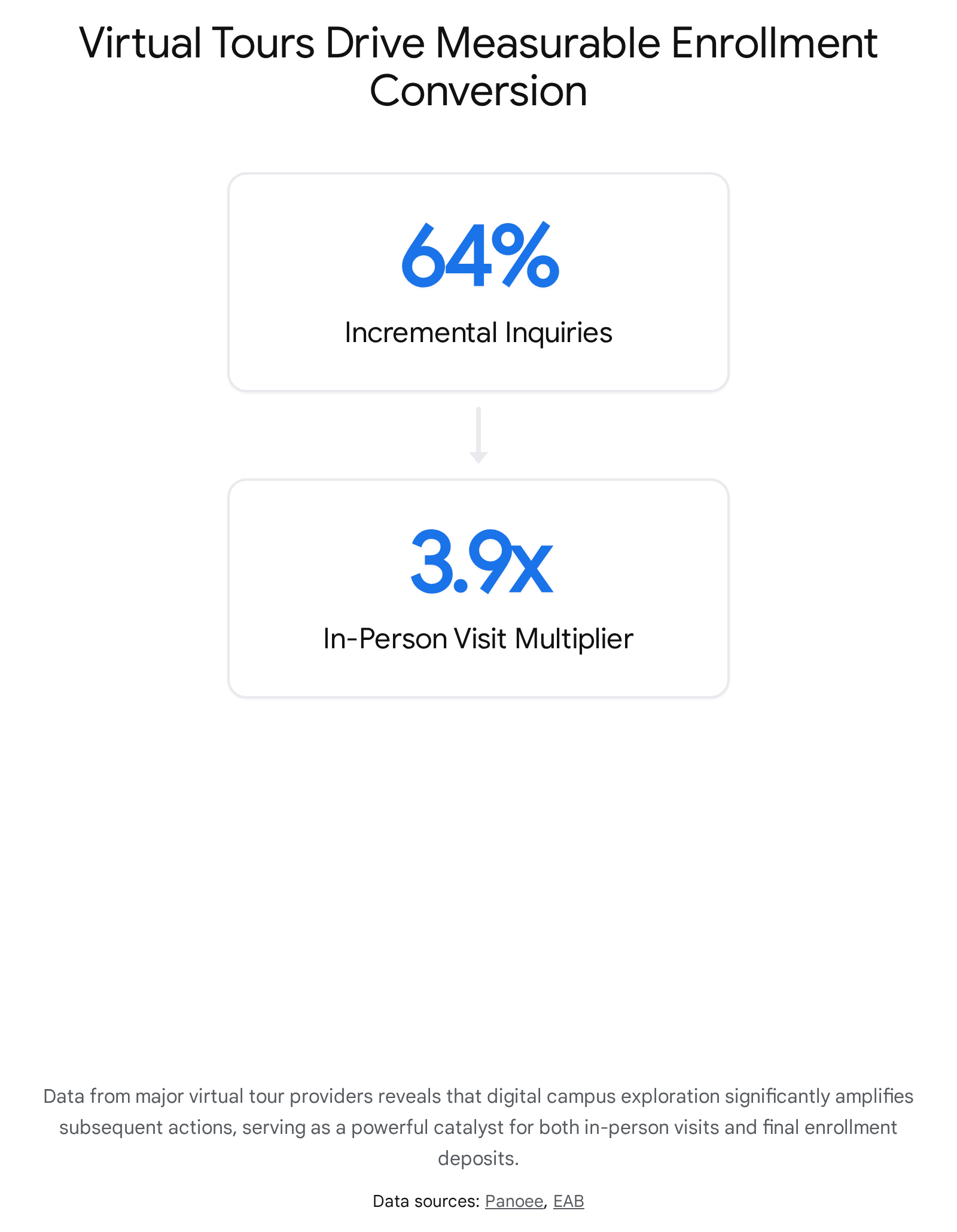
This allows the university to immediately deploy highly targeted marketing materials; if a student spends ten minutes exploring the virtual engineering quad, their next automated email will highlight the robotics program rather than a generic campus overview 238.
Looking toward the bleeding edge of educational technology, institutions are aggressively experimenting with the concept of the "Metaversity" and the utilization of Digital Twins. A digital twin is an exact virtual representation of the physical university, continuously updated with real-time data regarding space utilization, energy consumption, course scheduling, and physical infrastructure 392441. While primarily used by administrators for facility management and predictive analytics, universities like Old Dominion University and the University of Kansas are leveraging these digital twins to create fully immersive learning environments and exploratory spaces for prospective students 2543. In these digital spaces, an applicant could utilize a VR headset to not only walk the campus but dynamically interact with digital avatars of current students and faculty, fundamentally blurring the line between physical presence and digital exploration 43. Accenture's Technology Vision research highlights that an overwhelming 95% of participants prefer learning using VR tools over traditional desktop computers, signaling a massive shift in how the incoming generation of students expects to consume spatial information 43.
Simultaneously, recognizing that Generation Z harbors a deep skepticism toward polished, institutional marketing, colleges are heavily investing in platforms that facilitate raw, peer-to-peer authenticity. Niche survey data indicates that today's juniors expect highly personalized digital experiences akin to a TikTok "For You Page" or Spotify recommendations; 83% of students state that personalized content makes a school more appealing, yet only 17% feel colleges are currently delivering that experience 2. To bridge this gap, universities are turning to decentralized, student-driven platforms.
ZeeMee has emerged as a dominant force in this space. Operating as a dedicated social media network exclusively for college-bound students, ZeeMee allows applicants to join university-specific communities, find potential roommates, and interact directly with current undergraduates via live chats and unscripted video feeds 192645. The platform currently hosts over 2.6 million students across more than 3,000 college communities, with one in three freshmen expected to use the app 45. For universities like Grinnell College and Washington University in St. Louis, ZeeMee has become a critical tool for demonstrating interest and boosting yield 1326. At Grinnell, an analysis revealed that out of 5,000 students in their ZeeMee community, 1,300 applied for admission - yielding an exceptional 26% inquiry-to-application rate, well above the industry average 26. By allowing admitted students to ask unfiltered questions to current students in a moderated digital space, the university fosters a sense of community long before move-in day.
Furthermore, to counteract the widespread adoption of generative AI in crafting application essays, platforms like InitialView have gained immense traction. InitialView's "Glimpse" and "VIVA" features allow students to submit short, unscripted video recordings responding to prompt questions on the fly, directly uploading their academic work and defending it verbally 4647. This provides admissions officers with authentic, verifiable proof of a student's critical thinking and communication skills, effectively bridging the gap for international, home-schooled, or virtual high school applicants who cannot secure an in-person alumni interview 46. Admissions directors from institutions like Middlebury College and the College of the Holy Cross have lauded these video glimpses for bringing a black-and-white application to life, allowing the student's true personality to shine through without the filter of an AI writing assistant 47.
Through vertical, student-produced videos resembling Instagram Reels or TikTok trends, universities are finally providing the unfiltered viewpoints that physical tours fail to deliver. Prospective students can watch an authentic video of a current sophomore showcasing the best late-night study spots or demonstrating secret shortcuts between buildings - content that builds significantly more trust and emotional resonance than a scripted admissions brochure 4827.
Geographic and Demographic Barriers: The Economics of the College Visit
The debate over the efficacy of physical versus virtual visits is inextricably linked to socioeconomic status, geography, and systemic equity in higher education. Expecting a student to physically visit multiple campuses across the country assumes a level of financial privilege that the majority of applicants simply do not possess.
For international students, the barriers to physical visitation are monumental. Beyond the exorbitant costs of intercontinental travel, international applicants face severe logistical and bureaucratic hurdles. State Department visa data released in 2025 indicated that student visa issuances dropped by a staggering 35.6% during the summer compared to the previous year, highlighting the profound geopolitical friction international students must navigate simply to enter the United States 1. Consequently, for an applicant residing in Jakarta, Lagos, or São Paulo, booking a flight to tour a campus in the American Midwest is rarely feasible. Virtual tours have shifted from an optional marketing convenience to the primary, critical mechanism for international recruitment 6. An immersive, multilingual 360-degree tour serves as a round-the-clock recruitment office operating across all time zones, allowing universities to aggressively court the international market without requiring students to cross borders or secure temporary travel visas 6.
Furthermore, financial barriers deeply impact domestic students and exacerbate educational inequality. Despite the fact that generous financial aid policies at elite institutions often mean lower-income students would pay as little as 15% of the sticker price, these students dramatically underapply to highly selective colleges 116. Extensive research by the Brookings Institution and the Jack Kent Cooke Foundation indicates that tenth-grade students in the top academic quartile are only half as likely to apply to a selective college if they come from a low-income family compared to a wealthy one 1516. The out-of-pocket cost of touring multiple out-of-state campuses serves as a massive psychological and financial deterrent, reinforcing the false perception that elite spaces are inaccessible. Even highly effective, national-scale advising programs face limitations; while they successfully mobilize low-income students to apply to stronger performing colleges, institutional admissions and financial aid practices have often lagged behind, leaving a quality education out of reach for many 16.
To combat this structural inequity, proactive universities are actively adjusting their expectations and leveraging technology to level the playing field. Many selective institutions offer targeted "fly-in" programs, covering the travel, accommodation, and meal costs for highly qualified, underrepresented, or first-generation students to experience the campus firsthand 50. Moreover, universities with a commitment to socioeconomic diversity utilize their enrollment algorithms to ensure that low-income students are not penalized for low demonstrated interest scores resulting from a lack of physical visits. The digital footprint - opening emails, attending virtual high school visits, logging into online financial aid calculators, and participating in virtual college fairs - becomes the great equalizer 2051. It allows economically disadvantaged students to signal their strong intent to enroll without spending thousands of dollars on speculative travel 20.
Additionally, elite institutions actively publicize their "need-blind" admission policies for international students to alleviate financial anxieties early in the search process. In 2025, a select group of U.S. institutions - including Amherst College, Bowdoin College, Brown University, Dartmouth College, Harvard University, MIT, Princeton University, and Yale University - continue to maintain need-blind policies for international applicants, meaning a student's ability to pay has zero impact on their chances of acceptance 52. By pairing these policies with robust virtual tour technologies, these institutions ensure that top-tier education remains accessible to global talent regardless of physical mobility.
Macro-Trends Influencing the College Search: The View from Higher Ed Media
The strategic purpose of the college visit is also being reshaped by broader macroeconomic shifts within higher education, as chronicled extensively by outlets like Inside Higher Ed and The Chronicle of Higher Education. Students are no longer touring campuses merely to assess the aesthetic beauty of the quad; they are deeply anxious about the return on investment (ROI) of their education in an economy increasingly disrupted by artificial intelligence.
Recent surveys highlighted by Inside Higher Ed reveal that a startling 47% of college students have considered changing their major specifically because of the rise of AI, with roughly one in six students having already done so 53. Students are expressing severe anxiety over the future job market, moving away from certain technology fields out of a fear of automation, while simultaneously demanding coursework that teaches them how to work alongside AI tools effectively 53. Consequently, there has been a marked increase in student interest in specific, career-focused programs, particularly in healthcare and specialized technology sectors 54.
This anxiety directly impacts how students utilize virtual versus in-person visits. The Niche 2025 Spring Junior Survey found that prestige and brand recognition are losing their absolute dominance; today, only 42% of students state that brand matters significantly in their decision-making process, while one in five juniors state they will not even consider a school that does not offer their highly specific, intended major 2. "Fit beats prestige" has become the defining mantra of the Class of 2026 2.
Because students are prioritizing academic specifics over general campus vibes, virtual tools have become indispensable. A student evaluating five different biomedical engineering programs can utilize virtual tours to directly inspect the laboratory equipment and research facilities at each institution in a single afternoon. In-person tours, which generally offer a broad, generalized overview of the university tailored to undecided liberal arts majors, often fail to provide the granular, major-specific detail that today's anxious, career-focused applicants demand. Universities are adapting to this by ensuring their marketing messages are heavily outcomes-focused, utilizing alumni surveys to demonstrate specific salary increases and job placement rates alongside their digital tours 55.
Extracting a Practical, Hybrid Visit Strategy
Given the disparate benefits of digital and physical exploration, the most effective approach for prospective students and their families is not to choose between the two mediums, but to deploy a strategic, phased hybrid model that optimizes both time and financial resources.
Phase 1: Broad Discovery and Curation (Virtual Only) During the sophomore and early junior years of high school, physical travel should be entirely minimized. Students should utilize comprehensive platforms like Appily, YouVisit, and CampusTours to aggressively explore 20 to 30 diverse institutions 56. This initial phase is about establishing baseline personal preferences: distinguishing between a large state research university versus a small liberal arts college, or an integrated urban campus versus an isolated rural setting. Engaging in virtual tours during this phase helps eliminate definitively poor fits without spending a single dollar on airfare or hotels 2829. EAB research indicates that 35% of students take their first virtual tour right before or just as they begin applying to schools, using it as a critical elimination tool 2328.
Phase 2: Targeted Engagement and Yield Protection (Virtual + Local) Once the college list is narrowed to 8-12 target schools during the spring of junior year and the summer before senior year, strategic digital engagement becomes critical. This is particularly vital for mid-tier private universities that actively track demonstrated interest to manage their yield. Students must formally register for official virtual information sessions using their legal name and the exact email address they plan to use on their Common Application to ensure their activity is properly logged in the university's CRM 69.
During this phase, students should join the respective ZeeMee communities, open marketing emails and click through the links, and attend local college fairs or high school visits when regional admissions representatives travel to their area 201426. Establishing this robust digital footprint ensures the applicant is maximizing their measurable "interest score" before applications are submitted in the fall 20. Furthermore, the summer before senior year provides a critical window to reach out to regional admissions officers with highly specific, well-researched questions via email, as admissions staff have more availability for genuine engagement before the application reading season begins 59. This deep virtual research also provides the exact details needed to craft a highly compelling, specific "Why Us?" supplemental essay, which remains one of the strongest possible demonstrations of applicant intent 60.
Phase 3: The Final Decision Visit (In-Person) Physical travel should be reserved strictly for the final stages of the admissions process. If a student is applying Early Decision - which constitutes a binding contractual agreement to attend if admitted - an in-person visit prior to application submission is highly recommended to ensure the absolute certainty required for that commitment 5061.
However, for Regular Decision and Early Action applicants, the most financially sound strategy is to defer all physical visits until after acceptance letters and financial aid packages have been received in the spring 50. Visiting a campus in April during an official "Admitted Students Weekend" ensures that the family is only spending money to evaluate realistic, financially viable options. Because there is a pending final decision, students and parents tend to be far more critical and observant when visiting colleges after acceptance rather than before 50. During these final visits, the focus should shift entirely away from the scripted official tour. Families should prioritize unscripted exploration - eating meals in the dining hall, talking to random students in the quad, reading campus newspapers, and assessing the true, unfiltered community culture to confirm their final choice 17.
| Feature | Virtual Campus Tours | In-Person Campus Visits |
|---|---|---|
| Cost & Time Investment | Zero. Highly efficient; allows a student to thoroughly explore dozens of campuses across multiple continents in a single afternoon without leaving their home, entirely bypassing the financial burden of travel 6. | High. Requires significant financial outlay for airfare, gas, hotels, and meals, alongside the opportunity cost of missed days of high school instruction and parental work 52. |
| Sensory Details | Lacking. Limited to visual and auditory inputs. Cannot convey weather realities, the physical exertion required to navigate the campus topography, or the actual quality of dining facilities 21. | Immersive. Allows students to physically feel the climate, taste the food, gauge the ambient noise levels of the library, and assess the true physical condition of the dormitories 21. |
| Unscripted Interactions | Moderate. While traditional virtual tours are highly polished, new platforms like ZeeMee and InitialView offer raw, peer-to-peer interaction and live, student-led Q&As that foster genuine connection 26454648. | High. Provides irreplaceable opportunities to observe the organic body language of the student body, read local bulletin boards, and initiate spontaneous conversations with faculty or current students 1721. |
| Admissions Impact | Strategic. Creates a highly trackable digital footprint in university CRM systems. Essential for logging demonstrated interest at mid-tier private colleges, especially for demographics unable to travel 5920. | Contextual. Fulfills demonstrated interest requirements, but offers no mathematical advantage over a registered virtual visit at most institutions. Largely irrelevant at highly selective universities 6910. |
Bottom Line
The narrative that a prospective student must physically walk a campus to demonstrate their commitment or understand an institution is an outdated relic of a pre-digital admissions landscape. Virtual college tours - powered by sophisticated CRM analytics, immersive 360-degree photography, and authentic peer-to-peer social platforms - offer unparalleled efficiency. They provide students with critical insights into academic programs and facilities while seamlessly logging demonstrated interest where it matters most, leveling the playing field for international and lower-income applicants. However, the physical visit retains its supreme value as the final arbiter of psychological fit, offering the unscripted, sensory realities that confirm whether a campus truly feels like home. By embracing a strategic, phased hybrid approach, families can protect their financial resources, maximize their admissions footprint, and ultimately make a highly informed, confident enrollment decision.