
What Does College Fit Actually Mean
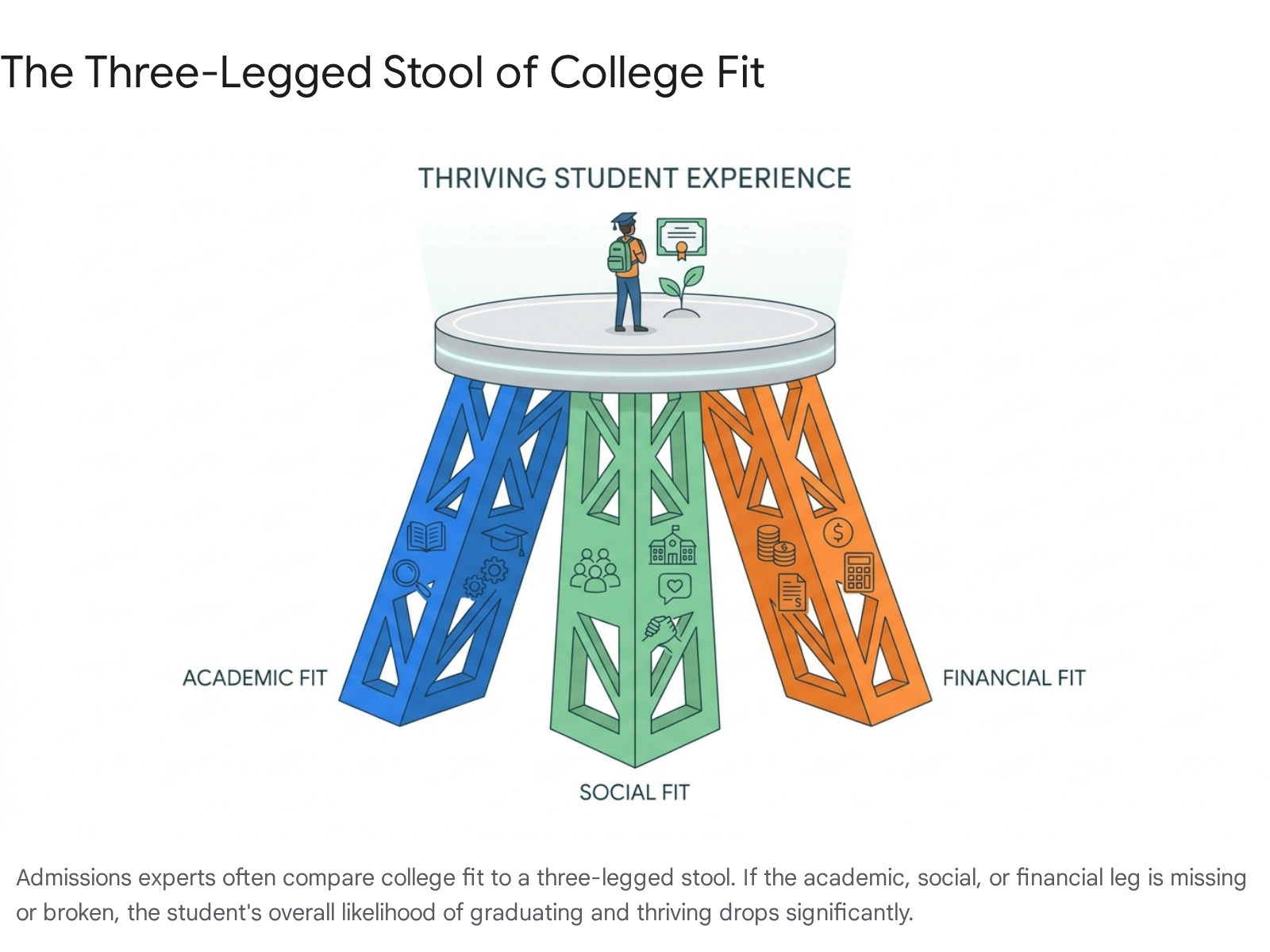
College fit is a holistic framework used to evaluate how well an institution aligns with a prospective student's academic goals, social preferences, and financial realities. By balancing these three foundational pillars - often described by admissions experts as a three-legged stool - students maximize their chances of graduating on time, protecting their mental health, and entering the workforce without debilitating debt.
The process of selecting a higher education institution is arguably the first major life decision a young adult makes, carrying lifelong economic and psychological implications. Yet, the college search process is routinely clouded by marketing brochures, subjective national rankings, and mounting anxiety over tuition costs. High school guidance counselors, independent educational consultants, and university admissions officers frequently advise families to ignore external noise and focus entirely on finding a school that represents a "good fit" 12.
However, "fit" is an incredibly complex, multifaceted term that is often misunderstood by the general public. It is not simply a quantitative assessment of whether a student's high school grade point average (GPA) and standardized test scores fall within an institution's historical admissions averages. That quantitative alignment is more accurately described as a "match" 1. True college fit is a qualitative, holistic alignment of the student's needs with the institution's offerings. To navigate this high-stakes process successfully, families must critically evaluate the three foundational pillars of the college experience: academic fit, social fit, and financial fit 242.
The Evolution and Controversy of "Fit"
Before deconstructing the mechanics of evaluating a university, it is necessary to address the evolving controversy surrounding the term "fit" within the higher education landscape. The metaphor of the "three-legged stool" has long been utilized in various industries to describe essential balance - from retirement planning relying on savings, pensions, and Social Security, to faculty tenure relying on teaching, research, and service 673. In college admissions, the three legs represent academics, the social environment, and affordability 429. When one of these legs is broken, the entire college experience is at risk of toppling over 29.
Despite the utility of this metaphor, modern higher education leaders and diversity, equity, and inclusion (DEI) experts warn that the concept of "fit" can inadvertently be weaponized against marginalized populations. Lawrence Alexander, a national expert on DEI in higher education, notes that "fit" has historically implied that a student needs to assimilate into the mold of a campus's dominant culture 1. When "fit" functions as a code word for "similarity," it places the burden on students of color, first-generation students, and low-income students to adapt to predominantly white, affluent, Eurocentric college cultures 1.
Tierney Bates, an administrator at the University of North Carolina - Chapel Hill, has similarly argued that the traditional use of the word "fit" leaves little room for students of diverse backgrounds to be genuinely embraced for their differences 1. Bill Conley, the former Vice President for Enrollment at Bucknell University, echoes this sentiment, noting that institutions should not seek conformity, as demanding uniformity stifles intellectual and cultural evolution on campus 1.
To correct this historical bias, progressive admissions offices are actively redefining the term. Northwestern University, for example, explicitly tells applicants that there is no single way to "fit" on their campus. Instead, they reframe the concept as "a story you tell us about how you see yourself thriving on campus" 1. For students and families, this is a vital paradigm shift. Evaluating a college is not an exercise in figuring out if the student will easily blend into the background; it is a rigorous investigation into whether the institution possesses the specific resources, pedagogical environment, and structural culture required for the student to grow, succeed, and ultimately graduate 12.
The First Pillar: Evaluating Academic Fit
Academic fit is frequently the most visible and prioritized pillar of the college search, but it extends far beyond simply verifying whether a university offers a specific undergraduate major. A significant percentage of high school students enter college undecided about their academic trajectory, and among those who do declare a major, an overwhelming number will change it multiple times before graduation 4. Selecting a college based solely on a single highly ranked academic department is therefore a risky strategy. True academic fit must be evaluated holistically, examining the overarching learning environment, the accessibility of the faculty, and the structural interventions the institution provides to ensure students actually cross the finish line.
Pedagogical Style and Learning Environments
When assessing academic fit, families must critically consider the fundamental mechanics of how a particular student learns best. Institutions vary wildly in their pedagogical approaches. Some students thrive in massive, anonymous lecture halls containing hundreds of peers, relishing the independence of a large state flagship university 24. Others require intimate, discussion-based seminars where participation is mandatory and professors notice if a student is absent 211.
Key variables to investigate include the ratio of tenured professors to graduate teaching assistants (TAs). At large research universities, introductory and survey courses are frequently taught by TAs, while liberal arts colleges pride themselves on having full-time faculty instruct undergraduates directly 115. A common myth among high school students is that professors at rigorous institutions are inherently unapproachable or intimidating. In reality, faculty accessibility is largely a function of institutional priorities 4. Students who require hands-on mentorship should prioritize colleges where professors are explicitly incentivized to hold office hours and involve undergraduates in their research 56.
Curriculum flexibility is another vital component of academic fit. Students must determine how easy it is to double major, add a minor, or take interdisciplinary electives outside of their primary field 2. Some universities enforce strict core curriculum requirements that dictate a student's schedule for the first two years, while others offer an "open curriculum" that allows students to design their own educational pathways 11. Furthermore, institutions differ significantly in their commitment to experiential learning. Students seeking a direct pipeline to the workforce should prioritize schools with robust co-op programs, integrated service-learning, and heavy investments in career services 78.
The Flawed Proxy of Commercial College Rankings
For decades, families have relied on national lists, most notably the U.S. News & World Report Best Colleges rankings, as a definitive proxy for academic fit. A school moving up five spots is celebrated, while a drop of seven spots can cause families to abruptly cross an institution off their list 16. However, higher education researchers, university presidents, and admissions experts increasingly warn that treating these rankings as an objective measure of academic quality is a dangerous trap 16910.
The primary criticism of commercial college rankings is that their mathematical formulas are heavily weighted toward institutional inputs rather than student outcomes. Historically, a massive portion of the U.S. News ranking has relied on "peer assessment" surveys, where university administrators subjectively rank rival schools based on perceived reputation 919. Additionally, formulas have historically rewarded alumni giving rates, faculty compensation, and student selectivity (the percentage of applicants a school rejects) 910. Critics argue that these metrics are essentially proxies for generational wealth and historical privilege, rewarding institutions for asset hoarding rather than measuring what students actually learn or how effectively a faculty teaches 1020.
In recent years, the credibility of these ranking systems has fractured under the weight of data manipulation scandals. When Columbia University was caught submitting inaccurate data to U.S. News, the institution plummeted from No. 2 to No. 18 in a single year 1610. Similarly, a former dean at Temple University's business school was federally sentenced for orchestrating a massive rankings fraud scheme, and Rutgers Business School faced lawsuits regarding the inflation of post-graduate employment data to boost rankings 20. These incidents highlight a persistent pattern: the intense pressure to climb the rankings incentivizes dishonest behavior and rewards administrative gamesmanship that does nothing to improve the actual classroom experience 20.
The movement against these rankings is gaining significant institutional momentum. By 2023, approximately one-third of the nation's law schools had publicly withdrawn their cooperation from the U.S. News surveys, following similar boycotts by prestigious medical schools and undergraduate institutions like Reed College 920.
If commercial rankings are a flawed metric for academic fit, what should students evaluate instead? Experts recommend focusing on concrete student outcomes. Specifically, prospective students should look at retention rates (the percentage of first-year students who voluntarily return for their sophomore year) and graduation rates (the percentage of students who complete their degree within a standard timeframe) 119. Furthermore, families can utilize the U.S. Department of Education's College Scorecard to investigate alumni earnings and post-graduate debt loads relative to specific academic programs 1921.
Retention, Interventions, and the Graduation Guarantee
A college's willingness to admit a student does not always equate to a willingness to support them through to graduation. Despite the immense financial and personal investment required to attend college, national data paints a sobering picture: four-year institutions graduate an average of only 51% of their students within six years of matriculation 22.
True academic fit means an institution possesses the structural infrastructure to support students when they inevitably face rigorous academic hurdles. Research continually demonstrates that targeted, data-driven academic interventions dramatically improve student outcomes. For example, a landmark study of the Accelerated Study in Associate Programs (ASAP) model at the City University of New York (CUNY) served as a blueprint for institutional reform. The CUNY model - which provides students with special tutoring, proactive success coaching, and customized courses in remedial reading and math - successfully doubled the graduation rate of developmental students 11.
Similarly, studies approved by the What Works Clearinghouse (WWC) have found that intrusive interventions, goal-setting reflection exercises, and predictive analytics-based proactive advising significantly improve student retention 11. An analysis of at-risk university students revealed that when institutions provide personalized academic support and success coaching, graduation rates for those specific subgroups increased by 55% to 60% 11.
When touring campuses, students should look past the multimillion-dollar recreation centers and actively inquire about the presence and accessibility of tutoring centers, writing labs, academic advising, and disability support services 28. An institution's academic fit is ultimately defined by its safety nets.
The Second Pillar: Understanding Social and Personal Fit
A student's academic performance is inextricably linked to their social and emotional well-being. Even if a university boasts a world-class engineering program or a prestigious business school, a student who feels isolated, alienated, or unsafe on campus is highly unlikely to thrive, and their academic performance will invariably suffer 4. Social fit encompasses the geographic location of the school, the size and demographics of the student body, the dominant campus culture, and the availability of extracurricular engagement 24.
Campus Culture and Post-Pandemic Realities
Campus culture is the intangible "vibe" of an institution. It dictates how students spend their weekends, how heavily Greek life (fraternities and sororities) influences the social hierarchy, and whether the campus is politically active, heavily focused on Division I athletics, or oriented around the arts 24724.
The COVID-19 pandemic radically disrupted campus culture, leading to unprecedented levels of social isolation and academic detachment. However, longitudinal research tracking college students from 2020 through 2025 indicates a significant post-pandemic rebound. Students are currently reporting rising life satisfaction, declining loneliness, and a sharp increase in in-person social interactions 12. Data analyzing over 100,000 students reveals that average time spent engaging in social activities on campus has escalated by over 80% compared to pandemic lows, particularly among highly engaged students 26.
Interestingly, the pandemic permanently altered how students approach their daily routines and learning preferences. While students overwhelmingly desire a return to a robust, in-person campus social life, they retain a strong preference for hybrid academic and work environments 1227. Furthermore, student habits regarding physical spaces have shifted; post-pandemic, student use of on-campus fitness centers dropped drastically, suggesting students are increasingly seeking independent or off-campus fitness opportunities 26. When evaluating social fit today, students must consider how a university integrates digital flexibility with traditional in-person community building.
The Imperative of Mental Health Support
When evaluating social fit, prospective students must critically consider an institution's mental health infrastructure. The transition to emerging adulthood - which coincides with the typical college years - is a developmental period when mental health disorders historically peak across the general population 13.
Recent data from the annual Healthy Minds Study, which surveys over 100,000 undergraduate and graduate students across nearly 200 U.S. universities, offers cautious optimism alongside stark reality. For the second consecutive year (2023-2024), overall symptoms of depression, anxiety, and suicidal ideation declined slightly across the college demographic 1415. However, the baseline remains alarmingly high. Approximately 38% of undergraduates reported moderate depressive symptoms, while 19% reported severe depressive symptoms 1415. Nonsuicidal self-injury dropped to 13%, and reports of eating disorders stabilized at 13% 1415.
Perhaps the most encouraging metric is treatment utilization. Among students exhibiting symptoms of depression or anxiety, a record 61% are now actively utilizing mental health therapy or counseling 1415. Furthermore, the stigma surrounding mental health on campus has largely evaporated; only 7% of students surveyed agreed that they would think less of someone who received mental health treatment 14.
These figures underscore a critical reality for prospective families: college is inherently stressful, and mental health challenges are highly prevalent. Consequently, social fit must include a rigorous evaluation of a university's counseling center. Research demonstrates a direct, undeniable link between college counseling and academic retention. Students who utilize campus mental health services and remain in counseling as recommended are significantly more likely to experience GPA increases and successfully graduate than peers who drop out of therapy or are relegated to off-campus waitlists 22.
When assessing social fit, families should ask admissions officers and current students specific questions: How long are the wait times for the campus counseling center? Are there strict session limits per semester? Does the university utilize proactive "early alert" systems to identify struggling students before they reach an academic or psychological crisis point? 2213.
How to Accurately Research Campus Culture
Colleges spend millions of dollars on sophisticated marketing materials and highly orchestrated campus tours designed to present an idyllic, frictionless version of campus life. To determine true social fit, students must look past the glossy brochures and curated messaging. Admissions counselors, educational consultants, and current college students recommend several specific strategies for uncovering the authentic campus culture:
- Leverage Unofficial Digital Communities: Platforms like Reddit (specifically the
r/ApplyingToCollegecommunity and individual university subreddits) are invaluable resources. Prospective students can read unfiltered discussions about the true social scene, the quality of dining hall food, and administrative frustrations that will never appear in a brochure 31323334. Other sites like Unigo, Niche, and Greekrank provide crowdsourced student reviews that reveal the dominance of fraternity/sorority life and overall student satisfaction 31323334. - Observe the Unscripted Campus: If visiting in person, students should spend time deliberately disengaged from the official tour group. Eat a meal in the main dining hall, read the bulletin boards in the student union, sit in on a lecture, and pick up a copy of the independent student newspaper to see what controversies or issues are currently animating the student body 16.
- Ask Direct, Revealing Questions on Tours: Tour guides are trained ambassadors, but they are also current students who generally want to share their authentic experiences. Instead of asking easily Googled questions, prospective students should ask behavioral and cultural questions that force the guide to elaborate 11624.
| Assessment Goal | Traditional Question (Avoid) | High-Value Question (Ask Instead) |
|---|---|---|
| Gauging Academic Culture | "Are the classes hard?" | "Is the academic culture here more collaborative or competitive? Do students form study groups easily?" 68 |
| Gauging Weekend Social Life | "What is there to do for fun?" | "What percentage of students stay on campus during the weekends versus going home?" 824 |
| Gauging Faculty Access | "What is the student-to-faculty ratio?" | "How often do you interact with your professors outside of class, and do undergrads actually get to assist in research?" 116 |
| Gauging Institutional Honesty | "Do you like it here?" | "If you were the university president for a day, what is the one thing about this school you would fix?" 816 |
The Third Pillar: Navigating Financial Fit
A college can offer the perfect academic curriculum and a vibrant, supportive social scene, but if attending requires a family to take on an insurmountable burden of high-interest debt, it is fundamentally a poor fit. Financial fit is the reality check of the college search process. Unfortunately, the higher education pricing model is notoriously opaque. The system for setting the actual price for each student is often compared to airline pricing - where the student sitting next to you in a lecture hall may be paying a vastly different amount for the exact same education 36.
Deconstructing Sticker Price Versus Net Price
The most common and costly mistake families make when evaluating financial fit is ruling out an institution based solely on its "sticker price." The sticker price is the published, advertised cost of attendance, which includes tuition, mandatory fees, room, and board 173839.
For the 2024-2025 academic year, the average published sticker prices represent a massive financial commitment. Public four-year institutions charge an average of $11,610 for in-state students and $30,780 for out-of-state students, while private nonprofit four-year institutions average $43,350 17. Highly selective elite universities and Ivy League institutions frequently feature total sticker prices exceeding $85,000 per year 3940.
However, the sticker price is essentially a "retail" illusion. The vast majority of college students do not pay this amount 41. What matters is the net price - the actual amount a family pays out-of-pocket or borrows after all grants, merit-based scholarships, and federal aid are subtracted from the sticker price 173918.
| Institution Type | Pricing Mechanism | Typical Financial Impact on Families |
|---|---|---|
| Public State Universities (In-State) | Lower baseline sticker price subsidized by state taxpayers. 17 | Generally the most affordable option, though massive institutional grants are less common than at elite privates. 38 |
| Public State Universities (Out-of-State) | High sticker price with limited state-based financial aid for non-residents. 17 | Often the most expensive net price scenario unless the student secures substantial merit scholarships. 1738 |
| Elite Private Universities | Massive sticker price (often $85k+), but backed by multi-billion dollar endowments. 4043 | Often surprisingly affordable for low- and middle-income families; many families earning under $100k pay zero tuition due to institutional need-based grants. 3940 |
Because private universities generally possess much larger endowments than public state schools, they have the financial capacity to offer massive institutional grants. Consequently, a highly selective private university with an $85,000 sticker price may actually result in a significantly lower net price for a middle-income family than their local public university 394043.
To accurately assess financial fit before applying, families must utilize Net Price Calculators (NPCs). Federal law mandates that every college host an NPC on its financial aid website 214445. By inputting tax information, household size, and student academic metrics, families receive a customized estimate of their out-of-pocket costs for that specific institution 4445. As a rule, students should never apply to a college blindly; families should run the NPC for every prospective school to ensure it is financially viable before the student becomes emotionally attached to the campus 3646.
The 2024-2025 FAFSA Simplification Act: Winners and Losers
Financial fit is heavily dictated by the data submitted through the Free Application for Federal Student Aid (FAFSA). In the 2024-2025 academic cycle, the U.S. Department of Education implemented the FAFSA Simplification Act, representing the most radical overhaul to the federal financial aid system in decades 1948.
The most significant structural change is the replacement of the Expected Family Contribution (EFC) with the Student Aid Index (SAI) 1949. While the new FAFSA is designed to be shorter and easier to fill out - dropping from over 100 questions to fewer than 40 and drawing tax data directly from the IRS - the underlying mathematical formula has shifted significantly, creating distinct financial winners and losers 48.
| FAFSA Metric / Policy | Old Formula (EFC) | New Formula (SAI) | Impact on Financial Fit |
|---|---|---|---|
| Multiple Children in College | Parent contribution was divided by the number of children in college simultaneously. 4950 | Sibling discount eliminated. The formula no longer divides the parent contribution. 4950 | Negative for middle- and high-income families with multiple children in college simultaneously, potentially reducing their aid. 4851 |
| Income Protection Allowance (IPA) | Lower baseline of income protected from the aid calculation. 48 | IPA increased by roughly 20%, protecting significantly more parent and student income from assessment. 4852 | Positive for working families; higher income doesn't automatically spike the SAI, often offsetting other formula penalties. 52 |
| Pell Grant Expansion | Eligibility tied strictly to the complex EFC formula. 48 | Eligibility directly tied to Adjusted Gross Income (AGI) and poverty guidelines; minimum SAI can drop to -$1,500. 4851 | Positive for lower-income families and single-parent households, resulting in guaranteed Pell Grants for a wider demographic. 5051 |
| Small Businesses & Family Farms | Businesses with fewer than 100 employees and family farms were exempt from asset reporting. 5153 | The net worth of small businesses and family farms must now be reported as an assessable asset. 505153 | Negative for farming families and small business owners, likely raising their SAI and reducing overall aid eligibility. 5051 |
The Long-Term Return on Investment
When evaluating financial fit, families must view the cost of college not merely as an immediate four-year expense, but as a long-term investment with a measurable economic return. Despite rising anxiety over student debt and high-profile debates regarding the value of higher education, extensive economic research continues to prove that, for the vast majority of students, college remains a highly sound financial decision.
A 2024 analysis by the Federal Reserve Bank of New York found that a college degree yields a 12.5% rate of return over a lifetime - well above the threshold for a standard sound investment 20. The "wage premium" for college graduates is currently near an all-time high; a typical bachelor's degree holder earns a median of $32,000 more per year than a peer with only a high school diploma, which compounds to approximately $625,000 in additional lifetime earnings 2021.
Furthermore, the financial fit of a degree pays massive dividends beyond base salary. College graduates are 47% more likely to receive employer-provided health insurance and 72% more likely to have employer-sponsored retirement plans 21. During economic downturns, the employment stability of a degree becomes starkly apparent; the unemployment rate for college graduates is routinely half that of those with only a high school education 21.
Balancing the Trade-Offs: The FAST Framework
Very few colleges will score perfectly across all dimensions of fit. Ultimately, families must make calculated trade-offs. Some educational consultants have expanded the three-legged stool into the "FAST" acronym: Financial, Academic, Social, and Timeliness 57.
Timeliness refers to the reality that taking five or six years to graduate drastically alters the financial fit of an institution 5758. An extra year of college does not just mean an extra year of tuition; it also represents a lost year of full-time professional income, creating a massive opportunity cost 2058. Therefore, a school that is slightly more expensive upfront but boasts a 90% four-year graduation rate may ultimately be a better financial fit than a cheaper school where students struggle to secure the classes they need to graduate on time.
Admissions and financial advisors strongly suggest that financial fit must be viewed as the foundational prerequisite for the other two legs 42260. If a family must resort to massive, high-interest private parent loans to cover the gap between grants and the net price, the school is fundamentally unaffordable, regardless of how prestigious it is 57. Financial stress is one of the leading causes of college dropout rates; an academically rigorous environment is of little use if the student is forced to withdraw due to unpaid tuition bills 23.
When forced to choose between a highly prestigious, hyper-expensive university and a more affordable, moderately selective college that still offers a strong social and academic environment, research points toward the latter. Landmark economic studies by Alan Krueger and Stacy Berg Dale have demonstrated that attending an elite "name-brand" university does not inherently lead to greater success or higher earnings compared to attending a less selective school, provided the student remains engaged and performs well academically 6263. Success is driven by what a student does on campus - forging mentorships, engaging in undergraduate research, and protecting their mental health - rather than the prestige of the bumper sticker on their car 263.
A college application strategy should be targeted and deliberate. Applying to dozens of random schools in hopes of securing a single elite acceptance spreads a student's energy thin and completely ignores the mechanics of fit 6264.
Bottom line
Finding a college that represents the right fit requires balancing a three-legged stool of academic, social, and financial alignment. Students must seek out learning environments that support their specific academic needs, campus cultures that foster belonging and protect their mental health, and net prices that do not require insurmountable, high-interest debt. While the FAFSA simplification process has altered the financial math for many middle-class families, the rigorous use of Net Price Calculators and a focus on long-term graduation outcomes rather than prestigious commercial rankings remain the most effective strategies for identifying a college where a student will genuinely thrive.
- What Does Fit Really Mean?
- What is Best Fit
- College Match and Fit Toolkit
- Step by Step: College Awareness and Planning
- What to Know About College Fit
- Graduation Rates and Student Success Interventions
- Postsecondary Student Mental Health Transitions
- College Students' Mental Health Improving (UMich)
- College Students' Mental Health Improves (BU)
- Mental Health and College Graduation Rates
- Five Tips for Using a College Net Price Calculator
- How to Use Net Price Calculators (Video)
- Net Price Calculator Lesson
- Understanding College Costs: Net Price Calculator
- Net Price Calculators (Great Choices)
- Time in USA
- Time in New York
- Students Rebounding After Pandemic (MSU)
- Analyzing Student Engagement Trends Pre/Post Pandemic
- Impact of COVID-19 on College Academic/Social Lives
- Revitalizing the Higher Ed Campus Experience
- How the Pandemic Changed Student Mindsets
- Criticism of College Rankings
- Do You Trust US News College Rankings? (Reddit)
- The Value of a College Degree vs Rankings (CBS)
- The Scandal of US News College Rankings
- The U.S. News College Ranking Trap
- The Three-Legged Stool of Academia
- Three-Legged Stool of Retirement (SoFi)
- Origins of the Three-Legged Stool Metaphor
- Three-Legged Stool of College Funding
- Three-Legged Stool in Education
- Sticker vs. Net Price 2024-25 (NASFAA)
- Trends in College Pricing 2024 (College Board)
- How FAFSA Changes Impact Students 2024-25
- FAFSA Simplification Act Implementation (FSA)
- Ignore the Sticker Price (Brookings)
- Time in Kansas City
- Time in USA
- What is the Student Aid Index (SAI)?
- Most Important FAFSA Changes
- FAFSA 2025-26 SAI Income Protection Allowances
- 5 Important FAFSA Changes
- How the New SAI Impacts Financial Aid
- Discovering Your Fit: College Tour Questions
- NACAC Campus Visit Checklist
- Questions to Ask on a College Tour (CEG)
- Questions to Ask Your College Tour Guide (Tufts)
- Questions to Ask on a College Tour (Princeton Review)
- College Planning Myths Debunked
- Biggest Myths About College Admissions
- College Application Myths Debunked (Forbes)
- 13 Misconceptions About College Life
- Enrollment Myths Universities Believe
- Weighing Prestige vs Cost of Colleges
- College a Good Investment for Most (AAU)
- True Value of College Education
- TIAA Institute: College Degree Still Pays Off
- Is College Worth It? (Pew Research)
- Researching Campus Culture (Reddit High School)
- Researching School Social Scenes (Reddit A2C 1)
- Researching School Social Scenes (Reddit A2C 2)
- Getting to Know a School's Culture (Video)
- Learning About College Culture (Reddit A2C 3)
- Financial, Academic, Social Fit
- Trade-offs in College Decisions
- Understanding College Fit (College Funding Coach)
- College Decision Walkthrough (Video)
- Academic vs Social Fit (Reddit A2C)
- What Does Fit Mean to You? (College Confidential)
- Best Colleges in America 2025 (Money)
- Higher Education Faces Its Biggest Test
- Equity as a Three-Legged Stool
- Defining Quality in Undergrad Experience
- Time in Nottinghamshire
- The Three-Legged Stool Analogy in Admissions
- History of Testing
- Three-Legged Stool Essay Structure
- William James College Report
- ERIC Document 133094
- Why Does College Cost So Much?
- Sticker Price vs Net Price (Admissions Sight)
- Don't Think You Can Afford College? Look at Net Price
- How Much Does an Ivy League Education Cost?
- Sticker Price vs Net Price Estimates