
What to Look For and Ask on a College Campus Visit
Direct Answer Summary
A successful college campus visit requires a strategic transition from a passive consumer of institutional marketing to an active, analytical investigator of academic and social realities. Crucial steps involve meticulous pre-visit preparation, specifically researching an institution's demonstrated interest tracking policies through the Common Data Set to leverage the visit for admissions leverage. During the visit, prospective students must deliberately separate the highly curated, scripted narratives of official guided tours from the authentic, lived experiences of the broader student body. This objective is achieved by engaging in independent campus exploration, auditing live academic classes, and conducting informal interviews with unaffiliated students and faculty members. Finally, the visit must conclude with immediate post-tour documentation within a twenty-four-hour window and strategic follow-up communications to solidify impressions and maximize the visit's impact on institutional predictive admissions algorithms.
The "Test Drive" Imperative
Purchasing an automobile based solely on a dealership's glossy promotional brochure or an aggressively curated social media advertisement is universally recognized as an ill-advised consumer practice. A prudent buyer conducts a rigorous test drive to evaluate the handling, inspects the mechanical components under the hood, and assesses the vehicle's real-world performance under varied conditions. The college campus visit operates on the exact same premise, albeit for an investment that often exceeds hundreds of thousands of dollars and fundamentally dictates four formative years of a young adult's personal and professional trajectory 1.
University marketing materials, viewbooks, and digital platforms represent the showroom floor: highly polished, perfectly lit, and intentionally devoid of structural imperfections. The campus visit, conversely, represents the test drive. It is the critical, irreplaceable juncture where a prospective student must evaluate whether a multi-million-dollar infrastructure genuinely supports rigorous academic inquiry, if the underlying social climate aligns with personal values, and if the institution represents an optimal environmental and geographic fit 123. Exploring the physical campus provides a holistic, multi-sensory perspective that highly stylized websites cannot replicate, offering tangible insights into the atmospheric, pedagogical, and cultural realities of higher education institutions 416.
Within the context of a rapidly expanding, multi-billion-dollar independent college counseling industry characterized by heightened anxiety and the relentless pursuit of elite admissions, the physical visit serves as a necessary grounding mechanism 2. It shifts the focus away from abstract institutional prestige and redirects it toward the tangible, day-to-day lived experience of the undergraduate student.
The Evolution of the Campus Visit in the Post-2023 Landscape
The landscape of college admissions and campus engagement has undergone rapid, systemic changes, significantly accelerated by the lingering effects of the COVID-19 pandemic and exponential advancements in enrollment management technologies. Coverage from prominent publications such as the Chronicle of Higher Education highlights a sector bracing for an impending demographic enrollment cliff, driven by falling fertility rates and shifting population patterns 39. Consequently, universities are under immense pressure to secure their incoming cohorts, leading to the rapid adoption of highly sophisticated, data-driven admissions strategies 39.
The Sophistication of "Demonstrated Interest" Tracking
The concept of demonstrated interest is no longer limited to shaking a hand at a local college fair or signing a physical guestbook in a campus admissions office 10. In the modern admissions landscape, enrollment management is a highly sophisticated, algorithmic operation. Universities rely heavily on predictive yield models to forecast exactly how many admitted students will accept their offers, a metric that directly impacts the institution's financial planning, bond ratings, and national rankings 101112.
To feed these predictive models, colleges utilize advanced Customer Relationship Management (CRM) platforms, with Technolutions' Slate commanding a dominant market share among competitive institutions 10414. These platforms quietly and meticulously track digital and physical engagement to build comprehensive applicant profiles 1012. When a prospective student is entered into a college's CRM, the system begins logging a detailed digital footprint. Admissions counselors utilize centralized dashboards that track "quiet signals," such as whether an applicant opens promotional emails, the specific latency of those opens, which hyperlinks within the email are clicked, and the exact duration a student remains logged into a virtual information session 1011125.
Furthermore, integrated tools seamlessly share application statuses and activity data between high school counseling offices and university admissions departments, creating unprecedented real-time transparency regarding applicant behavior 1467. If an applicant claims a specific institution is their absolute first choice in a supplemental "Why Us?" essay, but the admissions CRM dashboard reveals they have never opened an email, attended a virtual session, or visited the campus, the algorithm flags this behavioral discrepancy. This lack of interaction can actively lower their probability of admission at schools that heavily weight predictive yield management 1011.
However, independent college counselors frequently remind families that highly selective, elite institutions - such as the Ivy League universities and top-tier public flagships - generally do not factor demonstrated interest into their holistic review processes 101819. These institutions are inundated with applications and operate under the correct assumption that any admitted student is highly interested; their yield rates are already overwhelmingly secure, rendering the tracking of campus visits unnecessary for admissions leveraging 101920.
The Efficacy and Limitations of Virtual Alternatives
The pandemic forced universities to rapidly develop virtual engagement tools, resulting in a permanent structural shift in how students initially explore colleges 1212223. Advanced technologies, including Virtual Reality (VR) photography, black-box tested interactive applications, and 360-degree immersive web-based environments, now allow prospective students to navigate campuses globally without geographic or financial barriers 21238. Enrollment management data indicates that universities utilizing robust virtual tours saw significant increases in overall application volume and early-stage engagement, proving the top-of-funnel efficacy of these digital platforms 21.
Virtual tours offer unmatched accessibility, breaking down inherent barriers for students from lower-income brackets, international locations, or marginalized communities who cannot afford the exorbitant costs of cross-country airfare and lodging required for physical visits 22325. They serve as a highly efficient, cost-free mechanism for narrowing down a massive initial list of potential colleges from a desktop computer 2326.
Despite these technological advancements, recent data reveals a post-pandemic recalibration in student sentiment. While virtual tours are excellent for preliminary research, they possess profound limitations regarding final matriculation decisions 123. Virtual platforms fundamentally cannot convey the authentic atmospheric "vibe" of a campus, the realities of the local climate, or the spontaneity of interactions with the academic community 123. Educational research indicates a powerful resurgence in the desire for physical, in-person campus experiences among prospective students, who increasingly cite social connection, extracurricular vitality, and tangible community fit as the primary drivers of their final enrollment decisions 229. Consequently, the optimal, evidence-based strategy integrates both methodologies: utilizing virtual tours to efficiently curate a targeted shortlist, followed by physical visits to confirm the ultimate cultural and spatial fit 2326.
Strategic Phasing of the Campus Visit
To maximize the utility of a college tour and extract actionable intelligence, educational consultants and admissions experts strongly advise dividing the process into three distinct, highly structured phases: Before, During, and After.
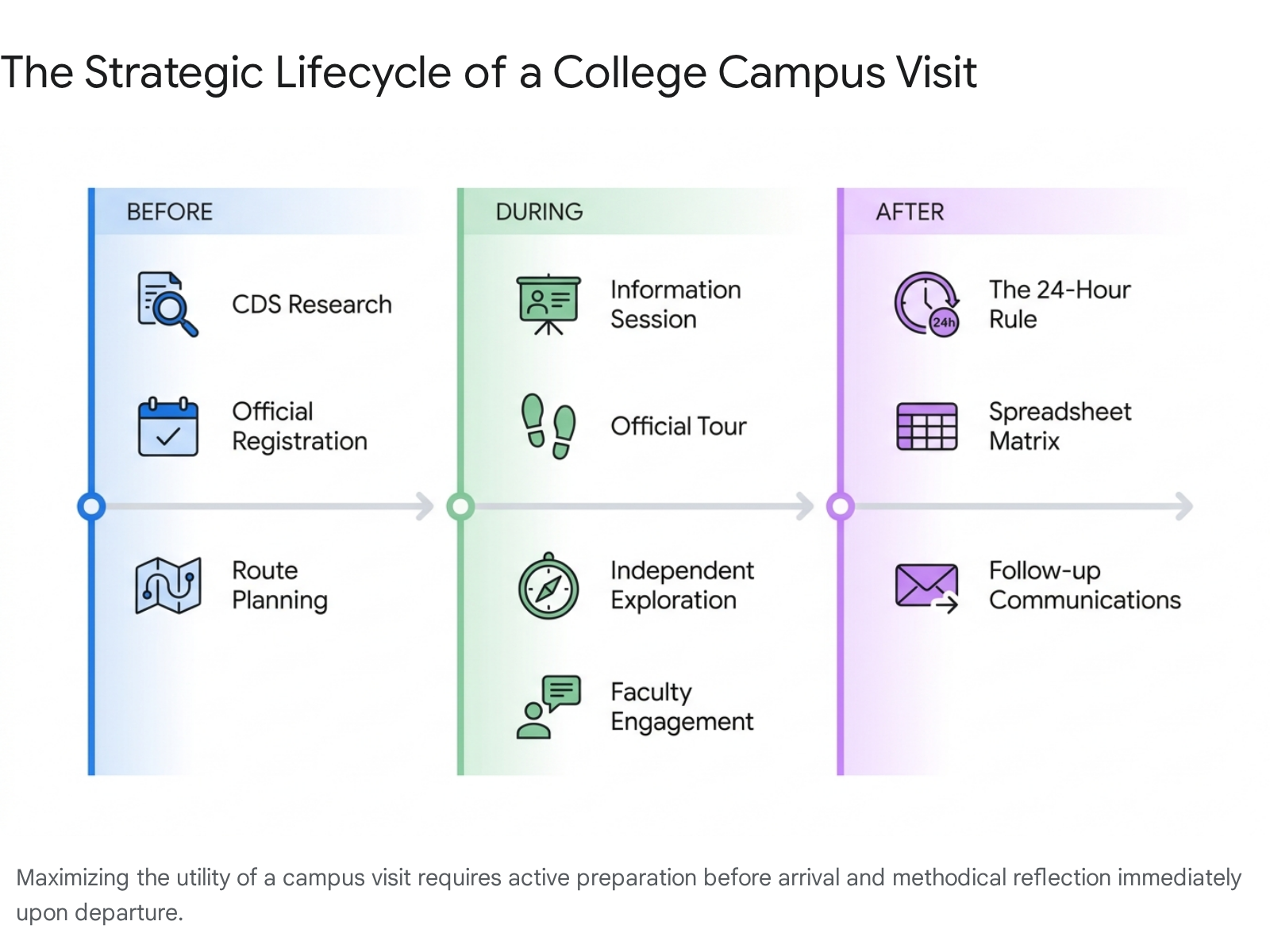
Phase 1: Before the Visit (Preparation and Strategy)
The efficacy of a campus visit is largely determined before the prospective student ever steps foot on the grounds. Strategic planning ensures that the physical visit yields high-value qualitative insights rather than redundant quantitative information.
Optimal visits occur when the university is operating under normal, active academic conditions. Touring a campus during a holiday weekend, a winter recess, or the height of summer deprives the visitor of observing the most critical variable: the active student body 428. Admissions professionals strongly advise scheduling visits between Monday and Thursday while classes are actively in session 28. This scheduling strategy allows families to observe the genuine tempo of the institution, ensuring the campus is bustling rather than resembling a deserted architectural park 2028. Independent counselors also strictly warn against over-scheduling; attempting to cram three or four campus tours into a single day is a recipe for physical exhaustion and the blurring of institutional memories, reducing the analytical value of the trip 2930.
A common error among visiting families is utilizing highly valuable face-to-face time with admissions officers to ask easily searchable questions. Information regarding student-to-faculty ratios, the number of academic majors offered, or basic application deadlines is readily available on the institution's website 3132. Time on campus should be strictly reserved for qualitative, nuanced inquiries that cannot be answered by a search engine. Pre-visit research should involve analyzing the university's academic calendar, mapping out distinct departments of interest, and identifying specific facilities - such as niche research laboratories, specialized art studios, or specific library archives - to explore beyond the boundaries of the standard tour route 36.
Before finalizing travel plans, families must determine whether the target institution tracks demonstrated interest. A highly effective method for determining this policy is searching for the institution's "Common Data Set" (CDS) online 1133. Section C7 of this standardized report explicitly indicates whether an institution considers an applicant's level of interest during the holistic admissions review 1133. If the institution does track interest, officially registering for the tour through the admissions portal - rather than wandering the campus anonymously - becomes a strategic necessity to ensure the applicant receives algorithmic credit for the engagement 619.
For families facing profound financial barriers that preclude cross-country travel, the proliferation of institutional "Fly-In" programs offers a critical avenue for equity and access. These initiatives are fully funded, immersive, multi-day campus visits designed specifically for high-achieving high school seniors from low-income backgrounds, first-generation households, and underrepresented rural communities 341011. Leading institutions absorb the comprehensive costs of airfare, lodging, and meals, allowing participants to attend actual classes, sleep in traditional dormitories, and engage directly with faculty without bearing the financial strain of the trip 341011. Programs such as Bowdoin College's "Explore Bowdoin" or Babson College's "Access Babson" frequently incorporate specialized workshops focusing on financial aid literacy and application strategy, fundamentally leveling the playing field for disadvantaged applicants evaluating elite institutions 1011.
Phase 2: During the Visit (Engagement and Observation)
The physical campus visit is typically bifurcated into formal, university-sponsored programming and informal, independent exploration. Both segments are essential, but they serve entirely different analytical purposes and require distinct evaluation frameworks.
The standard official campus visit commences with an information session led by an admissions officer, immediately followed by a walking tour led by a current undergraduate student 2812. It is vital to approach these events with a highly analytical mindset. Information sessions are meticulously crafted marketing presentations designed to aggressively highlight institutional strengths while minimizing or obfuscating structural weaknesses 293839. Independent college counselors advise families to listen carefully not just to the explicit content, but to the subtext of the presentation. Observers should analyze whether the institution emphasizes collaborative undergraduate research, or if the presentation leans heavily on athletic prestige, massive new amenities, and social fraternities. The underlying themes of the presentation often reveal the administration's true financial and cultural priorities 40.
When embarking on the student-led walking tour, visitors must actively guard against the psychological phenomenon known as "Perfect Tour Guide Bias." Tour guides are specifically selected, rigorously trained, and financially compensated to serve as enthusiastic, articulate ambassadors for the university 293913. Their stated experiences are generally genuine, but inherently curated to reflect positively on the institution. A pervasive misconception among prospective families is allowing the charisma - or lack thereof - of a single twenty-year-old guide to disproportionately influence their perception of a sprawling institution 1342. The tour guide represents an extremely limited sample size within a population of thousands. While their insights are valuable, visitors must extract objective data from the tour while consciously filtering out institutional rhetoric and memorized jokes 313813.
To truly ascertain the cultural and academic reality of a college, prospective students must transition from the guided tour to independent exploration. Going "off-script" strips away the marketing veneer and allows for unfiltered, objective observation of the university ecosystem 34344.
| Evaluation Method | Objective Focus | Limitations & Blind Spots |
|---|---|---|
| The Curated Guided Tour | Provides an efficient geographical overview of the campus, highlights flagship architectural facilities, and delivers standardized institutional facts regarding safety, housing policies, and historical traditions 31238. | Highly scripted and sanitized. Guides are trained to avoid discussing systemic administrative issues, outdated facilities, or negative aspects of the campus social climate. Showcases only the most pristine "model" dormitories 383913. |
| Authentic Independent Exploration | Allows for the observation of unscripted student behavior, the assessment of baseline infrastructure (older academic halls and standard freshman dorms), and spontaneous interactions with unaffiliated faculty and students 3314445. | Requires proactive extroversion and self-direction. Families may miss subtle historical context or specific policy details that a trained guide would otherwise provide during a structured walk 314446. |
Independent exploration encompasses several critical audits. First, executing the "Dining Hall Test" by eating a meal in a central dining facility provides profound insight into both culinary quality and underlying social dynamics. Observers should note whether students congregate in diverse, lively groups, or if the atmosphere is isolated, stressed, and segmented 1242. Second, conducting a "Bulletin Board Audit" by scanning physical fliers in student centers or academic buildings reveals the true pulse of campus life. Advertisements for grassroots protests, niche academic lectures, diverse religious organizations, or Greek life events highlight the actual interests and daily activities of the student body, far beyond what is printed in the viewbook 2946. Finally, prospective students must perform a "Facilities Check." While official tours showcase pristine model dormitories and state-of-the-art flagship buildings, visitors should deliberately explore older academic halls, standard unrenovated freshman dormitories, and deep library stacks to assess the baseline infrastructure that average students utilize daily 313845.
The most potent strategy for evaluating a campus environment is engaging directly with individuals who are not on the admissions office payroll 384414. Approaching random students in common areas - while requiring a degree of extroversion - consistently yields highly authentic, unvarnished perspectives regarding campus life 3146. Furthermore, if a prospective student has a defined academic interest, attempting to sit in on a live lecture or briefly interacting with a professor in that specific department provides critical insights into the institution's pedagogical environment. Observing whether classes are taught by tenured professors or graduate teaching assistants, and whether faculty members appear accessible and invested in undergraduate mentorship, offers invaluable data regarding academic quality 123815.
Phase 3: After the Visit (Reflection and Follow-Up)
The cognitive load of touring multiple colleges, often across varying geographic regions in a highly condensed timeframe, quickly leads to profound memory blurring. Campuses begin to merge in the applicant's mind, making objective comparison impossible 4249. To prevent distinct campus attributes from homogenizing, rigorous post-visit protocols are absolutely required.
Admissions professionals strongly advocate for the implementation of the "24-Hour Rule": prospective students must document their thoughts, feelings, and concrete takeaways no more than twenty-four hours after departing the campus 49. Creating a standardized spreadsheet matrix allows for objective, apples-to-apples comparisons across multiple institutions 1249. This matrix should meticulously track objective data points, such as specific academic programs, average class sizes, and distance from home, alongside highly subjective impressions, such as the friendliness of the student body, the aesthetic feel of the campus architecture, and overall comfort levels within the surrounding town 50.
The conclusion of the physical tour does not mark the end of the engagement strategy. Sending personalized follow-up emails to admissions representatives, financial aid officers, or specific faculty members met during the visit serves a critical dual purpose 64516. First, it adheres to professional networking etiquette. Second, it generates another trackable digital touchpoint for institutions that monitor demonstrated interest, keeping the applicant's profile active, engaged, and highly visible within the university's CRM database 121852.
Targeted Inquiries: Who to Ask What
Formulating incisive, non-generic questions is paramount to extracting value from the visit. The questions asked must vary significantly depending on the audience being addressed. Asking a twenty-year-old student tour guide about complex financial aid policies is just as ineffective as asking a senior admissions director about the quality of the late-night dining options 53.
Below is a comprehensive framework outlining high-yield, specific questions tailored to extract maximum value from distinct campus personas:
| Target Persona | Strategic Objective | High-Yield Questions |
|---|---|---|
| Student Tour Guides & Unaffiliated Peers | Uncovering the authentic social realities, academic pressures, and logistical hurdles of daily student life. | • "What is the biggest negative surprise you experienced after enrolling here?" 32 • "If you could change one specific thing about this school, what would it be?" 32 • "How many hours a week do you realistically spend studying versus socializing, and is that typical for your major?" 1517 • "What actually happens on campus during the weekends? Do a large percentage of students commute home, leaving the campus empty?" 5253 • "Describe the last time you needed help from a professor outside of class. How accessible were they, and how did you contact them?" 32 |
| Faculty & Academic Staff | Evaluating pedagogical quality, departmental resource allocation, and tangible undergraduate mentorship opportunities. | • "Are introductory level courses primarily taught by full, tenured professors, or by graduate teaching assistants?" 1215 • "What specific opportunities exist for freshmen and sophomores to participate in faculty-led research, or is that reserved for upperclassmen?" 112 • "How does the academic advising process function? Are students assigned the same dedicated advisor for all four years, or does it rotate?" 5318 • "Where do your recent graduates typically secure employment or pursue postgraduate education?" 4452 |
| Admissions Representatives | Understanding institutional priorities, application mechanics, and the nuances of holistic review criteria. | • "Beyond standard metrics like grades and test scores, what specific characteristics or institutional needs is the admissions committee looking to fulfill this year?" 18 • "Can you clearly articulate the defining cultural difference between this institution and [Name of Peer Competitor Institution]?" 53 • "How specifically does the university handle and track 'demonstrated interest' in the application review process?" 1933 |
| Financial Aid Officers | Decoding the true cost of attendance, scholarship stacking policies, and potential hidden fees. | • "Are merit scholarships guaranteed for all four years, and what specific GPA must be maintained to keep them from being revoked?" 1856 • "Can external, private scholarships be 'stacked' on top of institutional aid, or will the university reduce its internal grant offer accordingly?" 1857 • "What is the average debt load of a graduating senior from this specific institution?" 18 |
Navigating Diverse Campus Environments
Evaluating a college requires a nuanced understanding of geographical and institutional typologies. A campus is not merely a collection of buildings; its physical location and demographic scale fundamentally dictate the social architecture, the level of academic intimacy, and the professional opportunities available to the student body 1959.
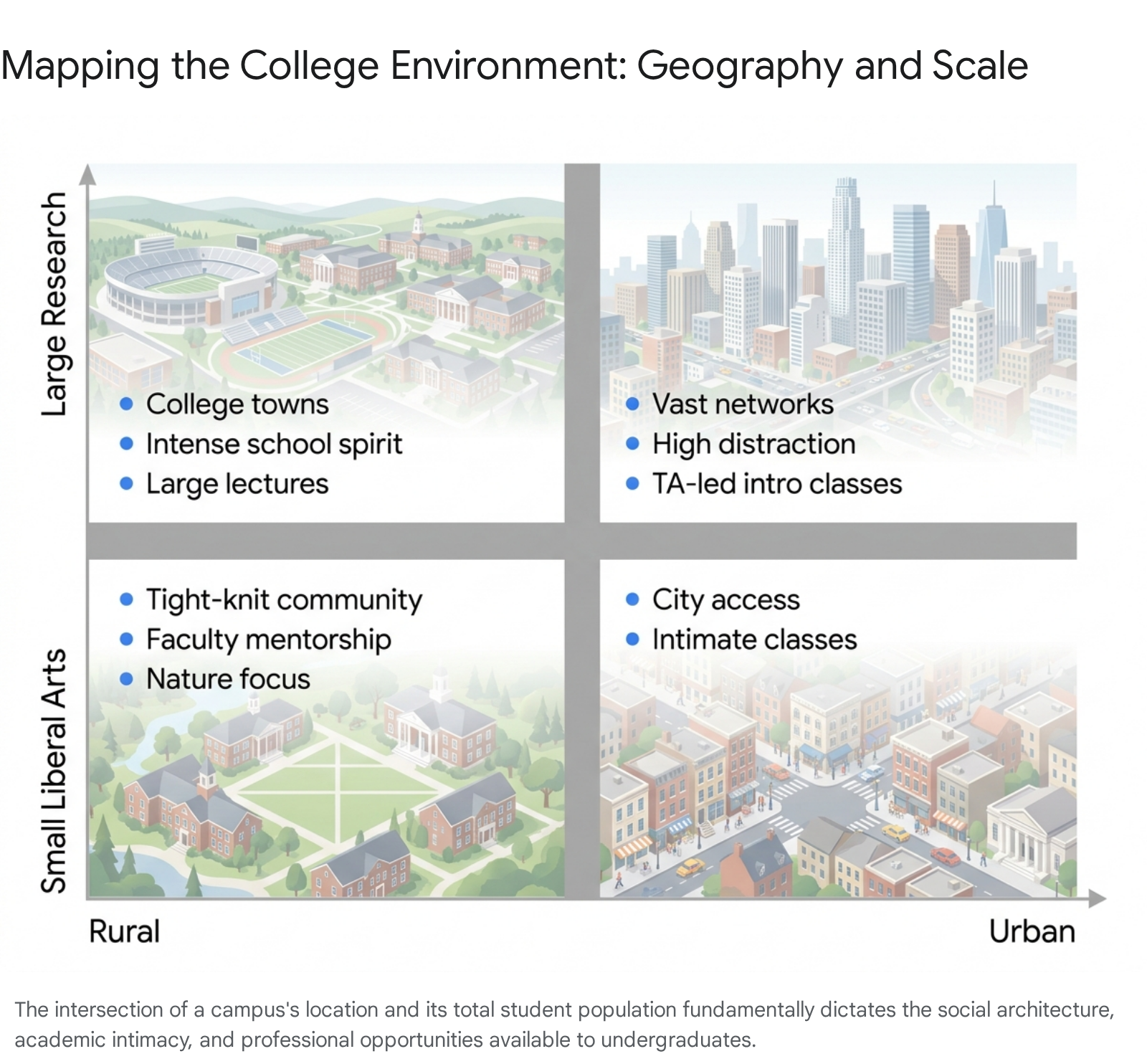
Urban, Suburban, and Rural Settings
The environmental setting of a university plays a disproportionate role in the daily lifestyle, financial budget constraints, and mental well-being of its students 6061.
Institutions seamlessly integrated into major metropolitan centers - such as those located in New York, Chicago, or Boston - offer undergraduates unparalleled access to off-campus corporate internships, diverse cultural ecosystems, and robust public transportation networks 606263. Urban universities frequently blur the traditional lines between the campus proper and the city, forcing students to adopt a higher level of maturity and independence 60. Statistical data underscores the professional value of this proximity; approximately 74 percent of students who secure internships in urban environments ultimately receive full-time job offers from those specific companies 61. However, this integration comes with distinct structural drawbacks. Urban campuses often suffer from a weaker, less centralized sense of traditional college community, as students frequently reside in disparate neighborhoods scattered throughout the city rather than in a cohesive campus bubble 60. Furthermore, the cost of living - encompassing off-campus housing, dining out, and entertainment - is exponentially higher in metropolitan areas, adding substantial hidden financial costs to the overarching price of attendance 606162. Potential distractions and the relentless fast-paced nature of city life can also heavily challenge academic focus 60.
Rural institutions offer a stark contrast, typically characterized by sprawling, self-contained campuses completely surrounded by natural landscapes and wilderness 6061. The defining advantage of a rural campus is the organic creation of an intensely tight-knit, insular community 6120. Because there are significantly fewer external distractions and entertainment options in the surrounding area, the social life and culture become hyper-focused on the campus itself, leading to deep peer connections, robust on-campus events, and heightened school spirit 616365. Economically, the cost of living in rural college towns is dramatically lower than in urban centers, offering significant financial relief regarding housing and daily expenses 61. Conversely, the extreme isolation of a rural setting can induce feelings of profound disconnection or claustrophobia for certain students who thrive on external stimulation 1662. Opportunities for off-campus employment, highly specialized corporate internships, and exposure to diverse cultural events are inherently limited by the geographic reality 62. Students requiring extensive access to public transportation or specialized off-campus amenities may find rural environments highly restrictive 62.
Suburban campuses frequently occupy the optimal "Goldilocks zone" for many applicants, offering a measured compromise between the extremes of urban density and rural isolation 6021. Located in towns or smaller cities positioned just outside major metropolitan hubs, these institutions feature self-contained, traditional campus borders while maintaining accessible proximity to urban career and entertainment opportunities 2167. They generally offer significantly more green space and a stronger localized residential community than urban schools, coupled with vastly better transportation infrastructure and internship access than their purely rural counterparts 67.
Large State Research Universities vs. Small Liberal Arts Colleges
Beyond geographic location, institutional size is a critical metric that profoundly alters the pedagogical approach and the level of bureaucratic navigation required by the undergraduate student 5968.
With undergraduate populations frequently exceeding 20,000 to 40,000 students, large state research universities offer vast, sprawling infrastructures. They provide hundreds of highly specialized academic majors, massive global alumni networks, multi-million-dollar graduate-level research facilities, and high-profile Division I athletics that serve as central social touchstones 596168. The sheer scale of these institutions essentially guarantees that any student can find a niche organization or subculture that perfectly matches their precise interests 59. However, navigating a large university requires intense self-advocacy and initiative. Lower-level introductory courses are frequently held in massive auditorium-style lecture halls accommodating hundreds of students, and these critical foundation courses are often taught by graduate teaching assistants rather than tenured professors 596568. Students at large research institutions risk becoming "a number" within the vast bureaucracy, requiring proactive, aggressive effort to secure faculty mentorship, register for highly impacted classes, or access necessary academic support services 59.
Typically housing between 1,500 and 3,000 undergraduates, small liberal arts colleges (SLACs) operate on an entirely different educational philosophy centered on extreme personalization 5965. The defining characteristic of a SLAC is the intimate student-to-faculty ratio 1865. Classes are overwhelmingly seminar-based, highly interactive, and taught exclusively by professors whose primary contractual mandate is undergraduate teaching rather than independent graduate research 5968. This intimate environment fosters deep, long-term mentorships between faculty and students, creating robust academic safety nets where struggles are quickly noticed and addressed before they become systemic failures 6568. The limitations of a smaller institution lie primarily in the overall breadth of resources. Course catalogs are inherently less expansive, highly specialized STEM or pre-professional majors may be entirely unavailable, and the overall volume of extracurricular clubs and athletic facilities is heavily scaled down 59. Socially, the small population creates a highly familiar environment where "everyone knows everyone," which can be either deeply comforting or socially suffocating, depending entirely on the individual student's temperament 5965.
Addressing Cognitive Biases and Campus Misconceptions
To accurately assess an institution, prospective students and their families must be acutely aware of cognitive biases and structural illusions that frequently distort the campus visit experience.
The Amenities vs. Academic Quality Illusion
Over the past two decades, higher education has engaged in a highly publicized "amenities arms race." To attract prospective applicants in a fiercely competitive market, colleges have invested billions of dollars in luxury non-academic infrastructure, including resort-style dormitories, massive recreation centers featuring lazy rivers and rock climbing walls, and gourmet dining facilities 2223. Economic research indicates that these physical investments successfully influence enrollment decisions, creating a documented "college as a country club" effect where the sheer visual appeal of high-end amenities overshadows the fundamental academic mission of the institution 2324.
A comprehensive study by the National Bureau of Economic Research (NBER) reveals that while students consistently state they desire rigorous academics, their actual enrollment choices heavily favor institutions that spend aggressively on non-academic amenities 23. However, post-recession data shows a growing divide: lower-income students increasingly prioritize sheer cost and financial aid, while high-income students without financial aid needs continue to prioritize reputation, rankings, and luxury amenities 22. Independent counselors strongly urge visiting families to critically decouple the aesthetic luxury of the campus from the core quality of the education 56. While high-end recreational facilities and comfortable living quarters undoubtedly enhance daily well-being and stress relief, they do not inherently correlate with rigorous classroom instruction, robust career placement networks, or high graduation rates 56. Applicants must continually remind themselves that the primary objective of the massive financial investment in higher education is long-term intellectual and professional development, not temporary access to high-end fitness equipment 5622.
The Subjectivity of Weather and "Visit Fatigue"
Basic human psychology makes it notoriously difficult to separate an assessment of a physical environment from the temporary circumstances under which it is experienced. A campus visited during a torrential downpour, while the prospective student is exhausted from travel and hungry, will almost invariably leave a negative, lasting impression 2. Conversely, a fundamentally mediocre institution visited on a pristine, sunny spring day may falsely elevate the applicant's perception of the school's quality 29.
Independent college counselors frequently observe families entirely dismissing highly suitable institutions simply because the physical visit occurred during inclement weather, or because it was the third college toured that day and profound "visit fatigue" had set in 22930. Evaluators must consciously acknowledge these external variables and attempt to separate their transient emotional state from the permanent, structural attributes of the university 2.
FAQ-Worthy Sub-Questions
Should campus visits occur before or after submitting the application?
There is distinct strategic value in both timelines, and the optimal choice depends entirely on the applicant's geographical constraints, financial budget, and overarching admissions strategy. Visiting before applying - typically during the spring of junior year or the early fall of senior year - is highly advantageous for effectively narrowing down a vast initial college list 434. Furthermore, a pre-application visit provides specific, sensory details, names of faculty, and anecdotal evidence that can be directly utilized to craft highly compelling, authentic, and specific "Why Us?" supplemental essays, which are critical for selective admissions 181950.
Conversely, if travel budgets are heavily restricted, delaying physical visits until after acceptance letters are officially received in the spring of senior year is a highly pragmatic approach 221240. This strategy prevents families from expending significant financial resources and emotional energy touring institutions that ultimately issue rejections 40. Post-acceptance visits, frequently marketed by universities as "Admitted Student Days," are highly tailored, celebratory events specifically designed to showcase the absolute best of the university to secure final enrollment deposits 2934.
Does visiting a campus actively help an applicant's chances of getting in?
The answer is highly nuanced and dependent entirely on the specific institution's enrollment management strategy. If the university explicitly considers "demonstrated interest" as a metric (as verified via their Common Data Set), then an official, registered campus visit is the strongest behavioral signal of intent a student can provide short of applying via a binding Early Decision agreement 61833. This registered visit feeds directly into the predictive CRM algorithms that calculate yield probabilities, marginally increasing the applicant's chances at schools desperate to protect their yield rates 10.
However, at elite, highly selective universities - including the entirety of the Ivy League, institutions like Stanford and MIT, and massive public flagships like UC Berkeley or the University of Michigan - a physical campus visit will yield absolutely zero direct benefit to an applicant's admission probability 10181920. These institutions are inundated with tens of thousands of applications from highly qualified candidates annually; they operate under the correct assumption that any admitted student is already highly interested in attending 1019. In these elite contexts, the campus visit serves solely for the applicant's personal edification and environmental assessment, not as leverage for the admissions committee 1020.
The Bottom Line
Evaluating a college campus requires the conscious suspension of emotional impulse and the rigorous adoption of objective, systematic analysis. A successful campus visit transcends the passive consumption of institutional marketing narratives and demands active, unscripted engagement with the academic and social infrastructure of the university. Prospective students must critically weigh geographic realities, institutional scale, and academic pedigree against the superficial allure of multimillion-dollar recreational amenities. By mastering pre-visit data preparation, engaging deeply with unaffiliated community members to bypass tour guide bias, understanding the quiet, algorithmic mechanics of demonstrated interest tracking, and meticulously documenting post-visit reflections within twenty-four hours, families can effectively transform the campus tour. It ceases to be an overwhelming tourist excursion and becomes a highly strategic, evidence-based exercise in long-term educational and financial planning.