
History of alchemy and its contributions to chemistry and psychology
Origins and Evolution of Alchemical Traditions
Alchemy represents an ancient, multifaceted branch of natural philosophy that emerged independently across several distinct geographic and cultural centers over four millennia 1. While contemporary colloquial understanding often reduces the discipline to a superstitious pursuit of transmuting base metals into gold, historical alchemy encompassed a vastly broader set of practices, theories, and philosophical inquiries into the fundamental nature of matter, the cosmos, and the human soul 12. The discipline's foundational goals generally included chrysopoeia (the artificial production of noble metals), the discovery of a universal panacea or elixir of life, and the spiritual perfection of the practitioner 1.
The general penchant for cryptic symbolism, allegorical language, and intentional secrecy within alchemical texts makes tracing strict genetic relationships between global traditions challenging. However, historical scholarship identifies three primary, largely independent strands of early alchemical practice: the Greco-Egyptian tradition centered in the Mediterranean basin, the Chinese tradition deeply intertwined with Daoist cosmology, and the Indian tradition rooted in Ayurvedic medicine and Dharmic faiths 12. While these traditions developed independently in their nascent stages, the eventual cross-pollination of their texts via the Silk Road and Islamic trade routes generated a rich, globally interconnected proto-science 24.
Hellenistic and Egyptian Foundations
The earliest recorded texts of Western alchemy originated in Greco-Roman Egypt during the first few centuries of the Common Era, with the city of Alexandria serving as a vital intellectual crucible 12. In this environment, indigenous Egyptian metallurgical and embalming practices merged with Hellenistic philosophy - particularly Greek atomic and elemental theories - and Gnostic mysticism 23. Practitioners in this era frequently referred to their work as "the Art" (τέχνη) or "Knowledge" (ἐπιστήμη), viewing laboratory manipulation as a divine or sacred undertaking 1.
Zosimos of Panopolis, a Gnostic mystic who flourished around 300 CE, authored some of the oldest surviving foundational texts on alchemy, which he termed "Cheirokmeta" (things made by hand) 45. Zosimos defined alchemy as the study of the composition of waters, movement, growth, embodying and disembodying, drawing the spirits from bodies, and bonding the spirits within bodies 5. His work advanced the theoretical concept that all matter was composed of a single primordial substance, which could be manipulated through varying processes to yield entirely different materials, foreshadowing later atomic theories 6.
Furthermore, Zosimos established the early practice of integrating spiritual metaphors with material processes. He likened the tincturing vapors of mercury and sulfur to the purifying waters of baptism, viewing the alchemical vessel as a site of spiritual redemption 5. In his visions, the liberation of the pneuma (the volatile part of a substance or the spiritual part of a human) was ritualized as a process of torture, death, and resurrection, wherein vile base metals were sacrificed to be reborn as noble metals 3. He frequently referenced a "divine water" or "sulfur water" (theion hydor) obtained through distillation, which acted as an undifferentiated original matter essential for transmutation 37.
Equally critical to the Hellenistic foundation was Mary the Jewess (also known as Maria the Prophetess), who lived in Alexandria between the first and third centuries CE 28. Zosimos extensively cited her empirical contributions, crediting her with the invention of fundamental alchemical apparatus that formed the basis of laboratory chemistry for centuries 8. Mary is recognized for engineering sophisticated equipment designed to control temperature and capture volatile vapors. Among her most prominent inventions was the tribikos, a three-armed alembic used to obtain substances purified by distillation, and the kerotakis, an airtight reflux chamber used to heat substances and expose copper or lead to corrosive vapors like sulfur or mercury 3689. The kerotakis was intended to replicate the subterranean gestation of gold within the earth, and its requirement for perfectly sealed joints birthed the enduring concept of "hermetically sealed" environments 78. Furthermore, Mary is credited with inventing the bain-marie (Mary's bath), a double boiler system that limited the maximum temperature of a chemical reaction to the boiling point of water, a device still ubiquitous in both modern laboratories and culinary arts 89.
Islamic Alchemy and the Introduction of Empirical Methods
Following the translation of Greek and Syriac texts during the 8th and 9th centuries, the epicenter of alchemical research shifted to the Islamic world 1011. Scholars in this era rigorously expanded upon Aristotelian theories of matter, systematically integrating knowledge from India and China, and moving the discipline toward rigorous experimentation, quantification, and early proto-chemistry 12.
The most influential figure of this era was Jabir ibn Hayyan (c. 721 - 815 CE), known in Latin Europe as Geber, whose name is attached to a vast corpus of chemical, philosophical, and esoteric writings 41314. While modern historians debate whether the "Jabirian corpus" was the work of a single historical figure or a later school of Ismaili Shi'ite alchemists, the texts fundamentally revolutionized the theoretical framework of metallurgy 1314. Jabir modified the Aristotelian elements (earth, air, fire, water) by postulating that all metals were formed deep within the earth by the combination of two immediate principles: sulfur (representing combustibility, heat, and masculine traits) and mercury (representing fusibility, metallicity, and feminine traits) 2412. According to Jabir, gold represented the perfect, purest stoichiometric balance of these two principles, while base metals like lead and copper were merely corrupted or immature variations 412. Consequently, base metals could theoretically be perfected into gold by artificially adjusting their sulfur-mercury ratios in a laboratory 24.
Jabir's most enduring legacy was his commitment to the "science of the balance" (ʿilm al-mīzān), a philosophical theory aimed at reducing all material phenomena to a system of precise measures and quantitative proportions 13. This empirical rigor resulted in monumental practical discoveries. Jabir and his followers are credited with isolating vital mineral acids - including sulfuric acid, nitric acid, and hydrochloric acid - and discovering aqua regia, a highly corrosive mixture of nitric and hydrochloric acids capable of dissolving gold 2412141718.
The Jabirian corpus also contains the oldest known systematic classifications of chemical substances, categorizing them into spirits (which vaporize on heating), metals, and pulverizable stones 1314. Furthermore, the texts provide explicit instructions for synthesizing inorganic compounds, such as sal ammoniac (ammonium chloride), from organic materials like hair and blood 13. By shifting focus to meticulous laboratory practices - including distillation using the alembic, filtration, sublimation, and crystallization - Islamic alchemists laid the empirical groundwork that would eventually allow chemistry to emerge as a distinct scientific discipline 1418.
Eastern Traditions: Chinese Neidan and Indian Rasayana
In parallel to Western developments, highly sophisticated alchemical traditions emerged in Asia. While Western alchemy ultimately gravitated toward metallurgy and the production of gold, Asian traditions developed unique philosophical frameworks characterized by an intense focus on medicine, extreme longevity, and internal physiological transformation.
Chinese External and Internal Alchemy
Chinese alchemy, deeply rooted in Daoist cosmology, developed two distinct but historically intertwined streams: Waidan (external alchemy) and Neidan (internal alchemy) 21915. Emerging by the 2nd century BCE, Waidan involved the literal compounding of herbs, minerals, and metals in a laboratory crucible to produce elixirs designed to bestow physical immortality, enhance vitality, or protect the adept from malevolent spirits 191622. The foundational text for this tradition is the Baopuzi (The Master Who Embraces Simplicity), written by the Daoist scholar Ge Hong (c. 283 - 343 CE), which detailed external elixir recipes while emphasizing the necessity of moral purity 116.
The central substance in Chinese external alchemy was cinnabar (mercury sulfide), which held a symbolic weight equivalent to gold in Western traditions 1718. However, the pursuit of Waidan proved highly dangerous; the ingestion of heavy metal elixirs containing mercury, lead, and arsenic resulted in numerous documented cases of elixir poisoning, claiming the lives of several emperors and high-ranking officials 11819.
Partly in response to these physical dangers, and driven by evolving philosophical interpretations of Daoism, the Chinese tradition underwent a profound paradigm shift between the 8th and 10th centuries CE 11618. Daoist practitioners increasingly turned to Neidan, a contemplative and physiological practice that interpreted alchemical operations purely as metaphors for spiritual self-cultivation 11915. In Neidan, external laboratory equipment was abandoned; the practitioner's own body became the crucible (the ding). The vital substances to be refined were no longer physical minerals, but rather the Three Treasures of the body: essence (jing), breath or vital energy (qi), and spirit (shen) 151622. Through rigorous meditation, breath control, and visualization, practitioners sought to reverse the natural process of aging and cosmic entropy, reverting to an original state of primordial purity to achieve transcendent union with the Dao 1622. During the Tang Dynasty (618 - 907 CE), these internal alchemical concepts were further absorbed by Chinese Chan (Zen) Buddhism, which localized the alchemical crucible entirely within the mind, viewing the transmutation of ignorance into enlightenment as the ultimate alchemical act 26.
Indian Rasayana and Tantric Alchemy
Indian alchemy, known as Rasayana (from rasa, meaning essence, juice, or mercury, and ayana, meaning path or journey), developed with a dual focus on complex metallurgy and advanced Ayurvedic medicine 416. The roots of Indian alchemy can be traced back to the Vedic period and the ancient pursuit of Soma, a legendary energizing and euphorigenic plant (often theorized to be ephedra) consumed to prevent exhaustion and promote longevity 20. As Soma became unavailable, Indian ascetics and physicians substituted it with complex herbal and mineral compounds, eventually incorporating Chinese knowledge of mercurials to create powerful energetic tonics 20.
By the 8th century CE, Rasayana became deeply integrated with Tantric traditions, resulting in the proliferation of mercurial elixirs that promised both dehasiddhi (bodily immortality and perfection) and lohasiddhi (the transmutation of base metals into noble metals) 16. Within the Tantric cosmological framework, physical elements were deeply homologized with divine forces: mercury (rasa) was revered as the generative essence or semen of the god Shiva, while sulfur represented the menstrual blood or creative energy of the goddess Devi 2.
The operations performed on physical elements in the laboratory were viewed as strictly analogous to the processes occurring within the spiritual body of the alchemist 28. The ultimate pursuit of the perfected, divine body (divya-deham) in Indian alchemy aimed not merely at prolonged physical life, but at achieving spiritual liberation while still embodied (jīvan-mukti), ensuring that the practitioner could overcome the limits of individuality and ascend to higher states of cosmic being 2428.
Comparative Summary of Global Alchemical Traditions
To contextualize the varied developmental pathways of early alchemy, the following table summarizes the core philosophies, goals, and material focuses of the three major global traditions.
| Feature | Western Alchemy (Greco-Egyptian/Islamic/European) | Chinese Alchemy (Waidan/Neidan) | Indian Alchemy (Rasayana) |
|---|---|---|---|
| Philosophical Roots | Aristotelian elements, Hermeticism, Gnosticism 13 | Daoism, Yin-Yang, Five Elements (Wuxing) 152217 | Ayurveda, Tantra, Shaivism, Buddhism 2429 |
| Primary Goal | Chrysopoeia (gold), Philosopher's Stone, Panacea 1 | Immortality, Harmony with the Dao, Inner perfection 1522 | Bodily immortality (dehasiddhi), spiritual liberation (jīvan-mukti) 24 |
| Core Substances | Sulfur, Mercury, Salt (Tria Prima) 2421 | Cinnabar, Lead, Qi, Jing, Shen 151718 | Mercury (rasa), Sulfur, Herbs 22028 |
| Internal/Mystical Branch | Spiritual alchemy, psychic integration (later interpreted by Jung) 193132 | Neidan: Breathwork, meditation, visualization 191622 | Inner alchemy via Yoga and Tantric rituals 428 |
The Transition to Chymistry and Iatrochemistry
The translation of Arabic alchemical texts into Latin during the 12th century sparked a renaissance of the art in medieval Europe, laying the groundwork for widespread laboratory experimentation 116. By the Renaissance, however, European alchemy began a profound structural and philosophical evolution that would eventually bridge the gap to modern scientific medicine and chemistry.
Paracelsus and the Iatrochemical Revolution
The critical pivot away from purely metallurgical alchemy toward chemical medicine was initiated by the Swiss physician, alchemist, and radical philosopher Theophrastus von Hohenheim, universally known as Paracelsus (1493 - 1541) 41922. A famously combative figure, Paracelsus aggressively rejected the prevailing scholastic medical orthodoxy of antiquity, which relied heavily on the humoral theories of Galen and Avicenna. He commenced his tenure as a professor at the University of Basel by publicly burning Avicenna's Canon of Medicine, insisting that medical knowledge must be derived from direct observation of nature rather than ancient dogma 2223.
Paracelsus fundamentally redefined the primary aim of alchemy in the West. He argued that the discipline's true purpose was not the selfish pursuit of artificial gold, but the preparation of potent, chemically refined medicines to cure disease and restore physical harmony 419. This approach established the field of iatrochemistry (medical chemistry), which treated the human body as a highly complex chemical system where disease was the direct result of chemical imbalances rather than an imbalance of the four bodily humors 232436.
To support his medical theories, Paracelsus expanded upon Jabir's sulfur-mercury theory by introducing a third principle, Salt, forming the Tria Prima (the three primes) 2122. In this framework, Sulfur represented flammability and transformation, Mercury represented fluidity and volatility, and Salt represented solidity and resistance to fire 21.
Crucially, Paracelsus pioneered the application of toxicology to medicine. Drawing on his early experiences working in Austrian mines, he posited that inorganic minerals and heavy metals - such as mercury, sulfur, lead, and antimony - could serve as highly effective therapeutics if chemically refined and administered in exact dosages 2225. While his contemporaries viewed these substances as deadly poisons, Paracelsus articulated the foundational axiom of modern pharmacology: "the dose makes the poison" 2225. Among his many medical innovations, he is credited with reintroducing opium to Western Europe in the form of laudanum (an opium tincture) and inventing opodeldoc, a liniment of soap, alcohol, and herbal essences used to treat joint pain 2225.
The Era of "Chymistry"
Historical scholarship from the late 20th and early 21st centuries has fundamentally corrected a pervasive historiographical anachronism that rigidly separates "alchemy" (historically viewed as magical pseudoscience) from "chemistry" (viewed as rational science) during the early modern period 262740. Historians of science Lawrence M. Principe and William R. Newman have demonstrated through exhaustive linguistic analysis that in the 17th century, the terms "alchemy" and "chemistry" were entirely synonymous 2628.
Principe and Newman advocate using the archaic spelling "chymistry" to describe the unified pursuit of matter theory and chemical manipulation practiced during the Scientific Revolution 2629. The chymists of the 17th century engaged simultaneously in the pursuit of chrysopoeia, the creation of iatrochemical pharmaceuticals, and the rigorous analysis of material composition, utilizing the exact same theoretical frameworks and laboratory instruments 29. The belief in the transmutation of metals was not viewed as an occult superstition by these figures, but rather as a highly rational scientific hypothesis supported by prevailing particulate matter theories 273031.
The Experimental Foundations of Modern Chemistry
The empirical methodologies honed by generations of alchemists provided the direct observational bedrock for the mechanical philosophy that defined the Scientific Revolution, culminating in the foundational works of Robert Boyle and Isaac Newton 11.
Robert Boyle and the Corpuscular Theory
Robert Boyle (1627 - 1691), frequently lauded as the "father of modern chemistry," was deeply embedded in the alchemical tradition, having learned much of his sophisticated laboratory technique from the renowned alchemist George Starkey 28324733. In his seminal 1661 text, The Sceptical Chymist, Boyle launched a devastating empirical critique against both the Aristotelian theory of the four elements and the Paracelsian Tria Prima 24284950.
Drawing heavily upon medieval alchemical traditions of material analysis and synthesis, Boyle articulated a corpuscularian theory of matter 1149. He proposed that all physical reality was composed of a ubiquitous "catholic matter" divided into microscopic, impenetrable particles (corpuscles) 4951. The vast diversity of chemical substances, he argued, arose not from inherent elemental forms or spiritual essences, but simply from the mechanical juxtaposition, shape, and motion of these fundamental particles 49. Assisted by Robert Hooke, Boyle utilized advanced instrumentation, such as the vacuum air pump, to conduct reproducible experiments on gases, ultimately formulating Boyle's Law regarding the inverse relationship between pressure and volume 495034.
Despite dismantling classical elemental theories, Boyle's mechanical philosophy actually supported the theoretical possibility of transmutation. If all matter was composed of the exact same universal particles merely arranged in different structural configurations, it logically followed that rearranging the corpuscles of lead could transform it into gold 2834. Consequently, Boyle remained an active, practicing alchemist throughout his life, encrypting his laboratory notes, searching for the Philosopher's Stone, and successfully lobbying the British parliament for the repeal of an old statute that criminalized the artificial multiplication of gold 283334.
Isaac Newton's Secret Laboratory
The unified nature of early modern chymistry is perhaps best exemplified by the work of Sir Isaac Newton (1642 - 1727). While globally celebrated for formulating classical mechanics, optics, and the universal law of gravitation, Newton wrote over a million words on alchemy - a volume of writing that far exceeded his output on physics or mathematics 313233. For centuries, historians dismissed Newton's alchemical pursuits as an embarrassing dalliance with magic, a symptom of mental breakdown, or an expression of his heterodox Arian religious views 273536. When the economist John Maynard Keynes purchased a large cache of Newton's alchemical manuscripts at auction in 1936, he famously assessed Newton not as the first of the age of reason, but as "the last of the magicians" 2731.
Recent "experimental history" led by William Newman has systematically dismantled this dismissive view by actively replicating Newton's encoded alchemical recipes in modern laboratories 31333637. Newton was intensely secretive, utilizing complex Decknamen (cover names) such as the "Green Lion," "Neptune's Trident," and the "Scepter of Jove" to conceal his chemical materials 3338. By painstakingly cross-referencing Newton's sources and decoding these terms, Newman demonstrated that Newton was conducting highly sophisticated, quantitative chemistry 313338.
One heavily documented replicated experiment involved Newton's synthesis of the "Star Regulus," a crystalline alloy of antimony and iron that forms beautiful, radiating, starlike crystalline shards upon cooling 3336. Furthermore, Newton's alchemical pursuit of active, vegetative principles in matter (the "Secret Fire") directly informed his physics 31. By observing how chemical affinities and repulsions operated on particles, Newton realized that invisible forces - such as gravitational attraction - could operate across empty space, allowing him to break from the strictly contact-based mechanics championed by René Descartes 3135.
Alchemical Apparatus and Laboratory Techniques
Beyond theoretical shifts regarding the nature of matter, modern analytical chemistry inherited its physical infrastructure directly from the alchemical laboratory. Alchemists invented, refined, and perfected the specialized glass and metal tools required for high-temperature reactions, distillation, sublimation, filtration, and crystallization 4171839. The table below outlines the continuity between ancient alchemical tools and modern laboratory equipment.
| Ancient Alchemical Apparatus | Historical Description & Function | Modern Chemical Equivalent |
|---|---|---|
| Kerotakis | A sealed vessel used to heat substances and expose metals to corrosive vapors without allowing gas to escape. Its airtight design established the concept of "hermetic sealing." 689 | Reflux condenser / High-temperature closed-system reactor. |
| Bain-marie (Mary's Bath) | A vessel of water in which another container is heated, limiting the maximum temperature to the boiling point of water. 89 | Water bath / Double boiler. |
| Alembic / Tribikos | A still consisting of a boiling flask, a cap to collect vapor, and descending tubes (sometimes three, as in the tribikos) to collect condensation. 81439 | Standard distillation apparatus. |
| Cucurbit | The lower, heated pot of an alembic that contains the raw liquid or amalgam to be distilled. 395859 | Boiling flask / Round-bottom flask. |
| Retort | A spherical glass vessel with a long, downward-pointing beak, used for distilling highly corrosive mineral acids where a joined alembic head might leak. 395940 | Distillation flask / Retort. |
| Pelican | A circulatory distillation vessel with two side-arms feeding condensed vapor back into the main body for repeated refinement. 5961 | Continuous reflux apparatus. |
The Chemical Revolution and the Etymological Split
The formal partition of "alchemy" and "chemistry" into distinct, adversarial concepts did not occur until the turn of the 18th century. Influential textbook writers, notably the French chemist Nicolas Lémery, began to restrict the definition of "alchemy" exclusively to the pursuit of metallic transmutation and occult secrecy 264029. Simultaneously, "chemistry" was redefined as the respectable, institutionalized science of material analysis and pharmacology 2640.
This artificial demarcation was cemented during the 18th-century Chemical Revolution. Scientists such as Antoine Lavoisier, Joseph Priestley, and John Dalton established the modern atomic model, isolated oxygen (disproving the phlogiston theory), and created a systematic nomenclature based on measurable chemical composition rather than mythological allegory 514142. Lavoisier's 1789 textbook firmly established the modern list of elements, and Dmitri Mendeleev later organized them into the periodic table based on atomic weight 42. In seeking to establish chemistry as an enlightened, rational discipline worthy of university study, these pioneers actively distanced themselves from their alchemical predecessors, permanently relegating alchemy to the realm of fraud, mysticism, and the occult 402951.
Alchemy in the Foundations of Analytical Psychology
As academic chemistry completely abandoned the symbolic, allegorical, and esoteric dimensions of alchemy in the 18th and 19th centuries, these aspects went dormant until they were resurrected in the 20th century - not as a physical science, but as a framework for exploring the human mind. The Swiss psychiatrist and psychoanalyst Carl Gustav Jung (1875 - 1961) revolutionized the study of alchemy by interpreting its bizarre textual history as a complex symbolic map of the unconscious 1943.
Carl Jung and the Psychological Interpretation of Alchemy
Jung's intense fascination with alchemy began following a series of recurring dreams in 1926, in which he found himself exploring an unknown annex of his house that appeared to belong to the 17th century 44. Recognizing this unknown wing as an unconscious aspect of his own personality, Jung began a rigorous, decades-long study of medieval and early modern alchemical texts 44. Through this research, Jung arrived at a fundamental psychological insight: historical alchemists, lacking a modern understanding of molecular chemistry, were unwittingly utilizing the physical transformations occurring in their crucibles as a blank screen for psychological projection 314345.
Jung posited that the cryptic imagery found in alchemical manuscripts - such as hermaphrodites, green lions devouring the sun, and the copulation of kings and queens - were not merely encodings of chemical recipes 3243. Rather, they were spontaneous manifestations of the collective unconscious 3143. In Jung's view, the alchemist's quest for the Philosopher's Stone (the Lapis Philosophorum) was, psychologically speaking, the quest for "individuation." Individuation is defined as the arduous psychological process of integrating the conscious ego with the unconscious shadow and archetypal components to achieve a unified, whole Self 193144.
Jung utilized alchemical texts extensively in his clinical practice. When pressed to explain the intricate dynamics of psychological transference between analyst and patient, he published The Psychology of the Transference (1946), which used a 16th-century alchemical text, The Rosarium Philosophorum, as a template to map the merging and transformation of psyches 43. Jung argued that alchemy secretly operated in the background of collective consciousness for centuries, acting as a repository for spiritual and psychological realities that orthodox orthodox religion and the emerging strict rationalism of the Enlightenment could not accommodate 3143.
The Stages of Alchemical Transformation in Psychotherapy
Jung and later analytical psychologists, notably Edward F. Edinger, mapped specific alchemical laboratory operations directly onto the clinical phenomena of psychotherapy 434668. The alchemical Magnum Opus (Great Work) was generally divided into color phases - Nigredo (blackening), Albedo (whitening), Citrinitas (yellowing), and Rubedo (reddening) - which encompassed a series of distinct operational stages that mirror the therapeutic journey 4668.
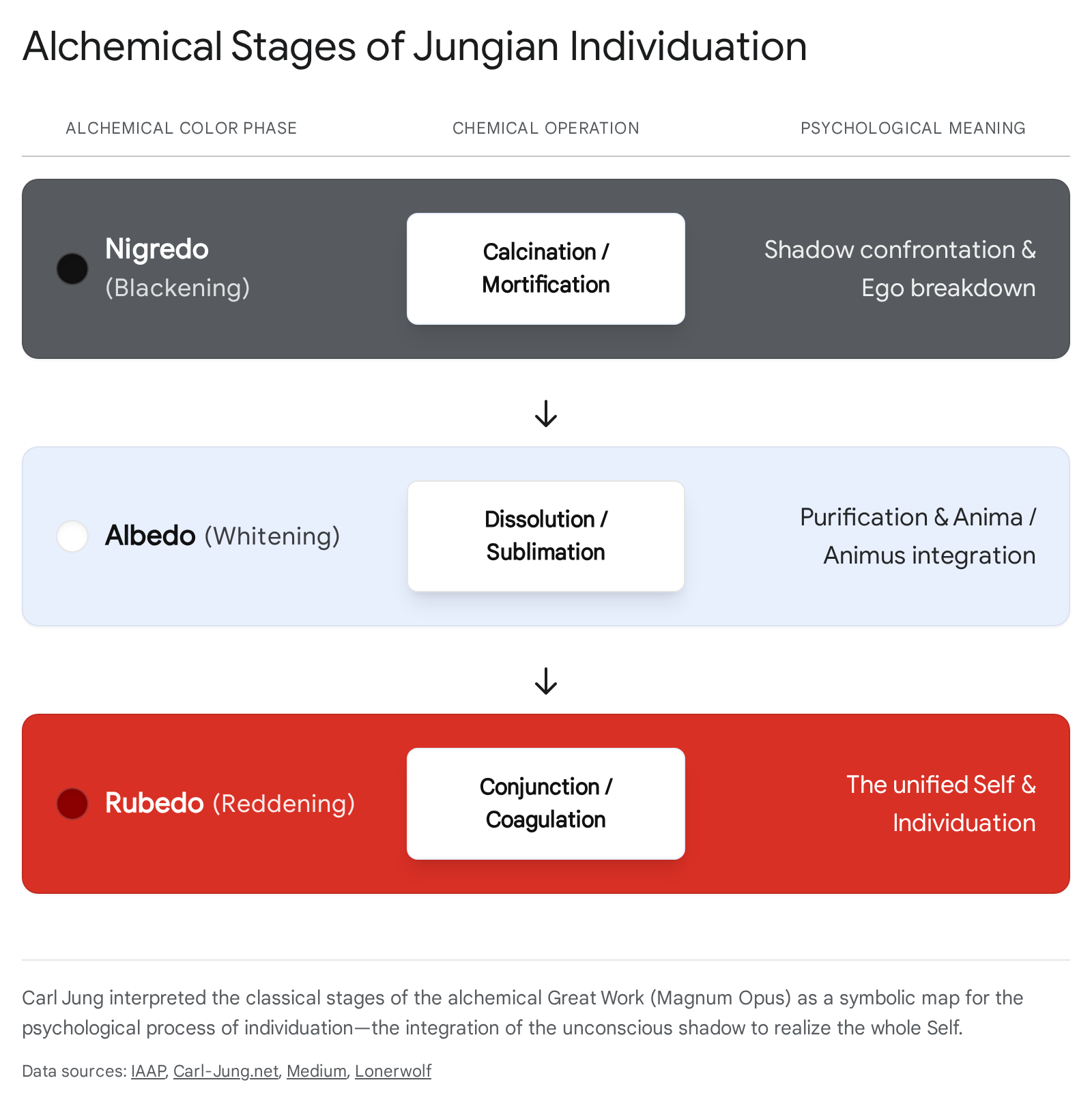
The following table details how these physical chemical operations were reinterpreted as distinct stages of psychological development and crisis resolution.
| Alchemical Operation | Chemical Description | Jungian Psychological Interpretation |
|---|---|---|
| Calcination (Calcinatio) | Heating a substance over an open flame until it is reduced to dry ash, burning away volatile impurities. 214668 | The breakdown of the inflated ego; experiencing intense grief, frustration, or depression to burn away illusions and false identities. 214647 |
| Dissolution (Solutio) | Dissolving ashes or solids in a liquid solvent to create a fluid, unformed solution. 2147 | The immersion of the conscious mind into the unconscious; processing repressed emotions, weeping, and surrendering rigid ego control. 6847 |
| Separation (Separatio) | Filtering and isolating the distinct, pure components of a dissolved mixture. 616847 | Cultivating psychological discernment; distinguishing the true self from false societal conditioning, and separating light from shadow. 6847 |
| Conjunction (Coniunctio) | The recombination of purified, separated elements into a new, stable compound (often depicted as a chemical marriage). 216143 | The union of conscious and unconscious forces (often the archetypal masculine and feminine, or anima and animus) into a harmonious whole. 436847 |
| Putrefaction / Mortification | Allowing the matter to rot, ferment, or break down biologically in darkness, generating new vital energy. 616847 | Facing one's deepest fears and the darkest aspects of the shadow; a psychological "death" of the old self that precedes rebirth. 6847 |
| Sublimation (Sublimatio) | Heating a solid until it vaporizes and condenses on the upper part of the vessel without entering a liquid phase. 216146 | Elevating psychic energy; detaching from immediate emotional entanglement to gain a higher, objective, and philosophical perspective. 4668 |
| Coagulation (Coagulatio) | The final solidification or crystallization of the perfected substance (The Philosopher's Stone). 216146 | The realization of the Self; the grounding and materialization of new psychological insights into everyday behavior and conscious reality. 466847 |
Historiographical Debates and the Rehabilitation of Alchemy
The deep entanglement of alchemy with Jungian psychology in the 20th century profoundly influenced how the general public, and many academics, perceived the discipline. For decades, the dominant historiographical view - championed by Jung and historian of religion Mircea Eliade - held that alchemy was fundamentally a spiritual, esoteric, or psychological endeavor 3245. Within this paradigm, laboratory work was viewed as secondary or merely a ritualistic metaphor for inner transformation, and alchemists were seen as proto-psychologists rather than proto-chemists 2745.
However, since the late 1980s, a movement known as the "New Historiography of Alchemy," spearheaded by historians of science like William R. Newman and Lawrence M. Principe, has aggressively challenged the Jungian paradigm 3045. These historians criticize Jung's approach for being fundamentally ahistorical, reductive, and dismissive of the actual scientific intent of the practitioners 324570. They argue that Jung selectively ignored the concrete, practical reality of the alchemical laboratory, treating detailed chemical recipes as if they were nothing more than transcriptions of dreams or archetypal projections 324548. As evidence of this bias, critics point to instances where Jung quoted highly technical Greco-Egyptian texts, only to dismiss the actual chemical recipes that followed as being "of no interest" to his psychological theories 48.
The New Historiography demonstrates that while alchemical texts undeniably employed dense allegories and spiritual language, these were predominantly Decknamen (cover names) deliberately engineered to conceal highly specific, workable chemical procedures from the uninitiated and the unworthy 103238. By reproducing these ancient recipes in modern laboratories, scholars have proven that alchemists were not merely projecting psychic states onto inert matter out of ignorance; they were observing genuine, highly complex chemical reactions 32333648.
While modern spiritual practitioners and analytical psychologists often defend Jung's theories as a highly valid mechanism for inner transformation and clinical therapy, academic historians warn that viewing historical alchemy purely through a psychoanalytic lens strips the discipline of its rightful place in the history of the hard sciences 434570. The rehabilitation of alchemy by modern historians insists on recognizing the field as a rigorous, empirical, and profoundly influential proto-science that laid the structural, theoretical, and methodological foundations for modern chemistry 322930.
Conclusion
The history of alchemy is a testament to humanity's enduring, multi-millennial drive to understand and master both the physical and spiritual universe. Originating in the crucibles of Hellenistic Egypt, systematized by the empirical rigor of the Islamic Golden Age, and paralleled by the profound internal physiological and metallurgical traditions of China and India, alchemy served as the universal precursor to modern scientific inquiry. Through the transitional, iconoclastic figure of Paracelsus and the later corpuscular theories of Robert Boyle and Isaac Newton, alchemical practice directly birthed analytical chemistry. It gifted the modern scientific world with the laboratory apparatus, the empirical methodologies, and the material discoveries necessary to launch the Scientific Revolution.
Simultaneously, the dense, symbolic language of the alchemists - originally crafted to protect their material secrets and express the profound, seemingly magical mystery of matter in transition - found an unexpected second life in the 20th century. Through the pioneering psychoanalytic work of Carl Jung, the allegories of elemental transmutation provided analytical psychology with a structural map of the unconscious, transforming the ancient physical quest for the Philosopher's Stone into a potent, enduring metaphor for the pursuit of psychological wholeness and individuation. Today, modern scholarship navigates between these dual legacies, recognizing alchemy neither as mere superstitious magic nor pure psychological projection, but as a deeply complex, rational pursuit that fundamentally shaped both the modern understanding of the material world and the architecture of the human mind.