
How Alchemy Contributed to Modern Science
Alchemy was a rigorous, millennia-spanning proto-science that laid the critical foundations for modern chemistry, metallurgy, and pharmacology. While often associated in popular culture with mystical wizards attempting to spin lead into gold, early alchemists actually invented essential laboratory equipment, pioneered distillation, and discovered transformative materials ranging from gunpowder to synthetic pigments. By meticulously observing and recording how matter transforms, these early experimentalists established the systematic empirical methods that drive scientific inquiry today.
The Global Origins of the Alchemical Art
The popular imagination often reduces alchemy to medieval European charlatanism, but the discipline was actually a global, multicultural enterprise. It flourished across ancient Babylonia, Graeco-Roman Egypt, the Islamic Golden Age, India, and China 12. Early alchemy was deeply rooted in the prevailing philosophical frameworks of its time, such as the Aristotelian concept of the four elements (earth, water, air, and fire) and the belief that all matter existed on a spectrum of purity and could be fundamentally transformed or "perfected" 3.
Crucially, the ancient alchemical tradition did not rigidly separate the spiritual from the material. Alchemists viewed the transformation of base metals into noble metals (a process called chrysopoeia) as physically analogous to the purification of the human soul. This dual pursuit of material and spiritual elevation drove centuries of meticulous, empirical laboratory work 45. Far from stumbling blindly, these early practitioners utilized their deep knowledge of materials to engineer efficient, controlled chemical pathways 67.
Chinese Alchemy: The Quest for the Elixir of Life
In ancient China, alchemy emerged in tandem with Taoist philosophy. Rather than focusing primarily on the transmutation of base metals into wealth, Chinese alchemists sought the "Elixir of Life" to achieve physical immortality and spiritual harmony 89. The traditional view in China summarized cosmological processes through the five agents of change, or Wuxing (wood, fire, earth, metal, and water), and achieving alignment with the Tao 89.
This tradition was divided into two distinct but complementary practices. Neidan, or internal alchemy, focused on meditation, diet, and breath control to nourish the spirit 810. Waidan, or external alchemy, focused on the preparation and ingestion of herbal and mineral concoctions found outside the body 8. The relentless experimentation of Waidan practitioners, dating as far back as the 4th century BCE with figures like Zou Yan, led to several of the most consequential material discoveries in human history 910.
Chinese alchemists meticulously studied the properties of toxic and highly reactive minerals like realgar (arsenic disulfide), cinnabar (mercuric sulfide), and lead. Cinnabar was particularly prized; its blood-red color symbolized life and fire, and when roasted, it transformed into liquid mercury, representing the balance of yin and yang 8. While seeking immortality, alchemists realized that many of these compounds possessed potent antibacterial properties, using them as disinfectants and laying early groundwork for Traditional Chinese Medicine 911.
The Accidental Invention of Gunpowder
Perhaps the most world-altering byproduct of the Chinese alchemical pursuit of eternal life was the invention of gunpowder. Taoist monks systematically studied saltpeter (potassium nitrate), sulfur, and charcoal for generations 1112. Saltpeter was frequently used in medicinal compounds, while sulfur and charcoal served as purifying agents and carbon sources 12.
By the Tang Dynasty (618 - 907 AD), an attempt to create a powerful life-extending pill resulted in a catastrophic explosion. A text from 808 CE explicitly describes a failed batch of immortality pills that burned down an alchemical laboratory and singed the alchemist's beard 1112. This flammable compound was initially called "smoky" or "black" powder, and Chinese experimenters quickly realized its potential, first using it for fireworks and soon weaponizing it into fire-arrows, flamethrowers, and eventually bombs 111314. The earliest surviving chemical formula for gunpowder appears in the military manual Wujing Zongyao from 1044 AD, cementing alchemy's role in initiating the global "gunpowder age" 15.
The Mastery of High-Temperature Ceramics
Beyond explosives, Chinese proto-chemists mastered the manipulation of silicates, clays, and metallic oxides. Through centuries of trial and error with kaolin clay and feldspar, they invented porcelain - a vitrified, translucent ceramic that became a global technological and artistic marvel 16.
To create true porcelain, kilns had to reach staggering temperatures of 1,200 - 1,400 °C 16. By the 13th century, the city of Jingdezhen had become the epicenter of this industry, utilizing rich local deposits of kaolin. Chinese artisans also experimented with alchemical pigments, importing cobalt from the West to create the iconic "Blue and White" porcelain that became one of the most coveted luxury goods in global trade 16.
Indian Rasashastra: Metallurgy and Perfumery
In the Indian subcontinent, alchemy emerged as Rasashastra, often translated as the "Science of Mercury." Dating back to the first millennium BCE and flourishing through the medieval period, Indian alchemy was heavily integrated with Ayurveda, the traditional medical system 1719. Indian alchemists believed that heavy metals - when properly detoxified, purified (shodhana), and calcined (marana) - possessed therapeutic properties capable of rejuvenating the body 1821. These meticulously prepared metallic ash medicines, known as bhasmas, were used to treat a variety of illnesses and balance the body's doshas 2122.
One of the absolute crowning achievements of Indian alchemy was the mastery of zinc distillation. Zinc is an incredibly difficult metal to smelt. Its boiling point (907 °C) is lower than the temperature required to reduce its oxide ore (around 1,000 °C) 1920. If heated in an open furnace, the zinc vaporizes immediately and oxidizes in the air, leaving no pure metal behind. The ancient Persians had attempted to reduce zinc oxide in open furnaces and failed 20.
By the 12th century AD, Indian metallurgists at the Zawar mines in Rajasthan solved this chemical puzzle by inventing a sophisticated "downward distillation" process (tirakpatnayantra). They heated the ore in a sealed crucible and condensed the pure zinc vapor in a cooler receptacle situated beneath the furnace 1920. This allowed for the mass production of pure zinc and high-quality brass centuries before the technique was successfully replicated in Europe 1920.
Indian alchemists also made profound contributions to the chemistry of cosmetics and perfumery (Gandhayukti). Ancient texts like the Brihatsamhita (circa 500 AD) contain complex recipes for extracting essential oils using hydro-distillation and maceration 252122. The ancient perfumers, known as gandhikas, utilized specialized apparatus to capture the volatile aromatic compounds of jasmine, rose, and sandalwood, laying the foundation for the modern fragrance industry and the creation of traditional attars 2823.
The Islamic Golden Age and European Translation
Following the translation movements of the 8th and 9th centuries, scholars in the Islamic world inherited and synthesized Greek, Egyptian, and Indian alchemical knowledge 215. Polymaths like Jabir ibn Hayyan and Al-Razi introduced a more rigorous, empirical approach to chemical processes, classifying substances by their properties and reactions 2431. They refined the theoretical framework that all metals were composed of varying proportions of sulfur (representing combustibility) and mercury (representing fusibility and metallic properties), a theory that dominated chemical thought well into the 18th century 2526.
When Arabic alchemical texts were translated into Latin in the 12th and 13th centuries, the art sparked a scientific awakening in Europe. While many European alchemists pursued the mythological Philosopher's Stone to generate infinite wealth, others focused on practical, medicinal applications. In the 14th century, the Franciscan friar John of Rupescissa pioneered the concept of the quinta essentia (fifth essence), recognizing that the distillation of wine produced alcohol - a potent solvent and preservative that revolutionized the preparation of plant-based medicines 2527.
How Alchemists Built the First Chemistry Labs
Modern chemistry owes its physical and structural existence to the laboratories built by alchemists. Because they were constantly attempting to separate the pure from the impure, alchemists engineered specialized glassware, crucibles, and furnaces that remain the functional ancestors of modern chemical apparatus 335.
The foundational technique of both ancient alchemy and modern industrial chemistry is distillation. This process involves heating a liquid mixture to vaporize its most volatile component, then cooling the vapor to condense it back into a purified liquid 2829. Alchemists perfected this technique to isolate essential oils, purify highly corrosive mineral acids, and concentrate alcohol 303940.
To capture vapors, alchemists utilized the cucurbit (a gourd-shaped boiling flask) and the alembic (a domed distillation head) 4131.
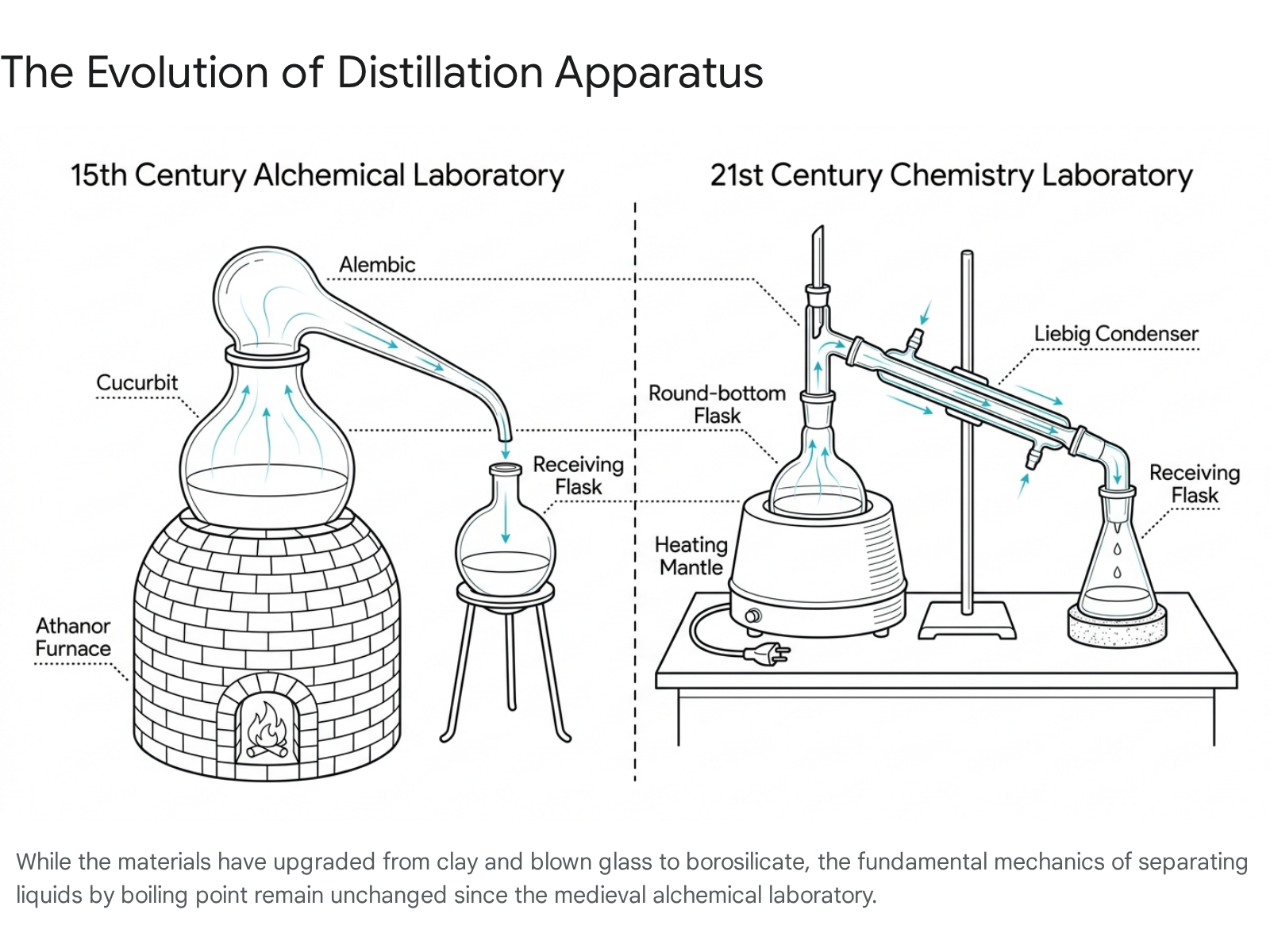
For prolonged, continuous reactions, they invented the pelican, a circulatory distillation vessel, and the Bain-Marie (water bath) - a gentle, regulated heating method allegedly invented by Mary the Jewess in antiquity, which is still used in both scientific and culinary kitchens today 4131.
Standardizing Chemical Processes
Beyond building the physical lab, alchemists standardized the mechanical processes required to manipulate matter. Many of these procedures are still taught in introductory chemistry courses today, albeit under different theoretical paradigms.
Table 1: Alchemical Processes and Their Modern Equivalents 4132
| Alchemical Process | Historical Description | Modern Scientific Equivalent |
|---|---|---|
| Calcination | Breaking down a substance by fierce heating in an open crucible to reduce it to a dry ash (a calx). | Thermal decomposition or oxidation of solid materials at high temperatures. |
| Sublimation | Raising the active, subtle parts of a substance upward via heat, bypassing the liquid state. | The phase transition of a substance directly from the solid to the gas phase. |
| Cohobation | The frequent return of a liquid distillate to its solid residue, followed by repeated distillation. | Continuous reflux distillation, used to maximize yield or complete a reaction. |
| Amalgamation | The formation of an alloy between mercury and another metal. | The creation of mercury alloys (amalgams), historically used in mining to extract gold. |
| Coagulation | The conversion of a thin liquid into a solid mass through heating, cooling, or a chemical additive. | Precipitation or crystallization from a solution. |
The Coded Language of Early Science
To protect their intellectual property from rivals and avoid accusations of heresy or counterfeiting, alchemists shrouded their laboratory notes in dense layers of allegory, metaphor, and code words known as Decknamen (cover names) 444. Because the era lacked a standardized chemical nomenclature, they frequently described chemical reactions using biological, astrological, and gendered analogies 33.
For instance, the compounding of two elements was often described as a "marriage" or "conjunction," and the creation of a new substance was a "pregnancy" occurring within the "womb" of the glass flask 33. Specific metals were linked to planets (e.g., gold to the Sun, silver to the Moon, iron to Mars) 34.
This poetic obfuscation has led many modern readers to mistake practical laboratory manuals for esoteric mystical poetry 3335. However, by painstakingly cross-referencing alchemical texts and reproducing the experiments, modern historians have successfully decoded the true chemical nature of these substances.
Table 2: Decrypting Alchemical Terminology 26414434
| Alchemical Term / Deckname | Modern Chemical Name | Historical Application & Formation |
|---|---|---|
| Aqua Fortis ("Strong Water") | Nitric Acid ($HNO_3$) | Dissolving silver and base metals; prepared by distilling saltpeter with green vitriol. |
| Aqua Regia ("Royal Water") | Nitrohydrochloric Acid | A mixture of nitric and hydrochloric acid capable of dissolving gold. |
| Butter of Antimony | Antimony Trichloride ($SbCl_3$) | Used medically; formed by distilling corrosive sublimate with antimony trisulfide. |
| Cinnabar | Mercuric Sulfide ($HgS$) | The primary red ore of mercury, historically roasted to extract "quicksilver." |
| Green Lion / Copperas | Ferrous Sulfate ($FeSO_4$) | Used to produce sulfuric acid and in early dye/ink making. |
| Lunar Caustic | Silver Nitrate ($AgNO_3$) | Used in surgery to cauterize wounds; "Luna" was the deckname for silver. |
| Sal Ammoniac | Ammonium Chloride ($NH_4Cl$) | Used in refining metals; originally derived from soot and animal dung. |
| Spirit of Salt | Hydrochloric Acid ($HCl$) | A highly corrosive mineral acid distilled from common salt. |
What Did Alchemy Contribute to Real Science?
Through their ceaseless manipulation of matter, alchemists stumbled upon and refined chemical agents that drove both the industrial and artistic revolutions.
The Birth of Modern Pharmacology
By the 16th century, the Swiss physician and alchemist Paracelsus completely reoriented European alchemy toward medicine, a movement known as iatrochemistry 3. He famously argued that the true purpose of alchemy was not to manufacture gold, but to cure disease.
Paracelsus theorized that the human body was essentially a chemical system, and that illnesses were chemical imbalances that could be treated with precisely dosed mineral compounds 3. He pioneered the medical use of heavy metals and minerals - such as zinc, mercury, and antimony - echoing the Ayurvedic Rasashastra traditions developed centuries earlier in India 31918. This marked a profound shift away from the ancient Galenic medical theory of "four humors" and laid the groundwork for modern pharmacology and toxicology, operating on the foundational principle that "the dose makes the poison."
The Invention of Synthetic Pigments
Before the advent of modern chemistry, specific pigments - particularly blues - were exceedingly rare and expensive. "True blue" ultramarine had to be ground from lapis lazuli imported from distant mountain ranges in Afghanistan, making the pigment more expensive than gold 36. The ancient Egyptians had previously solved a similar problem by inventing "Egyptian Blue" around 2,200 BCE, fusing silica, calcium, and copper into the world's first synthetic pigment 3637.
However, in 1704, an alchemical accident in Europe changed the art world forever. A Berlin dye-maker named Johann Jacob Diesbach was attempting to create a red pigment using iron sulfate and potash. He sourced his potash from a local alchemist and pharmacist, Johann Konrad Dippel 3650. Unbeknownst to Diesbach, Dippel's potash was contaminated with animal blood 3650. When the ingredients combined, the iron reacted with the cyanide in the blood to form iron ferrocyanide - a brilliant, deep blue compound that became known as Prussian Blue 5038.
Prussian Blue was cheap, stable, and intensely vibrant. It revolutionized European painting, became the standard dye for military uniforms, and was exported globally. In Japan, it drove the golden age of aizuri-e woodblock printing, famously utilized by Katsushika Hokusai to create the vibrant, lasting hues in The Great Wave off Kanagawa 3750. The chemical legacy of Prussian Blue continues today; it is on the World Health Organization's List of Essential Medicines, utilized as an antidote for heavy metal and radiation poisoning 39.
Establishing the Scientific Method
Perhaps the most enduring legacy of alchemy is the establishment of the experimental method itself. While their theoretical frameworks (such as the four elements or the mercury-sulfur theory) were eventually overturned, their operational methodology - hypothesis, controlled experimentation, systematic observation, and iteration - formed the bedrock of the modern scientific method 35.
Famed figures of the Scientific Revolution were avid, practicing alchemists. Robert Boyle, largely considered a founder of modern chemistry, acknowledged his debt to alchemical methods in his foundational text, The Sceptical Chymist 540. Sir Isaac Newton spent decades secretly conducting alchemical experiments in his laboratory. He systematically sought to understand the hidden attractive forces between chemical particles, a pursuit of "active principles" that ultimately influenced his physical theories on gravity and optics 540.
The "New Historiography": Recreating Ancient Alchemy
For much of the 19th and 20th centuries, historians of science dismissed alchemy as a superstitious, pseudoscientific dead-end. However, a movement known as the "New Historiography of Alchemy," spearheaded by scholars like Lawrence M. Principe at Johns Hopkins University and Matteo Martelli at the University of Bologna, has radically altered this perspective 354041.
These scholars recognize that to truly understand alchemy, one cannot merely translate ancient Greek, Syriac, and Latin texts; one must step into the laboratory. By performing physical replications of alchemical recipes - using period-accurate materials, temperatures, and apparatus - they have proven that alchemists were astute observers of empirical phenomena who accurately described complex chemical reactions 404243.
Case Study: Extracting Mercury with "Natron Oil"
A prime example of this replicative approach is the recent work by the EU-funded AlchemEast project, which analyzed the ancient extraction of mercury from cinnabar (mercuric sulfide).
Conventional historical wisdom assumed that ancient alchemists merely roasted cinnabar in open air, allowing atmospheric oxygen to react with the sulfur and release pure mercury vapor 7. However, ancient texts by the 1st-century CE alchemist Pseudo-Democritus explicitly called for the use of "natron oil" and a closed, "double vessel" to capture the vapors 4445. For decades, modern chemists assumed this was either allegorical nonsense or an unnecessary complication.
When the AlchemEast team replicated the exact text in a laboratory, they made a stunning discovery. By mixing cinnabar with "natron" (sodium carbonate) and heating it in a closed environment devoid of oxygen, the sodium carbonate acted as a highly effective reducing agent. The reaction successfully yielded liquid mercury and sodium sulfate 745.
This proved that ancient alchemists had intentionally developed a sophisticated mechanochemical extraction process that did not rely on oxygen 7. The addition of "oil" - which researchers determined was likely water or vinegar mixed with the natron to create a viscous suspension - helped facilitate the reaction, as alchemists correctly believed that liquid substances reacted more promptly than solid ones 745. Far from stumbling blindly, these early practitioners utilized their deep knowledge of materials to engineer efficient, controlled chemical pathways, effectively practicing what we now recognize as chemistry 67.
Bottom line
Alchemy was not a chaotic detour in human history, but the vital, experimental precursor to the modern physical sciences. Driven by complex philosophical frameworks and a desire to perfect nature, alchemists across Asia, the Middle East, and Europe developed the foundational tools of the laboratory, pioneered metallurgy and pharmacology, and discovered materials that reshaped global commerce. By stripping away the layers of allegory and replicating their historical texts in modern laboratories, historians have revealed a tradition defined by rigorous empiricism, proving that the roots of modern chemistry run deeply through the alchemical furnace.