
History and psychology of belief in occultism
Introduction: Establishing the Academic Boundaries of the Hidden
The academic study of the occult, esotericism, and mysticism has undergone a rigorous transformation over the last century, shifting from an antiquarian curiosity to a formalized, highly structured discipline that intersects the psychology of religion, anthropology, and sociology. To navigate this multidisciplinary terrain effectively, it is imperative to establish precise academic definitions at the outset, as the colloquial conflation of these terms obscures their distinct historical origins and cognitive functions.
Scholars within the academy generally differentiate these domains by analyzing their orientation toward knowledge, practice, and the divine. Esotericism refers to the inner, guarded traditions of knowledge restricted to initiates, often emphasizing a hidden cosmological order and the profound interconnections between the macrocosm and the microcosm 11. Occultism, conversely, denotes the practical application of these hidden forces - such as divination, alchemy, or sympathetic magic - to manipulate, predict, or interpret reality. Mysticism refers to the pursuit of unmediated, direct experiential union with the absolute or the divine, fundamentally transcending rational apprehension and linguistic representation 1. However, boundary disputes remain highly active within the academy. Certain scholars argue that esotericism functions merely as an overarching heuristic category for rejected Western knowledge, a polemical wastebasket for ideas discarded by the Enlightenment. Others, applying the term globally, argue that the "esoteric" appellation genuinely distinguishes advanced, experiential, and secretive methodologies from exoteric, community-oriented religious dogma across various global cultures 13.
It is also crucial to explicitly call out and dispel pervasive misconceptions that have historically plagued both the practice and the study of these traditions. First, the media-driven conflation of broad occultism with Satanism is anachronistic and academically baseless; occult and esoteric practices overwhelmingly focus on cosmological harmony, self-actualization, or systemic divination, rather than the inversion or mockery of Judeo-Christian theology 23. Furthermore, as early Christian missionaries and colonial anthropologists encountered non-Western esoteric systems, they frequently miscategorized these complex philosophies as primitive paganism or satanic rites, a bias that modern scholars are actively working to dismantle 23. Second, empirical research definitively refutes the assumption that esoteric beliefs correlate strictly with lower education or lower intelligence. Rather, susceptibility to occult paradigms is closely tied to specific cognitive styles, personality spectrums, and environmental stressors, operating as highly sophisticated mechanisms for managing uncertainty, cognitive load, and societal marginalization 47.
Methodologically, this analysis prioritizes peer-reviewed academic journals and clearly distinguishes between primary historical texts (practitioner writings designed for initiates) and secondary scholarly analyses (the academic observation and categorization of these practices). Primary texts often employ intentional obfuscation and metaphorical language to protect the teachings from the uninitiated, necessitating rigorous secondary hermeneutical interpretation to understand their psychological and historical significance.
The Geography of the Hidden: Expanding Beyond the Western Paradigm
Historically, the academic study of esotericism has exhibited a profound Eurocentric bias, focusing heavily on Hermeticism, Renaissance magic, Rosicrucianism, and 19th-century Theosophy. A truly exhaustive analysis requires mapping the esoteric and occult methodologies across geographically and culturally diverse non-Western traditions, acknowledging that the drive to codify the hidden mechanics of the universe is a universal human cognitive endeavor.
The Inner Elixir: Taoist Neidan
In the Chinese spiritual landscape, the practice of Neidan, or internal alchemy, represents a highly formalized esoteric discipline. Emerging distinctly during the Tang dynasty as a philosophical and practical divergence from Waidan (external, laboratory-based alchemy), Neidan internalizes alchemical symbolism 59. While early Waidan practitioners utilized physical substances like cinnabar and mercury in a laboratory crucible to forge an elixir of immortality, Neidan practitioners view the human body itself as the cauldron (ding) 59. The primary texts of this tradition, heavily indebted to the Cantong qi (The Kinship of the Three) written by Wei Boyang in 142 AD, map cosmological processes directly onto human physiology and psychology 510.
Within this esoteric system, practitioners cultivate the "Three Treasures" - Jing (Essence), Qi (Breath/Energy), and Shen (Spirit) - refining them through intense meditative and respiratory disciplines 59. The process is fundamentally cyclical and retrograde; whereas the natural cosmological flow moves from the Dao to multiplicity, the Neidan practitioner seeks to reverse this process, returning to the primordial unity of the Dao 110. Isabelle Robinet, a prominent scholar of Taoism, emphasizes that Neidan relies heavily on the trigrams of the Yijing (Book of Changes) and correlative cosmology, utilizing the concepts of True Yin (the Yin enclosed within Yang) and True Yang (the Yang enclosed within Yin) 10. Secondary scholarly analysis views Neidan not merely as a superstitious pursuit of physical immortality, but as a sophisticated late Chinese mystical tradition aiming to overcome the binary oppositions of existence 1. The ultimate generation of the "immortal embryo" or "Red Child" within the lower dantian operates as both a somatic and psychological reintegration of the fragmented self, serving as an inner deity that survives physical death 911. The modern academic study of these primary texts, largely found within the Daozang (Taoist Canon), only began in earnest after 1926, shifting the scholarly consensus from dismissing these practices as primitive chemistry to recognizing them as a complex spiritual and psychological science 1.
The Secret Mandala: Tantric Buddhism and Mikkyō
In Japan, the transmission of Vajrayana Buddhism evolved into Mikkyō, translated directly as "secret teachings" or Japanese esoteric Buddhism. Introduced primarily by the monk Kūkai, the founder of the Shingon school, in the early 9th century, Mikkyō distinguishes itself sharply from kengyō, or exoteric teachings 136. The structural division between the exoteric and esoteric is central to understanding this tradition. While exoteric teachings (like those found in mainstream Mahayana Buddhism) were adapted by the historical Buddha, Shakyamuni, using expedient means (upaya) to suit the varying intellectual capacities of the masses, esoteric teachings are considered the direct, unadulterated presentation of the absolute truth by the Dharmakaya Buddha, Mahavairocana 3.
Mikkyō relies on a highly complex, secretive structural triad known as the Three Mysteries (Sanmitsu): the body (symbolized by hand gestures or mudras), speech (sacred utterances or mantras), and mind (visualization through mandalas) 17. Unlike exoteric practices that traditionally require eons of reincarnation and gradual accumulation of merit to achieve enlightenment, the esoteric methodology of Mikkyō posits that through the rigorous, ritualistic synchronization of one's actions, speech, and cognition with the cosmos, a practitioner can attain Buddhahood in this very body (sokushin jōbutsu) 37. The Shingon school focuses almost exclusively on these esoteric rites, drawing upon primary tantric texts such as the Mahavairocana Sutra and the Vajrasekhara Sutra, which present a systemic hierarchy of cosmic energies 6. Scholarly analysis points out that Mikkyō deeply influenced Japanese court culture, shifting aristocratic aesthetics away from rigid Confucian structures and integrating heavily with indigenous Shinto and Taoist practices to create syncretic traditions like Shugendō 1.
The Hierarchy of Light: Suhrawardi and Ishraqism
Within the Islamic philosophical tradition, Shahab al-Din Yahya ibn Habash Suhrawardi (1154 - 1191) inaugurated the Illuminationist school, or Ishraqism (from the Arabic for "illumination" or "rising of the sun") 15817. Moving beyond the dominant Avicennan Peripateticism (Aristotelian logic) of his era, Suhrawardi fused Islamic theology, Neoplatonism, and ancient pre-Islamic Zoroastrian concepts into an entirely novel esoteric epistemology 89. The core of Ishraqi metaphysics is the ontology of light (nur), asserting that all existence is a gradation of luminescence emanating from the "Light of Lights" (nur al-anwar), which is the ultimate divine source 1517.
Suhrawardi introduced the revolutionary esoteric concept of the Alam al-Mithal, or the Imaginal World 15. This is an ontological realm situated between the pure, immaterial spirit of the divine and the gross, physical matter of the earthly plane 159. It is not a world of fantasy, but a real, objective plane accessible only through spiritual intuition, presential knowledge, and cultivated imagination 159. Modern depth psychology, particularly through the interpretive translation work of Henry Corbin and his subsequent influence on Carl Jung, recognizes Suhrawardi's hierarchy of lights as an elaborate psychological map of human consciousness. Suhrawardi's progression from the material to the divine mirrors the psychological integration of the collective unconscious and the process of individuation, bringing an extraordinary psychological depth to medieval Islamic mysticism 1519. Despite being executed for his unorthodox views, Suhrawardi's illuminationist philosophy profoundly influenced later thinkers, including Mulla Sadra in Safavid Iran, and represents a crucial, often overlooked pillar of global esoteric history 8.
The Architecture of the Soul: Kabbalah
Jewish mysticism, particularly the Kabbalah, presents one of the most structurally complex and psychologically rich esoteric systems in religious history. While exoteric, rabbinical Judaism emphasizes the rational, legalistic adherence to the mitzvot (the 613 commandments), Kabbalah imbues these physical actions with a divine-immanent cosmic significance. In Lurianic Kabbalah, human action is not merely about obedience; it is deeply tied to the concept of Tikkun Olam, the active, mystical rectification of an exiled, fragmented divinity 10. Primary texts, most notably the Zohar (The Book of Splendor), articulate a multi-layered structure of the human soul, which corresponds directly to the sephirotic tree of life and broader cosmological dimensions.
Scholarly consensus, following the pioneering academic work of Gershom Scholem and Moshe Idel, outlines five primary dimensions of the Kabbalistic soul. The lowest level is the Nefesh, the animalistic instinct tied strictly to physical survival, bodily cravings, and immediate gratification; psychologically, modern scholars draw direct parallels between the Nefesh and the Freudian Id 10212223. Above this is the Ruach, the moral spirit or conscience that distinguishes good from evil, functioning similarly to the psychological Superego, allowing the individual to manage the raw instincts of the Nefesh 102123. The third level is the Neshamah, the higher intellect and super-soul that separates humans from other lifeforms, enabling the apprehension of divine concepts and rational wisdom 102123. According to the Zohar, while the Nefesh is implanted at birth, the Ruach and Neshamah must be actively developed through spiritual awakening and positive deeds 102122. Beyond these three are the transcendent, rarely actualized esoteric levels of Chayyah (the life force allowing profound awareness of the divine) and Yehidah (the highest plane representing absolute, undifferentiated union with God) 2124. Modern psychological analysis, bridging Jungian archetypes with Lurianic symbols, views these esoteric soul-strata as a robust framework for profound self-discovery and therapeutic healing, aligning the mystical ascent through the Sephirot with the psychological mastery over impulse and the integration of the conscious and unconscious minds 1022.
The Syncretic Matrix: Afro-Diasporic Religions
Afro-diasporic traditions - such as Santería (Lukumí) in Cuba, Candomblé in Brazil, and Vodou in Haiti - represent a unique category of esoteric practice forged under the extreme trauma and violence of the transatlantic slave trade 211. These traditions strategically syncretized indigenous West African cosmologies (particularly Yoruba and Kongo beliefs) with European Catholicism and 19th-century Spiritism (Kardecism) to preserve their spiritual technologies in absolute secrecy under the oppressive eyes of colonial masters 1126. Academic analysis of these faiths is undergoing a renaissance; historically dismissed as folkloric mythology or demonized as primitive witchcraft, modern scholars of Africana religions recognize these systems as profound philosophical paradigms that challenge dominant Western epistemology 2.
The esoteric structure of these religions is fiercely guarded through strict, graduated initiation hierarchies that require immense psychological and physical endurance. In Santería, for instance, the broader community interacts on an exoteric level, but to truly access the esoteric layers, a practitioner must ascend a complex ladder. One begins as an Aleyo (an uninitiated outsider), moves to an Aborisha upon receiving basic protections, and eventually undergoes the intensive, secretive seven-day kariocha ceremony 122829. During this ritual, the practitioner becomes an Iyawo (bride of the Orisha), undergoing a year of strict behavioral, dietary, and dress restrictions (iyaworaje) to purify the soul 122830. This culminates in the literal and metaphysical "crowning" of the practitioner's head with their tutelary Orisha, elevating them to an Olorisha or Santero 2829. The pinnacle of this hierarchy is the Babalawo or Oba Oriate, specialized high priests tasked with mastering the incredibly complex Ifá divination system 2829. Philosophically, these traditions posit a worldview where the material and spiritual realms are entirely contiguous. Knowledge is transmitted not merely through rational, written discourse, but somatically through spirit possession, divination, and the harnessing of Aché, the divine, generative energy of the universe 23. Interestingly, 19th-century West African intellectuals, such as John Augustus Abayomi Cole, actively utilized Western esoteric networks, comparing practices like Ifá to the Jewish Kabbalah and the Tarot to argue that African traditions were sophisticated sciences of the mind, explicitly combatting colonial marginalization 3.
Systemic Instability and the Occult Revival: A Historical Mapping
The historical record indicates a pronounced, cyclical correlation between periods of severe systemic societal instability - such as wars, pandemics, and economic crashes - and sudden, massive spikes in public interest in the occult and esoteric.
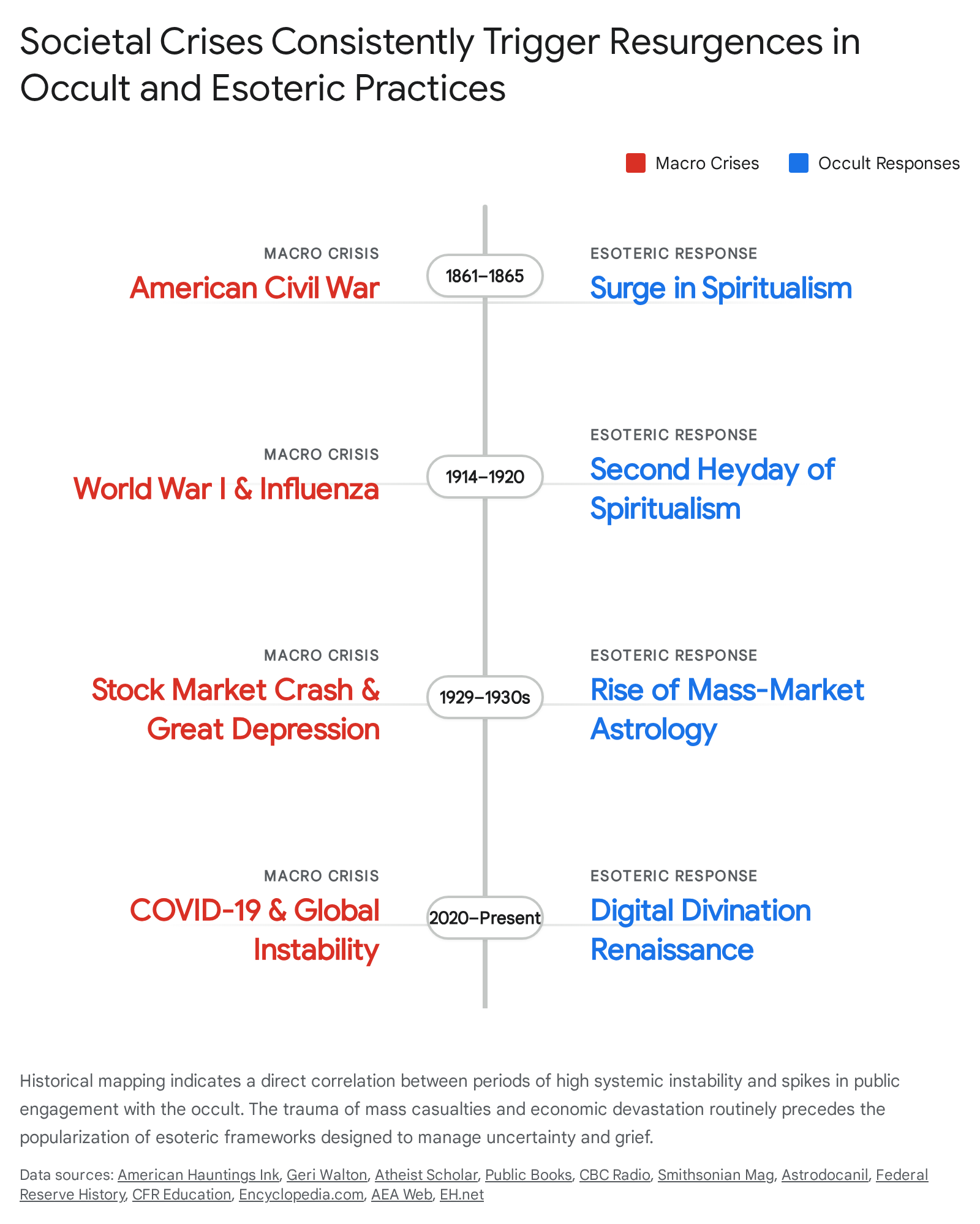
When orthodox institutions, including the state, mainstream religion, and empirical science, fail to protect populations from catastrophic trauma, individuals pivot en masse to alternative frameworks that promise hidden order, continuity beyond death, and psychological agency.
In the mid-to-late 19th century, the United States suffered a series of devastating financial panics, most notably in 1857, 1873, and 1893 1314. These events were not minor recessions; they resulted in the suspension of thousands of banks, mass unemployment, the failure of tens of thousands of businesses, and widespread destitution 1314. This profound economic fragility was compounded by the unprecedented carnage of the American Civil War (1861 - 1865). The war introduced the civilian population to the wholesale slaughter of young men, heavily publicized through the new medium of battlefield photography, leaving hundreds of thousands of families grieving without the closure of recovering their loved ones' bodies 331535.
In this climate of profound national trauma, Spiritualism - which had been sparked locally in 1848 by the mysterious rappings reported by the Fox sisters in Hydesville, New York - exploded into a ubiquitous mass movement 331536. Séances moved from parlor tricks to urgent societal necessities, even reaching the highest echelons of power; Mary Todd Lincoln notoriously hosted séances in the White House to contact her deceased son, a practice tolerated by President Abraham Lincoln 153536. Spiritualism offered empirical, experiential "proof" that the dead survived and could be actively communicated with, thereby mitigating the overwhelming grief of a war-torn nation and providing a voice for marginalized groups, particularly women involved in the suffrage and abolitionist movements 153536.
This socio-historical pattern repeated globally a half-century later. Following the localized decline of Spiritualism around the turn of the century due to internal disorganization and exposed frauds, the movement experienced a massive, secondary resurgence immediately following World War I (1914 - 1918) and the concurrent 1918 influenza pandemic 333516. The Great War resulted in millions of casualties, and the Spanish Flu dwarfed even the Black Death in its sheer volume of victims; once again, a concentrated dose of mass death drove the bereaved back to the séance tables of Europe and America 351617.
Financial devastation acts as an equally potent catalyst for divinatory occultism. The "Roaring Twenties" was a period of rampant economic speculation, ending violently with the October 1929 stock market crash and the onset of the Great Depression 391819. Prior to the crash, astrologers had famously, and falsely, predicted an era of unbroken prosperity and high wages 20. However, as the Depression deepened into the 1930s, the public did not abandon astrology; rather, newspaper astrology columns were introduced to the masses for the first time 21. As noted by contemporary scholars, astrology surged in popularity precisely because it provided a narrative of cosmic order and distraction during an era of extreme economic impotence and the existential dread of looming global conflict 21. This psychological dynamic was critiqued heavily by Theodor Adorno in his 1952 essay "The Stars Down to Earth," where he argued that astrology provided citizens with the illusion of control over massive, opaque systems (like capitalism) that actually controlled them 21. This historical architecture laid the groundwork for modern astrological algorithms, which continue to spike during contemporary economic contractions, including the 2008 Great Recession and the 2020 COVID-19 pandemic, mirroring the celestial and terrestrial anxieties of 1929 214445.
Psychological Frameworks: Cognition, Control, and Alienation
To understand why human beings repeatedly turn to esoteric frameworks during periods of both personal distress and societal collapse, it is necessary to examine the intersecting psychological and sociological drivers that underpin belief. Contemporary academic analysis relies on several sophisticated frameworks to decode the occult mind, moving far beyond the archaic notion that magic is merely the domain of the uneducated.
Compensatory Control Theory vs. Mass Marginalization
Compensatory Control Theory (CCT) posits that human beings possess a fundamental, evolutionarily ingrained psychological need to perceive the world as orderly, structured, and predictable 22. When an individual's sense of personal or systemic control is threatened - whether by random tragedy, illness, economic ruin, or social upheaval - they experience acute, debilitating anxiety. To mitigate this psychological discomfort, individuals unconsciously substitute their diminished personal agency by endorsing external systems that promise overarching order 22. According to CCT, religious conviction and esoteric belief act as highly flexible cognitive resources; when personal control drops, belief in an external controlling deity, karmic justice, or the deterministic, mathematical cycles of astrology rises 22. This provides epistemic personal control, making a chaotic world seem understandable and survivable.
This micro-level psychological drive can be contrasted with macro-level sociological theories of mass marginalization, most notably Guy Debord's foundational Marxist critique, The Society of the Spectacle (1967) 47. Debord argued that modern, neoliberal capitalist society fundamentally alienates the individual from the collective praxis of shaping the social world. The populace is rendered culturally denuded, divorced from genuine community, and reduced to passive consumers of corporate-supplied, entrancing narratives - the "spectacle" 47. From this sociological perspective, the turn to mass-marketed, superficial occultism (e.g., generic newspaper horoscopes or commodified crystal healing) can be viewed as a symptom of the spectacle itself. Individuals, entirely divorced from true political or economic agency, consume pre-packaged magical narratives that simulate agency without threatening the capitalist status quo 2147.
However, deep, rigorous engagement in esoteric initiatory practices (such as Taoist Neidan, Vajrayana Mikkyō, or Afro-diasporic Santería) functions conversely. Rather than passive consumption, these traditions require intense discipline, study, and physical praxis, operating as a localized rebellion against the spectacle. They provide the practitioner with a highly structured, communal, and agentic identity that actively resists cultural homogenization, serving as a powerful counter-narrative for historically marginalized communities 262947.
Locus of Control and the Healthy Schizotypy Spectrum
Within individual psychology, the concept of "Locus of Control" (LOC), initially developed by Julian Rotter, is critical to understanding the propensity for occult belief. Individuals with an Internal LOC believe they directly command their own destinies through their actions, whereas those with an External LOC attribute their life outcomes to fate, luck, the actions of others, or powerful external forces 723. Exhaustive psychological studies, utilizing tools like the Multidimensional Locus of Control Scale and Tobacyk's Revised Paranormal Belief Scale (PBS-R), consistently demonstrate a strong positive correlation between an External Locus of Control and high scores on paranormal and superstitious beliefs 72349. For these individuals, engaging with esoteric practices (like witchcraft, sympathetic magic, or divination) is not a sign of irrationality, but a highly rational attempt to regain influence over an unpredictable world by utilizing tools designed to interact directly with those external forces 4924.
Furthermore, psychologists have identified that belief in the occult is strongly predicted by traits along the "Positive Schizotypy" spectrum, specifically the "Unusual Experiences" (UnExp) subscale 4. It is vital to separate this psychological construct from pathological schizophrenia. In the general population, healthy schizotypy relates to a cognitive style highly prone to magical thinking, vivid perceptual imagery, out-of-body experiences, and exceptionally enhanced pattern recognition 4. Individuals scoring high in UnExp are more susceptible to cognitive biases such as the misrepresentation of chance and "illusory causality" - the tendency to perceive deep, meaningful associations between entirely random or coincidental events in the environment 4. For these individuals, esoteric frameworks like New Age Philosophy (NAP) or traditional occultism provide a highly effective, subjective structure that successfully organizes these hyper-associative cognitions into a coherent, livable worldview, turning the noise of the universe into decipherable signals 4.
Mapping Psychological Drivers to Occult Practices
To synthesize the relationship between human cognition and specific esoteric systems, the following table maps core psychological needs directly to the occult practices that historically and functionally fulfill them.
| Psychological Driver / Cognitive Need | Definition within Psychological Literature | Corresponding Occult / Esoteric Practice | Mechanism of Fulfillment |
|---|---|---|---|
| Need for Cognitive Closure & Certainty | The intense desire for a firm answer to a question and an aversion toward ambiguity; seeking to reduce the anxiety caused by unpredictable environments. | Astrology / Horoscopes / Numerology | Provides deterministic, cyclical frameworks (e.g., planetary transits) that classify complex human behavior and future geopolitical events into predictable, categorized archetypes 21. |
| Desire for Agency (External Locus of Control) | The belief that life is controlled by outside forces, combined with an urgent psychological need to influence, navigate, or appease those forces. | Tarot / Divination / Witchcraft / Sympathetic Magic | Offers a tangible, ritualistic mechanism to interface with, interpret, and subtly manipulate external forces, granting the practitioner a sense of localized, vicarious control over their fate 449. |
| Pattern Recognition (Illusory Causality) | A cognitive propensity (often tied to healthy positive schizotypy) to detect meaning, connections, and structure in random, coincidental, or noisy data sets. | Precognition / Synchronicity / Omens | Validates the individual's unique cognitive style by framing coincidences not as statistical anomalies, but as deeply meaningful, interconnected signs generated by the universe for the observer 4. |
| Structural Identity & Social Efficacy | The fundamental human need to belong to a defined social hierarchy that confers status, purpose, and clear, achievable rules of progression. | Santería / Candomblé / Initiatory Fraternal Orders | Provides highly rigid, secretive, step-by-step initiatory hierarchies (e.g., Aleyo to Babalawo) that grant deep psychological grounding, moral instruction, and communal protection against marginalization 2829. |
The Digital Occult: Algorithmic Divination and Predictive Processing (2023+)
The most profound and rapid development in the modern occult revival - accelerating massively post-2023 - is the complete digitization of esoteric practices and the rise of "mystic tech." Generation Z and digital natives are currently facing a confluence of severe macro-crises: acute climate anxiety, unprecedented economic precarity, political polarization, and a deep-seated distrust of traditional institutions. In response, this demographic has driven a mass migration away from traditional, expensive, in-person psychic practices toward on-demand algorithmic divination within online esoteric communities and digital subcultures like "WitchTok" on TikTok 51.
This hypermodern mysticism takes several forms. Software platforms mapped with predictive analytics generate hyper-personalized astrological transits, utilizing blockchain-backed engines to track celestial movements in milliseconds 52. Neural networks, trained on thousands of illustrated archetypes and historical grimoire texts, generate entirely unique AI Tarot readings 52. Occult chatbots act as digital familiars, dispensing spell recipes, affirmations, and divinatory interpretations in real-time 52. Traditional tarot readers have also begun incorporating AI like ChatGPT into their practices to generate multiple interpretations of complex spreads, though this has caused fractures within the community regarding the erosion of human intuition and the ethical use of training data 535455.
This synergy thrives because, fundamentally, both the occult and machine learning are engines of pattern recognition, built on repeating motifs, symbolic rule sets, and vast data processing 5256. From a clinical psychological standpoint, digital divination operates as a highly effective projective technique. Much like the Rorschach inkblot test or the Thematic Apperception Test (TAT) used in clinical psychology for decades, Tarot imagery - whether physically printed on cardstock or generated dynamically by an AI - bypasses cognitive defenses 5725. The archetypal imagery embedded in the cards (e.g., The Tower symbolizing sudden catastrophic change, or The Fool symbolizing blind leaps of faith) triggers immediate emotional memory 57. This allows individuals in distress to project their subconscious anxieties, relationship patterns, and internal conflicts onto the visual metaphor, often facilitating rapid therapeutic breakthroughs and moments of deep self-reflection where traditional, verbal talk-therapy might stall 572559.
Predictive Processing in Digital Ecosystems
To fully explain the cognitive efficacy, appeal, and persistence of algorithmic divination, cognitive scientists and anthropologists are increasingly applying Predictive Processing (PP) theory 562661. Rooted in neuroscience and the work of Karl Friston, PP theory argues that the human brain is not a passive receiver of sensory inputs waiting to assemble a picture of reality from the bottom up. Rather, the brain is a proactive "hypothesis tester" operating top-down 6127. The brain constantly generates internal generative models (predictions or Bayesian "priors") about what the external world should look like based on past experience 6127. When incoming sensory data contradicts the brain's prediction, a "prediction error" occurs, forcing the brain to either update its model to minimize future surprise (perceptual inference) or actively change the environment to match the prediction (active inference) 6127.
In the context of the digital occult, algorithmic divination functions as an externalized cognitive map 5628. Users approach an AI Tarot app or an astrological algorithm with strong internal "priors" (e.g., deep anxiety about an impending exam, or the suspicion of an unfaithful partner). The algorithm processes massive, chaotic datasets to output a specific reading, achieving an "ostensive detachment" that makes the machine appear as an impartial, omniscient oracle 56. Even if the reading is generated via completely randomized code or biased training data, the user's brain - evolutionarily wired to minimize uncertainty - seizes upon the archetypal output, instantly retrofitting and mapping the algorithm's "prediction" to match their highly specific personal circumstances 5626.
Strikingly, the anthropological and historical records show that failures in divination - whether the death of a poisoned chicken in Zande rituals, or a wildly inaccurate AI horoscope - rarely deter belief 562628. In the Predictive Processing framework, if a ritual or prediction fails, the believer simply rationalizes the failure (e.g., "the algorithm lacked context," or "mercury was in retrograde") to protect the overarching system of meaning. The brain prefers to explain away the prediction error rather than dismantle the entire generative model, maintaining the integrity of the worldview against the terrifying alternative of a random, meaningless, and uncaring universe 2628. Thus, the objective "accuracy" of algorithmic divination is ultimately irrelevant to its survival. Its true function is not prophecy, but cognitive regulation: it manages emotional states, restores a sense of cognitive order, and reduces systemic anxiety for a marginalized generation navigating the overwhelming complexity of the digital age 56.
Conclusion
The comprehensive academic study of esoteric and occult traditions reveals unequivocally that they are far from the irrational, superstitious remnants of an uneducated past. Rather, from the internal alchemy of Taoist Neidan and the luminous metaphysics of Islamic Ishraqism, to the psychological complexities of the Kabbalistic soul and the resilient, community-forging hierarchies of Afro-diasporic faiths, the occult represents a highly sophisticated series of cognitive, philosophical, and cultural technologies.
Historically triggered by periods of profound systemic trauma, warfare, and economic collapse, and psychologically driven by the fundamental human need for agency, meaning, and pattern recognition, these traditions continuously adapt to their environments. The contemporary explosion of AI Tarot, algorithmic astrology, and digital witchcraft communities is merely the latest iteration of this ancient psychological drive. As humanity faces unprecedented digital complexity, shifting geopolitical landscapes, and global instability, the hidden architectures of the occult will inevitably persist. They will continue to provide order in the dark, process the chaotic data of human existence, and offer a profound mirror to the depths of the human mind.