
History of CIA Project MKUltra
The Central Intelligence Agency's Project MKUltra remains one of the most exhaustively documented and profound instances of systematic medical and ethical abuses conducted by a modern state intelligence apparatus. Officially authorized in 1953 and formally halted in 1973, MKUltra was an extensive, highly classified human experimentation program designed to develop procedures and identify chemical, biological, and radiological materials capable of altering human behavior 122. Driven by the geopolitical anxieties of the Cold War, the program sought to counter perceived Communist advances in psychological warfare and to develop offensive mind control capabilities, including a reliable "truth serum" for interrogations, methods for creating synthetic amnesia, and techniques to engineer programmable assassins 12.
Operating for two decades, the program encompassed at least 149 known subprojects executed across more than eighty institutions, including universities, hospitals, pharmaceutical companies, and federal prisons 123. In pursuit of its intelligence objectives, the agency frequently utilized unwitting American and Canadian civilians, military personnel, and psychiatric patients as non-consensual test subjects 123.
Due to the systematic destruction of the vast majority of the program's official operational records in 1973 by order of Director of Central Intelligence (DCI) Richard Helms, the exact number of victims and the complete operational scope of the experiments remain permanently obscured 125. However, surviving documentation - uncovered largely through subsequent congressional investigations and Freedom of Information Act (FOIA) requests in the late 1970s - provides a detailed taxonomy of state-sponsored ethical transgressions. The legacy of MKUltra extends far beyond its immediate operational failures; its public exposure fundamentally altered the landscape of medical ethics, catalyzed the implementation of strict human subject protections within the United States, and caused a profound, enduring erosion of public trust in both governmental transparency and scientific institutions 456.
Precursor Programs and the Origins of Behavioral Research
The genesis of CIA behavioral modification research was rooted in the escalating geopolitical tensions of the early Cold War and the specific psychological anxieties generated by the Korean War. The United States intelligence community harbored deep fears that the Soviet Union, the People's Republic of China, and North Korea had developed advanced "brainwashing" techniques 1. This fear was ostensibly evidenced by the televised, seemingly coerced false confessions of American prisoners of war (POWs) and the perceived ideological conversion of captured personnel 1. This perceived disparity in psychological warfare capabilities prompted the United States government to rapidly initiate defensive and offensive research programs.
While American military interest in chemical interrogations dated back to 1943, when the Office of Strategic Services (OSS) sought a "truth drug" that would produce "uninhibited truthfulness," the modern bureaucratic lineage of MKUltra began in the post-war era 1. In 1947, the United States Navy initiated Project CHATTER, an interrogation program that marked the military's first organized testing of lysergic acid diethylamide (LSD) on human subjects 1. However, the Central Intelligence Agency soon assumed primacy over these efforts.
Project Bluebird
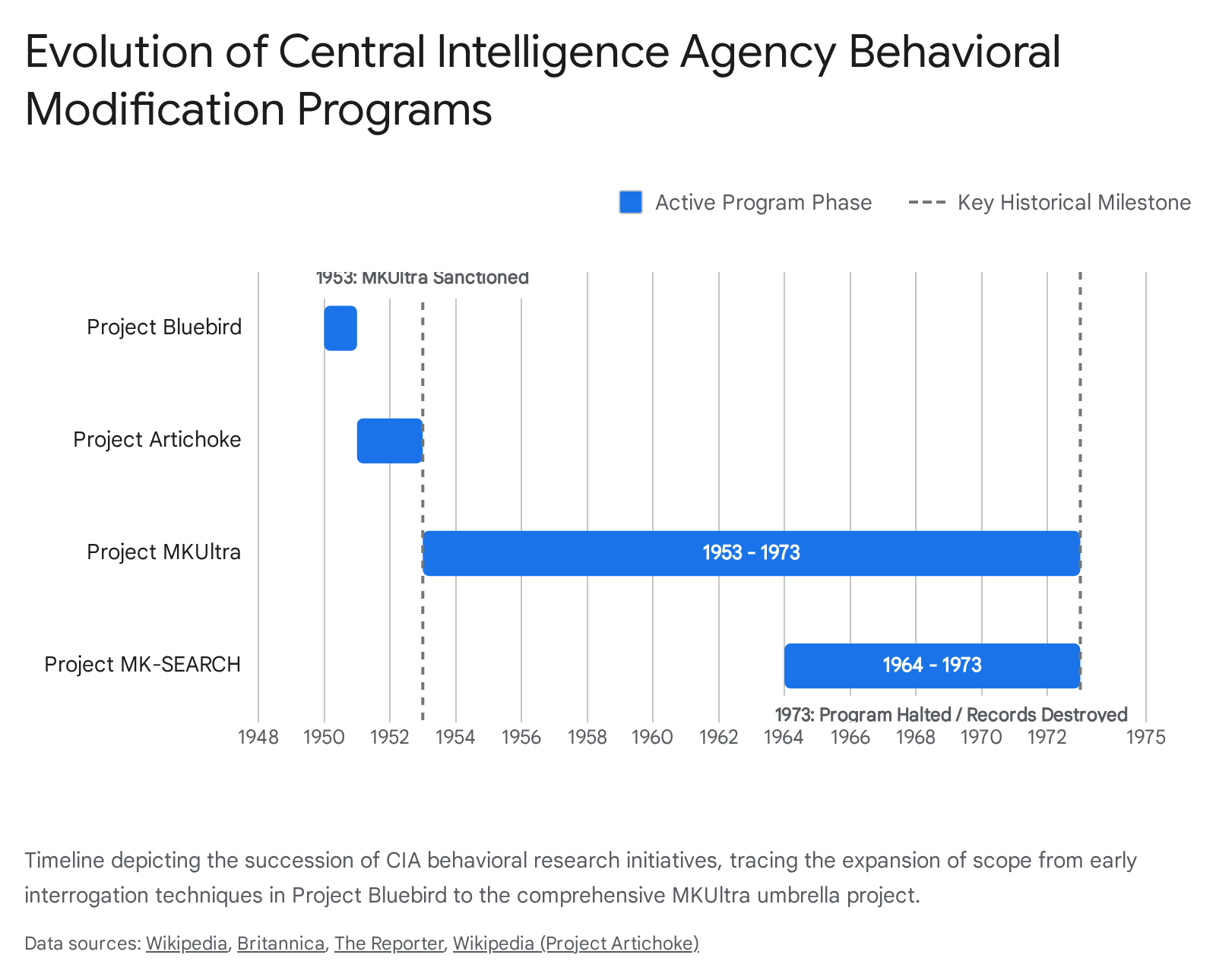
In April 1950, CIA Director Roscoe H. Hillenkoetter formally authorized the agency's first dedicated behavioral control initiative, designated Project Bluebird 178. Organized under the Office of Security, Project Bluebird was designed to develop reliable interrogation techniques, explore the creation of synthetic amnesia to protect covert operatives, and prevent adversarial extraction of information from captured U.S. personnel 17.
The research methodology integrated polygraph testing, hypnosis, and the administration of pharmaceutical agents 78. Significantly, Bluebird teams engaged in the non-consensual testing of these methodologies on unwitting subjects. Declassified documents reveal that in October 1950, during the Korean War, North Korean POWs under U.S. custody were subjected to experimental interrogation techniques under Project Bluebird 178. The core objective of these early tests was to determine if human autonomy could be entirely subverted. A guiding operational question was whether the agency could control an individual to the point where they would do the interrogator's bidding against their will, potentially even overriding fundamental laws of nature such as self-preservation 18.
Project Artichoke
As the scope of the research outgrew its initial parameters, Allen Dulles, then head of the CIA's covert operations, ordered the program expanded and intensified in August 1951 2. The initiative was renamed Project Artichoke and its administrative control was transferred to the CIA's Office of Scientific Intelligence (OSI) 28.
Artichoke pursued identical goals with greater resources, explicitly inquiring in a January 1952 memorandum: "Can we get control of an individual to the point where he will do our bidding against his will and even against fundamental laws of nature, such as self-preservation?" 8. The primary operational goal was to determine whether a person could be involuntarily programmed to perform an act of attempted assassination 8. Artichoke researchers experimented with a variety of coercive techniques, including induced morphine addiction followed by forced withdrawal, advanced hypnosis, and the weaponization of biological agents 811. A declassified Artichoke memo regarding biological research noted that "Not all viruses have to be lethal... the objective includes those that act as short-term and long-term incapacitating agents," leading to research into the potential of dengue fever and other diseases 8.
However, ongoing bureaucratic disputes between the OSI, the Office of Security, and military intelligence divisions regarding jurisdiction, coupled with the limitations of the substances being tested, led to a comprehensive restructuring of the intelligence community's behavioral research 8. This restructuring culminated in the creation of a massive, consolidated umbrella program.
Authorization and Architecture of Project MKUltra
On April 13, 1953, newly appointed Director of Central Intelligence Allen Dulles officially sanctioned Project MKUltra 12. The cryptonym itself reflected its organizational placement and its extreme level of secrecy: "MK" designated sponsorship by the Technical Services Staff (TSS) of the CIA, while "Ultra" represented an arbitrary dictionary word used to name the project, historically associated with the highest classification of top-secret intelligence during World War II 1.
The program was placed under the direction of Dr. Sidney Gottlieb, an American chemist and spymaster whose tenure at the head of the TSS Chemical Division would define the agency's pursuit of mind control for the next two decades 19. Dulles's brother, John Foster Dulles, was simultaneously serving as United States Secretary of State, a dynamic that provided the CIA with unprecedented diplomatic cover and operational latitude on the global stage 9.
Bureaucratic Framework and Funding Mechanisms
Under Gottlieb's stewardship, MKUltra evolved into a vast "umbrella project" that deliberately bypassed normal agency procedures for funding, accounting, and ethical review 31011. A 1963 CIA Inspector General report explicitly noted that the program utilized "purely internal and compartmented controls" to maintain maximum secrecy 10. The report stated that "normal procedures for project approval, funding, and accounting were waived" 10. To fund the research with minimal oversight, DCI Dulles authorized the allocation of a portion of the TSS Research and Development budget - eventually set at 6 percent of the total CIA operating budget - specifically for MKUltra activities without requiring standard financial auditing 110.
The scientific ambition of MKUltra was boundless. Internal agency documents describe a mandate to research and develop "chemical, biological, and radiological materials capable of employment in clandestine operations to control human behavior" 110. Researchers sought to synthesize knockout pills, truth serums, memory-erasing technologies, and substances that would "promote illogical thinking and impulsiveness" in order to discredit foreign leaders or adversarial intelligence assets 112. The ultimate goal was to manipulate human behavior in a predictable manner 13.
Front Organizations and Academic Complicity
Because the TSS could not conduct all necessary research internally, MKUltra relied heavily on outsourced contracts. The program funded activities at over eighty institutions, including forty-four colleges and universities, hospitals, state and federal prisons, and pharmaceutical companies 1214. To disguise CIA sponsorship and maintain the illusion of independent civilian research, Gottlieb and the TSS established and utilized several front organizations 2.
One of the most prominent cut-outs was the Society for the Investigation of Human Ecology, a CIA-funded foundation that served as a primary conduit for funneling research grants to prominent universities and medical professionals .
Another critical front was the Scientific Engineering Institute (SEI), founded in 1956 near Boston, Massachusetts 15. Ostensibly established as a proprietary company to conduct research on radar and technical matters unrelated to human behavior, SEI was headed by Dr. Edwin Land, the famous scientist, inventor, and founder of the Polaroid Corporation, who acted as a "figurehead" president 15. By the early 1960s, SEI had shifted its focus to behavioral control and life sciences under the direction of the CIA's Office of Research and Development 16. SEI's classified operations were extreme; historical accounts indicate that in July 1968, SEI teams deployed to Bien Hoa Hospital in South Vietnam to implant electrodes into the skulls of Vietcong POWs in experimental attempts to direct human behavior via remote control 17.
Similarly, the Amazon Natural Drug Co. (ANDCO) served as a covert procurement front. Operated by Joseph Caldwell King, the CIA's former Western Hemisphere chief, and Garland Williams, a former Federal Narcotics Bureau official, ANDCO was utilized to import hundreds of crates of unknown hallucinogenic plants and botanical toxins from South America 14. These biological samples were shipped to the U.S. Army Biological Warfare Laboratories at Fort Detrick, where scientists allegedly tested pulverized Amazonian magic plants on simians to determine if the dust could induce the animals to kill one another 14.
In many instances, the academic researchers receiving grants from these front organizations were unaware of the ultimate source of their funding or the operational intent behind the data they gathered 1. This compartmentation allowed the CIA to harness the intellectual output of the American academic establishment under false pretenses, utilizing civilian scientific infrastructure to advance military and intelligence objectives 12.
Scope and Categorization of MKUltra Subprojects
The true breadth of the MKUltra program was hidden for decades until 1977, when a Freedom of Information Act (FOIA) request uncovered a cache of roughly 20,000 documents that had survived the 1973 purge because they had been incorrectly stored in a financial records building 1. These surviving financial disbursement records and accounting approvals confirmed the existence of 149 numbered MKUltra subprojects, along with an additional 33 subprojects that the CIA claimed were unrelated to behavioral modification 31118.
During the 1977 joint hearings before the Senate Select Committee on Intelligence and the Subcommittee on Health and Scientific Research, the activities covered by the 149 subprojects were grouped into fifteen distinct categories to illustrate the program's methodology 311.
| Category | Description of CIA MKUltra Activities | Subproject Count |
|---|---|---|
| Drug & Alcohol Effects | Research into behavioral drugs. Included 17 projects likely not involving human testing, 14 definitely involving human volunteers, 19 probably involving volunteers, and 6 definitely testing on unwitting subjects. | 56 |
| Hypnosis | Research on hypnosis, including two projects combining hypnosis with drugs. | 8 |
| Chemical Acquisition | Acquisition of obscure chemicals, botanicals, or psychoactive drugs. | 7 |
| Covert Delivery / Magic | Adapting aspects of the magicians' art for covert operations (e.g., surreptitious delivery of drug-related materials in food or drink). | 4 |
| Behavioral Studies | Studies of human behavior, sleep research, and behavioral changes during psychotherapy. | 9 |
| Academic Monitoring | Library searches and attendance at international conferences on behavior modification to monitor global scientific advancements. | 6 |
| Motivation & Assessment | Motivational studies, psychological assessment of defectors, and training techniques. | 23 |
| Polygraph Research | Advancement and testing of polygraph (lie detector) technology. | 3 |
| Funding Mechanisms | Administrative subprojects established purely as funding mechanisms for MKUltra external research activities. | 3 |
| Biologicals & Toxins | Research on drugs, toxins, and exotic pathogens in human tissue, including effective delivery systems for biological warfare. | 6 |
| Unspecified | Activities whose specific objectives could not be determined from the surviving financial documentation. | 3 |
| Army Coordination | Subprojects involving funding support for unspecified activities connected with the Army's Special Operations Division at Fort Detrick, Maryland. | 21 |
Notable Subprojects and Methodologies
The specific operational details of these subprojects highlight the diverse and frequently unethical methodologies employed by the Technical Services Staff. The program ranged from laboratory synthesis to field deployment.
| Subproject | Timeframe | Primary Personnel / Location | Core Research Focus and Methodology |
|---|---|---|---|
| Subproject 1 | 1953 - 1954 | Princeton University | Isolation and characterization of alkaloids from Rivea corymbosa (a Mexican hallucinogenic trailing vine) for psychoactive properties 23. |
| Subproject 2 | 1953 - 1958 | James Hamilton / Stanford Univ. | Investigating the synergistic action of drugs to abolish consciousness and surveying methods for the surreptitious administration of drugs to patients without their knowledge 23. |
| Subproject 4 | Mid-1950s | John Mulholland (Magician) | Funding a professional stage magician to write a manual adapting sleight-of-hand arts for the covert delivery of pills or powders into targets' beverages 23. |
| Subproject 11 | 1950s | Classified | Identifying, developing, and stockpiling toxins, including the preparation of a supply of the highly toxic protein Abrin 24. |
| Subproject 54 | Early 1950s | United States Navy | "Perfect Concussion": A top-secret initiative theoretically utilizing sub-aural frequency blasts to induce total memory erasure, though records suggest it was never operationally carried out 12. |
| Subproject 119 | Late 1950s | Classified | Literature review and scientific analysis regarding the feasibility of the "remote electronic activation of the human organism" 25. |
Chemical Experimentation and the Weaponization of LSD
Central to MKUltra's chemical strategy was the intensive study of lysergic acid diethylamide (LSD-25). Following the discovery of its potent hallucinogenic properties, the CIA recognized the drug's dual potential: as an interrogation tool to break psychological resistance, and as an offensive weapon capable of temporarily incapacitating adversarial leadership or enemy combatants 261920.
Sidney Gottlieb sought to establish an American monopoly on the chemical. To prevent foreign powers from stockpiling the substance, CIA Director Allen Dulles approved the purchase of the global supply of LSD from Sandoz Laboratories in Switzerland, the drug's original manufacturer 121. Subsequently, the agency established a contract with the U.S. pharmaceutical manufacturer Eli Lilly & Company to serve as a reliable domestic supplier, ensuring the CIA had uninhibited access to the compound 1219.
Initially, the CIA tested LSD on witting volunteers, including agency employees, military personnel, and academic drug researchers 119. However, Gottlieb and the TSS leadership quickly concluded that clinical testing on consenting adults in laboratory environments failed to accurately replicate the stress, paranoia, and psychological dynamics of clandestine field operations 1922. The agency determined that the drug's capability to produce "disabling or discrediting effects" could not be established solely through volunteer populations 22.
Consequently, the CIA commenced administering the drug to unwitting subjects. The targets encompassed a wide cross-section of society, including mental patients, prisoners, sex workers, drug addicts, and members of the general public - described internally by one agency officer as "people who could not fight back" 121. The ethical violations were profound. In one egregious instance, Subproject 39 exploited a group of 142 criminal-sexual psychopaths confined at the Ionia State Hospital in Michigan 22. In another case, a psychiatric patient in Kentucky was administered LSD continuously for 174 days to study the effects of prolonged intoxication 1. Furthermore, Dr. Harris Isbell tested over 800 psychoactive drugs on prisoners with a history of addiction in exchange for rewards of heroin, providing them no opportunity for withdrawal or informed consent 21.
Operation Midnight Climax (Subprojects 3 and 42)
The most notorious field-testing apparatus of the MKUltra program was Operation Midnight Climax. Initiated in 1955 under Subprojects 3 and 42, this initiative was explicitly designed to test the efficacy of surreptitious drug administration and observe the behavioral responses of unwitting subjects in uncontrolled, social environments 2324.
To execute the operation, Sidney Gottlieb recruited George Hunter White, a seasoned Federal Bureau of Narcotics officer. Operating under the alias "Morgan Hall," White established a network of CIA-funded safehouses, most notably in New York City and the North Beach neighborhood of San Francisco 232324. White and his associates employed local sex workers to lure men from bars and public venues back to the apartments under the pretense of a sexual encounter 2324.
Once inside the safehouses, the unwitting subjects were secretly dosed with LSD or other psychoactive compounds via their food and drinks, or through aerosol delivery methods 2324. CIA operatives concealed behind two-way mirrors observed the subjects' reactions, taking detailed notes on the drug's effects on psychological vulnerability, erratic behavior, and sexual disinhibition 2324. The operation proceeded entirely without medical supervision or prescreening. Subjects experienced extreme disorientation, acute paranoia, and severe psychological distress, with some instances leading to hospitalization and enduring psychological trauma among the unidentified victims 2324.
Psychiatric Abuse and Depatterning: Subproject 68
MKUltra extended beyond the borders of the United States, most significantly in Canada. Under Subproject 68, the CIA funded the work of Dr. Donald Ewen Cameron, a preeminent psychiatrist who served as the president of the American and World Psychiatric Associations, and director of the Allan Memorial Institute at McGill University in Montreal 12425. From 1957 to 1964, the CIA covertly funneled grant money to Cameron via the Society for the Investigation of Human Ecology to support his draconian behavioral modification experiments .
Cameron theorized that severe mental illnesses, such as schizophrenia, could be cured by completely erasing a patient's existing personality and reconstructing it from a blank slate. He termed this initial erasure process "depatterning" 12235. Patients seeking treatment for relatively minor ailments, such as postpartum depression or generalized anxiety, were unwittingly enrolled in the program without their consent 2235.
The depatterning regimen involved placing patients into continuous drug-induced comas for prolonged periods - some lasting up to 86 days - using heavy, repeated doses of barbiturates and insulin 2235. While comatose or heavily sedated, patients were subjected to extreme electroconvulsive therapy (ECT). Cameron administered multiple shocks a day, utilizing voltages that exceeded standard clinical recommendations by up to 76.5 times 2422.
Following the systematic obliteration of their memory and cognitive function, Cameron initiated the second phase: "psychic driving." This entailed forcing the conscious, but severely disoriented and regressed patient to listen to looped audio messages via headphones, or speakers hidden inside football helmets strapped to their heads, for up to sixteen hours a day 11722. The goal was to imprint a new personality and behavioral patterns 17.
The results of Subproject 68 were uniformly catastrophic. Patients emerged from the Allan Memorial Institute with permanent brain damage, total amnesia, incontinence, and the inability to recognize their own families or recall their previous lives 24. One prominent victim, Velma "Val" Orlikow, the wife of a Canadian Member of Parliament, was treated for depression with massive doses of LSD and depatterning, leaving her emotionally and cognitively crippled 12. Decades later, a class-action lawsuit filed by Orlikow and eight other victims against the CIA was settled out of court for $750,000 in 1988 1224.
The Frank Olson Case and Fatalities
The blatant disregard for human rights intrinsic to MKUltra constituted severe violations of the Nuremberg Code - the set of ethical principles established after World War II prohibiting non-consensual human experimentation, which the U.S. government had formally endorsed and prosecuted Nazi scientists for violating 126. The program explicitly targeted vulnerable populations who could not provide informed consent, leveraging the absolute secrecy of the intelligence apparatus to shield researchers from legal or moral accountability 121.
The most prominent and publicly scrutinized casualty of this systemic negligence was Dr. Frank Olson. Olson was a senior bacteriologist and biological warfare scientist employed by the U.S. Army Biological Warfare Laboratories at Camp Detrick, Maryland 3626. As an insider, Olson was fully cleared and deeply aware of the most sensitive aspects of the TSS biological programs 2627. According to subsequent legal filings by his family, in the year of his death, Olson traveled to Europe, visiting bases in Paris, Norway, West Germany, and the UK's Porton Down 28. During these trips, Olson allegedly witnessed extreme interrogations in which the CIA purportedly committed murder using the biological agents he had helped develop, leading him to experience a profound moral crisis 2728.
In November 1953, Olson attended an MKUltra retreat at Deep Creek Lodge in rural Maryland alongside Sidney Gottlieb, CIA operatives, and Army colleagues 36. Without prior warning or consent, Gottlieb spiked the attendees' after-dinner Cointreau with a heavy dose of LSD 3628. Upon being informed twenty minutes later that they had ingested a potent hallucinogen, Olson reportedly suffered a severe psychological crisis 136. In the following days, his mental state deteriorated rapidly, characterized by intense paranoia, erratic behavior, and a stated desire to resign from his classified position 3626.
Recognizing him as a massive security risk, the CIA assigned an agent, Robert Lashbrook, to escort Olson to New York City to seek psychiatric help from an agency-cleared doctor 36. Nine days after the unwitting dosing, in the early hours of November 28, 1953, Olson plunged to his death from the window of his tenth-floor room at the Hotel Statler in Manhattan, a room he was sharing with Lashbrook 3626.
The CIA and the New York Police Department immediately ruled the death a suicide brought on by work-related stress, concealing the role of LSD 3626. The truth of the unwitting administration remained highly classified until 1975, when the Rockefeller Commission report exposed the agency's domestic drug testing 3626. The revelation prompted massive public outrage, leading President Gerald Ford to invite Olson's widow, Alice, and her children to the Oval Office for a formal, unprecedented presidential apology for Olson's wrongful death 362640. To prevent a highly public trial, the government subsequently negotiated an out-of-court settlement of $750,000 (reduced from a higher recommendation by a dissenting congressman) in exchange for the family relinquishing further legal claims against the state 362640.
Despite the settlement, Olson's sons, Eric and Nils, never accepted the suicide narrative. They later exhumed their father's body, and a secondary forensic analysis raised suspicions of blunt force trauma to the head sustained prior to the fall 262728. The sons alleged that their father was murdered by the CIA - thrown from the window to prevent him from blowing the whistle on the agency's lethal biological weapons research and interrogation practices, noting the circumstances mirrored those detailed in a CIA assassination manual drafted that same year 262728. Although they filed a lawsuit against the government in 2012 alleging murder and fraudulent concealment, the case was dismissed by a federal judge in 2013 due to the pre-existing 1976 settlement 3628.
Termination, Document Destruction, and Public Exposure
By the early 1960s, the initial optimism surrounding MKUltra had faded. In 1963, CIA Inspector General John Earman issued a highly critical internal report highlighting the immense legal, ethical, and public relations risks of surreptitious drug testing on unwitting citizens 4101218. Earman noted that the program violated standard operational safeguards, produced little actionable intelligence, and warned that exposure would severely jeopardize the agency 41012. Earman and other senior officials pushed back against Gottlieb and Helms's desire to continue unwitting domestic testing 12. Consequently, high-risk projects like Operation Midnight Climax were phased out, and MKUltra was officially reduced in scope and renamed MKSEARCH in 1964 213.
The ultimate destruction of MKUltra's historical record occurred in early 1973. Amid the escalating Watergate scandal and a generalized panic within the Nixon administration regarding impending congressional scrutiny of intelligence activities, DCI Richard Helms ordered the systematic destruction of all MKUltra files 12541. Helms later testified that the purge was initiated at the behest of Sidney Gottlieb, specifically to protect the identities of the external academic researchers, physicians, and institutional collaborators who had assisted the CIA, sparing them from legal repercussions and public embarrassment 541. Gottlieb personally traveled to the CIA records center to oversee the shredding of seven boxes containing the program's most sensitive operational and medical files 25.
Congressional Investigations
Despite Helms's efforts, the program was ultimately exposed. In December 1974, investigative journalist Seymour Hersh published a landmark New York Times exposé detailing widespread illegal domestic operations by the CIA, including the first public references to drug experiments on American citizens 2412. This catalyzed a wave of unprecedented government inquiries, most notably the United States President's Commission on CIA activities within the United States (the Rockefeller Commission) and the Senate Select Committee to Study Governmental Operations with Respect to Intelligence Activities (the Church Committee) in 1975 122943.
Because the primary documentation had been destroyed, the 1975 investigations relied heavily on the sworn, often evasive testimony of uncooperative witnesses, including Richard Helms and Sidney Gottlieb 14330. Under oath, Gottlieb admitted that the vast expenditures, extreme risk, and ethical breaches had yielded negligible operational results, stating that mind control and the pursuit of a reliable "truth serum" was "probably not a high pay-off program" 2430.
The full scope of the program was only partially realized in 1977. In response to a FOIA request filed by researcher John Marks, the CIA discovered a cache of roughly 20,000 documents that had survived the 1973 purge because they had been misfiled in a budget and fiscal records facility rather than the central operational archives 111. These vouchers and accounting approvals confirmed the existence of the 149 subprojects and exposed the network of front organizations and universities involved 31113. The discovery prompted a joint hearing by the Senate Select Committee on Intelligence and the Subcommittee on Health and Scientific Research, chaired by Senator Edward Kennedy, during which DCI Admiral Stansfield Turner formally acknowledged the extent of the agency's domestic experimentation, stating he was "horrified" by the findings 3112145.
Impact on Medical Ethics and Legal Frameworks
The revelations of MKUltra, coinciding with the exposure of the Tuskegee Syphilis Study, triggered a paradigm shift in American legal and ethical standards regarding human experimentation. The American public was confronted with undeniable proof that their government and elite medical institutions were capable of severe moral atrocities under the guise of national security and scientific advancement 4545.
Executive Orders and Intelligence Oversight
In immediate response to the Church Committee's findings, President Gerald Ford issued Executive Order 11905 in February 1976 293147. This directive implemented sweeping reforms across the intelligence community, replacing the covert 40 Committee with the Operations Advisory Group and establishing the Intelligence Oversight Board to report illegal activities to the Attorney General 29. Most notably, EO 11905 established a blanket prohibition on political assassination: "No employee of the United States Government shall engage in, or conspire to engage in, political assassination" 293147. Furthermore, it explicitly prohibited experimentation with drugs on human subjects without fully informed, witnessed, and written consent from the subject 1.
Subsequent administrations strengthened these intelligence oversight mechanisms. President Jimmy Carter's EO 12036 (1978) and President Ronald Reagan's EO 12333 (1981) expanded the directive to apply to any human experimentation, permanently banning non-consensual testing by any federal intelligence agency 12948.
The Belmont Report and Informed Consent
Within the medical and scientific communities, the exposure of MKUltra catalyzed the creation of modern institutional review boards (IRBs) and the codification of bioethics. In 1979, the Department of Health, Education, and Welfare issued The Belmont Report: Ethical Principles and Guidelines for the Protection of Human Subjects of Research 5. The document established three immutable pillars of biomedical ethics required for any human trials: 1. Respect for Persons: Recognizing the autonomy of human subjects and the absolute necessity of acquiring informed consent prior to experimentation. 2. Beneficence: Ensuring that research is beneficial to the individual or society and actively does no harm to the subjects. 3. Justice: Ensuring that the anticipated benefits of the research outweigh the risks, and that the burden of risk is not unfairly placed on vulnerable populations - a direct rebuke of MKUltra's targeting of prisoners, addicts, and mental patients 5.
Cultural Resonance and Legacy
The epistemological impact of MKUltra on American society was profound. By demonstrating that the most paranoid fears of citizens - that the government was secretly drugging civilians, operating hidden facilities, and utilizing brainwashing techniques - were rooted in objective historical fact, the exposure of the program fundamentally validated anti-institutional skepticism and eroded public trust in governmental transparency 4649.
Emergence of the Conspiracy Thriller Genre
In the realm of popular culture, the psychological trauma of the Cold War and the specific specter of MKUltra gave birth to the "conspiracy thriller" genre in literature and film 493233. Audiences, processing the shock of the Church Committee hearings and the Watergate scandal, found resonance in media that depicted omnipresent, corrupt state apparatuses operating beyond democratic control 32.
Richard Condon's novel The Manchurian Candidate (1959) - and its subsequent 1962 film adaptation - anticipated the exact anxieties MKUltra sought to address, depicting an American soldier programmed by Communist scientists into an unwitting, brainwashed assassin 3549. Following the program's declassification in the 1970s, films like The Parallax View (1974) and Three Days of the Condor (1975) crystallized a new narrative archetype: the lone individual besieged by a shadowy, omnipotent government cabal engaging in surveillance, murder, and psychological manipulation 3252. This cultural shift marked a departure from the heroic espionage narratives of the early Cold War, reflecting a "culture of intrigue" where the state itself was viewed as the primary antagonist 33.
Monarch Programming and Extremist Folklore
While academic and historical analyses emphasize the bureaucratic failures, hubris, and ethical crimes of MKUltra, the program's incomplete historical record - caused by the 1973 document destruction - created an informational void that has been aggressively filled by fringe conspiracy theories 535455.
The most prominent of these is the "Monarch Programming" theory. Emerging in the late 1980s and 1990s alongside the Satanic Panic, this unfounded, overarching theory posits that the CIA successfully mastered mind control and continues to operate a global, underground network of trauma-based programming 535455. Proponents allege that by subjecting individuals (often children) to extreme ritualistic abuse, electroshock, and sensory deprivation, programmers fracture the victim's psyche to create multiple, distinct personalities (alters) 355355. These alters can supposedly be triggered by specific phrases, symbols (like the Monarch butterfly), or visual cues to commit assassinations or act as sex slaves for global elites 355355.
Historiographical consensus and academic debunking confirm that no such program exists, and no official documentation supports the claims 5354. Monarch Programming theories inappropriately amalgamate documented MKUltra techniques - such as Ewen Cameron's depatterning and the real use of electroshock - with baseless folklore regarding celebrity mind control, Illuminati symbolism, and intergenerational cults 545556. The irony of the Monarch theory is that it credits the CIA with a level of scientific omnipotence that Sidney Gottlieb himself admitted the agency never achieved; the true failure of MKUltra was that its vast expenditures of capital and human suffering failed to produce a single reliable method for programmable mind control 2430.
Echoes in Contemporary Intelligence Practices
Despite the termination of MKUltra and the implementation of stringent legal frameworks like EO 11905, the legacy of CIA behavioral research continues to surface in contemporary contexts. Investigations into the CIA's post-9/11 "War on Terror" interrogation practices revealed alarming historical parallels to the agency's mid-century experiments.
The Senate Intelligence Committee report on CIA torture detailed the use of "enhanced interrogation techniques" on detainees at black sites and the Guantanamo Bay detention camp 34. Methods utilized by contractors James Mitchell and Bruce Jessen - such as severe sensory deprivation, sleep deprivation, enforced standing, and waterboarding - trace their conceptual lineage back to the Kubark Counterintelligence Interrogation Manual of 1963 34. The Kubark manual explicitly drew upon "a number of experiments at McGill University," linking the 21st-century abuses directly to Ewen Cameron's MKUltra research 34.
Furthermore, declassified documents from the CIA's Office of Medical Services revealed that in the 2000s, agency doctors explored "Project Medication," seeking to utilize the psychoactive drug Versed as a modern truth serum on detainees 35. In developing this proposal, CIA medical officials explicitly studied old MKUltra and Soviet drug records, ignoring the 1977 testimony of former directors who deemed human guinea pig experiments "abhorrent" 35. While Project Medication was never fully operationalized, the continued presence of medical professionals participating in, and providing a veneer of scientific legitimacy to, coercive interrogations demonstrates the enduring, complex legacy of the agency's historical quest to conquer the human mind 35.