
History and Structures of World Mysticism
The study of mysticism encompasses a vast array of human experiences, practices, and ontological frameworks aimed at establishing a direct, transformative connection with an ultimate reality, the divine, or the foundational nature of existence. Across world traditions, mysticism reveals a complex evolutionary history, transitioning from prehistoric shamanic rituals embedded in oral cultures to highly systematized contemplative philosophies within major organized religions 122. Despite the profound cultural, linguistic, and doctrinal differences separating these traditions, rigorous comparative analysis reveals distinct structural commonalities. These shared structures emerge in the epistemological debates surrounding the nature of unmediated experience, the methodological reliance on specific physical and cognitive practices, the dualistic employment of apophatic and kataphatic language, and the measurable neurobiological correlates that accompany the mystical state 453.
Typologies of Mystical Experience
In the academic study of comparative mysticism, researchers classify phenomena using structural dichotomies to differentiate the core nature of the reported experiences. The philosopher Walter Stace formalized the distinction between "extrovertive" and "introvertive" mysticism 3. Extrovertive mystical experiences occur when an individual perceives the external physical world as a unified, sacred whole, projecting a sense of divine unity onto their sense-perception of nature. Introvertive mysticism, by contrast, is achieved by turning inward, systematically stripping away sensory input and conceptual thought until the practitioner experiences an undifferentiated awareness or "nothingness" 3.
A second structural distinction separates "dualistic" from "monistic" experiences. Theistic traditions, such as Christianity, Judaism, and Islam, frequently report dualistic mystical experiences. In these accounts, the mystic achieves profound intimacy or union with the divine (unio mystica), yet a fundamental ontological distinction remains between the created human subject and the uncreated Creator 37. Conversely, monistic experiences, common in Advaita Vedanta and certain Buddhist schools, involve the total dissolution of the subject-object duality, resulting in the realization of absolute ontological oneness where the concept of a separate self is entirely extinguished 34.
Epistemological Debates in Mystical Scholarship
The interpretation of these diverse experiences has generated intense epistemological debate within religious studies, dividing scholars into essentialist and constructivist camps.
Essentialism and the Perennial Philosophy
For much of the early twentieth century, the dominant academic paradigm was essentialism, heavily associated with the "perennial philosophy" championed by figures like Aldous Huxley and formalized by Walter Stace 356. Essentialists argue for a "doctrine of unanimity," positing a common core hypothesis. According to this view, all human beings share the neurological and spiritual capacity for a universal mystical experience - specifically, an unmediated encounter with the absolute. Essentialists argue that while a Christian, a Buddhist, and a Sufi all experience the exact same phenomenological reality at the peak of their contemplation, the vast differences in their written accounts are merely post-experiential interpretations. The core experience is uniform; the cultural and linguistic overlay is diverse 561112.
The Constructivist Critique
In the late 1970s, Steven Katz introduced a highly influential critique of perennialism, establishing the constructivist or contextualist school of thought 5613. Katz argued against the existence of pure, unmediated experience. Utilizing a hyper-Kantian epistemological model, Katz asserted that a mystic's pre-experiential beliefs, cultural conditioning, religious vocabulary, and expectations actively shape and construct the mystical experience as it happens 35613. Under strict constructivism, a Zen Buddhist meditating on Sunyata (emptiness) experiences a fundamentally different ontological reality than a Hasidic Jew meditating on Ayin (divine nothingness) 13. Because the ontological frameworks and inherited structures of each tradition differ, the resulting forms of consciousness are phenomenologically distinct from their inception 56. Constructivism succeeded in returning the study of mysticism to rigorous historical and textual analysis, emphasizing that differences between traditions should not be flattened into a generic universalism 614.
Pure Consciousness Events
Constructivism, however, has faced sustained criticism from scholars specializing in Asian philosophical traditions and contemplative science. Critics like Robert K. C. Forman argue that strict constructivism suffers from logical inconsistencies and fails to account for the specific mechanics of meditative self-cultivation 1315. Constructivism relies on a dualistic epistemology - a subject interpreting an object - which fails to map onto traditions like Zen or Daoism, where the explicit goal is the total eradication of dualistic cognition 413.
Forman introduced the concept of the Pure Consciousness Event (PCE), defined as a wakeful, objectless state devoid of specific sensory, conceptual, or linguistic content 315. Researchers point out that advanced meditation induces "trophotropic" states - hypoaroused physiological conditions marked by a radical decrease in cognitive activity, such as Hindu samadhi 15. Because these states involve the systematic unlearning and shedding of concepts, defenders of the PCE argue it is illogical to claim these experiences are constructed by the very cultural concepts the practitioner has successfully discarded 315. Furthermore, contemporary clinical studies utilizing psychedelics like psilocybin have reliably triggered identical unitive mystical experiences across highly diverse secular and religious populations, suggesting a hardwired biological capacity for non-dual experience that bypasses specific cultural conditioning 4516.
Historical Development of Mystical Traditions
The historical trajectory of mysticism demonstrates a continuous adaptation of spiritual praxis to shifting social, cultural, and intellectual environments. While specific religious doctrines provide the vocabularies for mystical expression, the drive toward direct experiential realization exhibits continuity across distinct epochs 117.
Prehistoric Origins and Shamanic Frameworks
The earliest roots of human spiritual practice are deeply embedded in the prehistoric era (prior to 600 BCE), particularly within the framework of shamanism and animistic belief systems 11718. Archaeological and anthropological evidence indicates that early human societies relied on specialized individuals - shamans - to navigate altered states of consciousness 12. Shamans utilized techniques such as rhythmic drumming, chanting, fasting, and the ingestion of psychoactive botanicals to induce trance states, allowing them to traverse spirit realms 119.
However, anthropologists draw a structural distinction between the operative mechanics of early shamanic magic and the contemplative nature of later mysticism. Shamanic practices were historically associated with pragmatic efficacy: the shaman sought to control unseen forces for the immediate survival of the tribe, seeking specific worldly outcomes such as healing the sick, predicting weather patterns, ensuring fertile hunts, or locating lost objects 2192021. The mystic, conversely, pursues a path of self-realization, ego-dissolution, or union with the absolute, often detached from immediate material concerns 221.
Despite this functional distinction, the foundational architecture of the shamanic journey provided the psychological scaffolding for later mystical traditions. Contemporary anthropologists define "core shamanism" as the underlying array of universal techniques used across geographically isolated indigenous populations to access non-ordinary reality 22. In indigenous North and South American traditions, this ancient framework evolved into highly sophisticated forms of "earth mysticism." Unlike the transcendental asceticism that later characterized specific Eurasian traditions (which sought to escape the physical world), indigenous Native American mysticism is structurally immanent. The practitioner plunges into the physical world, experiencing the local landscape, oral traditions, and the broader ecosystem as a unified, synesthetic revelation of the sacred 22378.
Classical Antiquity and the Axial Age
During the Classical era, the raw experiential techniques of antiquity were subjected to systematic philosophical categorization. In ancient Greece, the intellectual frameworks established by figures such as Socrates and Plato introduced the concept of an ultimate, immaterial reality accessible through philosophical contemplation and the ascent of the soul, laying the groundwork for Western mystical theology and later Neoplatonism 1.
Concurrently in East Asia, the foundations of Daoist mysticism were codified during the Warring States period and the subsequent Han Dynasty (c. 206 BCE - 220 CE) 26928. Classical texts such as the Daodejing, the Zhuangzi, and the mid-fourth-century BCE Nei-yeh (Inner Cultivation) outlined methodologies for internalizing spiritual forces 92829. Daoism presented a paradigm centered on wuwei (effortless action) and ziran (naturalness), seeking harmony with the Dao - the enigmatic, underlying process of reality 928. Daoist practitioners utilized breath control, visualization, and the cultivation of qi (life-energy), jing (vital essence), and shen (spiritual consciousness) to refine their internal state 29. By the time of the Six Dynasties period (316 - 589 CE), these classical philosophies had synthesized into organized religious movements, producing the Shangqing (Highest Purity) school based on the revelations of Yang Xi, which formalized the practice of neidan (inner alchemy) as an individual mystical pursuit of longevity and wisdom 928.
The Emergence of Vajrayana Buddhism
Between the 5th and 7th centuries CE in medieval India, Vajrayana ("Diamond Vehicle" or "Secret Mantra Vehicle") emerged as a distinct esoteric path within Mahayana Buddhism 3110. While Theravada and conventional Mahayana traditions emphasized a gradual "path of the cause" - nurturing virtues over countless lifetimes to eventually achieve Buddhahood - Vajrayana introduced the "path of the fruit." In this accelerated framework, the practitioner takes their innate, already-existing Buddha-nature as the immediate means of practice 3133.
Vajrayana scriptures, known as tantras, marked a departure from earlier sutras by emphasizing the efficacy of esoteric rituals 10. The tradition relies heavily on the esoteric transmission of knowledge from a qualified guru (vajracarya) to an initiate 31. This period saw the formalization of intense somatic and cognitive methodologies, including the use of mantras (sacred sounds), mudras (hand gestures), and mandalas (spiritual diagrams) 3134. The core innovation of Indian Vajrayana was Deity Yoga, a practice wherein the adept visualizes themselves as a fully enlightened being, actively merging their mundane self-perception with the enlightened qualities of the deity 31103334. As Vajrayana spread to Tibet, it integrated with the indigenous Bon religion and developed advanced meditative technologies such as Dzogchen, Mahamudra, and Tummo (inner fire meditation) aimed at experiencing the true nature of reality directly 3134.
Medieval Cross-Cultural Intersections
The Middle Ages witnessed unprecedented institutionalization and cross-pollination of mystical traditions. The boundaries often retroactively applied to major world religions were highly permeable in the realms of esoteric practice. In medieval Iberia, scholarly research points to structural and thematic resonances between Jewish Kabbalah and Islamic Sufism 3511. Key figures such as the Spanish rabbi Moses de León (compiler of the foundational Kabbalistic text, the Zohar) and the Andalusian Sufi master Ibn 'Arabi operated within shared intellectual milieus 3511. Both traditions articulated intricate cosmologies designed to bridge the infinite and the finite. Sufi orders maintained hierarchical chains of initiation (silsila), while Kabbalistic systems expressed theology through the ten Sefirot - dynamic emanations of the Infinite (Ein Sof) that structure creation through divine attributes of power, mercy, and majesty 11.
Similarly, in South Asia, the interaction between arriving Islamic Sufi orders and the indigenous Hindu Bhakti movement resulted in a profound spiritual synthesis 113738. Originating in South India with the Alvars and Nayanars, the Bhakti movement challenged orthodox Brahminical ritualism and the rigid caste system, advocating for an inclusive, personal devotion to God 3738. When Sufism arrived from Persia, it shared identical humanistic values 38. Sufi concepts of fana (annihilation of the ego) and dhikr (remembrance of the divine names) found immediate structural parallels in Bhakti practices of self-surrender and kirtan (devotional chanting) 373812.
This cross-pollination catalyzed a literary revolution. Poets and mystics such as Kabir, Mirabai, Rumi, and later Rabindranath Tagore utilized vernacular literature to disseminate a highly accessible, emotionally resonant form of mysticism 3738. The Hindu motif of Krishna and the gopis (cowherd women) became a generative matrix for Indo-Islamic devotional poetry, where the passionate, sometimes painful longing of the human lover perfectly mapped onto the Sufi wayfarer's yearning for the divine 1240.
Ontological Frameworks in Comparative Mysticism
When analyzing the textual output of world mystics, scholars identify recurring structural mechanisms used to articulate the inarticulable. The fundamental problem of mysticism is the inadequacy of human language to describe an ultimate reality that is, by definition, beyond conceptual limitation.
Apophatic and Kataphatic Modalities
To navigate this linguistic limitation, mystical traditions universally employ two complementary theological frameworks: the apophatic (via negativa or way of negation) and the kataphatic (via positiva or way of affirmation) 541.
The kataphatic path approaches the ultimate reality through symbols, positive attributes, images, and narratives. It operates on the principle that the divine can be known through its emanations and creations 42. Scriptures, liturgical art, and devotional practices rely heavily on kataphatic frameworks, speaking of God as a creator, shepherd, or light 42. In the Christian tradition, Ignatian prayer is a premier example of kataphatic practice, requiring the believer to deeply imagine scenes from the life of Christ 4243.
In contrast, the apophatic path asserts that any positive description inherently limits the infinite. Therefore, ultimate reality can only be approached by stripping away concepts, declaring what the absolute is not 4144. The apophatic tradition trains the mind to relinquish conceptual control, plunging into an awe-struck silence where the divine eludes definition by definition 54142. Christian apophaticism is exemplified by the 14th-century text The Cloud of Unknowing, which directs the practitioner to empty the self into unknowable goodness, moving beyond the intellect into the dark night of the soul 43.
| Tradition | Apophatic Expression (Via Negativa) | Kataphatic Expression (Via Positiva) |
|---|---|---|
| Hinduism | Nirguna Brahman: The ultimate reality without attributes; pure existence and consciousness beyond conceptualization. Approached via Neti, Neti ("not this, not this") 4546. | Saguna Brahman: The ultimate reality viewed through the lens of manifestation; possessing infinite auspicious qualities; the personal Lord (Isvara) 454613. |
| Buddhism | Sunyata: Emptiness; the doctrine that all phenomena are empty of intrinsic, independent existence (svabhava). A rejection of inherent selfhood 4849. | Tathagatagarbha: Buddha-nature; the positive, luminous potential for enlightenment inherent in all sentient beings 48. |
| Kabbalah | Ayin: Divine Nothingness; the state of the infinite prior to emanation; uncontainable by any human concept 355014. | Yesh: Divine Somethingness; the physical and spiritual realms; the manifestation of the ten Sefirot 3514. |
| Christianity | The Dark Night of the Soul; The Cloud of Unknowing; understanding God by stripping away all human concepts and descriptions 43. | Ignatian prayer; intense engagement with biblical imagery; assigning attributes such as love, justice, and mercy to God 4243. |
| Daoism | Xin Zhai (Fasting of the Mind): Emptying the mind of concepts and sensory attachments to merge with the formless Dao 52. | Visualizations of internal energy channels; mapping the cosmos onto the physical body through Neidan (inner alchemy) 52. |
Hindu Conceptions of the Absolute
In Hinduism, the apophatic/kataphatic duality is formalized in the concepts of Nirguna and Saguna Brahman. Nirguna Brahman represents the ultimate reality without attributes (nir = without, guna = quality) 4613. It is pure existence (Sat), consciousness (Chit), and bliss (Ananda) - not as possessable attributes, but as its very nature. It is unknowable to the intellect and is traditionally described using the apophatic method of Neti, Neti ("not this, not this") 454650.
Saguna Brahman is the exact same absolute reality viewed from the temporal standpoint of human understanding (Maya). It possesses infinite operational attributes - omniscience, omnipotence, and compassion - and functions as the creator and preserver of the universe (Isvara) 454615. The philosopher Shankara and his Advaita Vedanta (radical non-dualism) school emphasized Nirguna Brahman, arguing that the phenomenal world is ultimately an illusion. Conversely, Ramanuja argued that characterizing the absolute requires acknowledging its Saguna nature, as the concept of an entirely attribute-less reality is itself a conceptual attribute 13.
Buddhist Conceptions of Reality
Buddhism exhibits a similar dichotomy in its articulation of ultimate reality. The apophatic extreme is represented by the Mahayana concept of Sunyata (emptiness), forcefully articulated by Nagarjuna's Madhyamaka school 4816. Sunyata posits that all phenomena are empty of intrinsic, independent existence because everything arises through dependent origination 44849. Emptiness is not a nihilistic void; rather, it is a soteriological tool to free the mind from attachment to rigid concepts.
Conversely, the kataphatic expression in Buddhism is found in the doctrine of Tathagatagarbha (Buddha-nature). Formulated in texts like the Lankavatara Sutra, Buddha-nature uses positive language to describe an eternal, pure awareness and the potential to realize Buddhahood. Some Tibetan schools, like the Jonang, interpret Tathagatagarbha literally as an ultimate, true self, while others view it merely as a provisional, metaphorical teaching designed to encourage practitioners 48.
Kabbalistic and Sufi Cosmologies
In Jewish Kabbalah, a parallel ontological structure exists in the concepts of Ayin (Nothingness) and Yesh (Something) 3514. Before the universe was created, there was only Ayin, closely associated with the Ein Sof (the Infinite without end) 35. Creation is the paradoxical process of Yesh me-Ayin (Something from Nothing) from the perspective of the emanated realms. However, from the divine perspective, creation is Ayin me-Yesh (Nothing from Something), as the physical universe is entirely dependent on the continuous flow of divine life-force; without it, all would revert to nothingness 3514. Hasidic contemplative practices focus on the psychological experience of Deveikut (cleaving to God), recognizing that the infinite divine essence (Ayin) is concealed within every finite, concrete manifestation (Yesh) 3514.
The Neuroscience of Mystical States
In the 21st century, the structural analysis of mysticism has expanded to include cognitive neuroscience. The emerging field of neurotheology seeks to identify the specific neural architectures that correlate with the subjective reports of mystics. Regardless of the tradition being practiced - whether Christian contemplative prayer, Buddhist mindfulness, or secular awe - modern neuroimaging reveals highly consistent patterns of brain activity during peak mystical states 161756.
The Triple Network Model
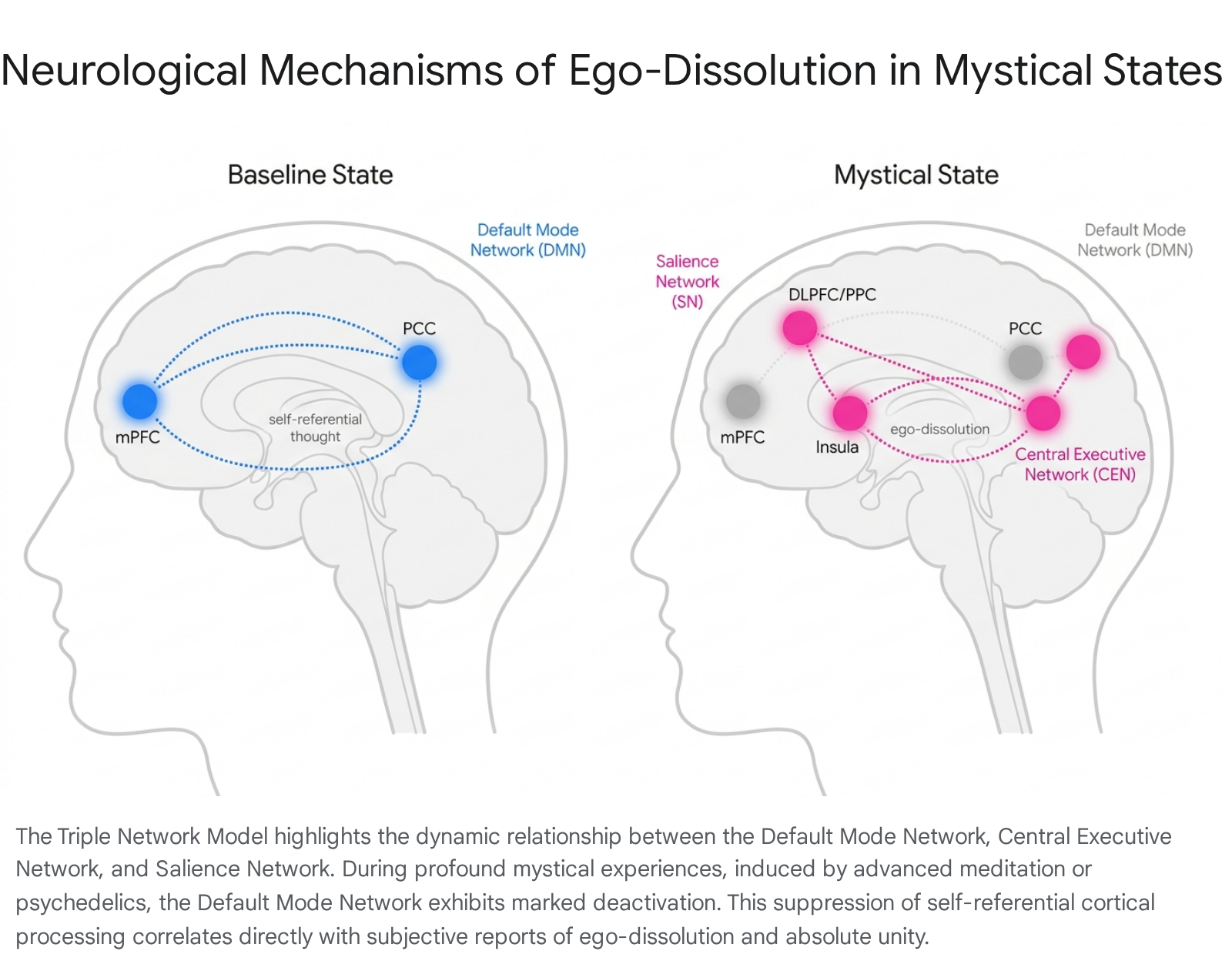
Recent neuroscientific syntheses rely on the Triple Network Model (TPM) to explain altered states of consciousness. The TPM involves the dynamic interaction of three large-scale brain networks:
- The Default Mode Network (DMN): Centered in the medial prefrontal cortex (mPFC), posterior cingulate cortex (PCC), and inferior parietal lobule, the DMN is highly active during rest, mind-wandering, and self-referential thought 4165758. It is widely considered the neurological seat of the "ego" or the autobiographical self 4.
- The Central Executive Network (CEN): Known as the fronto-parietal network, the CEN supports executive functions, focused attention, and goal-directed behaviors 5859.
- The Salience Network (SN): Anchored in the anterior insula and anterior cingulate cortex, the SN monitors internal and external stimuli, assigns importance (salience), and dynamically drives the switching of brain activity between the introspective DMN and the externally focused CEN 5859.
Empirical research from 2024 and 2025 demonstrates that both advanced meditation and the ingestion of psychedelic compounds trigger a dramatic reduction in DMN activity and alter its coupling with the SN and CEN 4165618. As the network responsible for maintaining the narrative boundary between "self" and "other" quiets down, practitioners reliably report phenomenological feelings of boundless unity, interconnectedness, and ego-dissolution 41656.
Neuroimaging and Neurological Correlates
Foundational work in neurotheology by researchers like Andrew Newberg identified this unitive state as "Absolute Unitary Being" (AUB) 61. Utilizing fMRI and PET scans on Franciscan nuns and Tibetan Buddhists, Newberg demonstrated that during intense spiritual experiences, the posterior superior parietal lobe - a region responsible for spatial awareness and orienting the physical body in space - experiences a significant decrease in neural activity (deafferentation) 6219. When this area shuts down due to a lack of sensory input, the brain loses the capacity to compute a spatial boundary between the self and the external world, resulting in the overwhelming perception of absolute oneness 6219.
Further studies by Judson Brewer and Sara Lazar confirm these structural changes. Lazar's research demonstrates that regular mindfulness meditation increases the cortical thickness of the prefrontal cortex and insula (enhancing attention and introspection) while simultaneously decreasing the size of the amygdala, thereby reducing the brain's baseline reactivity to stress 62. Brewer's work shows significant decoupling within the DMN among experienced meditators, preventing the automatic generation of self-referential narratives 4. Similarly, Richard Davidson's studies on long-term compassion meditation reveal increased connectivity between the DMN and the salience network, fundamentally rewiring the brain toward greater emotional regulation and empathy 62.
Psychedelics vs. Sustained Contemplative Practice
Comparative neurotheological studies have also analyzed the differences between meditation and psychedelic-assisted mystical experiences. Research involving psilocybin and LSD reveals that these serotonergic psychedelics rapidly and intensely suppress DMN activity, mimicking the neural correlates of deep meditation 4165657. While psychedelics offer a rapid, chemically induced pathway to altered states and ego-dissolution, researchers note a distinct functional difference in longevity. Psychedelics produce temporary state changes, whereas decades of sustained contemplative practice produce lasting trait changes, resulting in permanently enhanced neural efficiency and reduced DMN activity even outside of formal meditation sessions 1656.
Philosophical Critiques of Neurotheology
While neurotheology provides a powerful structural lens, historians and philosophers caution against strict biological reductionism. Identifying the "switches" in the brain that correlate with mystical experiences does not necessarily invalidate the metaphysical claims of the mystic, nor does it fully encapsulate the phenomenon 17. Scholars note that neural insights remain inherently tethered to cultural imaginaries 17. Reducing complex traditions like Indian Yogic breathing or Indigenous Amazonian rituals strictly to DMN deactivation or enhanced parasympathetic tone strips away the relational, ecological, and sacred contexts that give these practices their meaning 17. In this view, neurotheology functions best not as a mechanized reduction of transcendence, but as a meeting ground between ancient indigenous knowledge systems and the empirical rigor of modern cognitive science 17.
Typology of Mystical Goals
To systematically compare the diverse outcomes of mystical praxis, scholars categorize the ultimate goals of various traditions. While neurobiology points to a common physiological mechanism (the suppression of the self-referential ego), the teleological goals described by the traditions reveal profound philosophical divergence regarding the ultimate nature of reality.
| Tradition | Ultimate Mystical Goal | Ontological Definition | Relationship to the Ego/Self |
|---|---|---|---|
| Hinduism (Advaita) | Moksha | Liberation from the cycle of rebirth (samsara) through the realization that the individual soul (Atman) is identical to the universal absolute (Brahman). | The temporary, illusory ego is discarded to reveal the eternal, true Self 42021. |
| Buddhism | Nirvana | The cessation of suffering (dukkha) and the extinguishing of the fires of attachment, aversion, and ignorance. | Total realization of Anatta (no-self); there is no permanent, unchanging essence to merge with 42021. |
| Sufism (Islam) | Fana / Baqaa | Fana is the annihilation of the self in the presence of the Divine. It is followed by Baqaa, subsisting eternally in God. | The ego is destroyed (fanāʾ) through divine love, allowing the practitioner to abide in divine plenitude 1112. |
| Daoism | Wu-wei / Union with Dao | Effortless action; aligning one's internal energetic flow with the natural, spontaneous order of the cosmos. | The rigid, conceptual mind is "fasted" or quieted, allowing natural harmony to operate through the practitioner 952. |
| Christianity | Unio Mystica | The intimate union and progressive deification (theosis) of the human soul with God, mediated by love and grace. | The ego is surrendered to the Divine Will, though a subtle distinction between Creator and created is generally maintained 37. |
These distinct goals underscore the complexity of comparative mysticism. Whether a tradition aims for the realization of an eternal, universal Self (Moksha) or the realization that absolutely no such self exists (Nirvana), the structural journey requires a radical departure from ordinary baseline consciousness 21.
The history of mysticism is not merely a catalog of disparate religious anomalies, but a comprehensive record of humanity's sustained effort to structurally engineer consciousness. From the paleolithic shaman altering their sensory inputs in coordination with the natural landscape, to the modern Zen monk systematically quieting the Default Mode Network, the mechanisms of mysticism exhibit remarkable continuity. By synthesizing historical analysis, textual ontology, and modern neurobiology, the study of mysticism continues to map the shared structural capacities of the human mind to seek integration with the absolute.