
The Influence of Conspiracy Theories on Historical Events
Conspiracy theories have historically functioned as potent political catalysts, providing explanatory frameworks for complex socio-political crises and serving as mechanisms for mass mobilization. Far from being marginal phenomena or simple historical curiosities, conspiratorial narratives have repeatedly occupied the center of statecraft, revolution, and societal collapse. By examining major historical epochs - from the systemic upheavals of the French Revolution to the institutional collapse of the Weimar Republic, the global spread of orchestrated antisemitism, and the state-directed purges of the Chinese Cultural Revolution - it becomes evident that conspiracy theories possess a profound capacity to shape political realities. These narratives operate on a spectrum, originating either as grassroots cognitive responses to uncertainty or as deliberately engineered top-down mechanisms designed to consolidate power and justify extreme violence. The historical record indicates that when systemic fragility intersects with epistemological uncertainty, conspiracy theories offer a highly legible, human-centric explanation that frequently dictates the trajectory of history.
The French Revolution and the Aristocratic Plot
The French Revolution serves as a foundational case study for understanding how conspiracy theories operate during periods of rapid, unprecedented political transformation. In the late eighteenth century, the disintegration of the ancien régime created an epistemological vacuum, forcing both revolutionaries and reactionaries to rely on conspiratorial thinking to rationalize the chaos that consumed the French state.
Grassroots Paranoia and Political Escalation
In the initial phases of the Revolution, conspiratorial fears emerged primarily from the grassroots level, driven by acute anxiety over resources and security. The concept of an "aristocratic plot" became deeply embedded in the public consciousness, fundamentally altering the trajectory of the Revolution. Historical analyses of contemporary correspondence, such as the letters of the Parisian lawyer Adrien-Joseph Colson, reveal how ordinary citizens who were not inherently radical became consumed by the fear of aristocratic sabotage 12. This fear was not initially driven by abstract ideology or highly developed class consciousness, but rather by a visceral anxiety over the collapse of social order and the perceived threat of intentional food hoarding by the nobility 22.
When Jacques Necker, the popular finance minister, was dismissed in July 1789, the resulting food riots quickly acquired a definitive political dimension. The public interpreted localized crises as symptoms of a coordinated elite strategy to starve the populace and crush the nascent revolutionary movement before it could consolidate power 2. The press amplified these anxieties; publications like Le Moniteur universel equated Necker's exile with an impending apocalypse of famine and bankruptcy 2. This transition from localized economic anxiety to a totalizing belief in a malicious aristocratic plot significantly accelerated the radicalization of the populace, normalizing retributive violence as a necessary defensive measure against perceived elite treachery 12. Events such as the storming of the Bastille and the subsequent September Massacres were largely driven by the pervasive belief that the citizenry was preempting an organized, murderous counter-revolution 22.
Historiographical Interpretations of Revolutionary Conspiracism
The role of conspiracy in the French Revolution is the subject of intense historiographical debate. This debate is broadly divided between those who view conspiracism as the primary underlying cause of the Revolution and those who view it as an essential cognitive and rhetorical response to it 3.
Reactionary contemporaries of the Revolution posited that the upheaval was the direct result of a coordinated master plan. In the late 1790s, writers such as Augustin de Barruel and John Robison independently authored treatises arguing that the Revolution was engineered by an unholy alliance of philosophes, Freemasons, and the Bavarian Illuminati 3. Barruel's Mémoires pour servir à l'histoire du jacobinisme (1797 - 98) became the foundational text of the paranoid style, arguing that the Revolution was not a spontaneous socio-economic event but a systematic, premeditated attempt to overthrow "throne and altar" 3. This reactionary framework marked a critical paradigm shift: it moved the concept of conspiracy away from traditional, localized "court intrigues" and introduced the modern concept of a vast, anonymous, ideological cabal seeking global destruction 3.
Conversely, modern historians interpret this obsession with conspiracy as a functional mechanism for rationalizing systemic shocks. The secularization of eighteenth-century thought demanded that complex social effects be attributed to direct human intent 3. As the historian Gordon Wood argues, because the Enlightenment paradigm asserted an indissoluble link between cause and effect, conspiratorial explanations became a "normal, necessary and rational" way to make sense of a world that seemed to have lost its coherence 3. In this context, conspiracy theories were not the underlying motor of the Revolution, but rather an essential ideological discourse required to navigate political fragility. Scholars such as François Furet and Lynn Hunt note that the obsession with conspiracy became a required part of revolutionary discourse, allowing actors to pervert causal schemes by reducing every historical friction to subjective, malicious intent 3.
| Historiographical School | Primary Proponents | Core Argument Regarding Revolutionary Conspiracism | Historical Function |
|---|---|---|---|
| Reactionary / Causal | Augustin de Barruel, John Robison | The Revolution was engineered by secret societies (Freemasons, Illuminati) to destroy the monarchy and the Church 3. | Served as a post-hoc conservative explanation for the collapse of the ancien régime, birthing modern grand conspiracy theories. |
| Cognitive / Epistemological | Gordon Wood, J.M. Roberts | Conspiracism was a rational cognitive response to secularization; humans sought direct human causes for systemic social effects 3. | Allowed populations to rationalize complex, chaotic events by attributing them to specific human intent rather than abstract forces. |
| Discursive / Ideological | François Furet, Lynn Hunt | The "idea of a plot" was the central organizing principle of revolutionary rhetoric, necessary to justify radical actions 3. | Functioned as a political tool to unite factions, identify enemies, and legitimize state violence and the Reign of Terror. |
| Emotional / Grassroots | Timothy Tackett, Marisa Linton | Fear of aristocratic plots arose organically from communal anxiety and the collapse of local order, distinct from formal ideology 12. | Explains the rapid radicalization of ordinary citizens and the spontaneous escalation of mob violence as a defensive mechanism. |
Interestingly, the revolutionaries themselves occasionally embraced the concept of conspiracy, reframing it as a positive mechanism for human progress. Gracchus Babeuf, during his 1797 trial, defended conspiracy as a "philosophical project" necessary to defend the Republic against royalism 3. Later writers like George Sand reworked Barruel's hostile narrative into an idealist counter-discourse, positing that secret societies were a "necessity of empires" to repair injustice where official society failed, reformulating the plot into a vision of "liberty, equality, conspiracy" 3.
The Protocols of the Elders of Zion
If the French Revolution demonstrated the grassroots power of conspiratorial paranoia, the twentieth century witnessed the industrialization and global weaponization of fabricated plots. The Protocols of the Elders of Zion stands as the most influential and widely distributed antisemitic publication of the modern era, providing a durable, ideologically flexible blueprint for political persecution and ultimately genocide 456.
Fabrication and Early Dissemination
The Protocols is a demonstrably fabricated text, presenting itself as the secret minutes of twenty-four meetings held by a Jewish cabal plotting global domination 87. Textual evidence and historical investigations confirm the document was forged by agents of the Russian Empire, likely Pyotr Rachkovsky of the Tsarist security service (the Okhrana), in Paris between 1897 and 1903 4710. The forgery was largely plagiarized from earlier political satires and novels. The primary source was Maurice Joly's Dialogue in Hell Between Machiavelli and Montesquieu (1864), a critique of Napoleon III that contained no mention of Jews 4511. The secondary source was Hermann Goedsche's sensationalist novel Biarritz (1868), which featured a fictional scene of a Jewish cabal meeting in a Prague cemetery, heavily leaning on ancient tropes of devil worship and blood sacrifice 458.
The forgery was first serialized in the Russian newspaper Znamya in the autumn of 1903 by Pavel Krushevan, a prominent antisemite who had helped instigate the deadly Kishinev pogrom months earlier 46. In 1905, the Russian mystic Sergei Nilus published the full text as an appendix to the second edition of his apocalyptic book, The Great within the Small and the Antichrist 46. Nilus claimed the document was the product of the First Zionist Congress, held in Basel in 1897, overseen by Theodor Herzl 48. The immediate function of these early Russian imprints was state-sponsored scapegoating. Monarchists and the Tsarist government utilized the text to blame the Jewish population for Russia's domestic instability, its humiliating defeat in the Russo-Japanese War, and the revolutionary fervor of 1905 4.
Structural Content and Ideological Adaptability
The narrative structure of The Protocols outlines a detailed, sinister plot to undermine the world order. It alleges that Jews view liberalism and democratic governments as inherent weaknesses to be exploited 87. The text refers to non-Jews (goyim) as a "savage mob" and "alcoholised animals" who are easily manipulated 813. The purported conspirators plan to achieve global hegemony by sowing discord, fomenting war, dominating global financial markets, and controlling the press to indoctrinate the masses, eventually culminating in a universal despotic state 879.
The enduring danger of the text lies in its lack of specific names, dates, or verifiable contemporary references 9. This deliberate ambiguity allowed The Protocols to be mapped onto diverse and contradictory ideological enemies. Antisemites could claim that Jews were simultaneously responsible for the exploitative excesses of international capitalism and the subversive, anti-property doctrines of international communism 9.
Global Transmission Post-1917
The text remained relatively obscure outside of Russia until the Bolshevik Revolution of 1917. When the Russian Tsar abdicated and the Bolsheviks seized power, fleeing anti-communist emigrés carried The Protocols westward 611. They presented the text to receptive European and American audiences as definitive proof that the communist uprising was not a localized political event, but the first stage of an international Jewish plot 1110.
By 1920, the text experienced a sudden, explosive translation and distribution network across the globe.
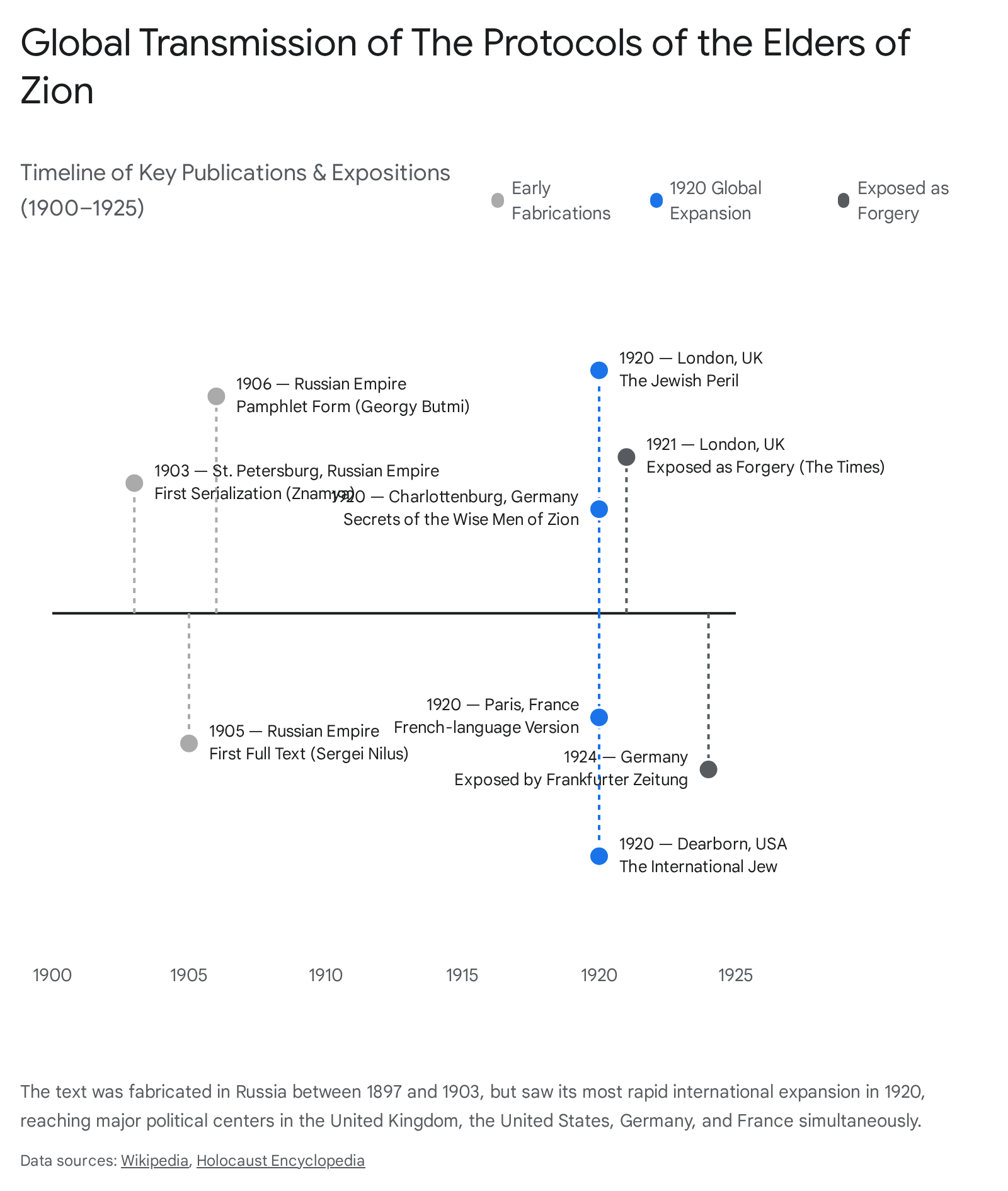
In the United Kingdom, The Protocols was published under the title The Jewish Peril in 1920, gaining significant mainstream traction 510. The establishment press, traumatized by the war and fearful of Bolshevism, initially treated the text with disturbing credulity. The Spectator and The Times published editorials entertaining the possibility of its authenticity, with the latter publishing a disturbing piece titled "The Jewish Peril: A Disturbing Pamphlet" 1016. However, in August 1921, The Times reporter Philip Graves definitively exposed the text as a forgery, publishing side-by-side comparisons with Maurice Joly's 1864 work 4510. This exposure dealt a severe blow to the text's credibility within the British establishment, preventing British politics from becoming seriously entangled in the conspiratorial upsurge that would consume central Europe 10.
In the United States, industrialist Henry Ford adapted the text into a series of articles and a subsequent book titled The International Jew, published in Dearborn, Michigan, in 1920 511. Ford's immense wealth and platform allowed the book to sell over 500,000 copies and be translated into at least 16 languages, fundamentally shaping global antisemitism 5. Even after American journalists like Herman Bernstein declared it a "cruel and terrible lie," Ford and his defenders relied on an epistemological defense common to conspiracy theories: they argued that even if the document was technically a forgery, it possessed an "inner truth" that accurately described global realities 511.
Epistemological Resilience and Contemporary Survival
The text's immunity to empirical debunking is its most alarming characteristic. During the famous Bern Trial in Switzerland (1934 - 1935), a local pro-Nazi group was sued for distributing the pamphlet 47. The trial meticulously dissected the text, with Russian witnesses testifying to its origins as Okhrana propaganda, resulting in the court officially declaring it a hoax 7. Yet, this legal and historical defeat did nothing to stem its circulation among committed antisemites.
| Region | Contemporary Propagation of The Protocols | Ideological Function |
|---|---|---|
| Middle East | Promoted by state actors in Egypt (Nasser, Sadat), Saudi Arabia (textbooks), and Iran (Astan Quds Razavi Foundation) 1213. | Used as historical fact to legitimize opposition to the State of Israel and justify organizations like Hamas, whose charter relies heavily on its framework 712. |
| Asia | Widely circulated in Japan as bestsellers; promoted in Malaysia by former Prime Minister Mahathir Mohamad 131213. | Adopted as a generalized explanation for global financial structures and perceived Western manipulation, despite the absence of native Jewish populations 13. |
| United States & Europe | Resurfaces in extreme far-right and neo-Nazi networks; echoed in modern iterations like QAnon 8. | Provides the structural DNA for theories regarding globalist cabals, "New World Order" plots, and satanic ritual abuse tropes 8. |
| Russian Federation | Echoed in the "Golden Billion" conspiracy theory promoted by state media and officials 10. | Exploited as an overarching narrative to frame the West as a conspiratorial entity seeking to subjugate Russian sovereignty 10. |
Despite being thoroughly debunked for a century, The Protocols remains a vital template for modern conspiracism. It demonstrates how a fabricated narrative, once it successfully identifies a scapegoat for systemic anxieties, can divorce itself entirely from historical reality and survive as an autonomous ideological weapon.
World War I and the Stab-in-the-Back Myth
The collapse of the German Empire at the end of World War I provided the crucible for another highly destructive conspiracy theory: the Dolchstoßlegende, or the "stab-in-the-back" myth. This narrative served to explain the traumatic and seemingly sudden defeat of the German military, directly undermining the legitimacy of the succeeding Weimar Republic and paving the way for totalitarianism.
Post-Hoc Rationalization of Defeat
In November 1918, Germany signed an armistice while its armies were still deployed on foreign soil, having not suffered a definitive, crushing military defeat on its own territory 1415. This geographical reality, combined with severe domestic censorship that had obscured the true, desperate military situation from the public, created a profound sense of cognitive dissonance among the German populace 1522. The reality was that Germany was facing imminent invasion, overwhelming Allied production advantages, and devastating domestic famine caused by the British naval blockade and a disastrous harvest 22.
To reconcile the discrepancy between expected victory and sudden surrender, the conservative military elite - most notably Field Marshal Paul von Hindenburg and General Erich Ludendorff - propagated the myth that the undefeated German army had been "stabbed in the back" 1523. The narrative specifically targeted the home front, accusing socialists, communists, and Jews of orchestrating strikes in munitions factories and deliberately sabotaging the war effort on behalf of foreign Bolshevik activists 141522.
Psychologically, this theory functioned as a post-decisional dissonance reduction tool; it allowed the military high command to evade responsibility for strategic failure and permitted the wider population to externalize blame for a humiliating defeat 2224. By framing the founders of the Weimar Republic - the moderate left and centrist coalitions who negotiated the peace - as traitors, the myth provided a cohesive, highly emotional narrative that absolved the military and the nation of any fault 1415. Furthermore, any lack of concrete evidence for this treason was perversely cited by adherents as proof of how effectively the conspirators had hidden their tracks, rendering the theory unfalsifiable and immune to rational debate 16. High-profile defamation lawsuits, such as the one brought by Republic President Friedrich Ebert against an antisemitic publisher, only provided massive public platforms for military figures to reiterate the conspiracy theory under oath 17.
Electoral Impact and Democratic Erosion
The Dolchstoßlegende was not merely a cultural coping mechanism; it operated as a potent, measurable political force. It functioned as the primary transmission vector for anti-democratic sentiment throughout the interwar period, effectively hollowing out the institutional legitimacy of the new democracy from its inception 141523.
Recent empirical analyses of disaggregated electoral data from 1893 to 1933 reveal the tangible impact of this conspiracy theory on voter behavior, particularly among demobilized soldiers. The reintegration of roughly eight million veterans heavily exposed to the stab-in-the-back narrative triggered a massive, persistent shift in political preferences 1415. Research indicates that areas with a higher population share of former soldiers significantly shifted electoral support, increasing support for right-wing, nationalist parties (such as the DNVP and the NSDAP) by an average of 14 percentage points, while reducing support for the left by 15 percentage points 15.
Crucially, this radicalization was highly pronounced in precincts with a large share of working-class veterans 14. This suggests that the conspiracy theory successfully overrode traditional socio-economic voting patterns by offering a highly inclusive form of militant nationalism built on anti-communist paranoia 1415. In this context, the conspiracy theory did not just justify fascist political rhetoric; it causally dismantled the demographic foundation required to sustain the Weimar democracy.
Historiographical Debates on Weimar's Collapse
Historians continue to debate the precise mechanisms of Weimar's fall. The older "Sonderweg" (special path) theory posited that Germany's delayed unification and the continuity of pre-industrial elites prevented a successful bourgeois democratic revolution, making the rise of authoritarianism somewhat inevitable 27. However, this theory is largely rejected by modern historians who emphasize comparative international studies 27.
Contemporary scholars like Hedwig Richter argue that the Weimar Republic was not killed merely by bad slogans, but rather hollowed out by its own institutions and the failure of elites to defend the republic 2327. In this view, Nazism was not a total break with Weimar, but rather a "totalitarian democracy" built on mass politics and elite-driven manipulation 27. The stab-in-the-back myth exemplifies this dynamic: it was a top-down narrative, crafted by military elites, that successfully mobilized the masses to reject the democratic state 1423.
World War II, Lebensraum, and Genocidal Conspiracism
The conspiracy theories incubated during the interwar period reached their catastrophic zenith during the Third Reich and the execution of World War II. The Nazi regime synthesized the Dolchstoßlegende with the global paranoia of The Protocols of the Elders of Zion to construct an apocalyptic worldview that necessitated preemptive, total war and systemic genocide.
The Institutionalization of The Protocols in Nazi Germany
While some top Nazi leaders recognized The Protocols as a technical forgery, they found it indispensable for promoting belief in an international Jewish conspiracy 1311. Hitler referenced the text in Mein Kampf, and ideologues like Alfred Rosenberg heavily cited it to reinforce anti-Jewish policies 511.
Following the Nazi seizure of power in 1933, the state assumed control over the document's distribution. The official Nazi publishing house, Eher Verlag, aggressively printed the text; by 1934, it had sold 150,000 copies, and by 1938, it had reached its twenty-second printing 11. Distillations of the work were assigned by teachers to be read by schoolchildren as factual history, ensuring that the conspiratorial worldview penetrated the educational system 428. The text was used to present Germany as a victim of encirclement, arguing that "Jewry has occupied all those positions and bases of the North American Union that The Protocols... present as the prerequisite for achieving world domination" 11. Even during the war, as the Holocaust was underway, the Nazis published editions of The Protocols in Russian, Ukrainian, and Belarusian within occupied territories to foster local collaboration and justify mass murder 5.
Lebensraum as a Conspiratorial-Demographic Justification
The strategic aims of World War II were heavily influenced by the concept of Lebensraum (living space), which historian interpret as a fusion of pre-Nazi geopolitical theories with radical racial conspiracism 29. Originally coined by Friedrich Ratzel in 1901 as an organic state's need for territorial expansion to sustain its population, the concept was adapted by Karl Haushofer and ultimately distorted by Nazi ideology 29.
Under Hitler, Lebensraum ceased to be mere economic imperialism; it became a demographic imperative tied to the conspiratorial belief that Germany was being actively strangled by a Jewish-Bolshevik alliance 29. The pursuit of living space in Eastern Europe was framed as a defensive necessity against this conspiracy. Contemporary historical analyses, drawing on declassified Soviet and German records, reveal the staggering scale of this vision: planning documents from 1942 projected the intentional displacement or elimination of 30 to 50 million people from Eastern territories to secure agricultural resources (such as Ukraine's chernozem soils) and eliminate perceived racial enemies 29.
Historiographical debates continue regarding whether Lebensraum was the primary causal driver of the war in the East or a post-hoc justification for opportunistic conquest 29. Functionalist historians argue it was adapted to justify escalating military overreach, while intentionalists point to Hitler's long-standing obsession with securing space against the perceived Jewish-Bolshevik threat 29. In either interpretation, the Holocaust - the systematic genocide of six million Jews - was inextricably linked to this conspiratorial worldview. The perpetrators did not view themselves as aggressors, but as soldiers defending the Aryan race against a documented, international conspiracy to destroy them 9. The indoctrination of SS camp guards, supported by state-mandated biology and history texts, created an autonomous cadre of killers who viewed their actions as a historically necessary defense against subversion 28.
The Chinese Cultural Revolution and "Capitalist Roaders"
While the stab-in-the-back myth and The Protocols were leveraged by right-wing and fascist movements in Europe, the Chinese Cultural Revolution (1966 - 1976) demonstrates how a Marxist-Leninist state deployed conspiracy theories from the highest echelons of power to engineer societal upheaval. This represents the ultimate manifestation of top-down conspiracism used to bypass institutional constraints.
Redefining the Enemy: Revisionists and Hidden Traitors
By the mid-1960s, Chairman Mao Zedong found his absolute authority challenged by a pragmatic faction of the Chinese Communist Party (CCP) leadership, notably President Liu Shaoqi and General Secretary Deng Xiaoping 1819. These leaders favored bureaucratic stability, economic modernization, and the "theory of productive forces" over Mao's vision of permanent, disruptive revolution 19. Unable to easily dislodge these deeply entrenched figures through standard institutional channels, Mao initiated the Cultural Revolution by constructing a sweeping, state-sponsored conspiracy theory: the party apparatus had been infiltrated by "capitalist roaders" and "revisionists" who were secretly orchestrating a restoration of capitalism in China 182021.
This required a profound theoretical mutation in how the communist regime defined its enemies. Previously, class enemies were identified by objective, historical socio-economic status or "bloodline" - such as former landlords, capitalists, or the bourgeoisie 2235. However, because the targets of Mao's purge were veteran communist revolutionaries with impeccable proletarian credentials, the definition of a class enemy was shifted to a matter of hidden ideological intent 2035. The "capitalist roader" narrative portrayed high-ranking officials as two-faced conspirators, operating a hidden "bourgeois headquarters" within the Party, intent on subjugating the working class 2036.
Top-Down Weaponization and Threat Inflation
Unlike grassroots conspiracies that organically bubble up from public anxiety (as seen in the French Revolution), the hunt for capitalist roaders was a deliberate, top-down psychological operation. The state apparatus, specifically the Cultural Revolution Group (CRG) led by figures like Jiang Qing and Chen Boda, utilized hyperbolic propaganda to weaponize the youth - the Red Guards - against the party bureaucracy 192137.
To lend urgency and plausibility to this domestic conspiracy, the Maoist faction heavily inflated the external threat of the Soviet Union. State media consistently aligned the domestic "capitalist roaders" with Soviet "revisionists," alleging a grand collusion to subvert Chinese socialism and pointing to the USSR as a prime example of a state where capitalism had already been successfully restored by traitors 3723. This dual narrative of internal betrayal and external encirclement justified the suspension of standard governance and the militarization of society 2324.
The structural ambiguity of the "capitalist roader" label was its most destructive feature. Lacking objective, empirical criteria, the designation was entirely subjective; anyone in a position of authority could be suspected of harboring capitalist propensities 25. Young rebels, lacking inside information on cadre performance, relied on structural paranoia, assuming almost unexceptionally that those in power were corrupt 25.
The resulting epistemological chaos tore the country apart. Lacking clear directives on who precisely constituted the conspirators, factional rebel groups turned on one another, each claiming to be the true defenders of Chairman Mao against hidden capitalist agents 1825. The state-sponsored conspiracy theory resulted in the purging of an estimated 60% to 80% of incumbent cadres, the collapse of the formal economy, and localized massacres bordering on anarchy 2541.
This dynamic reached absurd extremes in border regions. In Inner Mongolia, the central leadership became convinced of a vast conspiracy by a non-existent separatist group called the Neirendang (Inner Mongolian People's Revolutionary Party) 41. The ensuing witch hunt resulted in the torture and death of tens of thousands of ethnic Mongols. The Cultural Revolution thus exemplifies how the deliberate state-manufacture of a conspiracy theory - creating a "revolution without an enemy" that required the constant invention of scapegoats to justify ongoing mobilization - can lead to total systemic breakdown and autogenocide 41.
Synthesis: Structural Dynamics of Political Paranoia
Across these distinct historical epochs, conspiracy theories exhibit alternating functions: they act as both post-hoc justifications for established realities and active, causal drivers of historical mutation. The data suggests several core mechanisms regarding how these narratives shape history:
- The Epistemological Function (Rationalizing the Incomprehensible): In the French Revolution and Weimar Germany, conspiracy theories served a vital psychological utility. They provided highly legible, human-centric explanations for systemic failures - whether it was the collapse of a centuries-old feudal order or an unexpected military surrender 315. By identifying a specific, malevolent actor (the aristocrat, the Jew, the socialist), these theories reduced cognitive dissonance and simplified unmanageable geopolitical realities into basic moral struggles.
- The Strategic Function (State-Sponsored Scapegoating): As seen with the dissemination of The Protocols by Tsarist Russia and Nazi Germany, and the "capitalist roader" campaigns of Maoist China, conspiracy theories are highly effective technologies of state power. When elites face internal crises or strategic failures, the projection of blame onto a hidden, subversive element allows the state to deflect complicity and bypass institutional constraints 42. The "emergency" posed by the conspiracy justifies totalitarian measures, transforming the rule of law into an instrument of persecution 23.
- The Unfalsifiable Paradigm: The enduring danger of these narratives lies in their structural immunity to empirical debunking. Evidence contradicting the conspiracy is dismissed as fabricated by the conspirators, while a lack of evidence is cited as proof of the conspirators' cunning 16. Whether it is the persistence of The Protocols long after its exposure as a forgery, or the Red Guards' inability to empirically identify a "capitalist roader," the narrative's power relies entirely on ideological utility rather than factual accuracy 825.
Ultimately, the historical record indicates that conspiracy theories are rarely isolated aberrations or harmless fringe beliefs. They are central historical mechanisms that emerge at the intersection of acute societal anxiety and elite opportunism, possessing the demonstrated capacity to dismantle democracies, instigate mass violence, and reshape the global order.