
Cognitive and emotional demands of virtual and hybrid public speaking
The transition from traditional face-to-face environments to virtual and hybrid platforms has fundamentally restructured the mechanics of public speaking and professional communication. Current research indicates that digital communication environments impose distinct psychological, cognitive, and emotional burdens on speakers that differ substantially from in-person interactions. Rather than merely serving as an alternative medium for information delivery, video-mediated communication and hybrid presentation formats require an entirely new subset of cognitive skills. These skills involve dual-audience management, nonverbal decoding under severely restricted visual conditions, and the continuous allocation of divided attention across multiple technological interfaces.
This report examines the contemporary research surrounding virtual and hybrid public speaking, focusing on cognitive load models, spatial and interface constraints, the impact of parallel communication channels, cross-cultural dynamics, and the efficacy of immersive virtual reality as an interventional training tool for anxiety reduction.
The Hybrid Communication Paradigm
The proliferation of hybrid work and educational models following the global shift to remote operations has permanently altered the physics of presentations. Hybrid meetings, characterized by the simultaneous presence of in-person attendees and remote participants connecting via digital platforms, introduce a structural phenomenon frequently termed the "dual audience" problem 11.
Presence Disparity and Collaboration Equity
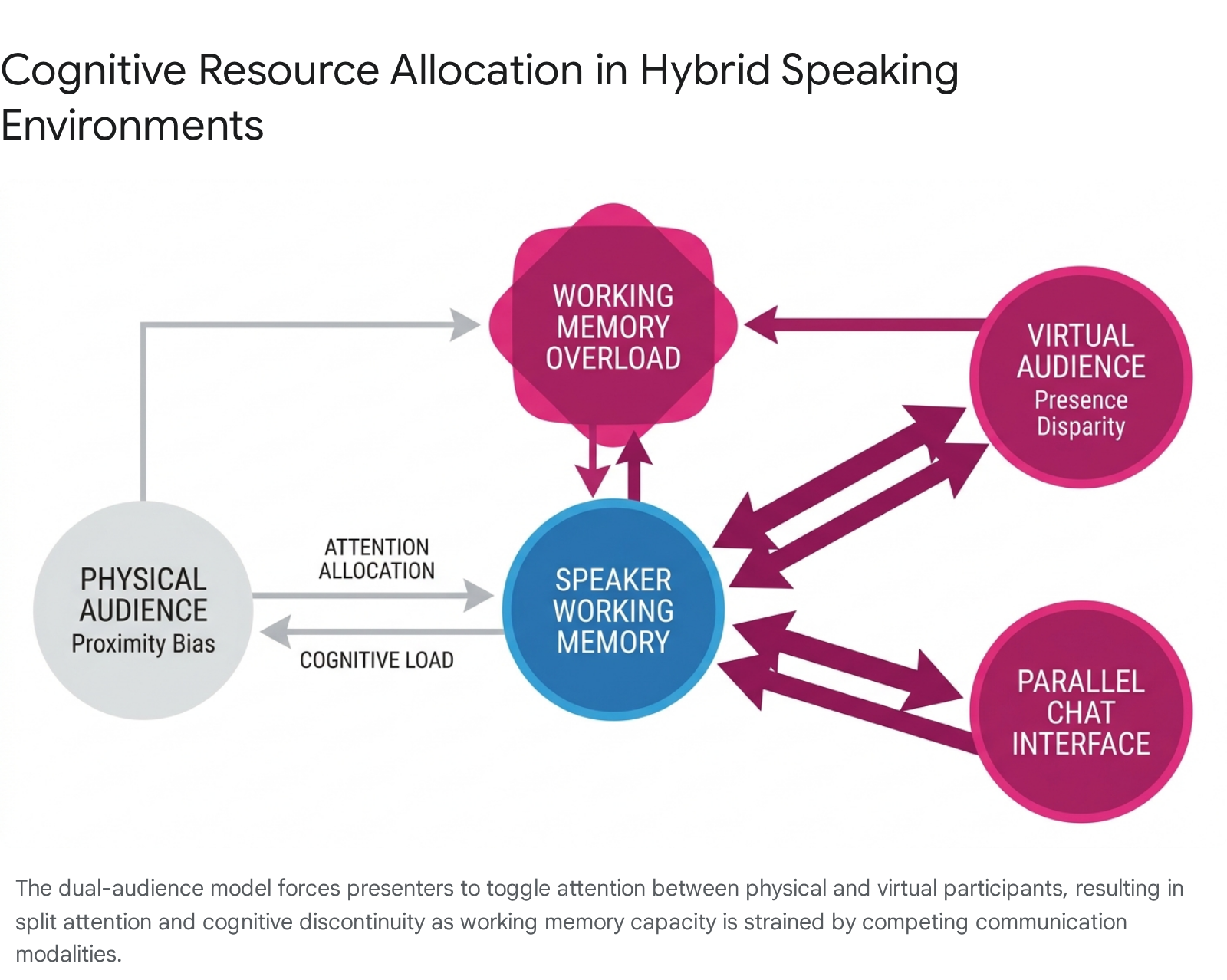
In a hybrid setting, speakers must navigate "presence disparity," a condition wherein physical attendees inherently benefit from proximity bias, while remote participants face reduced visibility and influence 1. Achieving "collaboration equity" - the strategic imperative to ensure all participants can interact effectively regardless of location, device, or language - places an immense emotional and cognitive demand on the presenter. Facilitators and speakers are required to consciously toggle their attention, continually shifting eye contact, engagement tactics, and questioning strategies between the physical individuals in the room and the faces rendered on the virtual screen 1.
Research assessing hybrid teaching and corporate presentation models demonstrates that this dual-audience structure generates high levels of cognitive discontinuity and split-attention effects. The human working memory possesses a finite capacity; the frequent switching between digital interfaces, physical environmental cues, and multimedia content can rapidly overload this capacity, degrading the speaker's ability to maintain a coherent narrative flow and accurately assess audience comprehension 2.
Furthermore, communication experts suggest that presenters must actively alter their pacing, introducing new stimuli or pattern interrupts at an accelerated rate - such as altering the engagement method every six minutes - in order to retain the fragile attention of virtual attendees 13. This heightened requirement for active engagement engineering adds another layer of operational weight to the speaker's responsibilities.
Job Demands-Resources Framework in Virtual Teams
The application of the Job Demands-Resources (JD-R) theoretical framework to virtual and hybrid environments illustrates the dual nature of these modalities on speaker and team well-being. The framework posits that workplace characteristics can be categorized into demands (which require effort and deplete energy) and resources (which facilitate achievement and stimulate personal growth). While virtual flexibility can act as a resource that enhances well-being when individuals are empowered to manage their time and physical space autonomously, it simultaneously introduces severe psychological demands 4.
The lack of implicit, nonverbal communication in digital spaces requires speakers to expend additional, conscious effort stating expectations and information explicitly that would normally be conveyed through environmental context 1. When this intense effort is compounded by back-to-back virtual meetings - a common feature of the contemporary digital workplace - it initiates a resource depletion cycle. Speakers often lack the time to disengage, recover, or engage in quiet reflection between cognitive tasks, culminating in emotional exhaustion, motivational fatigue, and eventual burnout 24.
Split Visual Attention and Information Processing
The concept of split visual attention is central to understanding the limitations of online learning and presenting. Split attention occurs when an individual must simultaneously attend to multiple, spatially separated visual stimuli in order to comprehend a single cohesive message 256. In a typical virtual presentation, a user might need to look at a slide deck, monitor the speaker's facial expressions in a small video feed, and read a live transcript or chat window.
The human visual system cannot process multiple distinct visual signals simultaneously with high acuity. Speakers and attendees must choose to view signals sequentially - which requires additional processing time and hinders real-time participation - or rapidly switch between visual signals, inevitably losing elements of each 5. This rapid switching significantly increases both visual fatigue and cognitive load, ultimately compromising learning and retention 56. For specific populations, such as deaf and hard of hearing (DHH) individuals who rely entirely on visual accommodations like sign language interpreters or captioning alongside standard visual content, this split-attention effect is magnified, presenting profound accessibility and equity challenges in virtual public speaking spaces 58.
Interface Architecture and Visual Processing
The phenomenon widely recognized in academic literature and popular media as videoconference fatigue (VF) is deeply rooted in the technological architecture of computer-mediated communication. The transition from physical three-dimensional spaces to two-dimensional digital screens alters spatial dynamics, social information processing, and the biological mechanisms of human visual attention 789.
The Mirror Effect and Public Self-Awareness
A primary driver of cognitive overload in virtual public speaking is the self-view (SV) feature, commonly referred to as the "mirror effect" or the "all-day mirror effect" 781011. Typically, human beings only engage in self-evaluation for brief, intentional periods throughout the day. Videoconferencing software, however, forces prolonged, continuous exposure to one's own moving reflection during complex social and intellectual tasks 1011.
This continuous self-observation triggers an elevated and sustained state of public self-awareness. The cognitive resources required for self-monitoring, continuous emotion regulation, and maintaining a curated public display siphon working memory away from the primary task of presenting or listening 811. Furthermore, faces act as powerful "flanker stimuli" in visual processing; human attention is naturally drawn to faces, and one's own face is particularly difficult to ignore, leading to significant attentional interference 1014.
Research highlights that this effect is highly variable among users. It is particularly severe for individuals predisposed to high public self-consciousness and those with attention-deficit/hyperactivity disorder (ADHD), who must exert substantially more mental effort to stay focused despite the distracting self-stimulus 810. Additionally, the pervasive use of webcams has inadvertently exposed speakers to digitally distorted reflections of themselves, contributing to an increase in appearance scrutiny and the emergence of phenomena such as "Zoom dysmorphia," which uniquely affects individuals at risk for body image and eating disorders 1412.
Nonverbal Overload and the Hyper-Gaze Phenomenon
In addition to the self-view constraint, the standard gallery layout of most videoconferencing platforms creates a "hyper-gaze" environment that defies the norms of natural social interaction. In traditional physical settings, the audience's gaze is dispersed; a speaker's attention focuses dynamically on a few individuals at a time while peripheral faces naturally fade into the background 1314.
In a digital gallery view, speakers are confronted with a rigid grid of faces appearing to stare directly at them simultaneously, often at an unnaturally close, interpersonal distance 1113. This presentation acts as a sea of highly salient stimuli that overwhelms the brain's visual attention filter. The psychological impact is profound, as the illusion of being stared at by a large group simultaneously triggers heightened physiological arousal and a continuous perception of social-evaluative threat 1114.
Concurrently, speakers must expend significant, conscious cognitive effort attempting to infer missing nonverbal signals. Because the camera frame heavily restricts visibility, critical cues such as micro-gestures, posture shifts, and proxemics (the use of space) are eliminated 1314. The Media Naturalness Theory posits that the degree of naturalness in a communication medium dictates the cognitive effort required to use it; as naturalness decreases due to digital mediation, cognitive load increases proportionally 1015. The brain attempts to integrate these fragmented signals to achieve a complete read of the conversation, and the failure to do so seamlessly results in profound neural exhaustion 14.
| Dimension of Interaction | Traditional Physical Speaking | Virtual/Videoconference Speaking | Cognitive and Emotional Impact |
|---|---|---|---|
| Audience Gaze | Dispersed, contextual, and shifting naturally. | Concentrated "Hyper-gaze" via frontal camera grid. | High arousal; continuous perception of social-evaluative threat 111314. |
| Self-Observation | Transient, intentional self-awareness. | Continuous "Mirror Effect" via self-view feed. | Depleted working memory via forced emotion regulation and self-monitoring 7810. |
| Eye Contact | Natural, localized, and mutual. | Unnatural disconnect (looking at camera vs. screen). | Misinterpretation of engagement; increased effort to simulate direct attention 1116. |
| Spatial Context | Shared, unified physical environment. | Segmented, isolated background environments. | Decreased situational awareness; difficulty assessing audience comprehension 19. |
Spatial Dynamics: Gallery Layouts Versus Room Layouts
Interface design choices fundamentally dictate how nonverbal cues are processed and interpreted by speakers. Recent studies comparing standard grid-based "Gallery" layouts to spatially organized "Room" layouts (where participant video feeds are embedded into a digital illustration of a shared physical space, such as chairs in a circle) demonstrate that spatial configuration significantly influences cognitive load and social behavior 917.
The ubiquitous Gallery layout lacks an intuitive spatial order. Because participants are simply tiled across the screen against their own varied physical backgrounds, the layout fails to provide cohesive environmental cues, often leading to random participation sequences and disjointed team dynamics 917. Conversely, Room-style configurations establish specific, shared seating zones. This artificial spatial grounding has been shown to facilitate better team identification, enhance perspective-taking, and promote immersion. Participants utilize these spatial references to orient their allegiances and engage in simulated nonverbal behaviors, such as virtually "turning" toward a neighbor 917.
However, researchers note a critical caveat: if the anticipated 2D spatial layout conflicts with the actual layout behavior or if the visual integration is poor, the effort required to process the artificial environment can inadvertently increase the user's cognitive burden, counteracting the intended collaborative benefits 917.
Parallel Chat and Divided Attention
A defining, native feature of virtual and hybrid public speaking platforms is the presence of parallel text chat. While this feature introduces novel avenues for synchronous backchannel communication, allowing groups to interact without verbally interrupting the primary speaker, it presents severe challenges directly related to human divided attention capacities 181920.
Multiple Resource Theory in Virtual Presentations
The cognitive mechanics required to manage a presentation alongside a parallel chat can be comprehensively understood through Multiple Resource Theory (MRT) and the Parallel Process Model (PPM). MRT, pioneered by Wickens, postulates that human beings possess limited pools of attentional resources that are categorized by sensory modality (e.g., visual versus auditory processing) and processing codes 21222623.
In a standard virtual presentation, the speaker is already pushing their cognitive resources to maximum capacity. They must encode their verbal message, decode the severely limited visual and auditory cues of the remote audience, and manage their own curated self-presentation via the camera feed. The introduction of a dynamic, parallel text chat forces the speaker to visually search text streams while simultaneously maintaining vocal coherence and monitoring complex video feeds 1923.
Because both language comprehension (reading the chat) and language production (delivering the speech) heavily compete for similar central cognitive resource pools, profound structural interference occurs. Presenters frequently report that it is nearly impossible to seamlessly monitor rapid, concurrent chat streams without noticeably disrupting their primary presentation flow 192024. The task requires continuous, exhausting context-switching rather than true parallel processing.
Information Asymmetry and Interaction Quality
Despite the cognitive tax it levies, parallel chat is widely utilized. In large-scale corporate studies analyzing communication patterns, nearly 70% of employees reported using parallel chat during their meetings, and a majority indicated that its use has increased substantially as remote work solidified 192024. The benefits are notable: it reduces competition for the verbal floor, allows for the asynchronous sharing of URLs and reference documents, and can enhance psychological safety by providing a lower-friction avenue for participation for introverted or marginalized voices 2024.
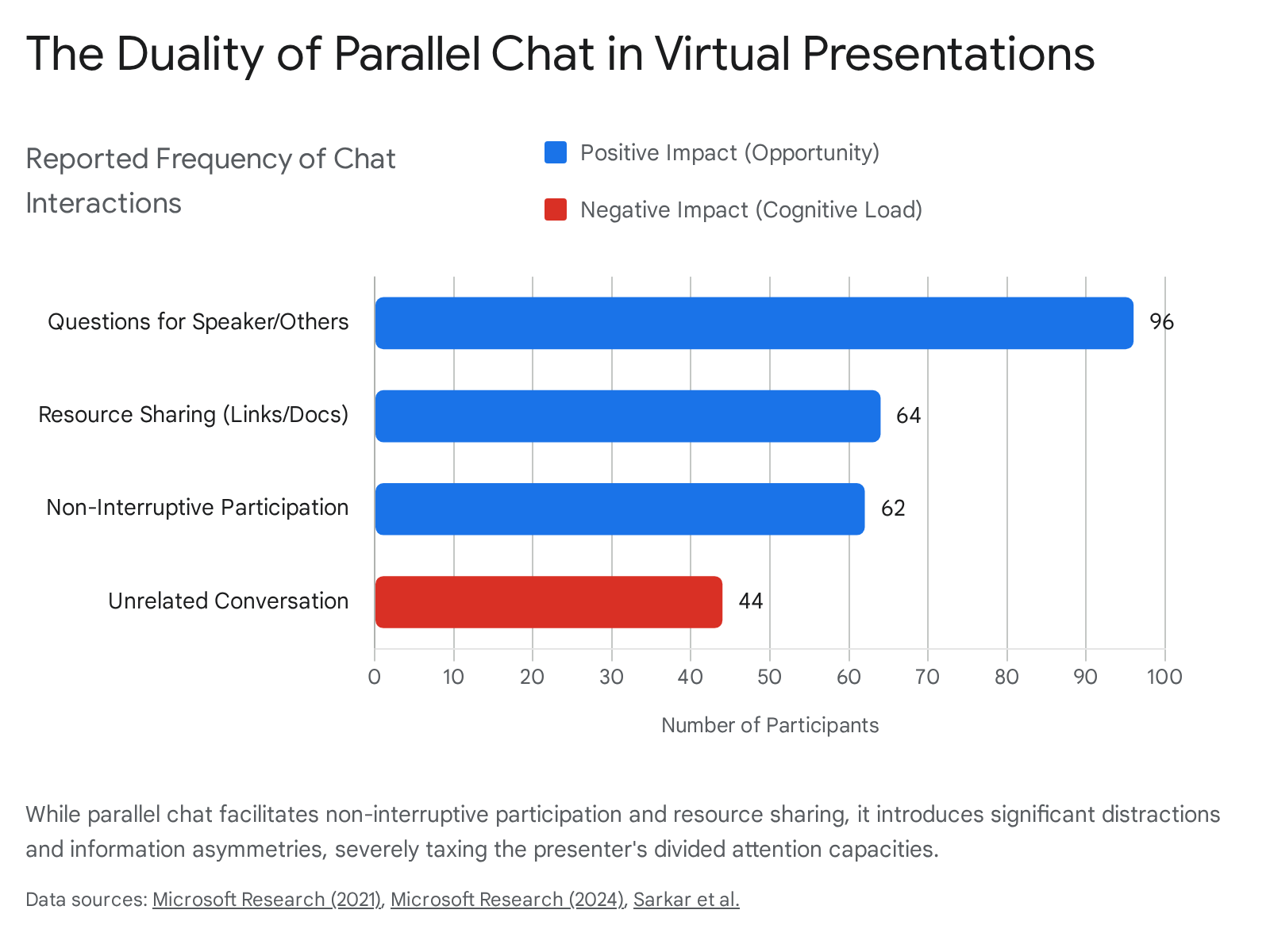
However, the unregulated use of parallel chat generates distinct information asymmetry within the meeting. Participants who are highly active in the chat may synthesize context, answer questions, or establish a consensus that the primary speaker - who is focused on delivery - remains entirely unaware of. The chat often devolves into a mix of critical task-related questions, tangential socializing, and affective reactions (e.g., memes or emojis) 2024. Filtering this noise to locate relevant inquiries adds severe friction to the speaker's cognitive processing, often requiring dedicated moderators to triage engagement effectively 1824.
System Latency and Interaction Fluency
From a telecommunications and systems engineering perspective, the psychological efficiency of computer-mediated communication relies heavily on low feedback latency. Virtual interactions are consistently subjected to technical constraints that fundamentally alter conversational pacing and interpersonal connection 292526.
Perceptual Thresholds for Feedback
Human neurophysiology is exquisitely attuned to the synchronous timing of real-world interactions. Decades of research evaluating system latency guidelines in human-computer interaction (HCI) have established strict psychophysical thresholds for optimal user experience. Current standards suggest that tactile feedback latency should remain under 50 milliseconds, visual feedback latency should not exceed 85 milliseconds, and audio feedback should be delivered within 100 milliseconds to preserve the illusion of simultaneity 2526.
In standard consumer videoconferencing and even advanced virtual reality environments, end-to-end network transmission delays routinely exceed these critical thresholds. Research indicates that when latency drifts between 150 milliseconds and 300 milliseconds, the audiovisual lag drastically degrades the fluency of the interaction 142526. Even when the delay is so brief that it falls below conscious human detection limits, it continues to negatively impact subconscious performance and psychological assessment 25.
Psychological Impacts of Transmission Delay
The interpersonal consequences of these microscopic delays are significant. When audio and visual streams are out of sync, or when verbal responses are delayed by technical routing, the human brain misattributes the lag to negative social characteristics rather than technical faults. Empirical studies demonstrate that delays as brief as 1.2 seconds cause participants to perceive the person on the other end of the call as less attentive, less friendly, and less competent 1425.
For the speaker, this latency creates continuous, competitive overlaps in speech. Because visual cues indicating that a participant is preparing to speak (e.g., drawing breath, leaning forward) are either delayed or obscured, multiple people frequently begin speaking simultaneously. This disrupts the deeply ingrained, automatic human turn-taking mechanism, leading to awkward, start-and-stop cadences and prolonged silences. The speaker, isolated in their physical space, is left to internalize these disrupted rhythms as a failure of their own communicative competence or as evidence of audience rejection 192427.
Cross-Cultural Dynamics in Digital Spaces
Global virtual collaboration requires an advanced degree of cultural intelligence. Digital platforms strip away much of the nonverbal richness present in face-to-face interactions, leaving the remaining behavioral cues highly susceptible to cross-cultural misinterpretation. When the cognitive load of navigating technology merges with the cognitive load of navigating cultural nuance, the potential for friction multiplies 282930.
High-Context Versus Low-Context Frameworks
To understand cross-cultural communication gaps, researchers frequently utilize the frameworks introduced by Edward T. Hall and expanded by Geert Hofstede, which divide cultures along dimensions such as high-context versus low-context communication styles 28. In low-context cultures (predominantly Western societies such as the United States and Germany), communication relies on explicit, direct verbal exchange. In high-context cultures (such as Japan, China, and various Latin American nations), the primary meaning of a message is deeply embedded in situational context, hierarchy, nonverbal cues, and what is deliberately left unsaid 2829.
Divergent Interpretations of Eye Contact
Eye contact serves critical, yet contradictory, communicative functions depending on cultural background. It regulates conversational flow, signals attentiveness, and establishes trust 16. In low-context Western business environments, steady, direct eye contact is perceived as an indicator of confidence, honesty, and leadership presence; avoiding eye contact is often viewed with suspicion 1636.
Conversely, in many high-context East Asian, African, and Latin cultures, sustained mutual gaze is approached cautiously. It is frequently perceived as aggressive, challenging, or disrespectful, particularly when communicating across hierarchical boundaries. In these contexts, lowering the eyes or looking away is a demonstration of deference and active listening 163631.
In a virtual environment, this already complex dynamic is further distorted by technological hardware constraints. Maintaining the illusion of direct eye contact with a digital audience requires looking directly into the physical camera lens, rather than at the faces displayed on the screen. Consequently, a speaker who is actively attempting to read their audience's reactions by looking at the gallery view will inadvertently appear avoidant, aloof, or dishonest to Western viewers, while potentially appearing appropriately deferential to Eastern viewers 1116.
The Ambiguity of Digital Silence
The absence of speech carries enormous weight in communication, yet its interpretation is highly variable across cultural fault lines. In traditional intercultural communication, silence in high-context cultures is frequently and deliberately utilized to express thoughtfulness, demonstrate respect, or preserve social harmony by avoiding direct confrontation 282930. In low-context cultures, silence is rarely comfortable; it is overwhelmingly interpreted negatively, serving as an indicator of disengagement, confusion, or a breakdown in the communicative process 2930.
Digital environments severely exacerbate the ambiguity of silence. Without the subtle physical cues that accompany and contextualize silence in a shared physical room - such as a thoughtful posture, a nod, or a micro-expression of consideration - virtual silence becomes an interpretive vacuum. A pause during a virtual meeting can feel hostile, loaded, or like a technical failure to a Western speaker, while an immediate, rapid-fire response might feel aggressive and dismissive to an Eastern participant 282930.
Current artificial intelligence-based communication platforms and real-time translation tools generally fail to bridge this specific gap. While they successfully dismantle literal language barriers, they struggle to capture the nuanced emotional states underlying pauses, tone, irony, and culturally specific hesitation 2830.
| Cultural Communication Variable | Low-Context Interpretation (e.g., US, Germany, UK) | High-Context Interpretation (e.g., Japan, China, Mexico) | Virtual Platform Distortion / Impact |
|---|---|---|---|
| Eye Contact | Expected indicator of confidence, honesty, and active engagement. | Approached cautiously; prolonged gaze can signal disrespect, challenge, or aggression. | Hardware constraints (camera vs. screen positioning) force speakers to choose between reading the audience and simulating eye contact 1636. |
| Silence and Pausing | Uncomfortable; indicates disengagement, confusion, or technical audio failure. | Purposeful; indicates respect, thoughtful reflection, and the preservation of group harmony. | Lack of physical micro-expressions renders silence completely ambiguous, often triggering anxiety in low-context speakers 282930. |
| Direct Negation ("No") | Valued for efficiency, clarity, and boundaries in business. | Avoided as disrespectful; preference for hesitation or indirect phrasing to save face. | AI translation and transcription tools translate literally, stripping the intended politeness and context of indirectness 2830. |
Virtual Reality Exposure Therapy as an Interventional Tool
To combat the rising prevalence of public speaking anxiety (PSA) - a ubiquitous social phobia that carries severe, documented negative impacts on medical health, academic attainment, and career progression - researchers and clinicians are increasingly deploying Virtual Reality Exposure Therapy (VRET) 38324033. VRET leverages immersive headsets to simulate high-stakes social environments, providing a controlled mechanism for users to practice communication skills without the logistical constraints or intense emotional risks of assembling a live physical audience 3435.
Physiological and Psychological Mechanisms of VRET
Extensive clinical research confirms that VRET demonstrates therapeutic efficacy that is highly comparable to traditional in-vivo (real-world) exposure therapy for addressing Social Anxiety Disorder (SAD) and PSA 3240. Virtual platforms are engineered to allow users to present in front of photorealistic, increasingly challenging audiences. By systematically altering the virtual avatars' programmed behavior - shifting them dynamically from a supportive, nodding audience to an unsupportive, distracted, or hostile audience - researchers can reliably induce specific, measurable physiological stress responses in the speaker 3834.
A study tracking physiological markers during virtual scientific presentations demonstrated that unsupportive virtual audiences successfully elicited greater negative affect, arousal, and anxiety. Physiologically and behaviorally, speakers facing hostile avatars exhibited decreased speaking rates, greater emotional arousal reflected in their vocal paralinguistics, and reported a substantially higher perceived cognitive effort 3435. The capacity of virtual reality to reliably trigger these psychophysiological threat responses - including elevated epinephrine levels, measurable heart rate variations, and electroencephalography (EEG) alterations in cortical areas related to emotional regulation and sensorimotor integration - validates VR's utility as a robust and highly realistic training mechanism 343536.
Feedback Modalities: Real-Time Versus Delayed Analytics
A critical advantage of smart VR and AI-augmented training systems is the integration of multimodal analytics to provide objective feedback on a speaker's executive, cognitive, and emotional skills 3537. These sophisticated systems track speech rate, gaze direction, the usage of filler words, and the amplitude of hand gestures via integrated spatial tracking and acoustic analysis 3847.
The optimal timing of this feedback delivery is a subject of rigorous ongoing investigation. Experimental studies comparing real-time interactive feedback (e.g., visual prompts appearing during the speech) with delayed, after-action summary analytics indicate that both modalities contribute uniquely to skill acquisition. Real-time feedback significantly enhances the speaker's sense of immersion and motivation, acting as an active, immediate behavioral conditioning tool. Conversely, delayed personalized feedback allows the user to reflect deeply on their performance metrics without adding extraneous cognitive load during the highly demanding act of speaking 48.
However, implementing effective real-time feedback requires highly optimized system architecture. Visual, auditory, and haptic feedback loops must be tightly synchronized. If the predictive coding or latency mitigation algorithms fail, the resulting desynchronization shatters the user's sense of agency and can induce motion sickness or severe cognitive dissonance, rendering the training counterproductive 394051.
Applications in Foreign Language Anxiety (FLA)
Beyond the treatment of clinical anxiety disorders, VR has proven highly effective in standard educational contexts, particularly for mitigating Foreign Language Anxiety (FLA). For non-native speakers, delivering an oral presentation requires mastering presentational competence, managing physical delivery, and executing linguistic proficiency simultaneously in a target language. This convergence places an extraordinary strain on cognitive resources 3847.
Research utilizing commercial immersive VR applications (such as Ovation VR) allows learners to extensively customize their rehearsal environments. Students can adjust audience size, demographic makeup, and environmental setting (e.g., a small, intimate conference room versus a massive, intimidating lecture hall) to specifically match their current anxiety threshold 3841. Longitudinal studies show a significant, sustained reduction in FLA scores and notable improvements in speech clarity and fluency following repeated, self-guided VR sessions. Interestingly, researchers noted that introverted participants demonstrated the most substantial reductions in anxiety, highlighting VR's unique capacity to provide a psychologically safe, uncritical space for highly vulnerable populations to experiment and build resilience 41.
Emergent Technologies and the Agentic UX Paradigm
The integration of artificial intelligence into daily public speaking and presentation tools is advancing at an unprecedented pace, altering the foundational mechanisms of speech delivery. For example, online teleprompter tools embedded with AI voice recognition capabilities now allow scripts to scroll autonomously based on the speaker's specific cadence. This dynamic adjustment eliminates awkward pacing pauses, cuts down on post-production editing for pre-recorded speeches, and dramatically reduces the cognitive burden associated with rote memorization 3853.
However, researchers caution that the reliance on such tools must be balanced carefully. If a speaker becomes overly dependent on an AI-driven teleprompter, their gaze remains fixed on the scrolling text, reducing the perception of authenticity and exacerbating the unnatural, rigid appearance that already plagues virtual communication 53.
Designing for Dual Audiences: Human and AI
Furthermore, as autonomous AI agents become deeply integrated into corporate workflows and digital environments, the design of virtual communication interfaces must account for an entirely new paradigm: "Agentic UX" 54. Presenters are no longer speaking solely to human beings; they are increasingly addressing AI delegates that are silently capturing transcripts, summarizing key action items, and analyzing the sentiment of the meeting in real-time 5442.
This creates a novel "dual-audience" challenge for modern communicators. Speakers must now design and deliver their content so that it is emotionally resonant, engaging, and persuasive for human listeners, while simultaneously being highly structured, predictable, and cleanly parseable for machine analysis 5442. The redistribution of cognitive, creative, and logistical loads between human speakers and intelligent agents represents the next critical frontier in the study of public speaking 54.
Ultimately, the transition to effective virtual and hybrid public speaking requires far more than merely transferring physical presentation habits to a digital camera. It demands a sophisticated, conscious understanding of human cognitive resource allocation, the deliberate management of environmental and interface constraints, and a highly nuanced approach to cross-cultural nonverbal communication in low-fidelity environments.