Cognitive Science of Human Multitasking
The Illusion of Simultaneous Processing
The modern technological environment heavily incentivizes the concurrent execution of multiple tasks, framing multitasking as an indicator of professional competence and cognitive efficiency. However, comprehensive analyses spanning cognitive neuroscience, behavioral psychology, and neurobiology consistently demonstrate that the human brain is not architecturally designed for the true parallel processing of multiple cognitively demanding tasks 12. The behavior colloquially termed "multitasking" is, in neurological reality, a process of rapid sequential task-switching 234.
True parallel processing within the human brain is largely reserved for task combinations that utilize distinct, non-overlapping neural circuits. This typically occurs when an autonomic or extensively automated motor function, such as walking or basic postural control, is combined with a conscious cognitive function, such as holding a conversation 25. In contrast, when an individual attempts to engage in two or more tasks requiring active conscious attention, working memory, and executive function - such as writing an analytical email while actively monitoring a complex verbal presentation - the brain's central processing architecture cannot perform these operations simultaneously without severe performance degradation 26.
Instead of processing these demands in parallel, the brain's executive control system toggles attention back and forth. Because this shifting mechanism can occur within fractions of a second, it creates a subjective illusion of continuous, concurrent productivity 2. This illusion is highly persistent and often leads individuals to overestimate their own multitasking efficacy, a phenomenon driven by a self-efficacy bias wherein individuals assume their personal cognitive focus or intelligence allows them to bypass fundamental biological processing limitations 27.
Bottleneck Models and the Psychological Refractory Period
The biological limitation preventing the true parallel processing of complex conscious tasks is best explained through the concept of the Psychological Refractory Period (PRP) 58. In a classic PRP paradigm, when two distinct stimuli are presented in rapid succession, requiring two distinct cognitive or motor responses, the processing of the second target is reliably and unavoidably delayed by the processing of the first 8.
Behavioral experiments and subsequent neurocognitive theories, such as the Response-Selection Bottleneck (RSB) model, postulate that while early peripheral perceptual stages and late motor execution stages can operate in parallel, the central decision-making stage imposes a strict serial bottleneck 8910. This central stage is responsible for coordinating sensory-motor operations and selecting appropriate responses. Under the bottleneck model, dual-task costs arise because the processing of different task components requires access to the exact same localized, limited neural resources 10. When two tasks require simultaneous access to these executive control resources, severe dual-task interference occurs, forcing the brain to queue the information, which drastically reduces processing efficiency 2.
True Parallel Processing Versus Sequential Task-Switching
While strict serial processing remains the dominant and most efficient mode for complex cognitive tasks, advanced functional imaging indicates that the brain can occasionally adopt limited parallel processing modes under highly specific constraints or following extensive, dedicated practice 101112. Time-resolved functional magnetic resonance imaging (fMRI) combined with electroencephalography (EEG) has provided physiological evidence for the coexistence of serial and parallel processes within a single cognitive architecture 48. To understand these functional differences, the distinct neurological characteristics of true parallel processing and sequential task-switching are summarized below.
| Characteristic | True Parallel Processing | Sequential Task-Switching (Standard "Multitasking") |
|---|---|---|
| Neural Substrate for Response Selection | Striatum / Basal Ganglia 11 | Lateral Prefrontal Cortex (PFC) 11 |
| Circuitry Overlap | Utilizes distinct, non-overlapping sensory-motor circuits 2 | Relies on shared executive control and working memory resources 2 |
| Conscious Cognitive Demand | Usually involves at least one automated or autonomic task 2 | Involves two or more high-effort cognitive tasks competing for attention 2 |
| Interference and Bottlenecks | Negligible dual-task interference 2 | High susceptibility to Response-Selection Bottlenecks 210 |
Neural Pathways and Processing Modes
Neuroimaging data indicates that different processing states rely on entirely different functional neuroanatomical correlates. Response selection executed under the constraint of more parallel processing is primarily mediated by mechanisms operating at the striatal level of the basal ganglia 1011. In contrast, response selection under the constraint of serial processing - the default necessity for most active multitasking - is mediated via mechanisms operating within the lateral prefrontal cortex 1011.
Temporal Dynamics of Visual Cognition
The debate over whether visual search and cognitive processing are strictly serial or partially parallel has been refined by electrophysiological data from the prefrontal cortices of rhesus monkeys 1313. By analyzing simultaneously recorded spike trains using hidden Markov models and correlated binomial models, researchers have quantified the time evolution of visual cognition processes immediately following stimulus onset 1313.
These models reveal that both processing mechanisms are active, but they operate sequentially. When presented with multiple visual stimuli, the neurons tend to follow a parallel processing mechanism in the initial milliseconds following the onset of the stimulus pair, primarily driven by sensory bottom-up, feedforward signals 1313. However, this parallel capacity is short-lived. Between 150 and 200 milliseconds after stimulus onset, the processing shifts strictly to a serial mechanism 13. This transition is linked to the arrival of top-down cognitive modulatory influences guiding attentional effects in recurrent feedback connections, which direct all available processing capacities sequentially toward the attended objects to achieve deep comprehension 13.
Executive Control and Quantitative Switch Costs
When the human brain engages in sequential task-switching, it relies heavily on complex executive control processes. Cognitive psychologists have modeled these processes as consisting of two distinct, complementary stages that must be executed every time attention is diverted from one active task to another 14.
Goal Shifting and Rule Activation
The first cognitive stage is "goal shifting," wherein the executive system makes a conscious or unconscious decision to disengage from current task objectives (e.g., ceasing to write a document to interact with a communication application) 1415. Following this disengagement, the brain enters the "rule activation" stage. During rule activation, the brain must suppress the cognitive rules and parameters required for the previous task and load the entirely different set of rules, environmental context, and working memory constraints required for the new task 1415. When the individual eventually returns to the original task, this complex neurological sequence must be executed in reverse, resulting in a temporal delay known as an activation lag 15.
Temporal and Accuracy Penalties
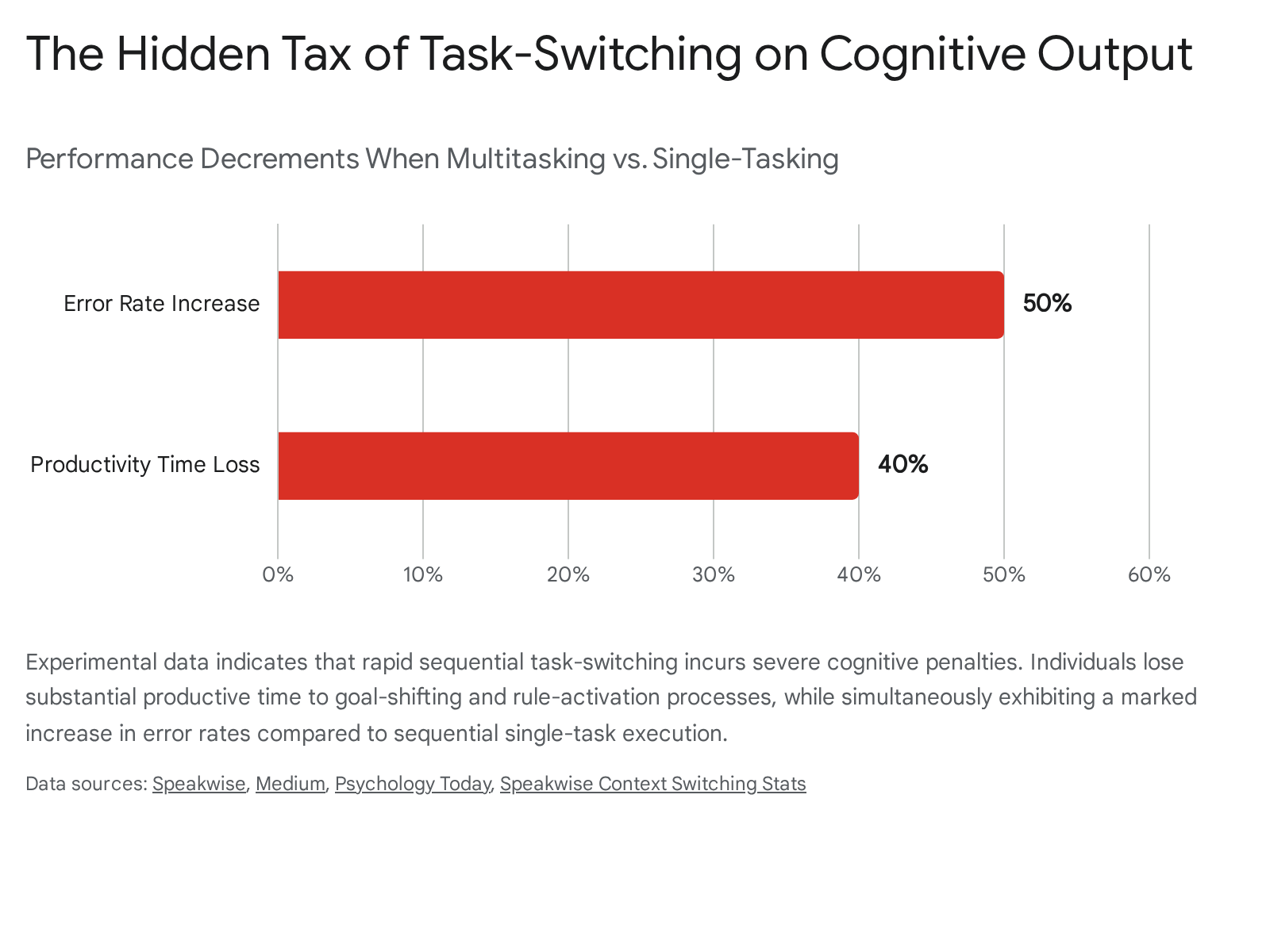
The time required to successfully execute goal shifting and rule activation is empirically known as a "switch cost" 141617. While a single switch cost may be measured in fractions of a second, the cumulative effect in modern work and educational environments is highly detrimental to overall productivity 1418. Experimental data demonstrates that the average digital knowledge worker toggles between applications and websites up to 1,200 times per day, engaging in over 300 contextual task switches 119. At this frequency, even brief mental blocks created by shifting between tasks accumulate, consuming as much as 40 percent of an individual's productive time 1314.
A comprehensive web-based quantitative study analyzing task-switching costs across 1,004 participants performing complex pattern-matching tasks provided definitive empirical data supporting these penalties. The study found that high school-aged participants took 95% more time to complete tasks when switching between them compared to executing them sequentially 1820. The equation for quantifying this specific switch cost in time ($T_{switch}$) is calculated by subtracting the average mean completion time of single tasks ($T_A$ and $T_B$) from the mean completion time of the interleaved tasks ($T_{AB}$) 18.
Beyond temporal costs, rapid task-switching introduces severe accuracy deficits. The same pattern-matching study revealed a 120% increase in error rates during multitasking scenarios 1820. Broader industry and cognitive research corroborates this, estimating that routine workplace multitasking increases error rates by at least 50% across adult populations, causing tasks to take twice as long to complete with lower fidelity 16.
The cognitive load imposed by holding partial contexts in working memory while activating new rules can also result in a temporary reduction in effective fluid intelligence, with some researchers equating the intellectual drop during heavy task-switching to the cognitive impairment observed after losing a full night of sleep 12.
Task Complexity and Habitual Response Inhibition
The magnitude of switch costs is intricately dependent on the nature and complexity of the tasks involved. Studies grounded in Cognitive Load Theory indicate that as task complexity increases, the working memory resources required to maintain rule sets and goals expand exponentially, resulting in significantly longer switch times 1418. Switching to a relatively unfamiliar task incurs a higher temporal penalty than switching to a highly practiced task, as the brain must expend significantly more effort to retrieve and activate less-automated rules 14.
However, behavioral studies have identified a paradoxical effect known as asymmetrical switch costs. In certain experimental settings, researchers have found that it is noticeably harder and slower to switch to a more habitual, dominant task from a non-habitual task 14. This phenomenon suggests that the brain must exert a massive amount of top-down inhibitory control to suppress a dominant, habitual response when performing a weaker, unfamiliar task. Releasing that deep inhibition to switch back to the familiar task requires measurable time and cognitive effort, demonstrating that task-set inertia plays a major role in slowing down cognitive shifting 1417.
Neurological Mechanisms of Executive Function
Neuroimaging studies, utilizing functional magnetic resonance imaging (fMRI) and functional near-infrared spectroscopy (fNIRS), have mapped the specific cortical networks activated during dual-tasking and sequential task-switching. Multitasking places heavy metabolic and processing demands on a distributed network of cortical regions. This primarily involves the frontoparietal control network (responsible for overall goal-setting and information filtering), the dorsal attention network (responsible for maintaining focused top-down attention), and the ventral attention network (responsible for detecting and reorienting to external distractions) 1621.
Cortical Networks and Interference Management
The prefrontal cortex (PFC), specifically the dorsolateral prefrontal cortex (dlPFC), acts as the central hub for task-switching. It is fundamentally involved in shifting attention, holding instructions within working memory, and selecting which tasks to prioritize 32223. The anterior cingulate cortex (ACC) operates in tandem with the lateral PFC during these high-demand periods. The ACC functions primarily as a conflict monitor; it detects operational errors, mediates emotional responses to task difficulty, and assists the individual in avoiding external distractions that conflict with the primary cognitive goal 324.
Simultaneously, the posterior parietal lobe activates to retrieve and implement the unique rules for whichever task the brain is switching toward, while the pre-motor cortex prepares the physiological systems for any required physical responses 3. When an individual attempts to multitask, these regions exhibit intense metabolic activation as they struggle to manage dual-task interference 225.
Interestingly, longitudinal studies on dual-task training have shown that neuroplasticity can alter this biological response. Following weeks of extensive practice on specific dual-task paradigms, fMRI scans reveal that most regions initially involved in dual-task processing show a marked reduction in activation 25. This reduction correlates strongly with improved behavioral performance, suggesting that as task coordination becomes partially automated through practice, it requires less metabolic exertion from the central executive control networks, bypassing the primary bottleneck 2526.
Age-Related Differences in Frontal Cortex Activation
The ability to successfully manage task-switching and dual-task interference undergoes significant developmental changes across the human lifespan. Studies utilizing fNIRS to measure hemodynamic changes across 132 adults aged 18 to 79 during task-switching paradigms have isolated specific age-related neural mechanisms 23.
Behavioral results demonstrate that advancing age has a negative linear relationship with the time required to switch tasks, and a negative quadratic relationship with the accuracy of the switch 23. However, fNIRS data reveals a compensatory neural mechanism: age has a positive linear relationship with activation in the left posterolateral frontal cortex 23. Among older adults who exhibit slower and less accurate switch performance overall, those who engage greater left posterolateral frontal activation achieve faster and more accurate switch performance than their peers. This increased engagement of regions specifically responsible for reconfiguring and implementing task rules helps older adults compensate for natural, age-related declines in baseline cognitive flexibility 23. Conversely, studies analyzing younger cohorts indicate that the human brain does not reach peak maturity regarding multitasking efficiency and minimum switch costs until approximately 24 years of age 1820.
The Dopamine Reward Circuit and Perceived Competence
A profound disconnect exists between the objective inefficiency of multitasking and the subjective human experience of engaging in it. Despite rigorous laboratory data confirming that multitasking degrades output and increases error rates, occupational surveys consistently show that the majority of professionals firmly believe they are highly effective multitaskers 1. This widespread cognitive dissonance is driven by the human brain's endogenous reward systems and reinforced by modern cultural conditioning.
Mesolimbic Pathways and Incentive Salience
The human brain possesses an intrinsic "seeking system" mediated primarily by the mesolimbic dopamine pathway, which connects the ventral tegmental area (VTA) in the midbrain to the nucleus accumbens (NAc) in the ventral striatum 2827. While popularly mischaracterized purely as a "pleasure chemical," dopamine functions largely as an anticipatory and motivational neuromodulator. It signals the brain to pay attention to novel or potentially rewarding stimuli, driving behavior toward acquiring those rewards 282728.
Recent electrophysiological research has identified neuropeptide-defined subpopulations of dopamine-producing neurons within the VTA that serve distinct cognitive functions. For example, VTA neurons expressing corticotropin-releasing hormone receptor 1 (Crhr1) project to the NAc core and are deeply involved in reinforcement learning and reward association 29. Conversely, VTA neurons expressing cholecystokinin (Cck) project to the NAc shell and are primarily responsible for signaling "incentive salience" or sustained motivated responding 29.
"Successful" rapid task-switching - such as firing off a brief email, immediately answering a chat message, and subsequently refreshing a social media feed - aggressively activates this dopaminergic reward circuit 630. Each completed micro-task or novel digital stimulus delivers a reinforcing dopamine hit 1530. Because unpredictable or variable rewards generate more sustained dopamine activity than predictable outcomes, the modern digital environment operates on the same psychological principles as a slot machine, conditioning the human brain to compulsively seek out constant distraction 628.
This continuous neurochemical rush induces an "illusion of competence." The dopamine release makes the individual feel highly active, engaged, and productive, completely masking the simultaneous increase in actual error rates and the rapid degradation of working memory 26. Furthermore, multitasking prompts the release of stress hormones, such as adrenaline 6. This combination of dopamine and adrenaline creates a state of heightened physiological arousal that feels functionally productive but actively impairs the deep neural processing required for long-term memory encoding 6.
The Perception of Task Complexity
While engaging in actual multitasking objectively degrades performance, manipulating the psychological perception of multitasking can produce paradoxically positive results. A robust series of 30 incentive-compatible experiments led by Shalena Srna, involving 6,768 participants, demonstrated that an individual's perception of task complexity is highly malleable and directly influences cognitive output 73132.
In these studies, participants were assigned complex tasks, such as watching a lecture video while taking detailed notes. One group was informed they were executing a single, unified complex task; the other group was explicitly told they were "multitasking" (completing two distinct tasks concurrently) 31. Holding the actual activity constant, the group that believed they were multitasking significantly outperformed the single-task group across metrics including transcription speed, word accuracy, and subsequent comprehension quizzes 73132.
To uncover the mechanism behind this improvement, researchers utilized eye-tracking technology to measure pupil dilation - a reliable physiological marker of cognitive effort and arousal 3233. The data confirmed that the individuals who perceived themselves as "multitasking" experienced higher levels of arousal and exerted more direct, sustained cognitive effort 33. The brain, perceiving a steeper cognitive challenge or "hill" ahead, preemptively recruited additional attentional resources 33. Therefore, while true dual-tasking is detrimental, actively framing a complex, unified activity as a multi-component challenge can successfully hijack the brain's effort-allocation systems to boost cognitive engagement and output 73133.
Exceptional Multitasking Capabilities
While approximately 97.5% of the human population suffers severe cognitive degradation when attempting to process multiple demanding tasks simultaneously, cognitive scientists have identified a statistically significant minority who appear immune to typical dual-task interference. First identified by psychologists David Strayer and Jason Watson, this elite 2.5% of the population are classified in the literature as "supertaskers" 13634.
Identifying the Supertasker Phenotype
The supertasker phenotype was initially discovered using a highly demanding, naturalistic dual-task paradigm. Participants were required to operate a high-fidelity driving simulator while simultaneously performing a continuous auditory memory and math test known as the OSPAN task 3635. As predicted by standard bottleneck and cognitive load models, the vast majority of participants experienced a drastic drop in performance across all metrics: their following distances became erratic, braking reaction times slowed by roughly 20%, and their math and memory recall plummeted significantly compared to their single-task baselines 3435.
However, a small cluster of participants exhibited zero performance decrement. These individuals scored in the top quartile for single-task conditions and, remarkably, maintained perfect time-sharing abilities during the dual-task condition. In a few isolated cases, their ability to navigate the driving simulator and accurately calculate complex math actually improved when combining the tasks, suggesting a unique neurological resistance to cognitive overload 363435.
Neural Efficiency and Cortical Activation
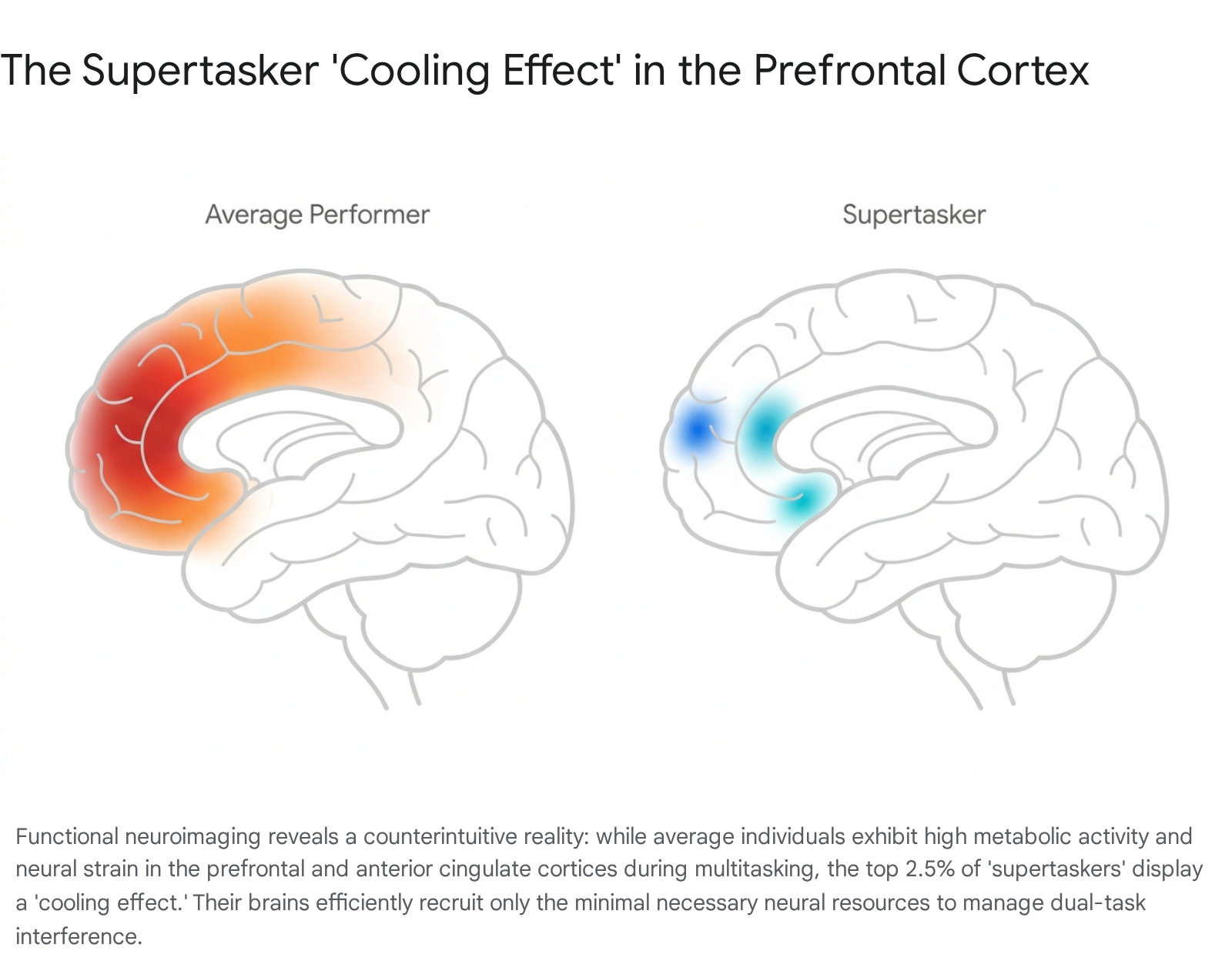
Subsequent neuroimaging research sought to identify the biological mechanisms underlying this extraordinary cognitive ability. Conventional wisdom dictated that supertaskers must possess a greater overall capacity for executive control, effectively "working harder" and expending more metabolic energy to force parallel processing. However, functional magnetic resonance imaging (fMRI) analyses revealed the exact opposite: supertaskers demonstrate profound neural efficiency 2636.
When subjected to rigorous dual n-back tasks designed to heavily tax working memory, supertaskers displayed a neurological phenomenon termed the "cooling effect" 24. Despite their flawless behavioral performance, the neural networks heavily involved in attention and cognitive control - specifically the lateral prefrontal cortex (LFC) and the anterior cingulate cortex (ACC) - exhibited significantly less metabolic activity and activation than those of average or low-performing individuals 2436.
Rather than haphazardly recruiting vast amounts of cortical resources to force parallel processing, supertaskers efficiently utilize only the exact minimal neural circuitry required to maintain competing goals and avoid distraction 1024. This efficiency indicates that high-level multitasking capability is not a product of brute-force processing power, but rather a highly refined, frictionless coordination of the brain's executive control networks, potentially allowing different task components to be scheduled in separate processing threads without catastrophic interference 102426.
Media Multitasking and Cognitive Profiles
As digital devices have proliferated, an entirely distinct subset of cognitive behavior has emerged: media multitasking. This behavior involves either the concurrent consumption of multiple media streams (e.g., watching television while simultaneously navigating social media on a smartphone) or engaging with media technology while concurrently performing non-media tasks (e.g., studying while messaging) 3637. The average adolescent and young adult spends an estimated 7.5 hours per day engaged with media, and roughly 29% of that time is spent engaged in simultaneous media multitasking 3839.
Heavy Versus Light Media Multitaskers
Unlike general real-world multitasking, which is often dictated by immediate, unavoidable environmental demands, media multitasking is primarily a habitual, self-selected behavior 40. Cognitive scientists commonly categorize individuals along a behavioral spectrum from Light Media Multitaskers (LMMs) to Heavy Media Multitaskers (HMMs), quantified using the Media Multitasking Index (MMI) 1641.
Counterintuitively, individuals who multitask the most with media are generally the least capable of handling dual-task interference 136. A seminal study by Ophir, Nass, and Wagner (2009), supported by subsequent comprehensive meta-analyses, reveals deep cognitive deficits associated with heavy media multitasking 374042. When subjected to controlled laboratory cognitive assays, HMMs routinely underperform compared to LMMs, even when they are isolated and asked to perform only a single focused task 1636.
| Cognitive Domain | Light Media Multitaskers (LMM) | Heavy Media Multitaskers (HMM) |
|---|---|---|
| Susceptibility to Distraction | Low; high top-down attentional control 3743 | High; attention is easily captured by irrelevant external stimuli 364344 |
| Working Memory Capacity | Standard baseline performance 16 | Frequently diminished; exhibits poor interference management 163643 |
| Task-Switching Efficiency | Generally efficient 3643 | Paradoxically slower; experiences larger switch costs 364243 |
| Trait Impulsivity | Standard baseline 36 | Elevated; tightly correlated with self-reported attention deficits 3643 |
The cognitive profile of a heavy media multitasker is primarily characterized by impaired environmental filtering. HMMs exhibit a greater tendency for exogenous attentional control, meaning their attention is continually hijacked by outside distractions, hindering goal-directed behavior 363743. Furthermore, despite practicing rapid toggling constantly in their daily lives, heavy multitaskers are demonstrably slower and make more errors when asked to rapidly switch between laboratory tasks than low multitaskers 3643. The constant state of divided attention also prevents the deep, sustained processing necessary for encoding information into long-term memory, reliably leading to poorer overall recall 163645.
Structural Brain Correlates and Neuroplasticity
The behavioral deficits observed in heavy media multitaskers are physically mirrored by structural differences within the brain. Neuroimaging studies measuring cortical volume have found that individuals with higher media multitasking scores exhibit significantly reduced gray matter volume in the anterior cingulate cortex (ACC) 3638. Given the ACC's vital role in cognitive and socio-emotional control, conflict monitoring, and error detection, this structural reduction aligns perfectly with the observed behavioral deficits in sustained attention, working memory, and impulse inhibition 243644.
The direction of causality in these findings remains a subject of intense scientific debate. It is currently unknown whether excessive media multitasking physically alters brain structure over time via detrimental neuroplasticity, or whether individuals born with inherently smaller ACC volumes and lower baseline attentional control are simply more susceptible to the allure of highly stimulating, fragmented digital environments 363946. Regardless of the causal direction, the correlation strongly indicates that chronic media multitasking is associated with a distinct, disadvantageous neurocognitive profile 363944.
Educational Implications and Academic Performance
The cognitive toll of media multitasking has profound implications for learning environments. Empirical studies consistently report that digital distractions - such as texting, browsing the internet, and using social media during class - are highly prevalent, with estimates suggesting students engage in off-task digital activities for 40% to 60% of class time 4247.
Drawing on Cognitive Load Theory, task-switching between academic materials and non-academic digital activities leads to severe attentional fragmentation 4748. This fragmentation significantly increases extraneous cognitive load, diminishing the brain's capacity to process and retain complex information 4248. Studies exploring the effect of social media multitasking on classroom performance confirm that students who frequently engage in these behaviors exhibit lower academic achievement, decreased reading comprehension, and shallower learning compared to non-multitasking peers 424748. Notably, the mere physical presence of a smartphone in a learning environment, even when not actively in use, has been shown to drain available cognitive capacity due to the subconscious effort required to inhibit the urge to check the device 4547.
Global Variations in Media Multitasking Behavior
The prevalence, behavioral habits, and cognitive impacts of media multitasking are not uniform globally. Rather, they are heavily modulated by distinct cultural norms, varying levels of technological infrastructure, and localized digital environments 4849. Cross-cultural studies utilizing the Media Multitasking Index across diverse nations - including the United States, Brazil, India, Germany, Taiwan, Portugal, and the Netherlands - reveal significant geographic and cultural disparities 415051.
Cultural Dimensions of Time Management
Researchers attribute a significant portion of these variances to deep-seated cultural dimensions of time management, specifically the anthropological distinction between "polychronic" and "monochronic" cultures 50. Polychronic cultures generally view time as fluid and heavily value interpersonal interactions and doing multiple things simultaneously. Monochronic cultures view time as strictly linear, valuing punctuality and sequential task execution 50.
When comparing media habits across nations, these cultural frameworks are highly predictive. For instance, empirical research demonstrates that media multitasking is significantly more prevalent in the United States than in European countries such as the Netherlands, and more prevalent than in Asian counterparts like Taiwan 505152. In comparative samples, American respondents were categorized as highly polychronic, engaging in heavier media multitasking with less negative emotional friction regarding their divided attention compared to Taiwanese or European samples 5052.
Macro-Economic Drivers of Media Consumption
Beyond individual cultural traits, macro-level market characteristics also drive multitasking behaviors. Structural characteristics of national markets, specifically the saturation of new information and communication technologies (nICT) and the Human Development Index (HDI), are strong predictors of multitasking frequency 5053.
In highly saturated, high-HDI markets like the United States, media multitasking behavior - particularly among individuals with high sensation-seeking psychological traits - appears to have become deeply ritualized and habitual 53. The behavior is automatic. Conversely, in rapidly growing or emerging technological markets such as Russia or Kuwait, the relationship between sensation-seeking traits and multitasking behavior is much stronger, suggesting that in these environments, multitasking is actively pursued for novel stimulation rather than executed as an ingrained daily habit 53. Furthermore, democratic development and press freedom indices are thought to play a role, as the availability of diverse, uncensored media contents and platforms naturally facilitates a higher volume of concurrent media consumption 53.
| Macro-Level Predictor | Impact on Media Multitasking | Cultural Examples |
|---|---|---|
| Cultural Time Orientation | Polychronic cultures exhibit significantly higher rates of multitasking compared to monochronic cultures 50. | United States (High); Netherlands (Low) 5052 |
| Technology Saturation (nICT) | Highly saturated markets ritualize the behavior, making it a ubiquitous baseline habit 53. | United States 53 |
| Market Growth Phase | In rapidly emerging digital markets, multitasking is driven heavily by active sensation-seeking rather than passive habit 53. | Russia, Kuwait 53 |
Cognitive-Motor Interference
It is critical to distinguish purely cognitive multitasking (e.g., reading a complex report while listening to a conference call) from cognitive-motor multitasking (e.g., navigating a crowded sidewalk while composing a text message, or driving a vehicle while engaged in intense mental calculation).
In dual-task paradigms involving a physical motor component and a mental cognitive component, cognitive-motor interference reliably occurs. However, this interference manifests differently depending on the complexity of the motor task and the individual's age or neurological health 59. Standard bottleneck models that require discrete, sequential processing stages struggle to explain dual-task costs in continuous, dynamic motor tasks like walking or balancing 9. Instead, neuroscientists rely on models of "capacity sharing" or "crosstalk" to explain how the brain manages simultaneous physical and mental demands 9.
Continuous Motor Tasks and Capacity Sharing
Functional near-infrared spectroscopy (fNIRS) studies assessing interactive motor-cognitive tasks demonstrate that cortical activation fluctuates dynamically based on task difficulty 54. When healthy individuals perform complex dual-task walking (e.g., walking while performing spatial navigation or backward counting), functional connectivity (FC) strength increases significantly across the brain 54. The brain actively bridges motor-related regions - such as the right premotor cortex and sensorimotor cortex - with cognitive centers in the prefrontal cortex to synchronize resources and prevent failure in either domain 54. Recent findings also indicate a predominant right-brain lateralization during these interactive motor-cognitive dual tasks 54.
Postural Priorities and Cortical Downregulation
Interestingly, the brain does not always value cognitive and motor tasks equally. In specific high-risk scenarios, a distinct "posture-first" strategy emerges 554. If the motor task (such as maintaining physical balance or navigating treacherous terrain) becomes threatened by an excessive cognitive load, the human brain will autonomously prioritize the motor cortex to prevent physical injury 554.
During these events, neuroimaging shows that the brain will actually downregulate dorsolateral prefrontal cortex (DLPFC) activation, effectively shutting off the cognitive task to ensure physical survival 54. This phenomenon is particularly pronounced in elderly populations, where age-related declines in baseline balance require the allocation of more conscious cognitive resources simply to maintain posture, leaving fewer resources available for simultaneous mental tasks 5. Understanding this cognitive-motor interference is crucial for developing interventions for older adults, as dual-task training (practicing cognitive and motor tasks simultaneously) has been shown to improve both functional recovery and brain plasticity far better than practicing either task in isolation 554.
Conclusions
The vast body of cognitive science, functional neuroimaging, and behavioral psychology literature converges on a singular, definitive conclusion: for the overwhelming majority of the human population, the simultaneous processing of complex cognitive demands is a biological myth. The human brain manages multiple streams of information through rapid, sequential task-switching, a highly metabolic process heavily mediated by the lateral prefrontal and anterior cingulate cortices.
This switching mechanism incurs unavoidable quantitative penalties in the form of substantial time loss, severely elevated error rates, and diminished long-term memory encoding. While a microscopic fraction of the population - the 2.5% of supertaskers - possesses the profound neural efficiency required to bypass these standard cognitive bottlenecks, the average individual only experiences an illusion of competence. This illusion is fueled by the release of dopamine and adrenaline, which rewards the brain for seeking novel digital stimuli while actively masking the degradation of objective performance. In an increasingly fragmented, media-saturated global environment, understanding the firm neurological limits of human attention highlights the profound cognitive, academic, and professional advantages of sequential focus and deliberate monotasking.