
Why Emotions Spread Through Social Networks
Emotional contagion is the psychological process where individuals unconsciously mimic and absorb the feelings of those around them, a phenomenon that has evolved from physical spaces into a powerful digital force.
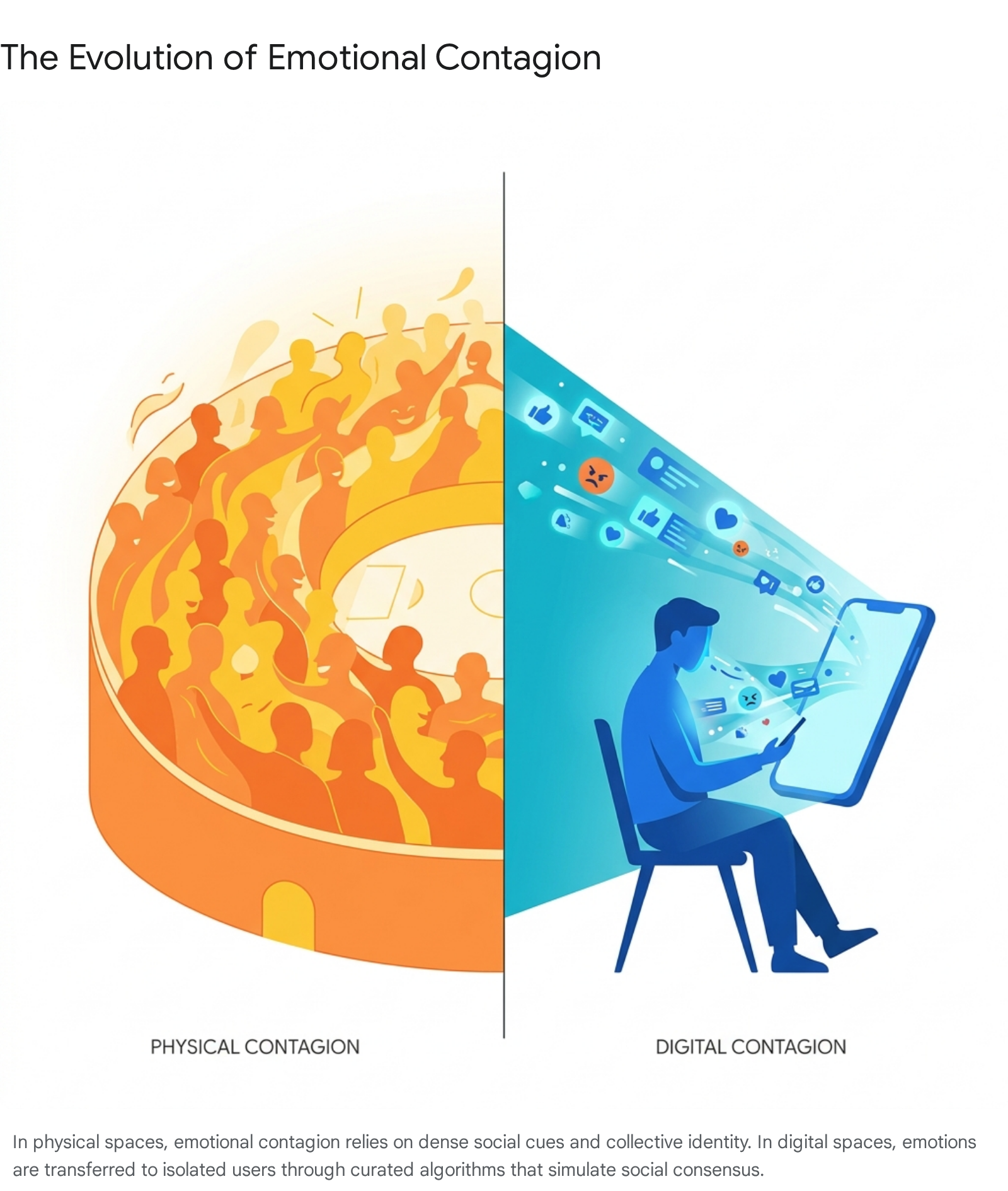
Today, social media algorithms exploit this biological wiring by amplifying highly arousing emotions like moral outrage and anxiety, facilitating their rapid spread across global networks. Understanding this science reveals not only why certain content dominates our feeds, but also how we can protect our mental well-being in an increasingly overstimulated digital environment.
The Biological Roots of Shared Feelings
Long before the advent of the internet, human beings were biologically wired to catch the emotions of others. This psychological imperative evolved to facilitate social cohesion, rapid threat detection, and group survival. When we witness someone expressing a strong emotion - whether it is a cry of fear or a burst of laughter - we do not merely observe it as neutral data. We frequently simulate it internally, aligning our own psychological and physiological state with the group.
The Psychology of Stadiums and Collective Emotion
The most visceral examples of emotional contagion occur in dense physical crowds, where social dynamics amplify individual feelings into a singular wave of shared experience. In a sports stadium, an atmosphere can shift in milliseconds. A collective gasp at a missed penalty or an eruption of euphoria following a winning goal is not simply a collection of individuals deciding to react independently; it is a synchronized emotional system operating in real-time 1.
Psychologists often refer to this merging of the self and the crowd as "identity fusion" or "collective effervescence," a state where the boundary between the individual and the group temporarily dissolves 11. In these environments, people experience a state of deindividuation. Personal responsibility weakens, the ability to self-monitor diminishes, and emotional reactivity spikes 13. When one person reacts to a play, nearby individuals unconsciously mirror the reaction, creating outward waves of micro-interactions that trigger a powerful feedback loop. The initial emotion prompts a reaction, which amplifies the emotion for the group, which in turn triggers an even stronger collective reaction 14.
This shared emotional linkage is incredibly potent. In competitive sports, an athlete's perception of their team's or the crowd's collective emotion can sometimes influence their on-field performance more heavily than their own internal emotional state 23. Stadiums act as modern ritual grounds where everyday social restraints are suspended, allowing for pure, unmediated emotional contagion 3.
Do Mirror Neurons Actually Cause Contagion?
For decades, the popular scientific explanation for how we catch emotions centered on "mirror neurons." Discovered in the 1990s, these are brain cells that fire both when an individual performs an action and when they observe someone else performing the same action 74. This neurological mimicry was widely touted by both the media and early researchers as the foundational biological switch for empathy, explaining why behaviors like laughing or crying are highly infectious 79.
However, recent neuroscientific research has heavily refined and, in some contexts, debunked the grandest claims surrounding mirror neurons. While the human brain certainly possesses action activation networks that reflect social cues, treating a single type of neuron as the sole biological mechanism for complex emotional empathy is a vast oversimplification 45.
The phenomenon of contagious yawning serves as a perfect example of this scientific pivot. For years, scientists hypothesized that contagious yawning was directly linked to an individual's capacity for empathy 612. Yet, more rigorous contemporary studies have revealed that the phenomenon is driven far more by biased attentional processes, basic stimulus detection, and physiological suggestibility rather than deep emotional sharing 7. Comprehensive studies mapping the human genome and behavioral responses have found that contagious yawning actually decreases with age and has no strong, consistent association with a person's baseline empathy, tiredness, or intelligence levels 128.
Therefore, while our brains are deeply wired to detect and reflect the emotions of others, emotional contagion is a highly complex orchestration of cognitive appraisal, social context, and sensory input, rather than a simple, hardwired neurological reflex.
How Do Emotions Spread Without Physical Cues?
For a long time, psychologists assumed that emotional contagion strictly required physical proximity. The established literature stated that humans needed nonverbal cues - hearing a subtle shift in vocal tone, seeing a facial expression, or observing body language - to accurately catch a feeling 910. The rise of digital communication presented a profound psychological question: Can emotions spread through a screen, stripped of all physical cues, using only text?
The Landmark Facebook Experiment
The definitive, albeit highly controversial, answer to this question arrived in 2014. Researchers from Cornell University and Facebook published the results of a massive-scale experiment involving 689,003 unaware Facebook users 1112. The goal was to test whether emotional states could be transferred via text-based emotional contagion, bypassing direct interaction.
For one week in 2012, the platform's data scientists secretly manipulated the algorithms governing the News Feeds of the selected users. One group was exposed to slightly fewer positive posts from their friends, while another group was shown fewer negative posts 1113. The researchers did not insert fake messages; they merely filtered the existing flow of information to skew the emotional baseline of the feed 1415.
The results were groundbreaking for the field of computational social science. Users whose feeds were stripped of positive content began writing fewer positive posts and more negative ones. Conversely, when negative expressions were reduced, users spontaneously generated more positive content 1617.
This study proved two critical realities about modern human psychology. First, it provided experimental evidence that emotions can indeed spread via text alone, completely untethered from in-person interaction or nonverbal body language 1216. Second, it revealed a structural reality of the modern internet: social media platforms are not neutral public squares. They are highly mediated environments where the algorithms deciding what content floats to the top directly dictate the emotional state of millions of people simultaneously 1115. While the study sparked widespread public and ethical outrage regarding informed consent, it permanently validated the concept of digital emotional contagion 13.
Emojis: The New Digital Body Language
If digital emotional contagion occurs without physical cues, how do human beings effectively signal tone and intent in rapid-fire text? Over the last decade, emojis have evolved into the functional equivalent of digital body language, bridging the gap left by the absence of faces and voices.
Contrary to the belief that emojis are simply a playful or lazy form of communication, cognitive pragmatics research shows they are incredibly efficient tools for meaning-making. Emojis trigger the exact same affective and inferential processes in the human brain as real-world facial expressions, fulfilling the predictions of the Emotion as Social Information (EASI) model 1819. In fact, the brain processes these digital symbols even faster than reality.
A 2023 neuroscientific study utilizing electroencephalography (EEG) testing found that human beings decode the emotion of an emoji roughly 73 milliseconds faster than they decode a photograph of an actual human face 20.
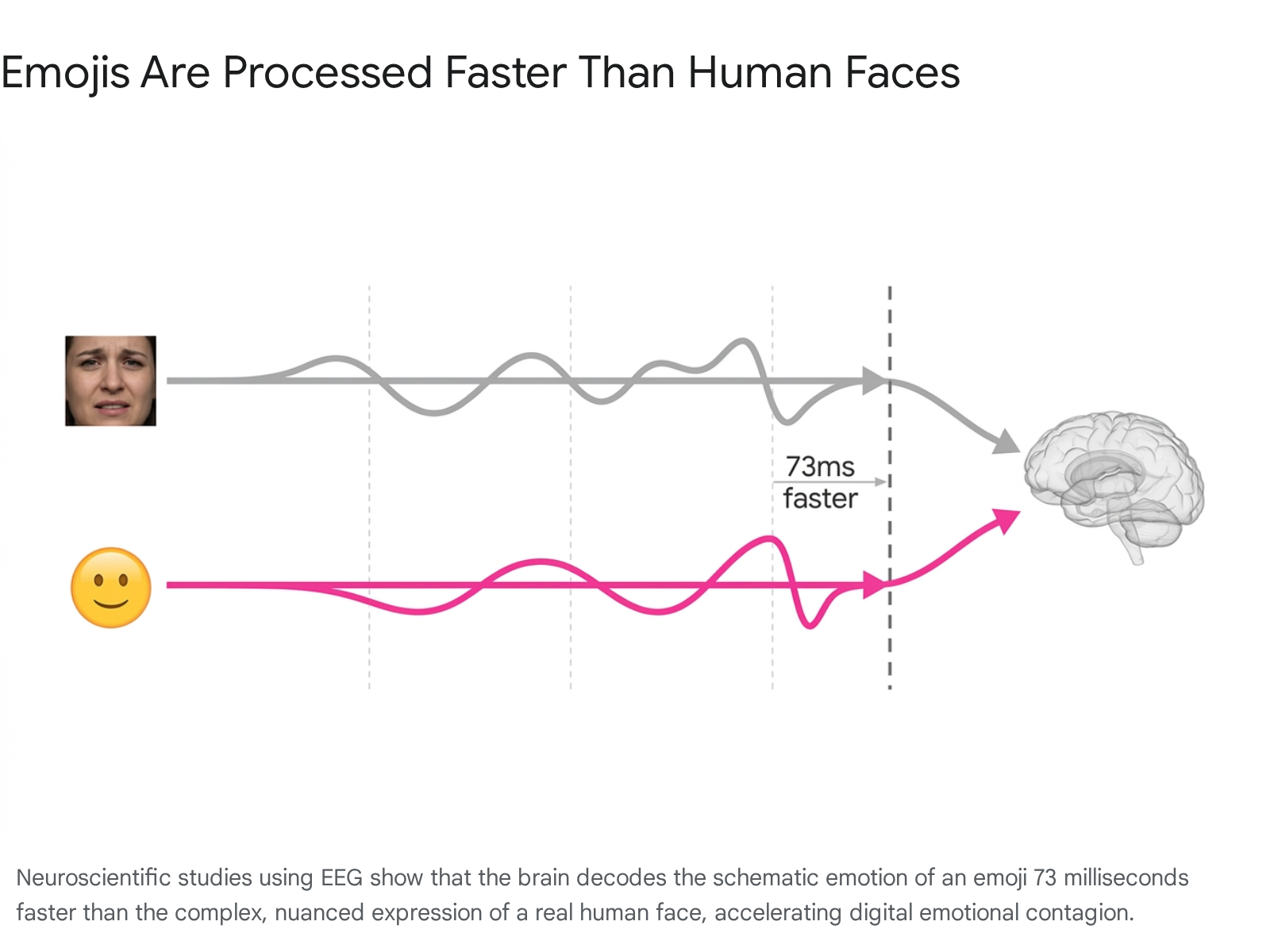
Because emojis lack realistic human details, individual identity markers, and physical ambiguities, their highly schematic nature allows the brain to categorize the intended emotion instantly 20. They operate as highly concentrated packets of emotional data. When an emoji is attached to a text message, the message is perceived as emotionally more intense and of a more extreme valence, acting as the primary vehicle for transmitting emotion across digital networks 1821.
Why Does Outrage Spread Faster Than Joy?
Social media companies are fundamentally advertising businesses, and their core product is user attention. Because their revenue depends entirely on keeping people scrolling on the platform for as long as possible, engagement-based algorithms are explicitly optimized to reward content that sparks strong, immediate reactions 2223.
Research consistently demonstrates that not all emotions are equally contagious online. While conventional wisdom might suggest that people prefer to share uplifting news or helpful facts, the data reveals a heavy, systemic bias toward high-arousal negative emotions.
The Network Dynamics of Anger
Anger and moral outrage are the most potent fuels for digital virality. A major study by Yale University researchers, analyzing 12.7 million tweets, found that expressing moral outrage online yields significantly more likes and shares than almost any other interaction. Because the algorithm rewards this behavior with increased visibility, it inadvertently trains users to become angrier and more combative over time 30.
Furthermore, anger behaves uniquely within the architecture of social networks. A computational analysis of social media diffusion found that anger spreads incredibly easily across "weak ties" - casual acquaintances or complete strangers 2425. Joy, by contrast, tends to stay trapped within "strong ties," meaning happy news usually circulates only among close friends and family. Because anger easily jumps between disconnected communities, it breaks free of local network traps, allowing outraged content to cascade exponentially across an entire platform 25.
Comparing the Virality of Different Emotions
Recent comprehensive analyses of social media cascades, such as a large-scale study of over 380,000 articles on the WeChat platform, provide a clear hierarchy of how specific feelings behave algorithmically 26:
| Emotion Type | Virality Profile | Network Behavior & Demographics |
|---|---|---|
| Anxiety | Very High | Drives the deepest and broadest diffusion cascades. Often shared by older demographics and users with large friend networks looking to warn others of perceived threats 26. |
| Anger / Outrage | Very High | Spreads the fastest. Highly contagious across "weak ties" (strangers), allowing it to escape echo chambers and infiltrate new communities rapidly 2425. |
| Joy / Love | Moderate | Joy triggers sharing, but results in smaller, shallower cascades. It relies on "strong ties" (close friends) and struggles to jump between disconnected social groups 2526. |
| Sadness | Low | Sadness is generally a low-arousal emotion. Unless tied to a massive cultural event, it slows down content diffusion and reduces overall user engagement 2627. |
The Disconnect Between Virality and Action
Interestingly, while outrage ensures content goes viral, it rarely guarantees meaningful real-world action. A massive study of over 1.2 million social media posts linked to online petitions found a striking digital disconnect. Posts laden with heavy moral outrage received the most likes and reposts, but they actually generated fewer petition signatures than less viral, prosocial posts that emphasized group identity and constructive agency 28.
This highlights a core principle of digital misinformation: a lie or a half-truth wrapped in anger does not necessarily need to be believed, and it does not necessarily drive collective action. It simply needs to be deeply felt to achieve its communicative goal of hijacking the algorithm and commanding attention 23.
The Impact of Algorithms and Affective Loops
The mechanics of emotional contagion have drastically accelerated with the rise of short-form video platforms. Unlike earlier social networks that relied on explicit "friend" graphs, modern platforms rely on discovery engines that systematically prioritize emotional intensity over social relationships or factual nuance 2930.
Micro-Signal Tracking on TikTok
TikTok's "For You" feed offers a clear illustration of how algorithmic environments cultivate emotionally primed attention. The platform tracks behavioral micro-signals - such as how long a user lingers on a frame, whether they re-watch a video, and their scrolling speed - to map the user's emotional reactions with remarkable granularity 30.
If a user pauses on a video evoking anxiety, grief, or anger, the algorithm instantly recalibrates, serving up similar content to confirm and amplify that specific affective response. This creates an "affective loop" 3031.
Over repeated cycles, this passive algorithmic optimization produces "affective convergence," where a user's feed becomes an emotionally homogeneous echo chamber, entirely independent of their declared ideological or political beliefs 30. Emotion serves as a pre-cognitive organizing principle, establishing an emotional baseline for the user before they even encounter factual reporting or nuanced discourse.
Overstimulation and Emotional Exhaustion
Because the engagement engine privileges virality and intensity, it exposes users to a relentless stream of varied, high-arousal content. A meta-analysis examining the habits of nearly 100,000 users indicated that heavy consumption of short-form video pulls the nervous system through emotional states faster than the brain can organically settle into them 32.
Within minutes, a user might cycle from awe, to disgust, to deep sympathy, to envy. Over time, the mind is left with half-finished feelings and a lingering hum of tension 32. This constant affective whiplash contributes to emotional straying, where the overwhelming nature of constant updates surpasses cognitive limits, ultimately leading to emotional exhaustion, anxiety, and eventual disengagement from offline life 323334.
Who Is Most Susceptible to Digital Contagion?
We do not all absorb the emotions of others equally. Research demonstrates that susceptibility to emotional contagion (SEC) is a distinct, measurable personality trait, heavily influenced by individual psychology and cultural background.
Positive vs. Negative Susceptibility
Historically, psychologists viewed emotional contagion as a single, global trait - assuming that if you easily caught happiness, you would also easily catch sadness. However, a landmark study confirmed that susceptibility is actually bi-dimensional: people can be highly susceptible to catching positive emotions (Positive SEC), negative emotions (Negative SEC), or both 3536.
The outcomes for human functioning between these two traits are drastically different. Treating susceptibility as a single score often biases results, as negative emotional contagion leads to vastly different psychological states than positive emotional contagion 36.
| Trait Dimension | Psychological and Social Outcomes | Mental Health Implications |
|---|---|---|
| Negative SEC | Highly correlated with emotional volatility, personal distress, and anxiety. Individuals easily absorb stress from their digital environments 36. | Strong predictor of psychological ill-being, burnout, emotional exhaustion, and lower overall life satisfaction 36. |
| Positive SEC | Linked to social success, high empathy, trust, and compassion. Individuals easily catch the joy and enthusiasm of others 36. | Generally uncorrelated with depression or anxiety. Protective for interpersonal functioning and prosocial behavior 36. |
Cross-Cultural Differences
How we catch and express emotions online is also heavily dictated by the macro-culture in which we are raised. Extensive research examining digital emotional contagion across dozens of countries has revealed a stark divide between individualist and collectivist societies 3738.
In individualist cultures (such as the United States and Western Europe), there is a strong cultural emphasis on prioritizing individual feelings, maximizing positive affect, and minimizing negative affect. Online, this translates to users expressing highly polarized, high-arousal emotions, which then spread rapidly through their networks because individualist users adhere strongly to the emotional norms of their peers 373839.
In contrast, collectivist cultures (such as Japan or China) tend to utilize "dialectical thinking" - a cognitive style that accepts contradictions, recognizes that emotions are fluid, and values a steady balance between positive and negative states 37. As a result, users from collectivist backgrounds tend to express more balanced, less polarized emotions online. Because they do not seek out maximum emotional arousal, they are far less likely to initiate, share, or participate in massive chains of extreme digital emotional contagion 37.
How to Set Digital Boundaries for Emotional Health
Because digital emotional contagion is largely involuntary and algorithmically amplified, prolonged exposure without intervention can damage psychological resilience. The digital landscape can quickly transition from a source of connection to a trigger for stress, self-doubt, and burnout 4748. We cannot easily shut off our evolutionary programming to absorb the feelings of others, but we can actively manage our exposure.
Recent psychological research and clinical therapy increasingly advocate for "digital boundaries" - intentional, evidence-based limits set around technology use to protect emotional well-being 47495051. Effective digital hygiene does not require completely abandoning social media; rather, it requires introducing deliberate friction into our digital habits to reclaim emotional control.
- Notification Audits: Every alert trains the brain to expect an interruption, keeping the nervous system in a state of heightened alertness. Turning off non-essential notifications across all apps prevents algorithms from hijacking your attention and initiating an unprompted emotional response 4849.
- Time-Blocking and Digital Curfews: Research shows that structured, pre-planned digital breaks are significantly more effective at reducing stress than relying on willpower alone to cut back. Establish specific windows for checking feeds, and enforce a "digital curfew" an hour before bed to prevent late-night emotional arousal and sleep disruption 484950.
- Creating Tech-Free Zones: Designating specific physical spaces - such as the bedroom or the dining table - as device-free areas helps break the cycle of reflexive, passive consumption, fostering offline connection and mental rest 474951.
- Affective Tracking and Curated Feeds: Therapists increasingly recommend periodic self-reflection to monitor how specific applications make you feel. If a platform reliably triggers anxiety, comparison, or outrage, actively curating your feed to remove those triggers is a necessary step in emotional regulation. By building awareness of your emotional triggers, you can harness digital tools positively 334750.
Bottom line
Emotional contagion is a deeply ingrained evolutionary mechanism that has been co-opted and dramatically accelerated by digital platforms. Because social media algorithms prioritize engagement to drive revenue, they systematically flood our feeds with high-arousal emotions - particularly moral outrage and anxiety - which infiltrate networks faster and further than joy. While the long-term cognitive impacts of endless affective loops are still being studied, it is clear that protecting our mental health requires setting intentional digital boundaries to reclaim control over our emotional environments.