
Are Honors Colleges Worth It
Honors colleges offer Ivy-level academic rigor, priority registration, and tight-knit scholarly communities, often at a fraction of the cost of elite private universities. However, demanding graduation requirements - such as a senior thesis - can induce burnout and offer limited advantages outside of traditional academic career tracks. Ultimately, their return on investment is rising rapidly as employers increasingly favor public university graduates with practical skills over traditional Ivy League alumni, making public honors programs a highly strategic choice for pragmatic students.
What Actually Is an Honors College?
As high-achieving students weigh the skyrocketing costs of private elite universities against the affordability of state schools, honors colleges have emerged as a compelling middle ground. But what exactly are they, and how do they function within the broader ecosystem of a massive public university?
At the most fundamental level, an honors program or college is a specialized academic track designed for highly motivated, academically gifted students. They offer a hybrid educational experience: the intimacy, small class sizes, and personalized mentoring of a boutique liberal arts college, backed by the massive resources, global research facilities, and alumni networks of a large public university .
The National Collegiate Honors Council (NCHC), an organization representing over 800 honors programs worldwide, highlights that while these entities share similar goals, there is a distinct structural difference between an "honors program" and an "honors college" 1:
- Honors Programs: Typically administered by a director and a small staff, these programs are woven into the existing university structure. Students take a set number of honors-designated credits but remain primarily tethered to their major's standard department. They generally do not have their own deans.
- Honors Colleges: These function as distinct, permanent administrative entities within the larger university, often reporting directly to the chief academic officer or provost 2. They usually have their own dean, a dedicated staff of advisors, substantial endowments, and designated honors residence halls for first-year students . Data from the NCHC reveals that honors colleges are far more prevalent in doctoral universities than in baccalaureate or master's institutions, and the deans of these colleges command salaries commensurate with their elevated administrative status 3.
Both models emphasize a rigorous, interdisciplinary curriculum. Students generally have to complete a specific number of honors credits (often around 30 for first-year entrants) and maintain a high GPA (typically 3.2 or above) to remain in good standing . The culmination of this track is often a capstone project or a senior honors thesis.
The Allure of Priority Registration and Small Classes
Beyond the prestige of the label, the tangible benefits of an honors college are deeply practical. Large state universities are often plagued by bureaucratic bottlenecks; required prerequisite courses fill up within minutes of registration opening, forcing students to delay their graduation.
One of the most highly coveted perks of an honors program is priority registration. This allows honors students to bypass the standard enrollment queue, virtually guaranteeing they get the classes they need to graduate on time . In an era where only 40% of full-time students at four-year flagship institutions graduate in four years 4, priority registration can literally save a family tens of thousands of dollars in fifth-year tuition and lost wages.
Furthermore, honors classes are typically capped. Rather than sitting in a massive lecture hall with 400 peers, honors students often take core requirements in seminar-style classes limited to 25 or fewer students 5. This allows for faculty-student mentorship, robust discussion, and a level of academic engagement that is otherwise difficult to find at a massive state flagship.
The Financial Equation: Hidden Costs and High ROI
One of the primary draws of an honors college is cost mitigation. For families facing $80,000-a-year tuition bills at top-tier private schools, a respected state flagship - especially in the South or Midwest - at half the price is hard to ignore 8. Many Southern public universities offer generous merit aid, making the out-of-pocket cost for an honors education significantly lower than that of a private institution 8.
However, prospective students must be aware that an honors designation is not always free, and admission to an honors college does not automatically guarantee a full-ride scholarship. While some programs are heavily endowed and offer substantial financial support, others require students to pay for the "extras" that come with the honors experience.
Unpacking the Fee Structures
The financial models of honors programs vary wildly across institutions. Some integrate the cost seamlessly into standard tuition, while others charge specific programmatic fees to fund enhanced experiences, retreats, and specialized advising.
| Institution | Honors Program Name | Honors-Specific Fees & Financial Implications |
|---|---|---|
| Georgia Institute of Technology | John H. Martinson Honors Program | Charges an $800 fee for first-year students ($400/semester) to offset programming costs like retreats, weekly events, and graduation medals. Transfer students pay a one-time $250 or $500 fee depending on their start term. There is no extra fee for honors housing 678. |
| Oregon State University | Honors College | Requires a differential tuition of $500 per term. Recognizing that this creates a financial barrier, the college developed experience scholarships to help offset these costs for students with significant financial need 9. |
| University of Virginia | Echols Scholars Program | Purely academic; carries no inherent financial component, stipend, or merit scholarship for incoming students. However, enrolled scholars can apply for competitive endowed research grants (up to $2,000) to fund their thesis or summer research 101112. |
| University of Texas at Austin | Plan II Honors Program | Standard tuition applies (which is frozen through 2026-27 for Texas residents), though out-of-state students pay significantly higher standard tuition rates. No distinct Plan II "fee" is prominently assessed beyond standard college costs 1314. |
Even when honors colleges charge differential tuition, students often view the benefits as worth the cost. Following community discussions at Oregon State University, students acknowledged the necessity of differential tuition to fund the smaller classes and specialized advising, but successfully advocated for scholarships to ensure the cost did not shut out low-income peers 9.
The True Cost of Attendance: In-State vs. Out-of-State
While honors colleges represent a bargain for in-state residents, the math changes significantly for out-of-state students. The prestige of public flagships has driven massive demand from out-of-state applicants, allowing these universities to charge premium tuition to non-residents.
For the 2024-2025 academic year, the undergraduate tuition and fees at the University of North Carolina at Chapel Hill are approximately $8,994 for North Carolina residents, but a staggering $41,203 for out-of-state students 18. When factoring in housing, meals, books, and living expenses, the total cost of attendance for an out-of-state student at UNC exceeds $59,000 annually 1819. Similarly, the University of Michigan charges its lower-division in-state students roughly $18,346 in tuition, fees, and standard living budgets, while out-of-state costs are substantially higher 15. At the University of Texas at Austin, out-of-state tuition approaches $90,000 annually for some programs 13.
Despite these high out-of-state costs, many families still find the return on investment (ROI) highly favorable compared to elite private schools, particularly when factoring in the shifting dynamics of employer preferences.
Shifting Employer Perceptions: Public Honors vs. The Ivy League
For generations, an Ivy League degree was considered the ultimate golden ticket to career success. Today, that perception is undergoing a massive realignment. Recent data suggests that the prestige gap between the traditional "Ancient Eight" Ivy League schools and top-tier public universities (often dubbed "New Ivies") is closing rapidly in the eyes of hiring managers.
According to recent Forbes surveys of U.S. hiring managers and executives, a sweeping reassessment of elite education is underway 1617. Only 14% of employers believe Ivy League schools are doing a better job preparing job candidates than they were five years ago, and roughly a third of hiring managers reported they are less likely to hire Ivy League graduates today 17. Executive respondents cited concerns over graduates possessing a "higher than real opinion of themselves," lacking humility, and leaning too heavily on institutional prestige rather than practical competence 16. Furthermore, heavy grade inflation at elite privates - where nearly 80% of undergraduates at some Ivy institutions average an A or A-minus - has undermined the signaling value of the degree 17.
Conversely, public universities are surging in employer esteem. The same survey revealed that 42% of hiring managers are more likely to hire graduates of public universities than they were five years ago 1617.
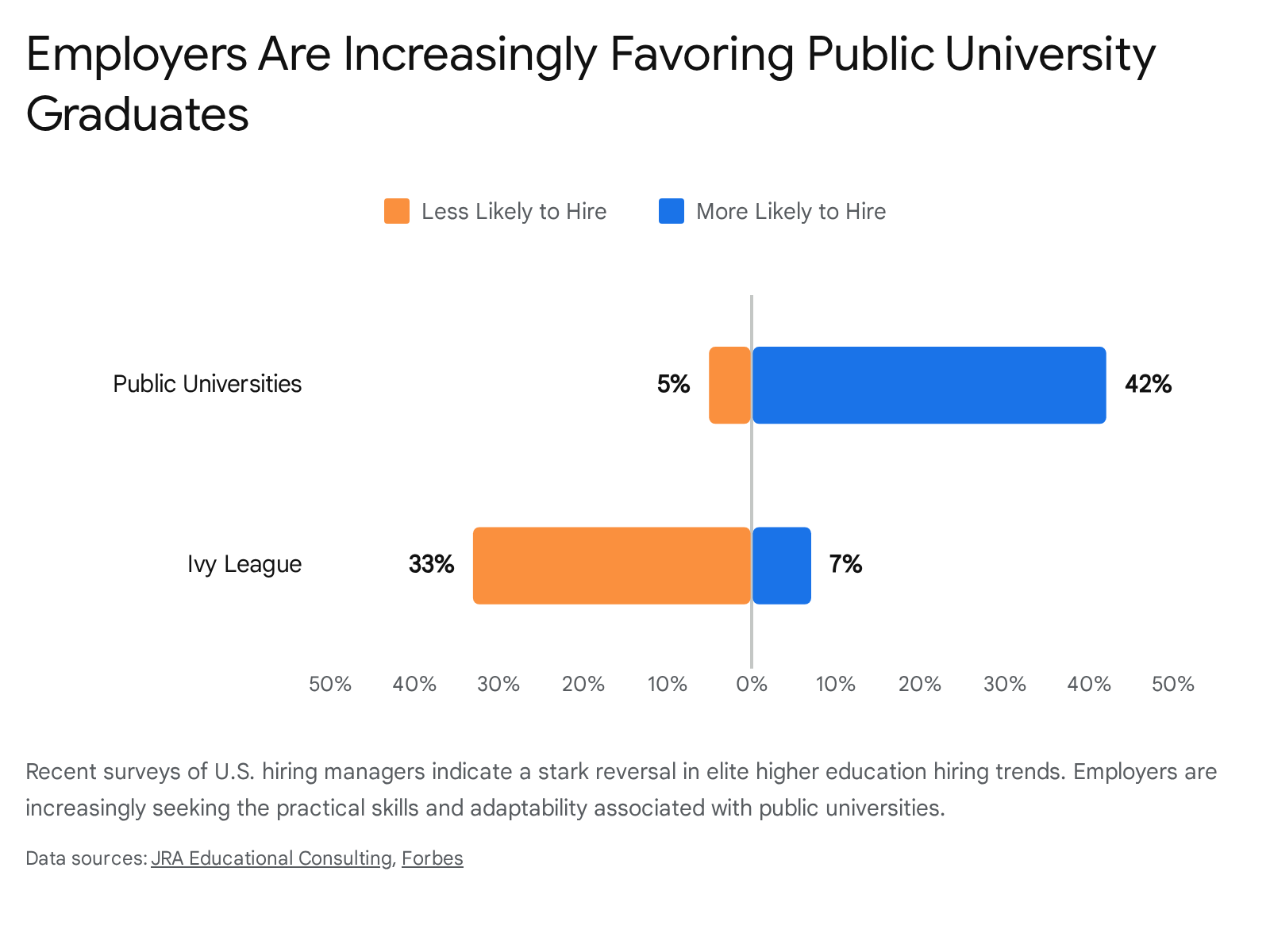
Employers increasingly value the adaptability, technical proficiency, and practical skills that public university graduates bring to the workforce 2318. Sixty-8 percent of hiring managers believe graduates from these "New Ivies" demonstrate stronger technical proficiency, and 74% say they excel in rapidly changing work environments 23.
In this landscape, an honors college degree from a state flagship operates as a powerful hybrid. It signals to employers that the candidate possesses the high-level intellectual horsepower historically associated with elite private schools, combined with the grounded, practical, and diverse experience of a large public university. Graduates of public "New Ivies" also carry about 23% less student debt on average than their private-school peers, while earning starting salaries that are only marginally lower - making the lifetime ROI exceptionally strong 16.
Regional Prestige Dynamics
It is also vital to understand that collegiate prestige in the United States is intensely regional. While a handful of elite Northeastern and West Coast schools maintain universal national name recognition, state flagships often dominate their specific geographic job markets 192627.
For instance, in Texas, degrees from the University of Texas at Austin (home to the highly regarded Plan II Honors Program) or Texas A&M carry immense weight. Alumni networks from these schools permeate the region's top industries, and local employers often prefer them over "near-Ivy" East Coast private schools 27. The same holds true for the University of Washington in the Pacific Northwest; holding a degree from UW in Seattle is a massive advantage in the local tech and business sectors 27.
Furthermore, Southern public universities - such as the University of Georgia, Clemson, the University of Tennessee, and the University of Florida - are rapidly transforming from regional powerhouses into national contenders. Drawn by lower costs, generous merit aid, and stellar honors programs, high-achieving students from the Northeast are increasingly migrating South 8. This influx of out-of-state talent is raising the selectivity and academic profile of Southern flagships, effectively shifting the national map of academic prestige 8.
The Graduation Dilemma: Completion Rates and Time to Degree
When universities promote their honors colleges, they often boast about the spectacular graduation rates of their students. However, there is a critical statistical distinction between graduating from the university and graduating with honors completion .
Honors students consistently persist in college and earn their bachelor's degrees at much higher rates than the general undergraduate population - often averaging between 86% and 97% 20. They are academically able, motivated, and benefit from specialized advising and peer support 20.
But completing the actual honors program is a different story entirely. The "honors completion rate" measures the percentage of students who finish all the specialized honors credit requirements and capstone projects . Across the country, the average honors completion rate hovers around 57.2% . While top-tier programs like CUNY Macaulay Honors College, UT Austin's Plan II, and Penn State's Schreyer Honors College boast completion rates of 70% or higher, many programs see significant attrition .
In some historical cohort studies, the completion rate for all honors requirements has dropped as low as 18% to 35% 20. Why do so many high-achieving students abandon the honors track right before the finish line? The answer almost always points to the capstone requirement: the senior honors thesis.
The Thesis vs. Internship Debate
The defining feature of most honors colleges is the requirement to produce an original undergraduate thesis. This is a massive, self-directed research project spanning 30 to 70 pages that typically dominates a student's senior year 212231.
Writing a thesis requires developing a research proposal, navigating funding or laboratory setbacks, managing time over a year-long period, and ultimately defending the work before a faculty committee 2223. For many students, it is an empowering journey that hones their critical thinking, patience, and ability to handle long-term, unstructured problems 23. As one student noted, the grueling process instilled an emotional strength and scientific mindset that passive coursework simply could not provide 23.
However, it is also a notorious bottleneck. The thesis requires a heavy time commitment - sometimes demanding over 135 hours of project time for a three-credit course 24 - which can conflict with senior-year coursework, graduate school applications, and job hunting. Students often struggle with time management, facing the temptation to prioritize immediate assignments over the nebulous, long-term demands of thesis research 22.
Academia vs. The Workforce
Whether the honors thesis is "worth it" depends entirely on the student's post-graduation goals. The divergence in value between academic pursuits and industry placement is stark.
| Student Goal | Value of the Honors Thesis | Value of a Professional Internship |
|---|---|---|
| Pursuing a PhD or Academia | Extremely High. Serves as a long-form writing sample, proves independent research capability, and builds deep relationships with faculty for letters of recommendation 343536. | Low. Does not demonstrate the ability to conduct rigorous, peer-reviewed academic research or navigate institutional review boards. |
| Entering the Corporate Workforce | Low to Moderate. Shows dedication and writing ability, but employers rarely read it. Theoretical research often does not translate to immediate business value 343525. | Extremely High. Provides hard industry skills, professional networking, software proficiency, and a proven track record of creating value in a corporate environment 34352639. |
If the goal is graduate school, medical school, or academia: The thesis is incredibly valuable. It provides a taste of the exact work required in graduate programs. Furthermore, the faculty advisor overseeing the thesis becomes a crucial asset for networking and securing strong letters of recommendation for advanced degree programs 3436.
If the goal is entering the non-academic workforce: The value of a traditional academic thesis diminishes sharply. Many hiring managers in corporate, non-profit, or government sectors prioritize real-world experience, teamwork, and practical application over theoretical research 343525. In these fields, spending a year writing a paper on 18th-century literature or theoretical physics offers far less resume value than spending that same year interning at a company, building a professional network, and acquiring hard industry skills 3439. As one industry recruiter noted, employers value candidates who have accomplished successes that actually helped a company, rather than just writing about abstract concepts 35.
A Modern Compromise: The Internship-Based Thesis
Recognizing this disconnect, forward-thinking honors colleges are adapting to better serve students headed for the private sector. Many programs now offer alternative capstone pathways.
For example, Syracuse University and the University of Missouri allow students to utilize a professional internship as the basis for their honors thesis 2426. This "internship-based thesis" bridges the gap between theory and practice. Students complete hands-on work in their field, developing vital soft skills like teamwork and adaptability, and then write a reflective, analytical paper on the industry challenges they encountered 26. This approach fulfills the academic rigor required for an honors degree while simultaneously building a highly employable resume and portfolio 26.
The Evolution of Honors: Diversity, Equity, and Access
Historically, honors programs have faced valid and intense critiques regarding equity, inclusion, and elitism. Because admissions to honors colleges traditionally relied heavily on standardized test scores (SAT/ACT) and unweighted GPAs, these programs disproportionately favored affluent, White students from well-resourced high schools who could afford test preparation services 127. A 2016 census showed that over 90% of honors students at participating institutions were classified as White 27.
Critics argued that by restricting access to smaller classes, elite mentorship, and specialized resources based on flawed metrics, honors colleges were exacerbating systemic educational inequalities rather than fixing them 2741. The very language of honors programs - often relying on terms of superiority and exclusivity - alienated students from marginalized backgrounds 1.
Reforming Historically Exclusionary Practices
Over the last several years, the landscape has begun to shift dramatically. The National Collegiate Honors Council (NCHC) has pushed institutions to re-examine their enrollment practices, formally revising its "Shared Principles and Practices" in 2022 to center diversity, equity, and inclusion in strategic planning 1228.
Rather than serving solely as a reward system for the highest-achieving high school students, modern honors programs are reorienting toward equipping curious, engaged learners to become agents of social change 2728. This requires a massive overhaul of admission practices. Many honors colleges have abandoned strict test-score cutoffs in favor of test-blind or test-optional policies, utilizing holistic application reviews that consider a student's background, resilience, and creative potential 15.
The Impact of Holistic Admissions
These changes are yielding measurable results across the country. Programs that have broadened their admissions criteria - such as the Honors College at Indiana University Indianapolis - have reported significant increases in their populations of first-generation students, 21st Century Scholars, and students of color, creating a much richer, more intellectually diverse classroom environment 5.
Similarly, Adelphi University's Honors College has revamped its process to interview all suitable candidates, utilizing a curriculum that features diverse voices to attract a wider demographic of applicants 28. When barriers to entry are removed, the demographics of honors colleges begin to mirror the diversity of the broader university population. This is critical, as a diverse honors cohort brings varied lived experiences to seminar discussions, enhancing the critical thinking, empathy, and cultural competence of all enrolled students 41.
Crucial Questions to Ask Before Committing
Because honors colleges vary so wildly in their requirements, financial costs, and institutional cultures, prospective students must treat the college visit and application process as a two-way interview. Rather than just asking basic questions about campus life, students should ask admissions officers targeted questions to determine if the specific honors program aligns with their long-term goals 294430:
- What are the specific requirements to graduate with honors? Do you enforce a single, traditional academic thesis, or are there multiple pathways (like a portfolio, internship, or creative project)?
- Is there an additional fee or differential tuition for honors students? If so, what specifically does that money fund, and are there scholarships available to offset it for students with financial need?
- How flexible is the honors curriculum? Can honors credits overlap with standard major requirements, or do they act as extra electives that might delay graduation or prevent a student from double-majoring?
- What is the honors completion rate? What percentage of students actually finish the program, and what is the primary reason students drop out?
- What are the tangible perks? Do honors students get guaranteed priority registration for all four years? Is honors housing mandatory, and does it cost more than standard dorms?
Bottom line
Honors colleges represent one of the best value propositions in modern higher education, offering the prestige, intimacy, and personalized mentorship of an elite private school backed by the vast resources of a state university. Their value is compounding rapidly as major employers increasingly express a hiring preference for the practical, adaptable skills of public university graduates over traditional Ivy League alumni. However, the decision to pursue an honors degree must be weighed carefully against its rigid requirements; students targeting the immediate corporate workforce should ensure the program allows for internships and practical capstones, rather than forcing them into a time-consuming, academia-focused senior thesis that offers little real-world resume value.