
Pros, Cons and How to Plan a Gap Year Before College
Taking a gap year before college offers significant academic and psychological benefits, including higher collegiate GPAs, reduced academic burnout, and faster early-career job placement. However, high program costs, strict university deferral policies, and the potential risk of academic "melt" require students to plan their time off with intense logistical and financial foresight. Ultimately, a gap year is highly effective when structured purposefully, but it remains a decision highly dependent on a student's budget, maturity, and long-term academic goals.
What Is a Gap Year and Who Takes One?
A gap year is an intentional, structured break from formal education, typically taken between high school graduation and the first year of college, or occasionally during undergraduate studies. Rather than a simple vacation or passive time off, a well-planned gap year emphasizes experiential learning, cultural immersion, community service, or professional internships 123. The primary goal is to deepen a student's practical and personal awareness, equipping them with the life skills necessary to thrive in higher education and the modern workforce 3.
In the United States, taking a gap year is a growing but still relatively niche phenomenon. The Gap Year Association estimates that between 40,000 and 90,000 American students defer college enrollment to take a gap year annually 14. However, this represents only about 3% of all eligible high school graduates 4. Demographically, women make up approximately 58% of gap year participants in North America, and the vast majority (76%) of participants fall between the ages of 18 and 24 4. Despite widespread interest - roughly 65% of US high school graduates consider taking time off - the transition from intention to execution is hindered by cultural norms and financial realities 4.
The Cultural Divide: United States vs. Europe and Australia
The popularity of the gap year varies drastically across the globe, driven by profound historical and cultural differences. The concept originated in the United Kingdom during the 1960s, drawing inspiration from the 17th-century "Grand Tour" where young elites traveled across Europe to absorb culture and refine their education 457. Today, taking time off is a democratized rite of passage in the UK, Europe, and Australia. Recent data from the UK's Universities and Colleges Admissions Service (UCAS) indicates that over 5% of accepted university applicants routinely defer admission for a year 5.
In Scandinavian countries, stepping off the academic treadmill is the cultural norm. In Sweden, for instance, it is standard practice for high school graduates to take minimum-wage jobs in retail or hospitality to save money for global backpacking trips before enrolling in university 6. European societies generally view this time as an essential phase of life education, believing that real-world exposure better prepares young adults for the responsibilities of adulthood 59. This is supported by high levels of societal trust in the Nordic region; survey data shows that 74% of people in Denmark, 72% in Norway, and 63% in Sweden believe "most people can be trusted," fostering an environment where young people feel safe exploring independently 7. The nature of European gap years is also evolving; Gen Z travelers are increasingly prioritizing wellness and authentic cultural immersion, with 64% of young UK travelers considering a sober gap year and only 6% traveling primarily to party 11.
Conversely, the American cultural framework is deeply rooted in a demanding work ethic that prioritizes constant, linear progression 45. In the United States, deviating from the immediate high-school-to-college pipeline has historically been stigmatized as irresponsible or lazy 45. American students often view themselves strictly within their peer cohorts, and taking a gap year can induce anxiety about falling behind 4. Furthermore, the staggering cost of American higher education turns a gap year into a daunting financial hurdle, leaving many to view it as a frivolous luxury rather than a developmental necessity 49.
The Pros: Why Students Step Off the Academic Treadmill
Despite cultural resistance in the US, the data supporting the efficacy of gap years is robust.
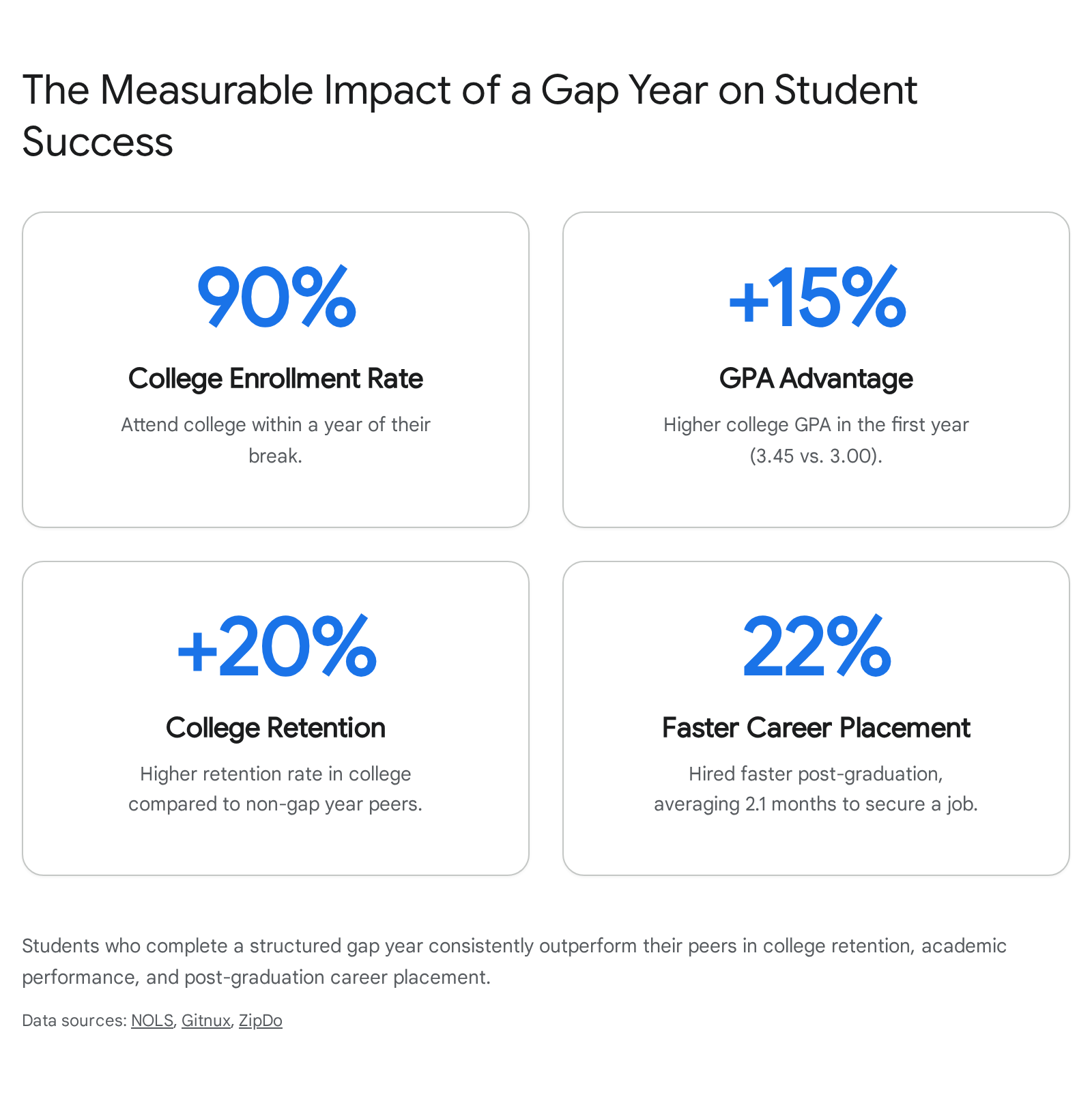
The benefits generally fall into three distinct categories: mitigating severe academic burnout, driving collegiate outperformance, and accelerating post-graduate career success.
Combating the Burnout Epidemic
The contemporary high school and college experience is characterized by intense pressure, leading to a widespread mental health crisis among students. In 2023, 74% of US college students reported experiencing moderate to severe emotional exhaustion due directly to academic stress 12. Globally, a meta-analysis of 50 studies revealed that 42% of university students experience high levels of burnout 1213. This exhaustion has severe consequences: burned-out students experience a 40% reduction in concentration, report 50% higher anxiety levels, and face a 2.5 times higher risk of dropping out entirely 1213. First-year college students are uniquely vulnerable, demonstrating a burnout risk 2.2 times higher than graduating seniors 1213.
A structured gap year acts as a critical intervention. By removing themselves from relentless assignment cycles and standardized testing, students have the psychological space to recover. A 2022 study by the American Psychological Association found that gap year participants experienced 40% lower anxiety levels upon re-entering formal education, measured via standardized GAD-7 scales 14. Similarly, researchers at the University of Colorado Boulder found that gap year alumni exhibited a 28% higher level of emotional resilience compared to their non-gap peers 14. This purposeful break allows students to return to the classroom not just rested, but psychologically equipped to handle collegiate stressors 14.
Academic Outperformance and Collegiate Retention
A common fear among parents is that a year away from the classroom will erode a student's study habits. Empirical evidence suggests the exact opposite. Students who complete a gap year consistently achieve higher academic marks than those who transition straight from high school. A 2022 study published in the Journal of Adolescent Research demonstrated that gap year students maintained a 15% higher college GPA (averaging 3.45 versus 3.00) after their first year, an advantage attributed to matured study habits derived from real-world experiences 14.
The academic advantages extend across disciplines. University of Pennsylvania research found that 78% of gap year takers achieved higher GPAs in rigorous STEM courses, averaging a 3.6 compared to a 3.3 for their peers 14. Furthermore, an evaluation of Harvard's gap year program reported that participants maintained a 12% higher retention rate and graduated 10% faster on average, while a separate NYU study found that gap year alumni enrolled in 25% more advanced courses upon their return and completed them with a 90% success rate 14.
Former Middlebury College Dean of Admissions Robert Clagett designed a methodological approach to track the academic performance of gap year students, discovering that they significantly out-performed expectations based on their high school academic credentials 8. This sustained outperformance throughout all four years of college indicates that gap years foster intrinsic motivation and a clearer sense of academic purpose 8.
Career Clarification and Professional Advantage
The traditional educational pipeline forces adolescents to select academic majors before they have any practical exposure to the professional world. A gap year provides a low-stakes environment to test these interests in real time. Data shows that 60% of gap year participants report their experiences either set them on their current career path or confirmed their choice of academic major, preventing costly mid-degree shifts 1.
This early exposure translates into tangible labor market advantages. A 2023 LinkedIn analysis of 10,000 gap year alumni revealed that they secure jobs 22% faster post-graduation, averaging 2.1 months of search time compared to longer periods for standard graduates 14. Employers actively seek the soft skills honed during a gap year; 76% of hiring managers rate gap year candidates as 30% more adaptable during interviews, and a 2020 McKinsey & Company report found that 89% of gap year alumni were viewed as "leadership-ready" by top firms 14. Furthermore, research published in the Harvard Business Review indicated that gap year participants command 18% higher starting salaries than their peers 14.
The Cons: Risks of "Melt" and Academic Disruption
Despite the compelling advantages, stepping away from the structure of formal education carries inherent risks. For some students, a gap year can lead to aimless drift, lost momentum, and severe financial strain.
The Risk of Not Returning to School
The most prominent fear among educators and parents is "gap year melt" - the phenomenon where students pause their education and simply never return. While the Gap Year Association reports that 90% of students who participate in a formal, structured gap year program enroll in college within a year, the risk is significantly higher for those who take unstructured breaks 1816.
College dropout rates generally highlight the danger of disengagement; currently, 39% of first-time, full-time bachelor's degree-seeking students fail to complete their program within eight years, and roughly 43 million Americans are considered college dropouts 9. Once a student leaves the educational ecosystem, the friction required to re-enroll is high.
Academic literature also presents some contested views on the universal benefits of delaying education. A major longitudinal study analyzing students in Finland and Australia evaluated gap years through the lens of the "Life Span Theory of Control," which posits that direct goal investment during developmental transitions is more adaptive than delaying those goals 10. The Finnish cohort showed no significant difference in goal commitment or academic expectations between gap year and direct-entry students 10. However, the Australian cohort found that gap-year youth were actually more likely to eventually drop out of their university degree, suggesting that for certain populations, severing academic continuity can have detrimental long-term effects 10.
The Socioeconomic Opportunity Gap
The most formidable barrier to taking a gap year is financial. The average cost of a structured, international gap year program in the US ranges from $10,000 to $30,000, equivalent to a full year of college tuition 4. For middle- and low-income families, absorbing this cost is functionally impossible, framing the gap year as an exclusionary luxury reserved for the affluent 411.
This financial barrier exacerbates broader educational inequalities. A 26-year longitudinal study by the Mary E. Walsh Center for Thriving Children at Boston College revealed a stark "opportunity gap" between income brackets. Wealthy children routinely experience six or more enriching developmental opportunities (like travel, camps, and after-school programs) between birth and high school, while nearly two-thirds of children from low-income households experience zero or only one 1213.
The impact of these experiences is profound. When children from low-income households moved from zero to four developmental opportunities, their odds of graduating from a four-year college surged from 10% to 50%, and their average annual salaries by age 26 increased by roughly $10,000 1213. Therefore, if gap years - which represent a massive developmental opportunity - remain accessible only to high-income families, they inadvertently widen the systemic wealth gap in educational attainment 1415.
Choosing the Right Path: Structured vs. Independent Gap Years
To navigate the risks of aimlessness and maximize personal development, students must decide between a structured program and an independent gap year. The choice depends entirely on a student's budget, maturity level, and desired outcomes.
| Feature | Structured Gap Year | Independent Gap Year |
|---|---|---|
| Definition | Programs run by specialized organizations featuring set itineraries, cohort groups, local staff support, and established safety protocols 225. | Self-directed time off where the student plans their own travel, work, volunteering, or independent study 225. |
| Best Suited For | First-time travelers, students needing external accountability, and those who prefer a guided experience with built-in community 225. | Highly independent self-starters, experienced travelers, and students who need strict control over their budget 225. |
| Average Cost | $10,000 to $30,000 (scholarships are available but highly competitive) 24. | Highly variable. Can be cost-neutral or profitable if the student works or freelances during the year 425. |
| Flexibility | Low to Medium. Itineraries are fixed, and students adhere to the program's schedule 25. | High. Total freedom to pivot plans, change locations, or seize unexpected opportunities 25. |
| Primary Advantage | Pre-vetted safety, guaranteed social circle, structured reflection, and seamless approval for college deferral requests 226. | Teaches real-world budgeting and logistical planning; allows for highly specialized, niche pursuits 25. |
| Primary Risk | High upfront costs; environments can occasionally feel overly sheltered or replicate high school group dynamics 23. | High risk of "drifting" or wasting the year if the student lacks intrinsic motivation and self-discipline 227. |
Domestic Service Programs: The Accessible Alternative
For students who require the accountability of a structured program but cannot afford a $30,000 international excursion, domestic service programs offer an excellent, fully funded alternative. Organizations operating under the federal AmeriCorps network, such as City Year, recruit young adults for 10-to-11-month commitments to work in public schools, disaster relief, or community development across the United States 161718.
Unlike traditional gap year providers that charge tuition, City Year and AmeriCorps compensate their members. Participants receive a bi-weekly living stipend - ranging from roughly $907 in cities like Columbia, NH, to $1,386 in the Bay Area, depending on the local cost of living 19. Members also receive health insurance, relocation support, and extensive professional development 161719.
Crucially, upon completion of a full-time 1,700-hour service term, members earn the Segal Education Award, currently valued at $7,395 19. This award can be directly applied to future college tuition or existing student loans 19. Furthermore, City Year partners with over 110 colleges and universities that offer exclusive grants, tuition waivers, and matching scholarships to program alumni, making domestic service one of the most financially viable pathways to a structured gap year 1620.
How to Plan a Gap Year and Defer Admission
Proper logistical planning is the difference between a transformative year of growth and a stressful year of uncertainty. The most critical step involves managing college admissions without jeopardizing future enrollment.
The "Apply Now, Defer Later" Strategy
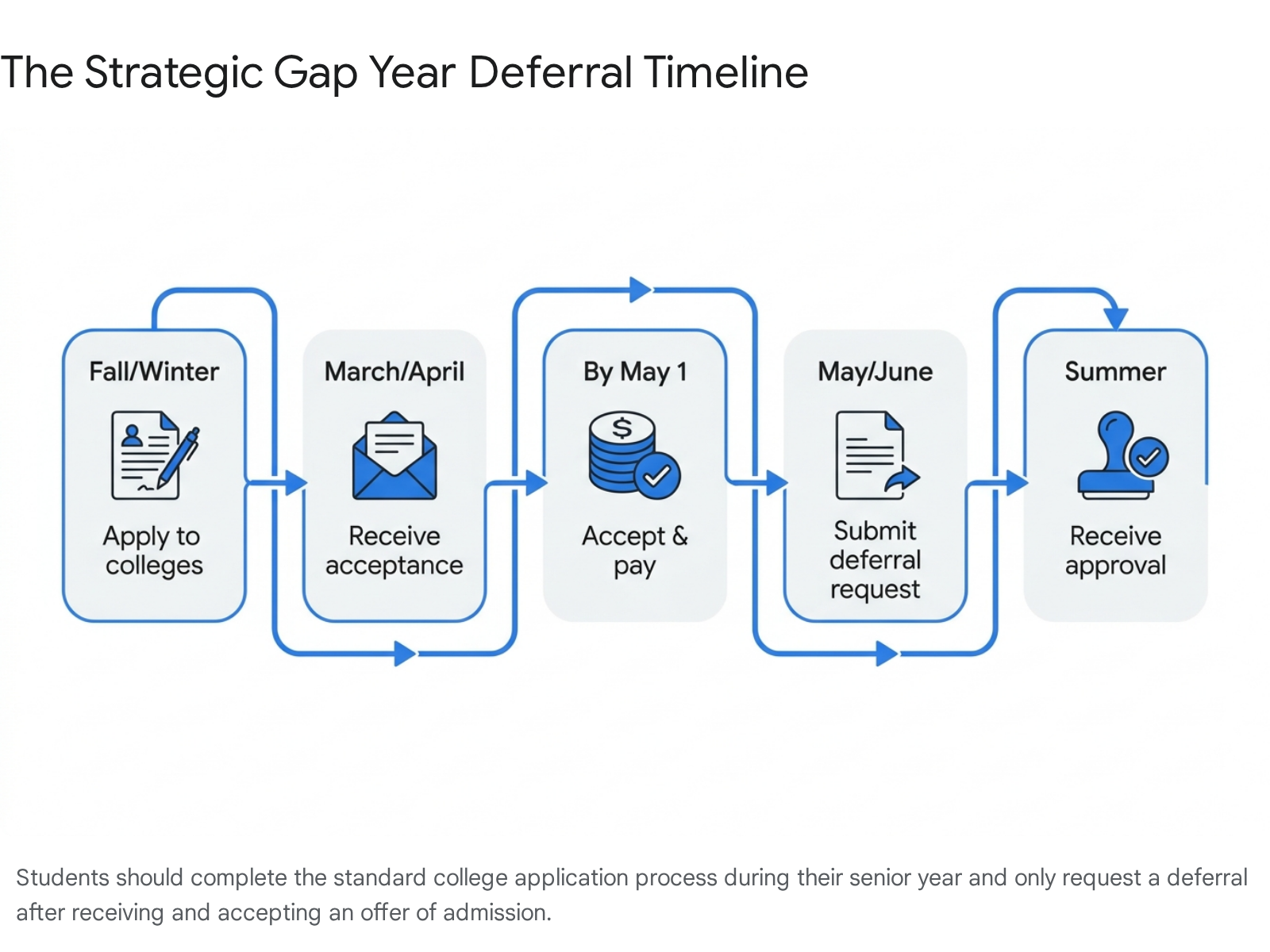
The consensus among educational consultants is that high school seniors should complete their college applications during their senior year, even if they are entirely certain they want to take a gap year 3321.
Applying during senior year provides several structural advantages. The student has immediate, in-person access to high school guidance counselors, teachers for letters of recommendation, and official transcript processing 3321. Furthermore, participating in the application cycle alongside peers provides crucial momentum. Once accepted, the student selects their preferred college, pays the standard enrollment deposit by May 1st, and only then submits a formal request for "deferred admission" 263321. This locks in their spot in the freshman class for the following year, allowing them to embark on their gap year with the security of knowing their post-gap plans are solidified 3322.
Navigating University-Specific Deferral Policies
Not all universities view gap years favorably, and policies vary widely depending on the institution's enrollment goals and prestige.
Ivy League and highly selective private institutions generally champion the gap year. Harvard, Princeton, MIT, and Yale actively encourage admitted students to take purposeful time off and routinely approve one-year deferral requests, provided the student submits a structured plan and explicitly agrees not to enroll elsewhere 262723.
Public university systems exhibit far more variance. The University of Michigan typically grants one-year deferrals for unique opportunities or military service, requiring the student to submit a formal request and enrollment deposit 26. Conversely, the University of California (UC) system (including UC Berkeley and UCLA) and the University of Texas at Austin generally do not allow gap year deferrals; students wishing to take a year off must forfeit their acceptance and reapply from scratch the following year 2623.
When writing a deferral request to the admissions office, students must avoid vague aspirations like "finding myself." Admissions committees look for concrete itineraries, including specific programs, employment dates, volunteer commitments, and a clear articulation of how the year connects to their long-term academic goals 262723.
Crucially, virtually every university enforces a strict rule: a deferred student cannot enroll in credit-bearing courses at another institution (such as a local community college) during their gap year. Doing so strips the student of their deferred freshman status, voids their admission, and forces them to reapply as a transfer student 26273324.
Financial Implications: FAFSA, Tuition, and Scholarships
Understanding the intersection of a gap year and college finances is complex but vital. Mismanaging the financial aid timeline can result in the loss of thousands of dollars in federal and institutional support.
FAFSA Timing and Federal Aid Rules
Federal financial aid does not apply to the gap year itself; it is designed strictly for enrolled, degree-seeking college students 2539. Taking a gap year does not disqualify a student from receiving federal aid in the future, nor does it impact their lifetime limits for federal student loans 394026.
However, students must reapply for the Free Application for Federal Student Aid (FAFSA) for the specific academic year they plan to attend college 392728. If a student graduates high school in 2025 and takes a gap year during the 2025-2026 school year, they do not need to fill out the FAFSA for that period 44. Instead, they will file the 2026-2027 FAFSA to secure aid for their freshman year in Fall 2026 272844. For the 2026-2027 cycle, the FAFSA is scheduled to open earlier, on September 24, 2025, utilizing the Direct Data Exchange (DDX) system to import tax information automatically from the IRS 45.
Because the FAFSA relies on tax data from two years prior (e.g., the 2026-2027 FAFSA uses 2024 tax data), a family's financial profile can change during a gap year 28. The new formula relies on the Student Aid Index (SAI) - which replaced the Expected Family Contribution (EFC) and can drop as low as negative $1,500 28. If a student works full-time during their gap year and earns significant taxable income, or if the parents' financial situation improves markedly, the student's SAI could increase, potentially reducing their eligibility for need-based federal grants like the Pell Grant when they eventually enroll 392729. Furthermore, if a student qualifies for Federal Work-Study, they cannot defer that specific job offer; they must re-qualify through the FAFSA upon their return, and positions are subject to campus availability 3926.
Deferring Institutional Aid and Navigating Rising Costs
While federal aid formulas are rigid, institutional aid (grants and scholarships provided directly by the university) is handled entirely at the school's discretion.
If a student is awarded a merit-based scholarship upon admission, most private universities will defer that scholarship alongside the admission offer, provided the student maintains the terms of their deferral agreement 2628. However, university policies are strictly enforced. Duke University, for example, dictates that university scholarships cannot exceed the total cost of attendance, and any outside scholarships won during a gap year must be reported, which will first reduce the student's loan and work-study burden before reducing institutional grants 3031.
The landscape for institutional aid is also shifting due to broader legal and economic changes. Following the 2023 US Supreme Court decision in Students for Fair Admissions v. UNC, universities receiving federal funds can no longer utilize race-conscious admissions or race-based scholarships 3250. At least 13 flagship public universities have since eliminated race-conscious scholarships worth millions of dollars, removing a layer of financial support that underrepresented students previously relied upon to fund their education 50. This places increased pressure on low-income and minority students taking gap years to secure funding strictly through need-based or merit avenues.
Additionally, deferring college means deferring tuition payments to a future academic year, subjecting families to tuition inflation. Between the 2024 and 2025 academic years, the average published "sticker price" for private, four-year universities rose 4% to $45,000, while public in-state tuition rose 2.9% to $11,950 5152. While massive legislative changes like the One Big Beautiful Bill Act (OBBBA) are set to alter borrowing limits and eliminate the Grad PLUS loan program by July 2026, undergraduate families must account for paying slightly higher tuition rates when their student finally steps on campus 33.
Grants and Scholarships for Gap Year Programs
To combat the high costs of experiential gap years, several organizations offer substantial scholarships and grants designed explicitly to help low-income and underrepresented students afford time off.
| Scholarship / Grant Program | Target Demographic / Eligibility | Typical Award Amount |
|---|---|---|
| Benjamin A. Gilman International Scholarship | US undergraduate students with limited financial means (Pell Grant eligible) looking to study or intern abroad 54. | Up to $5,000 54. |
| Carpe Diem Education Access & Inclusion Scholarships | Students pursuing Carpe Diem programs; preference given to Pell Grant eligible students, first-generation students, and BIPOC applicants 555657. | $1,000 to $5,000 5557. |
| ARCC Voyagers Scholarship | Students identifying within the BIPOC community participating in an ARCC gap program; includes mentorship and gear lending 5534. | $5,000 to $8,000 55. |
| Verto Education Opportunity Grant | Incoming Verto students with demonstrated financial need based on their Expected Family Contribution/SAI via the FAFSA 55. | Up to $15,000 tuition reduction 55. |
| CIEE Gap Year Abroad Scholarships | Students participating in CIEE programs; evaluated based on a combination of academic merit and demonstrated financial need 5657. | $500 merit awards plus larger need-based aid 56. |
Bottom line
Taking a gap year is a highly effective strategy to combat academic burnout, build emotional resilience, and gain early-career clarity before investing heavily in a college degree. While the risks of derailed momentum and the high costs of structured travel programs are genuine concerns, they can be mitigated by applying to college during senior year, securing formal university deferrals, and utilizing fully funded service options like AmeriCorps. Ultimately, a well-planned gap year leaves a student sharper, more self-aware, and better equipped to succeed in higher education, provided the time is spent with intentionality rather than idle drift.