
How AP, IB, and Honors Classes Affect Admissions
Admissions officers view course rigor as a foundational metric, assessing whether applicants actively challenged themselves with the most demanding academic pathways available at their specific high schools. While highly selective universities typically prefer the standardized curricula of Advanced Placement (AP) and International Baccalaureate (IB) programs, large public institutions often view Dual Enrollment as an equally rigorous and highly practical route to earning college credit. Ultimately, universities evaluate academic choices contextually, meaning students should focus on maintaining strong grades in a balanced, challenging schedule rather than stockpiling advanced courses to the point of severe burnout.
The Foundation of College Readiness
The landscape of higher education admissions is undergoing a period of profound transformation. Amid fluctuating standardized testing policies, historically high application volumes, and the aftermath of the Supreme Court's decision on affirmative action, admissions committees are aggressively searching for reliable indicators of student success. In this volatile and highly competitive environment, a student's high school transcript - specifically the grades earned and the academic rigor of the courses taken - remains the undisputed anchor of the holistic evaluation process.
According to the National Association for College Admission Counseling (NACAC), performance in core academic classes is the most significant factor in college admissions across the United States. Recent survey data underscores this reality: 77% of institutions attribute "considerable importance" to grades in college-preparatory courses, and 74% place the same weight on overall high school grades 12. Similarly, the strength of a student's curriculum is deemed considerably important by 64% of colleges 1. To put these numbers into perspective, subjective factors like application essays and demonstrated interest were considered highly important by only 19% and 16% of institutions, respectively, while standardized test scores (during the height of the test-optional era) registered at just 5% 12.
Course rigor is not simply a matter of accumulating difficult classes to impress evaluators; rather, it serves as a demonstrated proxy for long-term college readiness. Universities want to admit students who are likely to succeed academically, graduate on time, and contribute meaningfully to the intellectual environment of their campus. Taking advanced coursework shows initiative, intellectual curiosity, and an appetite for a faster pace and higher academic expectations 34. However, "advanced coursework" is a broad umbrella that encompasses several distinct educational pathways. Understanding the structural differences between Advanced Placement, International Baccalaureate, Dual Enrollment, and Honors classes is essential for navigating the admissions landscape successfully.
AP, IB, Dual Enrollment, and Honors: Structural Differences
High schools across the United States utilize different frameworks to provide advanced academics to their students. While all of these programs generally offer a "weighted" GPA boost at the high school level and signal academic ambition, they differ significantly in their curricula, standardization, and ability to generate college credit.
Advanced Placement (AP)
The Advanced Placement program, administered globally by the College Board, is the most universally recognized advanced curriculum in the United States 51. AP courses are designed explicitly to mimic introductory college-level material within a traditional high school setting 57. Currently, there are 38 AP courses available across a wide variety of disciplines, though very few high schools offer the entire catalog 8.
The defining characteristic of the AP program is its rigorous national standardization. Regardless of whether a student attends an elite private preparatory academy or an underfunded rural public school, the AP curriculum for a specific subject remains identical 19. At the end of the academic year in May, students sit for a standardized, nationally administered exam scored on a scale of 1 to 5 72.
Because the exams are normed and graded by independent readers, AP scores serve as a highly reliable, objective metric for admissions officers. A score of 3 is generally considered passing, and according to the College Board, nearly 2 million students achieved a score of 3 or higher on at least one AP Exam in 2024 2. However, many highly selective universities only award college credit or advanced standing for scores of 4 or 5 72. Even if a student does not achieve a top score on the exam, the mere act of taking the rigorous course and earning a strong classroom grade is viewed favorably in the admissions process, as it demonstrates a willingness to engage with challenging material 35.
International Baccalaureate (IB)
The International Baccalaureate is a globally recognized, comprehensive academic framework heavily focused on critical thinking, global citizenship, and deep research skills 211. Unlike the "a la carte" approach of the AP program - where students can pick and choose individual subjects based on their specific strengths - the IB program is traditionally pursued as a cohesive, highly structured two-year diploma during a student's junior and senior years 9.
The IB Diploma Programme requires students to take intensive courses across six subject groups. Furthermore, students must complete an independent research project known as the Extended Essay, engage in the philosophical Theory of Knowledge (TOK) course, and participate in Creativity, Activity, Service (CAS) projects. IB exams are graded on a scale of 1 to 7 11. A total IB score of 38 out of 45 places a student in the top 10-15% globally, equivalent to an unweighted GPA of roughly 3.7 to 3.8. However, Ivy League institutions and their highly selective peers typically look for IB scores in the 40-42 range 11.
Elite admissions committees view AP and IB curricula with equal reverence. There is no inherent preference between the two programs; rather, universities deeply value the student's willingness to engage with the most challenging standardized curriculum their specific high school offers 9.
Dual Enrollment (DE)
Dual Enrollment - often referred to as Dual Credit or Postsecondary Enrollment Options - allows high school students to take actual college classes and earn both high school and college credit simultaneously 57. These courses are facilitated through articulation agreements and partnerships between high schools and accredited tertiary institutions, typically local community colleges or regional state universities 12.
Dual enrollment has seen explosive, unprecedented growth over the last decade. In the 2022 - 2023 academic year, an estimated 2.5 million high school students participated in DE programs, a number projected to reach 2.8 million for the 2024-2025 school year 3. Unlike AP and IB classes, where the awarding of college credit hinges almost entirely on a single high-stakes standardized exam at the end of the academic year, Dual Enrollment credit is earned simply by passing the class itself with a satisfactory grade, usually a C or higher 512.
While DE offers an authentic college classroom experience and guaranteed credit at participating partner institutions, its lack of national standardization complicates its evaluation in elite, out-of-state admissions 92.
Honors Courses
Honors classes offer a more intensive, rigorous study of standard high school subjects, typically requiring deeper analysis, more complex long-term projects, and a significantly faster pace than standard regular classes 7. They follow a locally designed curriculum established by high school faculty rather than a national or global standard 7. While highly valued by admissions officers as a clear sign of academic ambition, Honors courses are generally viewed as a tier below AP, IB, and Dual Enrollment in terms of absolute rigor, primarily because they do not culminate in college credit and are not externally vetted for college-level equivalency 7.
Comparative Summary of Course Types
To clarify the structural distinctions between these academic pathways, the following table summarizes their credit models, curriculum origins, and general perception in competitive college admissions.
| Feature | Advanced Placement (AP) | International Baccalaureate (IB) | Dual Enrollment (DE) | Honors Courses |
|---|---|---|---|---|
| Curriculum Origin | College Board (National/Standardized) | IB Organization (Global/Standardized) | Partnering College/University (Local/Variable) | High School Faculty (Local/Variable) |
| College Credit Basis | Standardized Exam Score (Usually 4 or 5) | Standardized Exam Score (Usually 5, 6, or 7) | Final Course Grade (Usually C or higher) | None (High school credit only) |
| Course Structure | A la carte; single-subject focus | Comprehensive two-year diploma or individual certificates | Semester-based college courses | Year-long high school courses |
| Rigor Perception (Elite Colleges) | Highest Tier | Highest Tier | High, but highly variable depending on standardization | Moderate to High |
| Best Suited For... | Students with subject-specific strengths; out-of-state admissions | Holistic thinkers, strong writers; international university applicants | Guaranteed in-state college credit; exposure to actual college pacing | Foundational preparation prior to taking AP/IB/DE courses |
How Admissions Officers Evaluate Course Rigor
A common and pervasive anxiety among high school students is the fear of being severely penalized for not taking 10 to 15 AP classes, especially if their school only offers a handful of advanced options. This anxiety stems from a fundamental misunderstanding of how applications are actually read and processed. Admissions officers do not evaluate course rigor in a vacuum; they evaluate it strictly and exclusively within the context of the specific high school the applicant attends 37.
The Critical Role of the School Profile
When an application is submitted via platforms like the Common App, it is accompanied by a vital document known as the "School Profile," provided directly by the high school guidance counselor. This profile details the demographic makeup of the school, its unique grading scale, and, most importantly, a complete list of every advanced course offered to the student body.
If a student attends a well-resourced suburban high school that offers 25 AP courses and they choose to take only two, admissions officers at competitive universities will likely view that schedule as significantly lacking in rigor 713. Conversely, if a student attends an underfunded rural public school that offers zero AP courses, they cannot and will not be penalized for not taking them. If that student exhausts the highest level of Honors classes available or seeks out local Dual Enrollment options at a nearby community college, they will be viewed as having maximized their educational opportunities and will receive the highest possible rigor rating 37.
The Internal Rigor Rating System
Behind closed doors, highly selective universities often use an internal numerical scale to rapidly quantify an applicant's curriculum strength during the initial file read. For example, a common scale utilized by admissions committees ranges from 1 to 5: * 1 - Less than Demanding * 2 - Somewhat Demanding * 3 - Demanding * 4 - Very Demanding * 5 - Most Demanding
To earn a "Most Demanding" rating, a student's course load must generally be on par with the highest-achieving peers in their specific high school context 13. Former admissions officers note that taking the "most demanding" curriculum is often a strict baseline requirement for simply surviving the first round of review at top-20 universities 1314. If a school caps the number of APs a student can take (for example, prohibiting freshmen from taking advanced courses), admissions officers are made aware of this via the School Profile and adjust their expectations accordingly 13.
Specialized Contextual Reviews
Public university systems also employ highly structured contextual evaluations. The University of California (UC) system utilizes a specialized process called "Augmented Review" for applicants who demonstrate strong academic potential but present unusual circumstances, such as significant educational barriers, personal hardships, or a lack of traditional academic resources 4. In these reviews, course rigor is heavily scrutinized to determine how creatively students challenged themselves beyond the minimum UC "A-G" subject requirements, even if their high schools lacked extensive traditional AP offerings 45.
Furthermore, the UC system actively incentivizes dual enrollment. UC-transferable Dual Enrollment courses earn an extra "honors point" in the UC first-year admission GPA calculation (up to a maximum limit), provided the courses are completed with a letter grade of C or better 5.
The Great Debate: AP vs. Dual Enrollment
As Dual Enrollment programs continue their explosive expansion across the country, students and parents are increasingly caught between choosing AP classes or local college courses. The strategic decision ultimately depends on the student's post-secondary goals, as different tiers of universities view these pathways through vastly different lenses.
The Perspective of Highly Selective and Ivy League Institutions
For students targeting the Ivy League (e.g., Yale, Harvard, Princeton) and highly selective private universities (e.g., Stanford, MIT, UChicago), Advanced Placement and International Baccalaureate courses are generally highly preferred over Dual Enrollment 9217.
The primary reason for this preference is standardization 9. An admissions officer sitting in New Haven or Palo Alto knows exactly what material is covered in an AP Chemistry class and what a score of 5 on the standardized exam represents regarding mastery, regardless of whether the student lives in Connecticut, Alabama, or Uruguay 9.
Dual Enrollment courses, however, completely lack this national quality control. A psychology or linear algebra course taken at a highly regarded state flagship university may be incredibly rigorous, while an online "History of Rock and Roll" class taken at an under-resourced community college may be substantially less demanding than a standard high school class 121819. Because admissions officers cannot confidently vet the individual syllabus, professor quality, or grading standards of every community college in the country, they often view DE courses with much more caution when assessing a student's ultimate academic horsepower 92.
Furthermore, Ivy League institutions are notoriously strict about transfer credits. They rarely allow dual enrollment courses to count toward their graduation requirements, preferring that students take their proprietary introductory courses upon enrollment 4206.
The Perspective of State Flagships and Public Universities
Conversely, large public universities and state flagships (such as the University of Michigan, UNC-Chapel Hill, or the University of Georgia) highly value Dual Enrollment, often treating it equivalently to AP courses in their comprehensive rigor evaluations 22237.
For example, at the University of North Carolina at Chapel Hill, admissions officers clearly indicate that AP, IB, and Dual Enrollment are all viewed as rigorous pathways that improve a student's standing in the holistic review process 2225. Data from enrolling first-year students at UNC shows that 75% sought college credit for AP/IB courses, while a massive 57% sought credit for dual enrollment courses 25. Similarly, the University of Michigan, which admits roughly 15.6% of applicants, rates the "Rigor of Secondary School Record" as a "Very Important" admission factor and evaluates DE credits generously within the context of what a student's high school allowed 2627.
However, weighting policies vary wildly by district and university. Some universities, like the University of Georgia, specifically recalculate high school GPAs to strip away dual enrollment weighting while retaining the extra points for AP or IB courses 187. Despite these localized quirks, for students planning to attend a public university within their home state, Dual Enrollment is often the superior strategic choice. The credits are almost always guaranteed to transfer seamlessly through codified state articulation agreements, saving families thousands of dollars in tuition and allowing students to graduate early or pursue dual degrees with greater ease 5319.
The Myth of "More is Better": Diminishing Returns and Burnout
A pervasive and damaging myth in modern college admissions is the belief that there is an infinite, linear relationship between the number of AP classes taken and the probability of acceptance. This misconception drives extreme scheduling behaviors, with some high school students attempting to juggle 12 to 17 AP classes over four years simply to appear competitive to elite institutions 1320.
Current higher education research completely refutes this approach. Admissions data demonstrates a clear point of "diminishing returns" regarding advanced coursework, proving that quality and performance easily trump sheer quantity.
Quantifying the Plateau
A comprehensive study originating from New York University, frequently cited by university enrollment managers, investigated the exact correlation between the volume of AP classes taken and long-term academic success in college. The research concluded that the benefits of taking AP classes plateaued significantly after a student completed four to six courses 8.
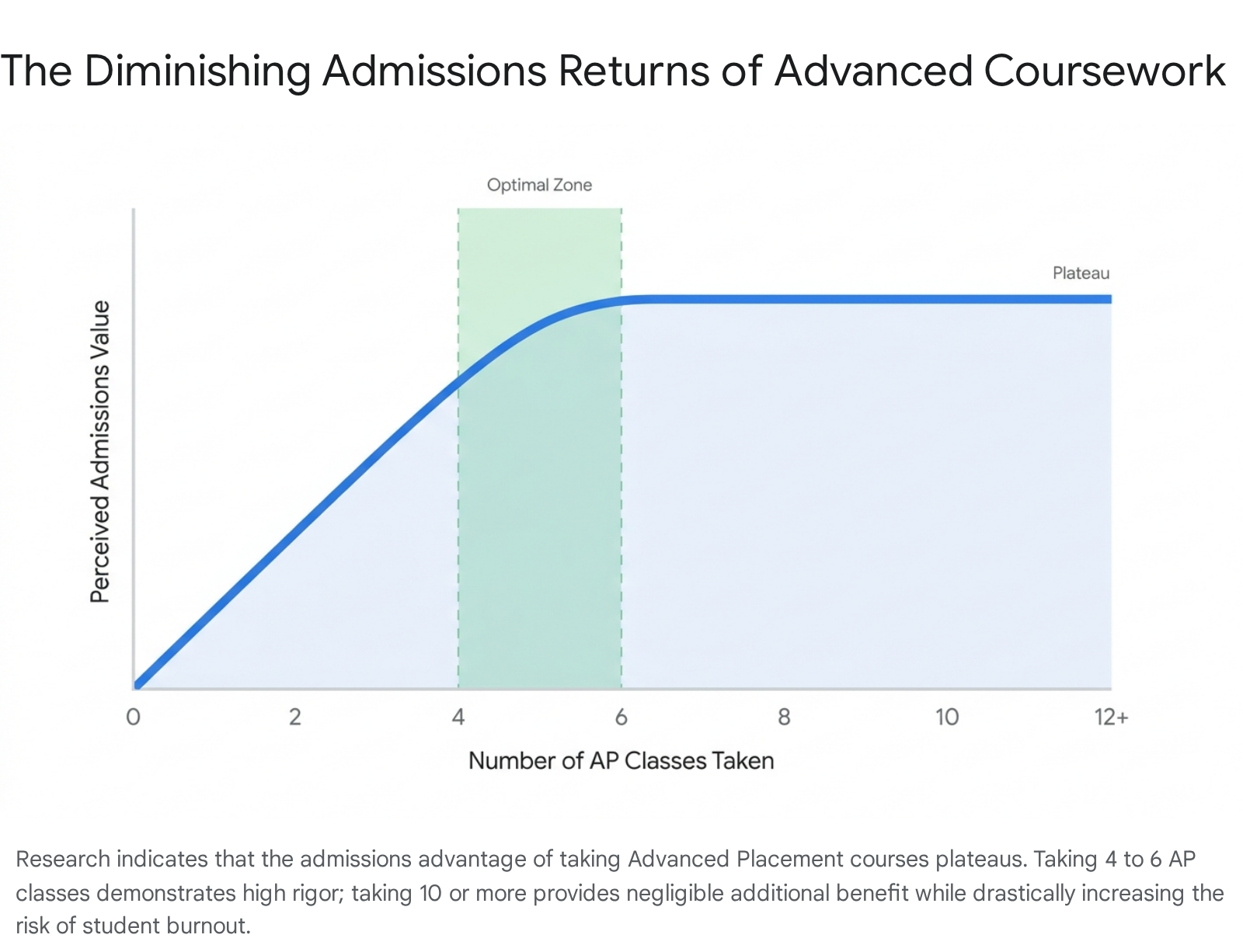
Beyond that threshold, additional AP classes had a negligible impact on college acceptance rates and did not reliably predict higher college GPAs or improved graduation rates 88.
Independent college counselors and former admissions officers heavily echo this data. Once a student successfully completes roughly 6 to 8 AP courses (and assuming they score well on the corresponding exams), they have thoroughly and undeniably proven their ability to handle college-level academic rigor 829. Taking an 11th or 12th AP class instead of engaging in meaningful extracurricular activities, leadership roles, part-time work, or personal hobbies can actually make an application look heavily one-dimensional and less appealing to holistic review committees 814. As admissions officers routinely note, achieving a C in an advanced course significantly hurts an application more than taking a standard course and securing an A 14.
The Student Burnout Epidemic
The immense societal pressure to stockpile advanced classes has contributed to a severe mental health crisis among high-achieving adolescents. Academic burnout - clinically characterized by emotional exhaustion, chronic cynicism toward learning, and a diminished sense of personal accomplishment - is rampant in competitive high schools 910.
A large-scale 2021 study involving over 33,000 students found that more than half experienced clinical anxiety or depression, with 83% stating unequivocally that their mental health negatively impacted their academic performance 32. Unhealthy lifestyle behaviors heavily linked to academic overload, such as severe sleep deprivation and poor nutrition, further compound these issues 9. When students overload their schedules with AP or IB classes merely to appease perceived Ivy League admissions standards, they frequently suffer from cognitive overload, leading to a paradoxical drop in their overall GPA and a complete loss of intellectual curiosity 1033.
In direct response to this wellness crisis, some progressive universities are formally altering their evaluation metrics. For example, Texas Christian University (TCU) intentionally updated its curriculum rigor requirements to explicitly cap the maximum rigor score a student can achieve. Students who successfully complete four to six AP courses receive the highest possible curriculum rating in TCU's internal system. Taking more than six courses provides absolutely no additional admissions points, a policy intentionally designed to eliminate excessive achievement pressure and promote overall student well-being 8.
Admissions Case Studies: How Specific Universities Evaluate Rigor
To fully grasp how course rigor affects admissions, it is highly instructive to examine the specific, stated policies of varied institutions, ranging from state flagships to the Ivy League.
University of Michigan
As one of the nation's premier public research universities, the University of Michigan is exceptionally competitive, accepting roughly 15.6% of applicants 2734. The average high school GPA of enrolling freshmen is a staggering 3.9, with approximately 39% of students boasting a perfect 4.0 34. Michigan uses a holistic review process but explicitly rates the "Rigor of Secondary School Record" and "Academic GPA" as "Very Important" on its Common Data Set 2627. Standardized test scores, essays, and recommendations are rated a tier below as "Important" 27. Michigan looks closely at both AP and Dual Enrollment pathways, advising students to take the most challenging classes available that align with their intended major 34.
UNC-Chapel Hill
The University of North Carolina at Chapel Hill also prioritizes rigor and class rank. The large majority of students who submit class rank come from the top 10% of their graduating class 25. UNC treats AP, IB, and Dual Enrollment largely interchangeably regarding rigor assessment, acknowledging that rural students may have more access to DE than AP 2335. The university has conducted internal research indicating that a specific number of rigorous courses correlates directly with better graduation outcomes, meaning they prioritize the number of hard courses attempted over simply protecting a 4.0 GPA with easy classes 35.
Yale University and the Ivy League
At Ivy League institutions like Yale, which routinely sees acceptance rates hover around 4%, the high school transcript is heavily scrutinized. Admissions officers at Yale explicitly state that the transcript is "the single most important document" in the entire application 36. In their holistic review, the rigor of the secondary record is designated as "Very Important" 36. While Yale is "test-flexible," meaning they accept advanced test evidence (like AP or IB scores) in lieu of or alongside the SAT/ACT, they overwhelmingly prefer students to max out their high school's AP or IB offerings 36. Dual enrollment is viewed with a more critical eye, as Ivy League schools generally want students taking their proprietary introductory courses and rarely accept DE transfer credits 49.
| Institution | Acceptance Rate | Course Rigor Rating | Preferred Advanced Pathways | Transfer Credit Policy |
|---|---|---|---|---|
| Yale University | ~4% | "Very Important" | AP, IB (Highest preference) | Highly restrictive; rarely accepts DE |
| Univ. of Michigan | ~15.6% | "Very Important" | AP, IB, Dual Enrollment | Generous, depending on the college |
| UNC-Chapel Hill | ~17% (varies by residency) | "Very Important" | AP, IB, Dual Enrollment | Generous; accepts extensive DE credits |
| UC System (General) | Varies by campus | "Very Important" | AP, IB, UC-approved DE | Generous; +1 GPA bump for DE/AP |
Equity, Access, and Post-Affirmative Action Dynamics
The national conversation surrounding course rigor cannot be divorced from the harsh realities of educational inequity in the United States. Access to advanced coursework is heavily dictated by localized school funding, district resources, and geography, meaning the playing field is far from level.
Data reveals stark, systemic disparities in advanced course availability. According to educational policy research, 83% of Asian students and 64% of White students attend high schools with a high availability of AP classes. In sharp contrast, only 56% of Black students and a similarly lower percentage of Latino and Indigenous students have access to the same volume of advanced coursework 11. Because academic rigor is the most heavily weighted factor in college admissions, these structural deficits make it disproportionately difficult for underrepresented minority students to demonstrate their academic capacity on paper to elite universities 11.
The Impact of SFFA v. Harvard
In June 2023, the U.S. Supreme Court struck down the use of race-based affirmative action in college admissions in the landmark Students for Fair Admissions (SFFA) ruling 1213. Without the ability to explicitly consider race as a demographic factor to build a diverse class, universities are relying even more heavily on quantifiable academic metrics - like course rigor, socioeconomic indicators, and GPA - to shape their incoming classes 13.
To maintain campus diversity without running afoul of the law, universities are actively expanding their contextual review models. Admissions offices are scrutinizing the School Profiles of under-resourced schools more closely than ever to ensure students are not implicitly penalized for systemic lacks of AP offerings 3. Furthermore, many top-tier universities are actively expanding recruitment pipelines into community colleges, explicitly recognizing that many high-achieving, low-income students utilize Dual Enrollment as a primary mechanism for upward mobility and affordability 12. Federal reporting requirements have also expanded, forcing colleges to rigorously track socioeconomic data, Pell grant eligibility, and high school GPA outcomes to ensure equitable access 14.
2024 - 2025 Application Trends: The "Application Inflation" Era
The strategic choices students make regarding course rigor must be viewed against the chaotic backdrop of the current admissions climate, which is heavily characterized by hyper-competition, the integration of Artificial Intelligence, and severe "application inflation."
Data from the Common Application for the 2024 - 2025 cycle reveals record-breaking application volume. More than 1.49 million distinct applicants submitted over 10 million total applications, representing an 8% increase in overall volume from the previous year, and crossing the 10 million threshold for the first time in history 154316. The average high school student now applies to 6.8 colleges, a number that has steadily crept upward over the last decade as students anxiously try to hedge their bets against plummeting acceptance rates 154345.
As acceptance rates at prestigious universities drop into the low single digits, high course rigor has fully transitioned from being a "differentiating factor" to a mandatory "table stakes" requirement 3645. It is simply the metric that keeps an application in the consideration pile during the initial rounds of review. However, once the baseline of a "Demanding" or "Most Demanding" curriculum is established, admissions committees turn heavily to extracurricular depth, leadership, and positive character attributes to make their final, highly nuanced decisions 24546.
The Rebound of Standardized Testing
Another notable trend impacting how rigor is evaluated is the strong resurgence of standardized testing. While many schools remain officially test-optional, the number of Common App users actively submitting SAT or ACT scores jumped by 11% in the recent cycle, while non-submitters decreased 4547. In a landscape currently suffering from widespread, systemic grade inflation - where nearly 40% of enrolled freshmen at institutions like the University of Michigan boast a flawless 4.0 GPA - the combination of high AP/IB exam scores and strong standardized test results serves to independently validate a student's transcript 3446. Without test scores, admissions officers lean entirely on course rigor to judge academic capability, making the choice to take AP or Dual Enrollment classes more critical for test-optional applicants 48.
Bottom line
Course rigor is the undisputed cornerstone of modern college admissions, heavily dictating a student's baseline competitiveness at four-year universities. Advanced Placement and International Baccalaureate programs remain the established gold standard for highly selective, out-of-state universities due to their rigorous, heavily standardized nature. However, Dual Enrollment provides an incredibly valuable, cost-effective pathway that is equally respected by state flagships and often guarantees transferable college credit. Above all, students must remember that colleges evaluate rigor strictly within the context of what a specific high school offers, and taking more than five to eight advanced courses yields stark diminishing returns that rarely justify the severe risks of academic burnout. The ultimate strategy is not to take every difficult class available, but to excel in a thoughtfully selected, challenging curriculum while preserving the time and energy necessary for meaningful extracurriculars and personal well-being.