
Will AI Cause Mass Unemployment? 4 Scenarios
Artificial intelligence will not inevitably cause mass unemployment, but it will fundamentally reshape the global labor market by automating routine tasks and creating new, highly specialized roles. While clerical and entry-level positions face significant immediate displacement risks, proactive workforce reskilling can transition the global economy into a highly productive "co-pilot" era characterized by higher wages and robust economic growth.
The Automation Reality: Tasks vs. Jobs
Whenever a disruptive technology enters the workplace, the immediate societal reaction is a fear of mass obsolescence. To understand what artificial intelligence (AI) will actually do to the labor market, it is essential to distinguish between the automation of tasks and the elimination of jobs.
Most jobs consist of dozens of distinct tasks. Generative AI, in its current state, is highly capable of automating specific, routine cognitive tasks - such as drafting a standard email, summarizing a legal document, or generating foundational code - but it struggles to replace the entirety of a job's responsibilities 112. The progression of AI task replacement typically moves from lower intelligences to higher ones: it masters mechanical and analytical tasks first, while struggling with intuitive and empathetic intelligence 1. As a result, roles that require complex problem-solving, physical navigation, or deep human empathy are insulated from full replacement.
The Substitution-Reinstatement Spectrum
Labor economists frame the impact of technology on employment through a dynamic model of substitution and reinstatement. Advanced by researchers such as Daron Acemoglu and Pascual Restrepo, this framework suggests that the net impact of AI on employment depends on three primary channels 356:
- The Displacement (Substitution) Effect: AI systems replace human labor in previously human-performed tasks, reducing demand for workers in those specific roles 37.
- The Productivity Effect: Automation lowers costs and increases overall productivity. If firms use these gains to expand production or lower prices, it increases aggregate demand in the economy, thereby raising the demand for labor in non-automated tasks 674.
- The Reinstatement Effect: Technological innovations create entirely new tasks and occupations that did not previously exist, expanding the set of opportunities where humans maintain a comparative advantage 379.
However, generative AI introduces a novel wrinkle. Unlike physical robots or traditional software that targeted manual labor, AI targets non-routine cognitive tasks - such as writing, analysis, and design - which were traditionally considered complements rather than substitutes to skilled labor 3. If the new tasks created by AI require highly specialized skills or capital-intensive infrastructure, the transition could lead to job polarization and severe wage inequality 356.
Historical Analogies: The Spreadsheet and the ATM
History is replete with "replacing technologies" that ultimately acted as "enabling technologies." Two historical analogies are frequently cited to explain the current AI paradigm and the reinstatement effect in action:
The Great Spreadsheet Scare of 1987: When digital spreadsheets like VisiCalc and Microsoft Excel were introduced to personal computers, headlines warned of a white-collar collapse in accounting. Between 1980 and 2000, more than 400,000 accounting clerk and typist jobs did indeed disappear in the United States 10. However, because software made financial modeling vastly cheaper and faster, the demand for complex data analysis exploded. During that same period, the number of actual accountants rose by 15%, and the number of financial managers and analysts surged from 600,000 to 1.5 million 1011. The economy traded manual data entry for strategic data analysis.
The ATM Paradox: When automated teller machines (ATMs) were deployed globally, experts predicted the death of the bank teller. Instead, the number of tellers increased steadily between 1980 and 2010 1112. Because ATMs made it significantly cheaper to operate an individual bank branch, banks opened many more branches. While the number of tellers per branch fell from 20 in 1988 to 13 by 2004, the massive expansion in total branches - fueled in part by deregulation in 1994 - resulted in a net increase in human headcount 12. The teller's job transitioned from simply dispensing cash to building customer relationships and selling complex financial products like loans and credit cards 11.
| Historical Technology | Primary Function Automated | Jobs Decreased | Jobs Increased | Net Result |
|---|---|---|---|---|
| Spreadsheets (1980s) | Manual arithmetic, ledger balancing | Bookkeepers, typists, clerical workers | Financial analysts, accountants, strategists | Traded arithmetic for analysis; higher net employment. |
| ATMs (1980s-2000s) | Cash dispensing, basic deposits | Cashiers per branch | Relationship managers, total branches | Traded cash handling for customer service; higher net employment. |
| Generative AI (2020s) | Drafting, summarizing, basic coding, data retrieval | Administrative assistants, basic customer service, entry-level coders | AI orchestrators, prompt engineers, strategic advisors | Currently unfolding; high potential for task augmentation but high risk for entry-level displacement. |
What Does the Latest Data Say About AI Job Displacement?
The statistics surrounding AI's impact on employment are often presented as contradictory, largely because different economic models measure different time horizons and task classifications. However, a consensus is emerging across major global institutions: the immediate future will be characterized by massive job churn, but ultimately positive net job creation.
Projections of Job Churn and Creation
The World Economic Forum (WEF), in its Future of Jobs Report 2025, estimates that by 2030, macrotrends (led heavily by AI and automation) will displace roughly 92 million existing roles globally 5678. However, these same technological advancements are projected to create 170 million new jobs - resulting in a net gain of 78 million jobs worldwide 679.
A Goldman Sachs analysis provides a slightly different lens, estimating that 300 million full-time jobs globally are exposed to AI automation 1810. However, the firm notes that this exposure will mostly lead to role reshaping rather than outright elimination. In the United States, if AI adoption takes place gradually over a decade, Goldman Sachs expects to see only a 0.6 percentage point increase in the unemployment rate, while driving significant growth in power and data center infrastructure jobs 10.
The Boston Consulting Group (BCG) offers a granular microeconomic assessment. BCG forecasts that over the next two to three years, 50% to 55% of jobs in the U.S. will be fundamentally reshaped by AI 11. This means employees will retain their roles but face radically new expectations for how they work. BCG anticipates that full substitution of human jobs by AI will be slower, estimating that 10% to 15% of U.S. jobs could be eliminated over a five-year horizon or longer 1112.
The Productivity and Wage Premium
For workers who successfully integrate AI into their workflows, the economic benefits are striking. According to PwC's 2025 Global AI Jobs Barometer, which analyzed nearly a billion job advertisements across six continents, sectors with high AI exposure are experiencing a boom in productivity 1314. Revenue per employee in these highly exposed industries has grown three times faster than in less-exposed industries since the widespread launch of generative AI in late 2022 613.
Furthermore, AI is not depressing wages for those who wield it. PwC found that wages are rising twice as fast in the most AI-exposed industries compared to those least exposed 613. Most notably, workers who possess specific AI skills - such as prompt engineering or machine learning integration - command a staggering 56% wage premium compared to peers in the exact same occupations without those skills, up from a 25% premium the previous year 513. The skills required for AI-exposed jobs are also changing 66% faster than for other jobs, indicating a rapid evolution in daily workflows 13.
Who Is Most at Risk? The Demographic and Geographic Divide
While the macroeconomic picture points to growth, the transition will be highly disruptive for specific demographics. The International Labour Organization (ILO) released a refined 2025 global index of occupational exposure to generative AI, incorporating task-level data across nearly 30,000 tasks 215. The ILO found that one in four workers worldwide (about 25%) are in occupations with some degree of generative AI exposure 1516.
The Gender Disparity in Automation
The most acute risk is concentrated in clerical and administrative roles. Tasks such as data entry, payroll processing, bookkeeping, and basic document formatting face the highest automation exposure across all regions 21718. Approximately 3.3% of the global workforce is in the highest exposure category (classified by the ILO as "Gradient 4"), where tasks are highly routinized and easily automated 21617.
This occupational concentration creates a severe demographic disparity. Because women are disproportionately represented in clerical, administrative, and support roles globally, they face significantly higher exposure to AI displacement 1619. A global analysis reveals that 4.7% of jobs held by women are at high risk of being displaced by technology, compared to only 2.4% of jobs held by men 19.
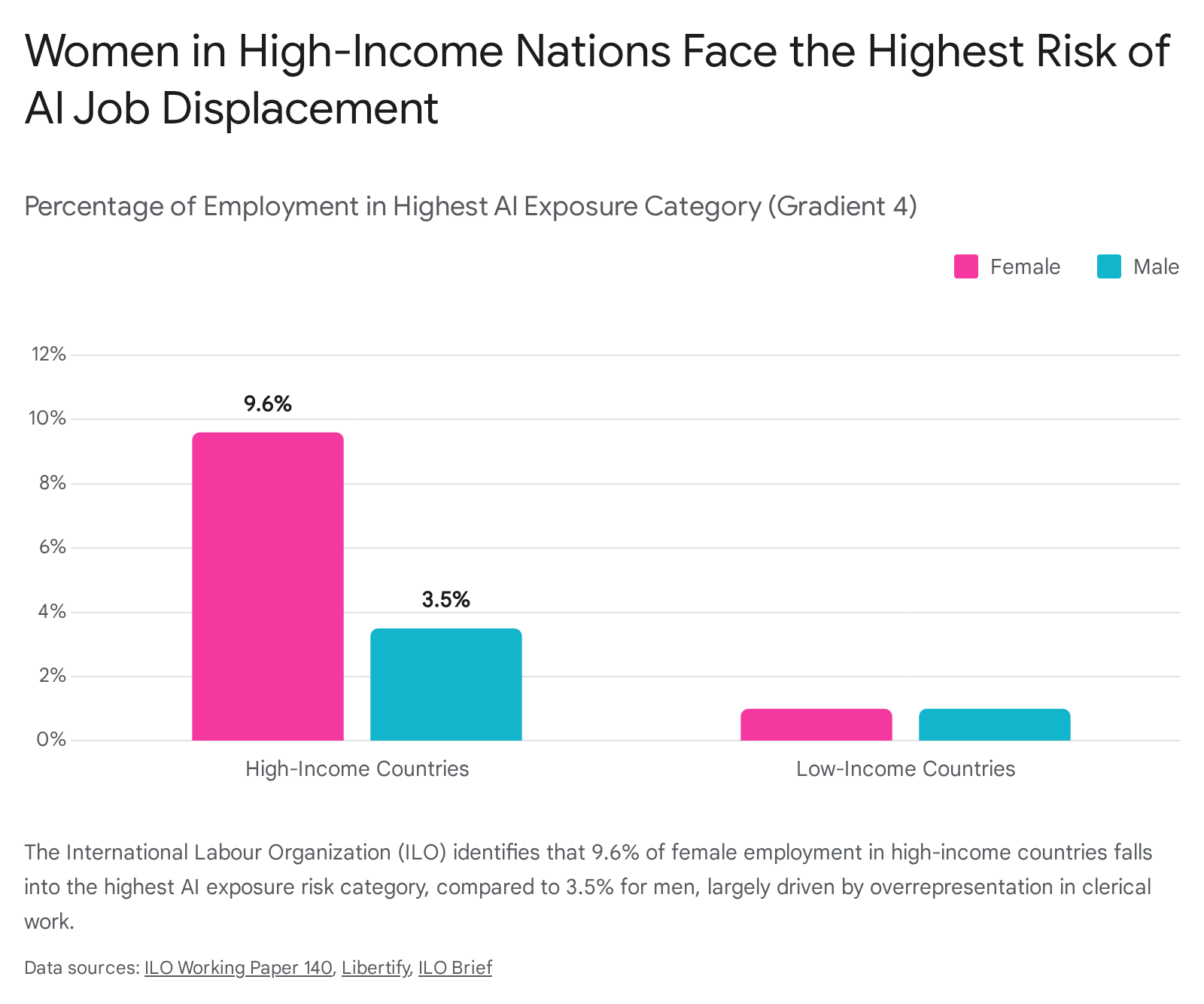
This gender disparity is even more stark in high-income countries (HICs), which have larger service sectors and more formalized administrative structures. In HICs, 9.6% of female employment falls into the highest AI exposure gradient, compared to just 3.5% of male employment - nearly a 3:1 ratio 161719.
The "Pipeline Shock" for Young Professionals
Another critical vulnerability lies with entry-level workers. AI has drastically improved the efficiency of foundational tasks, leading to a reduction in hiring for junior roles. Surveys indicate that 66% of enterprises are reducing entry-level hiring due to AI efficiencies 57.
In software development, for example, employment for 22- to 25-year-olds in high-AI-exposure jobs fell by 20% recently, while employment for older, more experienced workers in those same fields actually grew 957. When AI can generate first drafts of code, analyze basic datasets, or draft legal briefs, the traditional apprenticeship model - delegating "grunt work" to junior staff - breaks down. This presents a long-term challenge: if junior employees are displaced before they can learn the ropes, organizations will struggle to develop future senior talent equipped with necessary judgment and domain expertise 105.
The World Economic Forum's 4 Scenarios for 2030
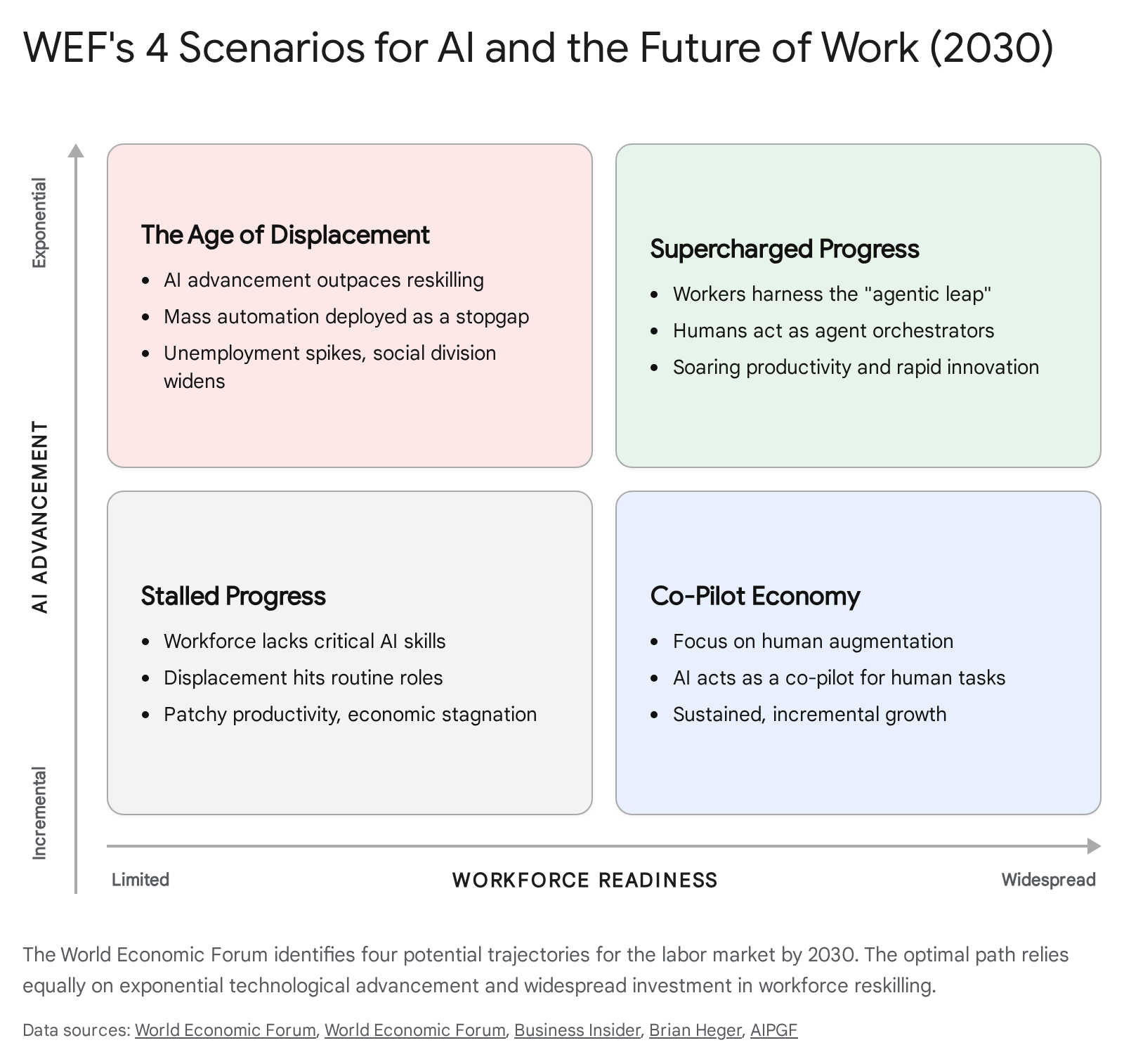
Because the future of work relies on a complex interplay between unpredictable technological breakthroughs and human adaptation, predicting exact job losses is impossible. To navigate this uncertainty, the World Economic Forum (WEF), in its 2026 report Four Futures for Jobs in the New Economy: AI and Talent in 2030, mapped out four distinct scenarios 202122232425.
These scenarios are built upon two independent variables: 1. AI Advancement: Will AI progress incrementally (steady, predictable improvements) or exponentially (rapid breakthroughs approaching artificial general intelligence)? 2. Workforce Readiness: Will institutions and businesses successfully deploy widespread reskilling, or will readiness remain limited and fragmented?
Depending on how these forces interact, the global economy will enter one of four paradigms.
Scenario 1: Supercharged Progress
(Exponential AI Advancement + Widespread Workforce Readiness)
In this highly optimistic future, exponential breakthroughs in AI capabilities reshape global economies and create entirely new industries. Capital expenditure surpasses $1.3 trillion from 2025 to 2030, cementing AI as a core economic actor 24. Productivity soars and innovation flourishes. Crucially, because education systems and corporate training have adapted rapidly, workers possess the skills to harness the "agentic leap" 222426.
In this scenario, while many traditional occupations disappear entirely, mass displacement is largely contained. Humans transition from executing granular tasks to orchestrating and managing portfolios of capable AI agents 2226. Economic growth is massive, but the pace of change is so fast that governance frameworks, ethical standards, and social safety nets constantly struggle to keep up 2226.
Scenario 2: The Age of Displacement
(Exponential AI Advancement + Limited Workforce Readiness)
This is the most disruptive and cautionary scenario. Here, AI technology advances at breakneck speed, but the workforce is completely unprepared. Traditional education systems fail to produce adaptive talent, resulting in acute talent shortages for advanced roles 2324.
To offset the lack of skilled human capital, businesses race to automate everything they can as a stopgap measure. Workers are displaced far faster than they can be reskilled 2224. While agentic AI drives a massive upsurge in corporate productivity and profit margins for a concentrated group of tech monopolies, the broader economy fractures socially. Unemployment spikes, consumer confidence collapses, and governments face severe societal instability and widening inequality 222526.
Scenario 3: Co-Pilot Economy
(Incremental AI Advancement + Widespread Workforce Readiness)
Dubbed the "Co-Pilot Economy," this scenario is explicitly designed to limit large-scale displacement 2126. AI progresses steadily, but capability breakthroughs are measured rather than explosive. Because workforce readiness is high, the focus of the labor market shifts heavily toward augmentation rather than mass automation 2122.
In this future, human-AI collaboration becomes the norm. AI acts as a digital assistant, handling routine work while freeing up humans to engage in complex, creative, and strategic tasks 26. Job churn exists, but it is manageable. Governments, businesses, and workers increasingly view AI as an opportunity rather than an existential threat, resulting in sustained productivity improvements and strong labor market stability 2125.
Scenario 4: Stalled Progress
(Incremental AI Advancement + Limited Workforce Readiness)
In this underwhelming future, AI technology improves, but breakthroughs are rare, costly, and difficult to implement due to rising computing constraints and regulatory caution 2224. Simultaneously, the workforce struggles to adapt due to underinvestment in leadership and skills 824.
Because there is a severe shortage of AI-ready talent, productivity gains are highly uneven. Benefits concentrate only within a few elite businesses and geographies, while the rest of the economy faces eroding competitiveness 2122. Businesses lean on basic automation simply to backfill scarce talent, leading to the displacement of routine roles without the corresponding creation of high-value jobs. The promise of AI-enabled prosperity fades into economic stagnation and a bifurcated, unequal economy 2223.
(Note: The Tony Blair Institute has modeled a similar set of macroeconomic scenarios - termed Tailwind, Jet Stream, Whirlwind, and Breeze - which echo these findings, projecting that highly disruptive AI rollouts could cause temporary unemployment spikes of over 1 million by 2035 in markets like the UK before re-employment effects stabilize the economy 4.)
How Will AI Affect Emerging Markets and the BPO Industry?
While advanced economies face significant labor transitions primarily in knowledge work, the impact of AI will look vastly different in emerging market and developing economies (EMDEs). A major report by the World Bank indicates that roughly 15% of jobs in EMDEs are at risk of automation, notably impacting young and moderately educated workers 3627. In advanced economies, exposure sits higher at roughly 60% due to the prevalence of cognitive-task-oriented jobs 28. However, workers in advanced economies are also better poised to exploit AI's complementary benefits due to existing digital infrastructure 2829.
Nowhere is the tension of automation more palpable than in the Business Process Outsourcing (BPO) sector, which serves as the economic lifeblood for nations like India and the Philippines. In India, the IT and Business Process Management (IT-BPM) industry generated nearly $254 billion in revenue in 2024 and employs over 5 million people 30. In the Philippines, the BPO sector generates approximately $38 billion annually and employs 1.7 to 1.8 million full-time professionals, accounting for over 7% to 8.5% of the nation's GDP 413143.
From Cost Arbitrage to Automation Arbitrage
For decades, the global outsourcing model relied on "cost arbitrage" - leveraging a highly skilled, English-speaking workforce in developing nations at a fraction of Western labor costs 3132. However, generative AI introduces "automation arbitrage." The very characteristics that made BPO work easy to offshore - repetition, predictability, and immense scale - make it highly susceptible to AI automation 32.
Large language models and AI agents can now resolve common customer service issues, generate first-draft email responses, and process legal contracts 24/7 without language barriers 413132. Gartner estimates that by 2029, 80% of common customer service issues will be resolved by AI 32. The disruption is already moving from theoretical to real. Major tech and outsourcing firms in India have recently enacted historic layoffs targeting entry-level roles, while net hiring for traditional contact-center jobs has drastically slowed or collapsed entirely in some quarters 32.
Transformation, Not Annihilation
Despite these stark realities, industry associations in both India and the Philippines remain optimistic, projecting continued job growth rather than industry collapse. The Information Technology-Business Process Management Association of the Philippines (IBPAP) estimates that BPO jobs in the country will actually increase by 1.1 million by 2028 3133. NASSCOM reports that India's AI market is growing at a 25-35% CAGR, demanding an influx of specialized talent 34.
How is this possible? The industry is rapidly pivoting to higher-value services. While routine, rules-based tasks are being automated or compressed, complex, judgment-intensive work is growing faster than automation can displace it 41. BPO agents are transitioning from reading scripts to managing AI assistants, requiring them to utilize greater empathy, cultural intelligence, and complex problem-solving for escalated issues 3235. Furthermore, AI requires massive human oversight; hundreds of thousands of new jobs are emerging in data classification, algorithm training, data editing, and AI annotation 3133. The survival of the global BPO sector depends entirely on the speed at which it can upskill its massive workforce to manage AI systems rather than compete against them.
Navigating the Transition: Guidance for Employers and Workers
If workforce readiness is the key variable that separates a prosperous "Co-Pilot Economy" from a fractured "Age of Displacement," organizations must take immediate, proactive steps. However, actual adoption is lagging. BCG reports that while executives use AI frequently, regular use among frontline employees has stalled at a "silicon ceiling" of just 51% 36.
To bridge this gap, both governmental bodies and corporate strategists are coalescing around a set of "no-regret" strategies designed to foster safe and productive AI integration.
The U.S. Department of Labor's AI Guidelines
In late 2024 and through 2026, the U.S. Department of Labor (DOL) released comprehensive best practices and AI literacy frameworks for employers and developers 37383940. The DOL explicitly views AI as a tool to expand equality and improve job quality, provided it is deployed ethically. Key mandates from the DOL include:
- Centering Worker Empowerment: Employers should integrate regular, early input from workers (and their unions) regarding the design, testing, and deployment of AI systems. Workers should have a voice in how technology alters their day-to-day tasks 373941.
- Ethical Development and Transparency: Employers must transparently inform job seekers and employees about what data is being collected by AI and how automated systems impact performance reviews, scheduling, or hiring 373854.
- Protecting Labor Rights: Organizations are explicitly warned not to use AI to undermine workers' rights to organize, nor to use electronic monitoring in invasive ways to detect protected activities or monitor non-work areas 3741.
- Creating Pathways for Upskilling: The DOL emphasizes that foundational AI literacy is only the starting point. Employers must provide clear opportunities for displaced workers to be retained and reallocated within the organization, funding their transition into AI-augmented roles rather than resorting immediately to layoffs 3740.
Corporate "No-Regret" Strategies
The World Economic Forum, alongside global consulting firms, identifies several immediate actions organizations must take to survive the AI transition, regardless of which macroeconomic scenario unfolds 14224256:
- Invest in Data Infrastructure and Governance: AI models are only as effective as the data they are trained on. Prioritizing secure, clean, and well-governed proprietary data is a foundational step before implementing external AI agents 2256.
- Align Technology and Talent Strategies: Workforce planning can no longer be a downstream afterthought to IT deployment. If a company buys AI software, it must simultaneously fund the human training required to use it. Underinvesting in training leads to tool abandonment and security risks 1136.
- Redesign Entry-Level Work: Because AI automates the "grunt work" traditionally used to train junior staff, companies must intentionally design analytical rotation programs and "human-in-the-loop" apprenticeships to build the next generation of senior leaders 14.
- Shift to Skills-Based Hiring: Organizations should move away from strict degree requirements and focus on hiring for adaptability, critical thinking, and social-emotional skills - traits that AI cannot easily replicate but are essential for managing complex automated systems 3057.
Bottom line
Generative AI will not eliminate human labor, but it will ruthlessly reshape it. While specific job displacement figures vary, consensus suggests that routine, clerical, and entry-level cognitive tasks face immediate automation risks, creating unique vulnerabilities for young professionals, female workers globally, and the outsourcing sectors of developing economies. However, if governments and businesses aggressively invest in reskilling - shifting the focus from task automation to worker augmentation - the global economy can transition into a highly productive "co-pilot" era characterized by higher wages, new specialized occupations, and robust economic growth. The deciding factor between mass displacement and economic prosperity is not the capability of the algorithm, but the adaptability of the workforce.