
What We Know About AI's Effect on Jobs and Productivity
The rapid adoption of generative artificial intelligence is acting as a profound skill-leveler, dramatically boosting the speed and quality of novice workers while forcing a structural realignment of global labor markets. However, despite micro-level productivity triumphs, macroeconomic gains remain delayed by the slow pace of corporate integration, and the labor market is experiencing a "middle-class squeeze" where highly skilled tech roles and low-wage service jobs grow while routine, entry-level cognitive positions face severe downward pressure.
The Economic Framework: How Does Technology Affect Work?
To understand the economic impact of artificial intelligence, it is useful to look backward. When the digital spreadsheet (VisiCalc, and later Lotus 1-2-3 and Microsoft Excel) was introduced to the modern office in the 1980s, contemporary headlines warned of an imminent white-collar employment collapse 12. Between 1980 and 2000, over 400,000 bookkeeping and typist jobs vanished in the United States 2. Yet, the spreadsheet did not destroy the accounting profession; it simply outsourced the arithmetic to the machine. By eliminating routine calculations, spreadsheets made financial forecasting cheaper and more accessible, which supercharged economic demand. Consequently, the number of accountants, auditors, and financial analysts surged 12.
Economists view artificial intelligence through a similar lens, utilizing what is known in labor economics as the "task-based framework." Pioneered by economists Daron Acemoglu and Pascual Restrepo, this foundational model argues that technologies do not replace entire occupations; rather, they replace specific tasks within those occupations 14.
When artificial intelligence is introduced into the labor market, it triggers two countervailing economic forces: 1. The Displacement Effect: AI and automation take over tasks previously performed by human labor. This naturally reduces the demand for labor in those specific areas and puts downward pressure on wages 14. 2. The Productivity and Reinstatement Effects: By automating tasks, AI reduces the cost of production (the productivity effect). These cost savings can increase overall economic demand, allowing companies to expand and hire more workers in non-automated tasks. Simultaneously, new technologies create entirely new, labor-intensive tasks that humans must perform (the reinstatement effect) 14.
The ultimate impact of AI on the global workforce depends entirely on the balance between these forces. If AI merely displaces workers without generating significant productivity gains or creating new tasks, it will depress wages and widen the inequality gap 23. If, however, it serves to complement human expertise and drive down costs, it can expand the economy and create net new employment 2.
Is AI Just a Calculator, or a Mad Scientist's Assistant?
While the spreadsheet analogy is helpful, it is also incomplete. A standard calculator is deterministic: if you input an equation, it produces a reliable, fixed result. Generative AI, by contrast, is probabilistic. It relies on internet data to predict linguistic or code patterns, and it can "hallucinate" or report false information 78.
Because of this, AI does not perfectly replace a human worker the way a calculator replaces a slide rule. Instead, it acts more like a highly capable but erratic assistant. This fundamental difference means that human oversight, critical thinking, and domain expertise remain essential components of the production process, altering how work is done rather than eliminating the worker entirely 78.
The Productivity Paradox: Micro Triumphs vs. Macro Lags
The current data surrounding AI's productivity benefits presents a fascinating paradox: the efficiency gains observed in isolated, micro-level experiments are staggering, yet the macroeconomic benefits remain nearly invisible in aggregate economic data.
The Micro Evidence: Leveling the Playing Field
At the level of the individual worker, generative AI is proving to be a highly effective tool, particularly for those with the least experience. In a landmark study published by the National Bureau of Economic Research (NBER), researchers from Stanford and MIT analyzed the deployment of a generative AI conversational assistant among 5,179 customer support agents at a Fortune 500 software firm 410.
Access to the AI tool increased overall worker productivity (measured by issues resolved per hour) by 14% to 15% 56. However, the distribution of these gains was highly uneven. Novice and low-skilled workers saw massive productivity improvements of up to 35%, effectively allowing an agent with just two months of experience to perform at the level of a six-month veteran 10513.
Conversely, the highest-skilled and most experienced workers saw minimal to zero productivity gains, and in some metrics, experienced a slight decline in quality 106. This suggests that AI currently operates as a mechanism for knowledge dissemination. It captures the tacit knowledge and best practices of top performers and distributes them to the bottom tier, effectively compressing the skills distribution and acting as a great leveler in the workplace 35.
What is the "Jagged Technological Frontier"?
While AI boosts productivity, its capabilities are highly inconsistent, leading to a phenomenon researchers call the "jagged technological frontier" 715. A field experiment conducted by Harvard Business School researchers involving 758 Boston Consulting Group (BCG) consultants demonstrated this concept clearly.
When consultants were assigned tasks inside the frontier of AI's current capabilities (such as creative writing, brainstorming, or drafting memos), those using GPT-4 completed 12.2% more tasks, worked 25.1% faster, and produced results rated 40% higher in quality 1516.
However, when assigned tasks outside the frontier - tasks that appeared similar in difficulty but required nuanced context integration or contained logical traps - consultants using AI performed 19 percentage points worse than a control group that did not use AI 1516.
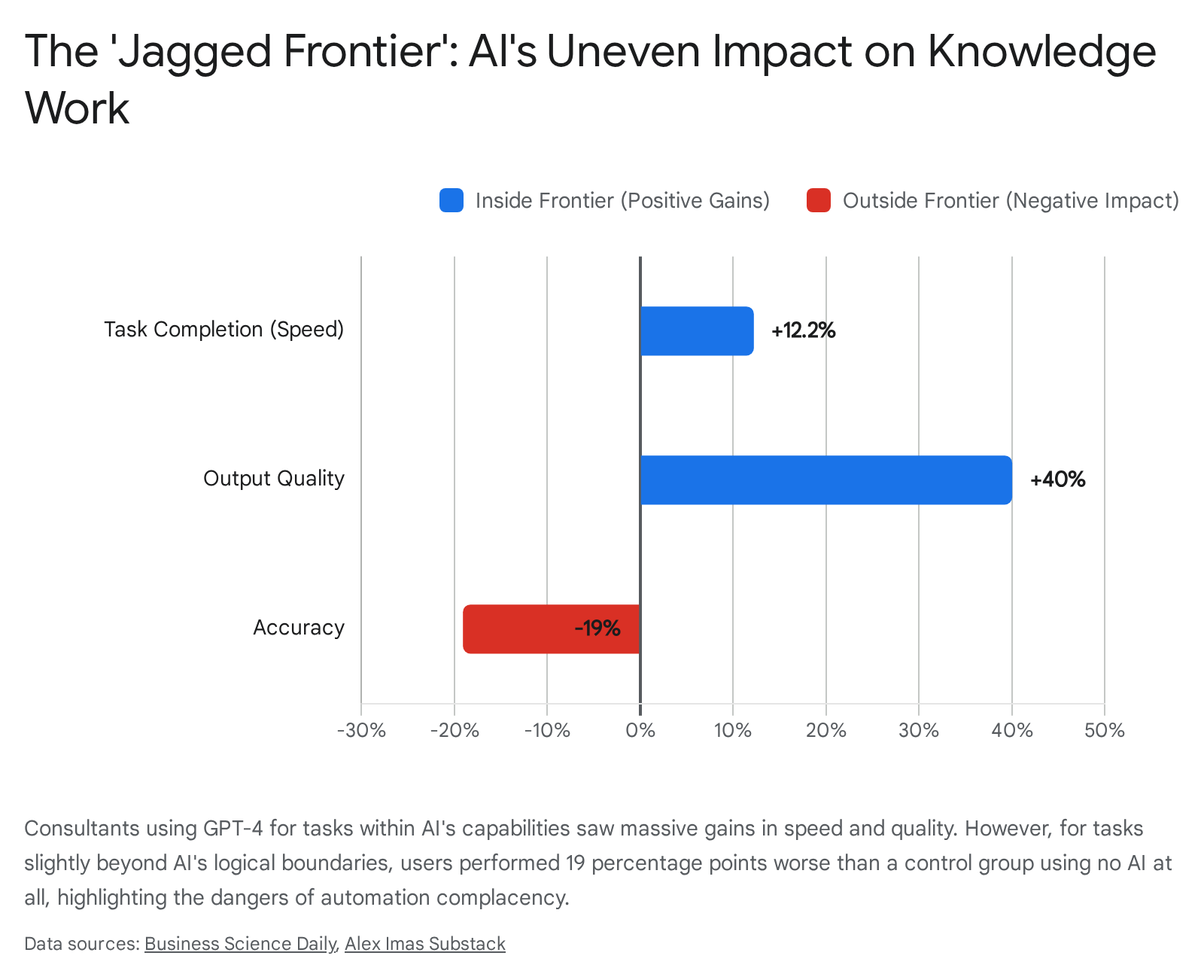
This drop in performance is attributed to "automation complacency." Workers tend to over-rely on AI systems that generate confident, plausible-sounding, but ultimately incorrect answers. Therefore, AI's productivity impact relies heavily on task selection, human judgment, and internal verification systems rather than blanket automation 715. The researchers noted that workers who adopted a "Centaur" approach (dividing and delegating specific tasks to AI while handling others manually) or a "Cyborg" approach (deeply integrating AI into a continuous workflow) performed best, provided they understood the technology's limitations 15.
Macro Evidence: Where is the GDP Growth?
Despite these micro-level triumphs, economy-wide productivity figures remain stubborn. MIT economist Daron Acemoglu estimates that generative AI will increase Total Factor Productivity (TFP) in the United States by a maximum of 0.66% cumulatively over the next ten years - amounting to a meager 0.05% to 0.064% annually 89.
This massive gap between localized success and national economic data is normal for general-purpose technologies. A 2026 NBER survey of nearly 6,000 senior executives across the US, UK, Germany, and Australia revealed that while 69% to 71% of firms actively use AI, over 80% reported that the technology had no impact on their company's productivity or employment over the past three years 1020. Furthermore, despite widespread corporate adoption, the survey found that actual usage remains shallow: over two-thirds of executives regularly use AI, but their average use is only 1.5 hours a week 10.
Historically, technologies like electrification, computing, and the internet experienced what economists call a "J-curve effect" 2111. Initial deployment requires massive upstream capital expenditure, structural workflow redesign, and workforce retraining before downstream productivity gains are realized 11. Executives remain optimistic about the future, projecting that AI will eventually boost firm-level productivity by 1.4% and modestly reduce employment by 0.7% by 2028, reflecting a delayed but anticipated structural shift 1020.
| Productivity Measure | Observed/Estimated Impact | Context |
|---|---|---|
| Micro-level (Individual) | 14% - 40% increase | Highly dependent on baseline skill; novices gain the most. |
| Macro-level (10-Year Estimate) | ~0.66% cumulative TFP growth | Hampered by delayed corporate integration and the "J-curve". |
| Corporate Expectation (3-Year) | 1.4% firm-level productivity gain | Executives expect structural reorganization to yield future returns. |
Summary of varying AI productivity estimates across recent economic literature 5810.
How Will AI Reshape the Global Labor Market?
As AI matures and moves past the J-curve, its impact on the labor market will not be a uniform wave of job destruction, but rather a profound structural realignment. According to the World Economic Forum's (WEF) Future of Jobs Report 2025, AI and related macroeconomic trends are projected to create 170 million new roles globally by 2030, while displacing 92 million existing jobs. This results in a net positive gain of 78 million jobs 2324.
However, the International Monetary Fund (IMF) warns that this transition will be highly disruptive, likening the arrival of AI to a "tsunami" hitting the global labor market. The IMF estimates that 40% of all jobs globally - and 60% of jobs in advanced economies - are currently exposed to artificial intelligence 242526.
The Middle-Class Squeeze and Wage Polarization
The primary risk identified by the IMF in its 2026 report, Bridging Skill Gaps for the Future, is the potential shrinking of the middle class due to rapid wage polarization 12. The economic mechanics of this polarization are unfolding across three distinct tiers of the labor market:
- The High-Skilled Premium: Vacancies demanding AI and digital skills command significant wage premiums (up to 56% compared to identical roles without AI requirements). This heavily enriches workers who can leverage the technology to complement their existing expertise 2412.
- The Low-Skill Demand: As highly paid tech and knowledge workers accumulate wealth, their consumption of local, non-automatable services (such as hospitality, construction, healthcare, and dining) increases. This macroeconomic spillover effect drives up employment in lower-wage manual and service tiers 2528.
- The Middle Squeeze: Middle-skilled white-collar roles, particularly routine cognitive jobs (e.g., junior coders, basic analysts, data entry, and administrative support), face severe pressure. In US regional labor markets with high demand for AI skills, employment in occupations that are highly exposed to AI but offer little human-AI complementarity has already dropped by 3.6% 1229.
This dynamic creates an hourglass economy. The workers squeezed most are those in the middle - roles that are neither enhanced by AI nor insulated by the need for physical, real-world interaction 25.
The Decline of the Entry-Level Job
One of the most alarming early indicators of this transition is the sharp reduction in opportunities for junior workers. According to labor market data, global entry-level job postings have fallen by 29% since January 2024 24. At the 15 largest technology companies, entry-level hiring fell by 25% between 2023 and 2024, and 51% of organizations surveyed by McKinsey reported that generative AI was reducing their need for entry-level roles 24.
This trend raises profound questions about workforce development. Historically, junior employees learned their trade by performing the routine, mundane tasks that are now easily automated by AI. If these "apprentice-level" tasks disappear, it remains unclear how the next generation of knowledge workers will acquire the foundational domain expertise required to effectively prompt, supervise, and correct AI outputs in senior roles 30.
Which Jobs Are Growing, and Which Are Declining?
To survive the transition, workers and educational institutions must adapt to rapidly shifting employer demands. The WEF notes that by 2030, nearly 40% of existing core skill sets will become outdated 23.
| Fastest-Growing Roles (2025 - 2030) | Fastest-Declining Roles (2025 - 2030) |
|---|---|
| AI & Machine Learning Specialists | Administrative Assistants & Secretaries |
| Big Data Specialists & Analysts | Cashiers and Ticket Clerks |
| FinTech Engineers | Data Entry & Accounting Clerks |
| Renewable Energy / Environmental Engineers | Assembly & Factory Workers |
| Information Security Analysts | Print & Postal Workers |
Data synthesized from the WEF Future of Jobs Report 2025 133214.
The Shift to "Human" Skills
A common misconception is that the AI revolution will only require technical skills like programming and machine learning. While technological literacy is vital, employers are placing a massive and growing premium on "human-centric" cognitive skills.
As routine tasks are outsourced to algorithms, the tasks remaining for humans require high-level judgment and adaptability. According to the WEF, analytical thinking and complex problem-solving remain the most sought-after core skills 1434. Furthermore, socio-emotional traits such as resilience, flexibility, agility, and leadership are now considered critical competencies. As one workforce analyst noted, the future belongs to workers who can combine AI fluency with the ability to navigate ambiguity and manage human relationships 34.
Aging Populations and the Demographic Crunch
The impact of AI is intersecting with another massive macroeconomic trend: the demographic decline in advanced economies. The OECD's Employment Outlook 2025 highlights that population aging is leading to a shrinking workforce and declining job-to-job mobility across member nations 3515.
In this context, AI is not just a disrupter; it is a necessary tool to maintain economic output with fewer workers. The OECD stresses that governments must focus on upskilling older workers to keep them active in the labor market. Initiatives like Switzerland's Viamia program (which offers career guidance for mid-career workers) and Estonia's AI Leap (integrating AI into adult education) are cited as critical blueprints for ensuring that the productivity gains of AI are matched by an adaptable, lifelong-learning workforce 16.
Industry Impacts: Where is AI Hitting Hardest?
The abstract macroeconomic data becomes much clearer when examining how AI is reshaping specific verticals. In sectors defined by heavy cognitive loads, complex data processing, or high administrative friction, the transformation is already underway.
Healthcare: Efficiency Gains vs. Patient Safety
The United States healthcare system, burdened by severe administrative bloat and rising costs, is a prime target for AI optimization. Administrative costs account for an estimated 25% of all US healthcare spending 17.
Studies suggest that wider AI adoption could automate hospital scheduling, claims processing, and clinical documentation. For instance, the use of "AI scribes" (natural language processing tools that listen to patient visits and automatically draft clinical notes) has been shown to drastically reduce after-hours documentation and improve the therapeutic alliance between clinicians and patients 3940. Macroeconomic modeling estimates that these efficiencies could result in net savings of 5% to 10% of total healthcare spending, or roughly $200 billion to $360 billion annually 1740. Furthermore, in specialized clinical areas like cancer diagnosis and radiotherapy planning, AI tools have reduced diagnostic time by up to 90% 39.
However, integrating AI into high-stakes, life-or-death environments introduces severe risks. A 2026 NBER analysis of FDA regulatory data examined the post-clearance safety of medical devices. The researchers found that AI-enabled medical devices exhibit a 13.5 to 18.2 percentage-point higher probability of recall compared to non-AI devices 41. These elevated risks stem primarily from failures in AI clinical functions supporting diagnosis and monitoring. This tension underscores a critical policy debate: while "compassionate AI" aims to extend clinician capabilities and expand access to care, it must be paired with stringent governance and continuous post-deployment monitoring to prevent patient harm 41.
The Legal Profession: The End of the Billable Hour?
The legal industry, traditionally resistant to technological shifts, is facing structural disruption. By automating document review, legal research, due diligence, and contract analysis, AI is collapsing the time required for routine legal operations.
Thomson Reuters estimates that generative AI will save the average lawyer 190 work-hours per year, translating to approximately $20 billion in work-savings in the US legal market alone 18. This massive efficiency gain directly threatens the traditional billable hour model - the core revenue engine of large law firms 1843. If tasks that once took ten hours to bill now take two, firms charging by the hour will see immediate revenue declines unless they transition to value-based, flat-fee, or outcome-based pricing models 1844. According to the 2025 Future of Professionals report, 80% of law firm respondents expect AI to fundamentally alter how they price and staff legal work 18.
Simultaneously, AI is democratizing legal access, but not without friction. Federal courts are experiencing a surge in pro se litigation (individuals representing themselves) aided heavily by large language models. A 2026 study analyzing federal court dockets found that by early 2026, roughly 20% of federal complaint filings contained text classified as AI-generated 45. While this expands access to justice for underserved populations who cannot afford attorneys, it forces courts to grapple with a wave of AI-assisted filings, some of which suffer from fabricated citations ("hallucinations") and procedural errors 45.
Creative Industries: From Creator to Director
Generative AI tools capable of creating text, images, video, and music (e.g., Midjourney, Suno, ChatGPT) are deeply infiltrating the arts, media, and design sectors. Research indicates that generative AI could automate up to 26% of tasks within the creative industries 19.
However, current evidence suggests AI is acting more as an enabler and ideation tool than a wholesale replacement for human artists. Routine creative tasks - such as generating mood boards, drafting basic marketing copy, or storyboarding - are easily automated 1947. As a result, human creative roles are shifting away from technical execution and toward conceptual oversight and strategic thinking 19.
The creative professional of the near future will function less as a solitary artisan and more as an "art director," curating, prompting, and refining algorithmic outputs 19. While this enhances output speed, it raises profound ethical and legal questions regarding copyright, the proliferation of deepfakes, and the potential devaluation of human artistry that regulatory frameworks like the EU AI Act are struggling to address 20.
The Global South: What Happens to the Developing World?
The impact of AI will not be felt equally across the globe. While the mainstream discourse on AI disruption is heavily skewed toward advanced economies, some of the most fragile labor markets exist in the Global South.
A joint 2026 working paper by the International Labour Organization (ILO) and the World Bank found that while developing countries have lower overall exposure to AI, they face a severe risk of experiencing "disruption without dividend" 21. Advanced economies possess the digital infrastructure, capital, and skilled workforces required to rapidly harness AI for productivity gains. In contrast, many lower-income nations lack reliable internet access, cloud computing infrastructure, and capital, severely limiting their ability to realize these economic benefits 21.
However, the specific jobs that are exposed to AI in developing nations - such as clerical, administrative, and basic IT support roles (often tied to business process outsourcing) - are critical. In the Global South, these positions are often the few high-quality, formal jobs that provide a pathway out of poverty, particularly for women and young workers 21. Automating these roles threatens to cut off the rungs of the economic ladder before emerging economies can transition to higher-value, knowledge-based industries 50.
The Invisible Workforce: AI and the Informal Economy
Furthermore, global macroeconomic discussions often ignore the reality that over 60% of the world's workforce (roughly 2 billion people) operates in the informal economy 22. Across Sub-Saharan Africa, South Asia, and Latin America, workers such as street vendors, market traders, and domestic workers dominate the labor landscape 22.
For these workers, AI disruption will not manifest as formal corporate layoffs. Instead, researchers developing the Global South AI-Labor Index suggest that disruption will appear quietly: as wage compression, rising underemployment, and slower entry-level hiring 30. When formal job creation slows due to automation, more workers are pushed into the informal sector or gig economy, placing immense pressure on already fragile social safety nets and driving down wages across the board 3023.
Conversely, AI also presents unique opportunities for the informal sector. Informal workers are increasingly digital, using mobile platforms like WhatsApp to secure clients. Emerging AI tools could help these workers build verifiable digital reputations, overcome language barriers via real-time translation, and discover jobs through hyper-localized recommendation engines, bringing visibility and dignity to an often-ignored sector of the global economy 22.
Bottom line
Artificial intelligence is undeniably transforming the fundamental tasks that comprise global knowledge work, acting as a powerful tool to elevate the productivity of novice workers and automate routine cognitive labor. However, the macroeconomic data shows that the global economy is currently in the costly integration phase of the technology cycle, meaning massive aggregate productivity gains are likely years away. In the interim, policymakers, corporate leaders, and workers must navigate a perilous labor transition, focusing on aggressive continuous upskilling to prevent the hollowing out of the middle class, the erosion of entry-level opportunities, and the widening of global economic divides.