
What the Data Says About AI Job Displacement in 2026
The data from early 2026 confirms that artificial intelligence is not triggering mass aggregate unemployment, but rather initiating a severe, structural churn of the global labor market. While millions of routine administrative and entry-level white-collar roles are actively being displaced today, these losses are currently being offset by massive productivity-driven job retention in specialized fields and the creation of entirely new technology sectors. Ultimately, the future of AI and employment relies less on what the technology can automate and more on how consumer demand, demographic shifts, and corporate reskilling strategies adapt to cheaper, faster cognitive labor.
From Speculation to Structural Churn
For years, the conversation surrounding artificial intelligence and the workforce was largely theoretical. Economists, technologists, and policymakers debated whether large language models (LLMs) would serve as benign copilots that elevate human potential or as ruthless job killers that hollow out the middle class. By the first quarter of 2026, the global economy has moved decisively past the experimentation phase. Enterprise adoption has reached a near-ubiquitous 88%, meaning the vast majority of the labor force now works at firms that have deployed AI in at least one core business function 1.
The data is now concrete, and it reveals a highly disruptive yet fundamentally nuanced reality. The workforce is not shrinking in the aggregate, but it is actively redeploying into entirely new paradigms 2. The sheer scale of this transition is historically unprecedented. According to 2026 analyses from the International Monetary Fund (IMF), approximately 40% of global employment is currently exposed to AI-driven change. However, this exposure is not evenly distributed; it skyrockets to 60% in advanced economies characterized by high concentrations of knowledge work, while dropping to roughly 28% in low-income nations 13.
Exposure, however, does not automatically equate to unemployment. The labor market is currently experiencing what experts describe as a massive structural churn. To understand the actual trajectory of AI job displacement, we must unpack the conflicting forecasts, examine the economic mechanisms that dictate job survival, and analyze the stark reality of which jobs are vanishing right now versus which are flourishing.
The Macro Forecasts: A Tale of Two Timelines
To grasp the current labor market dynamics, it is necessary to examine how institutional forecasts have evolved as AI technology has matured. Early predictions were often grim, but as companies began integrating AI, the models shifted from projecting absolute displacement to projecting massive workforce reallocation.
In its Future of Jobs Report 2023, the World Economic Forum (WEF) surveyed 803 companies employing over 11 million workers across 45 economies. At that time, the WEF projected a somewhat pessimistic near-term outlook for the 2023 - 2027 period: they anticipated 69 million new roles would be created while 83 million would be eliminated, resulting in a net decrease of 14 million jobs (roughly 2% of current employment) 44.
However, as the commercialization of generative AI rapidly accelerated into 2025 and 2026, the long-term outlook dramatically inverted. The updated WEF forecasts now recognize that while AI causes intense immediate volatility, it also spawns entirely new industries. By 2030, macroeconomic trends and AI integration are projected to displace roughly 92 million jobs globally. Yet, these same forces are expected to spark the creation of 170 million new roles, resulting in a staggering net positive growth of 78 million jobs 1256.
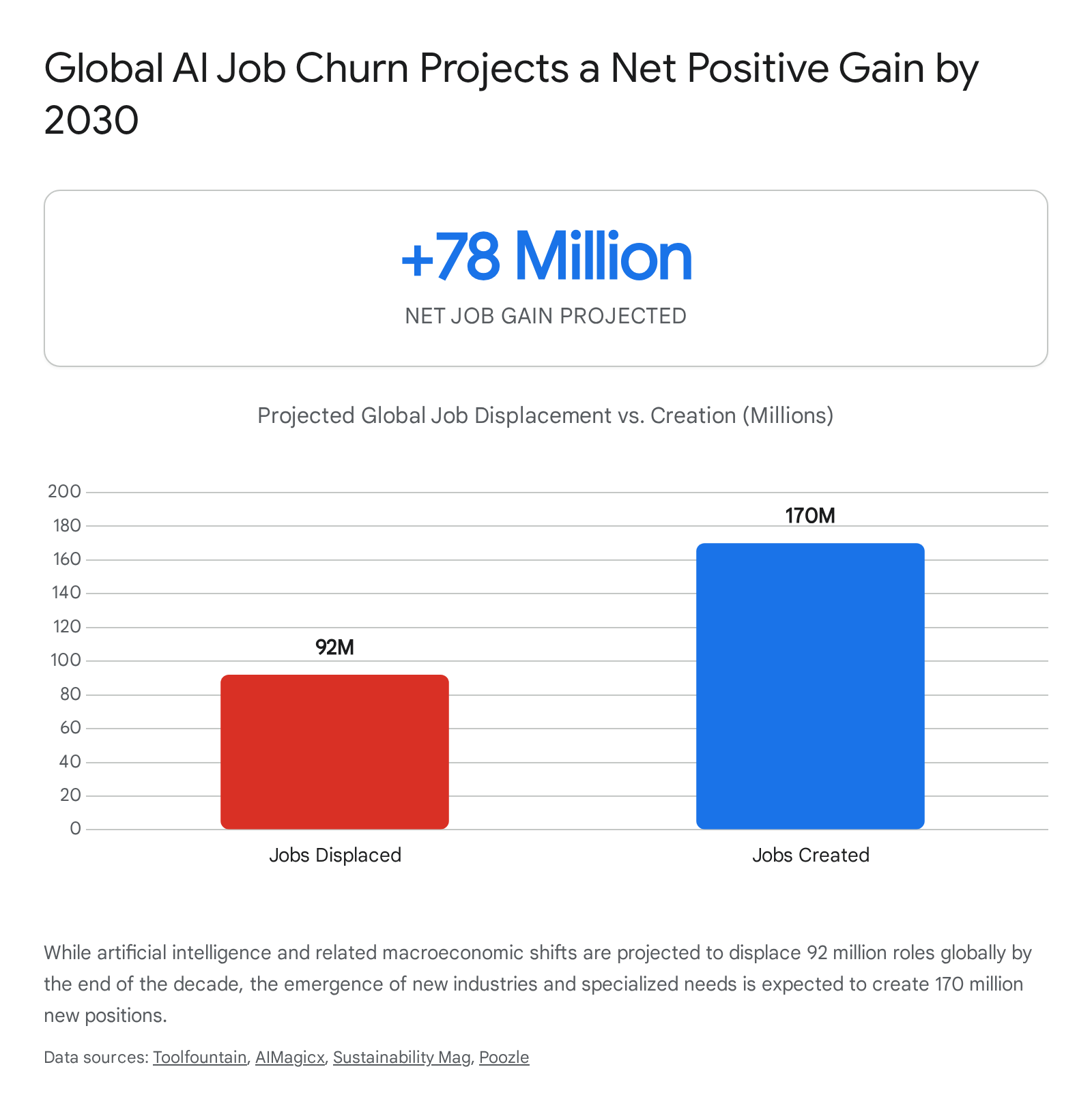
While this aggregate 78-million-job gain is highly optimistic, economists warn that a net positive macro statistic offers little comfort to the workers currently navigating the transition on the ground. A net gain does not mean the transition is painless; it means the workforce must undergo a massive, coordinated effort to shift from declining sectors into emerging ones.
Crashing Waves vs. Rising Tides
A major point of contention among forecasters is the speed at which this structural churn will occur. Different independent institutions offer varying timelines based on how they model corporate adoption rates, regulatory hurdles, and technological maturity.
| Forecasting Institution | Forecast Timeline | Projected Labor Market Impact | Key Insight / Methodology |
|---|---|---|---|
| World Economic Forum (WEF) | 2025 - 2030 | 92M displaced globally; 170M created (78M net gain). | Based on surveys of large global employers; anticipates 22% of all jobs will undergo structural churn 125. |
| Boston Consulting Group (BCG) | 2024 - 2029 | 50 - 55% of US jobs reshaped; 10 - 15% potentially eliminated. | Uses microeconomic modeling focused heavily on the balance between labor substitution and demand expandability 7. |
| Goldman Sachs | Over 10 years | 300M jobs exposed globally; 6 - 7% of US workers displaced. | Focuses on the timeline of corporate adoption; faster adoption pulls job losses forward, increasing short-term unemployment 98. |
| MIT / Oak Ridge (Iceberg Index) | Current (2025 - 2026) | 11.7% of the US labor market currently capable of being replaced. | Evaluates 32,000 skills to visualize what AI can already handle, splitting impacts into "visible" tech layoffs and "hidden" HR restructuring 910. |
Labor economists at MIT emphasize that the impending AI transition should not be viewed as a "crashing wave" that will instantly shock the workforce, but rather as a "rising tide" of capabilities 11. Their models suggest that while AI capabilities are expanding broadly, the technology will likely reach an 80% to 95% success rate - deemed "minimally sufficient" to handle the vast majority of cognitive work tasks - by 2029 11.
This slightly elongated horizon is vital. It implies that rather than facing sudden, overnight obsolescence, the global workforce has a narrow but distinct window of time to upskill before current roles are fundamentally devalued 11.
Historical Context: Is This Time Actually Different?
The profound anxiety surrounding AI in 2026 closely mirrors the public panic that has accompanied almost every major technological revolution in modern history. Understanding these historical parallels is essential for determining whether AI represents a unique existential threat to human labor or simply the latest iteration of industrial progress.
The Luddite Fallacy and the Triple Revolution
Predictions of technology-induced, long-term mass unemployment have been consistently proven wrong for centuries. In 1412, the city council of Cologne banned the production of the spinning wheel due to fears of unemployment among hand spindle workers 12. In the 19th century, textile workers famously smashed mechanized looms.
More recently, the anxiety of the 1960s serves as a perfect historical mirror to 2026. In 1964, a prominent group of intellectuals, scientists, and activists sent an open memorandum to U.S. President Lyndon B. Johnson titled "The Triple Revolution." They warned that the combination of cybernation (automation and computers), weaponry, and human rights movements would create a permanent jobless class because machines were becoming more capable than human workers 151314. They argued that the link between jobs and income had been permanently broken by technology. In retrospect, the fears of the 1960s were completely unfounded; the American economy continued to grow, and employment levels adapted 13.
Economists often refer to this persistent fear as the "Luddite Fallacy." The fallacy assumes that there is a fixed amount of work to be done in the economy. In reality, technological progress increases productivity, lowers prices, and generates new wealth, which in turn spurs demand for entirely new goods and services - creating new jobs in the process 1213.
Displacement, Reinstatement, and Productivity
Modern labor economists, such as Daron Acemoglu and Pascual Restrepo, analyze technological change through a framework of competing forces. When a new technology is introduced, it creates a displacement effect (automating tasks and destroying specific jobs) 1516. However, this is countered by two positive forces: the reinstatement effect (the creation of entirely new, more complex tasks for humans to perform) and the productivity effect (the economic growth that raises demand for labor across all sectors) 15.
Historically, the reinstatement and productivity effects have vastly outweighed displacement. When the Automated Teller Machine (ATM) was widely deployed, experts predicted the death of the bank teller. Instead, because ATMs made it significantly cheaper to operate a bank branch, financial institutions opened vastly more branches. The total number of human tellers actually increased, though their tasks shifted from dispensing cash to selling complex financial products 17. Similarly, the introduction of electronic spreadsheet software in the 1980s eliminated hundreds of thousands of routine bookkeeping clerk jobs, but it exponentially increased the demand for accountants and financial analysts who used the software to perform deeper strategic analysis 17.
The Baumol Effect and Anthropic's 2026 Data
While history suggests cautious optimism, there is growing empirical evidence in 2026 that the AI transition may be unfolding differently than past automation waves.
A critical 2026 Staff Discussion Note from the IMF highlights the re-emergence of the "Baumol Effect" in the context of cognitive labor 1822. The Baumol Effect is a productivity dynamic where sectors that achieve massive gains through automation - such as IT services or software development - actually see a decrease in total employment because output can be maintained or drastically increased with far fewer workers 22. Instead of creating massive numbers of new jobs within the tech sector, AI might push displaced workers toward slower-growing, highly labor-intensive service sectors (like personal care, hospitality, or physical trades) that do not benefit as easily from automation 22.
This theoretical concern is supported by early empirical data. A March 2026 study by Anthropic introduced the concept of "observed exposure," combining theoretical LLM capabilities with real-world usage data 19. While Anthropic found limited evidence of systematic, aggregate increases in unemployment, their data revealed a disturbing trend: a 14% drop in the job-finding rate for highly exposed occupations compared to 2022 levels 19. The IMF corroborates this, noting that in local labor markets with high demand for new AI skills, overall employment levels in AI-vulnerable occupations were actually 3.6% lower after five years 1820.
In short, while AI creates highly lucrative new jobs for a niche group of developers and integration specialists, it appears to be actively shrinking the entry-level and middle-class white-collar layers without immediately replacing them with equivalent high-paying roles 1822.
The 2026 Reality: Which Jobs Are Actively Disappearing?
The narrative that "AI will replace tasks, not jobs" has been a comforting mantra for corporate leadership over the last three years. In 2026, however, the data reveals a harsher truth: when enough discrete tasks within a specific job are automated, the job itself becomes economically redundant and disappears.
Corporate behavior across 2025 and 2026 demonstrates that companies are not waiting for AI to reach theoretical perfection before making structural headcount reductions. In the first eleven months of 2025 alone, U.S. layoffs directly tied to AI implementations hit roughly 55,000 - a staggering 400% year-over-year increase 9.
The scale of these targeted reductions is massive. Amazon eliminated tens of thousands of roles tied to AI-driven restructuring. Salesforce cut thousands of support positions after AI agents successfully took over more than half of all routine customer queries. Industrial giants like Dow Chemical automated away thousands of positions, while Lufthansa announced plans to eliminate 4,000 administrative roles by the end of the decade 9.
The Collapse of Entry-Level and Clerical Work
The most acute pain in the 2026 labor market is concentrated among younger workers and those in routine administrative roles. Global entry-level job postings have plummeted by 29% since January 2024 1. The IMF reports a corresponding 13% decline in employment for college graduates aged 22 to 25 operating in AI-exposed occupations between 2022 and 2025 1.
This collapse in junior hiring is a direct result of AI's burgeoning proficiency at routine cognitive and administrative tasks. Why hire a junior programmer, a data entry clerk, or a first-year legal analyst when an AI agent can write and debug code, process data, and review legal discovery documents at superhuman speed and a fraction of the cost? According to McKinsey, 51% of global organizations explicitly report that generative AI is actively reducing their need for entry-level roles 1.
The Organisation for Economic Co-operation and Development (OECD) provides the mathematical backing for this vulnerability through its "AI Capability Gap Index." This index measures the distance between what an occupation requires across nine core capabilities and what current AI systems can actually execute. A smaller gap signifies higher exposure 21.
For office and administrative support workers - including billing clerks, word processors, bookkeeping clerks, and data entry keyers - the capability gap has effectively closed. The occupational group as a whole records an overall gap index of just 0.8, the lowest of any major category 21.
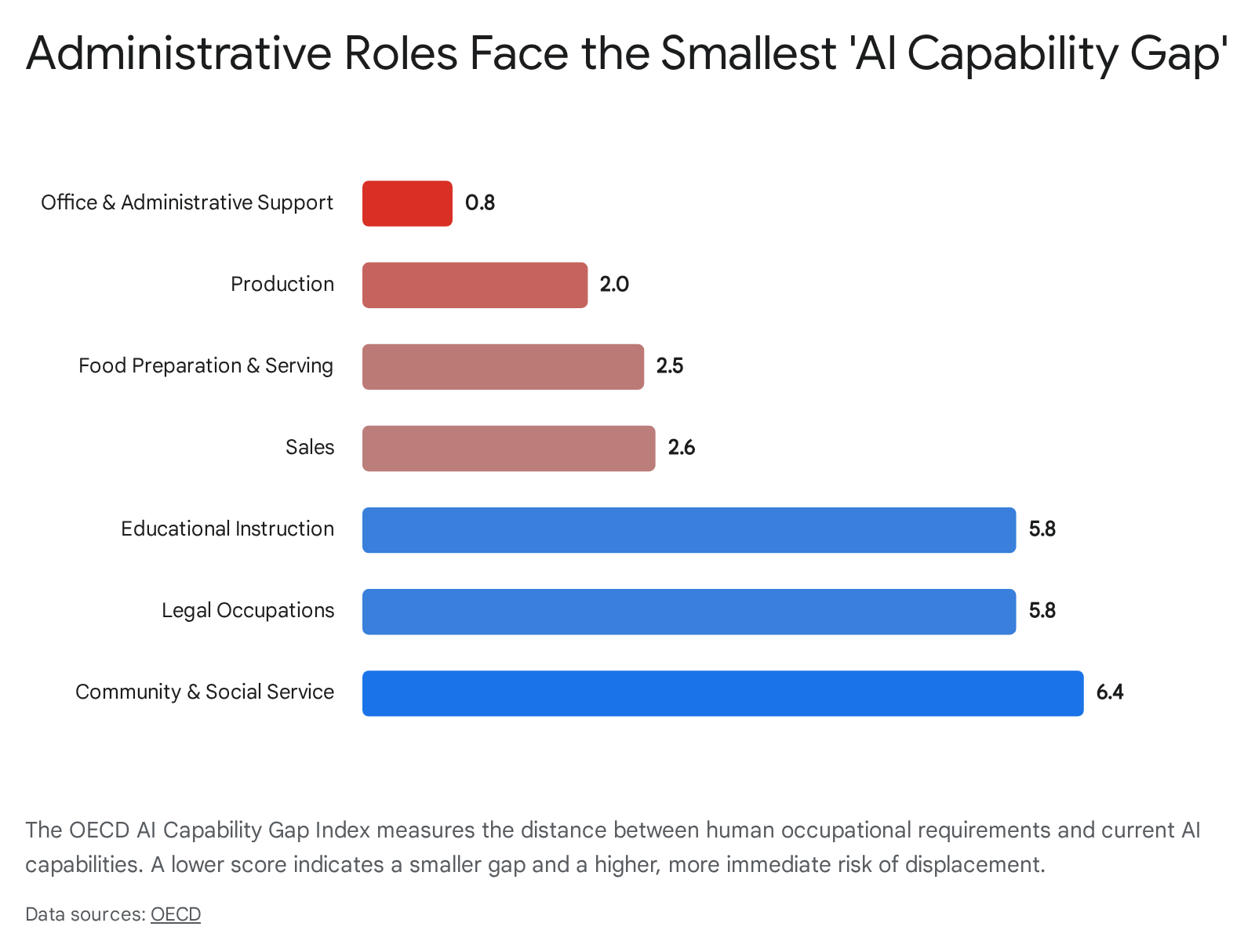
By contrast, occupations requiring contextual judgment, physical dexterity in unpredictable environments, and complex social empathy remain highly protected. Chief executives, firefighters, psychiatrists, and community service workers boast capability gap scores between 5.8 and 6.4, placing them safely out of reach of current AI automation 21.
The Shift to Agentic AI and Autonomous Workflows
The labor market shifts between 2024 and 2026 are largely defined by a technological evolution: the transition from generative AI to agentic AI.
Early generative models (like the initial iterations of ChatGPT) acted as sophisticated calculators for language; they required constant human prompting, supervision, and correction for every discrete output. Agentic AI, however, is designed to operate autonomously across multi-step workflows, bridging the gap between isolated software tools and making complex decisions without human intervention 2627. As of 2026, agentic AI is responsible for 50% of all AI-related job losses, up from just 29% in 2023 1.
The practical use cases of agentic AI demonstrate why specific jobs are disappearing so rapidly. In the sales and marketing sectors, AI agents act as autonomous Sales Development Representatives (SDRs). They engage with inbound leads, qualify them against complex corporate criteria, schedule discovery calls, and autonomously update Customer Relationship Management (CRM) databases - all without human oversight 22.
In Human Resources, AI tools have moved beyond simple resume parsing. They now conduct initial candidate screenings, auto-fill complex onboarding checklists, handle routine payroll audits, and answer employee policy queries. Industry reports indicate that automating these HR workflows can reduce hiring time by 30% and overall HR operational costs by roughly 40% 29. Similarly, IT departments are deploying autonomous agents to automatically categorize support tickets, predict server outages before they affect users, and validate code deployments 2722.
These are not theoretical futures; they are the 2026 operational standard. Because these autonomous systems seamlessly handle the repetitive, procedural work that has traditionally served as the training ground for young professionals, recent graduates are facing an impossible Catch-22: the entry-level jobs they need to build their careers are vanishing, but the remaining mid-level roles require years of experience managing the very AI systems they were never given the opportunity to use 9.
The "Augmentation" Argument: Why Exposure Doesn't Equal Unemployment
Despite the alarming statistics surrounding entry-level displacement, leading labor economists stress that for the broader economy, technological "exposure" does not inherently mean job destruction. The International Labour Organization (ILO) consistently notes that the overwhelming long-term effect of generative AI will likely be to augment existing occupations rather than completely automate them 23.
How Productivity Saves Highly Exposed Roles
A landmark study from MIT and the National Bureau of Economic Research (NBER), tracking AI adoption from 2010 through 2023 and beyond, provides a crucial, data-driven counter-narrative to the doomsday forecasts. The researchers found that the impact of AI is highly granular, affecting specific tasks rather than entire occupations 24.
When AI is capable of performing the vast majority of tasks that make up a particular job, the share of people in that role within a company falls by about 14%. However, when AI's impact is concentrated on only a few tasks - leaving the bulk of the worker's responsibilities untouched - employment in that role actually grows 24.
When workers are freed from routine, time-consuming tasks, they can refocus their energy on high-value activities where AI remains deficient: critical thinking, strategic planning, complex problem solving, and relationship building. Strikingly, the MIT study found that workers in high-wage roles heavily exposed to AI - such as management analysts, aerospace engineers, and architecture professionals - saw their share of total employment grow by about 3% over a five-year period 24.
The mechanism behind this growth is firm productivity. Companies that adopted AI extensively grew their revenues, output, and profits significantly faster than their non-adopting peers. This rapid expansion required them to sustain, or even expand, their headcount in high-exposure positions to manage the newly unlocked growth 24. As one MIT economist noted, "Firms that adopt AI don't necessarily need to shed workers; they can grow and make more stuff and use workers more efficiently than other firms" 24.
The "Missing Variable" of Consumer Demand (Price Elasticity)
Economists point out a critical, often ignored flaw in relying purely on "task exposure scores" to predict aggregate job losses. These exposure metrics make AI look exceptionally powerful, but they fundamentally ignore consumer behavior - specifically, the price elasticity of demand 25.
Price elasticity measures how consumer demand responds when a service or product becomes cheaper. If AI integration cuts the cost of delivering software code or reviewing legal documents by 60%, the long-term impact on employment depends entirely on how the market reacts to that lower price.
- If demand is rigid (inelastic): Clients are satisfied with their current volume of services and simply pocket the financial savings. The firm maintains its output but fires 60% of its lawyers or coders because they are no longer needed.
- If demand is flexible (elastic): The drastically cheaper price unlocks a massive wave of previously unmet demand. Clients realize they can now afford to litigate more cases, build more software features, or launch more marketing campaigns. The industry expands so rapidly that the firm must hire more humans to oversee the AI tools and manage the exponentially increased volume 725.
Historically, efficiency improvements have consistently increased total consumption rather than reducing it - a phenomenon economists call the Jevons Paradox 7. Yale's Budget Lab and University of Chicago economists caution that because we currently lack comprehensive, sector-by-sector data on price elasticity for modern professional industries (like corporate law or accounting), predictions of mass unemployment driven solely by exposure metrics are mathematically incomplete and functionally misleading 25.
The Wage Premium and the Shrinking Middle Class
For those who navigate the transition successfully, the financial rewards are immense. The labor market in 2026 is aggressively rewarding those who adapt to the new technological paradigm.
Data from PwC and the IMF indicate that workers who possess demonstrable AI skills command a massive 56% wage premium compared to their counterparts in identical roles who lack those competencies 1. Even at the entry level, job vacancies demanding at least one new AI or IT skill list starting wage offers between 3.0% and 15% higher than equivalent roles without those requirements 11820.
However, this lucrative wage premium is simultaneously deepening labor market polarization. The economic benefits of AI are currently flowing to the extremes of the skills spectrum. High-skilled workers (developers, AI managers, strategic orchestrators) are seeing their productivity and wages multiply 1820. Low-skilled workers (in physical services, hospitality, and trades) are also seeing employment gains, driven by the increased consumption and spending power of the wealthy high-skilled workers 182026.
The casualty of this polarization is the middle class. Middle-skilled, routine white-collar jobs are being systematically squeezed out, contributing to a hollowing effect in the global labor market. The IMF warns that the diffusion of AI skills is directly linked to lower employment in these middle-tier occupations, posing a profound societal challenge 1820.
The Global Divide: Advanced Economies vs. The Global South
Perhaps the most profound and concerning takeaway from the 2026 data is how geographically uneven the AI transition is proving to be. The global conversation around AI job displacement is overwhelmingly centered on white-collar workers in advanced Western economies. However, institutions like the World Bank, the ILO, and the IMF warn that the most severe structural risks lie in the Global South.
The Demographic Crunch vs. The Youth Bulge
In high-income nations, AI automation is increasingly viewed not as a threat, but as a necessary productivity tool to offset a looming demographic crisis. The OECD's 2025 Employment Outlook highlights that declining birth rates and increasing life expectancy will cause significant labor shortages across developed nations through 2070 212728. In these countries, AI may be one of the few mechanisms available to maintain economic output and tax revenue without relying on a working-age population that is actively shrinking 2127.
The reality in lower-middle-income countries is the exact opposite. These nations face a massive youth bulge entering the labor market and a desperate need to create roughly 800 million jobs over the next decade 17.
| Economic Region | AI Job Exposure | Demographic & Labor Market Reality in 2026 |
|---|---|---|
| Advanced Economies | High (~60%) | High direct exposure due to a concentration of cognitive roles. However, AI is increasingly required to offset aging populations, labor shortages, and declining workforce participation 132127. |
| Emerging Markets (Global South) | Moderate (~40%) | Facing severe threats to their offshore service economies (BPOs, call centers), which historically served as pathways to the middle class but are now highly vulnerable to automation 32930. |
| Low-Income Countries | Low (~28%) | Low direct automation exposure, but severe lack of digital infrastructure. At high risk of "premature deindustrialization" and falling further behind in global productivity 31730. |
Disruption Without Dividend
The ILO and World Bank note that developing nations risk experiencing "disruption without dividend" 30. For the past two decades, countries like India, the Philippines, and parts of Latin America and Sub-Saharan Africa have built their nascent middle classes by absorbing the outsourced administrative, data entry, and customer support tasks of the West. Today, these are the exact tasks agentic AI is eliminating at scale 2930.
In India, for example, the BPO (Business Process Outsourcing) sector is experiencing rapid AI adoption accompanied by job losses for upper-mid-skilled and younger workers 31. Microsoft's Work Trend Index confirms that AI is automating customer service and content moderation globally, impacting the estimated 1.7 million call center workers in the Philippines and India disproportionately 29.
Furthermore, researchers warn of a troubling "AI colonialism" dynamic. Workers in the Global South - such as data labelers in Kenya earning $1.50 an hour - are currently employed to annotate data, moderate toxic content, and train the very AI systems that are explicitly designed to automate their own jobs by the end of the decade 29. The economic rewards of this automation flow directly to technology hubs in Silicon Valley and high-income nations, while the labor displacement is concentrated in the developing world 29.
While AI does offer immense opportunities for the developing world - such as "small AI" applications for hyper-localized agricultural weather prediction, telemedicine, and education - the pervasive lack of foundational digital infrastructure means many of these countries cannot yet harness AI's benefits, even as their labor markets suffer its macroeconomic disruptions 30393233.
The Reskilling Bottleneck: Will Workers Adapt in Time?
If the global labor market is defined by rapid structural churn, the only viable survival strategy for individual workers and corporations alike is continuous upskilling. The scale of the necessary retraining is monumental. The WEF projects a 44% skills obsolescence rate, meaning nearly half of a worker's core skills today will be outdated by 2027-2030 2.
Employers are well aware of this imperative. By 2026, 85% of employers plan to prioritize workforce upskilling, and 77% intend to launch formal reskilling initiatives 56. Furthermore, 63% of employers explicitly identify skills gaps as the primary barrier to their own business transformation 6.
The Execution Gap in Corporate Training
However, the data reveals a massive "say/do" gap in corporate upskilling efforts. While nearly 90% of employers claim to offer upskilling benefits, studies show that only about 55% of workers actually participate in them 34.
A highly revealing 2026 report by BCG found that frontline corporate adoption of AI has effectively stalled at roughly 51% 44. The barrier is not the technology itself, but poor change management and a lack of leadership support. Only 25% of frontline workers feel supported by their leadership to use AI, and only 36% are satisfied with the training provided 44.
This hesitation is rooted in rational fear. Many organizations still lack clear, visible frameworks demonstrating how acquiring AI skills will translate into career advancement rather than redundancy 4445. When workers fear that using AI to automate their own workflows will result in their termination rather than a promotion, they actively resist adopting the technology 9.
To overcome this bottleneck, experts suggest companies must move beyond generic, one-size-fits-all training modules. Instead, they must integrate personalized, AI-driven learning paths that are tailored to specific roles 47. For instance, technical teams might require bootcamps on machine learning library creation, while functional teams require practical training in prompt engineering and workflow automation . The most successful reskilling programs are those that embed AI strategy directly into the core business model, rewarding employees who use AI to innovate rather than merely penalizing those who fail to adapt 745.
Bottom line
The 2026 data confirms that artificial intelligence is not an apocalyptic job-killer, but rather a profound catalyst for global labor market restructuring. While a net gain of 78 million jobs is projected globally by 2030, this transition is inflicting immediate, severe pain on entry-level professionals, administrative staff, and outsourced service workers in the Global South whose routine tasks are being absorbed by autonomous agents. What remains highly uncertain is whether the massive cost savings generated by AI will trigger enough new consumer demand to expand industries and create equivalent human roles, or whether the "Baumol Effect" will permanently shrink the white-collar middle class, leaving displaced workers scrambling to adapt in an increasingly polarized economy.