
Which Jobs Will AI Affect Most in 2026
Artificial intelligence is not triggering mass unemployment in 2026; rather, it is driving a rapid, fundamental restructuring of daily workplace tasks. Routine knowledge work in administration, customer service, and junior data analysis faces the highest automation exposure, while physical skilled trades and specialized AI governance roles are experiencing unprecedented demand. Ultimately, the modern labor market is heavily rewarding workers who can leverage AI as a tool to amplify their output, while heavily discounting those whose primary value lies in basic information processing.
The Automation Shift: From Titles to Tasks
To accurately measure how artificial intelligence is reshaping the labor market, economists have largely abandoned the concept of holistic "job replacement." Instead, contemporary labor economics relies on a task-based framework. An occupation is no longer viewed as a single, indivisible unit, but rather a complex bundle of interconnected tasks and micro-steps 1.
When evaluating labor market impacts, researchers analyze the specific micro-level tasks that make up a daily workflow. Large language models (LLMs) and generative AI agents operate by processing text, code, and structured data. Therefore, tasks that are rules-based, repetitive, and rely on existing data processing are highly susceptible to automation 2. Conversely, tasks requiring complex human decision-making, physical manipulation in unpredictable environments, or deep emotional intelligence remain firmly insulated from current AI capabilities 23.
The Task-Based Economic Framework
This task-level focus helps explain why widespread aggregate job losses have not materialized in 2026. In the near term, firm-size-and-sector-weighted aggregate employment is expected to decline by less than 0.4% due to AI 4. A comprehensive study by the National Bureau of Economic Research (NBER) underscores that contemporary AI acts more frequently as a tool that augments workers rather than substituting them entirely 56.
Macroeconomic models reflect this nuance. Leading economists predict modest but steady total factor productivity (TFP) gains over the next decade, with estimates ranging from 0.07 to 1.3 percentage points per year depending on the speed of corporate adoption 4. These productivity gains are primarily achieved by shrinking the time required to perform individual steps within a broader task 6. For example, a human worker might use an AI tool to execute a specific data-gathering step, review the output, and then apply human judgment to finalize the task 6.
The Divergence of Wages and Skills
This dynamic is creating distinct winners and losers within the exact same occupations. Workers who specialize in predictable, information-processing tasks are seeing their specific skills devalued, leading to wage stagnation or job transitions. Meanwhile, colleagues in the same departments who specialize in customer-facing coordination, complex problem-solving, or cross-functional strategy are seeing wage gains as their workflows shift toward their natural strengths 6.
The International Labour Organization (ILO) confirmed this trend in its 2025 update on generative AI, noting that one in four workers worldwide is in an occupation with some degree of AI exposure 7. However, because human input remains essential for oversight and nuanced judgment, the vast majority of these jobs are being transformed rather than made redundant 7.
The Most Exposed Roles in the 2026 Knowledge Economy
While total employment remains relatively stable, specific roles within the knowledge economy are undergoing intense disruption. Approximately 40% of global jobs are currently exposed to artificial intelligence, a figure that jumps to 60% in advanced economies due to their higher concentrations of white-collar, desk-based work 910.
The roles facing the most significant transformation share a common denominator: a high density of predictable, text-or-data-based processes that can be standardized.
Data Processing and Administrative Support
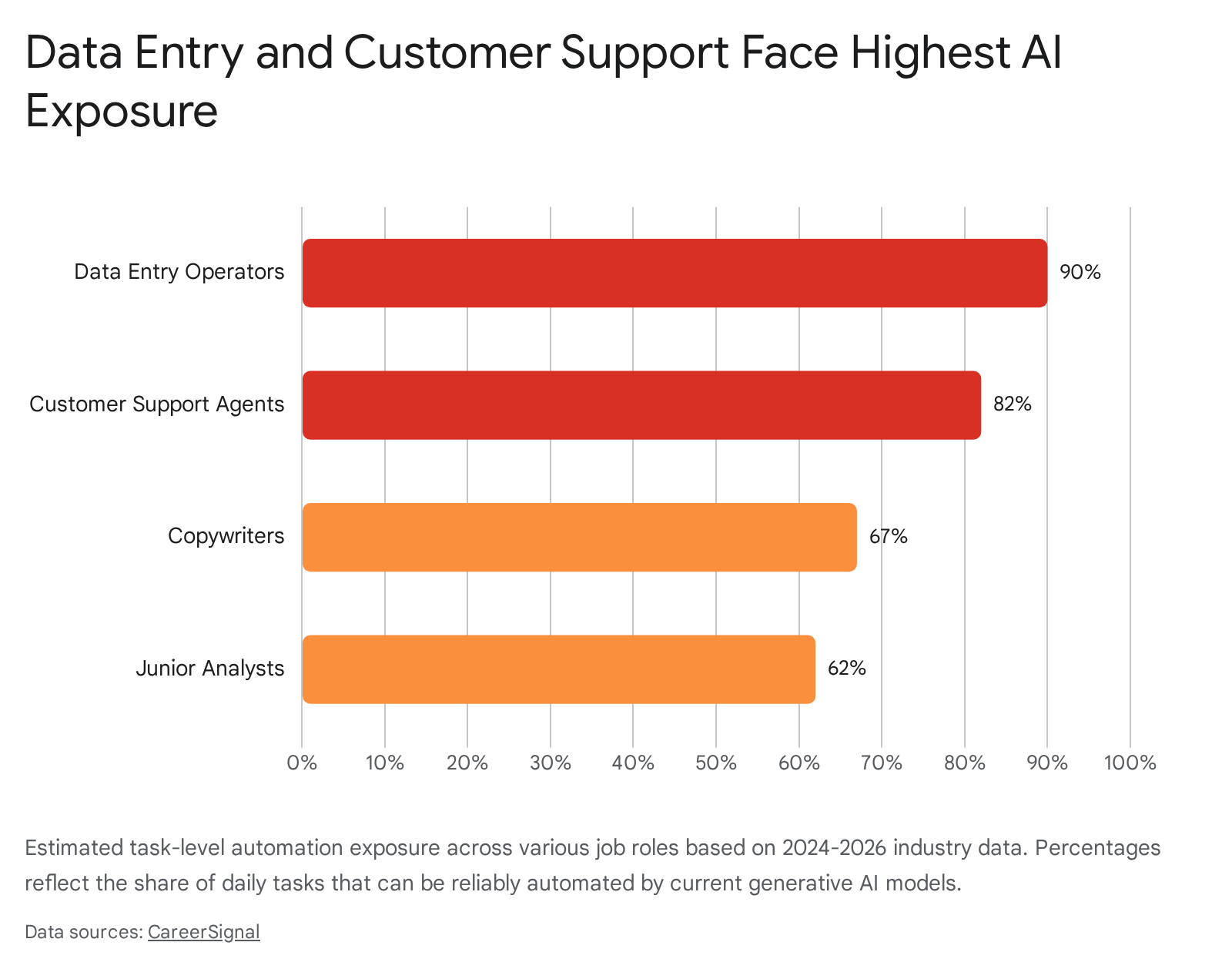
Office administration and data entry roles face immense exposure, with estimates suggesting 90% or more of core data entry tasks are now automatable 2. AI tools equipped with advanced optical character recognition (OCR) and natural language processing can ingest, format, classify, and validate data from invoices, ledgers, and bank statements without human intervention 211.
This capability forces a redefinition of administrative work. Executive assistants and clerical professionals are increasingly expected to focus entirely on higher-value work, such as interpersonal coordination, complex scheduling negotiations, and strategic decision support 11. According to McKinsey, administration roles could see up to a 26% reduction in headcount requirements as these efficiencies scale 9.
Customer Service and Routine Operations
Customer service representatives face an estimated 80% to 85% automation exposure at the task level 2. Modern AI chatbots, voice agents, and retrieval-augmented generation (RAG) systems are capable of resolving the vast majority of Tier 1 customer queries using trained corporate knowledge bases 21112.
Studies indicate that up to 80% of routine customer service roles could eventually be automated, leaving human agents to handle only complex, highly emotional, or high-stakes interactions 12. As AI intent recognition and multilingual support continue to improve in 2026, the traditional high-volume call center model is rapidly giving way to smaller teams of highly skilled human escalations experts 13.
Financial Analysis and Content Production
Routine bookkeeping - such as invoicing, payroll processing, and basic expense tracking - is now heavily automated across the corporate landscape 11. Furthermore, junior analysts face 55% to 70% task exposure, as AI-integrated corporate dashboards can automatically flag financial anomalies, synthesize data, and generate standardized reports 2. Consequently, the accounting profession is shifting away from historical ledger balancing and moving rapidly toward proactive advisory, corporate strategy, and compliance interpretation 11.
A similar trend is reshaping marketing and content production. Junior marketers, entry-level copywriters, and social media executives are seeing 60% to 75% of their core generative tasks shifted to AI 2. While current models do not replace deep brand strategy, original journalistic research, or high-level creative direction, they excel at churning out SEO-friendly product descriptions, first drafts, and variations of email sequences at immense scale 211.
Summary of Highly Affected Sectors
To contextualize the scale of this disruption, the following table summarizes the anticipated job exposure and the specific functions shifting from human to machine execution:
| Job Category | Estimated Task Exposure | Primary Automated Functions | Remaining Human Focus |
|---|---|---|---|
| Data Entry / Admin | 90%+ | OCR data ingestion, basic scheduling, document processing, formatting 211. | Strategic coordination, physical office management, decision support. |
| Customer Service | 80 - 85% | Tier 1 query resolution, basic troubleshooting, routine routing 211. | High-stakes negotiation, emotional de-escalation, complex support. |
| Basic Copywriting | 60 - 75% | First drafts, SEO generation, content variations, basic blog posts 211. | Original research, brand voice strategy, thought leadership. |
| Junior Analytics | 55 - 70% | Anomaly flagging, dashboard generation, ledger reconciliation 211. | High-level strategy, compliance, nuanced financial interpretation. |
The Demographic Impact: Who Bears the Risk?
The automation of these foundational knowledge tasks has created a severe bottleneck for junior professionals entering the workforce. The most acute disruption is occurring at the entry-level tier. Global entry-level job postings have fallen by 29.0% since January 2024 10.
This shift disproportionately impacts young workers. Recent economic analyses show that workers aged 22 to 25 in highly AI-exposed occupations experienced a 13.0% to 14.0% decline in employment relative to other demographics between 2022 and 2025 108. Entry-level hiring at the 15 largest technology companies fell by 25.0% in that same period, as organizations deployed AI to handle the routine research and coding tasks traditionally assigned to recent graduates 10. Furthermore, 51.0% of surveyed organizations reported that generative AI was directly reducing their need for entry-level roles 10.
Research from Anthropic introduces a critical metric known as "observed exposure," which combines a model's theoretical capability with real-world usage data on enterprise platforms 8. This research confirms that occupations with higher observed exposure are projected by the U.S. Bureau of Labor Statistics (BLS) to grow significantly less through 2034 8. Curiously, the workers currently occupying the most exposed professions tend to be older, female, more highly educated, and higher-paid than those in unexposed physical roles 108.
The "Labor Flip": Why Skilled Trades Are Booming
While white-collar knowledge work undergoes intense consolidation and automation, a striking counter-trend has emerged: the "labor flip." Skilled physical trades are not only resilient to AI automation but are experiencing a massive surge in demand that is directly fueled by the AI boom itself 9.
The Physical Backbone of the Digital Economy
Artificial intelligence is not purely software; it requires an enormous physical footprint. Behind every cloud system, large language model, and automated workflow sits a sprawling network of physical infrastructure. The construction and maintenance of modern data centers require a highly specialized workforce of union electricians, ironworkers, advanced machinists, and laborers 9.
Because high-density AI servers generate immense heat, cooling systems must be constantly upgraded and maintained by skilled HVAC technicians 9. As a result, demand for robotics technicians has spiked by 107% since late 2022, HVAC engineering demand has risen 67%, and overall construction roles have grown by 30% 9.
Major corporations, including legacy telecommunications giants and auto manufacturers, are aggressively ramping up blue-collar recruitment to secure talent in areas completely untouched by generative algorithms 16. This is creating a fundamental rebalancing in the American labor market, where decades of emphasis on traditional four-year college degrees are giving way to a renewed valuation of vocational training and apprenticeships 16.
Protection Against Automation
The resilience of the skilled trades stems from the severe limitations of current robotics and AI in navigating the physical world. While an LLM can write complex Python code or summarize a lengthy legal contract in seconds, it cannot navigate the unpredictable, unstructured environment of an active construction site 10. AI cannot troubleshoot an aging air compressor in a residential basement, nor can it physically replace a circuit breaker on a complex electrical panel 10.
Because these roles require hands-on physical dexterity combined with real-time, context-dependent problem-solving, they are fundamentally shielded from digital displacement. The ILO reports that the automation risk for physical roles such as roofers and construction workers sits at a mere 1.5% 10.
The U.S. Bureau of Labor Statistics continues to project solid, resilient growth across core vocational roles through 2034, including a 9% growth in electrician employment and an 8% growth for HVAC professionals 1011. Consequently, skilled trades now take longer to hire than knowledge workers, averaging 56 days to fill an open position compared to 54 days for corporate roles 9.
The AI Exoskeleton: Amplifying Human Capability
For the knowledge workers who remain in desk-based roles, the nature of their daily work is fundamentally changing. The most accurate mental model for AI in the 2026 workplace is not a new, autonomous coworker, but rather an "exoskeleton" 1920.
In manufacturing, logistics, and physical rehabilitation, robotic exoskeletons have already proven their value. Devices deployed by companies like Ford and BMW use advanced sensor arrays and machine learning to analyze a user's movements in real-time 1921. These wearable devices provide targeted physical assistance - such as 5 to 15 pounds of lift per arm - reducing muscle fatigue by up to 40% and decreasing workplace injuries by 83% 19. Crucially, the exoskeleton does not replace the worker; it makes the worker stronger, more resilient, and capable of sustained high-quality output 1922.
The Cognitive Exoskeleton at Work
This exact paradigm is now playing out digitally for knowledge workers. AI acts as a cognitive exoskeleton. It rarely operates entirely autonomously on high-stakes projects; instead, it plugs directly into existing human workflows to eliminate the "heavy lifting" of digital labor 19.
For a software engineer, this means spending seconds rather than 20 minutes drafting pull request descriptions, commit messages, and routine debugging code 19. For a financial analyst, it means uploading 15 quarterly earnings call transcripts and directing an AI agent to extract guidance language and compare sentiment trends - a synthesis task that previously took a full day, now reduced to a single hour 23. Anthropic reports that the median task time savings for these types of cognitive workflows approach 80%, with some tasks, such as compiling information from lengthy reports, seeing up to 95% time savings 24.
By offloading repetitive data processing, the digital exoskeleton preserves a worker's finite cognitive resources for the tasks that strictly require human judgment, empathy, and strategic negotiation 19. The compounding economic effects of this augmentation are massive. Since the widespread proliferation of generative AI, productivity growth in AI-exposed industries has nearly quadrupled, rising from 7% between 2018 and 2022 to 27% by 2024 25. Companies operating in these AI-enabled sectors are currently generating approximately three times higher revenue growth per employee compared to non-adopters 12.
This dynamic has created a highly lucrative premium for AI fluency. Jobs requiring advanced AI collaboration skills and technical proficiency now command a 56% wage premium compared to identical roles without those requirements, as organizations aggressively bid for talent capable of wielding these cognitive exoskeletons effectively 1025.
Emerging Careers and the New AI Workforce
While AI is undoubtedly automating legacy tasks, it is simultaneously birthing an entirely new category of professions. The World Economic Forum projects that while 92 million jobs will be displaced globally by 2030 due to AI and structural macroeconomic shifts, 170 million new roles will be created - resulting in a net positive of 78 million jobs 1025.
By 2026, major global organizations have moved beyond experimental AI pilot projects and are embedding these systems deep into their core business operations 12. This transition requires a massive influx of professionals who can build, manage, secure, govern, and monetize AI at an enterprise scale. These roles are highly specialized, often requiring a blend of technical computer science skills and high-level business acumen. They command premium salaries, frequently ranging from $155,000 to $270,000 annually in the United States 27.
Designing and Governing AI Systems
As artificial intelligence systems become more powerful and autonomous, the demand for human oversight has skyrocketed. Governments worldwide are introducing strict regulatory frameworks, such as the EU AI Act, to control how models use proprietary data and make decisions 27.
This regulatory environment has created a surge in demand for AI Governance and Compliance Leads. These professionals ensure that deployed AI models operate within legal boundaries, auditing algorithms to detect demographic bias, managing data privacy protocols, and monitoring for model drift 27.
Similarly, the role of the AI Product Manager has become crucial. Building a functional AI model in a laboratory setting is fundamentally different from deploying it as a profitable, user-friendly software product. AI Product Managers sit at the intersection of engineering, user experience, and business economics, determining which AI features are commercially viable and cost-effective to operate at scale 27.
The table below highlights several of the fastest-growing emerging roles in 2026 and their primary functions within the enterprise:
| Emerging AI Role | Primary Enterprise Function | Focus Area |
|---|---|---|
| AI Governance & Compliance Lead | Auditing models for bias, ensuring data privacy, managing legal compliance 27. | Risk mitigation, legal frameworks. |
| AI Product Manager | Translating technical model capabilities into profitable SaaS products 1227. | Commercial strategy, user experience. |
| AI Cloud Architect | Designing the distributed hardware and cloud infrastructure required to run massive models 27. | Scalability, computational efficiency. |
| Prompt / AI Interaction Engineer | Optimizing how human teams and enterprise systems interface with LLMs for accurate outputs 1213. | Workflow integration, human-AI teaming. |
| Machine Learning Engineer | Building, training, and maintaining the core predictive algorithms and neural networks 1213. | Model development, data science. |
The Global Divide: Adoption Gaps and Offshore Risks
The economic impact of AI in 2026 is profoundly uneven across different geographies. A sharp, accelerating divide has emerged between the Global North and the Global South, manifesting in three distinct macroeconomic trends: widening technological adoption gaps, an existential threat to offshore outsourcing hubs, and the rise of invisible "data laborers."
The Accelerating North-South Divide
Recent data reveals that the AI adoption gap is widening faster than early diffusion models predicted. Microsoft's Q1 2026 Global AI Diffusion Report shows that generative AI usage among the working-age population has reached 27.5% in the Global North, compared to just 15.4% in the Global South 29. This 12.1 percentage point divide represents the fastest rate of regional divergence since measurement began 29.
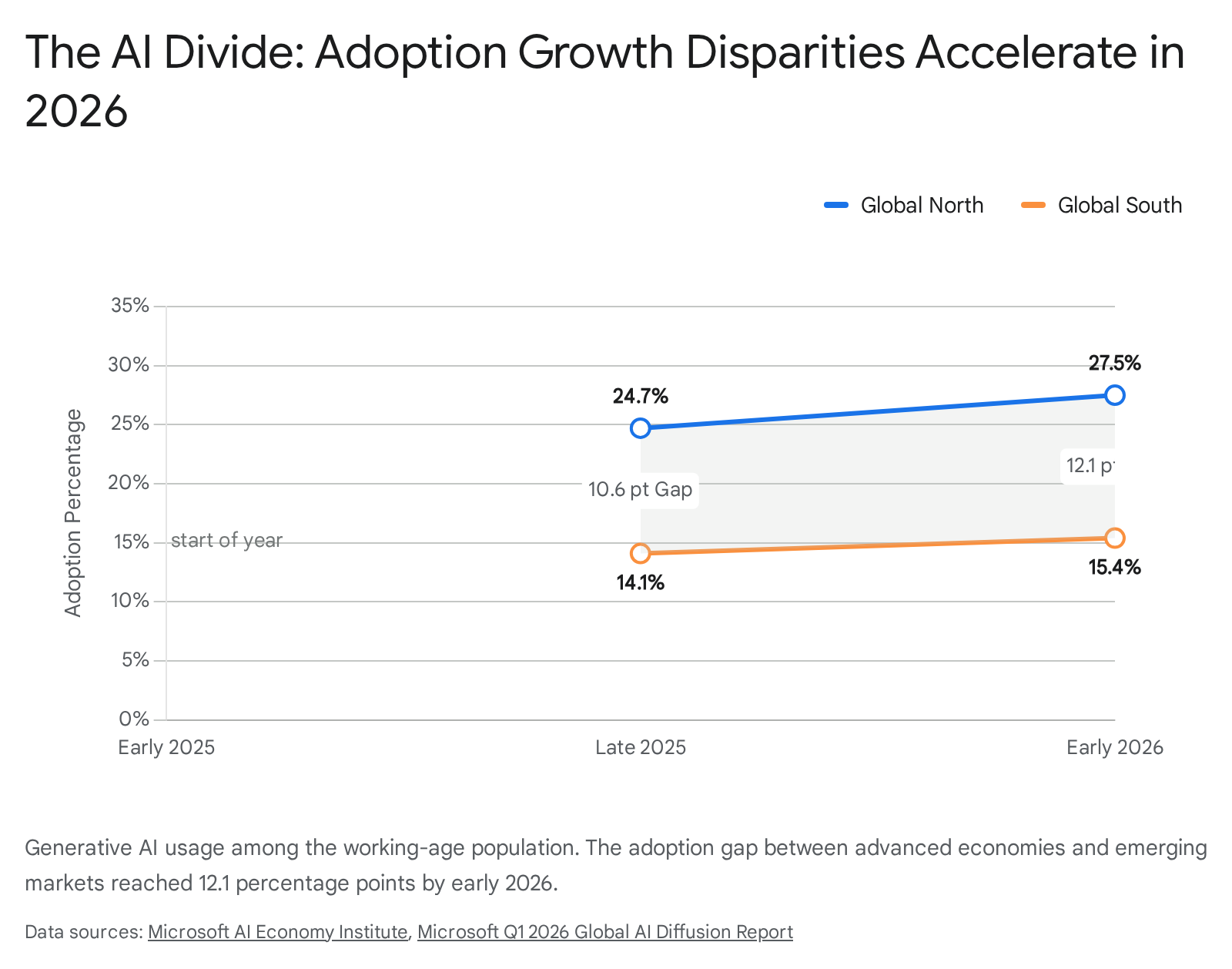
This divide is driven primarily by deep structural capacity deficits rather than a mere lack of interest. Meaningful AI adoption requires affordable high-speed broadband, stable electricity grids, and massive domestic data centers. Many emerging markets currently lack this foundational infrastructure 2930. For instance, achieving affordable universal broadband in Sub-Saharan Africa requires an estimated $418 billion in investment, a hurdle that severely restricts widespread enterprise AI deployment 30. Furthermore, a lack of local research and development funding creates a vicious cycle where low-income countries become passive consumers of Global North technology rather than creators of contextually appropriate, sovereign AI solutions 3014.
The Existential Threat to the Philippine BPO Sector
The aggressive capability growth of generative AI poses a direct, systemic risk to nations that have built their modern economies on business process outsourcing (BPO). The Philippines is ground zero for this disruption. The Philippine IT-BPM sector currently generates over $38 billion in annual export revenue and employs approximately 1.82 million professionals, accounting for roughly 8% to 9% of the nation's total GDP 3233.
Because the Philippine BPO industry has historically relied heavily on routine, rule-based tasks - such as Tier 1 customer service, data entry, and basic IT support - it is highly vulnerable to the exact automation trends reshaping the global knowledge economy 3334. Recent economic indices placed the Philippines 43rd out of 47 countries in its ability to capitalize on AI, highlighting the severe risk to its primary economic engine 34.
Recognizing that competing on cheap labor costs alone is no longer a viable survival strategy, industry leaders and the Philippine government have committed $25 million annually to retrain and future-proof the workforce 33. The sector is now aggressively pivoting away from basic voice services and toward higher-value, judgment-intensive work. This includes AI supervision, complex medical and legal documentation support, advanced data analytics, and escalated customer care that requires deep human empathy 323335.
The Invisible Workforce of Data Laborers
Paradoxically, while the Global South is at severe risk of losing traditional offshore IT jobs to AI automation, it is simultaneously providing the massive, low-paid human labor force required to build and train those very same AI systems 15.
The World Bank estimates that between 150 million and 430 million data laborers currently work behind the scenes of global AI platforms 1638. Predominantly located in Africa, South Asia, and Southeast Asia, these workers perform the grueling digital micro-tasks that make machine learning possible. They annotate vast data sets, draw precise bounding boxes around images for computer vision, transcribe audio dialects, and train content moderation algorithms 163817.
This dynamic has created a new, highly unequal global division of labor. Workers in countries like Kenya and India often earn between $1.50 and $2.00 per hour sifting through thousands of data points per shift 161718. In many cases, this involves reviewing deeply graphic, toxic, and traumatic online content necessary to train safety filters and make AI chatbots safe for Western consumers 1617.
Labor advocates and human rights organizations warn that this dynamic constitutes a modern form of "digital sweatshop" exploitation, wherein the Global North reaps the trillion-dollar economic benefits and productivity gains of AI while relying entirely on the precarious, unregulated labor of the Global South 163818. Adding a final layer of economic irony, these same data labelers are actively training the very algorithms that are expected to achieve sufficient competence to automate their own labeling jobs before the end of the decade 18.
Bottom line
In 2026, artificial intelligence is decisively shifting the labor market by automating routine cognitive, administrative, and data-processing tasks rather than wholesale eliminating entire occupations. While junior knowledge workers and offshore BPO hubs face significant structural disruption, the demand for physical skilled trades and specialized AI governance roles is experiencing an unprecedented boom. Ultimately, the workers and economies that will thrive over the next decade are those capable of leveraging AI as a cognitive exoskeleton to amplify productivity, while refocusing human capital on complex problem-solving, physical dexterity, and strategic judgment. However, the rapidly widening digital divide between the Global North and South remains a deeply concerning unknown for long-term global economic stability.