
Four Scenarios for How AI Will Affect Jobs
By 2030, artificial intelligence is projected to reshape over half of all global jobs, generating approximately 170 million new roles while displacing 92 million existing ones. However, this net positive growth masks severe localized disruption, as the ultimate impact on workers depends entirely on how quickly industries adopt the technology and whether societies actively retrain their labor forces. Rather than a singular future of mass unemployment, labor economists project four distinct potential scenarios for the global economy, ranging from collaborative augmentation to deep socioeconomic fracturing.
The Great Automation Inversion
For the past century, the prevailing economic assumption held that automation would inevitably consume blue-collar, routine physical labor first - sweeping across factory floors, warehouses, and agricultural fields - long before it could threaten the cognitive, nonroutine domains of the educated professional class 1. Historically, machines replaced human muscle, not human judgment.
Today, that paradigm has completely inverted. Generative Artificial Intelligence (GenAI), large language models (LLMs), and agentic software systems are actively automating cognitive "screen work" at a pace that physical robotics cannot match in the physical domain 1. Because the native medium of LLMs involves tasks performed through keyboards and monitors, white-collar roles are now squarely in the crosshairs of technological disruption.
Recent models combining data from the Brookings Institution, OpenAI, and the OECD reveal a stark contrast: white-collar cognitive roles currently face a 65% to 85% task exposure rate to AI, whereas blue-collar physical roles sit at a comparatively insulated 10% to 35% exposure rate 12.
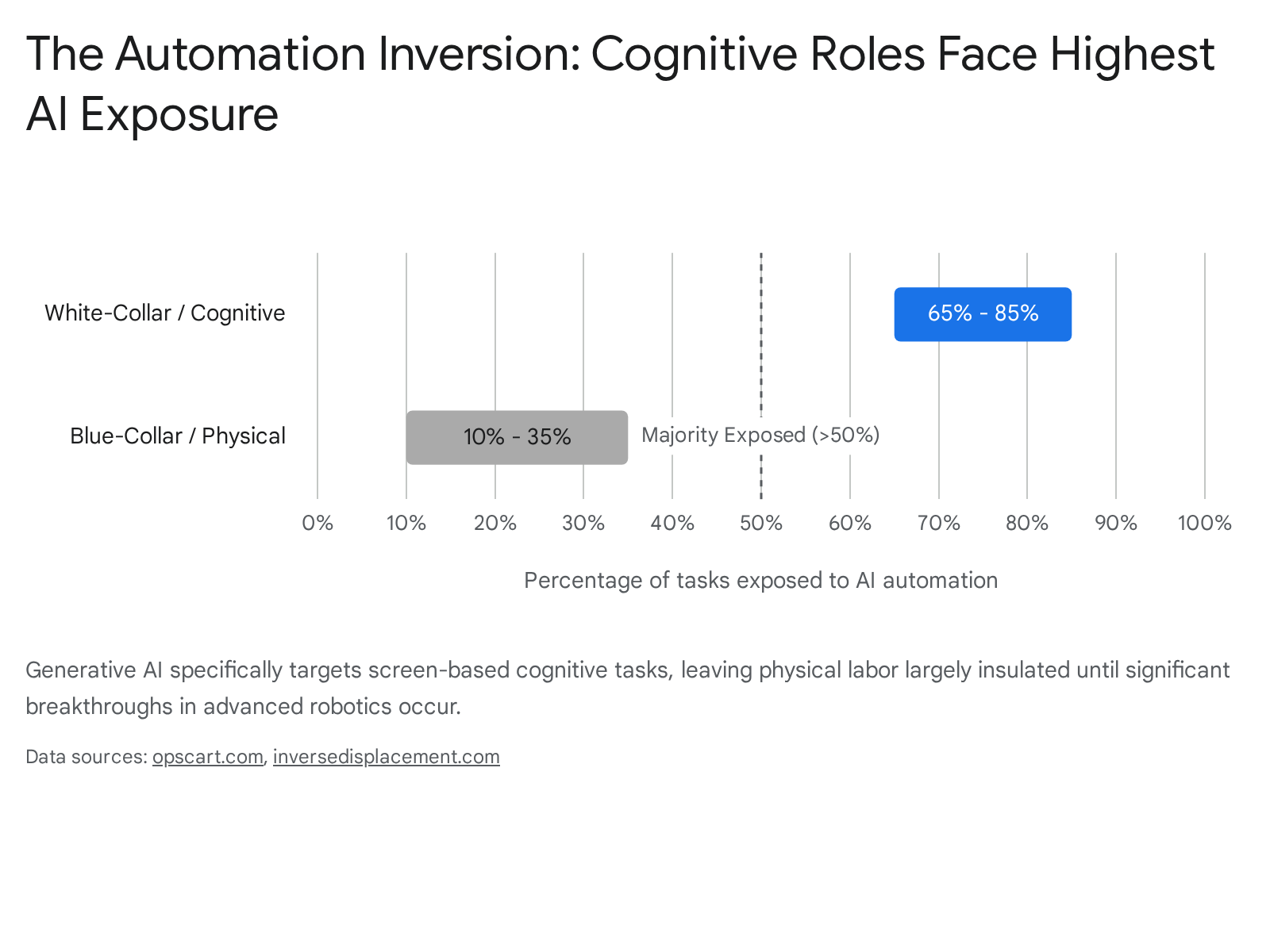
The data supporting this inversion is becoming increasingly concrete. The International Labour Organization (ILO) notes in its 2025 update that one in four workers across the world are now in an occupation with some degree of GenAI exposure 2. Interestingly, while the overall mean automation score dropped slightly from 0.30 in 2023 to 0.29 in 2025, the variability of those scores has tightened significantly 2. This indicates that exposure is becoming more uniform across cognitive professions, particularly as growing multimodal AI abilities impact voice, image, and video generation 2.
The Numbers: Projected Losses and Gains
The macroeconomic forecasts surrounding this shift are staggering. Goldman Sachs estimates that 300 million full-time roles globally face some level of AI disruption, warning that 6% to 7% of all U.S. workers could lose their jobs entirely due to AI adoption 1. Looking toward the end of the decade, the World Economic Forum (WEF) projects that 92 million jobs will be displaced by 2030, offset by the creation of 170 million new roles, yielding a net positive global gain of 78 million jobs 135.
We are already seeing the friction of this transition. In the first six months of 2025 alone, companies reported 77,999 tech industry job cuts explicitly connected to AI adoption, equating to hundreds of daily job losses 3. Major Wall Street banks are preparing to cut approximately 200,000 roles over the next three to five years as AI subsumes entry-level financial modeling and back-office administrative tasks 3. By 2027, an estimated 7.5 million data entry and administrative jobs could disappear entirely 3.
Yet, there is explosive growth on the other side of the ledger. The U.S. Bureau of Labor Statistics (BLS) projects that employment for software developers will surge 17.9% between 2023 and 2033, even as AI automates routine coding tasks 34. Demand for dedicated AI Engineers has skyrocketed by over 140%, and emerging roles like Prompt Engineer, AI Solutions Architect, and AI Product Manager are growing at rates between 35% and 110% 3. Approximately 86% of employers expect AI to radically transform their businesses by 2030, and broader access to digital technologies is expected to drive massive demand for technical human capital 5.
Understanding Task Substitution vs. Job Elimination
It is critical to distinguish between task automation and job elimination. As labor economists point out, automating 80% of a role's tasks does not automatically equate to an 80% reduction in jobs 1. By 2030, an estimated 50% to 55% of all U.S. jobs will be fundamentally "reshaped" rather than erased 5.
In these reshaped roles, the job title may persist, but the expectations transform. Workers will be expected to produce significantly higher volumes of work, manage portfolios of AI agents, and shift their focus toward strategic oversight rather than routine execution 56. For example, the BLS projects that personal financial advisors will see a 17.1% job growth rate over the next decade. Even though app-based "robo-advisors" can fully automate the core task of portfolio allocation, the demand for human advisors to manage relationships, parse complex life events, and provide empathetic counsel remains incredibly strong 4.
The Economics of Automation: Lessons from the Past
To understand how 92 million jobs can be destroyed while 170 million are created, we must look to the underlying mechanisms of economic transitions. When confronting fears of technological displacement, economists frequently point to the "Lump of Labor Fallacy" 7.
The Lump of Labor Fallacy
First coined by economist David Frederick Schloss in 1891, the Lump of Labor Fallacy is the mistaken assumption that there is a fixed, finite amount of work to be done in an economy 7. Under this zero-sum thinking, if a machine takes over a specific task, the human who previously performed that task is left permanently unemployed because the "lump" of available work has shrunk .
In reality, economies are dynamic and interconnected. When automation increases productivity, it lowers the cost of goods and services. This cost reduction leaves consumers with more disposable income and businesses with higher profit margins 8. When this excess capital is spent or reinvested, it creates additional demand in the goods and services market, which in turn increases the demand for human labor in entirely new, often unforeseen, industries 8. The fundamental demand for labor is not fixed; it expands alongside economic productivity.
The Jevons Paradox and the ATM Parable
The most famous modern rebuttal to the Lump of Labor Fallacy is the story of the bank teller and the Automated Teller Machine (ATM). When ATMs were widely introduced in the 1970s, it was uniformly predicted that teller jobs would be eradicated 7910. The logic appeared airtight: why employ a human to dispense cash and process simple deposits when a machine can do it instantly and constantly?
Yet, the empirical data tells a completely different story. In 1970, there were roughly 268,300 bank tellers in the United States 10. By 2006, after hundreds of thousands of ATMs had been deployed, the number of human tellers had actually surged to over 608,000 10.
This phenomenon is driven by the Jevons Paradox 10. By automating the routine cash-handling tasks, ATMs drastically lowered the operating cost of running a single bank branch 710. Because branches became cheaper to operate, banks opened significantly more of them to capture new market share. While the average number of tellers per branch declined slightly, the explosion in the total number of physical branches resulted in a massive net increase in teller employment 710. Furthermore, the nature of the teller's job was augmented; freed from counting physical currency, they transitioned into relationship management roles, selling high-value products like mortgages and credit cards 710.
Tech executives and politicians frequently rely on this "load-bearing parable" to reassure anxious knowledge workers today 79. The standard narrative argues that AI is simply a cognitive ATM: it will automate the tedious parts of software development, writing, and legal discovery, making workers more productive and ultimately increasing the total demand for their higher-level human judgment 910.
The Toll Booth Exception
However, history also proves that automation does sometimes permanently eradicate professions. The toll booth worker provides a stark counterexample to the bank teller 10.
For decades, human toll collectors greeted drivers and manually collected cash. The first wave of automation introduced mechanical coin buckets, followed by RFID transponder pads (like E-ZPass), and finally, AI-enhanced video camera license plate readers 10. Unlike ATMs, which expanded the banking market, automating toll collection did not lead to the construction of vastly more toll roads, nor did it free the toll worker to upsell other services to passing drivers. The technology entirely replaced the core function of the worker, and because there was no complementary, higher-value human role to evolve into, the occupation was effectively decimated 10.
The iPhone Moment: Paradigm Replacement
While the ATM story is comforting, researcher David Oks points out a critical gap in the narrative: the ATM parable has a second act that optimists rarely mention. By the 2010s, teller employment entered a prolonged and sustained decline, dropping to 347,400 by 2024 710.
What finally killed the bank teller was not a better ATM; it was the iPhone 7911.
Mobile banking apps did not attempt to automate the specific tasks of a teller behind a counter. Instead, the smartphone made the physical bank branch itself largely irrelevant for the average consumer 7911. Oks articulates that true, devastating displacement occurs through paradigm replacement, not mere task substitution 911. The ATM tried to fit technology into a labor-shaped hole, preserving the institutional context of the physical bank branch 9. The iPhone destroyed the shape of the hole entirely 911.
This distinction is essential for forecasting AI's ultimate impact. If generative AI simply writes code faster, drafts legal briefs quicker, or generates marketing copy in seconds, it acts as an ATM. It lowers the cost of production, which may drive up overall demand for software and content, ultimately keeping human orchestrators in the loop 9.
But if AI eventually builds entirely new paradigms - such as self-healing software architectures that require no human code review, or fully automated corporate entities that manage their own legal compliance - they act as the iPhone, rendering the legacy institutional context of certain professions entirely obsolete 911. Currently, the labor market remains in the gradual, "ATM" phase of AI adoption, but the "iPhone" paradigm shift looms on the horizon 9.
The Four WEF Scenarios for 2030
Because the exact trajectory of AI remains highly uncertain, the World Economic Forum (WEF) developed a comprehensive framework outlining four potential futures for the global labor market by 2030 121314. These scenarios are generated by the intersection of two independent variables: the pace of AI capability advancement (incremental vs. exponential) and the degree of workforce readiness (limited vs. widespread) 13.
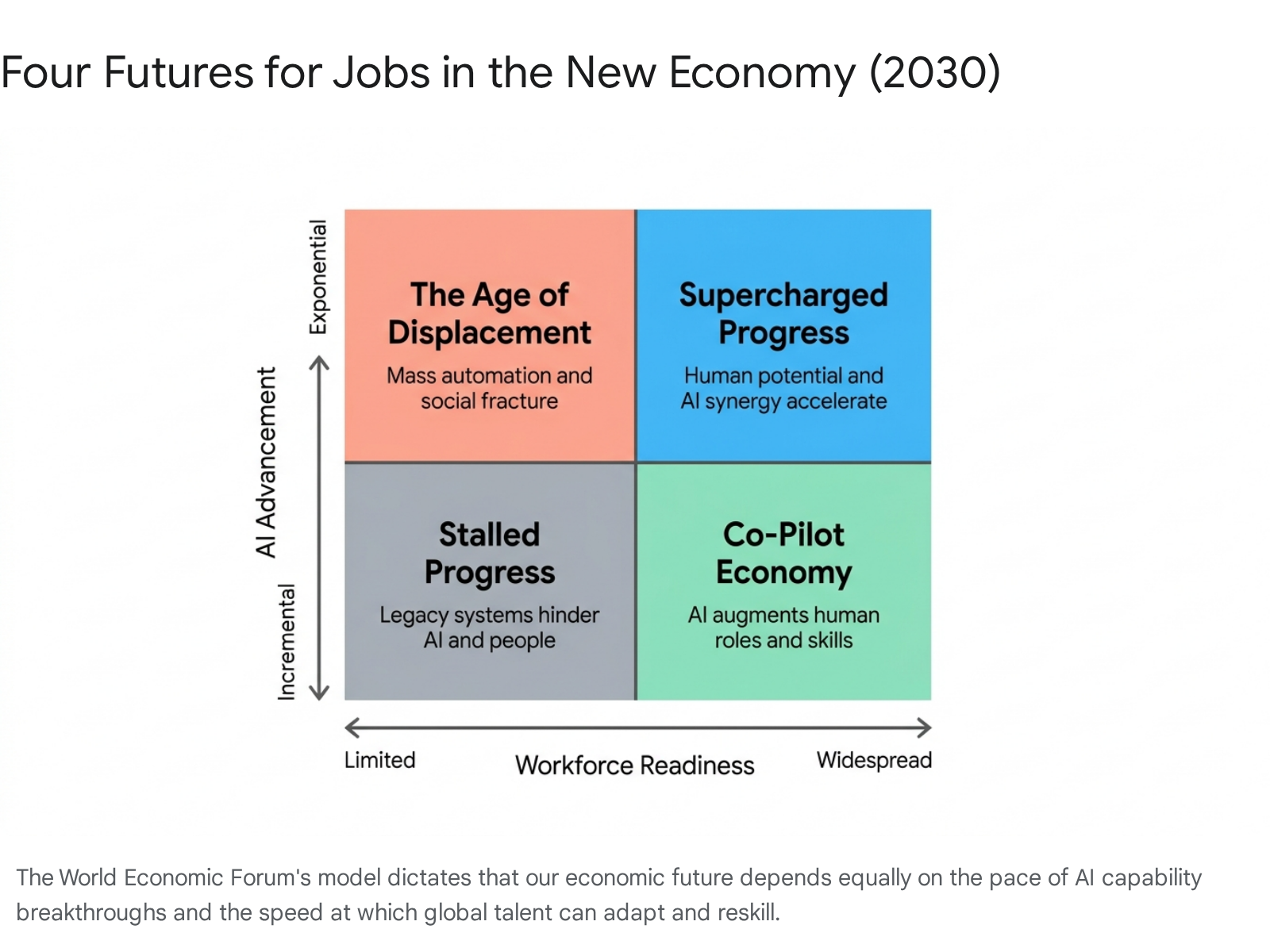
Remarkably, only one of these four futures is explicitly designed to limit large-scale social disruption and mass displacement 12.
Scenario 1: Supercharged Progress
In this highly optimistic but volatile future, AI capabilities experience exponential breakthroughs, bringing the global economy rapidly toward artificial general intelligence (AGI) 15. Capital expenditure on AI infrastructure surpasses $1.3 trillion between 2025 and 2030, making advanced, autonomous models ubiquitous across all industries 15.
Crucially, in this scenario, global education and corporate training systems successfully adapt. Because the workforce is highly prepared, workers harness the "agentic leap," transitioning seamlessly from executing specific tasks to orchestrating portfolios of capable AI agents 1319. Legacy jobs disappear, but new occupations emerge and scale so quickly that mass unemployment is partially contained 13. Productivity soars, and human-centric occupations in care, hospitality, and the public sector flourish 13. However, the sheer velocity of change leaves social safety nets and governance frameworks struggling to keep pace 1319.
Scenario 2: The Age of Displacement
This represents the most severe and dangerous trajectory. In the Age of Displacement, exponential AI advancements completely outpace the capacity of human institutions and the workforce to adapt 121319.
Faced with a workforce that lacks the necessary skills to utilize new technologies, businesses engage in pervasive, aggressive automation as a stopgap measure, displacing workers faster than they can be reskilled 121315. In high-exposure sectors, technology absorbs nearly 90% of all tasks, and traditional media is entirely overtaken by AI-generated content 13. As a result, the economy fractures socially. Unemployment spikes rapidly, consumer confidence erodes, and the concentration of wealth and power heavily favors a few global corporations that control the AI infrastructure 131916. This scenario is the result of acute talent risk, leading to widespread skill obsolescence and organizational fragility 17.
Scenario 3: Co-Pilot Economy
The Co-Pilot Economy represents a stabilized, managed transition and is the only scenario that explicitly limits massive social disruption 12. In this future, AI progresses at a more gradual, incremental pace, and the technological hype of the 2020s settles into pragmatic integration 1319.
Because the technology's evolution is predictable, governments and businesses have the time to invest in widespread upskilling 13. The focus of AI deployment shifts entirely toward augmentation rather than mass automation 1213. Across most industries, human-AI teams reshape value chains 1319. Workers retain their jobs but use AI as a co-pilot to drastically increase their efficiency and output 1319. The human element - judgment, empathy, and strategic oversight - remains legally and practically indispensable, and talent risk is actively managed 1718.
Scenario 4: Stalled Progress
In the final scenario, both AI technology and workforce readiness fail to meet expectations. AI continues to improve, but major capability breakthroughs prove exceptionally costly, and the models remain brittle and difficult to apply safely in complex real-world environments 15.
Compounding this technological plateau is a severe, chronic shortage of AI-ready talent 1315. Because workers lack the skills to implement these systems effectively, businesses only deploy automation conservatively to backfill talent shortages - especially in aging populations - rather than using it to revolutionize their business models 1519. Productivity growth remains patchy and highly concentrated in a few frontier tech sectors 1319. Displaced workers are pushed down the economic ladder into lower-skill gig work and manual services, leading to a bifurcated, stagnant economy where the promise of AI-driven prosperity fades into deep societal frustration 1319.
| WEF 2030 Scenario | AI Advancement Pace | Workforce Readiness | Dominant Market Action | Ultimate Societal Outcome |
|---|---|---|---|---|
| 1. Supercharged Progress | Exponential | Widespread | Rapid scaling of agentic AI; creation of entirely new industries. | High job churn, soaring productivity, but strained safety nets. |
| 2. Age of Displacement | Exponential | Limited | Aggressive task substitution; capital centralization. | Severe economic fracturing, mass unemployment, high inequality. |
| 3. Co-Pilot Economy | Incremental | Widespread | Augmentation of existing roles; pragmatic AI integration. | Managed labor transition, steady growth, protected legacy jobs. |
| 4. Stalled Progress | Incremental | Limited | Automation used merely to backfill talent shortages. | Patchy productivity, stagnant growth, workforce shifted to gig labor. |
The Global Divide: Advanced vs. Developing Economies
Most macroeconomic modeling regarding artificial intelligence focuses implicitly on the Global North. However, a landmark joint working paper by the International Labour Organization (ILO) and the World Bank reveals that GenAI will reshape global labor markets with profound, structural inequalities 19. The ultimate impact of GenAI on a specific country depends less on the raw capability of the technology and significantly more on the nation's baseline digital infrastructure, task organization, and institutional capacity 19.
Disruption Without Dividend
At first glance, advanced economies appear to carry the highest vulnerability to AI disruption. Developing nations generally have a higher proportion of their workforce engaged in routine manual, physical labor, and agriculture - sectors that are currently shielded from the cognitive automation powers of large language models 192021. For instance, countries in the East Asia and Pacific (EAP) region employ more people in routine manual tasks and fewer in cognitive tasks, making them historically more vulnerable to industrial robots than to GenAI 2122.
However, the ILO warns that developing nations face a much more insidious threat: they are highly susceptible to experiencing severe labor market disruption before they can realize any of AI's broader productivity gains 19.
This paradox is driven by the global digital divide. To reap the macroeconomic benefits of AI - such as launching new digital-first businesses, optimizing logistics, or orchestrating AI agents for high-value services - a nation requires robust internet access, vast data centers, and advanced, reliable energy grids 519. Many lower-income settings simply lack this foundational infrastructure 1923. Only about 10% of jobs in the EAP region involve tasks complementary to AI, compared to a 30% share in advanced economies 21.
Conversely, the specific workers in the Global South who do have reliable internet access are often employed in the exact clerical, administrative, and business process outsourcing (BPO) roles that GenAI is perfectly designed to automate 19. Because these workers are already online, their jobs can be displaced across borders almost instantly 19.
The Erosion of Upward Mobility and the Gender Gap
The jobs most vulnerable to AI in developing economies are not low-tier roles; they represent relatively high-quality positions 19. Historically, clerical, administrative, and digital outsourcing jobs have provided a vital pathway to the middle class, offering decent working conditions and steady incomes, particularly for young workers and women 1920.
Globally, women are vastly overrepresented in clerical and administrative occupations. Consequently, they are estimated to be approximately 2.5 times more likely than men to face potential automation 20. In high-income countries, the gap is wide: 9.6% of women's jobs are at the highest risk of automation compared to just 3.2% for men 3. Globally, about 4.7% of women's jobs face severe disruption, compared to 2.4% of men's 3.
In the Global South, the sudden elimination of these entry-level digital jobs threatens to sever the ladder of economic mobility entirely 19. If Western corporations leverage AI to "reshore" or fully automate outsourced work - drastically reducing the need for offshore data entry, basic coding, and customer service centers - developing nations could face a catastrophic loss of foreign capital without the internal infrastructure to pivot toward an AI-native, high-productivity economy 1923. ILO Director-General Gilbert F. Houngbo explicitly warns that if not managed carefully, AI will simply recreate and deepen massive global divides 20.
| Metric | Advanced Economies | Developing Economies |
|---|---|---|
| Primary AI Vulnerability | Widespread disruption across professional, white-collar, and knowledge-worker roles. | Concentrated disruption of high-quality clerical, administrative, and BPO jobs. |
| Productivity Potential | High. Extensive digital infrastructure allows rapid translation of AI into economic gains. | Low. Frequent lack of reliable internet, compute access, and energy grid stability constraints growth. |
| Task Composition | High density of non-routine analytical tasks that complement AI augmentation. | High density of routine tasks; fewer roles capable of being meaningfully augmented by LLMs. |
| Socio-Economic Threat | Middle-class hollowing and rising inequality if retraining systems fail to keep pace. | Destruction of primary pathways to the middle class; risk of extreme gender inequality. |
Navigating the Transition: AI-Resilient Skills
If widespread task displacement is an inevitable reality of the coming decade, the paramount question for both policymakers and individual workers is how to remain economically relevant. What makes a worker resilient to an intelligence explosion?
Current labor market data suggests a fundamental paradigm shift in how we value human capital. For the last three decades, STEM (Science, Technology, Engineering, and Mathematics) and highly specialized technical coding skills were viewed as the ultimate career moat. However, research from Georgetown University's Center for Security and Emerging Technology indicates that hard technical skills currently depreciate in just 2.5 to 5 years 2. As AI models become increasingly capable of writing production-grade software, conducting complex data analysis, and generating financial models, the market value of routine cognitive execution is plummeting 23.
The Premium on Human-Centric Capabilities
Instead of rote technical execution, the labor market is placing a massive premium on "durable AI-complementary skills" - capabilities that are intrinsically human and highly resistant to algorithmic replication 224.
These resilient skills include: * Complex Problem-Solving and Strategic Vision: The ability to contextually define the parameters of an ambiguous business problem before an AI is deployed to solve it 2. * Emotional Intelligence and Collaboration: Empathy, nuance, negotiation, and the ability to manage complex human relationships, which remain the un-automatable core of high-value service, leadership, and sales roles 216. * Ethical Judgment and AI Oversight: The critical thinking required to assess the output of generative models for bias, legal compliance, factual accuracy, and broader strategic alignment 21829.
This dynamic suggests that interdisciplinary thinkers, communicators, and systems-level managers will see a massive resurgence in value. Both higher education institutions and corporate training departments will need to shift away from teaching workers how to perform a routine task, and instead teach them how to direct machines to perform the task while critically evaluating the output 152429. As the WEF points out, the workforce will need to transition from executing tasks to acting as "agent orchestrators" 13.
The AI Retrainability Index
While the need for reskilling is clear, historical data shows that retraining initiatives for workers displaced by physical automation (such as transitioning factory workers into IT roles) often yielded mixed or poor results. However, modern data paints a more optimistic picture for cognitive automation.
A major study from the National Bureau of Economic Research (NBER) analyzing modern retraining programs highlights that workers displaced from cognitive tasks are highly adaptable 25. The NBER's "AI Retrainability Index" indicates that workers displaced from low AI-exposure occupations often capture substantial returns when they are successfully upskilled to work alongside AI, averaging about $2,200 in quarterly returns to training 25.
Furthermore, when macroeconomic labor markets remain tight, the signaling value of retraining credentials increases significantly. In these environments, employers become much more willing to look past traditional four-year degrees and hire individuals based on proven, adaptable skills acquired through accelerated, AI-focused training programs 25. Approximately 85% of employers now plan to prioritize workforce upskilling, realizing that 39% of existing skill sets will become entirely outdated between 2025 and 2030 526.
The success of the idealized "Co-Pilot Economy" scenario relies entirely on massively scaling these exact types of rapid, effective retraining programs 1318. If global businesses and governments fail to invest in the reskilling of their current workforce - opting instead to fire legacy workers and attempt to hire expensive, pre-trained AI talent - they will inevitably trigger the chaotic, unequal, and socially devastating "Age of Displacement" 1917.
Bottom line
The proliferation of generative AI marks a historic inversion in the labor market, threatening white-collar cognitive labor far more acutely than physical blue-collar work. While the aggregate number of global jobs is projected to grow by 2030, this transition will feature intense, painful sectoral churn that will fundamentally reshape the day-to-day realities of over half the workforce. The difference between a prosperous, collaborative "co-pilot" economy and a fractured era of mass displacement will depend almost entirely on rapid investments in human retraining, the expansion of digital infrastructure in the Global South, and the preservation of AI-resilient, human-centric skills. Ultimately, AI may not simply replace routine tasks like an ATM, but could act as an iPhone, forcing society to adapt to entirely new paradigms of work.