
Why We Yawn and Whether It's Really Contagious
Yawning is an ancient, involuntary reflex that regulates brain temperature and jumpstarts physiological alertness, rather than simply drawing more oxygen into the bloodstream. Contagious yawning is a fully documented scientific phenomenon driven by the brain's mirror neuron system, which likely evolved to help social animals synchronize group behavior and maintain collective vigilance. While catching a yawn has long been heavily associated with deep emotional empathy, recent large-scale research suggests that basic factors like your age, the temperature of your environment, and how tired you are remain much stronger predictors of whether you will yawn back.
The Physiological Mystery: What Causes Spontaneous Yawning?
For a behavior so universally recognized, yawning has historically received remarkably little attention from modern medical science. Since antiquity, it has been the subject of folklore, philosophy, and cultural myth. Hippocrates theorized that yawning served to evacuate fever from the body, while ancient Islamic traditions posited that a yawn was a moment of spiritual vulnerability that required covering the mouth 12.
Today, clinical science defines a yawn (or oscitation) as a stereotyped motor action pattern characterized by three distinct phases. It begins with a long inspiratory phase (a deep breath in) with gradual mouth gaping. This is followed by a brief climax, or acme, characterized by intense muscle stretching across the jaw, neck, and throat. The reflex concludes with a rapid expiratory phase, where air is pushed out and the muscles rapidly relax 34. This sequence typically lasts between four and seven seconds 34.
This reflex is shared across almost all vertebrates. Fish, amphibians, reptiles, birds, and mammals all yawn, pointing to a deeply conserved evolutionary origin 45. It is such an ingrained biological mechanism that human fetuses are observed yawning in the womb as early as twelve weeks of gestation 16. Because yawning is so ubiquitous across the animal kingdom, evolutionary biologists agree it must serve a vital physiological function. However, the exact nature of that function has been heavily debated in the literature for decades.
Debunking the Oxygen Myth
If you ask the average person why we yawn, the most common answer is that the brain is running low on oxygen or has built up too much carbon dioxide. According to this theory, the massive inhalation of a yawn acts as an emergency respiratory pump to restore gas balance in the blood 7.
Despite its logical appeal, this hypothesis has been thoroughly debunked by modern physiological research. In a landmark 1987 study, researchers tested the oxygen theory by having college students breathe different mixtures of gases. Some participants breathed 100% pure oxygen, while others breathed gas mixtures with artificially high levels of carbon dioxide, ranging from 3% to 5% 78. If the oxygen hypothesis were true, breathing pure oxygen should have stopped the yawning reflex entirely, and high carbon dioxide should have triggered uncontrollable yawning fits.
Instead, the altered gas levels had no significant effect on how often the participants yawned, even though the excess carbon dioxide predictably increased their standard breathing rates 18. A secondary study demonstrated that physical exercise intense enough to double a person's breathing rate also had absolutely no impact on yawning frequency 78. Furthermore, the observation that human fetuses yawn while submerged in amniotic fluid - where they rely entirely on the umbilical cord for oxygen rather than their own lungs - completely severs the link between yawning and lung oxygenation 19. Researchers now agree that yawning and regular breathing operate on entirely different internal mechanisms and are triggered by different physiological states 7812.
The Brain Cooling Hypothesis
If yawning does not exist to increase oxygen levels, what does the massive intake of air actually accomplish? The leading modern consensus points to thermoregulation. Specifically, the "Brain Cooling Hypothesis" proposes that yawning functions as the brain's natural radiator 3710.
The human brain is incredibly metabolically active. It consumes a massive amount of energy and generates significant heat throughout the day. When brain temperature rises slightly - often due to fatigue, stress, metabolic demands, or a warm external environment - mental alertness and cognitive efficiency begin to decline 710. A yawn combats this neurological overheating through two distinct physiological mechanisms.
First, the mechanical action of the yawn plays a critical role. The powerful stretching of the jaw and neck muscles during a yawn forcefully pushes warm blood away from the head and increases the circulation of cooler blood and spinal fluid back up to the brain 511. Second, the deep, rapid inhalation of ambient air cools the venous blood draining from the nasal and oral cavities. This air exchange specifically chills the blood entering the cavernous sinus, which heavily surrounds the internal carotid artery. This chilled blood then circulates, cooling the rest of the brain through a process of convective heat exchange 37.
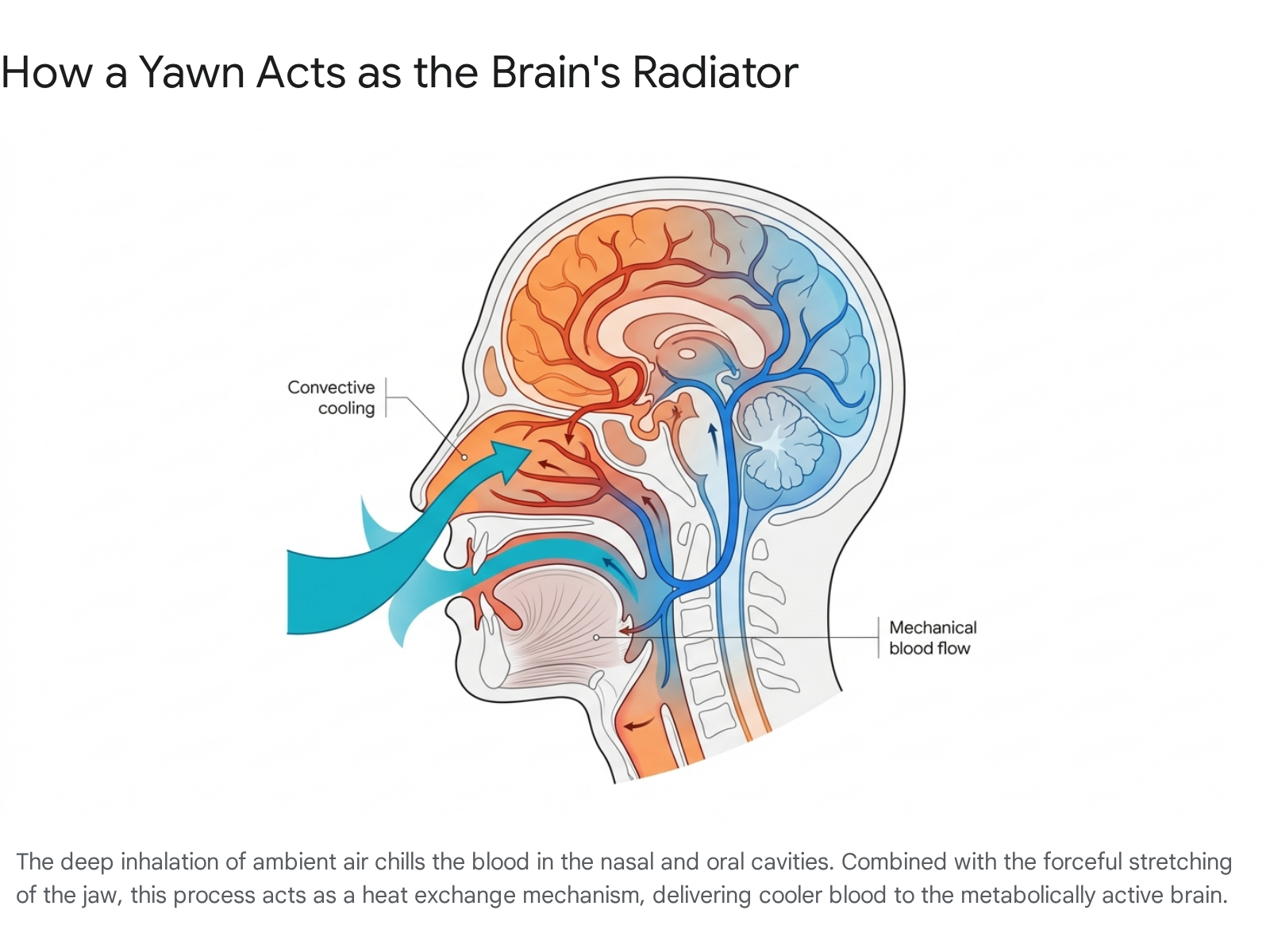
The empirical evidence supporting this theory is compelling. In laboratory studies involving rats, continuous monitoring of prelimbic brain temperatures using thermocoupled probes revealed precise thermal patterns. Brain heat spiked rapidly in the minute leading up to a yawn, and dropped significantly immediately after the yawn concluded, demonstrating a direct homeostatic response 71211.
The Thermal Window
Further behavioral evidence for the brain cooling mechanism comes from the concept of the "thermal window." If yawning is biologically designed to cool the brain using outside air, it should theoretically only occur when the ambient air is actually cooler than the body's internal temperature 712.
Researchers tested this constraint by observing and surveying pedestrians in two drastically different climates: the arid desert environment of Tucson, Arizona during a scorching summer where temperatures hovered around 37°C (98.6°F, roughly human body temperature), and the cooler climate of Austria during the winter 71213. The studies found that people yawn far less frequently when ambient temperatures match or exceed core body temperature. In excessive heat, inhaling air provides no convective cooling benefit and could actually warm the brain further, inhibiting the reflex 1214.
Conversely, in extreme winter cold, the brain is already sufficiently cooled by the environment, rendering the thermal regulation of yawning largely unnecessary 1214. The data indicates that yawning hits its peak frequency in moderately warm conditions, perfectly fitting the profile of a specialized thermoregulatory reflex operating within a specific environmental thermal window 71214.
Arousal, Alertness, and State Transitions
While brain cooling addresses the physical mechanism of the yawn, the action also serves a broader neurological purpose: managing transitions in our state of arousal.
Yawning frequently occurs when people are drowsy, bored, or preparing for sleep, which leads to the widespread misconception that yawning is what makes us tired. In reality, neurological evidence suggests yawning is the body's attempt to actively fight off sleep and maintain vigilance 1310. The physical act of a yawn stimulates the carotid artery, causes heart rate to rapidly rise, and triggers a surge of electrical conductance in the skin. This physiological profile is remarkably similar to the effects of consuming caffeine, indicating that the yawn is a wake-promoting event 515.
Furthermore, yawning acts as a neurological bridge during "state transitions." Humans consistently yawn when shifting from sleeping to waking, from a state of high alertness to relaxation, or from monotonous boredom to focused attention 1416. By forcing a sudden moment of hyper-arousal and increased cerebral blood flow, the brain resets its internal networks to adapt to a changing environment or a new set of demands.
Evaluating the Theories of Spontaneous Yawning
To summarize the current scientific landscape regarding why humans and other vertebrates yawn in isolation, the table below compares the leading physiological hypotheses and their current standing in the scientific community.
| Hypothesis | Proposed Mechanism | Current Scientific Status | Key Evidence |
|---|---|---|---|
| Brain Cooling | Jaw stretching and deep inhalation of ambient air cool the blood supplying the brain via the cavernous sinus. | Leading Consensus | Yawning frequency drops in extreme heat (37°C) and extreme cold; brain temperatures in rats drop immediately post-yawn 71214. |
| Arousal / State Transition | Muscle stretching stimulates the brainstem; heart rate and skin conductance increase to fight off sleep. | Widely Accepted | Yawning peaks during sleep-wake transitions; physical responses mimic the physiological arousal profile of caffeine 515. |
| Oxygen / Carbon Dioxide Balance | Deep inhalation forcefully corrects low blood oxygen or high carbon dioxide levels in the lungs. | Debunked | Breathing pure oxygen or high-CO2 gas mixtures has zero effect on yawning frequency; human fetuses yawn in amniotic fluid without using lungs 18. |
The Mechanics of Contagious Yawning
While spontaneous yawning helps an individual regulate their own brain temperature and alertness, it does not explain one of the most famous and perplexing quirks of human biology: contagious yawning.
Observational studies indicate that between 40% and 60% of healthy adults will experience a contagious yawn if exposed to someone else yawning 1718. Furthermore, you do not even need to see the action to catch it. Hearing the specific auditory cue of a yawn, reading the word "yawn," or simply thinking about the act of yawning is often enough to trigger the reflex in susceptible individuals 61923. Auditory yawns presented in isolation have been proven to elicit yawning in up to 49% of participants, matching the efficacy of visual stimuli 919.
Mirror Neurons and Motor Empathy
Neuroscientists attribute contagious yawning to the brain's "Mirror Neuron System" (MNS). Mirror neurons are a highly specialized class of brain cells that fire both when an individual performs a specific action and when they observe someone else performing that exact same action 182025.
When you watch a colleague yawn across a meeting room, your visual processing centers - specifically the Superior Temporal Sulcus (STS) - process the biological motion of their jaw opening and eyes squeezing shut 921. This visual and spatial data is immediately transmitted to the mirror neuron system, specifically activating the right inferior frontal gyrus and the anterior cingulate cortex. These regions are heavily involved in motor planning, emotional processing, and social cognition 182122.
Upon receiving the signal, these mirror neurons create a subconscious simulation of the other person's action. Your brain essentially drafts a motor plan to yawn, mirroring the fatigue, stress, or thermal state of the person you are observing. This process bypasses high-level, conscious cognitive reasoning, which is why a contagious yawn feels entirely involuntary 21. If the urge is not actively suppressed by the prefrontal cortex, your motor cortex executes the yawn, completing what psychologists call the "chameleon effect" 1821.
This neurological mirroring is a form of nonconscious mimicry. In highly social species, mimicking the physical postures, facial expressions, or grooming behaviors of others acts as a form of social glue, enhancing group cohesion, increasing feelings of liking, and reinforcing interpersonal rapport without requiring active communication 182823.
The Great Empathy Debate
Because contagious yawning relies heavily on the mirror neuron system - the same neurological hardware that allows humans to understand other people's emotions and perspectives - researchers have long theorized that catching a yawn is a fundamental biological signal of empathy 61718.
The "empathic modeling hypothesis" suggests that people who are highly empathetic are naturally more susceptible to contagious yawning because their brains are more finely tuned to the internal emotional and physical states of those around them 18. However, the scientific consensus on this hypothesis is currently deeply fractured. While early studies showed strong links between empathy scores and yawn contagion, recent large-scale data sets have upended several long-standing psychological assumptions.
The Familiarity and In-Group Bias
One of the strongest arguments supporting the empathy link is the well-documented "familiarity bias." In a comprehensive year-long observational study conducted across natural settings in Italy and Madagascar, researchers meticulously documented contagious yawning among adults during mundane activities like train rides and dinners. They found that the likelihood, frequency, and latency of catching a yawn was deeply tied to emotional proximity 424.
The statistical models revealed that the rate of contagious yawning was highest among kin (immediate family members). This was followed by close friends, then loose acquaintances, and the contagion rate was lowest among complete strangers 42425. This phenomenon suggests that emotional proximity, rather than mere spatial proximity, dictates the sensitivity of our mirror neurons.
Furthermore, studies have shown that human yawning can be heavily influenced by subtle societal markers, such as race. In a cross-cultural study examining implicit bias, Black and White participants viewed videos of individuals from varying racial and gender categories yawning. The analysis revealed that participants experienced significantly more contagious yawns in response to members of their own racial in-group than to out-group members, indicating that subconscious social identification plays a powerful role in behavioral contagion 1726. The study noted, however, that individual empathy scores did not correlate with the number of yawns, suggesting race was an independent and highly salient driver 1726.
Unraveling the Psychopathy Myth
If empathy drives contagious yawning, does a failure to catch a yawn indicate a clinical lack of empathy? In 2015, a widely publicized study from Baylor University seemed to suggest exactly that. Researchers tested 135 college students using the Psychopathic Personality Inventory-Revised, evaluating traits such as cold-heartedness, manipulation, and a lack of empathy. Participants were then wired to electrodes to measure physiological responses while watching yawning videos 272829.
The study found a distinct correlation: the less empathy a person demonstrated on the psychological inventory, and the less likely they were to startle, the less frequently they caught a yawn 2729. This research sparked a persistent internet and pop-psychology myth that immunity to contagious yawning is a hidden diagnostic sign of psychopathy.
However, recent, vastly larger studies have fundamentally shifted this narrative and urged caution. In 2021, an international team of scientists published the largest study on contagious yawning to date, evaluating 458 participants from over 50 different nationalities. Participants completed comprehensive psychopathy questionnaires alongside yawning contagion tests 233037.
While the researchers did find a statistically significant negative correlation between psychopathic traits and yawning, the effect size was relatively weak and was entirely eclipsed by a much simpler physiological factor: tiredness 3037. Self-reported fatigue was by far the strongest predictor of whether someone caught a yawn across all models, heavily overriding personality traits, emotional connectivity, and empathy scores 2337. The researchers specifically warned against diagnosing friends or partners as psychopaths or sociopaths simply because they do not yawn back. As lead researcher Dr. Jorg Massen noted, "He or she might just not be tired enough" 23.
The Role of Age and Fatigue
Complicating the empathy hypothesis further is a highly comprehensive study conducted by the Duke Center for Human Genome Variation. After exhaustively testing 328 healthy volunteers across multiple sessions to ensure yawn contagion was a stable trait, researchers found absolutely no strong connection between contagious yawning and variables like empathy, intelligence, or energy levels 6.
According to the Duke researchers, the only independent factor that significantly predicted contagious yawning was age. As participants grew older, they became significantly less likely to catch a yawn 6. However, even age only accounted for 8% of the statistical variance, leaving the vast majority of contagious yawning behavior completely unexplained by any measured psychological, cognitive, or demographic metric 6.
What researchers have firmly established is that contagious yawning is a developmental milestone. Infants and toddlers do not catch yawns; they only yawn spontaneously. The susceptibility to contagious yawning only emerges around age four or five 202131. This timeline perfectly coincides with the developmental emergence of "Theory of Mind" - the critical cognitive stage where a child first realizes that other people have thoughts, feelings, and physical perspectives distinct from their own 21.
Interspecies Contagion: Do Animals Catch Our Yawns?
Contagious yawning is not a uniquely human trait. It is a highly conserved evolutionary behavior observed in chimpanzees, bonobos, macaques, wolves, sheep, elephants, and domesticated dogs 5182032. For wild social animals, contagious yawning serves a vital survival function by synchronizing group behavior and maintaining collective awareness.
Imagine a flock of birds or a troop of baboons. When the sun sets and the group needs to transition from active foraging to resting, yawning serves as a non-verbal broadcast signal 16. As the yawn ripples through the group, it aligns the circadian rhythms and arousal levels of the collective. It ensures that all members transition to a state of rest simultaneously, reducing the risk that one individual might be sleeping alone and vulnerable, thereby optimizing the group's collective safety against predators 116. In baboons, yawning can even take on an aggressive communicative function, used to bare prominent canine teeth during competitive contexts or when predators approach 32.
The Canine Empathy Controversy
Domestic dogs occupy a unique space in contagious yawning research because they are one of the few species proven to catch yawns from a completely different species: humans 43334.
A landmark 2008 study from the University of London found that 72% of dogs would yawn in response to a human yawning - a remarkably higher contagion rate than is typically found among humans or chimpanzees 3334. Subsequent studies conducted in Japan in 2013 suggested that dogs were significantly more likely to catch yawns from their specific owners than from strangers. Researchers monitored the dogs' heart rates to rule out stress responses, leading them to hypothesize that dogs have developed a rudimentary form of cross-species empathy through thousands of years of domestication 3342.
However, the scientific pendulum regarding canine empathy has swung back in recent years. A rigorous Bayesian multilevel reanalysis published in 2020 and 2026 evaluated six separate dog-yawning studies. This extensive analysis found robust, undeniable evidence that dogs do catch human yawns, but it found absolutely no statistical evidence for a familiarity bias, a gender bias, or a prosocial bias 43. Dogs were just as likely to yawn at complete strangers or antisocial demonstrators as they were at their beloved owners. This led researchers to conclude that while contagious yawning is present in dogs, it is likely a product of basic behavioral mimicry, mild stress, or arousal coordination, rather than a genuine signal of empathetic mechanisms 4243.
Humans Catching Animal Yawns
Interestingly, the interspecific (cross-species) contagion effect works in reverse as well. A 2022 study sought to determine if humans catch yawns from animals. Researchers exposed nearly 300 human participants to videos of different animals yawning, spanning fish, amphibians, reptiles, birds, non-primate mammals, apes, and domesticated pets like cats and dogs 3545.
The results were striking: humans exhibited strong contagious yawning across the board, with nearly 69% of participants reporting yawn contagion during testing 35. The phylogenetic distance (how closely related humans are to the animal on the evolutionary tree) and the level of domestication did not significantly alter the contagion rates 3545. A human is statistically just as likely to catch a yawn from a fish or a frog as they are from a domesticated dog or a chimpanzee. This suggests that the human mirror neuron system is deeply primitive. It is triggered by the generalized, ancient motor pattern of a gaping mouth and stretched jaw, regardless of the biological species displaying it 3545.
Summarizing Contagious Yawning Across Species
To clarify how yawn contagion manifests across different evolutionary branches and whether it is driven by empathy or basic social synchronization, the table below highlights key behaviors among extensively studied species.
| Species | Yawn Contagion Susceptibility | Evidence for Empathy Link | Primary Function / Observations |
|---|---|---|---|
| Humans | High (40 - 60% of adults). Emerges around age 4-5. | Mixed. Influenced by familiarity, but tiredness and age are the dominant overall predictors 62337. | Group synchronization, shared arousal states, empathic modeling. |
| Chimpanzees / Bonobos | High. More susceptible to in-group members and dominant individuals. | Strong. Clear familiarity bias indicates emotional bonding heavily influences the contagion 2536. | Social cohesion, tension reduction, group coordination. |
| Domestic Dogs | High (interspecific - routinely catch human yawns). | Weak/Debated. Recent Bayesian reanalysis shows no familiarity bias, contradicting the empathy hypothesis 43. | Mild stress response, basic behavioral mimicry, reading human communication cues. |
Clinical Significance: When is Yawning a Symptom?
For the vast majority of the population, yawning is an entirely benign, harmless quirk of neurobiology. However, extreme deviations in yawning behavior can occasionally serve as a supplementary clinical diagnostic tool.
Excessive Spontaneous Yawning
If an individual yawns excessively in the absolute absence of tiredness, boredom, or a contagious visual trigger, it may indicate an underlying medical condition 1015. Excessive yawning can be triggered by a vasovagal reaction, where the vagus nerve (which connects the brainstem to the abdomen and heart) interacts irregularly with blood vessels, sometimes serving as an early warning sign for cardiovascular distress, heart attacks, or bleeding around the heart 5.
Because yawning is heavily tied to the hypothalamus and brain temperature, conditions that inhibit brain function, alter core body temperature, or induce chronic fatigue frequently cause excessive yawning as the body struggles to maintain neurological homeostasis. Multiple Sclerosis (MS), Parkinson's disease, stroke, sleep apnea, and epilepsy are all known to trigger excessive yawning 121015. Additionally, certain prescription medications, particularly Selective Serotonin Reuptake Inhibitors (SSRIs) used to treat depression, and opioids, are well-documented pharmacological triggers for excessive yawning 310.
The Absence of Contagious Yawning
Conversely, a complete lack of contagious yawning is sometimes noted in psychiatric and neurological assessments. Conditions that feature impaired social skills, difficulty processing emotional cues, and deficits in theory of mind - specifically Autism Spectrum Disorder (ASD) and schizophrenia - are associated with a significantly diminished susceptibility to contagious yawning 461837.
Research shows that children with ASD actually yawned less during videos of people yawning than during control videos 4. Because individuals with ASD or schizophrenia may experience atypical development in the mirror neuron system, or process social and facial gazing patterns differently, they often bypass the nonconscious mimicry that triggers a contagious yawn in neurotypical individuals 41837. While a lack of contagious yawning is never used as a standalone diagnostic tool, it offers neuroscientists a fascinating window into how the human brain processes social connection and empathic resonance at a cellular level.
Bottom line
Yawning is a deeply ancient, evolutionary reflex designed to cool the brain and regulate our internal state of alertness, completely independent of our physiological need for oxygen. Contagious yawning is a real, involuntary response triggered by the brain's mirror neuron system, acting as an automatic behavioral tool to synchronize the arousal levels and vigilance of social groups. While catching a yawn has long been romanticized as a strict measure of a person's emotional empathy, modern science reveals that basic physiological factors - namely your age, the ambient temperature, and how physically tired you are - play a much larger and more consistent role in whether you will mirror someone else's fatigue.