Science of laughter and its effects on social bonds and health
Laughter is a universal human behavior, frequently conflated in popular understanding with the cognitive experience of humor. While humor refers to the mental processing of incongruities or amusing stimuli, laughter constitutes the physiological and motor expression that often, but not exclusively, accompanies it. The study of laughter and humor spans evolutionary biology, cognitive neuroscience, psychology, and cross-cultural anthropology, revealing a complex phenomenon deeply embedded in human social survival. Far from being a mere reflexive response to comedy, laughter serves as an intricate nonverbal signaling system, a mechanism for group cohesion, and a biological process with distinct neuroanatomical pathways.
Evolutionary Origins of Laughter
To understand how laughter functions in contemporary human societies, researchers trace its phylogenetic roots to non-human animal play behaviors. Comparative behavioral studies suggest that laughter-like vocalizations have a deep evolutionary heritage, originating millions of years before the emergence of anatomically modern humans.
Homology with Non-Human Play Vocalizations
Laughter is not unique to Homo sapiens. Evidence of primitive laughter has been documented across several mammalian species, particularly within the context of social play and tickling 123. Affective neuroscience research has identified that rats produce ultrasonic vocalizations - approximately 50-kHz chirps - during rough-and-tumble juvenile play and tickling 14. These vocalizations occur strictly in cheerful, playful contexts and disappear entirely under conditions of stress, functionally mirroring the joyful laughter of human children 14. Other mammals, including dogs, squirrel monkeys, and flying foxes, also exhibit context-specific vocalizations during physical play 235.
The connection between human laughter and non-human animal play is most pronounced in other primates. Great apes, including chimpanzees, bonobos, gorillas, and orangutans, produce "play pants" or laugh-like vocalizations during tickling and physical play 23. Acoustic analyses indicate that these primate vocalizations likely began as auditory byproducts of labored breathing during physical exertion 23. Over evolutionary time, a process of ritualization transformed these physiological breathing cues into sophisticated communicative signals. These signals affirm non-hostile intent, encourage the continuation of play, and promote social cohesion without escalating into aggression 23.
Phylogenetic Emergence in Hominins
Phylogenetic reconstructions based on acoustic analyses of tickle-induced vocalizations in great apes suggest that the common ancestor of humans and great apes, living approximately 14 to 18 million years ago, likely exhibited basic laugh-like behaviors 56. However, significant acoustic divergence has occurred across the primate lineage. For instance, while African apes (chimpanzees, bonobos, and gorillas) utilize a breathy, panting laughter during play, orangutans predominantly produce squeaks 5.
Following the evolutionary split between hominins and the common ancestor shared with chimpanzees and bonobos, hominin laughter underwent substantial acoustic and functional shifts 5. Ancestral hominins evolved the capacity to produce a higher proportion of voiced components - tonal, harmonically structured features attributable to vocal fold vibration - distinguishing human laughter from the primarily unvoiced panting of other primates 7. Human social complexity drove the evolution of laughter from a play-specific vocalization into a highly versatile pragmatic signal capable of navigating intricate intragroup and intergroup dynamics 25. Consequently, human laughter expanded beyond the narrow confines of physical play to become a ubiquitous signaling tool integrated into almost every form of social communication 5.
Acoustic Properties of Laughter
A critical breakthrough in the scientific study of laughter is the distinction between involuntary, stimulus-driven laughter and voluntary, socially modulated laughter. These two manifestations rely on different neural circuitries, emerged at different evolutionary stages, and possess distinct acoustic signatures.
Duchenne Versus Non-Duchenne Mechanisms
Researchers broadly classify laughter into two distinct categories: Duchenne (spontaneous) and non-Duchenne (volitional) laughter 18.
Duchenne laughter, named after the French physician Guillaume Duchenne, is an involuntary, reactive, and highly emotional response driven by genuine amusement or external positive stimuli 189. Physiologically, it is characterized by the unforced contraction of both the zygomatic major muscle (which raises the corners of the mouth) and the orbicularis oculi muscle (which crinkles the eyes) 9. Duchenne laughter evolved first, serving as an honest, hard-to-fake signal of cooperative intent and positive affect 110. Because it is driven by deep subcortical emotional centers, it is difficult to accurately simulate 18.
Non-Duchenne laughter is voluntary, deliberate, and socially controlled. It lacks the involuntary involvement of the orbicularis oculi muscles 9. While it is primarily used to navigate conversations, signal polite agreement, or ease social tension, it is also occasionally referred to as the "dark side of laughter" because it can be deployed deceptively or aggressively to mock, taunt, or degrade others 111. Because it is generated through conscious motor control, non-Duchenne laughter is believed to have evolved later, alongside the development of human speech and complex social hierarchies 110.
Acoustic Structure and Perceptual Cues
The basic acoustic architecture of human laughter typically consists of a series of short, 75-millisecond notes (calls or bursts) produced during exhalation, separated by intervals of about 200 milliseconds 8. However, spontaneous and volitional laughs diverge significantly in their specific acoustic parameters.
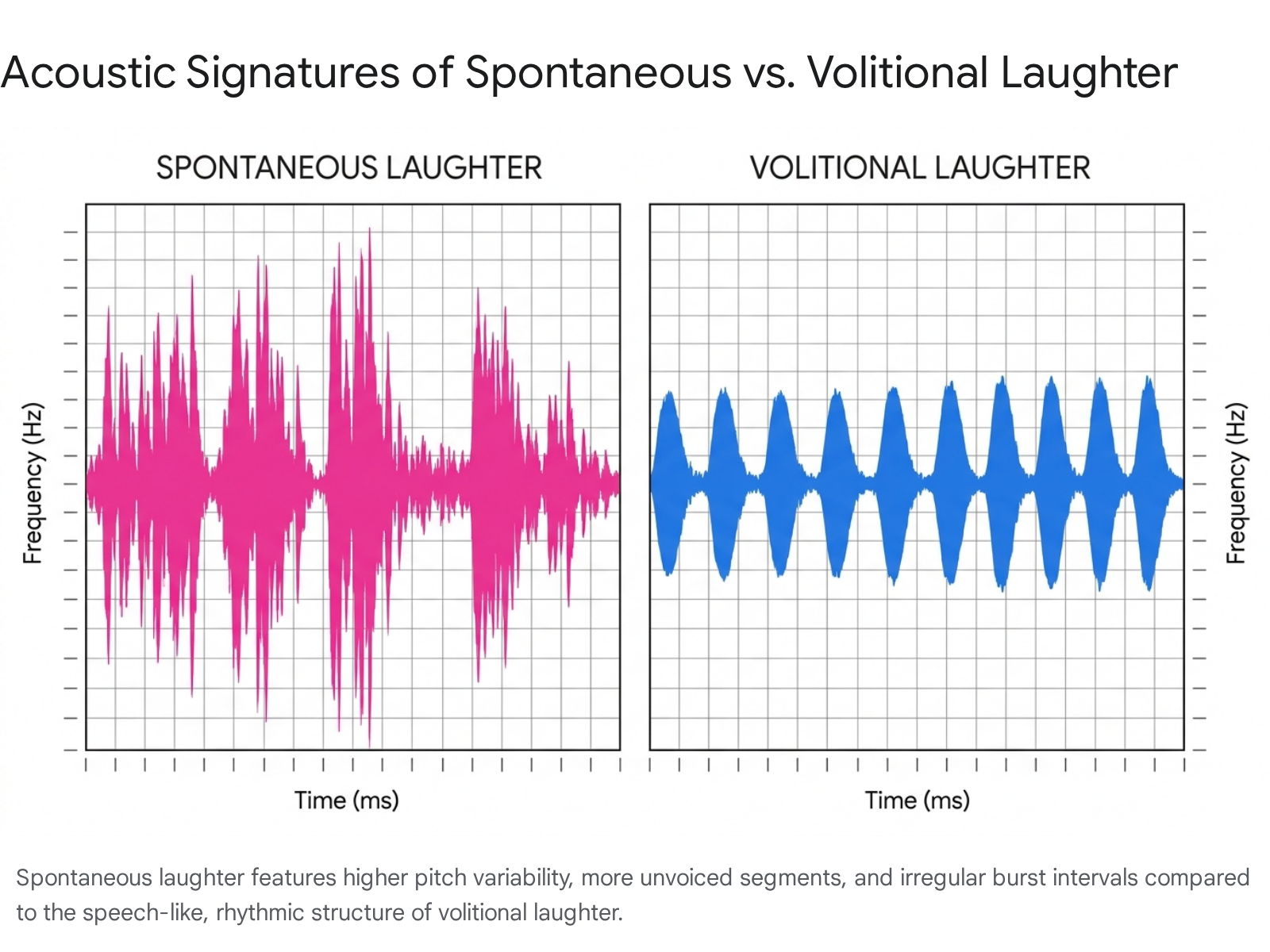
Listeners are highly sensitive to these acoustic differences. In forced-choice perception experiments, humans can reliably distinguish between spontaneous and volitional laughter without any visual or contextual cues 710. Spontaneous laughter exhibits acoustic markers of high physical arousal, which are difficult to consciously replicate. When researchers experimentally increase the speed of recorded laughs (decreasing duration by 33% while holding pitch constant), listeners judge all laughs as more genuine, likely because increased speed mimics the higher arousal state of spontaneous production 10. Conversely, when laughs are drastically slowed down (duration increased by 260% and pitch altered proportionally), listeners confuse spontaneous human laughs with non-human animal vocalizations, while still correctly identifying volitional laughs as human-made 10. This acoustic evidence suggests that spontaneous laughter shares primitive features with non-human animal calls, whereas volitional laughter is produced by the more recently evolved human speech system 10.
| Acoustic Parameter | Duchenne (Spontaneous) Laughter | Non-Duchenne (Volitional) Laughter |
|---|---|---|
| Fundamental Frequency (F0) | Higher mean F0, higher maximum F0, and significantly greater F0 variability 71012. | Lower mean pitch and restricted, controlled pitch range 1213. |
| Duration Metrics | Longer total bout duration, but shorter individual burst durations. Higher rate of calls per second 1012. | Shorter overall bout duration, longer individual bursts, and lower burst rate 1012. |
| Voicing and Tonal Purity | Higher percentage of unvoiced segments (intervoicing intervals). Sounds more breathy and animalistic 7101214. | Highly voiced, stable vowel sequences (e.g., "ha-ha"). Sounds more phonemic and speech-like 1013. |
| Harmonics-to-Noise Ratio (HNR) | Lower HNR variability (more consistent noise profile across the vocalization) 712. | Higher HNR in conversational forms, indicating a purer, more tonal sound 1214. |
| Intensity (Loudness) | Lower mean intensity but greater intensity variability, often trailing off as breath is expended 712. | Higher, more regulated mean loudness driven by deliberate speech-system breath control 712. |
In addition to the dichotomy of spontaneity, gender differences emerge in the acoustic production of laughter. Female laughter generally exhibits higher F0 means and larger distances between the first and second formants (F2-F1), characteristics reflective of sexually dimorphic vocal tracts 14. Furthermore, female laughter tends to feature more voicing and harmonics than male laughter, leading to perceptual judgments of female laughter falling on the more pleasant end of acoustic dimensions 14.
Psychological Theories of Humor
While laughter is a physiological and acoustic phenomenon, humor is the cognitive trigger that most frequently elicits spontaneous laughter in adult humans. Psychologists and philosophers have long debated what constitutes humor, resulting in several foundational theories that attempt to explain why humans find specific stimuli amusing.
Incongruity and Relief Theories
The Incongruity Theory is currently the most widely accepted cognitive model of humor among philosophers and psychologists 15161516. Rooted in the writings of James Beattie, Immanuel Kant, and Arthur Schopenhauer, this theory posits that humor arises from the perception of something that violates mental patterns and expectations 16. The process involves two distinct cognitive stages. First, the listener encounters an incongruity, such as a punchline that subverts the narrative setup 151920. Second, the listener engages in rapid problem-solving to resolve the incongruity and find a cognitive rule that makes the punchline follow logically from the premise 1920. This mental shift creates a cognitive reward, experienced subjectively as amusement.
The Relief Theory, heavily championed by Sigmund Freud and tracing back to Lord Shaftesbury, takes a psychoanalytic and physiological approach 15161516. It suggests that humor serves as a hydraulic release valve for psychological tension and suppressed nervous energy 1516. According to this model, an actual story or situation builds tension within the individual. Laughter cleanses the nervous system of this built-up societal, sexual, or aggressive repression, providing a safe psychological outlet for taboo thoughts 151621.
Superiority and Benign Violation Theories
The Superiority Theory is the oldest documented framework, tracing back to Plato, Aristotle, and Thomas Hobbes's Leviathan 1516151621. It argues that humor is fundamentally competitive and contemptuous. Humans laugh at the mistakes, stupidity, or misfortune of others because it engenders a sudden feeling of superiority or triumph over a perceived inferior 151521. While this theory successfully explains slapstick comedy, physical pratfalls, and aggressive teasing, it is limited in its scope and fails to account for wordplay, self-deprecating humor, or logical puns 16.
A more contemporary, unifying framework is the Benign Violation Theory, developed by researchers Peter McGraw and Caleb Warren, expanding upon earlier work by linguist Tom Veatch 15161521. This theory integrates aspects of previous models by proposing that humor occurs only when three specific conditions are met simultaneously: 1. A situation violates a person's sense of how the world "ought to be" (representing a threat to social norms, physical space, personal dignity, or logic). 2. The situation is simultaneously appraised as benign, safe, or acceptable. 3. Both interpretations occur at the exact same time in the mind of the observer 1615.
Under this framework, physical tickling produces laughter because it is a direct violation of personal space that is simultaneously recognized as a harmless play attack by a trusted individual. People cannot tickle themselves because there is no violation, and they will not laugh if tickled by a threatening stranger because the violation is not benign 16. Humor fails if a joke is too benign (rendering it boring) or if the violation is too severe (rendering it offensive or genuinely threatening) 1621.
| Humor Theory | Core Mechanism | Explanatory Strengths | Explanatory Limitations |
|---|---|---|---|
| Incongruity | Resolution of violated expectations and logical discrepancies. | Puns, wordplay, observational comedy, structural jokes. | Does not explain why some unexpected things are frightening rather than funny. |
| Superiority | Enjoyment of sudden glory over the misfortune or inferiority of others. | Slapstick, mockery, aggressive teasing, physical comedy. | Fails to explain self-deprecating humor, abstract logical jokes, or puns. |
| Relief | Release of pent-up psychological, sexual, or nervous tension. | Dark humor, taboo topics, risqué jokes, nervous laughter. | Does not account for benign humor, semantic puns, or tickle-induced laughter. |
| Benign Violation | Simultaneous perception of a norm violation and a safe context. | Encompasses physical play, taboo jokes, and logical twists based on distance/safety. | Heavily dependent on subjective, individual thresholds for what constitutes "benign." |
Neurobiology of Humor Comprehension and Laughter Production
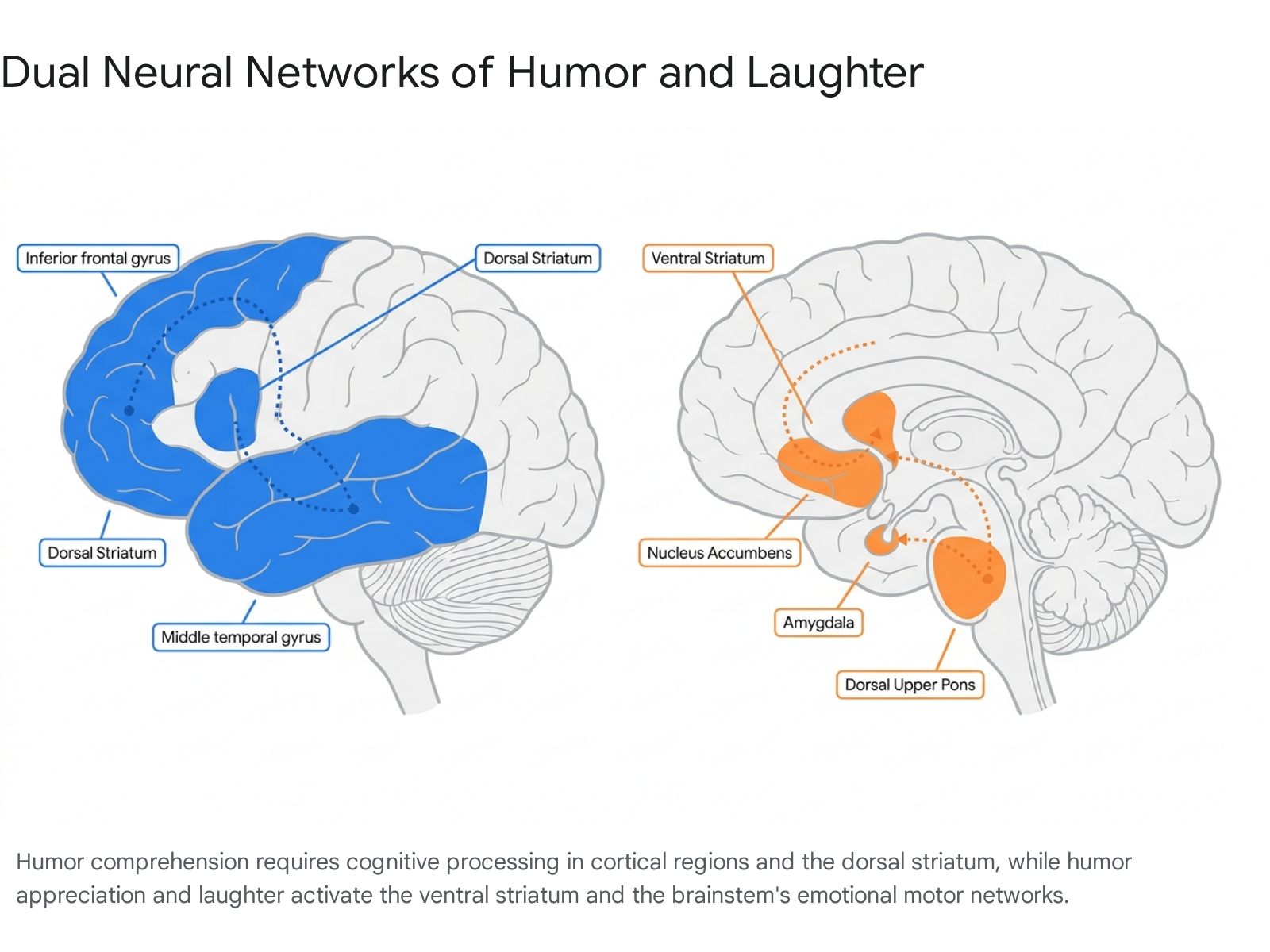
The advent of functional magnetic resonance imaging (fMRI) has allowed cognitive neuroscientists to map the specific brain regions activated during humor processing and laughter. Research reveals that "getting a joke" and "laughing at a joke" are biologically distinct processes handled by different neural networks 201718.
Cortical Processing and Humor Comprehension
Humor comprehension involves the intellectual decoding of a joke, including recognizing incongruity, understanding intent, and resolving ambiguity. This stage places heavy demands on executive control and language processing networks.
fMRI studies utilizing both traditional behavior-based joke tasks and naturalistic audio-visual sitcom viewing indicate that humor comprehension activates widespread cortical areas. Significant activation is observed in the inferior frontal gyrus, the middle frontal gyrus, and the middle temporal gyrus 171819. Furthermore, bridging-inference jokes require activation in the bilateral temporoparietal junction (TPJ) and left orbitofrontal cortex 20. The TPJ is critical for "Theory of Mind" processing, which allows individuals to understand the intentions of the joke-teller and fill in the cognitive gaps required to resolve the punchline 20.
Recent neuroimaging research has also identified the vital role of subcortical structures previously overlooked in humor studies. The dorsal striatum is fundamentally active during humor comprehension 1718. The dorsal striatum contributes heavily to working memory, cognitive flexibility, and ambiguity processing, all of which are required to accurately recognize the structure of humorous stimuli before any emotional reward is felt 1718.
Reward Systems and Motor Execution
Once a joke is comprehended, the brain shifts to humor appreciation - the emotional feeling of mirth, joy, and the physical act of laughter. This second stage recruits the brain's subcortical reward circuitry.
Humor appreciation primarily engages the ventral striatum, the nucleus accumbens, and the ventral anterior cingulate cortex (vACC) 17181920. The ventral striatum and nucleus accumbens are key nodes in the dopaminergic mesolimbic reward system 192026. The release of dopamine in these areas generates the pleasurable sensation associated with mirth, boosting mood and enhancing motivation 192026. This system's activation is heavily dependent on the "funniness" of the stimulus; experimental designs that subtract the humorous element from a cartoon eliminate the mesolimbic response, even though cortical comprehension areas remain active 21.
The physical motor execution of laughter relies on two partially independent neuronal pathways that bridge the brain to the body's respiratory and facial muscles: 1. The Involuntary Pathway: Spontaneous Duchenne laughter is emotionally driven and originates in subcortical structures. It involves the amygdala, thalamic/hypothalamic areas, subthalamic areas, and the dorsal/tegmental brainstem 2223. 2. The Voluntary Pathway: Volitional, non-Duchenne laughter is controlled by higher cortical structures associated with deliberate action. It originates in the premotor/frontal opercular areas and travels down the motor cortex and pyramidal tract to the ventral brainstem 2223.
Both pathways ultimately converge on a laughter-coordinating center situated in the dorsal upper pons, which regulates the complex respiratory, laryngeal, and facial muscle synchrony required to execute a laugh 2224.
Biological Sex Differences in Neural Processing
Neuroimaging has also highlighted significant individual variations, particularly regarding biological sex, in how humor is processed. While both sexes effectively comprehend and appreciate humor, their neural routing strategies differ measurably 1920.
Females exhibit significantly greater activation in the prefrontal cortex (including the inferior frontal gyrus and dorsolateral prefrontal cortex) and mesolimbic reward regions (nucleus accumbens, amygdala, insula, and ventral anterior cingulate cortex) 191920. This suggests women may rely more heavily on executive language-based decoding and socio-emotional integration, resulting in a stronger reward network response to successful jokes 191920. Conversely, males show greater reliance on cognitive control regions and the dorsal stream during humor comprehension, exhibiting less dramatic mesolimbic reward activation 1920.
Laughter as a Mechanism for Social Cohesion
Most of the laughter humans produce has little to do with formal jokes or humor. Observational studies demonstrate that laughter is highly sensitive to social context; humans are up to 30 times more likely to laugh in a group setting than when alone 12526. Laughter functions as the social glue of human societies, facilitating bonding and group synchrony.
The Endorphin Hypothesis and Social Grooming
In primates, physical social grooming is the primary mechanism for establishing trust and creating bonded alliances 1826. Grooming triggers the release of β-endorphins - opioid neuropeptides that facilitate social bonding and modulate pain via specialized afferent C-tactile peripheral neurons 126. However, grooming is highly inefficient; a primate can only interact with one group member at a time 1. As hominin group sizes expanded, physical grooming became insufficient to maintain group cohesion.
Evolutionary psychologists propose that laughter evolved as a form of "vocal grooming," allowing humans to trigger endorphin release across multiple individuals simultaneously, vastly increasing the efficiency of network building 1826. Because endorphins are difficult to measure directly in the living human brain without invasive procedures, researchers assay endorphin release by measuring changes in pain thresholds 19. Experimental studies reveal that participating in shared, spontaneous Duchenne laughter significantly elevates pain tolerance, confirming that laughter activates the endogenous opioid system 1926.
This endorphin surge mediates the subjective feeling of interpersonal closeness and well-being. Interestingly, while laughter increases the subjective sense of social bonding, economic game experiments (such as the Dictator Game) show it does not necessarily increase prosocial altruism or financial generosity, suggesting that evolutionary bonding mechanisms and altruistic behavior operate on different psychological axes and relate to different functional objectives 26.
Social Contagion and Group Dynamics
Because Duchenne laughter is an involuntary, emotionally valent signal, it acts as a highly contagious behavior 91427. Just hearing the acoustic properties of laughter primes the listener's supplementary motor area to prepare for smiling and laughing, creating a behavioral ripple effect 2027. This is the neurobiological justification for the use of "laugh tracks" in sitcoms 21. However, this contagion is deeply socially gated. Individuals are significantly more likely to catch a laugh from an in-group member or a known friend than from a stranger, demonstrating that laughter functions to solidify pre-existing social ties rather than uniformly bridging gaps between unknown entities 2728. The role of social context is profound even in early development; three- to four-year-old children are eight times more likely to laugh at humorous material when surrounded by other children than when alone 27.
Furthermore, the acoustic features of laughter actively dictate and reinforce social hierarchies. Dominance laughter - which relies on deeper, lower-arousal acoustics with higher entropy to make the producer sound physically larger - enforces norms and asserts status over a recipient 14. By contrast, higher-pitched, muted affiliation laughter signals submission, safety, and reassurance 14. Shared laughter between friends can even be weaponized to convey shared dominance over an ostracized third party 14.
Cross-Cultural Perceptions and Practices
Laughter is a human universal, occurring across all linguistic and societal boundaries. However, while the physical execution of laughter is deeply conserved, the perception, usage, and value placed on humor vary drastically across different cultures.
Universal Recognition of Laughter Types
Cross-cultural research, notably conducted by Gregory Bryant and colleagues involving over 880 participants across 21 to 24 diverse societies (ranging from industrialized Western nations to small-scale indigenous groups), sought to determine if the acoustic markers of spontaneous versus volitional laughter are universally recognized 72529.
The results establish a firm scientific consensus: listeners worldwide, regardless of their native language or cultural isolation, can accurately distinguish between spontaneous (real) and volitional (fake) laughter. Across these 21 to 24 distinct societies, human accuracy in identifying laughter type ranged consistently between 56% and 69%, well above random chance 72930. Across all societies, acoustic features linked to physiological arousal - specifically greater intensity variability, elevated pitch, and lower harmonics-to-noise ratio variability - predicted listeners' judgments of laughter as "real" 72931. While the baseline accuracy was universal, minor cultural variations were observed; individuals from small-scale societies with low market integration exhibited a slight bias toward rating laughs overall as volitional or "fake," suggesting a heightened sensitivity to potential deception in vocal signaling 732.
Furthermore, a study analyzing listeners from 24 societies found that people could accurately determine the degree of social closeness between two laughing individuals simply by hearing a brief, decontextualized audio clip of their co-laughter. Listeners reliably distinguished established friends from newly acquainted strangers based entirely on the presence of spontaneous acoustic markers, proving that laughter constitutes a universal signaling system for cooperative relationships 2533.
Cultural Variations in Humor Usage
While the biological recognition of laughter is universal, the social psychology of humor is highly culturally tinted. Substantial differences exist between Western (individualistic) and Eastern (collectivistic) societies regarding how humor is valued and utilized 343536.
Western cultures generally view humor as a highly positive, desirable, and common psychological trait 3536. In North America, humor is heavily utilized as a primary coping mechanism to manage stress, reframe challenges, and navigate difficult situations 3435. Conversely, Eastern cultures tend to maintain a more ambivalent attitude toward humor 3437. In Chinese culture, influenced by historical ideals that emphasize hierarchical respect, social harmony, and seriousness, humor is often viewed not as a standard trait of ordinary people, but as a specialized, sometimes controversial talent belonging primarily to experts, such as comedians 3536.
These perceptual differences directly influence humor usage. Easterners are significantly less likely to use humor as an everyday coping strategy 343537. When humor is deployed, individuals in collectivistic cultures (such as India and Hong Kong) strongly favor adaptive forms of humor (affiliative and self-enhancing humor) that promote group harmony, while actively avoiding aggressive or self-defeating humor that might disrupt social cohesion or challenge authority 343537.
Physiological Health Outcomes and Clinical Limitations
The proverb "laughter is the best medicine" is deeply ingrained in folk psychology. While the biological impacts of laughter on the human body are undeniably real, separating robust scientific fact from exaggerated wellness claims requires careful scrutiny of physiological pathways and clinical trial data.
Cardiovascular, Endocrine, and Immune System Effects
A substantial body of research confirms that robust, hearty laughter initiates a cascade of measurable physiological responses. Laughter acts as a buffer against sympathetic nervous system arousal (the "fight-or-flight" response) by regulating endocrine output 4445. A meta-analysis of clinical trials indicates that interventions involving spontaneous laughter significantly decrease levels of cortisol, the body's primary stress hormone. Pooling data from multiple studies revealed an average cortisol reduction of 31.9%, with some individual experiences yielding up to a 36.7% decrease after a lone 10-to-20-minute laughter session 453839.
Concurrently, laughter stimulates the cardiovascular system. It increases oxygen-rich air intake, improves endothelial function (the tissue forming the inner lining of blood vessels), and enhances overall blood flow and arterial dilation, which may help mitigate cardiovascular risk factors 443839404150. The physical act of laughing also engages the diaphragm, abdominal, and facial muscles, providing mild exertion followed by prolonged muscle relaxation that can lower tension for up to 45 minutes 443840.
Immunologically, laughter has been linked to temporary increases in the production of infection-fighting antibodies and the activation of natural killer (NK) cells and T-cells, which are critical components of the body's defense against viral infections and cellular abnormalities 44384041.
Critical Evaluation of Laughter Therapy
Despite these measurable benefits, the medical efficacy of laughter is frequently overstated in popular media. The concept of laughter as "inner jogging" - popularized by Norman Cousins, who famously claimed in 1979 to use Marx Brothers comedies to achieve pain-free sleep while battling illness - has led to claims that laughter burns vast amounts of calories and can serve as a primary therapeutic intervention 505152. However, while one study found that laughing for 10 to 15 minutes a day can burn approximately 40 calories, this metabolic expenditure is physiologically negligible compared to traditional aerobic exercise and is insufficient for significant weight loss 4540.
Furthermore, evidence-based medicine frameworks highlight severe limitations in the quality of existing laughter research. Systematic reviews point to a lack of high-quality randomized controlled trials (RCTs) assessing comedy and humor interventions 3842. Many existing studies rely heavily on subjective self-reported measures, fail to control adequately for the placebo effect, or study small, demographically limited populations, making it difficult to ascertain whether minoritized groups experience similar therapeutic benefits 38425443.
It is also crucial to acknowledge that humor and laughter are not universally therapeutic. Forced laughter, tone-deaf jokes, or laughter used in the context of ostracism and mockery can induce psychological distress, alienate patients, and elevate stress hormones rather than lower them 11154457. Laughter cannot cure chronic diseases such as cancer, nor is it a substitute for pharmacological interventions or psychiatric care 414458. However, in specific controlled environments, such as dementia care facilities, humor therapy utilizing trained "laughter bosses" has demonstrated a 20% reduction in patient agitation - an improvement comparable to antipsychotic drugs but without the adverse side effects 39. Ultimately, as a non-invasive, cost-free complementary intervention, spontaneous laughter remains a highly effective mechanism for improving subjective mood, fostering emotional resilience, and temporarily alleviating physical and psychological distress 44383957.