
Why We Blush When Embarrassed
Blushing is an involuntary, sympathetic nervous system reflex that floods the face with blood during moments of sudden self-awareness, social exposure, or embarrassment. Rather than a biological flaw, psychological and evolutionary research reveals blushing to be a highly adaptive "social white flag" - an honest, uncontrollable signal of appeasement that restores trust and proves our sincerity when we violate group norms.
The Physiology of a Blush: What Happens in the Body?
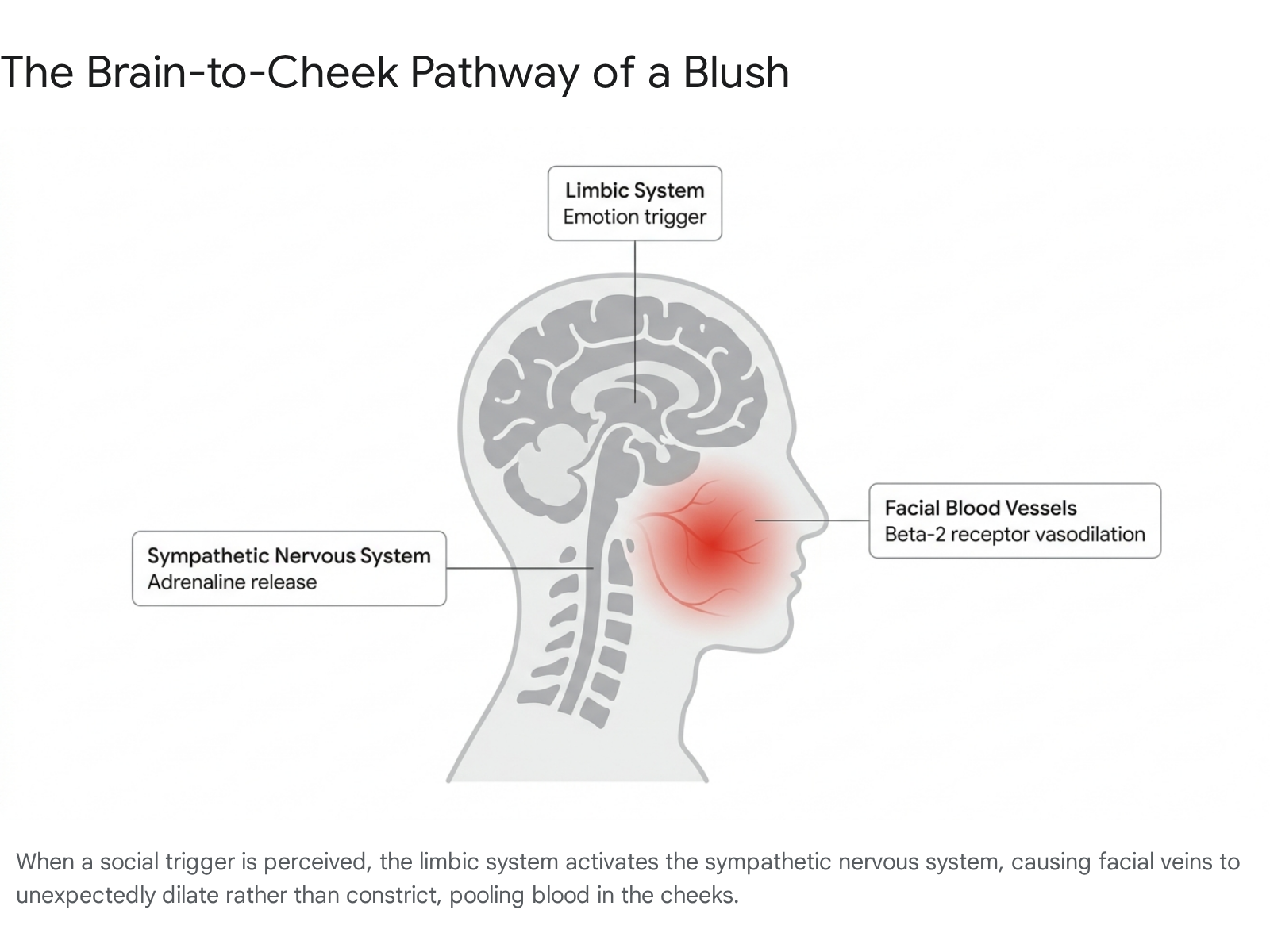
At its core, a blush is a complex neurovascular event driven by a quirk in the human autonomic nervous system. When you perceive a socially triggering situation - such as tripping in public, receiving unexpected praise, or having a secret exposed - the feeling of self-consciousness originates in the limbic system, the emotional center of the brain 1.
This emotional processing heavily relies on the orbitofrontal cortex, a brain region that developed late in human evolution to help correct social behavior; notably, individuals with damage to this area generally do not experience shame or the subsequent blush 1. From the limbic system, signals travel down the spinal cord to the sympathetic nervous system, the network responsible for the body's "fight-or-flight" response 123.
The sympathetic nervous system releases adrenaline (epinephrine). In most parts of the body, adrenaline causes vasoconstriction, meaning the blood vessels narrow to redirect blood to major muscle groups for immediate physical action 23. However, the blood vessels in the human face, neck, and upper chest are wired differently. They are heavily supplied with beta-2 adrenergic receptors. When adrenaline hits these specific receptors, it triggers an active, atypical response: vasodilation 24.
The tiny muscles in the walls of the facial veins relax, allowing them to open wide. Blood rapidly pools in the superficial venous plexus - the network of capillaries sitting just beneath the surface of the facial skin 4. This sudden rush of oxygenated red blood cells causes the characteristic visual flush and the accompanying sensation of heat or tingling 34.
Blushing vs. Flushing: Key Differences
While they look virtually identical to an outside observer, blushing and flushing are distinct physiological processes driven by entirely different triggers. Blushing is primarily psychosomatic, requiring a social or emotional catalyst. Flushing is a thermoregulatory or chemical response to physical stimuli 56.
| Feature | Blushing (Erythema Pudoris) | Flushing |
|---|---|---|
| Primary Triggers | Embarrassment, shame, guilt, unwanted social attention, shyness, romantic stimulation 458. | Physical exertion, heat, alcohol, spicy foods, fever, menopause, or medical conditions (e.g., rosacea, carcinoid syndrome) 5687. |
| Physiological Driver | Emotional arousal activating the sympathetic nervous system and beta-adrenergic nerves 278. | Thermoregulatory response to cool the body, or chemical reactions to vasodilators in the bloodstream 567. |
| Body Areas Affected | Usually restricted to the cheeks, forehead, ears, and upper neck 511. | Can extend broadly across the face, anterior chest, torso, and sometimes the abdomen 68. |
| Duration | Transient and sudden; usually fades within one to two minutes once the emotional trigger passes 711. | Can be prolonged, constant, or episodic depending on the underlying cause (e.g., prolonged physical exertion) 611. |
The Evolutionary Puzzle: Why Did We Evolve to Turn Red?
Charles Darwin dedicated an entire chapter to blushing in his 1872 book, The Expression of the Emotions in Man and Animals. He famously called it "the most peculiar and the most human of all expressions," expressing profound confusion over its existence 412910. If the survival of early hominids relied on projecting strength, confidence, and competence, why would natural selection preserve a mechanism that visibly broadcasts our inner vulnerabilities and mistakes to competitors?
Modern evolutionary biology and social psychology have largely solved this enigma through the Appeasement Hypothesis 2.
The Social White Flag
In the complex, interdependent social hierarchies of early humans, survival depended entirely on remaining in the good graces of the group. If an individual violated a social norm, cheated, or failed a collective expectation, they risked ostracization - a death sentence in prehistoric environments. Blushing evolved as a prosocial appeasement display 21015.
When you make a social misstep and turn red, your body is offering an automatic, nonverbal apology. It signals to onlookers: "I recognize the social rule, I know I broke it, and I care about your judgment." Because blushing is governed by the autonomic nervous system, it is completely involuntary. You cannot strategically produce a blush to game a social situation 2312. In evolutionary game theory, this makes the blush a highly reliable "honest signal" of sincerity and regret 211.
The Trustworthiness Dividend
Research consistently demonstrates the social advantages of this physiological betrayal. In a seminal 2011 study published in the Journal of Personality and Social Psychology, researchers observed participants who accidentally broke an expensive camera. Those who visibly blushed and acted embarrassed were rated by onlookers as dramatically more trustworthy, reliable, and likable than those who remained calm, stoic, or tried to hide the mistake 3.
Similarly, in economic trust games (like the Prisoner's Dilemma), participants who act selfishly but subsequently blush are forgiven faster and trusted more in future rounds than those who keep a "poker face" 310. Observers subconsciously recognize that a blush indicates a capacity for guilt and a desire to repair social bonds 3.
The Color Vision Connection
Our ability to detect a blush is as highly evolved as the blush itself. Old World primates, including humans, are unique among most mammals in having evolved trichromatic (three-cone) color vision 112.
While older evolutionary theories suggested this rich color vision evolved primarily to help primates spot ripe fruit against green foliage, researchers at the California Institute of Technology (Caltech) proposed a compelling alternative: primate color vision is specifically optimized to detect subtle changes in blood oxygenation under the skin 13. The specific spectral sensitivity of our color cones allows us to read the emotional and physical states of our peers - such as a red blush in embarrassment or blanching pallor in fear 1213. Notably, trichromatic vision tends to appear in primate species with bare, furless faces and rumps, where skin color changes serve as vital communication tools 13.
Do Other Animals Blush?
For over a century, the scientific consensus - echoing Darwin - was that blushing was a uniquely human phenomenon, requiring a level of self-awareness beyond the reach of animals 121420. However, recent advancements in primatology and infrared thermal imaging have complicated this anthropocentric view.
While humans are unique in our lack of facial fur - which makes a blush highly visible - other primates experience the exact same physiological rush of blood to the face during socially delicate moments 391520. Thermal imaging studies of rhesus macaques and chimpanzees have shown measurable increases in cheek and upper lip temperature during both positive emotional states (like being tickled or groomed) and negative ones (like being teased or experiencing a social failure) 151617.
Behaviorally, apes display the same appeasement tactics humans do. When a chimpanzee or rhesus monkey makes a clumsy physical mistake (like tripping and falling in front of older, higher-status troop members), primatologists have observed them averting their gaze, looking around to see if anyone noticed, and exhibiting behaviors parallel to human embarrassment 1418. In primates with pale, exposed skin, such as bald uakaris and Japanese macaques, this reddening is visually apparent and serves to de-escalate aggression from dominant members of the troop, showing submission and a desire for social harmony 3915.
The Psychology: Mentalizing vs. Self-Awareness
If blushing is a social signal, what cognitive processes trigger it? A longstanding psychological theory posited that blushing requires complex "mentalizing" (or Theory of Mind) - the advanced cognitive ability to imagine what other people are thinking about us 1419. On this view, we blush because we are actively calculating others' judgments.
However, a fascinating 2024 neuroimaging study challenged this assumption, suggesting the trigger is far more primal. Researchers at the University of Amsterdam placed teenagers inside a functional MRI (fMRI) machine and showed them pre-recorded video footage of themselves singing karaoke (a universally embarrassing task), alongside footage of strangers singing 1426. The researchers simultaneously tracked both the participants' cheek temperature and their brain activity.
Unsurprisingly, participants' cheeks became significantly hotter when watching themselves compared to watching others 2620. However, the fMRI scans revealed that the brain areas responsible for complex mentalizing (such as the medial prefrontal cortex and right temporoparietal junction) were not significantly engaged 1926. Instead, the brain showed pronounced spikes in the cerebellum and early visual cortices, regions linked to immediate emotional arousal and pre-reflective attention 192620.
This data indicates that blushing is a rapid, automatic emotional response to intense self-awareness and sudden exposure, rather than a slow, calculated assessment of others' opinions 419. We do not necessarily blush because we are consciously worrying about our reputation; we blush simply because we are suddenly, acutely aware of being seen.
Cross-Cultural Differences: Shame, "Face," and Simpatía
While the physiological mechanism of blushing is a human universal, the social triggers that cause it - and the cultural penalties for it - vary dramatically around the world. Anthropologists and cross-cultural psychologists often map these differences along the spectrum of individualistic versus collectivistic societies, revealing how cultural values shape our emotional arousal 2122.
Western Independence vs. East Asian Interdependence
In individualistic Western cultures (like the United States and Western Europe), independence, self-assertion, and high-arousal emotions (like pride and excitement) are socially valued 2123. In these cultures, moral failings are often internalized as guilt - a private feeling of having done a bad thing, which motivates reparative action 2324.
Conversely, in collectivistic East Asian cultures (such as Japan and China), society places a premium on group harmony, interdependence, and low-arousal emotions 232526. Here, the concepts of shame and embarrassment are deeply intertwined with the concept of "face" (mianzi in China) or avoiding haji (shame) in Japan 2728. Shame is highly public; it is the pain of failing the group's expectations and losing social standing 242729.
Because Japanese culture heavily emphasizes not burdening others and strictly conforming to group norms, making a public mistake carries a high risk of losing face 2729. Consequently, Japanese individuals are highly sensitive to social context 37. When a social violation occurs, individuals in these cultures may utilize distinct face-saving strategies, such as masking embarrassment with a polite, amused smile (the "embarrassed laugh") to avoid disrupting social harmony and creating discomfort for onlookers 303132. Studies show that while blushing occurs universally, strict cultural norms that penalize standing out can heighten social anxiety and increase the frequency of blushing triggers 2641.
The "Simpatía" of Latin America
Latin American cultures present a unique emotional script that differs from both Western individualism and East Asian collectivism. Psychological research identifies a cultural framework known as simpatía - an emphasis on being agreeable, friendly, warm, and expressing positive, socially engaging emotions 324133.
In cross-cultural studies comparing emotional expression, Latin American participants were highly expressive of positive, community-building emotions (like joy and shared sympathy) but showed a strong tendency to suppress negative, socially disengaging emotions (like anger), much like East Asian populations 323334. Because simpatía values smooth interpersonal relationships and the avoidance of open conflict, an individual raised in this context may blush more readily from positive social engagement or warmth, while actively working to suppress displays of interpersonal friction 3235.
The Othello Error: Does Blushing Mean Someone is Lying?
Because blushing is deeply associated with feelings of guilt, shame, and exposure, it is frequently misread by the general public and even law enforcement as a definitive sign of deception. If someone is accused of lying and their face turns bright red, onlookers often assume this proves their guilt 3646.
Psychologists and deception detection experts call this cognitive bias the Othello Error (named after Shakespeare's tragic character who misread his innocent wife's weeping terror as proof of infidelity) 37. The Othello Error occurs when an observer misinterprets the stress, fear, or embarrassment of being accused as hard evidence of a lie 1137.
Research confirms that blushing is not a reliable standalone indicator of deception 3646. The physiological "leakage paradox" dictates that innocent truth-tellers under severe stress or scrutiny will display the exact same autonomic arousal as guilty liars 37. When a person blushes during an accusation, it simply means that something private, sensitive, or uncomfortable has been exposed 3646. An innocent person may blush out of indignation, out of the sheer terror of not being believed, or because the interrogation accidentally touched upon a completely unrelated, embarrassing secret 363738. Relying on blushing to detect lies routinely leads to false accusations and wrongful assumptions.
Erythrophobia: When the Fear of Blushing Becomes a Burden
For most people, a blush is a brief, harmless annoyance that fades within minutes. But for a subset of individuals, often those diagnosed with Social Anxiety Disorder (SAD), blushing can become a source of intense, paralyzing psychological distress. The morbid fear of blushing is known clinically as erythrophobia 113940.
People with erythrophobia enter a vicious, self-fulfilling psychological feedback loop. They fear they will blush in a social or professional setting. This anticipatory anxiety spikes their stress levels, triggering the sympathetic nervous system, which in turn causes the exact blush they were desperately trying to avoid 394142.
Once they feel the heat rising in their cheeks, their self-focused attention (SFA) skyrockets. They withdraw their attention from the conversation and become entirely preoccupied with their internal physical state, often vastly overestimating the visible intensity of their blush (believing they are glowing neon red when they only have a mild pink flush) 84344. This leads to severe avoidance behaviors, where individuals skip meetings, avoid social gatherings, or refuse promotions to prevent being looked at 741.
Evidence-Based Treatments for Severe Blushing
Because the sympathetic nervous system operates automatically, attempting to "force" yourself to stop blushing through sheer willpower is impossible and usually exacerbates the response 2312. However, clinical psychology and medicine offer several evidence-based treatments for severe blushing and erythrophobia.
| Treatment Type | Description | Efficacy & Considerations |
|---|---|---|
| Task Concentration Training (TCT) | A specialized cognitive-behavioral technique that trains patients to shift their focus outward (toward the conversation or task) rather than inward (on their physical symptoms) 404556. | Highly effective for erythrophobia. Breaks the cycle of self-focused attention that sustains the blush 454647. |
| Cognitive Behavioral Therapy (CBT) | Includes exposure therapy and cognitive reframing to challenge catastrophic beliefs about the social costs of blushing 404559. | The gold standard for social anxiety. Helps patients realize that observers rarely judge blushing negatively 74144. |
| Beta-Blockers (e.g., Propranolol) | Medications that block beta-adrenergic receptors in the blood vessels, preventing adrenaline from causing vasodilation 84160. | Excellent for situational anxiety (e.g., public speaking). Stops the physical flush without altering mental state, though it is a temporary fix 7860. |
| SSRIs / SNRIs | Antidepressants used to lower overall baseline anxiety and reactivity in the nervous system 84041. | Effective for treating the underlying Social Anxiety Disorder driving the blushing 4041. |
| Endoscopic Thoracic Sympathectomy (ETS) | A surgical procedure where the specific sympathetic nerves responsible for facial blushing are severed or clamped 7845. | A last resort. Around 90% cure rate for blushing, but carries a high risk of compensatory sweating (excessive sweating on the torso or legs) 7845. |
Bottom line
Blushing is an involuntary surge of blood to the face caused by the sympathetic nervous system reacting to sudden self-awareness or exposure. Rather than a biological flaw, evolutionary science reveals it to be a sophisticated social tool - an honest, nonverbal apology that restores trust and proves sincerity to the group. While cultural norms and individual anxiety levels dictate how severely we judge ourselves for turning red, the physiological reflex itself is an ancient, hardwired feature of the primate brain designed to keep us socially connected.