
The Science of Why We Laugh
Humans laugh primarily to signal safety, facilitate social bonding, and regulate intense emotions within group settings. Through a complex interplay of neural pathways, both spontaneous and simulated laughter trigger a cascade of neurochemicals that significantly lower stress hormones, release pain-relieving endorphins, and provide measurable improvements to cardiovascular and immune health.
The Evolutionary Origins of Amusement
Long before modern neuroimaging technologies could illuminate the physiological mechanisms of amusement, philosophers and evolutionary biologists debated why human beings engage in such a strange, rhythmic vocalization. Today, the scientific consensus views laughter not merely as a reaction to a joke, but as an ancient, highly evolved social tool that predates the development of spoken language.
Laughter is a phylogenetically and ontogenetically young behavior, meaning it is deeply embedded in both our evolutionary timeline and our individual biological development 1. The capacity for human-like laughter likely emerged around 2.5 million years ago with the appearance of the genus Homo 2. This assertion is supported by the fact that human infants begin to laugh between fourteen and eighteen weeks of age, long before they possess the cognitive machinery or anatomical coordination required for speech or walking 2. Because babies utilize laughter as a primary method of non-verbal communication, evolutionary psychologists deduce that the behavior evolved as a foundational mechanism for survival and social cohesion 34.
Signaling Safety and Averted Danger
To understand why a surprising punchline triggers physical amusement, researchers look to the environments of our early ancestors. Neurologist V.S. Ramachandran has proposed that laughter originally evolved as an evolutionary signal of "averted danger" 57. In a primitive environment, an unexpected sound, such as a rustle in the brush, would instantly trigger a fight-or-flight stress response. If the rustle turned out to be a harmless gust of wind rather than a predator, an early hominid would emit a primitive laugh. This auditory signal communicated to the rest of the group that the anomaly was trivial, saving the collective energy of the tribe by calling off a panic 5.
This theory neatly maps onto the structural anatomy of modern humor. Most jokes build tension by creating a specific mental model or expectation, and the punchline subsequently violates that expectation in a surprising but completely harmless way 56. Our brains recognize the sudden shift from perceived tension to safety, resolving the incongruity and rewarding us with the physical release of laughter.
The Primate Connection and Vocal Grooming
Humans are not the only animals that laugh. Observations of other primates, including chimpanzees, gorillas, and orangutans, reveal that they produce laughter-like vocalizations during physical play, play-chasing, tickling, and wrestling 910. When chimpanzees laugh together, they play together longer, utilizing the sound to reinforce social bonds 11. However, human laughter diverges from non-human primate vocalizations in its complexity. While apes produce "proto-laughter" that is tightly coupled to their breathing cycle - producing one sound per inhale and exhale - humans possess the unique anatomical ability to produce multiple laugh-notes during a single exhalation 1.
Furthermore, human laughter serves a purpose that extends far beyond physical play. Evolutionary psychologist Robin Dunbar posits that laughter evolved in humans as a form of "vocal grooming" 78. Other primates maintain their social hierarchies and interpersonal bonds through mutual physical grooming, an activity that releases endorphins but is highly time-consuming because it can only be performed one-on-one. As early human social groups expanded in size, physical grooming became an inefficient way to maintain troop cohesion. Because laughter triggers the same endorphin release in the brain as physical touch, it allowed humans to "groom" multiple people simultaneously across a distance 78. A single joke shared around a fire could bond an entire group at once, facilitating the massive expansion of human social networks.
The Neurobiology of Laughter
For decades, neurologists searched in vain for a localized "laugh center" in the brain. Advancements in functional magnetic resonance imaging (fMRI) and positron emission tomography (PET) have since revealed that laughter does not originate in one single area. Instead, it is the product of a highly sophisticated, distributed neural grid that engages primary motor regions, language processing centers, and ancient emotional structures simultaneously.
The cognitive processing of humor requires a massive amount of mental energy. When a person hears a joke, the brain must activate working memory, detect conflicting interpretations, resolve semantic ambiguity, and rapidly update expectations 45. Researchers distinguish between two distinct phases in this process: humor comprehension and humor appreciation. Humor comprehension - the cognitive act of "getting" the joke - heavily recruits the dorsal striatum, the prefrontal cortex, and the temporal lobe 149. Once the brain resolves the logic of the joke, the experience shifts to humor appreciation. This latter phase activates the ventral striatum and the mesolimbic pathway, flooding the nervous system with dopamine and producing the pleasurable sensation of mirth 14910.
The Conflict Resolver: The Anterior Cingulate Cortex
Much of human mental life involves a constant push-and-pull between the prefrontal cortex, which operates slowly and relies on logic, and the limbic system, which operates rapidly and is dominated by raw emotion and impulse 11. Humor fundamentally represents a collision between logical expectations and emotional surprise.
When there is a conflict between logic and emotion, the brain relies on the anterior cingulate cortex (ACC) to mediate the dispute 18. The ACC essentially acts as a neurological meeting room. Clinical studies involving stereo-electroencephalography have demonstrated that applying high-frequency electrical stimulation directly to the pregenual anterior cingulate cortex (pACC) induces involuntary bursts of laughter accompanied by a genuine sense of merriment 12. The interaction between the prefrontal cortex and the limbic system, mediated by the ACC, provides a mechanistic explanation for how the brain down-regulates cognitive load and translates a conceptual punchline into a physical vocalization 412.
Dual Pathways: Spontaneous vs. Voluntary Laughter
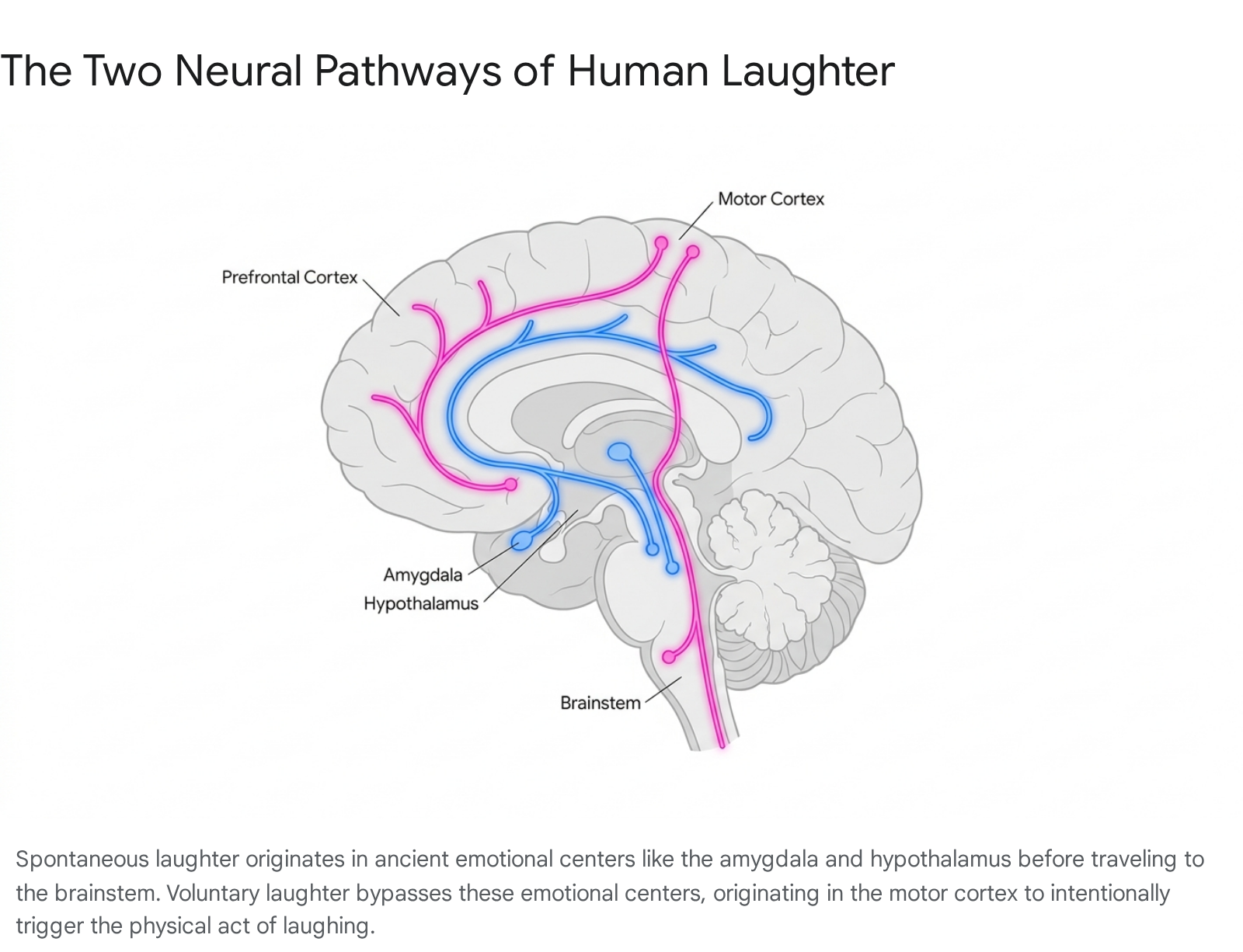
A critical discovery in affective neuroscience is that the expression of laughter relies on two partially independent neuronal pathways, explaining why human beings can laugh both uncontrollably at a hilarious event and politely at a mundane business meeting.
The involuntary, or emotionally driven, system is an evolutionarily ancient pathway. It involves the amygdala, the thalamic and subthalamic areas, the hypothalamus, and the periaqueductal gray (PAG) within the dorsal brainstem 31314. When something is genuinely hilarious, this system hijacks the body, overriding conscious control and producing a raw, hard-to-fake acoustic output.
Conversely, the voluntary system is utilized when we purposefully simulate laughter to smooth over a social interaction. This pathway originates in the premotor and frontal opercular areas, bypassing the deep emotional centers to travel through the motor cortex and the pyramidal tract directly to the ventral brainstem 131415. Because this pathway shares neural architecture with speech production, voluntary laughter sounds acousticly closer to spoken language 1516. Both pathways eventually converge at a coordinating center in the upper pons, which regulates the respiratory and facial muscles required to execute the laugh 1314.
Deciphering Authenticity: Real vs. Fake Laughter
Because humans rely so heavily on these two distinct neural systems, we have evolved to be incredibly adept at distinguishing between a genuine roar of amusement and a polite, forced chuckle. In the fields of psychology and gelotology, these are categorized clinically as Duchenne and non-Duchenne expressions.
Named after the nineteenth-century French scientist Guillaume Duchenne, who pioneered the mapping of human facial musculature, a genuine "Duchenne" expression involves specific involuntary muscle contractions that are exceptionally difficult for most people to fake deliberately 17.
| Feature | Spontaneous (Duchenne) Laughter | Simulated (Non-Duchenne) Laughter |
|---|---|---|
| Facial Musculature | Co-activation of the Zygomaticus major (mouth) and Orbicularis oculi (eyes) 171826. | Activation limited primarily to the Zygomaticus major 2619. |
| Visual Appearance | Corners of the mouth lift, cheeks raise, and "crow's feet" form around the eyes 17. | The mouth smiles, but the upper face and eyes remain relatively static 1719. |
| Acoustic Profile | Higher pitch, louder volume, faster bursts of non-articulate, non-tonal noise 1620. | Slower, more controlled, and acoustically similar to spoken language 1516. |
| Neurological Origin | Midline system and deep limbic structures 1115. | Lateral motor cortex and frontal brain areas 1115. |
| Social Function | An honest, unfiltered expression of affiliation and mirth 1617. | A polite mechanism to communicate social pleasantness or psychological distance 1718. |
The human brain is hypersensitive to these differences. While listeners often consciously realize when a laugh sounds forced, the brain registers the difference on a strictly neurological level even when individuals are not actively paying attention. In fMRI studies conducted by cognitive neuroscientists, researchers scanned participants as they passively listened to audio clips of both spontaneous laughter (evoked by funny videos) and volitional laughter (produced on command) 2130.
When participants heard genuine, evoked laughter, activation spiked in the bilateral superior temporal gyrus and Heschl's gyrus, areas associated with complex auditory processing 21. Conversely, when participants heard forced laughter, the anterior medial prefrontal cortex (amPFC) exhibited significantly higher activation 2130. The amPFC is deeply involved in "mentalizing" and understanding the intentions of others. The data suggests that when the brain detects the acoustic markers of a fake laugh, it instinctively goes to work attempting to figure out the vocalizer's true intentions and why they are simulating the emotion 1530.
The Science of Contagion
As the author Charles Dickens famously observed, "There is nothing in the world so irresistibly contagious as laughter and good humor." Modern neuroscience has validated this literary observation, identifying mirror neurons and endogenous opioids as the biological drivers of contagious amusement.
Mirror neurons are specialized cells located in the premotor cortex that fire not only when an individual performs a specific action but also when they observe someone else performing that same action 313222. They are considered the neurological foundation for empathy, imitation, and shared emotional processing. When a person hears the acoustic bursts of laughter, the auditory mirror neuron system activates, mapping the perception of the sound directly onto the listener's own laughter-production areas 19. Essentially, the listener's brain practically rehearses the act of laughing simply by hearing it, effectively hijacking the motor system and making it incredibly difficult to suppress a physical reaction 19.
The Endorphin Reward System
This contagious mirroring is fueled and reinforced by a powerful neurochemical reward loop. Utilizing positron emission tomography (PET) scans, researchers at the University of Turku and the University of Oxford measured brain activity before and after participants engaged in social laughter with close friends 7823.
The scans revealed that social laughter triggers a massive release of endogenous opioids - endorphins - in the thalamus, caudate nucleus, and anterior insula 2335. Endorphins are peptides that bind to opioid receptors in the brain to relieve pain and induce feelings of intense pleasure and safety. The researchers uncovered a direct correlation: participants who naturally possessed a higher density of opioid receptors in their brains were significantly more prone to contagious laughter than those with fewer receptors 7823. This chemical cascade not only induces euphoria but acts to fiercely solidify social bonds, creating a positive feedback loop that cascades through large groups and facilitates group cohesion 98.
Why Do We Laugh When We Are Nervous?
A perplexing dimension of this vocalization is the phenomenon of nervous laughter. It is a highly common, often highly embarrassing experience: finding oneself in a tense, uncomfortable, or even tragic situation - such as a funeral or during a severe reprimand - and suddenly being overcome by an irrepressible urge to laugh.
Clinical psychologists refer to nervous laughter as an "incongruous emotion," meaning the physical expression completely contradicts the environmental context 7. In the 1960s, Yale psychologist Stanley Milgram conducted infamous obedience experiments in which participants were instructed to administer increasingly severe electric shocks to strangers. Milgram observed a disturbing trend: as the voltage increased and the strangers seemingly cried out in pain, many participants began to exhibit uncontrollable fits of nervous laughter 7. They were not amused by the violence; they were highly distressed.
Neuroscientists view nervous laughter as a sophisticated, subconscious defense mechanism designed to protect the human mind from being overwhelmed by acute anxiety 72425. When a person experiences escalating uneasiness or fear, they risk reaching an unmanageable emotional limit where cognitive functioning breaks down. Laughter functions as a powerful emotional regulator - an attempt to "down-regulate" distress and return the physiological system to a state of homeostasis 2438. By triggering a physical action deeply associated with safety and endorphin release, the brain attempts to trick itself into calming down. Furthermore, nervous laughter acts as a distress signal to surrounding individuals, communicating that the laugher is overwhelmed and requires social assistance to down-regulate their anxiety 38.
Cross-Cultural Perspectives on Humor
Because the neurological architecture of laughter is a biological universal, the physical act of laughing transcends all linguistic and geographical boundaries. However, the cultural perception of humor - when it is appropriate to laugh, how heavily it should be utilized, and what it signifies about a person's character - varies wildly across the globe.
In acoustic perception studies involving twenty-one diverse societies across six continents, researchers found that listeners worldwide could accurately distinguish between genuine, spontaneous laughter and forced, volitional laughter 111626. Listeners were also able to detect whether a laughing person belonged to their own cultural group or an out-group based entirely on a one-second audio clip of a laugh, suggesting that while the emotion is universal, cultural environments shape the subtle acoustic inflections of our vocalizations 2027.
Extensive psychological research highlights substantial divergence in how different cultures approach the concept of humor.
| Dimension | Western Cultural Perspective (e.g., North America, Europe) | Eastern Cultural Perspective (e.g., China, Japan) |
|---|---|---|
| View of Humor | A universally positive, desirable, and common personality trait 4128. | A specialized disposition belonging to specific "humorists," often viewed with caution 4128. |
| Social Appropriateness | Highly encouraged in everyday interactions, workplaces, and interpersonal bonding 41. | Often regarded as inappropriate or frivolous in formal or professional settings 4128. |
| Coping Mechanism | Frequently utilized to diffuse tension, equal power dynamics, and cope with adversity 28. | Less frequently utilized as a primary coping strategy; preference for maintaining harmony and modesty 4128. |
In Western contexts, humor is widely celebrated, and a "good sense of humor" is frequently cited as a top requirement for romantic partners and leaders 4128. By contrast, many East Asian cultures have historically emphasized norms of modesty, social harmony, and indirect expression. In these environments, overt displays of humor can be perceived as unserious or potentially threatening to social hierarchies 41. Consequently, studies indicate that Chinese participants tend to associate humor implicitly with more negative or controversial adjectives compared to Western participants 228.
Despite these divergent cultural frameworks, the core physiological response remains consistent. When listeners from both Dutch and Japanese backgrounds were exposed to purely spontaneous laughter, both groups universally rated it as highly positive, demonstrating that genuine joy bridges complex cultural divides 20.
The Medical Case for Amusement: Systemic Health Benefits
The aphorism that "laughter is the best medicine" is no longer just a colloquial platitude; it is supported by rigorous clinical evidence. Engaging in a hearty laugh triggers a profound physiological shift in the body that mimics mild aerobic exercise, altering biochemistry in ways that actively promote long-term health and mitigate disease.
Cardiovascular Function and Artery Health
When a person engages in robust laughter, the body experiences a brief, initial spike in heart rate, oxygen consumption, and respiratory ventilation 432930. This is immediately followed by a prolonged period of profound muscle relaxation, reduced tension, and a drop in baseline blood pressure 2930. Crucially, this process causes blood vessels to dilate (vasodilation) due to the release of nitric oxide from the endothelium - the inner lining of the blood vessels. Nitric oxide reduces arterial stiffness and increases blood flow, which is a vital factor in preventing atherosclerosis 4647.
A landmark 2023 clinical trial led by Professor Marco Saffi at the Hospital de Clínicas de Porto Alegre investigated the effects of laughter therapy on adults diagnosed with coronary artery disease. Half the patients watched hour-long comedy programs weekly, while a control group watched serious documentaries. After twelve weeks, the comedy group exhibited a 10% improvement in their heart's overall oxygen-pumping capacity and significant measurable improvements in arterial flexibility 4731. Furthermore, blood tests revealed substantial reductions in inflammatory biomarkers within the laughter group. Because inflammation is the primary driver of the arterial plaque buildup that causes heart attacks, laughter therapy demonstrated a tangible ability to mitigate cardiovascular risk 3132.
Epidemiological data strongly supports these localized findings. A comprehensive analysis of older adults participating in the Japan Gerontological Evaluation Study found a stark correlation between laughter frequency and mortality. Controlling for other risk factors, individuals who laughed less than once a month exhibited a 62% higher risk of death from cardiovascular disease and a staggering 95% higher risk of all-cause mortality compared to those who laughed at least once a week 463334.
The Cortisol Crush
Laughter serves as a powerful antidote to chronic stress. In a high-stress environment, the adrenal glands pump out cortisol and epinephrine, which, over time, suppress immune function, increase weight gain, and elevate blood pressure 435.
Meta-analyses examining the impact of spontaneous laughter on the hypothalamic-pituitary-adrenal (HPA) axis reveal that participating in just a single session of laughter reduces circulating levels of salivary and serum cortisol by an average of 31.9% to 36.7% 4636. Concurrently, laughter increases levels of salivary Immunoglobulin A (IgA), an antibody that plays a critical role in the immune function of mucous membranes, enhancing the body's resistance to respiratory infections 37. By physically slashing stress hormones while simultaneously flooding the brain with dopamine and serotonin, laughter actively shields the nervous system against the toxic effects of chronic burnout 435.
Laughter Yoga and the Efficacy of Simulated Mirth
Given the extensive health benefits associated with laughing, researchers have asked a practical question: does a person actually have to find something funny to reap the physiological rewards? Clinical data suggests that the answer is no.
Developed in 1995 by Dr. Madan Kataria, "Laughter Yoga" is a non-pharmacological practice that combines deep yogic breathing (Pranayama) with deliberate, simulated laughter, gentle movement, and eye contact 433555. The foundational premise of Laughter Yoga is that the human body cannot neurologically distinguish between spontaneous laughter and self-induced laughter. When the entire body physically engages in the mechanics of laughing, the brain triggers the exact same biochemical releases - endorphins, serotonin, and dopamine - regardless of the absence of humorous stimuli 433355.
Scientific evaluations of Laughter Yoga validate its efficacy. A study analyzing final-year nursing students - a demographic notorious for high anxiety and academic burnout - divided participants into an intervention group receiving weekly laughter yoga sessions and a control group. The intervention group demonstrated significant decreases in stress and anxiety scores, alongside marked improvements in overall psychological well-being 5538.
Further systematic reviews highlight that deliberate laughter therapies successfully lower cortisol levels, decrease burnout, and improve sleep quality 383940. While laboratory tests note that simulated laughter actually raises the heart rate slightly more than spontaneous laughter - functioning closer to a mild physical workout - the overarching cardiovascular and psychological benefits remain remarkably robust 30.
Dispelling the Myth of Childhood Laughter
In both popular media and self-help literature discussing the benefits of humor, a specific statistic is frequently cited: "Children laugh roughly 400 times a day, while adults laugh only 15 times a day." While it serves as a charming motivational anecdote encouraging adults to embrace playfulness, it is a scientific fabrication.
Gelotologists and behavioral researchers have extensively traced the origins of this claim and found absolutely no empirical data, observational studies, or peer-reviewed literature to support the 400-times-a-day figure 4142. It operates purely as an urban legend.
However, the underlying sentiment - that children express joy much more freely than adults - remains contextually accurate. Infants utilize laughter as an essential exploratory and communicative tool, relying on it to elicit social engagement, provoke responses, and secure bonds with caregivers long before they master the complexities of language 2. As human beings age, the prefrontal cortex matures and takes on heavier cognitive loads. Adults are taught by societal norms to tightly regulate their emotional expressions, leading to a natural, culturally enforced decline in spontaneous outbursts 4. While adults may not naturally laugh hundreds of times a day, the clinical evidence overwhelmingly suggests that finding ways to intentionally increase our daily laugh count is a medical imperative.
Bottom line
Laughter is far more than a frivolous reaction to comedy; it is a highly conserved evolutionary tool that is critical for human survival, social cohesion, and emotional regulation. While the brain utilizes entirely distinct neural pathways to process genuine amusement versus polite, simulated laughter, engaging in either form unlocks profound physiological benefits. By actively suppressing cortisol levels, reducing arterial inflammation, and flooding the nervous system with endorphins, the simple, mechanical act of laughing has the proven capacity to trick the brain into a state of safety, mitigating disease and extending longevity.