
Science of contagious yawning and social cognition
Yawning represents a highly stereotyped, plesiomorphic motor pattern characterized by a powerful gaping of the jaw, deep inspiration, a brief period of apnea, and a passive closure of the jaw accompanied by expiration. For centuries, this ubiquitous vertebrate behavior was largely dismissed by the medical and scientific communities as a simple physiological reflex to systemic hypoxia or elevated carbon dioxide levels. However, rigorous empirical research has unequivocally debunked this respiratory hypothesis; manipulating inhaled oxygen and carbon dioxide concentrations in experimental settings produces zero impact on yawning frequency 123.
Today, comparative ethology, behavioral neuroscience, and advanced neuroimaging have repositioned yawning as an immensely complex, multifaceted neurobehavioral phenomenon. While spontaneous yawning serves fundamental homeostatic and developmental functions, the derived phenomenon of contagious yawning - the involuntary triggering of a yawn upon observing, hearing, or even conceptualizing another's yawn - represents a profound intersection of primitive motor reflexes and advanced socio-cognitive processing 456.
This comprehensive research report synthesizes the contemporary understanding of yawning, with a targeted emphasis on recent (2023 - 2026) fMRI and structural MRI neuroimaging data, the ontogenetic timeline of the behavior, its expression across clinical and neurodivergent populations, cross-cultural variances, and its surprising phylogenetic breadth.
Demystifying the Ontogeny: Spontaneous vs. Contagious Yawning
To accurately parse the neurobiology of yawning, it is critical to explicitly delineate a widespread misconception regarding its developmental timeline. The common lay assumption that yawning is inherently and uniformly contagious from birth conflates two distinct neurobiological mechanisms: the homeostatic physiological drive of spontaneous yawning and the socio-affective resonance required for contagious yawning.
The Prenatal Emergence of Spontaneous Yawning
Spontaneous yawning is an evolutionarily ancient behavior that emerges remarkably early in human ontogeny. High-resolution 4D full-frontal and facial profile ultrasound studies indicate that spontaneous yawning begins in utero, becoming clearly observable between 20 and 24 weeks of gestation 789. Unlike simple, uncoordinated mouth openings, fetal yawns follow the distinct kinematic profile of a prolonged opening phase followed by a rapid closure. Researchers tracking fetuses for ten-minute intervals discovered a baseline rate of approximately six yawns per hour at 24 weeks 8. The frequency of fetal yawning peaks around 28 weeks and subsequently declines, largely ceasing by the 36th week of gestation 78.
This specific developmental arc strongly refutes the notion that fetal yawning is driven by fatigue, boredom, or sleepiness 8. Instead, spontaneous prenatal yawning is hypothesized to serve a critical role in activity-dependent brain maturation and sensorimotor coordination. The intense, coordinated muscular contraction of the jaw, pharyngeal, thoracic, and abdominal muscles is believed to provide necessary neurodevelopmental stimuli, ensuring the functional integrity of cranial nerves and the maturation of the neural networks required for postnatal temporomandibular joint mechanics and respiratory control 7810.
The Delayed Onset of Postnatal Visual Contagion
In stark contrast to the early emergence of spontaneous yawning, visually mediated contagious yawning is ontogenetically delayed. Behavioral studies continuously demonstrate that infants and toddlers are largely immune to the contagious effects of yawning 1112. For instance, observational tracking of infants and toddlers aged 6 to 34 months shows they yawn spontaneously around two times per day (mostly surrounding sleep transitions), yet they almost never yawn in response to a parent or a video model yawning 12.
The reliable onset of visually triggered contagious yawning does not manifest until children reach four to five years of age 41314. This critical developmental milestone coincides directly with the maturation of cognitive empathy, "theory of mind" (ToM), and the capacity to accurately identify and reflect upon the emotional states of others 4111314. This temporal delay heavily suggests that while the basic motor program for spontaneous yawning is hardwired in the brainstem and hypothalamus early on, the specific trigger mechanism for visual contagion requires the subsequent myelination and functional integration of higher-order cortical networks involved in social cognition and motor resonance 413.
A Paradigm Shift: Non-Visual Prenatal Behavioral Contagion
While the dichotomy between early spontaneous yawning and delayed contagious yawning has been a foundational tenet of developmental psychology, groundbreaking 2025 and 2026 studies have introduced a profound nuance, suggesting that the architecture for contagion may possess non-visual, physiological roots. Research led by D'Adamo et al., published in Current Biology, utilized Cross Recurrence Quantification Analysis (CRQA) and Long Short-Term Memory (LSTM) neural networks to track 38 mother-fetus dyads during the third trimester 151616.
In this experimental paradigm, pregnant women were exposed to video stimuli designed to elicit yawns. The findings revealed that approximately 64 percent of the mothers yawned, and astonishingly, just over half of the fetuses responded with a yawn of their own roughly 90 seconds later 1016. CRQA confirmed that this temporal structure was stronger in true dyads than in bootstrap-shuffled pairings, indicating selective behavioral responsiveness and non-random coordination that far exceeded spontaneous base rates 151616.
Crucially, because the fetus cannot visually observe the mother's face in utero, this primitive form of behavioral contagion cannot be mediated by the visual mirror neuron system traditionally associated with empathetic yawning 10. Instead, it is theorized that this phenomenon relies on deeply embodied mechanisms of attunement. Proposed mechanisms include the physical pressure exerted on the uterus by the mother's diaphragmatic and thoracic movements during a yawn, which may act as a somatosensory signal. Alternatively, transient hormonal cascades or hemodynamic shifts triggered by the maternal reflex might prompt the fetal response 10.
This discovery provides a critical conceptual revision: the neurobiological architecture for behavioral contagion likely originates as a somatosensory or physiological resonance between mother and offspring. The later emergence of visually mediated contagious yawning at age four may not represent the sudden "birth" of contagion, but rather the cortical co-optation of a pre-existing physiological resonance mechanism, mapping it onto newly developed visual and social-cognitive neural pathways 1516.
Expanding the Phylogenetic Tree: Evolutionary Timelines and Interspecies Breadth
For decades, the prevailing scientific consensus held that while spontaneous yawning is a pan-vertebrate phenomenon dating back roughly 400 million years, contagious yawning was an exclusive hallmark of hominids, restricted to species with highly sophisticated social cognition and self-awareness 1181720. However, modern ethological research has radically expanded the phylogenetic tree of yawn contagion, demonstrating that the behavior either possesses deep homologous roots or has convergently evolved across multiple diverse taxa to serve group synchronization functions.
The Hominid and Primate Clusters
Contagious yawning is robustly documented in our closest primate relatives, including chimpanzees (Pan troglodytes) and bonobos (Pan paniscus), where it is heavily modulated by social closeness and in-group affiliation 1718192021. Beyond the great apes, yawn contagion has been confirmed in Old World monkeys such as geladas (Theropithecus gelada), drills (Mandrillus leucophaeus), stump-tailed macaques, and hamadryas baboons, as well as New World spider monkeys 17202122.
Intriguingly, the expression of yawn contagion varies significantly based on a species' social architecture. In geladas, which maintain highly cohesive, complex multilevel societies, yawning is accompanied by distinct, intricate vocalizations 22. These auditory cues alone are sufficient to trigger contagious yawning in conspecifics, facilitating coordination and spatial cohesion across large groups 2122. Conversely, in hamadryas baboons, yawn contagion is predominantly male-driven, directly reflecting the centralized, patriarchal role of males in hamadryas social dynamics 22. Furthermore, methodological nuances play a significant role in primate research; studies on bonobos have shown that the detection of contagion can be heavily influenced by whether researchers use live observation versus video stimuli, or 1-minute versus 3-minute observational windows, highlighting the context-dependent nature of motor replication phenomena 23.
Mammalian Resonance and Domesticated Species
The phenomenon extends deeply into non-primate mammals. Domestic dogs (Canis lupus familiaris) and captive wolves exhibit contagious yawning, which is often interpreted as a mechanism for pacification, social attunement, and tension reduction within packs 17272829. In domestic dogs, auditory contagious yawning and visual contagion emerge around seven months of age, suggesting a maturational component akin to human children 142729. While earlier literature debated whether dogs catching human yawns was a sign of cross-species empathy, recent rigorous Bayesian re-analyses suggest that canine contagious yawning functions more as a basal motor resonance and an appeasement signal rather than true affective empathy, as it frequently lacks the strong familiarity or gender biases predicted by strict empathy models 2829.
Recent field and pasture observations have also confirmed contagious yawning in other ungulates and carnivores, including domestic pigs (Sus scrofa), sheep, spotted hyenas, and horses (Equus caballus) 1730. In equine populations, researchers utilizing the Equine Facial Action Coding System (EquiFACS) have differentiated between "Covered Teeth" and "Uncovered Teeth" yawning morphologies, noting that contagion is highly sensitive to familiarity and frequent grooming partnerships, thereby providing selective advantages for group cohesion 30.
The Avian and Ectothermic Frontiers
The boundaries of contagious yawning have recently been pushed beyond the mammalian clade, fundamentally challenging the empathy-centric narrative. Research has demonstrated reliable yawn contagion in highly social flocking birds, specifically budgerigars (Melopsittacus undulatus) and galahs (Eolophus roseicapilla) 17201931. In these avian models, contagion is tightly linked to the Alertness Synchronization hypothesis; yawns serve as a rapidly spreading signal that modulates collective vigilance, a critical adaptation for species heavily preyed upon by raptors 20.
Most disruptively, a 2025 study published in Communications Biology provided the first definitive evidence of contagious yawning in a cold-blooded species: the zebrafish 24. Utilizing artificial intelligence to differentiate standard aquatic respiration from the wide-gaping, body-arching kinematics characteristic of a yawn, researchers found that zebrafish were more than twice as likely to yawn after viewing a video of a conspecific yawning 24. Crucially, this contagious yawn frequently precipitated a change in swimming direction. Because zebrafish navigate in highly synchronized schools, the contagion functions as a rapid, non-verbal physiological cue to execute collective directional shifts and coordinate group movement in the wild 24.
The presence of contagious yawning in zebrafish necessitates a paradigm shift. It firmly decouples contagious yawning from the strict requirement of high-level affective empathy or mammalian neocortical architecture. Instead, it suggests that contagious yawning evolved primarily as a primitive, automatic mechanism for motor and state synchronization within a group 24. Only much later in evolutionary history, particularly within the hominid lineage, was this ancient behavioral synchronization mechanism overlaid with affective, empathic, and social-bonding functions.
Neural Correlates: fMRI, Mirror Neurons, and Cerebrospinal Fluid Dynamics
The neurobiological substrate of contagious yawning has been extensively probed using functional Magnetic Resonance Imaging (fMRI) and, more recently, advanced structural fluid dynamic MRI techniques. The primary academic debate centers on the exact role of the Mirror Neuron System (MNS) - a neural network that fires both when an individual performs an action and when they observe that same action performed by another.
The Role of the MNS and the "Broca's Bypass"
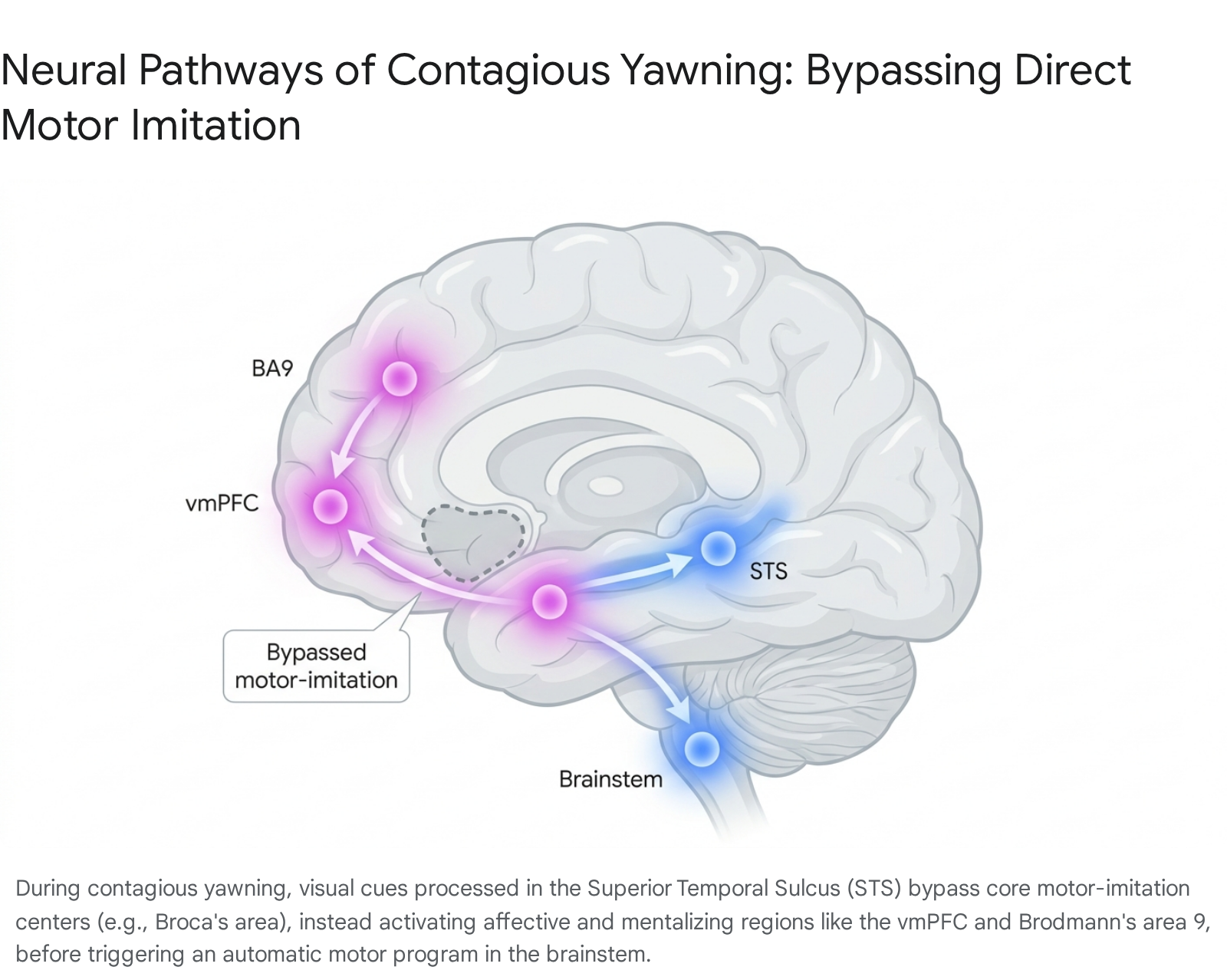
When human subjects view or hear stimuli of contagious yawning, robust blood-oxygen-level-dependent (BOLD) signal increases are consistently observed in specific cortical networks. Key regions include the posterior superior temporal sulcus (STS), the ventromedial prefrontal cortex (vmPFC), and select portions of the MNS, specifically Brodmann's area 9 (BA 9) located in the right inferior frontal gyrus (IFG) 62526352728.
The STS is highly attuned to processing biological motion and social cues, serving as the perceptual gateway for detecting a yawn in the environment 2628. Activation in BA 9, a region heavily implicated in mentalizing, cognitive empathy, and theory of mind tasks, facilitates the sharing of physiological and emotional states, translating the observed motor pattern into an internal affective representation 2627. The engagement of the vmPFC highlights the autonomic and emotional regulatory aspects of the behavior 62529.
However, a highly nuanced and consistent finding across multiple neuroimaging studies is the selective absence of activation in the core action-understanding and true imitation regions of the MNS. Specifically, Broca's area (the pars opercularis of the IFG), which typically activates intensely during deliberate motor imitation, remains dormant during contagious yawning 252628. When subjects are shown control videos of non-contagious facial movements (such as a generic gape or a cough), these core mirror areas light up, indicating that the brain is actively analyzing and mirroring the action 625. But during contagious yawning, these specific imitation centers are distinctly bypassed 2628.
This "Broca's bypass" suggests that contagious yawning is not a deliberate, cognitive act of true motor imitation. Rather, the visual detection of a yawn by the STS acts as an innate releasing mechanism. It bypasses the need for detailed action understanding and instead triggers a pre-packaged, highly stereotyped motor program managed lower down in the brainstem and hypothalamus 62528.
Furthermore, fMRI data reveals that a subject's self-reported tendency to contagiously yawn covaries negatively with activation in the left periamygdalar region 28. Because the amygdala governs threat detection and vigilance, heightened amygdalar activation (such as being in the presence of strangers) suppresses the yawn reflex, perfectly aligning with behavioral data showing that stress and unfamiliarity inhibit contagion 28.
2026 Breakthroughs in Cerebrospinal Fluid (CSF) Dynamics
Recent neuroimaging endeavors have expanded beyond functional cortical mapping into structural and fluid dynamics. A pioneering 2026 MRI study by Martinac et al. analyzed the flow of cerebrospinal fluid (CSF) and blood in 22 healthy subjects instructed to yawn, take deep breaths, and breathe normally 30.
While both deep breaths and yawns increase the outflow of deoxygenated blood from the cranial vault - making room for fresh arterial blood - yawns possess an entirely unique mechanical signature. Specifically, the muscular exertion of a yawn triggers a massive movement of CSF away from the brain, an effect completely absent during standard deep inhalation 30. Furthermore, during the initial stages of the yawn, carotid arterial blood flow into the brain surges by approximately one-third 30.
This finding provides a vital mechanical link supporting both the thermoregulation and arousal hypotheses. The bulk displacement of CSF, coupled with a surge of fresh carotid arterial blood, may serve to rapidly flush metabolic waste products and facilitate intracranial counter-current heat exchange. This physical "resetting" of the cortical environment suggests that yawning mechanically drives central nervous system homeostasis 30.
Clinical and Neurodivergent Populations: Yawning as a Proxy for Social Cognition
Because contagious yawning is deeply intertwined with networks governing empathy, Theory of Mind, and motor resonance, the behavior has emerged as a powerful, non-invasive behavioral proxy for evaluating social cognition across clinical and neurodivergent populations.
Autism Spectrum Disorder (ASD)
Children and adults diagnosed with Autism Spectrum Disorder consistently exhibit diminished, delayed, or entirely absent rates of contagious yawning, despite displaying completely normal frequencies of spontaneous, homeostatically driven yawning 1113143132. In controlled experimental settings, typically developing children readily catch yawns from an experimenter reading a story by age five. Conversely, children with severe ASD rarely exhibit the contagion, while those with milder presentations (such as pervasive developmental disorder) show intermediate rates of contagion 11.
This deficit is not attributed to a localized motor failure of the jaw's cortex, but rather to atypical development or compromised connectivity within the MNS and the broader socio-emotional processing networks in the prefrontal cortex 1114. Furthermore, recent biochemical research has directly linked contagious yawning in ASD to underlying neurochemistry; clinical studies out of the Parker Lab demonstrate that blood oxytocin concentrations - a neuropeptide critical for establishing social bonding, trust, and eye contact - positively predict the likelihood of contagious yawning behavior in children with ASD 33.
Psychopathy and Antisocial Traits
The empathy-based framework of contagious yawning is further corroborated by psychometric profiling in populations exhibiting antisocial traits. In non-clinical human populations, individuals scoring higher on the Psychopathic Personality Inventory (PPI) - particularly in trait domains related to coldheartedness, callousness, selfishness, and a lack of empathic concern - are significantly less susceptible to contagious yawning 1443. This inverse behavioral relationship aligns seamlessly with the fMRI data: psychopathy is historically associated with functional deficits and reduced gray matter volume in the vmPFC and amygdala, the precise neural regions implicated in the affective processing and autonomic release of a contagious yawn 142528.
Schizophrenia
Patients diagnosed with schizophrenia also demonstrate significantly reduced rates of contagious yawning compared to neurotypical controls 3143132. Schizophrenia is frequently characterized by profound negative symptoms, including social withdrawal, blunted affect, and severe deficits in social cognition and intention attribution. The impairment of the prefrontal neural circuits responsible for maintaining empathetic resonance and social synchronization likely underpins this lack of behavioral contagion, further validating contagious yawning as a reliable barometer for socio-emotional integration 31431.
Distinguishing Multiple Sclerosis (MS)
It is important to distinguish the loss of contagion from pathological increases in spontaneous yawning. Patients with Multiple Sclerosis (MS) often exhibit excessive yawning, but this is entirely distinct from social contagion 144. Polygraphic recordings indicate that MS patients yawn at significantly elevated rates, frequently followed by safe swallows, due to brainstem lesions or systemic dysregulation of brain thermoregulation pathways 144. In these neurological contexts, excessive yawning serves as a compensatory physiological reflex rather than a social signal.
Cross-Cultural and Regional Variations: The In-Group vs. Out-Group Dynamic
A persistent question in ethology and cultural psychology is whether macro-cultural constructs - such as a society's leaning toward individualistic (e.g., WEIRD societies like the UK or US) versus collectivistic structures (e.g., East Asian societies like Japan) - fundamentally alter the rates and rules of contagious yawning.
The Primacy of the Emotional Bias Hypothesis (EBH)
Research examining cross-cultural variation in motor mimicry strongly supports the Emotional Bias Hypothesis (EBH) over the Attentional Bias Hypothesis (ABH). The ABH suggests that yawn contagion is merely a byproduct of bottom-up visual processing; individuals pay closer visual attention to familiar faces, and thus are more likely to catch their yawns 1834. Conversely, the EBH posits that yawn contagion is driven by the strength of the emotional bond and top-down empathic processing 1834.
To control for visual attention, researchers tracked auditory contagious yawning - where the subject could hear but not see the yawner. The results confirmed the EBH: auditory contagion still occurs most frequently among kin and close friends, moderately among acquaintances, and least among strangers 183435. This gradient of contagion based on emotional proximity is a highly conserved evolutionary trait. It is mirrored exactly in primate studies; adult chimpanzees, bonobos, and geladas all show significantly higher rates of yawn contagion in response to in-group members and grooming partners compared to out-group members or strangers 18202123.
When evaluating human cross-cultural patterns, researchers utilizing Hofstede's and Minkov's cultural dimensions note that while macro-cultural values heavily influence self-reported measures of identity, uncertainty avoidance, and collectivism, these constructs do not readily alter basal physiological mimicry 364837. Broad meta-analyses of behavioral cooperation and social dilemma games conducted across 70 societies reveal very little cross-societal variation in baseline human responses to strangers 3638. Consequently, the fundamental architecture of yawn contagion - its reliance on immediate interpersonal emotional closeness - remains universally consistent across human societies. The specific country of origin does not significantly modulate yawn contagion rates; rather, the interpersonal bond remains the primary driver 1939.
Gender Variables and Environmental Contexts
While emotional closeness is a universal predictor, demographic variables like gender yield mixed results. Some epidemiological studies report that women are more susceptible to contagious yawning, theoretically aligning with higher self-reported empathy scores in female cohorts 18405341. However, larger, highly controlled investigations frequently find no significant difference between men and women in baseline contagious yawning 31324041. Discrepancies in the literature are often attributed to environmental variables. For instance, in wild settings, men's vocalized yawns may carry further, making them more frequent "triggers," while recent studies during the COVID-19 pandemic noted that face mask usage disrupted visual yawn contagion, potentially affecting demographics differently based on mask-compliance rates 1853. Overall, aside from emotional closeness, chronological age is the most consistent demographic predictor; susceptibility to contagious yawning slowly decreases as healthy adults age 93132.
The Paradox of Interspecific Contagion
To test the limits of the empathy framework, researchers have investigated interspecific contagious yawning (i.e., humans catching yawns from non-human animals). Surprisingly, humans exhibit robust contagious yawning in response to videos of domestic dogs and cats yawning 3541. However, when psychological instruments were applied, self-reported empathic concern was found to be negatively predictive of this interspecific response, and phylogenetic relatedness did not modulate the contagion rate (humans caught yawns from amphibians as readily as from mammals) 3541.
This apparent contradiction generates a vital insight into the dual-nature of yawning. While intraspecific (human-to-human) yawning is heavily gated by emotional bonds and MNS-driven empathy, interspecific yawning likely triggers the older, more primitive state-matching pathway (similar to the phenomenon observed in zebrafish and flocking birds). It relies on the basal pattern recognition of biological motion to synchronize physiological states, rather than requiring deep, socially constructed affective empathy 35.
Comparative Analysis of Primary Yawning Hypotheses
The ultimate evolutionary function of contagious yawning remains a subject of vigorous academic debate. The discourse is largely dominated by three competing, though increasingly viewed as complementary, hypotheses. The evidence, mechanisms, and criticisms for each are detailed below.
| Hypothesis | Proposed Mechanism | Supporting Evidence | Leading Criticisms & Nuances |
|---|---|---|---|
| Thermoregulation (Brain Cooling Hypothesis) | The wide gaping of the jaw and deep inhalation of ambient air acts as a biological radiator. It facilitates counter-current heat exchange, cooling arterial blood traveling to the brain via the vertebral venous plexus, thereby preventing hyperthermia and maintaining optimal cortical function. | Yawning frequency increases during transient spikes in brain temperature (measured directly in rat frontal cortices) and in warm ambient climates. The behavior is entirely suppressed if the forehead is artificially cooled or if the subject breathes exclusively through the nose (which cools the brain directly) 1244256. | Fails to fully explain the strict social modulation (in-group vs. out-group) of the contagion. Opponents (e.g., Guggisberg) argue that direct physiological arousal has not been definitively proven in post-yawn EEG scans 35758. However, the 2026 CSF fluid dynamics study suggests the mechanism may encompass broader central nervous system homeostasis 30. |
| Empathy and Emotional State-Matching (EBH) | Contagious yawning is a form of motor mimicry facilitated by the Mirror Neuron System. It evolved to allow social animals to share affective states, fostering group cohesion, mutual understanding, and emotional resonance. | High correlation with emotional closeness (kin/friends > strangers) 183435. Activates MNS and mentalizing brain regions (BA9, vmPFC) 62627. Severely blunted in individuals with ASD, psychopathy, and schizophrenia 11143143. | A comprehensive 2014 epidemiological study (N=328) found age to be the only reliable independent predictor of contagion, failing to find a strong statistical link to trait empathy scores 93132. Furthermore, the discovery of contagion in zebrafish suggests empathy is a later evolutionary overlay, not the foundational cause 24. |
| Alertness Synchronization (Arousal) | Yawning signals a state transition (from sleep to waking, or high arousal to low arousal). Contagious yawning serves as a non-verbal communicative tool to rapidly synchronize the vigilance levels and activity patterns of an entire social group. | Yawns heavily cluster around waking and sleeping transitions 145. Contagion triggers group directional shifts in fish 24 and synchronous activity transitions in lions 217. Eye-tracking studies show human observers detect threats (snakes, spiders) significantly faster immediately after viewing a yawn 172031. | While behavioral vigilance increases, autonomic measurements (heart rate, skin conductance) and certain EEG spectral patterns (e.g., delta wave reduction) do not always reflect a sustained, systemic physiological arousal post-yawn 31442. |
Synthesis and Evolutionary Outlook
The scientific understanding of yawning has evolved dramatically from its historical classification as a simple, reflexive response to anoxia. It is now recognized as a highly complex neuroethological behavior governed by dual, overlapping evolutionary systems.
At its basal physiological level, spontaneous yawning provides critical homeostatic regulation - driving cerebrospinal fluid clearance, facilitating brain thermoregulation, and emerging prenatally to aid essential sensorimotor development. Over 400 million years, this profound physiological reflex was co-opted for social survival. In diverse taxa ranging from zebrafish to flocking birds and social carnivores, the visual or auditory detection of a yawn triggers an automatic, brainstem-mediated motor program that synchronizes group movement and collective vigilance.
In the hominid lineage, this primitive state-matching mechanism was further integrated into the expanding prefrontal cortex and mirror neuron systems. Consequently, in human populations, contagious yawning operates as a subconscious tether for emotional resonance, strictly modulated by in-group biases, emotional proximity, and the structural integrity of socio-cognitive neural circuits. Its selective absence now serves as a reliable behavioral marker for neurodivergence in conditions such as ASD and psychopathy. Ultimately, contagious yawning stands as a profound evolutionary artifact, demonstrating how the fundamental biological need for physiological homeostasis was seamlessly transformed into a sophisticated, non-verbal tool for empathy and social cohesion.