
Why We Make Worse Decisions When Tired or Hungry
When the human body is exhausted or deprived of calories, the brain's prefrontal cortex - the region responsible for logic, planning, and self-control - loses its ability to regulate deeper, emotion-driven neural centers. This neurological imbalance predictably degrades cognitive flexibility, shortens attention spans, and shifts behavior toward impulsive, high-risk choices and a preference for immediate gratification. While recent research shows that mild, short-term fasting does not impair cognition as much as once believed, severe sleep deprivation can degrade decision-making as drastically as mild alcohol intoxication.
The Brain's Control Center Under Siege
To understand why a missed lunch or a restless night derails human judgment, one must first look at the anatomical architecture of the brain. The center of executive functioning is the prefrontal cortex (PFC), a highly evolved region located directly behind the forehead 12.
The prefrontal cortex acts as the Chief Executive Officer of the brain. It is responsible for organizing thoughts, prioritizing tasks, managing time, and regulating impulsive behavior 34. When an individual evaluates a complex problem, anticipates the long-term consequences of an action, or suppresses the urge to say something inappropriate, the PFC is actively mediating those processes 255. The term "executive functioning" itself was popularized in the 1970s by Karl Pribram, whose foundational research indicated that these higher-order cognitive processes are mediated primarily by the PFC 3.
The PFC is not a monolith; it relies on several highly specialized subregions to govern decision-making. The Dorsolateral Prefrontal Cortex (DLPFC) is primarily responsible for working memory, planning, and problem-solving, allowing us to hold information in our minds to execute multi-step tasks 6. The Ventromedial Prefrontal Cortex (vmPFC) is heavily linked to risk and reward processing, evaluating the potential consequences of our choices 67. Finally, the Orbitofrontal Cortex (OFC) evaluates actions based on potential rewards or punishments, regulating emotional responses 68.
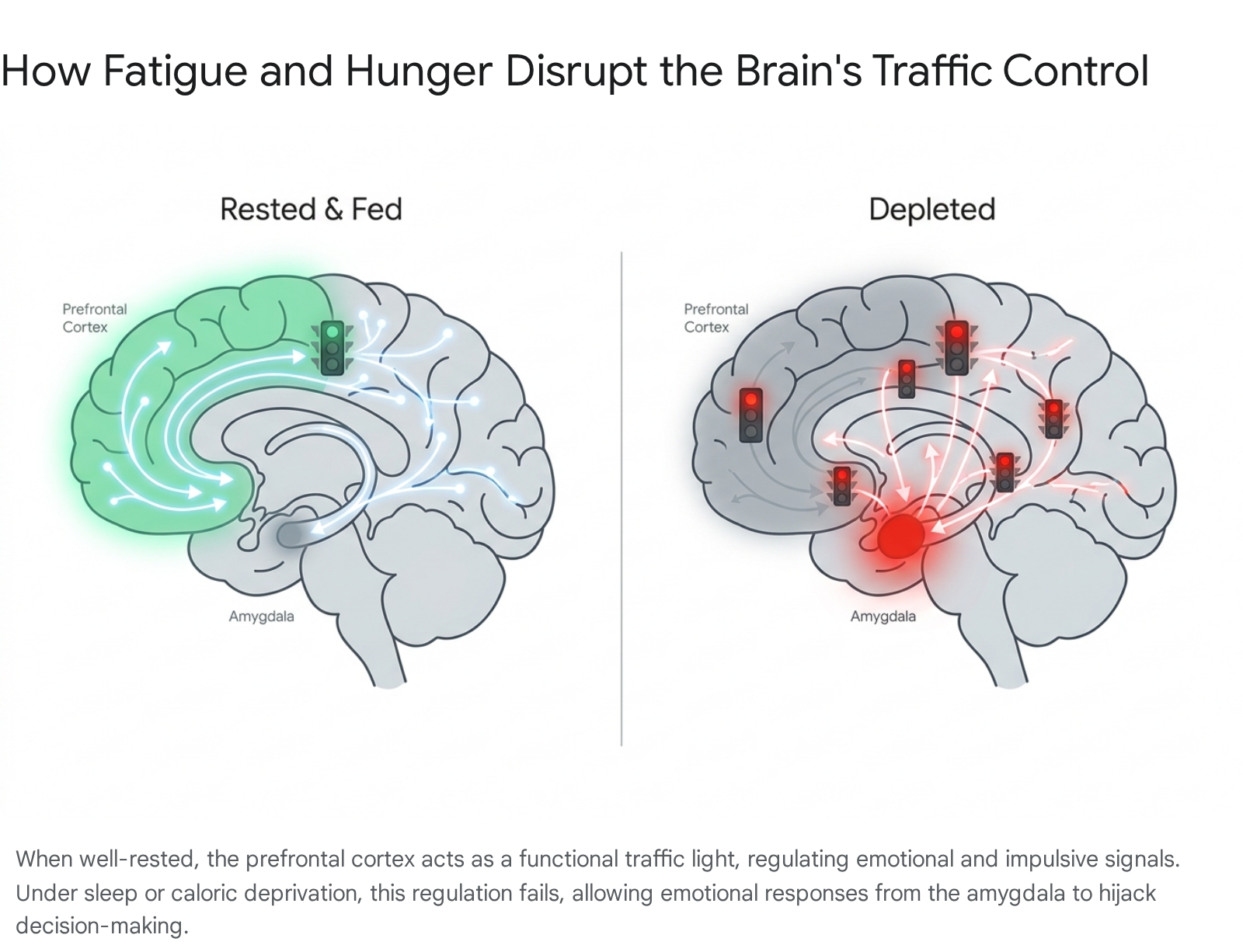
Another highly useful analogy for understanding the prefrontal cortex is a busy traffic intersection 9. In a healthy, well-rested brain, the PFC acts as a fully functioning set of traffic lights, regulating the flow of thoughts, external stimuli, and emotional responses (the "cars"). It dictates which thoughts get a green light to enter working memory and which impulsive urges get a red light. However, when the brain is subjected to physiological stress - such as acute sleep deprivation, chronic fatigue, or extreme metabolic depletion - the traffic lights lose power. The intersection becomes unregulated. Intrusive thoughts, emotional reactions, and distractions flood the intersection all at once, leading to a state of cognitive gridlock 9.
The Mechanics of Executive Dysfunction
When the prefrontal cortex is compromised, the result is known as "executive dysfunction." While this is a temporary, reversible state for the tired or hungry, it remarkably mimics the chronic baseline of neurodivergent conditions like Attention Deficit Hyperactivity Disorder (ADHD) or traumatic frontal lobe injuries 15511.
Executive dysfunction manifests in several highly predictable, measurable ways that directly impact decision-making:
- Working Memory Deficits: The brain's short-term scratchpad begins to fail. It becomes difficult to hold conflicting variables in mind, evaluate alternatives, or remember multi-step instructions 612.
- Time Blindness: Time perception is linked to the PFC and its connection to dopamine signaling. When depleted, individuals lose the intuitive ability to feel how much time has passed or estimate how long a future task will take, leading to terrible planning decisions 12.
- Task Initiation Paralysis: The barrier to starting a task feels insurmountable. Because the PFC cannot properly sequence the steps required to complete a goal, the brain becomes overwhelmed and avoids making a decision entirely 312.
- Inhibitory Control Collapse: Also known as a lack of self-restraint. Without the PFC applying the brakes, the brain defaults to its more primitive, reactive centers, leading to impulsive purchases, inappropriate outbursts, and poor dietary choices 356.
The Sleep-Deprived Brain: Running on Fumes
Sleep deprivation is arguably the most profoundly disruptive physiological state a healthy person can endure outside of clinical illness. It is also a globally pervasive issue, with estimates suggesting that 20% or more of adults suffer from some form of regular sleep deprivation 10.
The cognitive consequences of sleep loss are not merely psychological; they are deeply structural, neurochemical, and physiological. Researchers generally divide sleep loss into two distinct categories: acute total sleep deprivation (staying awake for 24 to 72 hours continuously) and chronic partial sleep restriction (sleeping less than the required 7 to 9 hours for consecutive nights) 11. Both forms wreak havoc on cognitive performance, but they do so in slightly different ways.
The Collapse of Attention and Vigilance
The most immediate and severe casualty of sleep loss is sustained attention, often measured by the Psychomotor Vigilance Test (PVT) 121314. The PVT requires subjects to respond to visual or auditory stimuli appearing at random intervals. In well-rested individuals, response times are swift and consistent. After 16 hours of continuous wakefulness, however, the ability to sustain vigilant attention begins to wane dramatically 12.
Sleep-deprived individuals experience "lapses" - micro-periods of non-responsiveness lasting half a second or longer 121314. These are essentially momentary system failures where the brain briefly goes offline. In high-stakes environments, such as driving, flying, or surgery, these lapses are catastrophic. In fact, research indicates that remaining awake for 24 hours induces a level of cognitive impairment equivalent to a blood alcohol concentration of 0.10%, which exceeds the legal limit for intoxication in most global jurisdictions 1516.
While chronic partial sleep restriction is far more common in everyday life, it is equally insidious. When individuals are restricted to 3 or 5 hours of sleep per night in laboratory settings, their speed and accuracy on cognitive tests deteriorate sharply for the first few days. Interestingly, those in the 5-hour and 7-hour restriction groups eventually hit a low plateau where performance stops actively worsening, though it remains severely impaired 11. Alarmingly, individuals subjected to chronic sleep restriction often lose the ability to accurately self-evaluate their own impairment; their objective performance plummets, yet they subjectively report feeling that they have adapted to the lack of sleep 11.
The Amygdala Hijack and Risky Choices
Beyond basic attention and reaction times, sleep deprivation fundamentally alters how we make complex decisions, particularly regarding risk and reward. This behavioral shift is driven by a stark reorganization of brain activity.
Functional MRI (fMRI) studies reveal that sleep deprivation significantly decreases activity in the prefrontal cortex and the insular cortex - regions responsible for critical evaluation, logic, and appetitive choices 17. Simultaneously, sleep loss triggers a massive amplification of activity within the amygdala, the brain's primitive emotional and threat-detection center 1718. Furthermore, sleep deprivation effectively severs the functional connectivity between the medial prefrontal cortex and the amygdala 19.
Without the prefrontal cortex to provide a rational check on emotional impulses, the brain becomes hyper-reactive. This neural environment is highly conducive to terrible decision-making. Sleep-deprived individuals exhibit a marked shift toward risk-taking behavior 720. For example, in laboratory gambling tasks like the Game of Dice Task, fatigued participants are significantly more likely to make risky choices, focusing heavily on potential high-reward gains while irrationally ignoring the probability of severe losses 720. Interestingly, some studies show a gender divergence here: males often make riskier decisions following sleep deprivation, while some evidence suggests females may become more risk-averse 7.
Furthermore, sleep deprivation causes a phenomenon known as "feedback blunting." A well-rested brain utilizes negative feedback (a bad outcome or a loss) to optimize future judgments. A sleep-deprived brain, however, loses the capacity to utilize negative feedback effectively, even after just 8 hours of sleep deprivation. This means tired people will stubbornly repeat the same strategic mistakes because the negative consequence simply does not register as salient 72021.
The Hidden Toxins of Wakefulness
The cognitive decline associated with sleep deprivation is also tied intimately to the brain's waste management system. During healthy non-rapid eye movement (NREM) sleep, the brain's glymphatic system becomes highly active. Cerebrospinal fluid flows at increased rates, and the interstitial space between brain cells expands by up to 60%, successfully flushing out toxic cellular byproducts that accumulate during wakefulness 19.
When sleep is restricted, this crucial clearing process is stalled. Toxins, including beta-amyloid proteins (which are strongly associated with the development of Alzheimer's disease and dementia), rapidly build up in the thalamus and hippocampus 19. This chemical accumulation alters glucose metabolism in the brain and induces insulin resistance, directly contributing to the sluggish processing speeds, mood instability, and memory deficits experienced after a poor night's rest 19. Over time, chronic night shift workers and those with severe insomnia show prolonged auditory P300 latencies on EEGs, indicating chronic, cumulative impairment in how fast their brains can process information 15.
Cultural and Socioeconomic Disparities in Sleep
The burden of sleep deprivation, and its subsequent impact on decision-making, does not fall equally across populations. Extensive research highlights significant racial, ethnic, and socioeconomic disparities in sleep health, which cascade into disparities in metabolic and cognitive outcomes.
In the United States, studies consistently show that racial and ethnic minorities, particularly Black and Latinx adults, experience shorter sleep durations and poorer sleep quality compared to White adults 2223. Black adults are up to five times more likely to report sleeping less than 6 hours per night and exhibit structural differences in sleep architecture, achieving less restorative slow-wave sleep (SWS) 2324. Similarly, Chinese adults in the US are more than twice as likely to report sleeping under 6 hours and exhibit poor sleep efficiency 23.
These disparities are heavily driven by systemic factors, including neighborhood noise, chronic stress from discrimination, shift work prevalence, and food insecurity 2224. Food insecurity is highly correlated with insomnia and short sleep duration 22. The resulting chronic sleep deficiency disrupts the neuroendocrine regulation of appetite, elevating diabetes and cardiovascular disease risks, while simultaneously degrading the executive function required to navigate these compounding stressors 24.
Hunger and the Brain: The Glucose Debate
The human brain is an incredibly energy-intensive organ. While it accounts for only about 2% of total body weight, it consumes roughly 20% of the body's daily energy intake, relying almost exclusively on glucose for baseline fuel 252627. It stands to logical reason that when blood sugar drops due to skipped meals or fasting, cognitive function should plummet alongside it. However, modern nutritional neuroscience paints a much more nuanced picture than the common "hangry" stereotype suggests.
The Myth and Reality of Blood Sugar Spikes
For years, wellness circles, biohackers, and productivity gurus have warned of the acute dangers of blood sugar "peaks and troughs." The prevailing narrative suggests that eating refined carbohydrates causes a rapid glucose spike, followed by a severe insulin-driven crash, leading directly to brain fog, fatigue, and poor decisions.
While it is entirely true that severe clinical hypoglycemia (dangerously low blood sugar) drastically impairs executive function and working memory, clinical dietitians note that for metabolically healthy individuals, normal post-meal fluctuations in blood sugar are entirely harmless and do not cause immediate cognitive collapse 2829. The human body is remarkably adept at maintaining glucose homeostasis. The brain can synthesize emergency glucose reserves from glycogen 30. The acute fatigue many people feel in the mid-afternoon is often driven more by natural circadian rhythm dips, sleep debt, and accumulated psychological stress than by minor post-prandial dips in blood glucose 2931.
However, chronic impairment of glucose metabolism - such as insulin resistance, prediabetes, or type 2 diabetes - has a devastating, measurable impact on the brain. Long-term exposure to high ambient glucose levels in the central nervous system is linked to cerebral atrophy, reduced hippocampal volume, and a significantly increased risk of dementia 2632. Longitudinal studies show that individuals with impaired glucose tolerance at midlife exhibit significant declines in episodic memory (specifically word-list delayed recall) over a ten-year period 3334. Population-based studies reveal a reverse U-shaped relationship between fasting glucose and cognitive function in non-diabetic adults, with optimal cognitive performance peaking at a fasting glucose threshold between 3.97 and 6.20 mmol/L, before declining at higher levels 35.
The Fasting Paradox: Clarity or Confusion?
A major debate in cognitive science surrounds intermittent fasting and skipping meals. Does fasting sharpen the mind and clear "brain fog," as some proponents claim, or does it leave the brain starved for glucose, leading to terrible decisions?
A massive 2025 meta-analysis published by the American Psychological Association reviewed 71 experimental studies involving nearly 3,500 healthy adults to settle this exact question 363738. The researchers compared the cognitive performance of satiated adults against those who had fasted for an average of 12 hours.
The results were highly illuminating. A 2025 meta-analysis of 71 studies and 3,484 participants found an overall effect size of nearly zero (g=0.02) when comparing the cognitive performance of satiated versus short-term fasted adults, indicating remarkable stability. Mental sharpness, reaction time, processing speed, and general decision-making remained remarkably stable regardless of whether the participant had eaten breakfast or skipped it entirely 363738. When deprived of immediate dietary glucose, the human body smoothly switches its fuel source, utilizing stored glycogen and eventually transitioning to ketone bodies to maintain operational efficiency 3036.
However, the meta-analysis did highlight crucial exceptions where hunger does impair cognition: 1. Prolonged Deprivation: Modest reductions in cognitive performance were observed when fasting extended well beyond the 12-hour mark 3638. 2. Developing Brains: Children and teenagers showed noticeable cognitive declines when fasting, suggesting that younger, developing brains require a steadier influx of calories and are less resilient to metabolic switching 3638. 3. The Food-Cue Distraction: The only time fasting adults reliably performed worse was when the cognitive tasks involved food-related stimuli (such as looking at photos of meals). In these scenarios, hunger acts as a potent distraction, diverting executive resources away from the task at hand and toward the biological drive to seek food 3637.
Ghrelin: The Hormonal Driver of Impulsivity
While a lack of glucose might not inherently crash a healthy brain, the hormonal signals of hunger actively change how we evaluate rewards and make decisions. Ghrelin, the peptide hormone produced primarily by the stomach to signal hunger to the brain, has a direct, detrimental impact on specific decision-making metrics.
Research shows that centrally elevated ghrelin levels significantly increase two specific types of impulsivity: motor impulsivity (the inability to restrain a physical response) and choice impulsivity (the inability to delay gratification) 8. In behavioral tests, subjects with high ghrelin levels consistently exhibited steeper delay discounting rates - meaning they abandoned larger, delayed rewards in favor of smaller, immediate rewards 8. The hormone essentially increases an individual's aversion to waiting, overpowering the logical value of a better long-term outcome.
Therefore, while a hungry person can still perform a complex math test accurately (as working memory is preserved), they are vastly more likely to make an impulsive, short-sighted financial or interpersonal decision. Their brain is neurochemically primed by ghrelin for immediate gratification 8.
Decision Fatigue: A Real Phenomenon or a Cultural Myth?
Beyond physical exhaustion and caloric depletion, there is a third, heavily debated pillar of cognitive depletion: decision fatigue.
The concept, originally tied to the psychological theory of "ego depletion," suggests that willpower and decision-making capacity are finite biological resources 3940. Like a muscle that tires after lifting weights, the brain allegedly becomes exhausted after making hundreds of micro-choices - what to wear, how to reply to an email, which project to prioritize 2541. As the day wears on and this resource drains, the depleted brain seeks irrational shortcuts. People either become highly impulsive, default to the easiest option (a phenomenon known as status quo bias), or avoid making a decision altogether (procrastination) 394042.
The High Stakes of Healthcare Decisions
Nowhere is the theory of decision fatigue more critical - and more thoroughly documented observationally - than in medicine. A massive 2025 systematic review analyzing 82 studies in healthcare settings found statistically significant evidence of decision fatigue in 45% of the cases evaluated 4344.
The data paints a concerning picture of how cumulative cognitive burden alters medical care. As a clinical shift progresses and doctors make more decisions, their choices become increasingly skewed in ways that conserve mental effort:
- Diagnostic Screenings: Ordering rates for routine tests, including breast cancer screenings, colorectal cancer screenings, and prostate antigen tests, decline significantly toward the end of a shift 44.
- Prescribing Patterns: The likelihood of prescribing preventive treatments (like statins or influenza vaccinations) drops off as appointments progress. Conversely, reactive, "easier" treatments (like prescribing opioids or antibiotics) significantly increase throughout the clinical day. Researchers hypothesize that providing reactive medications to a complaining patient is simply less effortful than spending the cognitive and emotional energy required to explain why they do not need an antibiotic 44.
- Surgical Interventions: Surgeons are up to 33% less likely to schedule a patient for an operation if the consultation occurs at the end of their shift compared to those seen first thing in the morning 4044.
- Safety Protocols: Nurses' response times to physiological monitor alarms become significantly slower with each successive hour of a shift, and hand hygiene compliance drops significantly from the beginning to the end of a typical 12-hour shift 44.
The Replication Crisis and "Reverse Ego-Depletion"
Despite the compelling observational data in healthcare and criminal justice (such as famous studies showing judges grant parole less frequently before lunch), the core psychological mechanism of decision fatigue - ego depletion - has faced intense scientific scrutiny in recent years. Rigorous recent meta-analyses, including a comprehensive review of 116 experiments, have found little to no robust evidence that self-control is actually a finite resource that physically drains over time 41.
This lack of replicability has led researchers to propose a fascinating alternative: decision fatigue might be, in large part, a self-fulfilling prophecy dictated by our cultural beliefs about the mind.
In 2017, researchers conducted a landmark study comparing American and Indian cultural contexts regarding willpower 454651. In Western cultures, the prevailing lay belief is that mental effort is draining and depleting. Consequently, Western participants in the study exhibited classic ego-depletion; their performance on cognitive tests dropped after completing initial, difficult mental tasks 4546.
However, in Indian culture, there is a widespread belief that exerting mental effort is energizing - that using concentration invigorates the mind for the next challenge, a concept culturally rooted in practices like extended meditation and focused prayer 4652. When tested using dual-task paradigms, Indian participants exhibited reverse ego-depletion. The harder the initial mental task, the better they performed on subsequent cognitive challenges 4546.
To prove this was a psychological framing effect rather than a biological hardwiring difference, researchers artificially manipulated Western participants. When Westerners read articles suggesting that willpower is an energizing force before taking the tests, they too exhibited reverse ego-depletion, maintaining or improving their cognitive performance 4651. This suggests that while cognitive fatigue is a very real biological phenomenon when tied to acute sleep loss or extreme systemic stress, much of everyday "decision fatigue" is mediated by our own psychological beliefs about our mental limits.
Comparing the Toll of Cognitive Depletion
To fully understand the varied ways human judgment is derailed, it is helpful to compare the exact mechanisms and real-world impacts of these three depleted states.
| Depletion State | Primary Biological Mechanism | Impact on Decision-Making | Real-World Example |
|---|---|---|---|
| Sleep Deprivation | Decreased PFC activity; hyper-reactive amygdala; mPFC-amygdala disconnect; toxic protein (beta-amyloid) buildup 1719. | Severe drop in vigilance; increased risk-taking; failure to learn from negative feedback; working memory failure 720. | A driver missing a red light due to a micro-lapse; an executive making a reckless financial gamble 712. |
| Hunger (Fasting) | Brain switches to glycogen/ketones; elevated ghrelin levels in the bloodstream 83038. | Stable baseline cognition and processing speed, but vastly increased choice impulsivity and an aversion to delayed rewards 836. | Abandoning a long-term diet plan for immediate junk food; snapping in frustration at a colleague. |
| Decision Fatigue | Cognitive load accumulation; psychological belief in limited willpower (ego depletion) 414346. | Preference for the status quo; avoidance of complex choices; impulsive shortcuts; conservative triaging 4044. | A doctor prescribing unnecessary antibiotics late in a shift to avoid a lengthy patient argument 44. |
Nutritional Interventions for Executive Function
While skipping a single breakfast may not ruin short-term cognition for a healthy adult, long-term dietary habits physically alter the brain's architecture and its baseline executive functioning.
The brain relies heavily on a steady supply of micronutrients and stable glucose. Diets high in ultra-processed foods, refined sugars, and processed meats cause rapid glycemic fluctuations and promote neuroinflammation, which accelerates cognitive decline and impairs executive function 305354. In children, particularly those who are neurodivergent, high intakes of refined starches disrupt brain glucose levels and actively worsen executive dysfunction, contributing to hyperactivity and poor task initiation 53.
Conversely, adherence to diets rich in complex carbohydrates, omega-3 long-chain polyunsaturated fatty acids (PUFAs), and B vitamins - such as the Mediterranean or MIND diets - provides sustained glucose delivery and neuroprotection 274748. Complex carbohydrates (like oats, lentils, and sweet potatoes) are digested slowly, preventing the spikes and crashes that destabilize mood and focus 2730. Omega-3 PUFAs are critical for building brain cell membranes and reducing inflammation, while B vitamins are crucial for homocysteine metabolism, the dysregulation of which is an independent risk factor for dementia 2747.
Recent clinical trials have also explored the intersection of fasting patterns and overall diet quality on brain aging. A 2024 study presented at the Alzheimer's Association International Conference compared the effects of a 5:2 intermittent fasting diet against a standard healthy living (HL) diet in older adults with insulin resistance 4950. While both diets successfully lowered brain glucose concentrations and reduced neuronal insulin resistance, the intermittent fasting group showed slightly stronger benefits, including approximately 20% greater improvements in executive function, strategic planning, and cognitive flexibility 4950.
Evidence-Based Strategies to Protect Decision-Making
Because the prefrontal cortex is so vulnerable to physiological and psychological stress, protecting its function requires intentional daily structuring. Based on current research, individuals can employ several evidence-based strategies to mitigate the effects of exhaustion, hunger, and fatigue.
1. Automate and Delegate
To combat decision fatigue, reduce the volume of micro-decisions required early in the day. High-performers routinely standardize their mornings - eating the same breakfast, maintaining a minimal wardrobe, and following a strict routine 254042. By automating low-stakes choices and delegating minor decisions to trusted colleagues, you preserve cognitive bandwidth for the high-stakes decisions required later in the day 2542.
2. Time-Block High-Impact Choices
Because vigilance and cognitive control are generally highest in the morning (following restorative sleep), schedule the most complex, analytical, or emotionally taxing decisions before noon 2551. Leave reactive tasks, such as responding to emails, organizing files, or attending routine administrative meetings, for the afternoon when cognitive resources naturally begin to dip.
3. Adopt a Neuro-Protective Diet
Aim for a balanced plate that includes complex carbohydrates, lean proteins, and healthy fats at every meal to ensure steady blood glucose levels 2754. Furthermore, address micronutrient deficiencies. Iron deficiency, particularly in children, is linked to long-term deficits in executive function and impulse control, while zinc is vital for mood regulation 53.
4. Reframe Your View of Willpower
Leverage the findings of the reverse ego-depletion studies. Recognizing that willpower and concentration can act as self-generating, energizing resources, rather than finite batteries, can actively prevent the psychological surrender associated with afternoon decision fatigue 4651. When faced with a difficult task late in the day, reframing the challenge as an opportunity to build mental stamina can materially improve performance.
Bottom line
We make worse decisions when tired or hungry because physiological stress actively disconnects the brain's rational control center (the prefrontal cortex) from its emotional and impulsive drives (the amygdala). While short-term hunger primarily increases our hormonal demand for immediate gratification without destroying baseline intelligence, sleep deprivation fundamentally degrades attention, learning, and risk assessment to dangerously low levels. Ultimately, while we can psychologically train ourselves to resist decision fatigue and optimize our diets for long-term brain health, there is no mental workaround for a biological lack of restorative sleep.