
Ego Depletion and Consumer Impulse Buying
Introduction to Self-Regulation and Consumer Vulnerability
The human capacity for self-regulation - the ability to override impulses, regulate emotions, and alter habitual responses to achieve long-term goals - is a fundamental component of rational consumer decision-making. However, converging evidence from behavioral economics, cognitive neuroscience, and consumer psychology indicates that this capacity is structurally finite. When consumers engage in successive acts of self-control or decision-making, they experience a temporary exhaustion of their regulatory resources, a psychological state formally termed "ego depletion" 1234. In this depleted state, the cognitive mechanisms required to resist subsequent temptations are severely compromised, rendering individuals highly susceptible to impulse buying.
Impulse buying is defined as a sudden, compelling, and hedonically complex urge to purchase a product immediately, often accompanied by emotional conflict and a diminished regard for long-term financial or personal consequences 56. In various retail sectors, impulsive behaviors account for a massive proportion of economic activity, with estimates suggesting that between 40% and 80% of all purchases fall into the impulse category, driving billions of dollars in annual revenue 78. While traditional neoclassical economic models assume rational utility maximization, impulse buying vividly violates the assumptions of homo economicus 9. It represents a structural failure of self-control wherein the immediate affective desire to acquire an item outstrips the cognitive willpower required to restrain the urge 28.
The intersection of ego depletion and impulse buying has become a critical area of scientific inquiry, particularly as modern digital marketplaces and e-commerce platforms actively engineer choice architectures designed to exploit cognitive fatigue 1011. The continuous evolution of consumer environments - characterized by ubiquitous digital advertising, one-click purchasing, algorithmic recommendations, and deceptive interface designs - places unprecedented demands on human self-regulation 21213. This research report provides an exhaustive analysis of the mechanisms underlying ego depletion, synthesizes experimental evidence alongside recent replication debates, explores the exacerbating role of digital dark patterns, examines cross-cultural boundary conditions, and evaluates empirically validated mitigation strategies.
Theoretical Frameworks of Ego Depletion
The Strength Model of Self-Control
The foundational framework for understanding ego depletion is the Strength Model of Self-Control, originally proposed by Baumeister, Bratslavsky, Muraven, and Tice in 1998 414. This model posits that all acts of self-regulation - whether controlling emotional expressions, focusing attention in the face of distractions, persisting at a difficult cognitive task, or resisting the temptation to purchase - draw from a common, domain-general pool of psychological resources 123.
Operating on a metaphorical "muscle" framework, the theory suggests that just as a physical muscle becomes fatigued after exertion, the self-regulatory faculty becomes depleted after active use 3415. Once depleted, subsequent attempts at self-control are more likely to fail, regardless of whether the subsequent task is related to the initial depleting task 316.
Evolution toward Conservation and Motivation Models
While the initial formulation of the Strength Model relied heavily on the concept of absolute resource exhaustion (often controversially linked to blood glucose levels), recent theoretical advancements have refined this model. A 2024 comprehensive review of ego depletion theory emphasizes a conservation mechanism rather than pure exhaustion 171819. According to this updated consensus, as individuals expend regulatory effort, their biological and cognitive systems shift to conserve remaining resources. This conservation imperative increases the perceived difficulty of subsequent tasks and reduces the individual's motivation to exert further effort, leading to a state of mental passivity or a reliance on low-effort, heuristic processing 171920.
Furthermore, event-related potential (ERP) studies in neuroeconomics provide physiological evidence for this shift. Under conditions of high ego depletion, individuals exhibit a smaller N1 amplitude during decision-making tasks, indicating a reduced allocation of early attentional resources to evaluate options. This neurophysiological deficit correlates directly with an inability to resist immediate, smaller rewards (temptations) in favor of delayed, larger rewards 21. Similarly, physiological stress responses, such as elevated cortisol levels, have been shown to increase the perceived cognitive cost of self-control, further accelerating the onset of depletion 22.
Dual-Process Theory and Cognitive Pathways
When self-regulatory resources are depleted, consumers experience a profound shift in their cognitive and affective processing systems. Drawing on dual-process theories of cognition, ego depletion compromises the reflective, rule-based, and effortful "System 2," forcing a reliance on the impulsive, associative, and automatic "System 1" 623.
In practical consumer contexts, this means that depleted individuals fail to elaborate on the long-term costs of a purchase, such as credit card debt or budget constraints. Instead, they succumb to immediate affective rewards 1. Ego depletion is heavily intertwined with emotional dysregulation. Individuals often engage in impulse buying as a compensatory mechanism to repair negative moods, alleviate stress, or counter social isolation 5624. When cognitive resources are low, the ability to effectively manage negative affect diminishes, amplifying the emotional drive to seek immediate gratification. The pursuit of positive emotions - such as the excitement or pleasure derived from acquiring a new item - overrides the depleted cognitive brakes that would ordinarily prevent the transaction 56.
Experimental Evidence on Ego Depletion and Consumer Spending
Laboratory Simulations of Consumer Behavior
The direct causal link between ego depletion and impulse buying was robustly established in a seminal series of experiments by Vohs and Faber (2007) 1225. Their research systematically demonstrated that individuals forced to expend self-regulatory resources in an initial, unrelated task were significantly more likely to engage in impulsive spending afterward.
In these experiments, depletion was manipulated through tasks requiring attention control (e.g., directing focus away from distracting elements in a video) or thought suppression. Across multiple simulated shopping environments, depleted participants not only reported stronger urges to buy but also expressed higher valuations for products, spent more actual money, and purchased a greater quantity of items 225.
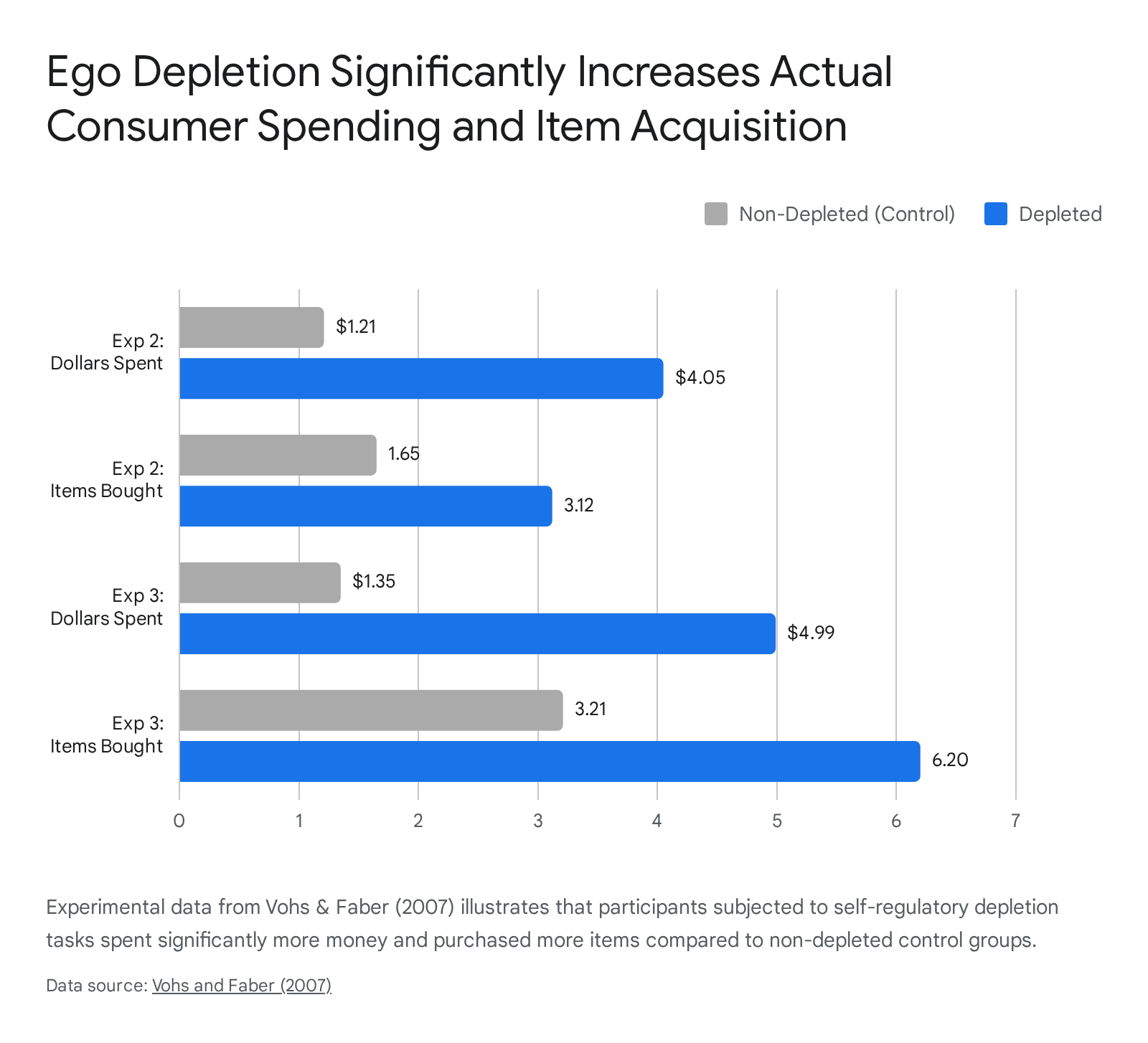
The magnitude of this effect was heavily moderated by an individual's innate impulsivity traits. Consumers scoring high on the Buying Impulsiveness Scale (BIS) exhibited a highly magnified response to ego depletion. For example, in the third experiment, high-BIS participants purchased an average of 8.01 items when depleted, compared to only 3.42 items in the non-depleted control condition 25. These findings confirm that while environmental and affective factors stimulate the desire to purchase, it is the availability of self-regulatory resources that dictates the ability to resist 226.
To further contextualize the quantitative outcomes of ego depletion on consumer choice, Table 1 summarizes the key behavioral metrics affected by self-regulatory exhaustion across seminal studies.
| Metric | Non-Depleted Condition | Depleted Condition | Reference Context |
|---|---|---|---|
| Willingness to Pay (Mean) | $22,789.61 | $30,037.12 | Experiment 1 (High-value goods) 25 |
| Actual Spend (Mean) | $1.21 | $4.05 | Experiment 2 (Bookstore simulation) 25 |
| Actual Spend (Mean) | $1.35 | $4.99 | Experiment 3 (Grocery simulation) 25 |
| Decision Deferral Rate | 42.2% | 57.9% | Decision to postpone a camera purchase 20 |
| Time Spent Reviewing Attributes | 10.26 seconds | 11.35 seconds | Product contemplation time 20 |
Mental Passivity and Decision Deferral
Notably, while depletion increases impulsive action when immediate rewards are present, it can also induce a state of "mental passivity" when consumers are faced with complex decisions. Vonasch et al. (2017) demonstrated that depleted consumers prefer to avoid making difficult consumer decisions altogether 20. In an experiment requiring participants to choose a digital camera based on complex attributes, depleted participants spent more time reviewing the information (11.35 seconds versus 10.26 seconds) but ultimately deferred the choice at a significantly higher rate (57.9%) compared to non-depleted controls (42.2%) 20. Thus, ego depletion creates a bipartite vulnerability spectrum: consumers either abandon choice when faced with complex decisions requiring System 2 processing, or they exhibit uninhibited impulse buying when faced with easy, immediately rewarding temptations requiring only System 1 heuristics 20.
Natural Experiments in Retail Environments
Beyond laboratory simulations, the effects of ego depletion have been observed in real-world retail settings. A natural experiment by Liu et al. tracked over 2,800 consumers waiting in grocery store checkout lines. The study found a statistically significant correlation between the amount of time a consumer spent in line - a proxy for prolonged exposure to temptation and subsequent willpower depletion - and the probability of purchasing a tempting, impulsive item placed near the register 27. The effect was notably larger when children were present, introducing additional cognitive and emotional load that further drained self-regulatory resources 27.
The Replicability Debate and Current Scientific Consensus
Given its central explanatory role in behavioral psychology and consumer research, the ego depletion effect has been subjected to intense empirical scrutiny over the past decade. It became a prominent focal point of the psychological sciences' broader "replication crisis," necessitating a nuanced understanding of the theory's current validity 152829.
Initial Meta-Analyses and Publication Bias
Early meta-analyses, notably by Hagger et al. (2010), reported a robust medium-to-large effect size (d = 0.62) for ego depletion across 198 published tests 430. This established the strength model as a dominant paradigm. However, subsequent re-analyses by Carter and McCullough (2015) applied advanced bias-correction techniques, specifically the precision effect test (PET) and the precision effect estimate with standard error (PEESE). These researchers concluded that the initial meta-analysis suffered from severe publication bias. After accounting for small-study effects using PET-PEESE, the ego depletion effect size was estimated to be statistically indistinguishable from zero, casting significant doubt on the entire phenomenon 4.
Registered Replication Reports and Methodological Flaws
This controversy prompted a massive Registered Replication Report (RRR) led by Hagger and Chatzisarantis in 2016. The RRR involved 24 independent laboratories and 2,141 participants worldwide, attempting to replicate the depletion effect using a standard sequential two-task paradigm 282929. The researchers utilized the "e-crossing task" to induce depletion in the experimental group. The results were highly damaging to the theory: the RRR found no significant difference in subsequent self-control performance between the depleted and control groups, yielding a null effect 42829.
However, the failure of the 2016 RRR quickly sparked critical methodological reviews. Independent researchers, including Dang (2018), identified that the specific experimental paradigm used in the replication - the e-crossing task - was fundamentally flawed 42829. A valid e-crossing depletion task requires participants to first establish a strong habit (crossing out every letter 'e') and then expend high cognitive effort to override that habit based on complex new rules. The RRR protocol failed to establish the initial habit, meaning it did not reliably induce the cognitive fatigue necessary for ego depletion to occur 429. A complementary analysis of the RRR data showed that among the subset of participants who subjectively experienced the task as highly effortful, the ego depletion effect did manifest 429.
Subsequent, stricter meta-analyses that filtered for validated, highly demanding depleting tasks (such as emotion suppression videos or prolonged working memory tasks) successfully recovered a reliable, small-to-medium effect size (g = 0.24 to 0.43) using conservative trim-and-fill methods 43031.
The 2024 Consensus on Self-Regulatory Fatigue
In a comprehensive 2024 review, Baumeister, Tice, and colleagues synthesized the current status of the theory. They acknowledged that the initial "exhaustible energy" model was overly simplistic and that early laboratory tasks were often too brief to induce true depletion 171932. However, the phenomenon of self-regulatory fatigue remains undeniably real and replicable under rigorous conditions.
The updated scientific consensus emphasizes that longer, more intense manipulations are required to ensure genuine cognitive fatigue 1732. In applied, real-world settings like digital consumerism - where cognitive load is sustained over prolonged periods through endless scrolling and choice evaluation, rather than short 5-minute laboratory bursts - the depletion effect remains a highly valid and potent predictor of self-control failure and impulsive behavior 193334.
Digital Choice Architecture and Algorithmic Fatigue
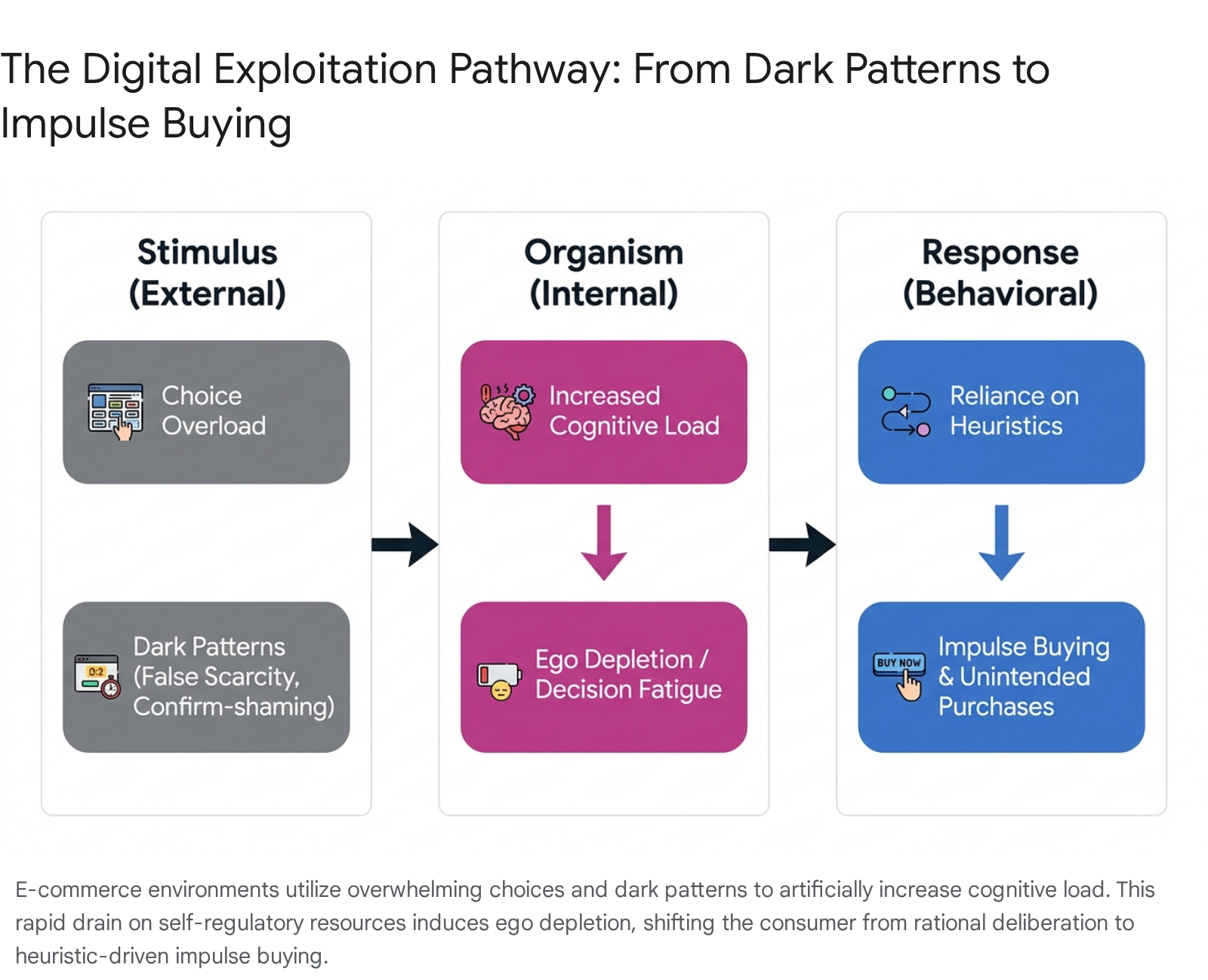
Modern retail has shifted predominantly to digital environments, where choice architecture is dynamically engineered to influence consumer behavior. The digital space leverages self-regulatory exhaustion through specific design methodologies, accelerating the onset of decision fatigue and capitalizing on the resulting cognitive vulnerabilities.
Decision Fatigue in E-Commerce Environments
The rapid expansion of e-commerce platforms provides consumers with unprecedented variety, which inherently introduces "choice overload" 35. Facing an endless array of products, variations, and reviews requires sustained cognitive evaluation, which heavily taxes self-regulatory resources. This sustained effort culminates in "decision fatigue," a specific manifestation of ego depletion wherein the quality of decisions deteriorates after a prolonged period of making choices 123836.
To theoretically mitigate this, platforms utilize artificial intelligence and personalization algorithms to curate recommendations. However, empirical research indicates this often backfires. A 2026 phenomenological study analyzing urban consumers in Southeast Asia (Jakarta, Bandung, Surabaya) revealed that constant exposure to algorithm-driven content, intrusive notifications, and infinite scrolling contributes to severe cognitive overload and mental exhaustion 37. The study found that 84% of participants experienced distinct mental fatigue due to algorithmic saturation. In these depleted states, users shift from active, goal-oriented shopping to passive, mindless browsing, becoming highly susceptible to peripheral triggers and immediate affective rewards 113437.
Exploitation via Dark Patterns
Compounding the problem of decision fatigue is the pervasive use of "dark patterns" (or deceptive patterns) - user interface designs intentionally engineered to trick users into choices that favor the business over the consumer 383940. Unlike physical retail environments, which are expensive to build and reconfigure, digital environments can be continuously optimized to exploit psychological vulnerabilities at scale 41. According to global reviews by the International Consumer Protection and Enforcement Network (ICPEN), 76% of popular e-commerce websites deploy at least one dark pattern, and a European Commission report found deceptive designs in 97% of leading mobile apps 1041.
When consumers operate with intact self-regulatory resources, they can deliberately evaluate interfaces and recognize deceptive tactics. However, under high cognitive load, consumers fall back on fast, low-effort heuristics 38. Dark patterns explicitly weaponize these heuristics: * False Scarcity & Urgency: Utilizing fake countdown timers or low-stock warnings (e.g., "Only 1 left in stock!") to trigger loss aversion and panic. This compresses the deliberation time necessary to exercise self-control 1042. Survey data indicates 76% of Indian e-commerce users experience false urgency tactics regularly 4042. * Basket Sneaking / Drip Pricing: Surreptitiously adding items, insurance, or hidden fees at the final stage of checkout. A depleted consumer lacks the cognitive energy to abort the transaction, recalculate costs, or navigate backwards, yielding to the friction of the checkout process 1038. * Confirm-shaming: Phrasing opt-out buttons with emotionally manipulative language (e.g., "No thanks, I prefer paying full price"). This leverages the emotional dysregulation and guilt susceptibility inherent in ego-depleted states 3841. * Roach Motel / Forced Continuity: Making it exceedingly easy to subscribe but requiring labyrinthine, cognitively taxing processes to cancel, directly exploiting a consumer's lack of persistence when depleted 42.
Experimental research explicitly testing the interaction between cognitive load and dark patterns has hypothesized that susceptibility to tactics like "sneak into basket" and "pop-up bundling" is significantly amplified when participants are subjected to high cognitive load 43. The fatigue breaks down the user's defensive skepticism, facilitating unintentional and impulsive purchases. Furthermore, physiological studies utilizing EEG and eye-tracking have demonstrated that navigating dark patterns substantially increases users' mental effort and emotional stress, creating a vicious cycle of depletion and impulsivity 44.
Digital Resistance and Regulatory Responses
The intersection of impulsive depletion and deceptive design has profound implications for consumer trust. The exhaustion caused by digital manipulation has birthed a phenomenon of "digital resistance." Consumers experiencing profound digital fatigue engage in coping strategies such as browsing in incognito modes, routinely clearing cookies, intentionally clicking unrelated content to confuse algorithms, or entirely uninstalling applications to reclaim emotional autonomy 37.
The systemic threat of these architectures has prompted regulatory bodies to intervene. In the European Union, the impending Digital Fairness Act (DFA) aims to introduce strict, enforceable rules preventing AI-driven deceptive marketing, addictive design features, and interface interference that unfairly influence consumer decisions 13. Similarly, guidelines from the U.S. Federal Trade Commission (FTC) seek to penalize practices that extract consent or purchases under cognitive duress 103942. Nonetheless, enforcement often relies on reactive "soft-law" advisories that lag behind the rapid evolution of deceptive interfaces 40.
Sociocultural Variables in Ego Depletion and Consumption
While the basic neurobiological mechanism of self-regulatory exhaustion is a universal human trait, the degree to which ego depletion manifests in impulse buying is heavily moderated by socio-cultural paradigms and environmental stressors.
Re-evaluating the Individualism-Collectivism Paradigm
Historically, cross-cultural consumer research relied on Geert Hofstede's cultural dimensions - specifically the dichotomy of Individualism versus Collectivism - to explain variations in impulse buying 4546. Traditional models assumed a binary: individualism was exclusive to Western societies, and collectivism to Eastern societies 47.
In highly individualistic cultures (e.g., the U.S. and Western Europe), consumers prioritize personal freedom, self-expression, and autonomy. Consequently, when their self-control resources run low, they are more likely to disregard the negative repercussions of impulse purchases, favoring immediate personal gratification 4852. Conversely, in collectivist cultures, individuals hold an interdependent self-construal, placing high value on social norms, group harmony, and long-term consequences 5349. Collectivist consumers are therefore theorized to maintain stronger external motivation to suppress impulses even when internally depleted, as irrational financial behavior threatens group stability and violates normative values 49.
However, recent exhaustive analyses covering 102 countries and 88% of the global population have challenged this strict East-West binary. Studies by Vignoles et al. reveal that individualism is strongly linked to socioeconomic development and existential security rather than geography. Prosperous Asian nations like Japan and Taiwan now score highly on individualistic metrics, differing minimally from the United States (a mere 2.2 points on a 100-point scale) 47. The study demonstrated that Hofstede's original 1970s data overestimated Western individualism by 27 points and Eastern collectivism by 22 points, skewing consumer behavior research for decades 47. Thus, measuring the impact of ego depletion requires examining specific, localized cultural mechanics rather than broad geographic assumptions.
Face Culture and Compensatory Consumption
A distinct cultural mechanism heavily influencing impulse buying under depletion is the concept of "Face" (mianzi) in Chinese society. Face represents an individual's social identity, status, and perceived prestige within their peer group 5051.
Experimental research exploring the intersection of face culture and ego depletion reveals that "face loss" - a failure to meet social expectations or a perceived drop in social standing - generates severe negative affect 751. Managing this negative affect requires the massive expenditure of internal self-regulatory resources. In randomized controlled experiments, individuals who suffered face loss and possessed low self-control engaged in significantly higher rates of impulse buying as a compensatory mechanism to repair their social standing 752. For these consumers, purchasing luxury goods, engaging in conspicuous consumption, or buying high-end cosmetics functions as a rapid, albeit impulsive, method to restore their depleted ego and project an enhanced public image to their in-group 5058.
External Stressors: Social Isolation and Pandemic Burnout
The macroeconomic and social environment in which a culture operates also dramatically impacts baseline ego depletion. Chronic stressors can systematically drain the self-regulatory capacity of entire populations. The COVID-19 pandemic served as a prime example of a global stressor that uniformly depleted self-regulatory resources.
Studies investigating "COVID-19 burnout" among consumers found that perceived uncertainty regarding the virus and prolonged social isolation were both directly and indirectly associated with heightened online impulse buying 535455. The prolonged regulatory exertion required to navigate pandemic lockdowns left consumers with a chronic deficit of self-control. This deficit rendered them highly reactive to online shopping triggers, driving them toward indulgent, mood-repairing consumption and panic-induced purchases 2455.
Table 2 contrasts the divergent cultural and situational factors that modulate the relationship between depletion and impulse buying.
| Factor | Primary Mechanism | Impact on Impulse Buying Under Depletion |
|---|---|---|
| High Individualism | Focus on personal gratification and autonomy. | Increases; consumers ignore negative consequences to fulfill personal desires 4852. |
| High Collectivism | Focus on group harmony and social norms. | Mitigates; social obligations provide external motivation to resist impulsive urges 49. |
| Face Culture (China) | Need to maintain social prestige and status (mianzi). | Increases; impulsive conspicuous consumption is used to repair lost face when self-control is low 5051. |
| Chronic Social Isolation | Generates negative affect and severe decision fatigue. | Increases; chronic depletion drives consumers toward indulgent, mood-repairing online purchases 2455. |
Interventions and Mitigation Strategies
Given the severe financial and psychological consequences of impulse buying triggered by ego depletion, researchers have identified several intervention strategies capable of preserving self-regulatory resources or buffering against their loss. These interventions operate at the individual cognitive level, the physiological level, and the broader policy level.
Implementation Intentions and Precommitment
A highly effective cognitive strategy for combating ego depletion is the formation of "implementation intentions" 316. Unlike vague goal intentions (e.g., "I want to spend less money"), implementation intentions are highly specific "if-then" plans that pre-decide a behavioral response to a temptation (e.g., "If I see a targeted product advertised on social media, then I will wait 24 hours before adding it to my cart") 56.
Experimental studies by Webb and Sheeran demonstrated that forming implementation intentions can both prevent the onset of ego depletion and completely offset its performance deficits 35758. In trials where depleted participants were given unsolvable puzzles or Stroop tasks, those who utilized implementation intentions persisted at levels equal to non-depleted controls 3. By automating the self-control response, implementation intentions offload the cognitive burden from the exhausted executive function (System 2) to automatic processing systems, allowing individuals to successfully navigate temptations without expending further willpower 16.
Similarly, precommitment strategies - where consumers voluntarily limit their future choices or block access to funds before encountering a tempting environment - serve to reduce decision-making impulsivity. However, the efficacy of precommitment is nuanced; irrevocable precommitments are generally more successful. Revocable precommitments may themselves require ongoing self-control resources to maintain, risking failure when the individual becomes deeply depleted during the actual shopping experience 59.
Emotion Regulation and Cognitive Reappraisal
Because ego depletion often triggers impulse buying as a maladaptive emotional repair mechanism, strategies that proactively regulate affect are crucial. Cognitive behavioral research distinguishes between two primary forms of emotion regulation: expressive suppression and cognitive reappraisal 60.
Expressive suppression is a response-focused strategy where an individual attempts to hide or push down a negative emotion after it has already fully developed 6061. This strategy is highly cognitively taxing and contributes significantly to ego depletion. In contrast, cognitive reappraisal is an antecedent-focused strategy. It involves identifying negative thought patterns and reframing the interpretation of an event before the emotional response fully triggers the amygdala 6162.
By altering the internal narrative, cognitive reappraisal reduces the physiological and emotional intensity of a trigger, preventing the negative affect loop that typically drives compensatory impulse buying 6263. Because reappraisal intervenes early in the emotion-generative process, it preserves the cognitive resources that would otherwise be exhausted by suppression. Individuals who habitually use cognitive reappraisal show lower symptoms of depression, better coping skills, and a higher capacity to maintain a balanced, deliberate approach to purchasing decisions 6064.
Longitudinal Self-Control Training
Returning to the muscle metaphor of the Strength Model, repeated and structured exertion of self-control can eventually strengthen an individual's baseline regulatory capacity over time 14. Longitudinal studies indicate that consumers who engage in structured physical or cognitive self-control exercises - such as adhering to a strict financial monitoring plan, maintaining a study schedule, or following a regular fitness regimen - demonstrate marked improvements in their self-regulatory endurance 8. After a two-week period of basic self-control exercises, participants showed a significant reduction in self-reported impulse buying urges, suggesting that consumer vulnerability can be mitigated through proactive behavioral conditioning 8.
Furthermore, economically vulnerable populations have been observed creating self-devised coping strategies in highly manipulative environments, such as live-shopping streams. These strategies include deliberately pausing before checkout, discussing purchases with family to establish accountability, and instituting strict personal ethical rules to mitigate impulsivity without external enforcement 11.
Systemic Mitigation and Choice Architecture Reforms
However, relying solely on individual psychological resilience is inherently insufficient in digital environments explicitly designed to deplete it. Public policymakers and ethical designers play a vital role in curbing the structural triggers of impulse buying by restructuring choice architectures 5665. Proposed systemic interventions include: 1. Friction Introduction: Mandating cooling-off periods or multi-step confirmation processes to interrupt the seamless "one-click" purchase loops, forcing a shift from System 1 to System 2 thinking 56. 2. Transparent Default Rules: Reversing "opt-out" subscriptions to explicit "opt-in" requirements, thereby neutralizing the power of the default bias on fatigued minds 13. 3. Warning Disclosures and Nutritional Labeling: Implementing clear, standardized labeling regarding the financial commitments of "buy now, pay later" schemes, or warnings about manipulative neuromarketing tactics, reducing the cognitive effort required for the consumer to calculate long-term costs 395666.
Conclusion
The intersection of ego depletion and impulse buying represents a critical and highly exploitable vulnerability in modern consumer behavior. The exhaustion of self-regulatory resources fundamentally shifts consumer decision-making from deliberate, rational evaluation to automatic, affect-driven heuristics. This state of cognitive fatigue demonstrably increases willingness to pay, amplifies the urge to acquire, and results in significantly higher actual spending in both laboratory and real-world environments.
While rigorous scientific debate regarding the exact statistical magnitude of ego depletion has prompted valuable methodological refinements within psychology, the core phenomenon of decision fatigue remains a robust predictor of self-control failure. This vulnerability is heavily weaponized in contemporary digital commerce. E-commerce platforms utilize choice overload and deceptive dark patterns to intentionally drain cognitive resources, facilitating unintended and impulsive transactions. Furthermore, the expression of these impulsive behaviors is deeply contextual, varying based on cultural factors such as individualism, face-saving motivations, and chronic external stressors like pandemic-induced social isolation.
To safeguard consumer welfare, a comprehensive dual approach is required. At the individual level, the adoption of implementation intentions and cognitive reappraisal techniques can automate resistance and preserve vital cognitive resources. Concurrently, at the systemic level, policymakers and regulators must aggressively enforce frameworks that dismantle manipulative choice architectures. Recognizing ego depletion not merely as a lapse in personal discipline, but as a predictable physiological and psychological state vulnerable to commercial exploitation, is essential for fostering ethical marketplaces and resilient consumer behavior.