
Scientific validity of decision fatigue and ego depletion
The human capacity for self-regulation - the ability to override immediate impulses, endure cognitive friction, and direct behavior in the service of long-term objectives - has long been considered the psychological bedrock of societal success, personal health, and economic stability. For decades, the dominant paradigm for understanding this self-regulatory capacity was grounded in a compelling, highly intuitive metaphor: self-control as a finite physical resource that drains with use, fundamentally akin to fuel in a combustion engine or the endurance of a contracting muscle. This hydraulic conceptualization became the standard model across behavioral sciences, deeply influencing economics, law, education, and public policy.
However, over the last decade, modern psychological science has undergone a profound, highly publicized paradigm shift. Driven by massive, multi-laboratory replication efforts, advanced meta-analytical bias-correction techniques, and rigorous cross-cultural investigations, the foundational tenets of the limited-resource model have been systematically dismantled. In its place, the discipline has adopted more sophisticated, neurologically plausible frameworks. These contemporary models posit that cognitive fatigue is not the mechanical exhaustion of a finite physiological resource, but rather a complex algorithmic reallocation of attention, a subconscious assessment of opportunity costs, and a reflection of deeply ingrained, culturally shaped implicit beliefs about the nature of the mind.
This exhaustive report provides an expert-level analysis of the evolution, collapse, and theoretical resurrection of cognitive fatigue research. It strictly demarcates the macroscopic pop-culture phenomenon of "decision fatigue" from the scientifically defined, microscopic construct of "ego depletion." Furthermore, it chronicles the rise and empirical fall of the strength model (including a detailed post-mortem of the debunked glucose hypothesis and the infamous Israeli parole judge study), evaluates contemporary alternative mechanisms such as the opportunity cost and process models, and explores the profound cross-cultural variations in implicit theories of willpower that are currently reshaping the global understanding of human agency.
The Lexical and Conceptual Divide: Decision Fatigue vs. Ego Depletion
To accurately map the modern landscape of cognitive fatigue, it is strictly necessary to decouple two distinct concepts that are frequently conflated in public discourse and interdisciplinary literature: the pop-culture notion of decision fatigue and the strictly defined psychological mechanism of ego depletion. While they share a superficial thematic resemblance, their operational definitions, scopes, and empirical foundations are fundamentally different.
The Macroscopic Illusion: Decision Fatigue in Pop Culture
The concept of decision fatigue has thoroughly permeated modern corporate, entrepreneurial, and lifestyle culture, largely popularized by the highly visible behavioral habits of elite executives, politicians, and public figures. Anecdotes surrounding figures like Apple co-founder Steve Jobs (who famously wore an identical black turtleneck, Levi's 501 jeans, and New Balance sneakers daily), Meta CEO Mark Zuckerberg (who defaults to gray t-shirts), and former U.S. President Barack Obama (who restricted his wardrobe to exclusively blue or gray suits) are routinely cited as optimal life-hacks for cognitive preservation 1132. The rationale provided by these figures, and subsequently amplified by lifestyle media, is uniformly consistent: by eliminating mundane micro-decisions regarding wardrobe or diet, individuals can preserve a finite daily "mental battery" for high-stakes executive functioning and complex problem-solving 15.
This phenomenon is also frequently invoked in consumer behavior and retail psychology. Supermarkets and digital platforms are often analyzed through the lens of decision fatigue, wherein consumers subjected to thousands of micro-choices (e.g., selecting between dozens of cereal brands or swiping on dating applications like Tinder) eventually experience a degradation in decision quality, leading to impulsive purchases or choice paralysis 11.
While conceptually elegant and pragmatically useful as a heuristic for personal organization, the pop-culture iteration of decision fatigue posits a macroscopic, generalized reservoir of cognitive energy that slowly and inevitably drains over the course of an entire waking day, regardless of the specific nature of the tasks. It assumes that choosing a shirt draws from the exact same physiological pool of energy as negotiating a high-stakes corporate merger, drafting complex legislation, or resisting a biological addiction 12. This broad, colloquial understanding lacks rigorous empirical boundaries, relies heavily on anecdotal observation, and is rarely subjected to controlled psychometric validation. It operates on the assumption that any choice, no matter how trivial or habitual, exacts a measurable metabolic or cognitive toll.
The Microscopic Framework: Ego Depletion and the Sequential-Task Paradigm
In sharp contrast to the sprawling, all-encompassing colloquial understanding of decision fatigue, the scientific construct of ego depletion was built upon a highly specific, microscopic experimental framework known as the sequential-task paradigm. Originally formulated by Roy Baumeister, Dianne Tice, and Mark Muraven in the late 1990s, the concept explicitly traced its theoretical lineage back to Sigmund Freud's early psychoanalytic models, which posited that the "ego" required literal energetic resources to mediate between the primal desires of the id and the moral constraints of the superego 3.
The seminal 1998 "radish and cookie" experiment (Baumeister et al., Experiment 1) serves as the paradigmatic bedrock for the ego depletion model 345. In this highly controlled laboratory study, 67 introductory psychology students were brought into a room that had been intentionally infused with the scent of freshly baked chocolate chip cookies. The participants were divided into experimental conditions: one group was permitted to freely eat the cookies and chocolate confections, while the other group was instructed to actively resist the tempting sweets and instead force themselves to eat pungent, unappealing red and white radishes 39106. Participants in the radish condition subsequently reported that they had to force themselves in an effortful fashion to eat the assigned food and found resisting the non-assigned food to be highly difficult 3.
Following this initial manipulation of impulse control, all participants were immediately asked to complete an ostensibly unrelated geometric tracing puzzle, which, unbeknownst to them, had been designed to be mathematically unsolvable. The primary dependent measure was task persistence - specifically, the amount of time participants were willing to dedicate to a frustrating cognitive challenge. The findings were stark and immediate: the group that had freely eaten the cookies, alongside a no-food control group, persisted on the frustrating puzzle for an average of 18.90 minutes and 21 minutes respectively, making approximately 34 attempts 3106. In dramatic contrast, the radish-eating group - who ostensibly had to exert high levels of self-control to override their biological desire for the sweets - quit after a mere 8.35 minutes, making only 19 attempts 356. Furthermore, the radish group self-reported significantly higher levels of subjective fatigue following the protocol 3.
Baumeister and his colleagues theorized that the exertion of volition, choice, emotional suppression, and behavioral inhibition all draw from a single, domain-general inner resource. When this resource is temporarily depleted by an initial act of self-control (Task 1), the individual enters a vulnerable state termed "ego depletion." Consequently, this state results in severely impaired performance on any subsequent, completely unrelated self-control task (Task 2), because the underlying psychological fuel tank has been drained 4578. This sequential-task paradigm - deploying two entirely disparate tasks linked only by their demand for executive control - became the gold standard for testing the strength model, sparking over 300 independent studies within the following fifteen years and spawning a dominant subfield within social and personality psychology 467.
The Empirical Bedrock and its Disintegration
For nearly fifteen years, the strength model of self-control was treated as established scientific orthodoxy. It offered a compelling, unified theory of human failure, explaining everything from dietary relapses to marital infidelity and workplace procrastination. However, a series of methodological advancements, improved statistical scrutiny, and the broader "replication crisis" that swept through the psychological sciences in the 2010s subjected the model to unprecedented interrogation. Ultimately, this scrutiny unraveled the model's most high-profile empirical pillars.
The Glucose Hypothesis and Its Methodological Collapse
Because the strength model fundamentally posited that self-control relied on a finite, depletable biological resource, researchers naturally sought to identify its exact physiological substrate. In the mid-2000s, the field coalesced around the glucose hypothesis, which proposed that blood glucose was the literal, metabolic fuel powering executive function in the human brain. Early, highly cited papers suggested that acts of self-control measurably reduced peripheral blood glucose levels, and that ingesting a sugar-sweetened beverage prior to the second task could completely reverse the effects of ego depletion, restoring self-control performance to baseline 149.
However, the glucose hypothesis suffered a swift and decisive empirical collapse when subjected to rigorous physiological scrutiny. Cognitive neuroscientists and physiologists pointed out a glaring biological inconsistency: the human brain's overall metabolic consumption remains remarkably constant regardless of cognitive load. The sheer caloric cost of overriding an impulse or solving a complex puzzle is microscopically negligible compared to the brain's baseline energy requirements, and such minor cognitive tasks absolutely cannot account for massive, system-wide drops in peripheral blood glucose.
The definitive debunking of the glucose hypothesis occurred when subsequent experiments utilized a "mouth-rinsing" paradigm. Researchers demonstrated that merely swishing a glucose-sweetened liquid in the mouth and spitting it out - without actually ingesting the fluid, absorbing the carbohydrates, or altering systemic blood sugar levels in any way - produced the exact same restorative effect on self-control performance as drinking the beverage. This proved unequivocally that the mechanism of restoration was not metabolic refueling at the cellular level. Instead, the mechanism was neural signaling: the sweet taste receptors in the oral cavity instantly activated reward pathways in the brain, rapidly shifting the individual's motivation and demonstrating that the post-task "depletion" was a matter of willingness and reward perception, not a literal lack of biological fuel.
The Statistical Illusion of the Israeli Parole Judge Study
Perhaps no single study did more to propel the concept of cognitive depletion from the confines of academic journals into the global public consciousness than Danziger, Levav, and Avnaim-Pesso's 2011 analysis of the Israeli parole board 1610. Published in the Proceedings of the National Academy of Sciences, the researchers analyzed 1,112 parole hearings conducted by eight highly experienced Israeli judges over a ten-month period 161018. The published data revealed a terrifying pattern for proponents of legal formalism and objective justice: at the beginning of a daily session, a prisoner's chance of being granted a favorable parole ruling was approximately 65%. Over the course of the session, as the judges ostensibly suffered from escalating mental depletion and decision fatigue, this probability dropped precipitously, approaching zero percent for the final cases of the session 9161011. Following a scheduled food break (a mid-morning snack or lunch), the approval rate spiked immediately back up to 65% 1618.
The study generated global headlines and was cited extensively as definitive proof that even highly trained legal experts are hostage to their physiological fuel tanks, often defaulting to the "easier" status quo option (denying parole) when mentally exhausted 91612. However, rigorous post-hoc analyses by statisticians, legal scholars, and psychologists fundamentally debunked this causal interpretation, revealing that the effect was entirely an artifact of institutional procedure rather than psychological depletion.
Researchers such as Weinshall-Margel, Shapard, and Glöckner demonstrated that the dramatic drop in favorable rulings was actually a statistical artifact driven by non-random case scheduling and rational judicial time management 10111213. The primary confounding variables were legal representation and case complexity. Within the specific procedural mechanisms of the Israeli system, prisoners represented by legal counsel are systematically heard earlier in the session, whereas unrepresented prisoners are routinely pushed to the end of the docket 1213. Crucially, the baseline success rate for prisoners with legal counsel is roughly 35%, while unrepresented prisoners prevail only 15% of the time 13.
Furthermore, because granting parole requires a lengthy, complex written justification, whereas denying or deferring parole is a faster, simpler administrative action, judges engage in rational time management. As a scheduled break approaches, judges intentionally defer complex, likely-to-succeed cases to the next session and cycle through quick, straightforward rejections and deferrals to clear the docket before the break 101114. When deferrals were correctly separated from outright rejections in the dataset, the data indicated a relatively stable success rate of 67% for represented prisoners and 39% for unrepresented prisoners throughout the day 13. Glöckner (2016) noted that the effect size reported in the original paper (Cohen's $d = 1.96$) was impossibly large - roughly eight times higher than the typical effect sizes observed in standard laboratory depletion literature - further indicating that institutional artifacts and scheduling priorities, rather than psychological ego depletion, drove the variance 1012.
The Replication Crisis and the Era of Massive Registered Reports
The ultimate empirical test of the ego depletion phenomenon came in the form of pre-registered, multi-laboratory replication efforts, designed to bypass the traditional pitfalls of publication bias and small-sample variance. An initial 2010 meta-analysis by Hagger, Wood, Stiff, and Chatzisarantis, encompassing 198 independent tests, had seemingly confirmed the effect with a robust medium-to-large effect size of $d = 0.62$ 4715. However, this analysis was fundamentally compromised by its failure to account for unpublished null results.
In 2015, Carter and McCullough published a devastating re-evaluation utilizing advanced bias-correction techniques (specifically PET-PEESE regression methods) to account for the "file-drawer problem." They demonstrated that the previously accepted effect size was severely inflated by small-study biases. Once these publication biases were statistically accounted for, the adjusted estimate of the ego depletion effect effectively vanished, dropping to an estimate practically indistinguishable from zero 471617.
This controversy prompted Hagger and colleagues to lead a monumental Registered Replication Report (RRR) in 2016, involving 23 independent laboratories and 2,141 participants across the globe 7161819. Using a standardized sequential-task protocol based on an earlier paradigm by Sripada et al. - an initial letter 'e' crossing task intended to deplete resources, followed by a multi-source interference task (MSIT) to measure behavioral inhibition - the meta-analysis revealed a trivial and non-significant effect size of $d = 0.04$, with 95% confidence intervals encompassing zero ([-0.07, 0.15]) 7161819. The authors starkly concluded that if an ego depletion effect existed at all, it was exceedingly close to zero .
Proponents of the strength model, including Baumeister and Vohs, vehemently criticized the 2016 RRR on procedural grounds. They argued that the specific "e-crossing" task chosen for the manipulation was fatally flawed. According to their critique, because the RRR protocol lacked a sufficient initial habit-forming stage prior to the instigation of new rules, it failed to genuinely require the overriding of an entrenched impulse. Therefore, they argued, the task did not sufficiently tax self-regulatory resources, rendering the subsequent null result on the outcome measure invalid 181920.
To definitively settle this methodological debate, Vohs et al. organized a second, even larger multi-site paradigmatic replication project in 2021, published in Psychological Science. This unprecedented effort encompassed 36 laboratories and 3,531 participants 19212223. To preempt prior critiques regarding task validity, laboratories were allowed to utilize either the contested e-task protocol or a separate writing-task protocol. Crucially, both of these specific tasks had received top combined ratings for effectiveness and feasibility from prominent depletion theorists prior to the commencement of data collection 22.
The results of the 2021 RRR were similarly devastating for the strength model. Confirmatory tests yielded a non-significant overall effect size of $d = 0.06$.
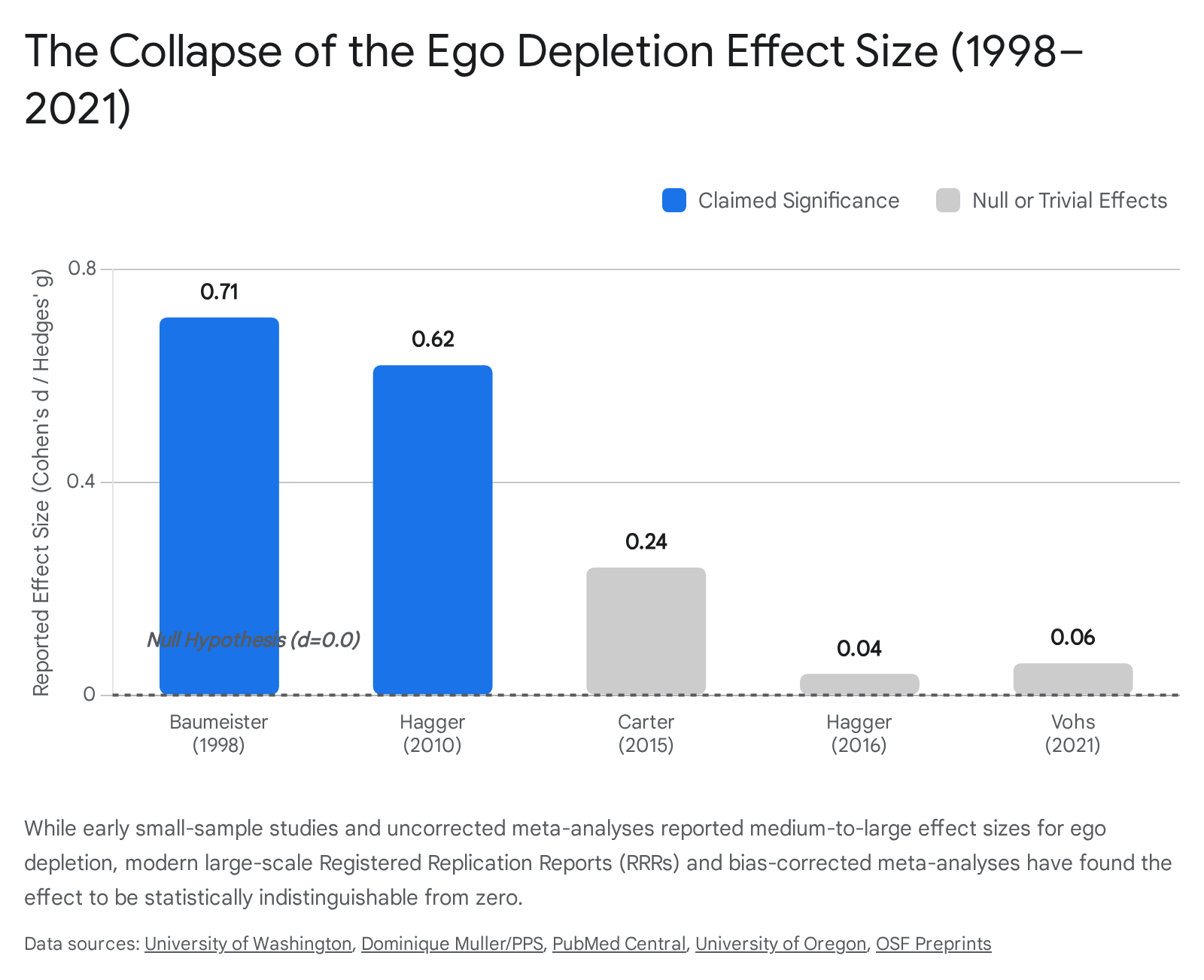
Furthermore, confirmatory Bayesian meta-analyses utilizing an informed prior hypothesis (set at an expected effect of $\delta = 0.30$) indicated that the observed data were approximately four times more likely to occur under the null hypothesis than the alternative hypothesis 212223. While the writing task protocol was subjectively rated as far more difficult and effortful by participants (yielding a massive effort index effect size of $d = 3.09$) compared to the e-task ($d = 0.46$), neither protocol succeeded in yielding a large or reliable depletion effect on the subsequent behavioral tasks 22. Exploratory analyses that explicitly ignored pre-registered exclusion criteria only managed to produce a statistically significant but practically trivial effect of $d = 0.08$ 2123. Exploratory moderator tests further confirmed that the depletion effect was not significantly moderated by trait self-control, willpower beliefs, or action orientation, though a slight moderation was noted for self-reported fatigue 2123.
Table 1: High-Profile Original Studies vs. Major Registered Replication Reports
| Study / Event | Methodology / Sample Size | Original Claimed Effect Size | Modern Re-Evaluation / RRR Result |
|---|---|---|---|
| Baumeister et al. (1998) 356 | Radish vs. Chocolate Cookie followed by unsolvable puzzle (N = 67). | Large effect ($d \approx 0.71$ implied). Massive behavioral difference (8 vs 19 mins). | Frequently cited as foundational, but deeply undermined by subsequent meta-analyses correcting for extreme small-N variance. |
| Danziger et al. (2011) 16111213 | Israeli Parole Judges (1,112 decisions). Tracking parole approval rates across daily sessions. | Massive effect ($d = 1.96$). Parole approval drops from 65% to ~0% before meal breaks. | Debunked. Effect driven entirely by non-random case ordering (unrepresented prisoners scheduled last) and rational judicial time management (deferring complex cases) 101314. |
| Hagger et al. (2016) RRR 71618 | 23 international labs (N = 2,141). Standardized sequential e-crossing task to MSIT. | N/A (Pre-registered replication attempt). | Trivial, non-significant effect ($d = 0.04$, 95% CI [-0.07, 0.15]). |
| Vohs et al. (2021) RRR 19212223 | 36 international labs (N = 3,531). Compared validated e-crossing and writing tasks. | N/A (Pre-registered replication attempt). | Non-significant confirmatory effect ($d = 0.06$). Bayesian analysis showed data 4x more likely under the null hypothesis. |
The Paradigm Shift: Contemporary Theoretical Models of Cognitive Fatigue
If the physical depletion of a finite physiological fuel source cannot account for the very real phenomenology of cognitive fatigue, what alternative mechanisms explain why sustained mental effort feels so inherently aversive? In the wake of the strength model's empirical collapse, several sophisticated computational and motivational models have emerged to fill the theoretical vacuum. These contemporary models share a foundational premise: the human brain is an advanced information-processing system, not a hydraulic engine governed by fluid dynamics.
The Opportunity Cost Model
Proposed by Kurzban and colleagues (2013), the Opportunity Cost Model approaches cognitive fatigue through the rigorous lens of neuroeconomics and evolutionary psychology 332435. The model begins with the observation that the human brain possesses certain domain-general computational mechanisms (heavily associated with executive function and working memory) that function as a processing bottleneck; they can only be deployed to a highly limited number of simultaneous tasks at any given moment 2425. Because working intently on one specific task mathematically precludes the pursuit of other potentially rewarding activities available in the environment, every act of sustained attention carries an inherent opportunity cost 332435.
As a task drags on, the relative utility of pursuing next-best alternatives naturally rises. The model posits that the subjective, highly aversive phenomenology we identify as "mental fatigue" or "boredom" is not the feeling of an empty biological fuel tank; rather, it is the conscious, felt output of a subconscious cost/benefit computation 243525. It functions as an adaptive internal alarm system signaling that the opportunity cost of continuing the current task has become too steep, mathematically motivating the individual to reallocate their finite computational resources to more valuable or rewarding tasks 243525.
This neuroeconomic perspective flawlessly explains why cognitive fatigue can evaporate instantly when the payoff for a task is suddenly increased (e.g., introducing a high monetary incentive), a widely documented phenomenon that the hydraulic strength model completely fails to explain 3326. If a physiological fuel tank is genuinely empty, offering someone a million dollars will not make the metabolic engine run; but if fatigue is merely a computed opportunity cost, a massive increase in external reward instantly shifts the internal algorithmic priority back to the current task, dissolving the sensation of fatigue 2638.
The Process Model of Self-Control (Shifting Priorities)
Closely related to the opportunity cost framework is the Process Model of Self-Control, articulated comprehensively by Inzlicht and Schmeichel (2014) 263827. This model, often descriptively referred to as the "shifting priorities model," argues that initial exertions of self-control do not drain an energetic resource, but rather trigger a systematic, organic shift in motivational priorities and attentional focus 382740.
According to this framework, engaging in a demanding "have-to" task (such as tedious labor or strict dietary restriction) temporarily satiates the individual's motivation for work and control, initiating an organic, psychological shift toward "want-to" tasks (leisure, impulses, and immediate gratification) 333827. This profound motivational shift is driven by two primary, measurable mechanisms: 1. Attentional Shifts: Following self-control exertion, individuals begin to process environmental cues differently. They pay progressively less attention to cues signaling the need for control (e.g., long-term goals) and exhibit heightened, often reflexive attention to cues signaling reward and gratification 3827. 2. Emotional Responding: The subjective emotional valuation of indulging in a temptation significantly increases, while the subjective valuation of exerting further effort declines 3827.
Motivational Control Theory
Hockey's Motivational Control Theory (1997, 2011) similarly frames mental fatigue not as a deficit of capacity, but as an adaptive emotional state indicating goal conflict. It characterizes fatigue as a biological signal highlighting a growing conflict in control activity between what the individual is currently doing and alternative actions they could be taking 2426. Performance under demanding conditions depends almost entirely on the willingness to mobilize cognitive resources, rather than the raw availability of those resources. If a task goal is deemed sufficiently critical, individuals can effectively channel compensatory effort to maintain performance indefinitely, although doing so continuously without sufficient intrinsic value generates rapidly escalating subjective discomfort 26.
Table 2: Competing Theories of Cognitive Fatigue
| Theoretical Model | Core Mechanism | View of "Fatigue" | Implications for Intervention |
|---|---|---|---|
| Strength / Resource Model (Baumeister et al.) 578 | Depletion of a finite, domain-general energy resource (metaphorically analogous to a muscle). | A literal physiological deficit of energy; a physical inability to continue exerting self-control. | Requires rest, sleep, or caloric/glucose replenishment to restore capacity. |
| Opportunity Cost Model (Kurzban et al.) 33243525 | Subconscious cost/benefit computation of deploying limited executive function mechanisms away from alternative rewards. | The conscious, felt output of an internal algorithm signaling that alternative tasks now hold higher relative utility. | Increase the subjective value/reward of the current task, or decrease the salient rewards of alternatives 2628. |
| Process / Shifting Priorities Model (Inzlicht & Schmeichel) 382740 | Motivation shifts organically away from "have-to" (labor) goals and toward "want-to" (gratification) desires. | A shift in attentional processing and emotional valuation; an unwillingness, rather than inability, to persist. | Reframe the task to align with intrinsic values; alter the attentional environment to physically remove reward cues. |
The Architecture of Belief: Implicit Theories of Willpower
If cognitive fatigue is largely driven by subjective valuation, attentional shifts, and calculated opportunity costs rather than objective physical depletion, the individual's psychological framing of the task becomes paramount. This realization ushered in a vital wave of research spearheaded by psychologists Carol Dweck and Veronika Job, examining how implicit theories of willpower dictate self-regulatory success 154229. Building upon Dweck's highly influential prior work regarding fixed versus growth mindsets regarding intelligence and personality, this framework applies the concept of implicit theories directly to the domain of self-control.
Job and colleagues (2010) proposed that the experience of ego depletion is heavily mediated, if not entirely dictated, by an individual's lay beliefs regarding the fundamental nature of self-control. Individuals tend to consistently endorse one of two implicit theories: 1. Limited-Resource Theory: The belief that willpower is a highly finite, fragile resource that easily depletes after a strenuous mental task and requires rest, recovery, or food to replenish 15422930. 2. Non-Limited-Resource Theory: The belief that willpower is abundant and self-generating, and that engaging in a strenuous mental task can actually activate and energize subsequent self-control efforts 154229.
In heavily controlled laboratory environments, Job et al. demonstrated that the classic ego depletion effect is effectively a self-fulfilling prophecy. Only participants who endorsed a limited-resource theory exhibited performance decrements on sequential self-control tasks 154230. Conversely, individuals holding a non-limited theory performed optimally on the second task, proving utterly immune to the ego depletion effect 1542.
The implications of these implicit beliefs scale dramatically when observed in real-world, highly demanding environments outside the laboratory. Longitudinal field studies tracking university students during heavy, stressful final exam periods revealed that those holding a non-limited theory earned significantly higher GPAs, engaged in less academic procrastination, and maintained healthier diets and personal goals under stress 293132. Strikingly, under conditions of high self-regulatory demand, students with non-limited beliefs actually saw measurable improvements in their performance, utilizing the pressure as a catalyst for deeper focus, whereas those with limited theories collapsed under the assumed depletion 3132.
Furthermore, these implicit beliefs profoundly alter proactive task selection and sustained learning. Recent pre-registered experiments indicate that individuals holding non-limited beliefs actively self-select into higher difficulty tiers on cognitive arithmetic tasks, whereas those with limited-resource beliefs systematically opt for easier, less demanding problems, even when controlling for baseline mathematical competence 33. On grueling working-memory assessments (such as N-back tasks), non-limited believers display sustained learning and accuracy improvements over extended 20-minute periods, while limited believers plateau rapidly and fail to acquire new cognitive skills 34.
In critical public health contexts, such as the lifelong management of Type 2 diabetes - which requires relentless dietary self-control, strict medication adherence, and constant glucose monitoring - willpower beliefs play a measurable prognostic role. Patients endorsing non-limited beliefs show superior objective disease management, lower treatment non-adherence, and vastly improved psychological well-being compared to those burdened by the persistent, stressful belief that their capacity for self-regulation is constantly draining 29.
Beyond WEIRD Populations: Cross-Cultural Variances in Self-Regulation
The foundational theories of ego depletion and the highly individualistic conceptualization of "willpower" were almost exclusively developed by studying WEIRD (Western, Educated, Industrialized, Rich, and Democratic) populations. As global researchers increasingly apply these frameworks across diverse cultural landscapes, it has become evident that the cognitive architecture of self-control is not a universal biological constant, but is instead heavily modulated by deep-seated cultural ontologies.
Eastern Philosophical Traditions and the Phenomenon of "Reverse Depletion"
The baseline assumption that exerting cognitive effort is inherently depleting is deeply embedded in Western, mechanistic views of the human body and mind. However, researchers examining populations in South and East Asia have documented stark, fundamental deviations from this norm. Savani and Job (2017) conducted a landmark study comparing Indian and American participants. A pilot assessment revealed a profound ideological divergence: while American subjects predominantly viewed the exertion of willpower as a depleting tax on the mind, Indian subjects overwhelmingly tended to view the exertion of willpower as an energizing, activating practice 3536.
When subjected to the classic sequential-task ego depletion paradigm, American participants exhibited the standard, expected performance decrement on the second task. Indian participants, however, exhibited a reliable phenomenon termed reverse ego-depletion - their performance on a strenuous cognitive task significantly and measurably improved after having initially worked on a challenging self-control task 35. This phenomenon is likely rooted in cultural and religious traditions that deeply emphasize asceticism, mental discipline, and the philosophical belief that actively resisting immediate impulses strengthens, rather than weakens, the spiritual and cognitive self.
Similarly, cross-cultural comparative studies involving Chinese and American college students reveal nuanced, domain-specific conceptualizations of fatigue. Utilizing the Implicit Theories on Willpower Questionnaire, researchers found that Chinese students were significantly less likely than their American counterparts to believe in the Depletion of Mental Resources (DMR). However, they exhibited a paradoxically stronger belief in the Depletion of Resisting Temptation (DRT) 3738. This divergence suggests that Eastern cultural paradigms may firmly differentiate strictly cognitive labor (which is viewed as a standard, dutiful expectation that does not deplete) from emotional impulse-resistance (which is viewed as culturally taxing).
Collectivism, Uncertainty Avoidance, and the Middle East
Expanding the scope of self-regulation research to the Middle East and African contexts introduces additional layers of societal complexity, best understood through the lens of Geert Hofstede's cultural dimensions theory (originating from his massive analysis of 116,000 IBM employees across 40 countries) 3839. Middle Eastern cultures frequently index highly on dimensions of power distance, uncertainty avoidance, and collectivism 383940. In these highly structured, collectivist societies, Western, individualistic notions of "muscling through" temptation via sheer inner willpower are often de-emphasized.
Instead, prevailing social values dictate a heavy reliance on situational, environmental, and attentional self-control strategies 41. Because group goals are strictly prioritized over individual desires, the burden of self-control is often outsourced to the collective environment. Attributions for human behavior in Middle Eastern cultures lean heavily situational rather than dispositional 39. Consequently, an individual operating within a highly collectivist culture may not perceive the avoidance of a taboo behavior as a draining, internal battle of "willpower," but rather as a natural, effortless adherence to powerful injunctive social norms 3942.
Studies tracking multicultural collaborative environments note that Middle Eastern samples often emphasize the interpersonal and spiritual dimensions of motivation far more strongly than Western samples 40. The mere presence of an authority figure or a salient injunctive norm can completely eliminate deferential fatigue or the necessity for internal goal-introjection, providing a powerful, invisible environmental scaffold for self-regulation that prevents the subjective feeling of depletion 4042. Furthermore, as macroeconomic and socioeconomic conditions transition rapidly in regions like Saudi Arabia - moving from deeply embedded traditional collectivism toward Western-modeled, market-based individualism - researchers are actively observing measurable shifts in how bilingual students conceptualize information, organize mental habits, and experience the friction of cognitive demands 43.
Synthesizing the Future of Cognitive Fatigue Research
The scientific journey of cognitive fatigue - from the intuitive, mechanistic allure of the ego depletion model to the complex, algorithmic realities of modern motivational theory - stands as a powerful testament to the self-correcting nature of psychological science. The deeply entrenched narrative that humans possess a literal, finite physiological tank of willpower that inevitably drains with every micro-decision is fundamentally incorrect. The empirical collapse of the glucose hypothesis, the rigorous statistical debunking of the infamous hungry judge study, and the near-zero effect sizes yielded by unprecedented, massive Registered Replication Reports have unequivocally demonstrated that the hydraulic strength model is theoretically and practically obsolete.
Consequently, the broad, pop-culture application of "decision fatigue" - while serving as a highly useful, comforting heuristic for executives looking to optimize their daily routines and minimize unnecessary friction - should not be interpreted as a rigid biological mandate. Wearing the same outfit every day may streamline a morning routine, but it is not preserving physiological fuel for corporate strategy or executive functioning.
Instead, cognitive fatigue must be accurately understood as an elegant, computationally demanding signal generated by the brain's opportunity cost algorithms. It is an organic shifting of motivational priorities driven by attention, emotion, and internal values. Crucially, the boundaries of human self-regulation are remarkably elastic, stretching and contracting based on the cultural contexts we inhabit and the implicit beliefs we harbor about our own cognitive capabilities. Acknowledging that willpower is not a fragile, inevitably depleting resource, but rather a dynamic, context-dependent motivational state, provides a far more empowering, resilient, and scientifically accurate framework for navigating the relentless cognitive demands of the modern world.