
Current Evidence on Decision Fatigue and Ego Depletion
The Replication Crisis in Self-Control Research
The conceptualization of cognitive effort and the deterioration of decision quality over time have undergone a fundamental paradigm shift over the past decade. For two decades, the dominant theoretical framework in behavioral science was the strength model of self-control, commonly referred to as ego depletion. This model proposed that executive function and self-regulation relied on a finite, domain-general physiological or psychological resource that became depleted through use, much like a muscle fatiguing after physical exertion 1234.
According to this original formulation, any act requiring self-control - whether resisting a temptation, regulating emotional responses, or making complex decisions - drew from this shared reservoir 456. Early empirical studies appeared to validate this hypothesis using a sequential two-task paradigm. In these experiments, participants who were forced to exert self-control in an initial task consistently demonstrated impaired performance on a subsequent, unrelated self-control task when compared to control groups 24. The effect was widely documented and cited in hundreds of independent studies, appearing to solidify the strength model as a foundational principle of human psychology 247.
The Glucose Hypothesis and the Gargle Effect
A central pillar of the original ego depletion framework was the glucose hypothesis, which posited that blood glucose served as the physical manifestation of willpower 87. Early research suggested that self-control tasks caused measurable drops in blood glucose levels, and that ingesting a sugar-sweetened beverage could replenish this metabolic resource, thereby restoring self-control capacity and decision-making quality 387. This metabolic explanation gained massive traction in both academic circles and popular science, establishing the heuristic that steady blood glucose was necessary for sustained executive function 87.
Subsequent rigorous testing dismantled the metabolic basis of this hypothesis. Advanced physiological research demonstrated that the brain's overall glucose consumption does not fluctuate sufficiently during brief cognitive tasks to account for the performance drops observed in ego depletion studies 78. A critical turning point in this literature was the discovery of the gargle effect. Studies by researchers such as Sanders and colleagues revealed that participants who simply rinsed their mouths with a glucose solution and spat it out - without ingesting or metabolizing the sugar - demonstrated the exact same restoration of self-control as those who swallowed it 889.
Because the glucose was not metabolized, it could not have replenished a depleted physiological resource. Instead, researchers concluded that glucose receptors in the oral cavity triggered reward pathways in the brain, specifically activating the anterior cingulate cortex and the striatum 88. This indicated that the deterioration in self-control performance was not a metabolic deficit, but rather a shift in motivation and resource allocation driven by reward signaling 88. Furthermore, the effect of glucose was found to be highly dependent on participants' implicit beliefs; sugar consumption only improved self-control performance among individuals who already believed that willpower was a limited resource 1011.
Large-Scale Replication Failures
The strength model faced existential challenges beginning in the mid-2010s, culminating in a series of large-scale replication failures that redefined the field. Early meta-analyses that had previously reported medium-to-large effect sizes for ego depletion were heavily criticized for failing to account for publication bias and small-study effects 241412. When modern bias-correction techniques, such as the PET-PEESE methodology, were applied to the existing literature, the estimated effect size of ego depletion became statistically indistinguishable from zero 21216.
These statistical critiques prompted massive, pre-registered, multi-laboratory replication efforts designed to settle the debate. In 2016, a Registered Replication Report involving over 2,000 participants across 23 laboratories worldwide tested the ego depletion effect using the standard sequential two-task paradigm. The study utilized the e-crossing procedure followed by a figure-tracing task. The results yielded an effect size that did not significantly differ from zero, directly contradicting the foundational claims of the strength model 4716.
Subsequent attempts to establish the effect also faltered, further eroding confidence in the phenomenon. A 2021 multi-site study involving over 3,500 participants across 36 laboratories utilized different protocols, including a writing task followed by the Cognitive Estimation Test (CET), to address criticisms of previous replication designs. The results were again inconclusive, yielding no reliable evidence for the ego depletion effect 416.
Methodological Criticisms of Measurement Instruments
Critics of the ego depletion literature noted that the measurement instruments themselves often suffered from severe methodological flaws. For example, the Cognitive Estimation Test (CET) used in the 2021 multi-site study was criticized for having low internal reliability, with Cronbach's alpha scores frequently hovering around 0.60 4. Furthermore, the CET lacked a theoretical fit for self-control measurement, as performance on the test relied heavily on a participant's prior knowledge and reasoning rather than on fluctuating self-control strength or the overriding of habits and impulses 4.
The scoring system for these instruments was often arbitrary, awarding points based on how closely an answer aligned with a small, unrepresentative norm sample's percentiles 4. Consequently, by 2024 and 2025, the scientific consensus acknowledged that while subjective fatigue from prolonged cognitive tasks over several hours is a real phenomenon, the specific mechanism of acute ego depletion via a finite, rapidly depleting resource after brief tasks is fundamentally flawed and unsupported by rigorous data 6111613.
| Replication Effort / Meta-Analysis | Key Authors & Year | Methodology | Primary Finding | Implication for Ego Depletion |
|---|---|---|---|---|
| Initial Meta-Analysis | Hagger et al. (2010) | Meta-analysis of 83 studies | Medium-to-large effect size ($d = 0.62$). | Supported the strength model and resource depletion. |
| Bias-Corrected Re-evaluation | Carter & McCullough (2015) | PET-PEESE bias correction | Effect size statistically indistinguishable from zero. | Highlighted severe publication bias in original literature. |
| Registered Replication Report | Hagger et al. (2016) | 23 labs, >2,000 participants | No significant difference between depletion and control groups. | Failed to replicate the standard e-crossing task effect. |
| Multi-Site Protocol Test | Vohs et al. (2021) | 36 labs, >3,500 participants | Inconclusive results across multiple task protocols. | Further undermined the reliability of standard depletion paradigms. |
Contemporary Models of Self-Control Fatigue
With the collapse of the resource-based strength model, behavioral science shifted toward theories that treat cognitive fatigue as an adaptive signaling mechanism rather than a physiological failure. Two dominant frameworks have emerged to explain why decision quality degrades over time: the Process Model and the Opportunity Cost Model. Both models offer robust explanations for why cognitive tasks feel exhausting without relying on biologically improbable theories of rapid metabolic depletion.
The Process Model of Self-Control
The Process Model, primarily proposed by Inzlicht and Schmeichel, conceptualizes self-control fatigue not as a loss of capacity, but as an unconscious shift in motivation and attention 18192014. In this framework, engaging in initial acts of self-control creates a systemic shift away from restraint and toward gratification 181920. The model posits that self-control failure occurs because individuals implicitly choose to stop exerting effort, not because they are inherently unable to continue 141516.
This motivational shift manifests through two primary, interconnected mechanisms. First, individuals undergo shifts in attention. As people exert continuous cognitive effort, their attentional focus gradually drifts away from cues signaling the need for control, such as long-term goals, rules, or obligations 181917. Simultaneously, their attention becomes increasingly captured by cues signaling reward, such as leisure activities, immediate gratification, or environmental distractors 1818.
Second, the emotional salience of tasks undergoes a recalculation. Individuals become less emotionally aroused by the prospect of goal success or failure in the primary task, and increasingly reactive to the prospect of immediate rewards 181918. This dual shift effectively explains previously anomalous data, such as the gargle effect and the influence of monetary incentives. When a clear external reward is introduced, it offsets the internal motivational shift toward leisure, prompting the individual to maintain cognitive effort despite prior exertion 81217. The brain has not found a new energy source; it has merely reassessed the motivational value of the task.
The Opportunity Cost Model
The Opportunity Cost Model, primarily advanced by Kurzban and colleagues, applies principles of microeconomics and computational neuroscience to the subjective experience of mental effort 201927. This model argues that the human brain possesses specialized computational mechanisms - specifically those associated with executive function - that can only be deployed for a limited number of simultaneous tasks 20192720. Because executive function is a mutually exclusive resource in terms of parallel deployment, engaging in any specific cognitive task inherently carries an opportunity cost. This cost is defined mathematically as the utility of the next-best alternative action that must be forgone to maintain focus on the current task 201920.
In this framework, the aversive phenomenology of mental fatigue, boredom, or decision exhaustion is not a physical breakdown or a lack of fuel. Rather, it is the conscious output of continuous cost-benefit computations conducted by the brain's monitoring systems 20192729. As time spent on a specific task increases, the value of continuing that task typically experiences diminishing marginal returns. Conversely, the value of exploring alternative tasks or engaging in cognitive leisure rises 1927.
When the computed opportunity costs of maintaining focus on the current task outweigh its ongoing benefits, the brain generates the aversive feeling of effort. This sensation is an evolutionary mechanism designed to motivate the individual to switch to a different, potentially more rewarding activity, ensuring that the organism does not perseverate on low-yield tasks 192729.
Distinctions in Agent Evaluation
The debate between the direct-cost (strength) accounts and the opportunity-cost accounts centers heavily on how the agent perceives and calculates the cost of effort. Under direct-cost frameworks, the agent evaluates the cost of an effort based entirely on how much of an internal physiological resource is consumed 12. The failure of this account lies in its inability to explain why subjective belief structures, self-affirmation, or unrelated positive affect can instantly restore performance 12.
Conversely, the opportunity cost account treats the cost as arising from the benefits lost by not pursuing alternatives. While this successfully explains moderators like monetary incentives, critics note that calculating opportunity costs is theoretically highly resource-intensive from a computational perspective, as it requires the brain to continuously evaluate a vast matrix of potential alternative actions 12. Nonetheless, the transition from resource depletion to motivational and computational models represents the current scientific consensus regarding why complex tasks feel exhausting and why self-control fails over time 201721.
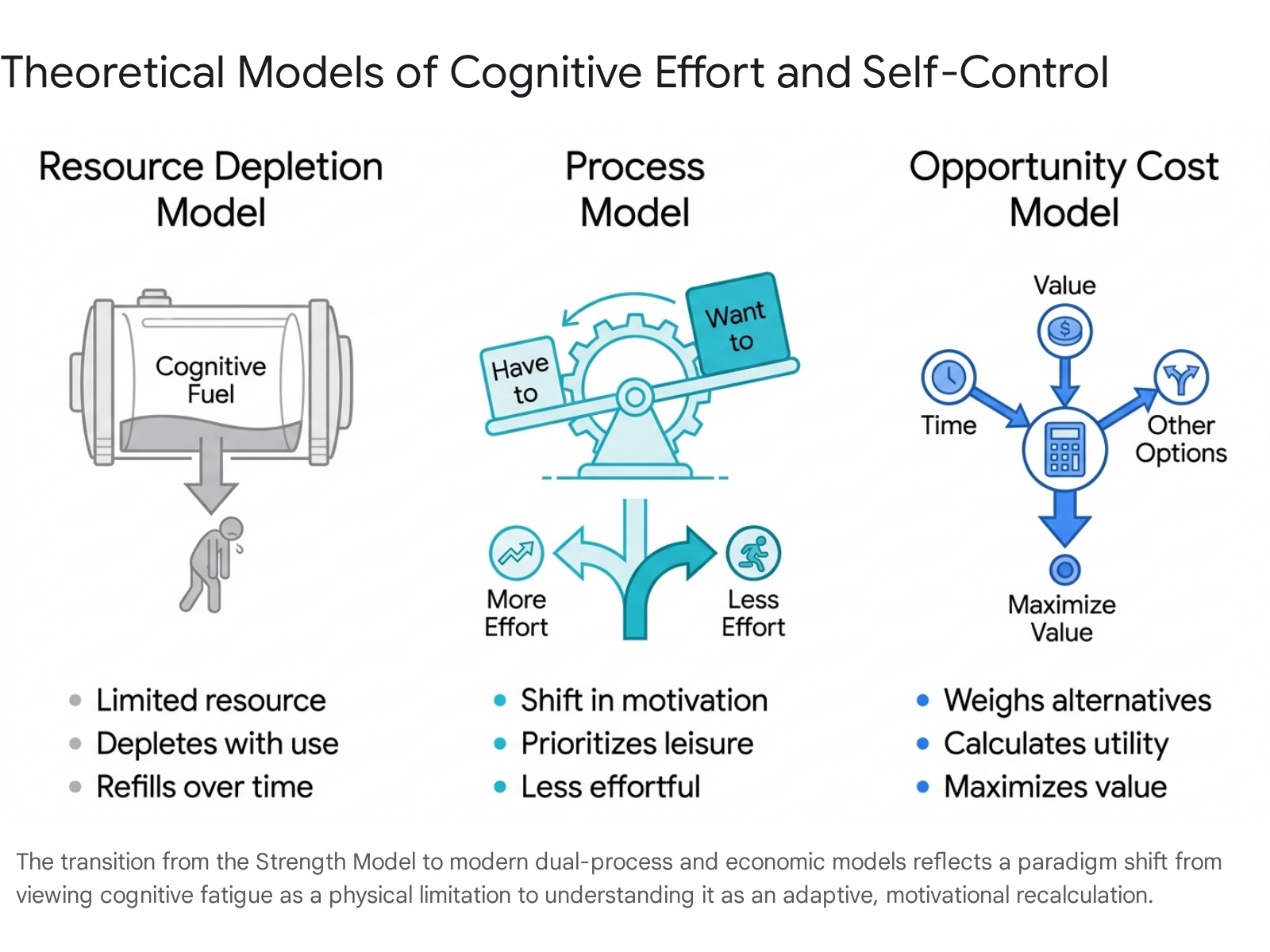
| Model Framework | Core Mechanism | Cause of Task Failure | Nature of Fatigue | Role of Blood Glucose |
|---|---|---|---|---|
| Strength Model (Ego Depletion) | Consumption of a finite physiological or psychological resource. | Inability to continue (empty reservoir). | A physical or metabolic deficit. | Fuel that is literally burned and requires metabolic replenishment. |
| Process Model | Shifts in motivation, attention, and emotional responding. | Unwillingness to continue (preference for gratification). | An affective state signaling a desire for cognitive leisure. | Acts as a reward signal in the oral cavity to boost motivation. |
| Opportunity Cost Model | Computational calculation of forgone alternative rewards. | Unwillingness to continue (alternative tasks offer higher utility). | A computational output signaling high opportunity costs. | Irrelevant to the core mechanism of effort calculation. |
Cognitive Scarcity and Mental Bandwidth
Parallel to the study of self-control fatigue, researchers heavily investigated how specific environmental contexts - namely poverty and financial scarcity - degrade cognitive capacity and decision-making over time. This field of study sought to explain whether the suboptimal economic decisions often observed in low-income populations were the result of cognitive load rather than inherent traits or lack of financial literacy.
The Original Scarcity Hypothesis
In 2013, Mani, Mullainathan, Shafir, and Zhao published a highly influential hypothesis asserting that poverty directly impedes cognitive function 22. They introduced the concept of mental bandwidth, arguing that the chronic stress of financial instability captures attentional resources, leaving fewer cognitive reserves available for unrelated tasks such as fluid intelligence, long-term planning, and executive control 222324.
This phenomenon, termed attentional tunneling, suggested that scarcity forces individuals to hyper-focus on immediate, pressing deficits - such as paying rent or securing food - at the severe expense of broader decision quality 3525. The original research relied on two primary methodologies to establish this causal link. First, the researchers utilized laboratory-induced scarcity. Participants at a New Jersey mall were primed with hypothetical scenarios involving high or low financial costs (e.g., a massive car repair bill). Lower-income participants exhibited significant cognitive deficits, measured via Raven's Progressive Matrices and spatial incompatibility tasks, when primed with high-cost scenarios, whereas higher-income participants remained unfazed 222335.
Second, the researchers conducted field observations. The cognitive function of sugarcane farmers in India was measured before the annual harvest, when they were objectively poor, and after the harvest, when they were relatively wealthy. The same farmers performed significantly worse on cognitive tests pre-harvest. The researchers equated this drop in cognitive capacity to losing a full night of sleep or experiencing a temporary 13-point drop in IQ 222326.
Methodological Critiques and the Empirical Audit
The scarcity hypothesis generated widespread enthusiasm in public policy, as it provided a structural explanation for poverty traps that absolved individuals of moral or intellectual failings 2324. However, this literature has recently faced rigorous scrutiny and replication challenges analogous to the ego depletion crisis.
In 2021, a comprehensive empirical audit published in the Proceedings of the National Academy of Sciences (PNAS) by O'Donnell et al. attempted to replicate 20 foundational findings related to the psychological consequences of scarcity 273928. The audit utilized large online samples and found that the vast majority of the studies failed to replicate. Specifically, replication effect sizes were smaller than the original effect sizes in 80% of the tested studies, and effect sizes were directionally opposite in 30% of the cases 28. Statistically significant results aligning with the original scarcity theories were recovered in only four of the 20 studies 28.
The publication of this audit sparked intense academic debate. The original authors published formal rebuttals arguing that the audit was methodologically flawed 2739. They cited unrepresentative online sampling, high attrition rates, and severe alterations to the experimental context. For example, they noted that the audit replicated studies regarding holiday gift shopping during the spring, thereby destroying the contextual validity of the scarcity prime 2739. Furthermore, the original authors highlighted analytical errors in the audit, such as incorrectly coding missing values and ignoring income skewness 27.
Current Scientific Consensus on Scarcity
Despite the defense by the original authors, subsequent large-scale, pre-registered replication attempts have continued to yield heterogeneous and often null results regarding acute scarcity manipulation. A 2025 registered report published in Royal Society Open Science, involving a highly powered sample of 4,280 participants, found that manipulating financial scarcity cues online did not reliably deteriorate the cognitive performance of poorer individuals compared to richer individuals 41. A systematic review by Szecsi and Szaszi examining Scarcity-Induced Cognitive Impairment (SICI) similarly concluded that the literature is plagued by highly heterogeneous findings, making definitive conclusions difficult 41.
The current scientific consensus suggests a nuanced middle ground. The longitudinal, real-world effects of chronic poverty on stress, malnutrition, sleep deprivation, and cognitive development remain undeniable, as observed in the field studies of farmers 25264142. However, the acute, short-term manipulation of scarcity mindsets via hypothetical priming in laboratory settings is highly fragile and lacks robust replicability 25264142. Cognitive capacity is undeniably affected by chronic, real-world resource constraints, but it is not easily disrupted by brief, laboratory-induced financial anxieties.
True Drivers of Decision Degradation
With the invalidation of simple resource-depletion models and the fragility of scarcity priming, contemporary research has successfully isolated specific, verifiable mechanisms that demonstrably degrade decision quality over time. The primary drivers are neurological fatigue resulting from acute sleep deprivation and behavioral shifts resulting from cognitive load saturation.
Sleep Deprivation and Neural Processing
Unlike ego depletion, the impact of acute sleep deprivation on decision-making is supported by highly replicable neuroimaging, physiological, and behavioral data. Total sleep deprivation (TSD) fundamentally alters the functional connectivity of the brain, specifically impairing the prefrontal cortex, which governs executive function, behavioral inhibition, and logical reasoning 294445.
Recent functional magnetic resonance imaging (fMRI) studies demonstrate that sleep deprivation dampens the brain's neural responses to decision outcomes. Specifically, individuals experiencing acute sleep loss exhibit significantly reduced activation in reward-processing regions when encountering positive, winning outcomes. Conversely, they show diminished negative emotional reactivity when facing losses 3031. This emotional blunting disrupts normal risk perception. Because the feedback mechanisms that normally guide risk-aversion are suppressed, sleep-deprived individuals tend to make highly variable, inconsistent, and increasingly risky decisions 4430.
Furthermore, sleep deprivation impairs vigilance and working memory linearly over time. Meta-analyses confirm that total sleep deprivation impairs attention and memory consolidation severely, heavily impacting professionals in high-stakes environments such as healthcare, aviation, and emergency response, where minor computational errors can compound into catastrophic failures 294432. While chronic partial sleep restriction primarily impairs sustained vigilance, acute total sleep deprivation aggressively degrades complex decision-making and divergent thinking 29.
Cognitive Load Saturation and Task Shift
In the absence of sleep deprivation, continuous decision-making still results in observable degradation of choice quality. This phenomenon is accurately termed decision fatigue, but it operates entirely distinctly from the debunked ego depletion mechanism. Decision fatigue emerges as a downstream behavioral effect of cognitive load saturation - a state where the informational, decisional, and attentional demands placed on an individual exceed their working memory capacity for deliberate, analytical processing 495051.
When cognitive load saturates, the brain engages in a strategic behavioral shift to conserve energy and manage the overflow of input. Decision-making transitions from reflective, deliberative evaluation, known as Type 2 processing, to reactive, heuristic-driven choices, known as Type 1 processing 4950. This structural shift manifests in several specific behavioral patterns that compromise decision quality: * Default Bias and Inertia: A heavy reliance on pre-selected or status-quo options, regardless of their actual utility, as seen in complex purchasing configurations or policy opt-ins 503334. * Choice Deferral: An increase in avoidance behavior, procrastination, and the ultimate refusal to make a decision at all, often referred to as choice paralysis 3536. * Impulsivity and Simplification: A preference for low-effort, immediate gratification over long-term optimization, and a tendency to ignore complex variables in favor of single-attribute decision-making 313435.
| Mechanism of Degradation | Primary Physiological/Cognitive Cause | Resulting Behavioral Shift | Impact on Decision Quality |
|---|---|---|---|
| Acute Sleep Deprivation | Altered functional connectivity; dampened reward/loss neural reactivity. | Emotional blunting; failure to properly weigh negative outcomes. | Increased risk-taking; inconsistent choice patterns; severe attention lapses. |
| Cognitive Load Saturation | Informational demands exceeding working memory capacity. | Transition from Type 2 (deliberative) to Type 1 (heuristic) processing. | Reliance on defaults; choice deferral; single-attribute simplification. |
| Prolonged Task Engagement | Rising opportunity costs of current task versus available alternatives. | Motivational shift away from restraint toward immediate gratification. | Impulsivity; decreased task persistence; seeking cognitive leisure. |
The Neurobiology of Physical vs. Cognitive Fatigue
Advancements in functional neuroimaging have clarified the distinction between physical exhaustion and the cognitive unwillingness characteristic of decision fatigue. While physical exhaustion limits maximal muscular output, it often leaves mental alertness and executive function intact 5657. However, cognitive fatigue distorts the affective processing of effort, making subsequent tasks feel impossibly difficult even when physiological capacity remains fully intact 315657.
This phenomenon maps to specific neural interactions. As the right dorsolateral prefrontal cortex (rdlPFC) processes sustained cognitive exertion and heavy working memory loads, it increases its functional connectivity with the right anterior insula (rIns), a brain region responsible for encoding the subjective valuation of effort 56. This neural coupling allows the cognitive fatigue signals from the dlPFC to actively modulate and exaggerate the perceived cost of physical or secondary mental effort in the insula 56. Consequently, cognitively fatigued individuals exhibit increased risk aversion and a decreased willingness to choose effortful options, demonstrating how mental saturation directly manipulates subsequent behavioral choices 56.
Behavioral Science Policy Adaptations
The replication crisis in psychology, encompassing both the collapse of ego depletion and the fragility of scarcity priming, catalyzed a profound evolution in how behavioral science is applied to public policy, organizational design, and choice architecture. Early applications of nudge theory relied heavily on the assumption that policymakers could seamlessly manipulate choice environments to bypass human cognitive limitations without the subject's awareness 375938. However, as the underlying evidence regarding subconscious priming and resource depletion weakened, practitioner frameworks required significant structural updating 61626339.
Choice Architecture 2.0 and Social Sensemaking
The initial models of choice architecture treated human decision-makers as relatively passive targets who would react mechanically to environmental cues, such as automatically accepting an opt-out default out of sheer inertia 5940. The updated framework, widely categorized as Choice Architecture 2.0, acknowledges that human beings are highly active interpreters of their environments who engage in complex social sensemaking when confronted with a designed intervention 5940.
When individuals interact with a nudge, they actively infer the beliefs, intentions, and goals of the choice architect 5940. If an intervention is perceived as coercive, patronizing, or manipulative, it triggers psychological reactance, frequently causing the policy to backfire entirely. A prominent example occurred when the Netherlands proposed changing organ donation to an opt-out default. Because the public perceived this choice architecture as a coercive overreach by the government, the intervention provoked a massive spike in individuals actively opting out to signal their displeasure and protect their autonomy 5940. Consequently, modern behavioral policies must undergo rigorous social sensemaking audits prior to deployment to predict how targets will interpret the structural design and intent of the intervention 5940.
Nudge Plus and Reflective Interventions
Recognizing that purely automated, heuristic-driven nudges suffer from decaying efficacy over time as individuals habituate to them, theorists introduced the concept of Nudge Plus 386667. Traditional nudges rely entirely on exploiting Type 1 (fast, automatic) processing, deliberately bypassing the agent's analytical faculties. Nudge Plus, however, incorporates a specific mechanism to trigger Type 2 (slow, reflective) processing either immediately before, during, or after the delivery of the environmental nudge 3866.
By prompting individuals to actively reflect on their personal goals or the societal impact of their actions, Nudge Plus preserves individual autonomy and helps build sustainable, internalized behavioral habits rather than temporary compliance 3866. Empirical studies conducted during the COVID-19 pandemic demonstrated that inference nudging - which explicitly prompts individuals to reflect on the goal-directed utility of an action, such as hand disinfection - yielded robust compliance in real-world settings while entirely avoiding the ethical concerns associated with subconscious manipulation 67.
System-Level Design and Ethical Frameworks
Prominent applied organizations, such as the UK's Behavioural Insights Team (BIT), have fundamentally overhauled their operational frameworks in direct response to the replication crisis 63396841. Modern behavioral policy has shifted aggressively away from relying on isolated cognitive biases, exotic priming effects, or acute scarcity manipulations. Instead, organizations focus on system-level friction reduction, decision hygiene, and long-term journey mapping 613970.
Frameworks like the BIT's EAST methodology (Easy, Attractive, Social, Timely) have been maintained and updated precisely because they rely on robust, highly replicable mechanisms - primarily the reduction of cognitive load and the use of unambiguous social norms 3942. Furthermore, modern interventions emphasize strict ethical guardrails, requiring transparent opt-outs, providing contextual justification for nudges, and rejecting deceptive choice architectures or dark patterns 6141.
In high-stakes environments such as healthcare and aviation, protocols have been updated to combat decision fatigue systematically rather than relying on individual willpower. Institutional decision hygiene protocols, such as mandatory fatigue-aware scheduling, strategic decision batching, and prioritization matrices (e.g., the 90-second framework), are utilized to conserve scarce cognitive resources and prevent the dual-process drift that leads to catastrophic errors 497273.
The integration of behavioral science into policy has thus matured from the pursuit of rapid, unconscious behavioral manipulation into the development of transparent, autonomy-enhancing environments. By designing systems that accommodate the realities of cognitive load, mitigate decision fatigue through structural friction reduction, and respect the social sensemaking capacity of the end-user, modern choice architecture builds sustainable decision quality that survives the pressures of real-world complexity 6139664170.