
How Cravings Affect the Brain and Why Willpower Fails
During a craving, the brain experiences a rapid neurological collision where the fast-acting limbic system - which drives ancient survival and reward-seeking behaviors - hijacks your neural circuitry and functionally overpowers the slower, logical prefrontal cortex. Willpower alone consistently fails because it relies on this executive center, which becomes actively suppressed by stress hormones and shifting neurochemical priorities during an urge. Ultimately, giving in to a craving is not a moral failing, but the result of a predictable biological mismatch between our deep-seated evolutionary drives and our conscious capacity for self-control.
The Anatomy of an Urge: Two Brain Systems at War
To understand why a sudden urge for a cigarette, a sugary dessert, or a smartphone notification feels so physically overpowering, we must look at the structural and evolutionary architecture of the human brain. The mind is not a single, unified entity; it is a complex amalgamation of different modules with distinct evolutionary histories, operating characteristics, and competing agendas 1. When you experience a craving, two primary brain systems are thrown into direct, asymmetrical conflict.
The Limbic System: The Fast-Acting Accelerator
Located near the center of the brain, the limbic system serves as our ancient survival machinery. It encompasses deep-brain structures like the amygdala, which processes emotions and threats, and the ventral striatum (housing the nucleus accumbens), which evaluates rewards 122. This network operates automatically, largely below the level of conscious awareness, and is evolutionarily designed to keep organisms alive by driving them rapidly toward energy sources and away from danger 2.
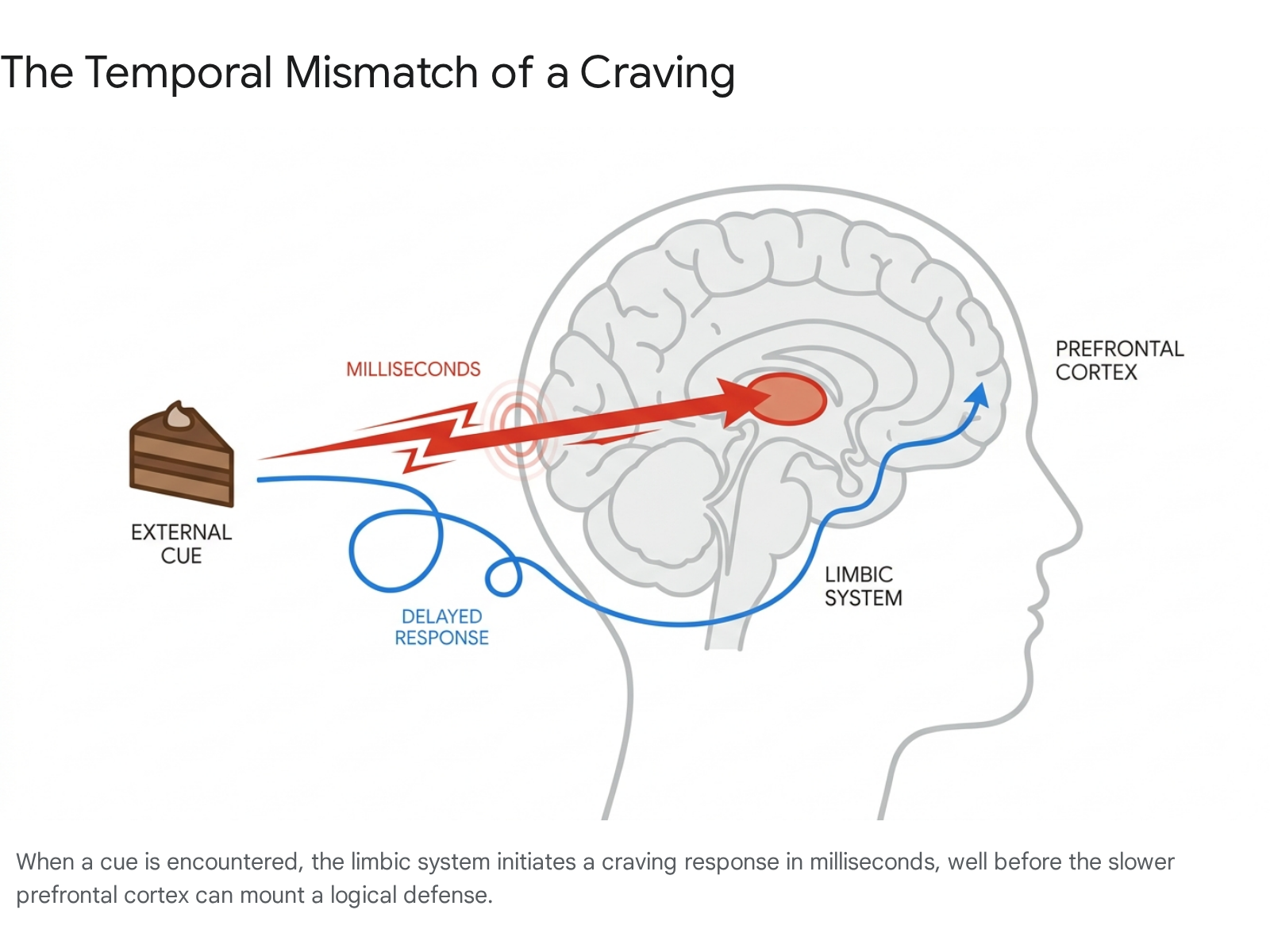
Crucially, the limbic system processes information at staggering speeds. Neural action potentials generally operate on a timescale of 1 to 100 milliseconds 3. The amygdala and associated limbic structures can react to environmental cues - such as the sudden smell of a bakery or the chime of a text message - in mere fractions of a second 1. This rapid-fire response means that before you have even consciously registered a temptation, your limbic system has already initiated a potent cascade of physiological craving signals.
The Prefrontal Cortex: The Slower Braking System
Operating in stark contrast to the limbic system is the prefrontal cortex (PFC), the region located directly behind your forehead. The cerebral cortex evolved significantly later in mammalian history. While all modern mammals share agranular limbic areas of the PFC, the highly complex granular isocortical regions expanded significantly during primate and human evolution, granting us capacities for metacognition, logical analysis, impulse control, and long-term planning 545.
While the PFC is highly sophisticated, it is also comparatively slow and computationally expensive. It requires conscious, labor-intensive effort to integrate spatial, temporal, and abstract information, meaning its neural processing operates on a slower timescale than the rapid-fire limbic system 16. Brain transmission speeds do increase throughout childhood and early adulthood, peaking at roughly twice the speed of a child's brain by age 30, but the fundamental speed discrepancy between the limbic and cortical systems remains 7.
When an environmental cue triggers a craving, the limbic system screams "go" with the urgency of a fight-or-flight response, while the PFC struggles to whisper "stop" 2. The temporal mismatch between these two systems is the first major reason willpower is at a severe disadvantage: by the time your logical brain fully comes online to exert self-control, the motivational circuits of the limbic system are already saturated and fully activated.
A Neuromarker for Craving
Modern neuroimaging has allowed scientists to map this conflict with incredible precision. A landmark 2022 functional magnetic resonance imaging (fMRI) study conducted by researchers from Yale, Dartmouth, and the French National Centre for Scientific Research identified a highly stable pattern of brain activity associated with intense urges, dubbed the "Neurobiological Craving Signature" (NCS) 10. Using machine learning algorithms on brain images from individuals exposed to drug and food cues, researchers found that this neuromarker accurately predicts the subjective intensity of a craving across different substances, including food, alcohol, and cocaine 10. The NCS provides a granular map of how the limbic and cortical regions interact, proving that craving is a quantifiable, physiological state, not merely a fleeting psychological thought.
Dopamine: The Molecule of Wanting, Not Liking
To truly understand craving, we must dismantle one of the most pervasive myths in popular neuroscience: the idea that dopamine is the "pleasure molecule." It is not. Dopamine is the molecule of motivation, anticipation, and behavioral reinforcement.
In the late 1990s, neuroscientists Kent Berridge and Terry Robinson fundamentally changed our understanding of addiction and craving by proving that "wanting" and "liking" are driven by two entirely separate neural systems 11128.
The Illusion of Pleasure
Through a series of experiments, Berridge demonstrated that dopamine governs incentive salience, or "wanting" - the potent motivational pull toward a stimulus and the compulsion to seek it 118. The actual hedonic pleasure of consuming a reward - the "liking" - is mediated by much smaller, fragile neural "hotspots" localized in the nucleus accumbens and the ventral pallidum, which run on opioid and endocannabinoid systems rather than dopamine 11814.
When a person repeatedly engages in a highly rewarding behavior, whether consuming highly processed foods, using stimulants, or engaging in behavioral addictions, the dopamine system becomes hyper-reactive or "sensitized" 128. It begins to forcefully tag environmental cues (a syringe, a bakery smell, a notification badge) with urgent, survival-level importance. However, with repeated exposure, the opioid-driven "liking" system often desensitizes 128.
This creates a tragic neurological divergence: the urge to consume (wanting) skyrockets, while the actual enjoyment derived from the consumption (liking) plummets 128. This explains the hollow, drained feeling of a craving. You can intensely desire a second slice of cake or another hour of endless social media scrolling while actively finding the experience unfulfilling 11. The dopamine system simply does not care whether the liking system is satisfied; its evolutionary mandate is strictly to drive pursuit.
Reward Prediction Errors
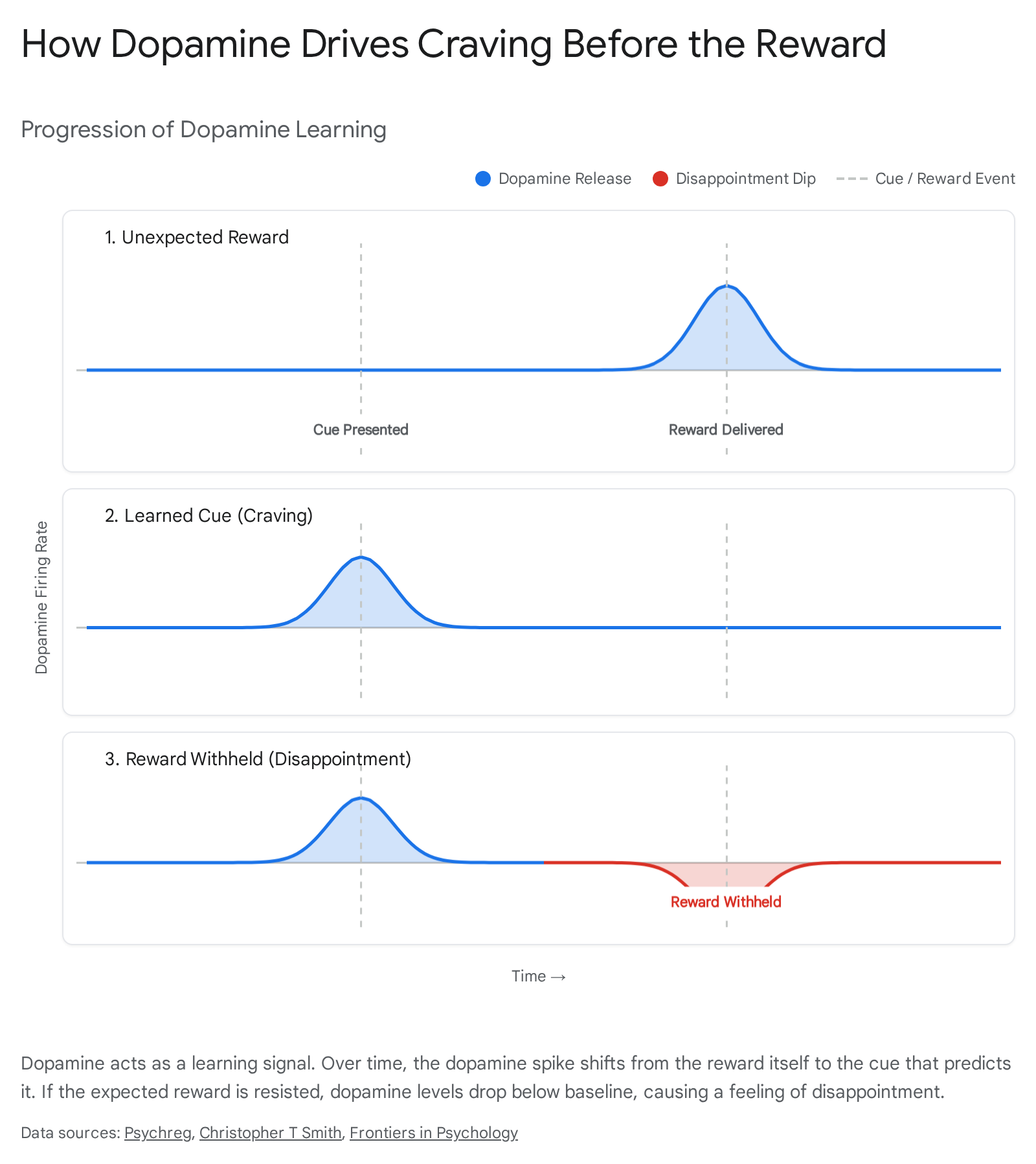
Dopamine also acts as a sophisticated learning signal through a mechanism known as "reward prediction error," pioneered by neuroscientist Wolfram Schultz 12159. Dopamine neurons do not simply fire when you receive a reward; they burst when an unexpected reward appears.
Once your brain learns that a specific cue (like seeing a familiar logo or a donut box) predicts a reward, the dopamine spike actually shifts backward in time. The surge occurs when you see the predictive cue, not when you consume the food 12917. This anticipatory spike is the physical manifestation of a craving; it propels goal-directed behavior to secure the expected reward 149.
If you follow through and eat the donut, dopamine levels stay relatively stable because the reward was successfully predicted. But if you actively resist the craving and deny yourself the donut, dopamine levels suddenly drop below baseline. This represents a negative prediction error, which the brain registers as a sharp physiological disappointment 12159. Resisting a craving literally creates a neurochemical deficit, fueling frustration and an intense urge to correct the error by giving in.
The Demise of Ego Depletion: Why Willpower Isn't a Muscle
For decades, the prevailing psychological framework for understanding self-control was the "Strength Model," commonly known as "Ego Depletion." Pioneered by Roy Baumeister, this theory posited that self-control relied on a finite, domain-general physical resource - often likened to a muscle that becomes fatigued or a fuel tank running low on brain glucose 10111213. According to this model, if you resist eating a pastry in the morning, your willpower "tank" is literally depleted, making you more likely to snap at a coworker or skip the gym later that evening 14.
However, the scientific consensus shifted dramatically in the 2010s and 2020s. Rigorous multilab replication studies repeatedly failed to find a robust ego depletion effect, and the hypothesis that the brain runs out of glucose during standard self-control tasks was proven biologically untenable 11121315.
The brain does not simply run out of energy. Instead, modern neurocognitive frameworks view self-control failure not as a loss of capacity, but as an active, calculated shift in motivation. Two primary models now explain this phenomenon: the Shifting Priorities Model and the Opportunity Cost Model 141617.
The Shifting Priorities Model
Proposed by neuroscientists such as Michael Inzlicht, the Shifting Priorities Model (also called the Process Model) reframes ego depletion as a dynamic motivational trade-off 161819. When you engage in prolonged self-regulation - such as rigidly denying yourself a craving - the brain begins to register this effortful control as an unrewarding, aversive task 161719.
Evolutionarily, organisms are incentivized to properly balance immediate survival needs with long-term preparations; excessive focus on delaying gratification can be maladaptive 17. Therefore, after a period of self-control, the brain actively shifts its motivational priorities away from long-term, obligation-based "have-to" goals (telic states), and redirects your attention toward immediate, desire-based "want-to" goals (paratelic states) 161819. You do not lose the physical ability to control yourself; you simply lose the motivation to do so. Your brain calculates that the cost of continued restriction is no longer yielding sufficient returns, making temptations appear significantly more rewarding 1319.
The Opportunity Cost Model
Similarly, the Opportunity Cost Model, articulated by Robert Kurzban and colleagues, views self-control not as a depletable fuel tank, but as a continuous, value-driven decision-making process largely orchestrated by the ventromedial prefrontal cortex (vmPFC) 11121516.
Because the brain's executive functions can only be deployed toward a limited number of computationally heavy tasks at one time, every moment you spend resisting a craving carries an "opportunity cost" - you are missing out on other potentially rewarding mental or physical activities 13. The subjective feeling of "mental fatigue" or "willpower depletion" is not a sign of physiological exhaustion. Rather, it is a negative emotion generated by the brain to signal that the current task (resisting the urge) is accumulating too high an opportunity cost 131419. It is an internal alarm bell urging you to switch to a more immediately rewarding behavior.
Summary of Prevailing Willpower Theories
| Feature | The Outdated "Ego Depletion" Model | The Modern "Opportunity Cost" / "Shifting Priorities" Models |
|---|---|---|
| Core Concept | Willpower is a finite physiological resource (like physical energy). | Willpower is a dynamic, value-based decision and motivational state. |
| Cause of Failure | The brain physically runs out of energy/glucose. | The brain computationally decides the effort is no longer worth the cost. |
| Feeling of Fatigue | A literal inability to function due to physiological exhaustion. | An emotion generated to compel you to switch to a more rewarding task. |
| Primary Remedy | Rest and replenish glucose stores. | Alter the perceived value of the choices to shift motivation. |
Comparison based on current cognitive neuroscience consensus, displacing the strength model with value-based decision paradigms 11121317.
The Chemical Sabotage: Stress, Glutamate, and the Gut
If willpower is essentially a matter of shifting priorities and opportunity costs, why is it so incredibly difficult to shift our priorities back toward long-term health when a craving hits? The answer lies in how specific chemicals and physiological systems structurally alter our decision-making capabilities in real time.
The Stress Response: Noradrenaline's Vicious Cycle
Psychological stress is universally recognized as one of the most powerful drivers of craving and relapse across all forms of addiction 2. Under conditions of stress, the amygdala activates stress pathways in the hypothalamus and brainstem, triggering a massive release of cortisol and catecholamines, particularly noradrenaline (norepinephrine) and dopamine 22030.
While moderate levels of noradrenaline bind to alpha-2 (α2) receptors to help the prefrontal cortex focus and maintain vigilance, the extreme high levels released during acute stress act as chemical sabotage 3021. High concentrations of noradrenaline engage lower-affinity alpha-1 (α1) and beta (β) receptors. This rapidly impairs PFC regulation, functionally disconnecting your logical brain from the rest of the network 2021. Simultaneously, this same chemical bath strengthens the amygdala and other limbic circuits, hyper-sensitizing them to rewarding cues and emotional stimuli 2203022.
When you are stressed, you are not just experiencing moral weakness; you are enduring a state where your brain's executive control center has been biochemically taken offline, while your primitive reward-seeking center has been handed a megaphone.
The Brakes of the Brain: Glutamate's Hidden Role
While dopamine rightly receives the spotlight for initiating cravings, another neurotransmitter, glutamate, is the true unsung hero of self-control. Glutamate is the primary excitatory neurotransmitter in the central nervous system. In the context of cravings, projections of glutamate from the prefrontal cortex down to reward centers (like the ventral tegmental area and nucleus accumbens) act as the vital regulatory "brakes" on dopamine release, facilitating inhibitory control 233.
Recent translational research combining rat models with human clinical data (2024) has revealed a stunning mechanism: chronic exposure to addictive substances or behaviors actually depletes glutamate concentrations in specific inhibitory regions of the medial prefrontal cortex, such as the dorsal anterior cingulate cortex (dACC) and prelimbic cortex 232436.
When researchers looked at human individuals with severe behavioral addictions (such as internet gaming disorder), they found that lower glutamate levels in the dACC were directly correlated with higher symptom severity and a poorer ability to resist temptation 232436. Furthermore, restoring glutamate homeostasis via behavioral interventions or physical exercise increases the expression of GLT-1 transporters, normalizing synaptic function and helping prevent relapse 33. Without sufficient glutamate signaling from the prefrontal cortex, the brain cannot send the necessary inhibitory signals to stop a dopamine-driven impulse. The brakes are effectively cut.
The Gut-Brain Axis and Nutrient-Specific Cravings
Cravings are not merely brain-bound phenomena; they are heavily influenced by the periphery of the body, particularly the gut. For decades, it was assumed that hunger and cravings were primarily driven by calorie deficits and taste preferences. However, modern research shows that the brain actively craves specific nutrients regardless of taste 3725.
In a landmark experiment, mice were genetically modified to remove their ability to taste fat on their tongues. Despite this, when given a choice, the mice still developed a strong preference for fatty water over sweet water 25. Researchers discovered that fat entering the intestines triggers a direct neural signal to the brainstem (specifically the caudal nucleus of the solitary tract, or cNST) 25. The gut tells the brain what the body needs, bypassing the tongue entirely. Furthermore, when blood sugar levels fall, AMPK-regulated CRH neurons in the hypothalamus drive a specific craving for carbohydrates, while MC4R-expressing neurons drive the ingestion of fats 37. Sudden cravings for sweets or fried foods are therefore not a failure of willpower, but the execution of highly specific, nutrient-seeking neurochemical pathways.
The Modern Trap: Choice Architecture and Ultra-Processed Foods
The biological mechanisms of craving evolved in an ancestral environment of caloric scarcity, where seeking out calorie-dense foods or focusing intently on rare, novel rewards was absolutely vital for survival 1426. Today, these exact mechanisms are routinely exploited by modern environments and food engineering.
The Global Rise of Food Addiction
Research spanning geographically diverse populations indicates that food addiction - characterized by an intense craving for and loss of control over highly palatable foods - is a rapidly growing global phenomenon, with the United States leading in research output on the topic 272829. Ultra-processed foods, engineered to be unnaturally high in both refined fats and sugars, overstimulate the reward circuitry, triggering massive dopamine prediction errors similar to those seen in substance use disorders 294330.
The consequences of this are profound. A recent clinical trial demonstrated that having healthy adults consume a high-fat, high-sugar snack daily for just eight weeks fundamentally rewired their brains. The dietary intervention heavily enhanced the brain's associative learning responses to food cues, entirely independent of any actual weight gain or changes in metabolic health 3146. In other words, modern ultra-processed diets rapidly train the dopamine system to crave junk food automatically, deepening the neurological rut that willpower must try to overcome. Furthermore, food addiction shows a startling overlap with mental health vulnerabilities; studies in Denmark found that adolescents with mental disorders are more than twice as likely to exhibit addiction-like attractions to unhealthy foods compared to their peers 30.
Strategies That Actually Work (Beyond Willpower)
Because willpower is a fragile, easily subverted motivational state rather than a reliable, muscular force, relying on it in the face of intense cravings is a losing battle. Fortunately, neuroscientific and behavioral research points to several evidence-based strategies that effectively bypass the need for brute-force self-control.
1. Implementation Intentions (If-Then Planning)
One of the most robust psychological tools for overcoming cravings is the use of "Implementation Intentions," a concept developed by psychologist Peter Gollwitzer 323334. This involves creating highly specific "if-then" plans long before you encounter a trigger. For example: "If I feel stressed after work and crave a drink, then I will immediately brew a cup of herbal tea."
This strategy works because it effectively pre-loads the decision into the brain. By linking a specific situational cue to a specific behavioral response, you shift the cognitive load away from the easily fatigued, cost-calculating prefrontal cortex, and hand it over to automatic memory systems 3234. Time-series analyses have shown that operationalizing habit degradation through implementation intentions successfully weakens the strength of bad habits over time, allowing individuals to transition from preparation to sustained action 3350. Even complex behavioral changes, like transitioning to a plant-based diet, show improved success rates when instigation habits and self-regulation strategies are consistently applied 35.
2. Choice Architecture (Nudging)
If the prefrontal cortex cannot be trusted in the heat of the moment, the best behavioral strategy is to alter the physical environment so that a taxing decision does not have to be made at all. This approach is known as "choice architecture" or "nudging" 363738.
Meta-analyses reveal that behavioral nudges - such as reducing portion sizes by default, making healthy options more visible, or removing unhealthy items from immediate sight - are significantly more effective in reducing unhealthy eating than cognitive nudges like nutritional labels 3655. For example, large-scale randomized controlled trials on food-delivery apps have shown that simply repositioning menus - putting the healthy or low-carbon options at the top - significantly reduces the selection of high-calorie, high-impact foods without ever restricting the user's freedom of choice 563958. In university cafeterias, modifying the choice architecture to highlight fruits and vegetables drastically improves meal quality 384060. By aligning the path of least resistance with long-term goals, nudging entirely bypasses the need to engage the brain's exhausting valuation and self-control conflict 3641.
3. Mindfulness and "Decentering"
When a craving inevitably hits, attempting to forcefully suppress it typically backfires. Psychological suppression creates a rebound effect, increasing negative affect and actually heightening the craving 42.
Instead, mindfulness-based interventions (MBIs) train individuals in a practice called "decentering" or acting with awareness 4243. A comprehensive 2025 meta-analysis found that while mindfulness does not necessarily reduce the frequency of cravings, it significantly reduces the intensity of those cravings, as well as minimizing rebound binge eating 434465. By observing the physical urge non-judgmentally without acting on it, individuals can decouple the dopamine-driven "wanting" from the physical action, essentially waiting out the neurochemical storm until the prefrontal cortex can regain regulatory control 4245.
4. Pharmacological and Technological Frontiers
For severe cases of food preoccupation and addiction, modern medicine is beginning to target these precise neural circuits. Recent first-in-human studies investigating GLP-1 receptor agonists (such as tirzepatide) show that these drugs do vastly more than slow digestion. Direct brain recordings using implanted electrodes reveal that these medications actively suppress low-frequency delta-theta brain signals in the nucleus accumbens, directly dampening the brain's craving and reward-seeking pathways 4647. As one neuroscientist noted, these drugs act on the deep brain systems that make you want the food, not just the systems that make you feel physically full 47.
Additionally, non-invasive brain stimulation techniques, such as transcranial direct current stimulation (tDCS) and repetitive transcranial magnetic stimulation (rTMS) applied over the dorsolateral prefrontal cortex (DLPFC), are being researched to artificially enhance inhibitory control and reduce the hedonic value of food in individuals struggling with severe cravings, though results remain complex and highly dependent on baseline neurochemistry 5548.
Bottom line
A craving is not an indication of weak character, but a fierce biological cascade where the brain's fast-acting, dopamine-fueled survival circuits temporarily overpower the slower, logical prefrontal cortex. The traditional idea of willpower as a depletable physical fuel is obsolete; instead, self-control fails because the brain dynamically calculates that the effort of resisting is no longer worth the cost, a shift that is heavily exacerbated by acute stress and depleted glutamate levels. While brute-force willpower is biologically destined to struggle against our evolutionary wiring, relying on environmental nudges, automated "if-then" plans, and mindfulness techniques offers a scientifically grounded path to outsmarting our own neurochemistry.