
Why We Crave Sugar
The Direct Answer Hook: Unpacking the "Dessert Stomach"
The phenomenon of the "dessert stomach" - the seemingly miraculous ability to find room for a slice of cake or a scoop of ice cream even after consuming a heavy, satiating meal - is not a myth of gluttony, but a hardwired evolutionary survival mechanism known as sensory-specific satiety 1231.
From an evolutionary perspective, human ancestors lived in environments where food was scarce, and securing a wide diversity of essential macronutrients and micronutrients was a constant challenge. To ensure that early humans consumed a broad spectrum of vitamins, minerals, and amino acids, the brain evolved a mechanism to decrease the palatability of a specific food as it is eaten, while maintaining the appeal of foods with entirely different sensory profiles, such as those with novel tastes, textures, or aromas 123. Once the body has extracted sufficient energy from a savory, protein-heavy main course, hypothalamic neurons in the ventral forebrain decrease their responsiveness to the sight and taste of that specific food 1.
However, introducing a novel sensory stimulus - such as the sweet taste of dessert - effectively bypasses this satiety signal 21. Recent neurobiological research has revealed the precise cellular mechanisms driving this behavior. When the brain perceives sugar, even in a state of physical fullness, a specific group of nerve cells called pro-opiomelanocortin (POMC) neurons becomes highly active 2. These neurons release $\beta$-endorphin, one of the body's endogenous opiates. This $\beta$-endorphin acts on opiate receptors in the brain to trigger a powerful feeling of reward, compelling the individual to consume sugar well beyond the point of gastric fullness 2. Furthermore, neuroimaging studies indicate that sugar stimulates two distinct areas of the striatum simultaneously: the ventral striatum processes the rewarding sensation of sweetness, while the dorsal striatum registers the high-caloric value, making sweet, energy-dense foods virtually irresistible 3. What was once a survival advantage designed to promote dietary diversity is now the driving force behind overconsumption in a modern environment overflowing with hyper-palatable, ultra-processed treats 13.
The Ancestral vs. Modern Landscape: Evolution Collides with the Obesogenic Environment
To understand why modern populations struggle so profoundly with sugar cravings, one must trace the historical trajectory of human sugar consumption and the rapid emergence of the global obesogenic environment.
Historical Trajectory of Sugar Consumption
Before the 1700s, human exposure to concentrated fructose and sucrose was exceedingly rare, limited primarily to seasonal fruits and occasional discoveries of honey. For example, before 1700, the average British citizen consumed approximately one pound of honey per year, with virtually no exposure to refined cane sugar 7. By the 18th century, the expansion of sugarcane plantations - driven largely by the transatlantic slave trade - made sugar increasingly available. By 1830, average per capita consumption in the United Kingdom had reached roughly 10 pounds (4.5 kg) per year 749.
The advent of industrialization, rising personal incomes, the removal of sugar taxes in the late 19th century, and the discovery of the sugar beet precipitated a steady, exponential climb in global consumption 491011. However, the most profound inflection point occurred in the 1970s with the introduction of high-fructose corn syrup (HFCS) 49. HFCS was significantly cheaper to produce than cane sugar, liquid in form, and easily integrated into a vast array of processed foods and soft drinks to drastically enhance palatability 4. By the year 2000, average per capita sugar disappearance in the United States peaked at over 150 pounds (68.2 kg) per year - a staggering physiological shock for a species that evolved foraging for seasonal berries 495.
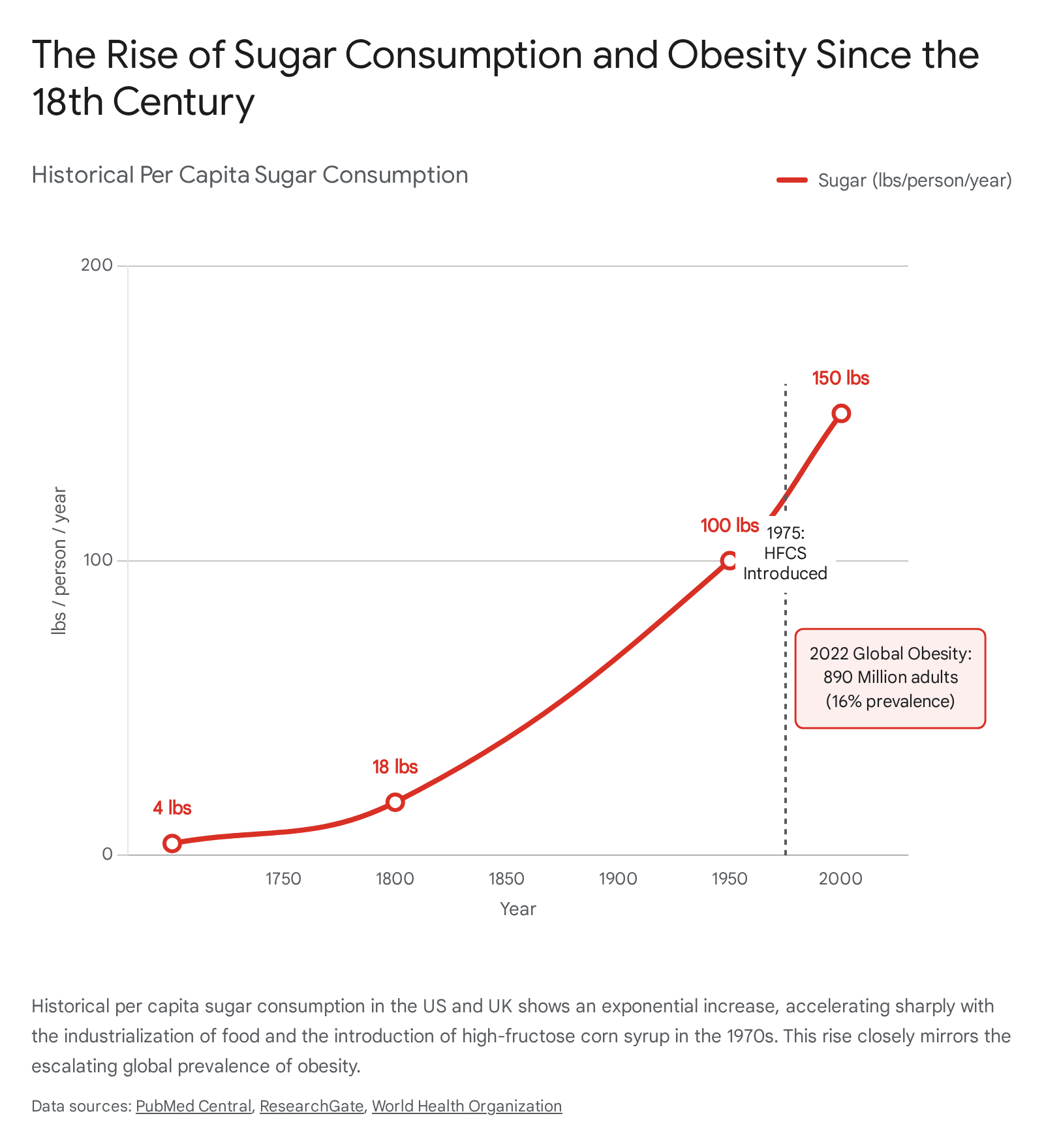
While recent dietary data suggests a slight leveling off or decline in added sugar consumption in some high-income nations due to increasing public health awareness - such as the U.S. seeing a drop from 21 teaspoons to roughly 16.1 teaspoons per day - the baseline intake remains alarmingly high 1314. The American Heart Association (AHA) and the World Health Organization (WHO) recommend a strict limit on added sugars to reduce the risk of cardiovascular disease and obesity. The AHA advises a maximum of six teaspoons (25 grams) per day for women and nine teaspoons (37.5 grams) for men 4515. Yet, the average American still consumes upwards of 17 to 22 teaspoons of added sugar daily, with teenagers routinely consuming over 34 teaspoons, largely driven by sugary beverages 517.
The Global Crisis of Ultra-Processed Foods (UPFs)
This overwhelming surplus of sugar is delivered primarily through the proliferation of ultra-processed foods. Evaluated under the widely adopted NOVA classification system, food is categorized by its extent of industrial processing 67. UPFs (NOVA Group 4) are industrial formulations comprised mostly of substances extracted from whole foods - such as hydrogenated oils, protein isolates, modified starches, and refined sugars - combined with cosmetic additives like colors, flavor enhancers, and emulsifiers 67208. These formulations are meticulously engineered to be highly profitable, hyper-palatable, and convenient, actively displacing traditional foodways 678.
Initially identified as a public health issue confined to high-income Western nations, the UPF crisis is now a definitively global phenomenon. Multinational food corporations have aggressively expanded their supply chains and marketing efforts into low- and middle-income countries (LMICs) 6910. According to data from the WHO and subsequent global dietary analyses, UPFs now account for over half of all dietary energy consumed in the U.S. (57.5%), the UK (56.8%), and Canada (46.8%) 81011. However, middle-income nations are experiencing the most rapid growth in UPF consumption. In Japan, UPFs now account for 38% of total caloric intake, followed by Mexico (30%), Chile (29%), South Korea (26%), and Brazil (20%) 610. In many of these emerging economies, the influx of UPFs has created a "double burden of malnutrition," where nations simultaneously grapple with historical undernutrition and rapidly escalating rates of obesity within the same communities 912.
This dietary shift correlates flawlessly with a global metabolic catastrophe. The WHO's recent reports (2024 - 2025) highlight that 2.5 billion adults (43% of the global adult population) are currently overweight, with 890 million of those individuals living with clinical obesity 13. Adolescent obesity has quadrupled globally since 1990, and an estimated 35 million children under the age of five are currently overweight 13. Once considered a disease of affluence, obesity is now rising most rapidly in Africa and Asia. The number of overweight children under five in Africa has increased by nearly 24% since 2000, and almost half of all overweight children globally reside in Asia 913. Healthcare systems in these regions are frequently ill-equipped to manage the corresponding surge in non-communicable diseases (NCDs) like type 2 diabetes, cardiovascular disease, and diet-related depression 6891227. If current trends hold and UPF consumption is not mitigated by coordinated policy interventions, the World Obesity Federation projects that 1 billion people will be living with obesity by 2030, presenting an economic burden projected to reach $3 trillion annually 91213.
The Neurobiology of Sugar Cravings: Blown Speakers and Bliss Points
To fully comprehend the iron grip that sugar maintains on human behavior, one must examine the intersection of modern food engineering and ancient neurobiology.
The Engineering of the Bliss Point
The human brain is deeply wired to seek out energy-dense foods, utilizing sensory cues to predict the caloric value and nutritional density of an item. Food manufacturers understand this evolutionary biology intimately and purposefully engineer ultra-processed foods to reach what the industry terms the "Bliss Point" 31415. The bliss point is the precise, mathematically optimized ratio of sugar, fat, and salt that triggers maximum sensory stimulation and subsequent dopamine release without activating the body's natural satiety signals 315.
When an individual consumes a product engineered to its bliss point - such as a heavily processed potato chip or a flavored soda - the sugar strongly activates sweet taste receptors, the fat provides a rich, prolonged mouthfeel, and the salt acts as a rapid flavor enhancer 1530. This triad causes a massive, immediate release of dopamine in the brain's primary reward centers, specifically the nucleus accumbens and the ventral tegmental area (VTA) 153116. Because UPFs are typically stripped of the structural fiber, complex proteins, and water content that naturally signal the gut to stop eating, the consumer becomes caught in a behavioral feedback loop 61517. The brain receives a massive, unadulterated reward signal, but the stomach and intestines fail to send a corresponding physiological "fullness" signal, leading to rapid, unconscious overconsumption 61518.
Quantifying the Dopamine Response
Dopamine is frequently misunderstood simply as the "pleasure chemical." In reality, it is a neurotransmitter that drives motivation, anticipation, and reinforcement learning; it tells the brain, "This behavior is vital for survival, repeat it" 1936. Under normal, baseline conditions, the dopaminergic neurons in the brain fire at a steady rate of approximately three to four times per second 36.
When anticipating or consuming a standard meal, this firing rate may double 36. However, the consumption of concentrated sugar produces a highly elevated response. Animal studies utilizing microdialysis to measure extracellular dopamine in the nucleus accumbens shell reveal that intermittent access to sucrose causes dopamine levels to spike to 130% above baseline during the first hour of consumption 16. Furthermore, while a normal physiological response to food includes a rise in acetylcholine (ACh) toward the end of a meal to signal behavioral satiation, studies show that in sucrose-dependent models, this ACh satiation response is significantly delayed, allowing the binge to continue unabated 16.
The Analogy of Dopamine Down-Regulation
Consistent, daily consumption of bliss-point-engineered foods creates a profound structural change in the brain's neurochemistry, leading to a phenomenon known as dopamine down-regulation 30313720.
To conceptualize this, imagine listening to music on a high-fidelity stereo system. If you play the music at a comfortable, moderate volume, the speakers function perfectly, delivering crisp, clear sound. But if you continually push the amplifier to its absolute maximum, blasting the music at peak volume day after day, the speakers will eventually blow out or become structurally damaged. To hear the music clearly again, you have to pump even more power into the compromised system, yet the sound quality remains muffled and distorted.
The human brain's reward system operates via a remarkably similar protective mechanism. When subjected to the constant, high-volume dopamine spikes caused by excessive sugar and UPF intake, the brain actively attempts to protect its neural circuitry from toxic overstimulation 30313720. It achieves this homeostasis by reducing the number of active dopamine receptors (specifically D2 receptors) and diminishing the baseline release of dopamine 303720.
This phenomenon is highly observable in experimental models. A recent neuroimaging study utilizing pigs - whose brains possess deeper, more complex structures analogous to humans compared to rodents - demonstrated that after just 12 days of consuming a daily sugar-water solution, the subjects exhibited major, measurable decreases in both dopamine and opioid receptor availability 20. As a result of this down-regulation, the individual experiences a blunted baseline pleasure response, frequently manifesting as lethargy or mild anhedonia 312039. The everyday joys of life - including the subtle taste of naturally sweet whole foods - no longer register as rewarding. To achieve the original feeling of satisfaction or euphoria, the individual is forced to consume progressively larger quantities of concentrated sugar, creating a cycle of tolerance and compulsive craving that heavily mimics substance addiction paradigms 313720.
Natural Sugars vs. Added Sugars: The Power of the Matrix
A pervasive point of confusion in public health discourse is the distinction between natural sugars (found intrinsically in whole fruits, vegetables, and dairy) and added sugars (such as high-fructose corn syrup, refined sucrose, or maltose added during processing). At a fundamental molecular level, glucose is glucose, and fructose is fructose. However, the biological context - known as the food matrix - alters how the body and brain process these molecules entirely 39212242.
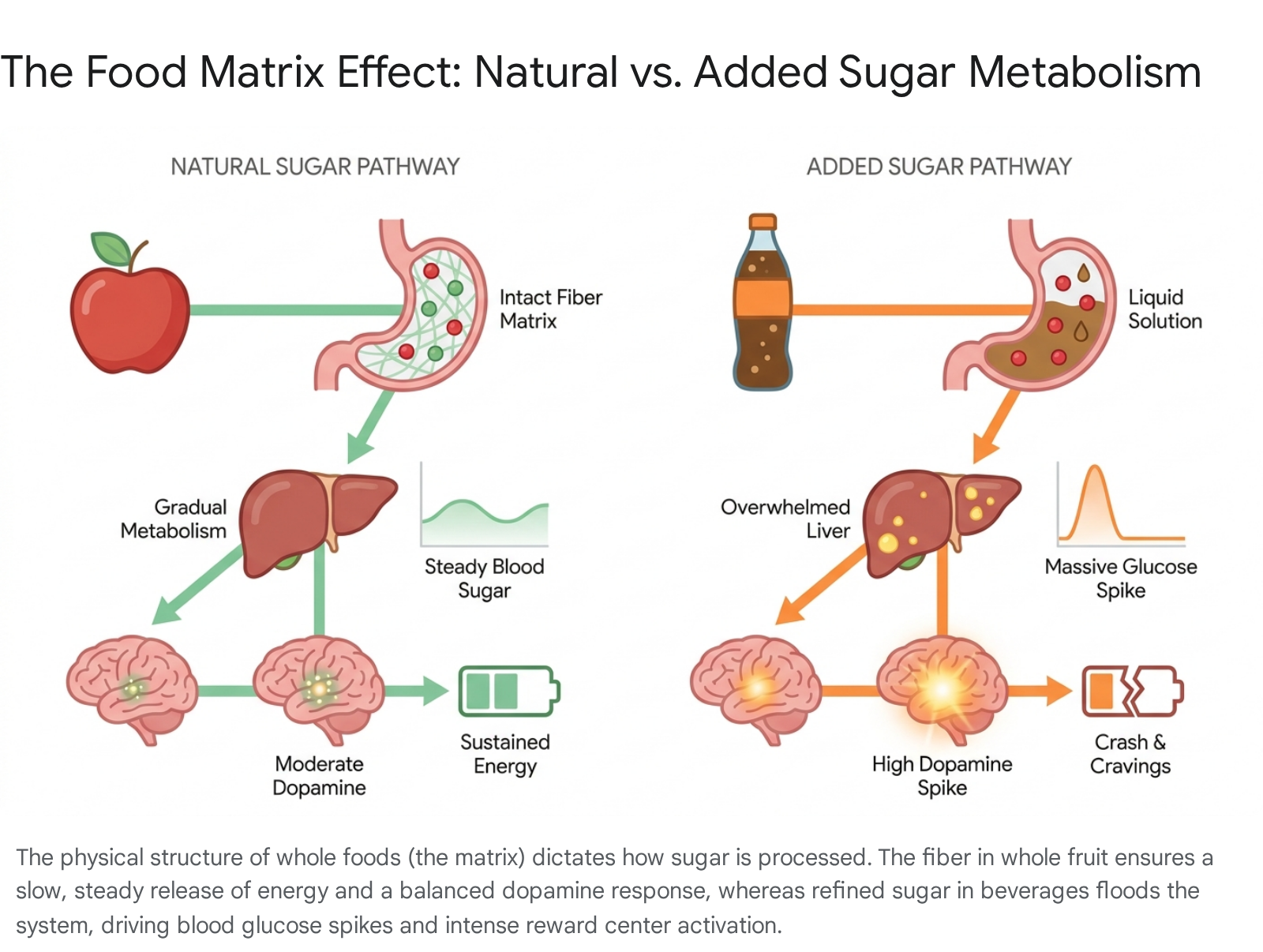
The following table summarizes the profound physiological differences between consuming sugar within its natural matrix versus as a refined, isolated additive.
| Physiological Feature | Natural Sugars (e.g., Whole Fruit) | Added/Refined Sugars (e.g., Soda, Candy) |
|---|---|---|
| Dietary Matrix & Structure | Encased in intact cellular walls; bound tightly with water, soluble and insoluble fiber, essential vitamins, minerals, and polyphenols 172122. | Extracted, purified, and isolated. Utterly lacks any structural fiber, complex macronutrients, or accompanying micronutrients 1721. |
| Digestion & Absorption Rate | Digestion is mechanically slowed by the fibrous matrix. Sugar is released gradually into the bloodstream over several hours, ensuring steady energy 21. | Rapidly absorbed directly through the intestinal wall, causing an immediate, steep spike in blood glucose and subsequent insulin surge 3942. |
| Hepatic (Liver) Load | The slow, metered release allows the liver to metabolize fructose efficiently into usable energy without becoming metabolically overwhelmed 39. | The sudden, massive influx overwhelms the liver's metabolic capacity, forcing it to convert excess fructose directly into visceral fat via de novo lipogenesis 39. |
| Satiety Signaling | High water and fiber content physically stretch the stomach walls, triggering the release of hormones like CCK and endogenous GLP-1 to signal robust fullness 2223. | Fails to trigger adequate stretch receptors or lower-gut satiety hormones. Liquid sugar, in particular, completely bypasses fullness cues, leading to passive overconsumption 42123. |
| Dopamine & Reward Response | Triggers a moderate, sustained dopamine release that is appropriate for evolutionary survival mechanisms and reinforcement learning 21. | Triggers an acute, intense dopamine spike, strongly activating the brain's reward centers and leading to subsequent intense cravings as blood sugar rapidly crashes 2142. |
| Long-Term Cardiometabolic Impact | Strongly associated with lower systemic inflammation, stabilized blood pressure, improved body mass, and overall metabolic health 22. | Directly correlated with the development of insulin resistance, neuroinflammation, obesity, fatty liver disease, type 2 diabetes, and cardiovascular mortality 17104224. |
Frequently Asked Questions: Separating Science from Myth
As the prevalence of metabolic disease has grown in tandem with UPF availability, so too has public anxiety regarding sugar. This anxiety has birthed a multitude of theories, diets, and classifications that often blur the line between rigorous physiological science and popular misconception.
FAQ 1: Is Sugar Actually Addictive?
The question of whether sugar is clinically addictive is a subject of intense and ongoing debate within the psychiatric, nutritional, and neurobiological communities. Currently, there is no unified consensus, as experts approach the data from differing diagnostic frameworks.
The Argument For Sugar Addiction: Proponents argue that sugar fits the behavioral and neurochemical profile of an addiction. Like recognized drugs of abuse, sugar strongly activates the brain's reward circuits, triggering the release of dopamine and endogenous opioids, which reinforces the compulsion to consume more 339242526. In animal models, rats subjected to intermittent access to sugar display behaviors that closely mirror substance abuse, including bingeing, tolerance, and neurochemical signs of withdrawal (such as anxiety and altered mu-opioid receptor states) 162647. Furthermore, researchers like psychologist Ashley Gearhardt suggest that the diagnostic criteria for addiction should be broadened to match frameworks used for tobacco. She points out that patients frequently exhibit an inability to control their intake of hyper-palatable foods despite severe, known health consequences (such as continuing to consume high-sugar foods after a type 2 diabetes diagnosis), which demonstrates a "compulsivity" that warrants classifying UPFs as addictive substances in manuals like the DSM 25.
The Argument Against Sugar Addiction: Conversely, many clinical psychiatrists and neuroscientists maintain that sugar does not meet the strict pharmacological or behavioral criteria for a drug of abuse. A central argument lies in the magnitude of the neurochemical response. While eating sugar increases dopamine levels to approximately 130% above baseline, illicit drugs like cocaine or methamphetamine hijack the circuitry far more violently, spiking dopamine levels by 300% to 1,000% above baseline 16362527. Researchers like Margaret Westwater point out that while sugar provides an immediate dopamine response due to sweet taste receptors on the tongue, it lacks the potent, delayed, and sustained pharmacological punch of narcotics 25. Finally, critics highlight that the "addiction-like" behaviors observed in rodents only occur under strict laboratory conditions of intermittent fasting and restricted access. When rodents are given ad libitum (free) access to sugar, these withdrawal and bingeing behaviors generally disappear, suggesting the compulsive response is driven by the stress of restriction rather than the pharmacological properties of the sugar itself 26. In humans, behaviors often measured by tools like the Yale Food Addiction Scale frequently overlap with binge eating disorders, making it difficult to isolate sugar as a uniquely addictive chemical 26.
Ultimately, while the psychiatric consensus has not officially classified sugar alongside cocaine or alcohol, experts universally agree that the modern food system's formulation of ultra-processed foods heavily exploits the brain's natural reward pathways, driving habitual, hard-to-break consumption patterns that produce severe physiological consequences 252628.
FAQ 2: Does Sugar Cause a "Sugar Rush" and Hyperactivity?
The belief that sugar causes a sudden "sugar rush" or induces hyperactivity in children is one of the most pervasive and resilient myths in modern parenting. The theory originated in the 1970s when cross-sectional observational studies noted a superficial correlation between hyperactive behaviors and high-sugar diets 2951. However, subsequent rigorous scientific investigation has entirely debunked this causal link.
A landmark 1995 meta-analysis published in the Journal of the American Medical Association (JAMA) analyzed data from 31 double-blind, placebo-controlled studies involving over 1,200 children 3031. The findings conclusively demonstrated that sugar does not affect the behavior or cognitive performance of children 293032. More recently, a comprehensive 2019 systematic review evaluating the acute effects of carbohydrates on mood found that carbohydrate administration is actually associated with higher levels of fatigue and decreased alertness within the first hour post-ingestion, directly contradicting the "rush" hypothesis 31.
If sugar does not cause hyperactivity, why do parents consistently observe it? The answer lies in environmental context and confirmation bias 32. Children typically consume large amounts of sugar during highly stimulating, chaotic events - birthday parties, holidays, and celebrations 32. It is the excitement of the environment, not the metabolic breakdown of sucrose, that drives the frenetic behavior. Furthermore, a fascinating challenge study on parental expectancies found that when mothers were falsely told their children had consumed a large amount of sugar (when they had actually received a placebo), the mothers subsequently rated their children's behavior as significantly more hyperactive, proving that the "sugar rush" exists primarily as a psychological expectation in the minds of the observers 30. Biochemically, sugar actually blunts the hypothalamic-pituitary-adrenal (HPA) axis - the brain's primary stress response system - meaning sugar is more likely to induce a mild physiological calming effect than a hyperactive one 32.
FAQ 3: Do Sugar Detoxes Actually Work?
The concept of a "sugar detox" implies that by completely abstaining from sugar for a set period (usually 10 to 30 days), an individual can flush "toxins" from their system, reset their palate, and cure their cravings forever 153334.
From a strict scientific and biochemical standpoint, the idea of dietary "detoxification" is a marketing term, not a biological mechanism. Toxins are continuously and efficiently removed from the body by the liver and kidneys regardless of one's specific diet; there is no evidence that restricting sugar accelerates this inherent physiological process 3334. Furthermore, European regulatory bodies have routinely rejected health claims surrounding commercial detox diets and supplements due to a profound lack of clinical evidence 33.
However, as a behavioral intervention, temporary abstinence from added sugar can have merit. Going "cold turkey" can quickly reduce overall caloric intake, leading to short-term weight loss (often initially from water weight due to glycogen depletion) and improved blood metabolic markers like triglycerides 1534. When an individual stops consuming hyper-palatable ultra-processed foods, their palate may eventually recalibrate, allowing them to perceive the natural sweetness in whole foods like fruit more acutely.
The profound danger of extreme sugar detoxes lies in their lack of sustainability. Strict restriction often triggers intense psychological deprivation. From a hormonal perspective, strict calorie and sugar limitations can lead to a rise in stress hormones, including cortisol, which actively stimulates a larger appetite and ultimately leads to weight regain over the long term 34. This creates a "rebound effect" of binge eating once the detox ends 47. While eliminating highly refined sugars is undoubtedly beneficial, nutritionists emphasize that the ultimate goal should be fostering a balanced, long-term relationship with food, rather than oscillating between strict abstinence and subsequent overconsumption 15.
FAQ 4: How Do Stress and Sleep Deprivation Trigger Cravings?
While diet composition is crucial, sugar cravings are heavily modulated by lifestyle factors - most notably, sleep duration and psychological stress. Sleep deprivation acts as a potent biological catalyst for weight gain and metabolic dysfunction by fundamentally altering the body's appetite-regulating hormones 5735.
In a healthy, rested state, the stomach releases the hormone ghrelin to signal hunger, while fat cells release leptin to signal fullness 3559. Chronic lack of restorative sleep (typically less than 7 hours per night) deeply disrupts this delicate balance. It increases ghrelin levels and decreases leptin levels, leaving the individual in a state of persistent, unmet physiological hunger, regardless of caloric intake 3559.
Beyond these basic homeostatic hunger hormones, sleep loss heavily impacts the endocannabinoid (eCB) system, the neural network responsible for regulating feeding, energy homeostasis, and reward. This is the exact same biological system targeted by the active ingredients in marijuana 573637. Clinical crossover studies have demonstrated that when healthy adults are restricted to 4.5 hours of sleep, blood levels of a specific endocannabinoid called 2-arachidonoylglycerol (2-AG) spike by 33% and remain elevated well into the evening, far beyond their normal midday peak 5737. This chemical signal actively amplifies the hedonic (pleasure-driven) aspect of eating 3637. Consequently, sleep-deprived individuals experience cravings that specifically target sweet, salty, and high-fat snacks, often consuming up to 50% more calories from junk food than they do when fully rested 575936.
Furthermore, sleep deprivation mimics a state of mild physiological stress, altering the secretion pattern of cortisol 3559. Sustained, elevated cortisol promotes insulin resistance and drives the brain to seek out fast-acting carbohydrates (sugar) to secure quick energy to combat the perceived environmental threat 3559.
The GLP-1 Revolution: Rewiring Brain Reward (2023+ Research)
The landscape of obesity management, addiction neurobiology, and craving regulation has been permanently altered by the advent of Glucagon-like peptide-1 (GLP-1) receptor agonists, such as semaglutide (Ozempic/Wegovy) and tirzepatide (Mounjaro/Zepbound) 6263.
Historically, GLP-1 medications were understood primarily as gastrointestinal and metabolic drugs. They mimic an endogenous hormone released by the gut after eating, which stimulates glucose-dependent insulin production, suppresses glucagon, and drastically slows gastric emptying, making individuals feel physically full for much longer 18626364.
However, groundbreaking neurobiological research from 2023 onward has revealed that GLP-1 drugs do far more than delay digestion; they fundamentally rewire the brain's reward circuitry at a cellular level, profoundly impacting psychological cravings for sugar, ultra-processed foods, and even addictive substances like alcohol 6263.
Targeting the Deep Brain and the Central Amygdala
Early assumptions were that large peptide-based GLP-1 drugs primarily targeted regions of the hypothalamus and hindbrain - areas responsible for basic, homeostatic, energy-driven hunger 3839. However, scientists funded by the National Institutes of Health (NIH) have recently mapped the neural pathways of next-generation oral small-molecule GLP-1 agonists (such as orforglipron and danuglipron) 3839. Utilizing advanced gene-editing techniques and brain mapping in mice, researchers discovered that these smaller molecules penetrate much deeper into the brain, triggering direct activity in the central amygdala 3839.
The central amygdala is a region heavily associated with emotional processing, fear, and deep-seated desire 38. Once activated by the GLP-1 drug, the central amygdala actively reduces the release of dopamine into the key hubs of the brain's reward circuitry 3839. This newly charted mechanism effectively dampens "hedonic feeding" - the compulsion to eat motivated purely by pleasure, stress, or sensory stimulation rather than biological energy demand 3839. Researchers are now investigating the intracellular activity inside these neurons, discovering that the weight-loss effects depend heavily on cyclic adenosine monophosphate (cAMP) signaling pathways, which helps explain why individual patient responses to the drug can vary 68.
Modulating Anticipatory vs. Consummatory Reward
Furthermore, research mapping the ventral tegmental area (VTA) - the epicenter of dopaminergic projection to the prefrontal cortex and nucleus accumbens - has elucidated how GLP-1 agonists separate the desire for sugar from the enjoyment of it 40.
Studies utilizing Pavlovian sucrose paradigms demonstrate that GLP-1 agonists actively decrease anticipatory reward (the intense craving, anticipation of relief, or cue-driven urge to seek out sugar) 40. Peripherally administered GLP-1 acts via the nucleus tractus solitarius (NTS), which projects GLP-1 secreting neurons to GABA neurons in the VTA. These GABA neurons then actively suppress the dopamine surges that normally compel excessive reward-seeking behavior 40. Fascinatingly, while it blunts the anticipatory craving phase, semaglutide appears to enhance VTA dopamine signaling during the consummatory phase (the actual eating of the food) 40. This results in a clinical paradigm where the patient no longer obsessively fixates on acquiring sweets, yet requires significantly less food to feel thoroughly satisfied and rewarded when they finally do eat 40.
Practical Takeaways for Managing Cravings
While pharmaceutical interventions are revolutionizing the treatment of obesity and metabolic syndrome, mitigating sugar cravings at the individual level still relies on fundamental physiological principles. Whether a patient is currently utilizing a GLP-1 medication or managing cravings through lifestyle modifications alone, specific, evidence-based strategies can naturally regulate the brain-gut axis and dampen hedonic eating.
1. Leverage Protein to Blunt Glucose Excursions and Stimulate Incretins Dietary protein is universally recognized as the most satiating macronutrient and acts as a powerful biological counterbalance to sugar cravings 1770. High-protein intake (such as whey, collagen, chicken, or legumes) inherently stimulates the body's natural release of endogenous GLP-1, gastric inhibitory polypeptide (GIP), and cholecystokinin (CCK) - the exact hormones that delay gastric emptying and signal profound satiety to the brain 17. Structuring meals around a robust protein source ensures that blood glucose levels remain highly stable, preventing the sharp peaks and subsequent hypoglycemic crashes that trigger urgent, panic-driven cravings for refined carbohydrates 176264. For individuals actively taking pharmaceutical GLP-1s, maintaining a moderately high protein diet (1.0 - 1.3 g/kg body weight/day) is non-negotiable to preserve lean skeletal muscle mass, which is often severely compromised during rapid weight loss 17626470.
2. Maximize Soluble, Prebiotic, and Resistant Fibers Dietary fiber forms the physical matrix that slows sugar absorption, but its biochemical benefits extend far deeper into metabolic health 177172. Soluble and prebiotic fibers (found in beans, oats, acacia, and chicory root) and resistant starches resist digestion in the upper gastrointestinal tract and ferment in the colon 707241. This fermentation process feeds the gut microbiota, which in turn produce short-chain fatty acids (SCFAs) like acetate, propionate, and butyrate 1772. These SCFAs cross the gut barrier and actively stimulate further endogenous GLP-1 secretion from intestinal L-cells, providing long-lasting appetite suppression that extends for hours after a meal 177241. Incorporating 25 to 30 grams of fiber daily is crucial for stabilizing blood sugar, promoting mechanical fullness, and mitigating the gastrointestinal side effects (like constipation) frequently associated with GLP-1 therapies 1762.
3. Prioritize Restorative Sleep Hygiene Because sleep deprivation actively raises the hunger hormone ghrelin, lowers the satiety hormone leptin, and violently spikes the endocannabinoids (2-AG) that drive junk-food cravings, optimizing sleep hygiene is a primary, foundational defense against sugar dependence 35593637. Ensuring 7.5 to 8.5 hours of uninterrupted sleep per night regulates the HPA axis, lowers daytime cortisol secretion patterns, and improves cellular insulin sensitivity 573559. This hormonal stabilization reduces the physiological stress signals that trick the brain into demanding fast-acting sugars for artificial energy, allowing the individual to make rational, rather than compulsion-driven, dietary choices 3559.
The Bottom Line
The human craving for sugar is not a manifestation of weak willpower or moral failing, but a highly predictable response of ancient evolutionary neurobiology clashing with a meticulously engineered, modern obesogenic environment. Driven by ancient survival mechanisms like sensory-specific satiety and powerful dopamine-mediated reward loops, our brains are exceptionally vulnerable to the bliss points of ultra-processed foods that strip away the protective matrix of natural fiber. While scientific controversies remain regarding whether sugar meets the strict pharmacological definition of an addictive drug, the severe physiological consequences of dopamine down-regulation, blood glucose volatility, and sleep-induced hormonal imbalances are undeniable. However, by understanding these complex neural pathways, individuals can leverage high-protein, high-fiber dietary structures and proper sleep hygiene to stabilize their neurochemistry naturally. Concurrently, emerging GLP-1 therapies are demonstrating unprecedented efficacy in penetrating deep-brain reward centers to recalibrate anticipatory desire, offering a powerful, revolutionary new tool in the global fight against metabolic disease and hedonic overconsumption.