
Why Emotions Make Online Content Go Viral
The phenomenon of viral sharing is not a product of random luck or purely serendipitous cultural resonance, but rather a predictable physiological response to content explicitly engineered to trigger "high-arousal" emotions - such as anger, awe, or anxiety - that forcefully activate the human nervous system. Modern social media algorithms on platforms like TikTok and X systematically weaponize these high-arousal states by prioritizing content that sustains maximal physiological engagement, effectively transforming involuntary emotional contagion into the foundational architecture of the global digital economy.
The scenario is universally familiar and highly recognizable in daily life: a smartphone notification illuminates, presenting the user with an infuriating political diatribe, a jaw-dropping physical stunt, or a deeply anxiety-inducing breaking news alert. Within seconds, often before deliberate, conscious, higher-order cognitive processing can even occur, the user instinctively forwards the post to a group chat or reshares it to their own timeline. This reflexive action - the sheer inability to resist distributing content that spikes the heart rate - is the lifeblood of the modern internet. For the general reader, understanding this mechanism requires looking past the specific topics or ideologies presented in the content itself, and instead examining the visceral, physiological reactions the content provokes. We do not share simply because a piece of information is interesting, nor do we share because the news is overwhelmingly positive. We share because the digital content has been algorithmically optimized to hijack our central nervous systems, compelling an immediate, action-oriented behavioral response to relieve internal tension 12.
What exactly is high-arousal emotion?
To understand why certain digital stimuli compel an involuntary share, it is essential to dismantle the psychological architecture of human affect. In the behavioral sciences, psychology, and affective computing, emotions are not merely categorized by simplistic binary labels such as "good" or "bad." Instead, they are mapped using the circumplex model of affect, a foundational psychological framework that plots emotional states along two continuous, intersecting axes: valence and arousal 32.
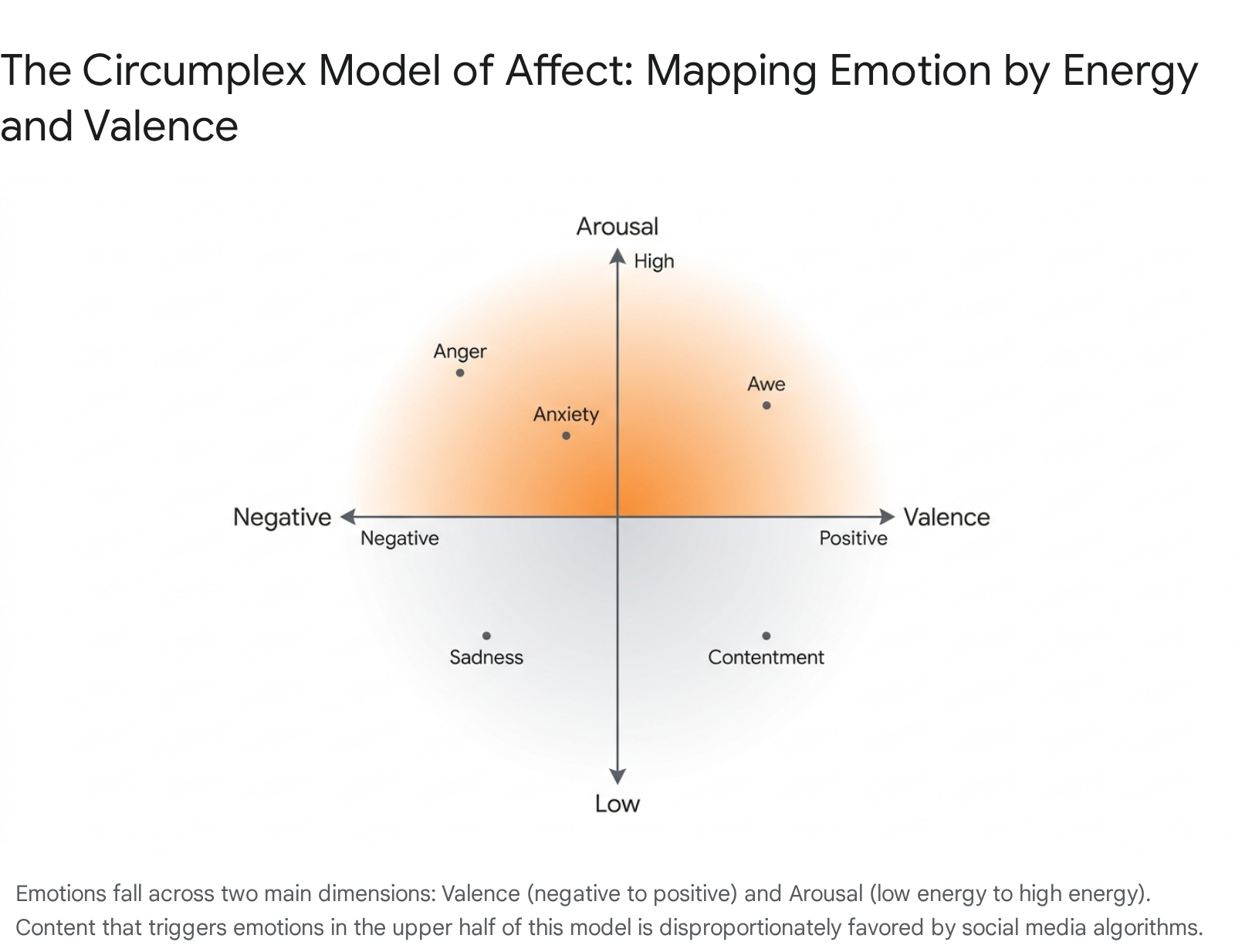
Valence refers to the intrinsic positivity or negativity of an emotional experience. Happiness, joy, and love possess a positive valence, while sadness, fear, and anger possess a negative valence 323. However, decades of media psychology research have demonstrated that valence alone is entirely insufficient to predict human behavior or interaction with a stimulus. The critical second dimension is arousal, which dictates the level of physiological and psychological activation an emotion induces within the human body 34. Arousal is the measurable difference between a resting, baseline heart rate and the sudden, explosive rush of adrenaline and cortisol.
Low-arousal emotions are fundamental states of biological deactivation. Contentment (which features a positive valence paired with low arousal) and sadness (which features a negative valence paired with low arousal) instruct the body to power down, conserve energy, reflect inward, or socially withdraw 33. Because these emotions deactivate the nervous system, they do not inherently prompt physical action. High-arousal emotions, conversely, are states of extreme physiological activation. Awe (positive valence, high arousal), anxiety (negative valence, high arousal), and anger (negative valence, high arousal) flood the nervous system with excitatory neurotransmitters 14. They dilate the pupils, increase the respiratory rate, and prepare the musculoskeletal system for immediate physical exertion.
In the context of digital engagement, this deep-seated biological activation is harnessed within the Stimulus-Organism-Response (S-O-R) framework 45. The digital post, image, or video serves as the external stimulus; the user's sudden emotional arousal serves as the internal, mediating organismic mechanism; and the subsequent share, like, or angry comment serves as the external behavioral response 45. High-arousal stimuli effectively bypass deliberate, prefrontal cognitive processing, prompting an automatic behavioral response engineered by evolution 4. When an individual encounters a high-definition video of an extreme sports stunt (triggering awe) or a highly polarizing, context-free political quote (triggering anger), their nervous system demands a release for that abruptly built-up energy. In the physical world, this might result in a shout or a sudden movement. In the digital environment, sharing the content provides that necessary, immediate psychological relief, successfully discharging the arousal back into the social network.
The Foundational Science: Berger & Milkman's Virality Code
For years, digital marketing, journalism, and early social media creation were guided by two pervasive, highly influential misconceptions. The first misconception was that viral success is entirely a matter of random, unpredictable luck - a lightning strike of cultural zeitgeist that cannot be reverse-engineered. The second misconception was that "positive news always performs best," stemming from a generalized assumption that people inherently want to consume and distribute uplifting narratives. Both of these widely held assumptions were fundamentally dismantled by Jonah Berger and Katherine Milkman's foundational 2012 study, which meticulously analyzed the discrete emotional drivers behind the most-emailed articles in The New York Times 13.
Berger and Milkman demonstrated conclusively that virality is not a chaotic lottery, nor is it strictly governed by the positivity or negativity of the content. Instead, the primary determining factor for whether a piece of digital content spreads rapidly across a network is the specific level of physiological arousal it provokes within the reader 13. While it is generally true that positive content tends to outperform negative content in broad, aggregate analyses, this superficial rule completely shatters when arousal levels are properly isolated and introduced into the econometric equation. A piece of high-arousal negative content (such as a story inducing profound anger or righteous indignation) will vastly and consistently outperform a piece of low-arousal positive content (such as a story inducing quiet, passive contentment) 12.
The primary regression analysis from their landmark study provided undeniable, quantifiable evidence of this physiological phenomenon. The data definitively revealed that emotions characterized by high arousal, completely regardless of whether their valence was positive or negative, drastically increased an article's statistical likelihood of going viral. Conversely, emotions characterized by low arousal actively and predictably suppressed the likelihood of an article being shared across the network 1.
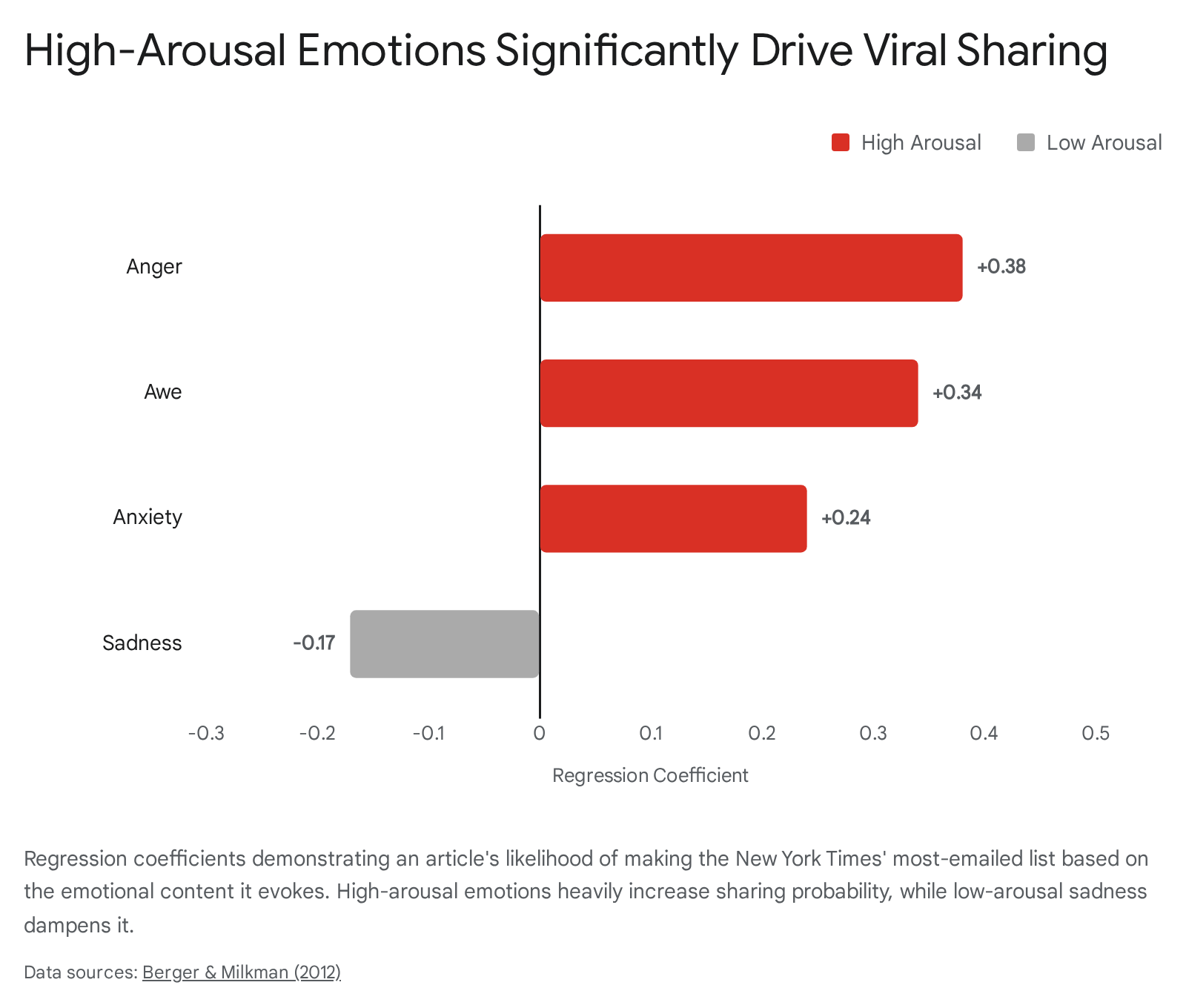
| Emotion Classification | Valence | Arousal Level | Impact on Sharing (Regression Coefficient) | Behavioral Outcome |
|---|---|---|---|---|
| Anger | Negative | High Arousal | +0.38* | Highly accelerates sharing |
| Awe | Positive | High Arousal | +0.34* | Highly accelerates sharing |
| Anxiety | Negative | High Arousal | +0.24* | Accelerates sharing |
| Sadness | Negative | Low Arousal | -0.17* | Dampens/suppresses sharing |
(Data derived from the primary regression specification, Model 4, of Berger & Milkman's 2012 content characteristics analysis. Higher positive coefficients indicate a significantly greater likelihood of making the most-emailed list, whereas negative coefficients indicate a reduction in sharing probability) 1.
This foundational data illustrates a profound, somewhat counterintuitive reality about the structural nature of human communication networks. Sadness makes us pause, grieve, and reflect inward; it halts the forward flow of information, acting as an algorithmic dead-end 12. Anger and awe force us to act externally, serving as the raw biological accelerants that power the velocity of the digital age.
Why does anger spread faster than sadness?
The biological mandate of anger is fundamentally distinct from that of sadness, and understanding this evolutionary divergence is key to understanding network virality. Evolutionary psychology posits that anger developed specifically as a mechanism for immediate self-preservation, threat neutralization, and the rapid enforcement of social norms. When an individual encounters a perceived threat, a moral violation, or a stark injustice, the resulting emotion of anger directly triggers the sympathetic nervous system. Blood pressure rises, cognitive focus sharply narrows onto the perceived target, and the body prepares for a high-intensity "fight" response 4. In a modern, screen-mediated context, where physical altercations are impossible, this intense biological fight response is sublimated into the aggressive act of clicking, typing a furious, capitalized comment, and rapidly sharing the offending content to alert one's broader social tribe of the encroaching threat.
Sadness, conversely, is an evolutionary signal explicitly designed for withdrawal, energy conservation, and psychological recovery. It is characterized by low physiological activation and a dampening of the nervous system 3. When a user encounters a genuinely depressing, nuanced, or deeply tragic news story without a clear, easily identifiable villain to blame, the cognitive load heavily encourages passive processing. The user may feel profound, lingering empathy, but they lack the energetic, neurochemical push required to actively distribute the content to others 13.
Furthermore, anger benefits immensely from self-reinforcing, algorithmic social cycles 6. When users share outrage-inducing material, they actively seek validation, solidarity, and agreement from their immediate network. If peers validate this anger by liking, retweeting, or echoing the outrage in the comments, the original user experiences a powerful dopamine reward, firmly cementing the aggressive sharing behavior as a socially beneficial act 6. This creates a potent, self-sustaining dynamic where anger not only spreads significantly faster but persists far longer in the digital ecosystem than other emotions. Each subsequent share re-ignites the emotional baseline of the network, continually sustaining the suppressing effect of negative sentiment until external factors finally weaken the collective emotional intensity 26.
How does the e612 contagion work?
In advanced discussions surrounding the rapid transmission of affect and behavior in digital spaces, researchers frequently reference the mechanisms underlying the "e612 contagion." To clarify this concept, it is necessary to trace its origins in epidemiological modeling. The marker "e612" historically originates as a prominent citation index - most notably identifying a highly influential 2020 public health study published in The Lancet Public Health (Volume 5, Issue 11, pages e612-e623) which detailed the massive-scale behavioral responses, societal lockdowns, and non-pharmaceutical interventions utilized during the COVID-19 pandemic in New Zealand 78912. This landmark paper meticulously modeled how behavioral adherence (or the lack thereof) rippled through a population, dictating the spread of a pathogen.
In the ensuing years, sociologists, network scientists, and digital psychologists adopted the exact same sophisticated epidemiological compartmental models (such as SIR: Susceptible, Infectious, Recovered) used in the e612 literature to explain how emotions - rather than physical viruses - spread like a highly transmissible pathogen through a population's digital interactions 101411. In this digital epidemiological framework, a high-arousal post acts as the primary contagion; the user who creates or first shares the post is the "infectious" index case; and the followers who view the post are the "susceptible" population 14.
Scientifically, this mechanism of digital affective transfer is governed heavily by the Emotions as Social Information (EASI) theory 416. The EASI framework postulates that emotional expressions embedded in text, video, or even subtle emojis do not merely reflect an individual's isolated internal state; they act as highly potent, infectious social signals that trigger reciprocal, mimicking reactions in observers 4. When an individual encounters a high-arousal post, the brain's mirror neuron system automatically and involuntarily simulates the observed emotion 412. This phenomenon is formally known in psychological literature as "automatic mimicry" or "digital emotional contagion" 1213.
Digital emotional contagion operates through two primary, concurrent pathways. The first is the affective reaction pathway, an automatic, subconscious physiological resonance where the viewer literally "catches" the emotion of the content creator merely by observing their facial expressions, tone of voice, or aggressive use of language. The second is the inferential pathway, a slightly more deliberate cognitive process where the viewer interprets the high-arousal display as a critical signal of urgency, threat, or importance, which logically compels them to act in solidarity 4. Because social media provides a relentless, high-volume stream of these emotional cues, the e612-style contagion effect creates a continuous, unbroken feedback loop. Users are not just passively consuming information; their baseline physiological states are constantly being calibrated and manipulated by the fluctuating arousal levels of the content traversing their feeds 1314.
Algorithmic Weaponization in 2024-2025: TikTok, X, and the Outrage Machine
While Berger and Milkman's 2012 research documented how high-arousal emotions naturally and organically drive human sharing behavior, the technological landscape has radically and fundamentally shifted in the 2024 - 2025 era. Social media platforms no longer merely passively host this psychological phenomenon; their underlying social media recommendation algorithms (SMRAs) have been explicitly, mathematically trained to amplify, optimize, and weaponize it 22015.
On platforms heavily driven by short-form video, such as TikTok, the algorithm is ruthlessly efficient at detecting, quantifying, and rewarding high-arousal states. In the 2025 iteration of its architecture, TikTok's recommendation engine evaluates content based on granular micro-interactions - specifically prioritizing watch time, video completion rate, and rapid, successive replays above nearly all other metrics 23. The algorithm operates on a highly sophisticated "micro-niche push" strategy, initially testing a newly uploaded video with a tightly targeted, highly relevant cluster of users 24. If the content triggers an immediate spike in physiological arousal - manifesting behaviorally as a user freezing their scroll to watch a video to absolute completion, immediately allowing it to loop and re-watch it, or rapidly navigating to the comment section to engage in a heated debate - the algorithm instantly identifies the content as highly "valuable" and blasts it to an exponentially wider audience 23.
This creates an incredibly volatile digital environment where nuance is actively penalized by the code, and extreme emotional arousal is the mandatory entry fee for visibility. Recent 2024-2025 peer-reviewed studies applying Arousal Level Theory to TikTok's recommendation algorithms demonstrate the profound psychological toll this takes. For instance, a structural equation modeling study analyzing Generation Z in Ho Chi Minh City found that the platform's personalized content delivery has a statistically massive, direct impact on inducing user arousal (β = 0.533, p < 0.001), which acts as a primary mediator shaping the youth's overall perception of their mental well-being 20. The platform's machine learning models effectively map the precise emotional triggers of an individual user, subsequently feeding them a continuous, endlessly escalating diet of high-arousal stimuli designed specifically to prevent them from closing the application, regardless of the long-term psychological fatigue it induces 2016. Major institutions, including multi-institutional research teams led by Georgia Tech, are currently utilizing AI to simulate these very video feeds in order to audit the "consumption rabbit holes" and negative exposures these algorithms actively construct for adolescents 17.
On X (formerly Twitter), the core architecture of the recommendation algorithm is explicitly and unapologetically designed as an "outrage machine" 2. The default predictive timeline ranks content almost entirely by its demonstrated ability to generate social friction and polarizing debate. Internal platform analyses and leaked documentation have consistently shown over the past several years that emotionally charged material - specifically fear-based political claims and outrage-inducing video clips - generates between two to five times more total engagement than neutral, objective posts 27. Content creators, pundits, and media organizations quickly adapt to these systemic financial and social incentives, structurally shaping their news headlines into highly optimized "outrage daggers" designed to pierce through the informational noise and trigger an immediate, angry response 28.
A highly visible, real-world example of this algorithmic weaponization occurred during the viral 2025 Jubilee "Surrounded" debates, where self-identified extreme conservatives and openly fascist participants faced off against ideological opponents 2. The structure of the video content was not designed in good faith to foster intellectual resolution, mutual understanding, or meaningful political discourse; it was engineered explicitly from the ground up as "rage bait." The platform algorithms predictably rewarded the escalating tension, the aggressive posturing, and the most extreme statements, ensuring that out-of-context clips of the most inflammatory, high-arousal moments completely dominated global algorithmic feeds for weeks 2. The creators are incentivized to platform extremist ideology simply because it is the most efficient fuel for the algorithmic engine. By ruthlessly prioritizing engagement-driven metrics above all other considerations, these platforms industrialize outrage, actively silencing marginalized, moderate, or nuanced perspectives in favor of whatever polarizing content can most efficiently spike the collective heart rate 15. This algorithmic bias is not limited to domestic squabbles; it profoundly influences global geopolitics, deeply affecting narrative legitimacy and public perception regarding ongoing, deadly conflicts in regions such as Ukraine, Palestine, and Kashmir by elevating the most sensationalist, polarizing viewpoints 15.
Beyond the West: Does this hold true globally? (WeChat, LINE, and Regional Nuance)
A critical, often overlooked flaw in much of the academic and popular discourse surrounding digital virality is a pronounced Western-centric bias. There is a pervasive, underlying assumption that the outrage-driven, highly individualistic mechanics of platforms like X, Facebook, or Western TikTok apply universally across all global cultures and network topologies. However, recent large-scale network science and sociological research investigating non-Western platforms reveals a far more complex, culturally nuanced, and highly regulated reality regarding the mechanisms of emotional contagion.
On WeChat, China's dominant super-app, the fundamental mechanics of high-arousal sharing operate under entirely different social constraints and network structures 2918. A comprehensive 2024-2025 econometric analysis studying the diffusion of 387,000 news articles and mapping the sharing paths of over six million WeChat users completely upended Western expectations of how discrete emotions drive information diffusion in this distinct digital ecosystem 2918. The findings challenged standard paradigms: while high-arousal emotions absolutely still drove engagement and virality, the specific type of high-arousal emotion mattered immensely.
On WeChat, content expressing high-arousal anxiety, love, or surprise reliably traveled the furthest, reached a significantly higher number of unique individuals, and formed deeper, broader viral cascades 2918. Astoundingly, anger - the undisputed, tyrannical king of Western algorithmic feeds - actually dampened the propagation of content on WeChat, as did sadness and extreme joy 2918.
This stark deviation occurs primarily because WeChat's most vital sharing channels (direct group messaging and the Moments newsfeed) operate fundamentally as strong-tie, closed networks deeply rooted in a more collectivist cultural framework that highly prioritizes social harmony 1819. In such tight-knit digital environments, the social cost of expressing aggressive, disruptive anger is prohibitively high. Users intuitively understand that injecting raw outrage into a closed network of close peers, family members, and professional colleagues risks severely damaging social cohesion and individual reputation 29. Instead, sharing information framed around "constructive uncertainty" (anxiety regarding the future or health) and prosocial appreciation (love and gratitude) serve as far more culturally acceptable, yet still highly activating, arousal triggers for group sharing 2918.
Similarly, research into online brand communities (OBCs) and digital marketing on platforms like LINE and various regional Asian forums highlights how emotional volatility is carefully monitored and regulated by users 432. In these specific digital spaces, the EASI framework demonstrates that emotional contagion is highly localized and subject to rapid decay. When a focal firm, an influencer, or a live-streamer exhibits high language arousal (such as extreme enthusiasm or passion), it can successfully drive intense, short-term engagement, tipping, and gifting behaviors through rapid affective resonance 432. However, these studies note a distinct ceiling effect: if the arousal level crosses a specific, culturally determined threshold and becomes overly intense, the inferential pathway of the EASI model dominates. Viewers suddenly transition from subconsciously mimicking the emotion to consciously interpreting the high arousal as overly strategic, manipulative, or unnecessarily aggressive 4. This immediately provokes skepticism and reactance, leading to a sharp, sudden drop in engagement, particularly when monetary commitment is involved 4. These cross-cultural findings underscore a critical reality: while the basic physiological mechanism of emotional arousal is a universal human trait, the behavioral expression of that arousal - whether it results in a viral share, a monetary tip, or a quietly suppressed post - is deeply and irrevocably mediated by platform architecture, the strength of the social ties, and localized cultural norms regarding emotional display.
Practical Takeaways: Reclaiming Digital Autonomy
Understanding the deep underlying mechanics of emotional contagion is the mandatory first step toward reclaiming digital autonomy in an era of industrialized outrage. As technology platforms increasingly deploy highly sophisticated, AI-driven recommendation engines specifically engineered to maximize physiological arousal, users must develop specific, actionable strategies to recognize, interrupt, and mitigate this algorithmic manipulation 33.
The most vital defense mechanism is learning to recognize the physiological spike before the cognitive response occurs. Algorithmic manipulation is quite literally felt in the physical body before it fully registers in the conscious mind. If interacting with a piece of digital content causes an immediate, involuntary physical reaction - such as a suddenly tightened chest, a noticeably quickened pulse, a clenching of the jaw, or a sudden flush of heat - it is highly probable that the content was explicitly engineered to bypass logical reasoning and trigger a high-arousal state 433. Recognizing this somatic, bodily response is the strongest, most immediate defense against involuntary sharing. It serves as an internal alarm bell signaling that the nervous system is currently under external influence.
Once that physiological spike is recognized, users must implement intentional friction to disrupt the algorithmic loop. High-arousal content relies entirely on speed and momentum. The entire UX/UI design of platforms like TikTok or X encourages frictionless, immediate, unthinking reactions 1734. By deliberately inserting a temporal delay - such as physically putting the phone down or closing the application for ten minutes before deciding whether to retweet a provocative post or forward an alarming video - the physiological arousal is given the necessary time to naturally dissipate. Operationalizing this "distress tolerance" allows the nervous system to return to a baseline, low-arousal state 33. Once that biological baseline is restored, the intense, overwhelming compulsion to share the content frequently vanishes entirely, revealing the urge as a temporary biological manipulation rather than a genuine desire to communicate.
Furthermore, users must begin to actively interrogate the motivation to share content within their networks. Before forwarding an anxiety-inducing alert or an infuriating political video to a private group chat, individuals should pause to interrogate the precise emotional transaction taking place 33. Is the primary goal to distribute vital, highly actionable information that will objectively benefit the recipients, or is it an unconscious, reflexive attempt to relieve one's own internal emotional tension by offloading the high arousal onto peers? Reframing this dynamic helps prevent users from unwittingly serving as unpaid, highly efficient distribution nodes in a corporate outrage economy 235.
Finally, maintaining digital autonomy requires users to actively audit their algorithmic inputs. Recommendation algorithms are highly responsive to even the most minute micro-interactions 23. Engaging with highly engineered rage-bait - even if the engagement is merely leaving a dissenting comment or watching the video multiple times out of sheer disbelief - sends a clear, undeniable signal to the platform's machine learning models that the content successfully captured human attention 2324. To effectively starve the outrage machine, users must practice strict, uncompromising digital discipline: ruthlessly scrolling past high-arousal negative content without pausing, without liking, and without commenting. This is the only method to actively train the recommendation engine that such manipulative, arousal-dependent tactics are entirely ineffective at capturing your attention 3320.
Bottom line
The viral spread of digital content is not a phenomenon of random chance, nor is it driven purely by the inherent positivity of the messaging. It is the direct result of a highly precise biological mechanism: the triggering of high-arousal emotions - specifically anger, anxiety, and awe - that hijack the nervous system and demand immediate physiological action in the form of sharing. While foundational psychological research initially proved that these high-energy states naturally accelerate human sharing behavior, modern social media platforms like TikTok and X have subsequently optimized their recommendation algorithms to actively weaponize this vulnerability, industrializing global outrage to maximize user retention and advertising revenue. However, this dynamic is not uniform globally; on culturally distinct, strong-tie platforms like WeChat, the social risks associated with displaying aggressive anger actually dampen its spread, favoring anxiety and prosocial arousal instead. By deeply understanding the physiological, epidemiological, and algorithmic architecture of this digital contagion, individuals can recognize precisely when their nervous systems are being manipulated by code, allowing them to consciously insert friction and successfully break the cycle of involuntary sharing.