
Online dissemination of conspiracy theories and corrections
Introduction
The digital information ecosystem has structurally transformed the mechanisms through which society creates, consumes, and disseminates knowledge. Within this environment, the proliferation of conspiracy theories - narratives that explain significant events as the secret plots of powerful, malevolent actors - has emerged as a severe systemic risk. These narratives do not merely represent fringe epistemological deviations; they pose measurable threats to public health, democratic integrity, and social cohesion 12. In recent years, entities such as the World Economic Forum have classified massive digital misinformation as a top global risk, emphasizing that a false rumor spreading virally through social networks can inflict devastating impacts before traditional corrections can take effect 23.
A central challenge for network scientists, psychologists, and platform regulators is the empirical phenomenon known as the "virality gap" - the observation that false information, including conspiracy theories, systematically outperforms factual corrections in speed, reach, and depth of diffusion 454. To understand why conspiracy theories propagate more successfully than factual corrections, research must examine the intersection of structural network dynamics, human psychology, and algorithmic curation. The spread of these narratives is a predictable outcome of socio-technical systems designed to maximize user engagement through personalization, emotional resonance, and algorithmic amplification.
This report provides an exhaustive analysis of the mechanisms driving the spread of online conspiracy theories. It examines the structural metrics used to quantify virality, the specific architectural features of dominant social media platforms, the behavioral profiles of the human agents who drive the majority of dissemination, the emerging role of generative artificial intelligence, and the efficacy of current mitigation strategies.
Quantitative Metrics of Information Cascades
Differential Spread of Truth and Falsehood
The foundational understanding of how truth and falsehood diffuse differently online relies on large-scale, longitudinal network analyses. The most prominent of these investigations was conducted by researchers at the Massachusetts Institute of Technology, who analyzed approximately 126,000 rumor cascades on Twitter (now X) spanning from 2006 to 2017 5678. A cascade is defined as an instance of a rumor spreading pattern that exhibits an unbroken retweet chain with a common, singular origin 56. By classifying news as true or false based on high-consensus evaluations from six independent fact-checking organizations - including Snopes, PolitiFact, and FactCheck.org - the researchers mapped the trajectory of 4.5 million retweets involving 3 million unique users 579.
The findings from this dataset definitively established the parameters of the virality gap: falsehood diffuses significantly farther, faster, deeper, and more broadly than the truth in all categories of information 48. Quantitatively, false news stories were found to be 70% more likely to be retweeted than true stories 68. The temporal advantage of false information is equally stark. It takes factual information approximately six times as long as falsehood to reach 1,500 people, and twenty times as long to reach a cascade depth of ten 489.
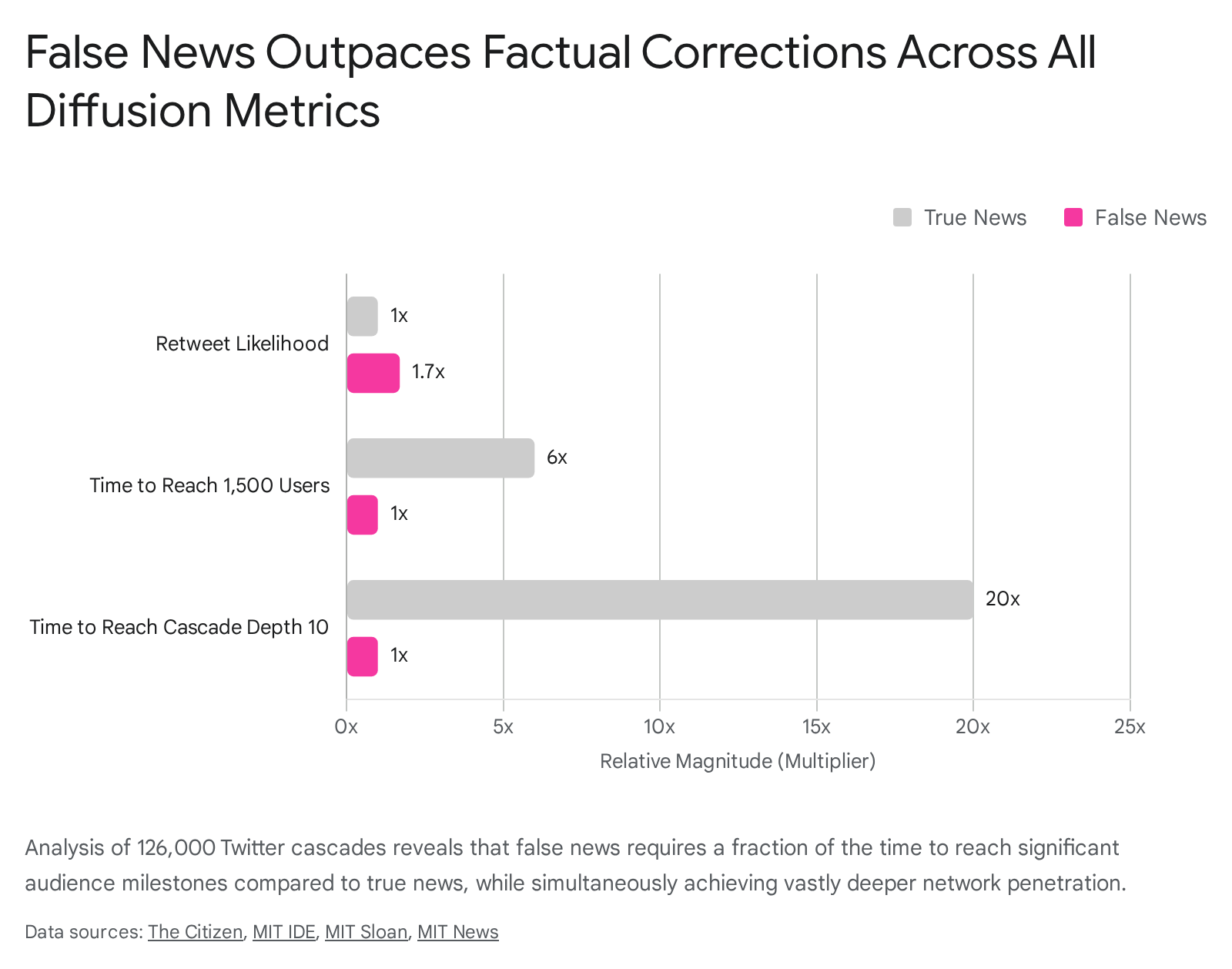
Furthermore, while factual news rarely diffuses beyond a depth of ten retweets, the top 1% of false news cascades routinely reach depths of 19 or greater, accumulating audiences ranging from 1,000 to 100,000 people 459.
This effect is particularly pronounced in the political domain. False political news travels deeper and more broadly, reaches more people, and exhibits higher virality than false news concerning terrorism, natural disasters, science, or financial information 69. Political falsehoods can reach audiences of 20,000 people nearly three times faster than all other categories of false news can reach 10,000 people 9.
Network Structural Virality and the Wiener Index
To fully comprehend the spread of conspiracy theories, network scientists employ specialized metrics to characterize the topology of information cascades. Beyond basic measurements of size (total retweets), depth (the longest path from the origin node), and maximum breadth (the highest number of nodes at the same distance from the root), the concept of "structural virality" is vital 3510.
Structural virality quantifies the difference between broadcast and viral diffusion patterns 11. It relies heavily on the Wiener index, defined mathematically as the average shortest path distance between all pairs of nodes in a network 141216. In broadcast diffusion, structural virality is low. The cascade shape resembles a star graph, where a single, highly followed node (such as a major news outlet or government agency) broadcasts to thousands of followers who do not share it further, keeping the average distance between any two nodes very small 1011. Conversely, in viral diffusion, structural virality assumes a high value. The cascade resembles a deep, multi-generational branching tree 11. The message gains popularity through peer-to-peer transmission over multiple generations, with any single individual responsible for only a fraction of the total adoption 1011.
Empirical data consistently shows that false rumors are characterized by cascades of larger size, longer lifetime, and significantly higher structural virality than true rumors 13. For instance, one study found the average cascade lifetime for false rumors was 149.61 hours, compared to 71.62 hours for true rumors 13. Because conspiracy theories capitalize on psychological vulnerabilities, their spread is much deeper and more peer-driven, distancing the original publisher from the ultimate consumer and making the spread exponentially more difficult to trace and control 11.
Advanced temporal tracking on datasets like ReCOVery and PolitiFact further demonstrates that fake news exhibits higher network modularity and temporal stability 14. This indicates that the sub-communities propagating conspiracy theories form tighter, more stable echo chambers over time compared to the transient communities that share factual corrections 14.
Methodological Critiques and Cascade Size Dependencies
While the narrative that falsehoods inherently spread faster than the truth is widely accepted, recent methodological critiques highlight necessary calibrations in how these metrics are interpreted. An important dynamic to consider is the tight mathematical dependency between the structural features of cascades and their overall size 3.
Subsequent research modeling classical diffusion processes has demonstrated that many structural features of cascades co-vary significantly with the total number of users reached 3. A 2021 study published in the Proceedings of the National Academy of Sciences utilizing advanced size-matching techniques found that when controlling for the overall size of a cascade, the differences in depth, maximum breadth, structural virality, and speed between false and true news cascades largely disappeared 3.
This finding suggests that while false-news and true-news cascades are structurally distinguishable in raw observational data, those structural differences may be explained almost entirely by a one-dimensional difference in infectiousness 3. Put simply, conspiracy theories do not necessarily spread through a structurally unique physical mechanism; rather, they are simply much more infectious to human users, leading to larger cascades, which inherently possess higher depth and structural virality due to their massive scale 3.
Furthermore, emerging studies in 2024 and 2025 have analyzed "mixed-flag" cascades - content that combines false textual narratives with highly engaging multimedia, such as AI-generated imagery. These mixed-flag cascades dramatically outperform pure text misinformation. In recent measurements, mixed-flag cascades achieved a mean cascade size of 26.96, a depth of 25.96, and a structural virality of 7.14, compared to pure textual misinformation cascades, which averaged a size of 2.58 and a structural virality of 0.56 15. This indicates that the inclusion of multimodal elements creates a compounding effect on the baseline infectiousness of falsehoods.
Psychological Mechanisms of Misinformation Propagation
Emotional Valence and Moral Contagion
If human agency drives the volume of misinformation, human psychology dictates its velocity. The success of a conspiracy theory relies on specific cognitive vulnerabilities and emotional triggers that factual corrections, constrained by evidence, typically lack.
False news is inherently more novel than true news. Human attention is biologically drawn to novel stimuli, and in the digital social economy, sharing surprising, previously unknown information grants the sharer social capital 816. On social networks, users gain attention by being the first to share insider knowledge; thus, people who share novel conspiracy theories are perceived within their subgroups as being "in the know" 8. Because factual corrections must adhere to reality, they are often mundane, whereas falsehoods can be engineered for maximum shock value 17.
Beyond novelty, false rumors are engineered to trigger high-arousal emotions. Research analyzing the language of rumor cascades finds that false rumors are highly viral when embedding words classified as fear, anger, disgust, and anticipation 1316. Furthermore, false rumors that successfully co-opt a positive sentiment - such as the promise of a secret cure, or the triumph of an in-group over a perceived villain - see massive engagement spikes. A one standard deviation increase in positive sentiment for a false rumor is linked to a 61.44% increase in cascade size, a 37.58% increase in cascade lifetime, and a 4.81% increase in structural virality 13.
This phenomenon is quantified in the literature as "moral contagion." A 2025 replication study on narrative literacy demonstrated that each additional moral-emotional word in a post is associated with approximately a 13% increase in sharing 5. Conspiracy theories naturally adopt dramatic narrative arcs - featuring clear villains, heroes, and victims - which drastically outperform neutral, factual posts. Villain narratives, which make political or scientific issues seem personal and urgent, correlate with a 170% increase in retweets compared to neutral posts, while hero narratives boost retweets by roughly 55% 5.
Epistemic Beliefs and Truth Relativism
Beyond emotional arousal, specific epistemic beliefs predict individual susceptibility to conspiracy theories. Analytical thinking generally serves as a protective barrier against misinformation, whereas a reliance on intuitive thinking does not significantly predict resilience 1819.
The strongest predictors of conspiracy ideation are a generalized "conspiracy mentality" and a belief in subjectivist truth relativism - the ideological stance that "truth is political" and dependent on personal perspective rather than objective, verifiable reality 1819. Individuals holding these beliefs reject the epistemic justifications offered by established institutions, viewing scientific consensus or traditional journalism as manipulated data serving hidden elite agendas 19. Consequently, providing these users with raw facts or debunking articles is often futile, as they inherently distrust the source of the correction and seek alternative media that provides different interpretive frameworks 19.
Paradoxically, vulnerability is not strictly tied to an inability to detect lies. A 2024 meta-analysis published in PNAS found that older adults actually demonstrate a greater ability to distinguish true news from false news than younger cohorts under neutral evaluation conditions 24. They possess the theoretical knowledge of what a lie looks like. However, in the high-speed, algorithmically curated environment of a social media feed, this theoretical knowledge is overridden by elements tangential to reason, such as partisan alignment, confirmation bias, and emotional contagion 24.
Human Agency and Network Supersharers
A persistent assumption regarding the rapid spread of online misinformation is that it is primarily driven by automated bots utilized by state-sponsored actors. However, extensive data analysis refutes this as the primary driver. While bots certainly exist and amplify content, they accelerate the spread of both true and false news at approximately the same rate 1267. When researchers surgically remove bot accounts from massive network datasets using state-of-the-art detection algorithms, the structural differences in the rapid, deep spread of false news remain entirely intact 678. The virality gap exists fundamentally because human beings are more likely to share falsehoods than corrections 78.
The Concentration of Dissemination
The dissemination of conspiracy theories is not evenly distributed across the user population; it is intensely concentrated. Empirical studies reveal that the vast majority of social media users rarely share news of any kind 20. Instead, a microscopic fraction of accounts is responsible for the vast majority of falsehoods. Multiple analyses indicate that approximately 80% of fake news sources are shared by just 0.1% to 1% of users, commonly referred to as habitual "super-sharers" 12202627.
A landmark 2024 study by Baribi-Bartov et al., published in Science, meticulously analyzed the behavior of these super-sharers during the 2020 US presidential election. Identifying a panel of 2,107 registered US voters who accounted for 80% of the fake news shared among a dataset of over 660,000 voters, the researchers found that supersharers were highly influential network nodes, reaching 5.2% of all registered voters on the platform 2721.
Demographic Profiles and Manual Amplification
Demographically, these super-sharers are not a random cross-section of the public. They show a significant overrepresentation of older adults, registered conservatives, and middle-aged women, predominantly residing in politically contentious states such as Arizona, Florida, and Texas 2721. These users often reside in neighborhoods characterized by relatively high income but lower formal educational attainment 27.
Crucially, the massive volume of content generated by these users does not stem from automated software scripts or coordinated inauthentic flooding; it is generated through persistent, manual retweeting 21. These individuals are highly motivated by political activism, moral outrage, and a deep frustration against specific political groups 2021. They leverage their organic networks and the platforms' recommendation algorithms for viral reach without requiring artificial amplification, highlighting a severe vulnerability in digital democracy where a small, hyperactive minority distorts the political reality for the majority 21.
Platform Architecture and Algorithmic Curation
The digital environment is not monolithic; different social media platforms possess distinct architectural features that shape how consumers interact with and propagate conspiracy theories. The structural design of a platform - specifically its followership symmetry and algorithmic priorities - directly impacts the efficacy of misinformation spread 2922.
To clarify the structural differences across platforms that impact the spread of conspiracy theories, the following comparison matrix details key architectural features:
| Platform | Social Graph Structure | Primary Feed Curation | Algorithmic Optimization Driver | Conspiracy Dissemination Mechanism | Privacy / Content Visibility |
|---|---|---|---|---|---|
| X (Twitter) | Asymmetrical (Follow without being followed) | Algorithmic ("For You") & Chronological | High engagement, controversy, real-time relevance | Deep, rapid retweet cascades; high structural virality. | Public; End-to-End (E2E) in DMs announced but limited 2931. |
| TikTok | Asymmetrical | Algorithmic ("For You") | Implicit signals (watch time, interaction, completion rate) | Independent Cascade (IC) model; high virality outside existing social graphs. | Public profiles; rapid algorithmic isolation into niche echo chambers. |
| Symmetrical (Mutual contacts) | User-directed (Chronological) | None (No central feed recommendation algorithm) | Deep attention cascades within closed, trusted peer groups. | End-to-End Encryption (Metadata visible to platform) 3132. | |
| Symmetrical | Algorithmic (News Feed) | Social connections, group affinity, emotional engagement | Homogeneous sharing among strong ties; echo chambers based on real-world networks. | Public/Private mix; Group-based dissemination. |
Algorithmic Amplification on Asymmetrical Networks
Platforms such as X and TikTok rely on asymmetrical structures where users can follow content creators without being followed back. These platforms run on weaker social ties and prioritize public exchanges based on interests rather than existing real-world social connections 29. The shift from chronologically ordered feeds to algorithmic recommendation systems on these networks has fundamentally altered information consumption, creating vulnerabilities that conspiracy theories exploit.
TikTok and the "For You" Architecture: Unlike platforms where users explicitly curate their feed by following friends or news outlets, TikTok's "For You" page (FYP) relies primarily on implicit signals. The algorithm begins making rapid inferences based on behavioral data, most notably how long a user watches a particular video 233435. Consequently, users have less explicit control over the content they are shown. The algorithm operates on an Independent Cascade (IC) propagation mechanism, where content is amplified based on independent interaction probabilities rather than requiring multiple exposures from friends 24.
This hyper-personalization creates robust confirmation bias and accelerates the formation of filter bubbles 232425. Experimental algorithmic audits utilizing sockpuppet accounts have demonstrated how quickly these systems can pivot toward extreme content. In one 2024 study, automated accounts set up to explore benign interests related to masculinity were, within five days, served feeds where recommended content containing misogyny, objectification, and extreme views increased from 13% to 56% 26. Furthermore, studies focusing on political and controversial topics indicate that the algorithm actively drifts users toward polarized content, rewarding divisiveness and negative emotions because they generate longer watch times 2527.
X (Twitter) and Ideological Drift: Similar algorithmic dynamics are observed on X. In 2023, the platform made its algorithmically curated "For You" feed the default experience. A rigorous field experiment published in Nature (2026) involving 5,000 users found that exposure to this algorithm significantly shifted political attitudes toward more conservative positions, particularly regarding policy priorities and political investigations 282942.
The mechanism behind this shift was not direct ideological persuasion, but rather the algorithm's optimization for engagement. The system promoted highly engaging, emotionally resonant political content - which, in this context, was heavily conservative - while demoting posts from traditional media by up to 58% and elevating political activists by 27% 284230. Users consequently adapted their following behavior, increasing their connections to partisan activist accounts, which created a persistent feedback loop that maintained conservative exposure even if they returned to a chronological feed 2942. This confirms that algorithmic systems optimized for attention inherently favor polarizing, confrontational, and conspiratorial narratives over nuanced journalism.
Attention Cascades on Symmetrical and Encrypted Networks
While algorithmic platforms amplify content publicly, encrypted messaging apps present a different mechanism for conspiracy theory spread. WhatsApp, which commands over 95% market penetration in several African nations (e.g., Kenya, South Africa, Nigeria), operates as an unstructured environment lacking central algorithms, ads, or news feeds 3231.
Information on WhatsApp spreads through "attention cascades" - trees of messages pairwise connected by replies within group chats 32. Because the platform features End-to-End (E2E) encryption, automated content moderation by the platform is mathematically impossible, allowing false narratives to multiply anonymously and unchecked 3132. In political and crisis contexts, cascades containing false information tend to be significantly deeper, reach more users, and involve more parallel interactions than non-political groups 32.
The impact of this architecture is profound in regions with systemic vulnerabilities. During the rollout of Nigeria's eNaira digital currency, WhatsApp served as a primary vector for disinformation, with rumors spreading that the government intended to seize personal savings 31. Similarly, during the Ebola and COVID-19 crises, misinformation on WhatsApp led directly to public health non-compliance 3233. Because fact-checking organizations cannot penetrate these encrypted, closed networks, traditional debunking strategies are largely ineffective, and the misinformation relies purely on the high levels of trust inherent in peer-to-peer sharing among family and close associates 313233.
Artificial Intelligence in Content Generation and Mitigation
The advent of Large Language Models (LLMs) and generative artificial intelligence has introduced severe complexities to the digital information ecosystem, acting simultaneously as an accelerator of misinformation and a novel tool for mitigation.
Synthetic Media and Mixed-Flag Cascades
By late 2024, empirical data revealed that the sheer volume of AI-generated articles published on the web had surpassed the quantity of human-written articles, accounting for nearly 39% of all new publications just twelve months after the launch of ChatGPT 3435. While much of this textual content exists in low-visibility SEO farms, the integration of generative AI into social media feeds poses a unique threat regarding visual evidence.
Experimental research indicates that AI-generated visual misinformation exacerbates user susceptibility. When individuals are presented with AI-synthesized images designed to emulate photojournalism, belief in corresponding false headlines increases significantly 36. The realism of the image and the strength of the visual evidence are powerful positive predictors of belief, bypassing the analytical filters that might normally flag textual claims as dubious 36. Because AI systems can rapidly generate bespoke, highly realistic multimedia content that aligns perfectly with a user's pre-existing biases, the friction of producing high-quality propaganda has plummeted 3637.
Conversational Artificial Intelligence Interventions
Conversely, generative AI offers unprecedented potential for mitigating conspiracy beliefs. Historically, psychologists assumed that conspiracy theories fulfill deep-seated psychological needs for control and uniqueness, rendering believers impervious to factual counterarguments 383940. According to this conventional wisdom, once an individual adopts a conspiratorial worldview, attempting to pull them out through logical debate is virtually impossible, as counter-evidence is often perceived as part of the cover-up 4142.
A landmark 2024 study published in Science fundamentally challenged this assumption. Researchers utilized GPT-4 Turbo to engage 2,190 conspiracy believers in real-time, personalized conversations through an interface dubbed "DebunkBot" 4043. Participants explained their specific theory and the evidence they believed supported it. The AI then engaged them in a three-round dialogue averaging 8.4 minutes, tailoring its fact-based counterarguments directly to the user's specific premises 383940.
The results were unprecedented in psychological literature. The AI-driven conversations reduced belief in the chosen conspiracy theory by an average of 20%, and approximately one in four participants completely disavowed the conspiracy after the interaction 384042. Crucially, this effect was not fleeting; the reduction in belief remained undiminished two months post-conversation 4042.
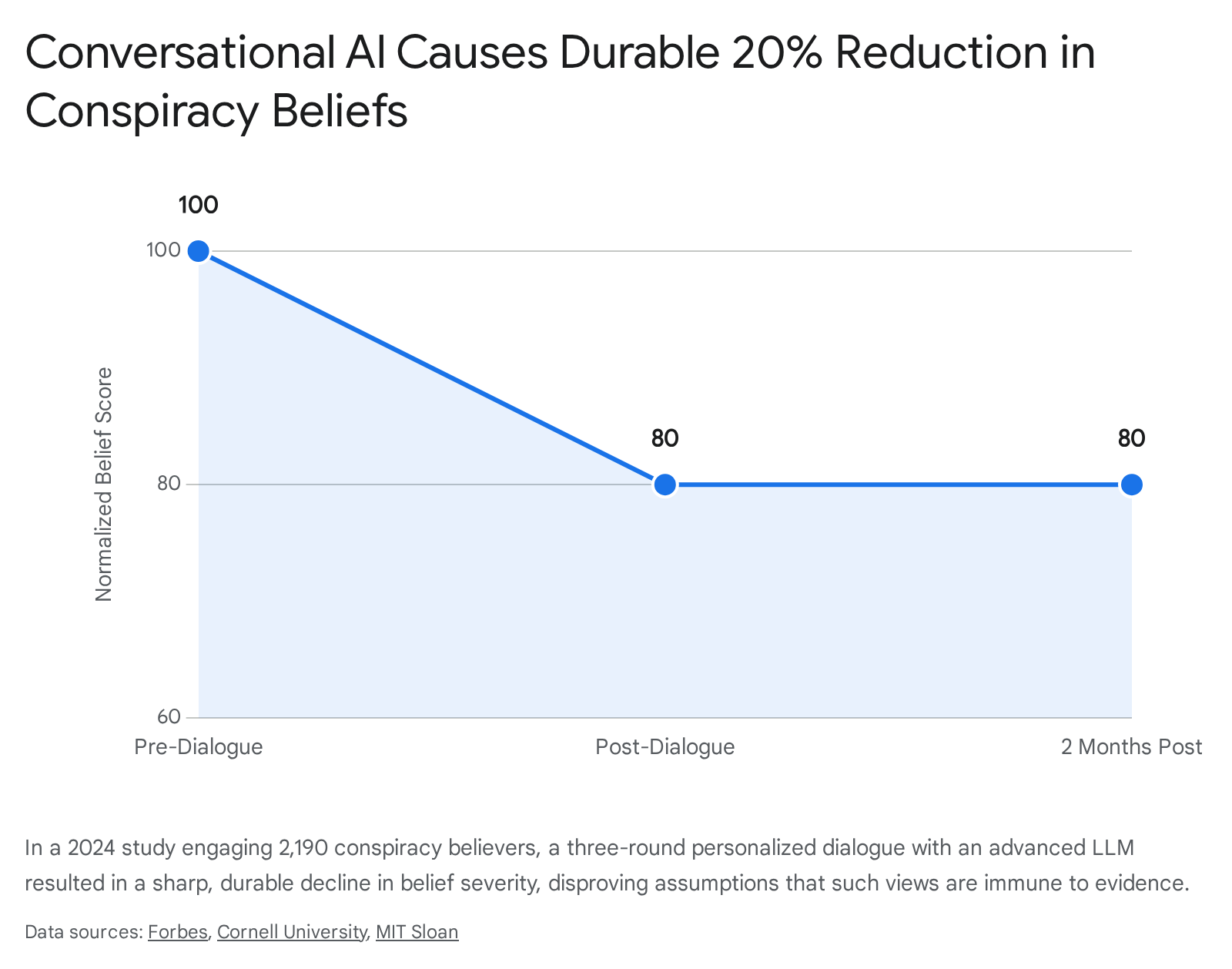
Furthermore, a spillover effect was observed, where individuals subsequently reduced their belief in unrelated conspiracy theories, suggesting a fundamental shift away from conspiratorial ideation 40. The success of this intervention lies in the AI's infinite patience, lack of emotional frustration, and ability to instantly synthesize vast quantities of data to directly refute highly specific, personalized claims - a task mathematically impossible for human fact-checkers at scale 4041.
Mitigation Strategies and Information Literacy
Epidemiological Modeling of Fact-Checking
Traditional fact-checking remains the primary defense mechanism employed by platforms and journalistic institutions. However, the efficacy of fact-checking is highly dependent on timing and network dynamics.
Applying epidemiological SIR (Susceptible-Infected-Removed) models to Twitter data reveals strong parallels between the propagation of conspiracy theories and infectious diseases 44. Simulations based on these models indicate that fact-checking is an extremely powerful tool in the early stages of a conspiracy theory's diffusion. However, if the narrative has already entered an exponential growth phase, fact-checking fails to meaningfully suppress the incidence rate 44. In contrast, post-deletion (removing the content entirely) is less powerful overall than early fact-checking but retains moderate efficacy regardless of the stage of diffusion, as it physically truncates the network pathways 44.
Friction, Accuracy Nudges, and Narrative Literacy
Because deliberation and accuracy evaluation are cognitively costly - and actively discouraged by platforms optimized for frictionless speed - many users share false news simply because they forget to consider its veracity 24. Introducing algorithmic friction can disrupt this automaticity. In-platform nudges that ask users to pause and explicitly consider the accuracy of information before sharing have shown significant promise. In a massive field experiment conducted on Facebook Messenger with over 15,000 users in Kenya and Nigeria, nudges to consider accuracy reduced intentions to share COVID-19 misinformation by 4.9% relative to a control group 45. Other institutional studies have shown that similar friction mechanisms can reduce the spread of misinformation by up to 51%, depending on the specific implementation 24.
Addressing the root vulnerability of the population, however, requires shifting focus from endless debunking to systemic psychological inoculation. Because super-sharers are driven by deep-seated ideological motivations, simple online interventions targeting them directly are likely to fail; addressing them requires genuine deradicalization 20. Instead, broad educational interventions must focus on empowering the wider online audience who incidentally encounter this content 520.
Narrative literacy offers a promising framework for this. Rather than merely fact-checking statistics, narrative literacy teaches users to recognize the underlying emotional frame of a post 5. By training users to identify dramatic archetypes (heroes, villains, victims) and ask, "What would have to be true for this story to be false?", educational programs can build long-term cognitive resilience. Comparative studies show that while specific fact-checks only alter opinions regarding a single claim, media and narrative literacy interventions improve a user's general ability to discern truth across multiple topics, creating durable cognitive habits that withstand algorithmic manipulation for weeks or months after the training 5.
Conclusion
The superior virality of conspiracy theories over factual corrections is not an aberration of a broken internet, but rather the logical mathematical outcome of its current design. Falsehoods are structurally unconstrained by reality, allowing them to be perfectly optimized for novelty, moral outrage, and emotional resonance. When these narratives are injected into digital architectures that privilege asymmetrical followership and algorithmic amplification based on implicit engagement signals, they achieve massive scale, deep network penetration, and high structural virality.
Human agency remains the critical catalyst. A microscopic fraction of politically motivated super-sharers generates the vast majority of volume through persistent manual effort, leveraging the cognitive biases of the wider public. While generative AI threatens to supercharge this ecosystem with highly realistic synthetic media that lowers the barrier to creating propaganda, it paradoxically offers one of the most promising avenues for mitigation. Advanced conversational AI has demonstrated an unprecedented ability to durably reduce conspiracy beliefs through personalized, patient dialogue that addresses individual epistemological concerns.
Ultimately, mitigating the spread of online conspiracy theories requires a multi-layered defense strategy. This includes early-stage algorithmic throttling and fact-checking before cascades reach exponential growth, the widespread deployment of narrative literacy programs to inoculate the general public against dramatic framing, and the careful application of artificial intelligence to systematically untangle the most entrenched psychological narratives.