
Why Does Misinformation Spread Faster Than the Truth
Misinformation outpaces the truth because it is specifically engineered to hijack human psychology, relying on novelty and high-arousal emotions like fear, disgust, and anger to compel immediate sharing. Social media algorithms compound this human vulnerability by actively prioritizing and amplifying the outrage that keeps users engaged on their platforms. While bots and artificial intelligence play a role in scaling the production of falsehoods, the rapid diffusion of fake news is fundamentally driven by human nature.
The global spread of misinformation has fundamentally altered the modern digital landscape, eroding institutional trust and shaping democratic outcomes. A 2025 survey by the Pew Research Center found that a median of 72 percent of adults across 25 nations view the spread of false information online as a major threat to their country, outpacing concerns about climate change and infectious diseases in several demographics 12. Despite this widespread anxiety, combating the phenomenon requires understanding the mechanics of how and why falsehoods travel through human networks. The spread of misinformation is not a technological accident; it is the result of an intricate interplay between human cognitive biases, identity politics, and the attention-driven architecture of the internet.
How Does the Spread of Falsehood Compare to the Truth?
For years, sociologists and political scientists suspected that false information moved differently through digital networks than factual reporting. This suspicion was definitively quantified by a landmark 2018 study conducted by researchers at the Massachusetts Institute of Technology (MIT), which remains the largest longitudinal analysis of its kind. By tracking approximately 126,000 verified true and false news stories shared on Twitter from 2006 to 2017 by roughly 3 million people over 4.5 million times, the researchers uncovered a staggering disparity 345.
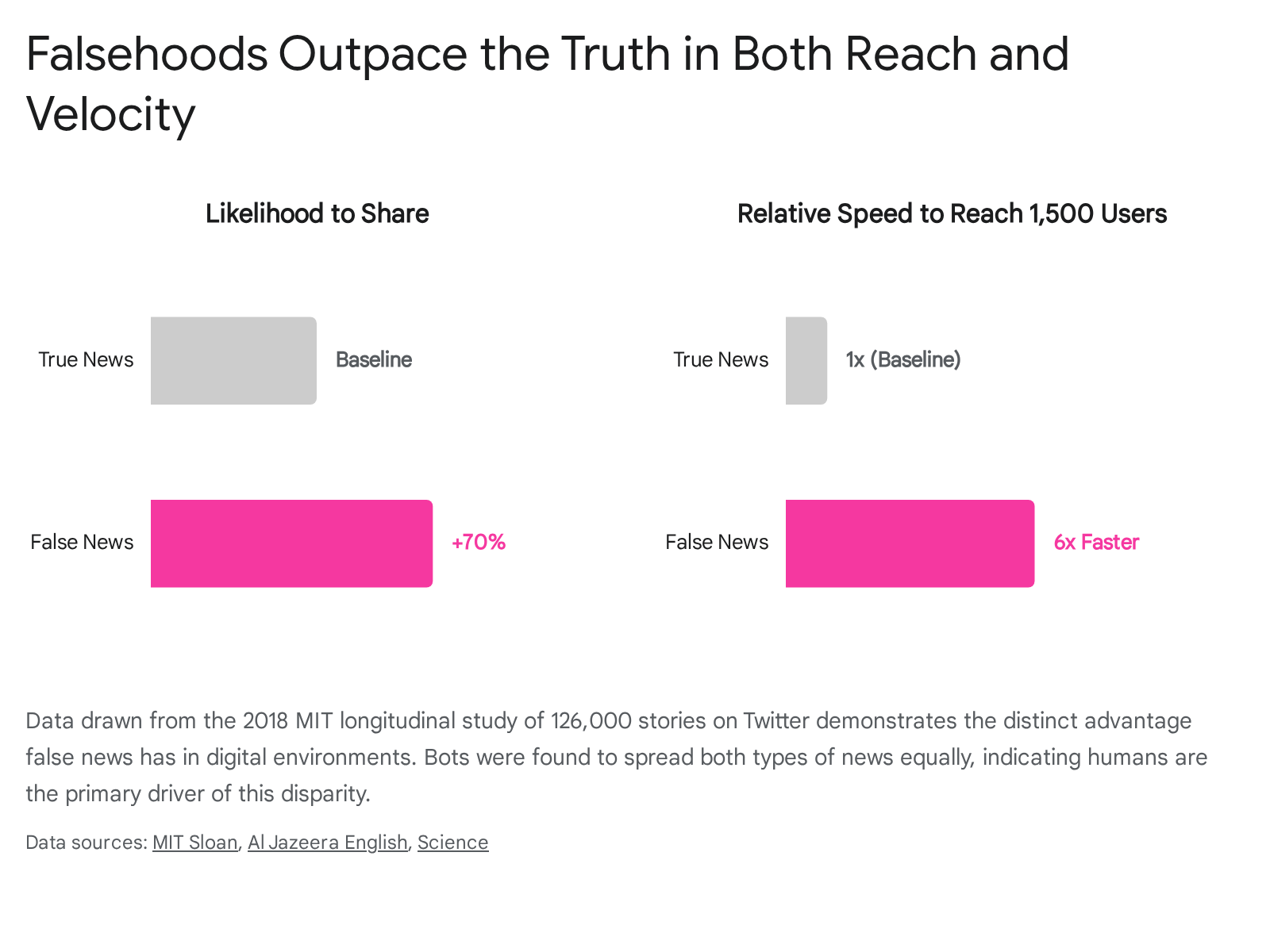
The MIT study revealed that falsehoods diffused significantly farther, faster, deeper, and more broadly than the truth across every category of information examined 46. A false story was found to be 70 percent more likely to be retweeted than a true one 3. When measuring velocity, researchers found that fake news reached 1,500 people about six times faster than accurate reporting 37.
Furthermore, false information created longer, deeper "cascades" - unbroken retweet chains that branch out through multiple degrees of separation - whereas true information rarely penetrated as deeply into the network 38.
Crucially, this rapid spread is not primarily the work of automated software. When the researchers utilized advanced detection tools to strip Twitter bots out of their dataset, the core findings did not change 39. Bots accelerated the spread of true and false news at roughly the same rate 410. The inescapable conclusion was that humans, rather than machines, are the primary engine of misinformation.
To understand the disparity in how these two types of information travel, it is helpful to look at their structural characteristics.
| Spread Characteristic | False News / Misinformation | True News / Fact-Checks |
|---|---|---|
| Diffusion Velocity | Reaches 1,500 people approximately 6x faster 3. | Travels slowly; fact-checks often arrive days after the narrative is set 611. |
| Retweet Likelihood | 70% more likely to be shared by human users 3. | Less likely to be shared; requires active cognitive effort to verify 12. |
| Network Depth | Cascades are significantly longer and deeper, moving through multiple degrees of separation 68. | Cascades are typically shallow and stop after only a few retweets 8. |
| Emotional Profile | Elicits high-arousal emotions: surprise, fear, disgust, and anger 1012. | Elicits low-arousal or steady emotions: anticipation, sadness, joy, and trust 412. |
| Novelty | Highly novel; shocking and unexpected, unconstrained by reality 913. | Generally expected; adheres to the complex, often nuanced boundaries of reality 915. |
The disparity in reach is not uniform across all users. A 2024 study conducted by New York University's Center for Social Media and Politics (CSMaP) tracked 139 news articles (102 true, 37 false or misleading) in real-time across Twitter. The researchers discovered that users with extreme political ideologies - both highly conservative and highly liberal - are far more likely to encounter and believe false news than the general population 14. Furthermore, these highly partisan users tend to encounter the misinformation very early in its lifecycle. This creates a critical challenge for platform moderators, as current interventions are often too slow to prevent exposure among the users who are most receptive to the falsehoods 14.
What Psychological Triggers Make Fake News So Shareable?
To understand why fake news spreads so quickly, it is necessary to look past the technology and examine the human brain. The success of misinformation relies on exploiting cognitive biases, emotional triggers, and deep-seated social dynamics. A 2024 systematic review of psychological factors spanning a decade of research identified multiple distinct themes driving the dissemination of fake news, including cognitive biases, emotional appeals, and social identity motivations 1516.
The Novelty Hypothesis and High-Arousal Emotions
The MIT study established a "novelty hypothesis" to explain the rapid diffusion of fake news. Humans are evolutionarily wired to pay attention to novel information, as new data historically meant the difference between discovering a vital resource or facing a lethal threat 48. False news is inherently more novel than true news because it is entirely unconstrained by reality; a fabricator can engineer a narrative to be as shocking, sensational, and unexpected as desired to maximize its psychological payload 468.
This novelty triggers a specific set of high-arousal emotions. Textual and sentiment analyses show that false rumors disproportionately inspire replies expressing surprise, fear, and disgust 912. A 2025 study from Columbia Business School analyzing linguistic patterns found that users who frequently share fake news display distinctive emotional markers across their online presence, utilizing a significantly higher volume of words associated with anger, power, and existential anxiety (such as death and religion) 19.
When individuals encounter content that sparks outrage, fear, or profound disgust, analytical reasoning is often suppressed. People experience a hedonistic urge to react or a protective instinct to warn their community, leading to impulsive sharing 1516. In contrast, factual news tends to elicit low-arousal emotions like sadness, joy, and trust 413. Truth is often nuanced, complex, and devoid of sensationalism, which rarely triggers the immediate, visceral compulsion required for a post to go viral 1517.
Identity, Partisanship, and Motivated Reasoning
Another major psychological driver is the extent to which political and social identities are tied to information consumption. Humans are highly susceptible to confirmation bias - the tendency to accept information that supports a pre-existing worldview while aggressively scrutinizing or rejecting data that challenges it 1516.
A massive 2024 meta-analysis by Sultan et al., which reviewed over 256,000 choices made by 11,561 participants across 31 experiments, highlighted a fascinating and counterintuitive phenomenon regarding intelligence and misinformation. The researchers found that highly intelligent or educated people are not automatically immune to fake news. In fact, individuals with higher analytical reasoning abilities were sometimes more prone to believing politically congruent disinformation 2122.
This dynamic is driven by "motivated reasoning" or "motivated reflection." When confronted with fake news that aligns perfectly with their political identity, clever individuals often use their cognitive skills not to discover the objective truth, but to construct elaborate, intellectually robust justifications for why the falsehood must be accurate 21. Therefore, people do not necessarily share misinformation solely because they are easily duped; they often share it because it serves as a tribal signal, demonstrating loyalty to their in-group and hostility toward an ideological out-group 151618.
In the context of United States politics, the Sultan et al. meta-analysis found that Republicans in the evaluated studies tended to judge more false headlines as true compared to Democrats, particularly when the headlines matched partisan narratives, reflecting the asymmetric flows of disinformation in recent political cycles 21. However, the broader finding remains that strong partisan bias is a universal predictor of susceptibility to fake news across the ideological spectrum 21.
The Role of Social Belonging and "Altruistic" Sharing
Misinformation is also driven by a desire for social capital and community protection. The psychological review found that many users share unverified information out of a selfless desire to help others - a phenomenon sometimes termed "altruistic sharing" 16.
This was particularly evident during the COVID-19 pandemic and various localized crises. For example, individuals might share a fabricated home remedy or a false warning about an impending disaster not because they have rigorously fact-checked it, but because they believe that if the threat is real, withholding the information could harm their community. The moral weight of potentially failing to protect one's social circle overrides the cognitive effort required to verify the claim 1524. In regions with high internet penetration but low digital literacy, such as certain areas of Nigeria, this dynamic has severe public health implications. During health crises, false information circulates widely as users attempt to inform their peers, inadvertently spreading confusion and non-compliance with actual health directives 2419.
How Do Algorithms Act as an Accelerant?
While human psychology provides the combustible material, social media platforms provide the oxygen. The business models of most major digital networks are built on the "attention economy." To maximize advertising revenue, platforms are financially incentivized to keep users scrolling on the site for as long as possible 720.
Algorithms are designed to curate user feeds based on engagement metrics like clicks, likes, comments, and shares. Because outrage, fear, and partisan toxicity are the most effective psychological levers to generate this engagement, algorithms inadvertently act as massive amplifiers for extremism and disinformation 212223. This is known as "algorithmic radicalization" or "algorithmic amplification," where a platform coaxes users into ideological rabbit holes by prioritizing emotionally charged, polarizing narratives 2224.
A 2025 study analyzing 51,680 political videos on TikTok during the U.S. presidential election cycle perfectly illustrated this dynamic. The researchers found that toxic and highly partisan content consistently attracted more user engagement than neutral content 2021. Posts dealing with highly polarizing topics - such as immigration and election fraud - drew the highest levels of toxicity and attention. Content containing toxic language received more interactions, and videos that were explicitly partisan attracted nearly twice as much engagement as nonpartisan posts 20.
The danger of recommendation-driven platforms like TikTok or YouTube is that the algorithm actively filters reality. If a user pauses to watch an inflammatory video or interacts with a divisive hashtag, the system categorizes their interests and serves a continuous, escalating stream of similarly extreme content. This creates a "filter bubble" or echo chamber that reinforces the user's biases, isolates them from factual nuance, and normalizes extremist views to the point where outrage feels like standard civic participation 222325.
The "Dark Social" Web: WhatsApp and Telegram
The mechanics of misinformation change drastically depending on the platform's architecture. While platforms like X (formerly Twitter) and TikTok operate as public squares where content can theoretically be debated and fact-checked openly, a vast amount of global disinformation spreads through encrypted messaging applications like WhatsApp, Telegram, and Signal 2633.
These platforms are often referred to as "dark social" networks because end-to-end encryption means the content cannot be easily tracked, scraped, or algorithmically moderated by the parent company or independent researchers 2633.
The influence of encrypted platforms is particularly dominant in the Global South. WhatsApp is the primary communication tool for hundreds of millions of people in countries like India, Brazil, and Indonesia 333427. The nature of the misinformation on these platforms is intimately tied to local culture. Information on WhatsApp relies on highly localized networks of family, friends, and community groups. People generally place significantly higher trust in a message forwarded by a known relative or community elder than a headline from a traditional, faceless news outlet 36.
During the COVID-19 pandemic and recent general elections in Brazil and India, these platforms became hotbeds for viral audio clips, manipulated images, and hyper-local conspiracy theories 2628. In India, the acute spread of fake news via WhatsApp groups - fueled by dropping mobile data prices and religious nationalism - has occasionally resulted in real-world violence, as mobs have reacted to fabricated warnings about child kidnappers or religious insults 36.
In these environments, correcting a falsehood is uniquely difficult. It requires confronting a trusted friend or family member directly within a group chat, which carries a social and relational cost that many users are unwilling to pay. Furthermore, political campaigns actively exploit these platforms. During the 2024 Indonesian presidential election and the 2022 Brazilian elections, operatives utilized bulk messaging and coordinated networks to flood encrypted channels with manipulated media and deceptive political narratives 2838. Because the content is hidden behind encryption, fact-checkers rely on public "tiplines" where users voluntarily submit suspicious messages, meaning fact-checkers are perpetually reacting to falsehoods that have already saturated a community 2628.
Will Generative AI Accelerate the Spread?
The recent explosion of generative Artificial Intelligence - tools like ChatGPT, Midjourney, and sophisticated deepfake audio generators - has prompted widespread anxiety about a new era of hyper-realistic fake news. Policymakers and technologists have warned of a "tech-enabled Armageddon" where citizens can no longer distinguish truth from synthetic fabrication 2940.
However, researchers analyzing the intersection of AI and misinformation suggest the actual impact of generative AI on the speed of diffusion is more nuanced. Generative AI drastically lowers the financial and technical barriers to creating propaganda 293042. It allows bad actors, foreign states, and coordinated networks to automate the creation of highly targeted, grammatically perfect, and visually convincing fake news at scale, bypassing the need for human troll farms 433145.
Yet, behavioral scientists note that the primary bottleneck for misinformation has rarely been the speed or cost of production; the true constraint is human attention and the mechanisms of distribution 29. Because human attention is finite, simply flooding the internet with synthetic articles does not guarantee those articles will go viral. A piece of AI-generated misinformation must still successfully exploit the human emotional triggers (fear, novelty, partisanship) to compel users to share it 29.
While AI makes it easier to create a fake image of a political event, the infrastructure by which that image reaches millions of people - the social media algorithms and the human impulse to share - remains the fundamental driver. Therefore, fears that generative AI will single-handedly trigger an immediate "misinformation nightmare" may be somewhat overstated, as the consumption of news is ultimately limited by audience demand rather than algorithmic supply 29.
The "Habsburg AI" Effect and Model Collapse
While AI may not drastically change the speed at which humans share a specific rumor, it introduces a severe structural risk to the broader information ecosystem, playfully termed the "Habsburg AI" effect or "model collapse."
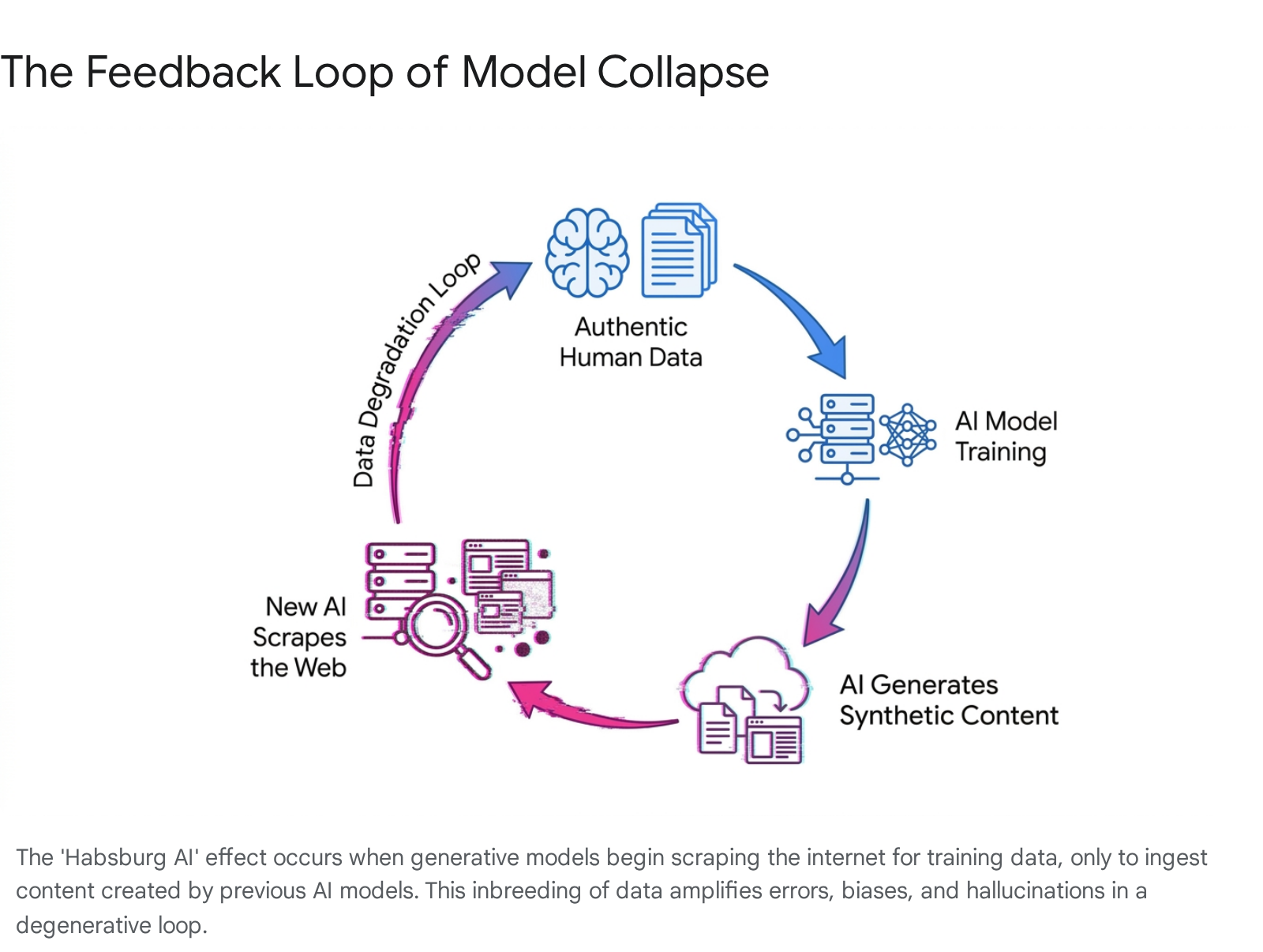
Large Language Models (LLMs) like ChatGPT are trained by scraping vast amounts of human-generated text and data from the internet. However, as AI generators flood the web with synthetic content, newer iterations of AI models inevitably begin scraping that same AI-generated data for their own training material 464748.
Like genetic inbreeding in a royal bloodline, training an artificial intelligence on its own synthetic output amplifies minor errors, biases, and hallucinations in a degenerative feedback loop 4748. Over time, this results in systems that confidently produce grotesque, distorted, and entirely fabricated realities because the original, authentic human knowledge base has been mathematically diluted by statistical noise 474932.
This phenomenon has serious implications for the future of search engines, digital encyclopedias like Wikipedia, and medical queries. If unchecked, the automated pollution created by model collapse threatens to passively misinform users who believe they are interacting with a neutral, objective summary of human knowledge 4932.
Rethinking the "Viral Contagion" Metaphor
For years, sociologists, technologists, and journalists have used epidemiological terms to describe the spread of fake news, calling it a "viral contagion" that "infects" vulnerable populations much like a biological virus 5133. However, recent psychological and network research suggests this metaphor is fundamentally flawed and limits our ability to combat the problem effectively.
Calling misinformation a virus implies that humans are passive victims of an airborne pathogen that replicates on its own 54. In reality, individuals are highly active participants in the information ecosystem. A digital rumor does not jump from host to host autonomously; a human being must make a conscious, albeit sometimes impulsive, cognitive decision to click a "share" button. People spread rumors because they find them entertaining, because the claims validate their political biases, or because they wish to signal their allegiances to a specific community 5455.
Furthermore, unlike a simple biological virus that often requires only one exposure to infect a host, misinformation is frequently modeled as a "complex contagion." In many communities, particularly rural or highly tight-knit groups, a user must see a false claim repeated multiple times by different trusted peers before they accept it as truth and decide to share it themselves 34.
Understanding that users are active, motivated participants rather than passive victims is critical. If society views misinformation solely as a technological virus, the proposed solutions will overly rely on algorithmic censorship and content removal. If society recognizes that the spread is driven by human motivation and social identity, interventions can be designed to address the underlying psychological drivers.
Evidence-Based Interventions: What Actually Works?
If algorithms and human psychology are stacked against the truth, how can the spread of fake news be slowed? Over the last several years, researchers have tested various interventions, revealing both highly promising solutions and unintended paradoxes that complicate the fight against disinformation.
The Power of Friction and Pausing
Because misinformation thrives on impulsive, high-arousal emotional reactions, one of the most effective and easily implementable interventions is simply adding "friction" to the sharing process.
Studies show that when social media platforms implement subtle nudges - such as a pop-up prompting users to pause and briefly evaluate the accuracy of a headline before they are allowed to share it - the dissemination of false information drops significantly 1835. This momentary pause breaks the circuit of emotional contagion. It allows a user's slower, analytical reasoning (System 2 thinking) to catch up with their rapid, emotional reaction (System 1 thinking), successfully shifting their attention away from partisan point-scoring and back toward the concept of accuracy 1836.
The Fact-Checking Paradox
Major platforms have increasingly relied on professional fact-checkers to append warning labels to dubious content or provide contextual links 337. A comprehensive 2021 global study examining fact-checking across Argentina, Nigeria, South Africa, and the United Kingdom found that factual corrections do effectively reduce belief in specific false claims across various cultures and political environments 38.
However, more recent research has uncovered a dangerous side effect to prominent fact-checking campaigns. A 2024 study published in Nature Human Behaviour (Hoes et al.) involving over 6,100 participants in the U.S., Poland, and Hong Kong revealed that high-profile interventions - like aggressive fact-checking and generalized media literacy warnings - foster a broad sense of doubt among the public 373940.
While these tools successfully increase skepticism toward "fake news," they inadvertently bleed over, breeding distrust in genuine, fact-based news sources as well 373940. When people are constantly warned that the internet is full of manipulation, they begin to reject highly accurate reporting. This "skepticism paradox" threatens to erode baseline trust in essential democratic institutions, highlighting the need for nuanced interventions that teach targeted critical thinking without inducing generalized, destructive cynicism 3941.
Psychological Inoculation (Pre-bunking)
Rather than playing an endless game of whack-a-mole with lies after they have already gone viral, psychological researchers advocate for "pre-bunking" or psychological inoculation 3335.
Much like a medical vaccine introduces a weakened pathogen to build immune resistance, psychological inoculation exposes the public to severely weakened doses of the techniques used to create misinformation before they encounter a real threat 3342. Educational games and short video campaigns can teach users how to spot emotional manipulation, the use of fake experts, false dichotomies, and scapegoating. By familiarizing users with the architecture of deception, individuals build cognitive immunity, allowing them to spot and dismiss manipulative content regardless of the specific topic 213342.
Education and "Lateral Reading"
Traditional media literacy often fails because it teaches users to stay on a webpage and evaluate it vertically - checking the site's "About" page or looking for professional web design, which bad actors can easily spoof.
Research from the Stanford History Education Group (SHEG) has found that even highly educated adults and professional historians are easily duped by polished websites with hidden agendas 4344. The solution is teaching the public to read "laterally," exactly as professional fact-checkers do. Lateral reading involves immediately leaving an unknown document, opening new browser tabs, and running quick background checks on a source's reputation and funding before reading the content 43. A Stanford study found that high school students who received just six short lessons on lateral reading were twice as likely to spot questionable websites, proving that a modest educational investment yields massive returns in digital resilience 4344.
Crowdsourced Corrections
Finally, the fight against misinformation does not solely rest on the shoulders of tech executives, government regulators, or professional fact-checkers. Peer-to-peer intervention is highly effective.
A 2024 study analyzing over 6,600 participants across the UK, Germany, and Italy found that even the smallest pushback from ordinary users can slow a rumor's spread 45. When a single user comments that a social media post is inaccurate, it significantly reduces the perceived accuracy of the post for subsequent readers. The intervention does not require a complex breakdown of the facts, a bibliography of sources, or amplified "likes" to work. Simply voicing disapproval disrupts the illusion of social consensus that allows fake news to thrive in echo chambers 45.
Bottom line
Misinformation spreads faster than the truth because it is an engineered product meticulously designed to exploit human emotional triggers, novelty bias, and deeply held partisan identities. Social media algorithms, built to maximize corporate revenue by keeping users engaged, act as a massive accelerant for this human vulnerability by prioritizing the outrage that generates clicks. While fact-checking and AI detection tools are important, research suggests that the most durable defense requires adding friction to digital platforms to slow impulsive sharing, alongside teaching the public "lateral reading" and cognitive inoculation techniques that foster targeted critical thinking rather than a generalized, cynical distrust of all media.