
Why Feedback Fails and How the Brain Responds
When a person receives critical feedback, their brain often processes it as a physical threat, triggering an "amygdala hijack" that actively shuts down the higher-order cognitive centers required for learning and adaptation. Because the delivery of criticism is heavily distorted by the cognitive biases of the sender, traditional feedback interventions frequently breed defensiveness and decrease performance rather than fostering growth. By utilizing neuroscience-backed frameworks that focus on future solutions and establish psychological safety, organizations can bypass these evolutionary defense mechanisms to deliver insights that actually drive behavioral change.
The Evolutionary Biology of Social Evaluation
Feedback is fundamentally an exercise in social evaluation. It requires one individual to observe, judge, and communicate the perceived value or shortcomings of another. To understand why this process is universally uncomfortable, one must look at human evolutionary history. For our ancient ancestors, social belonging was inextricably linked to physical survival. Being accepted within a tribal group provided access to shared resources, protection, and cooperation, while social exclusion or a drop in hierarchical status almost certainly guaranteed death in a hostile environment 1234.
Consequently, the human brain evolved sophisticated mechanisms to treat signals of social evaluation with profound caution. Modern workplaces are vastly different from the environments in which our brains evolved, but our neurological hardware remains identical. When an employee is called into a manager's office for a performance evaluation, or when a colleague begins a sentence with the ominous phrase, "Can I give you some feedback?", the brain does not perceive a calm, professional opportunity for career development. Instead, the brain's threat detection center - the amygdala - lights up instantly, interpreting the social evaluation as a life-or-death survival scenario 2456.
The Intersection of Social Threat and Physical Pain
The comparison between critical feedback and physical pain is not merely a poetic metaphor; it is a neurological reality. Research in social cognitive neuroscience has demonstrated that experiences of social evaluation, criticism, and rejection activate the exact same regions of the brain that are responsible for processing physical pain 125.
Pioneering studies conducted by researchers at the University of California, Los Angeles (UCLA), specifically identified that social exclusion activates the dorsal anterior cingulate cortex (dACC). This is the specific brain region that alerts us to the distress of physical injury 12. To the human nervous system, a harsh critique regarding a quarterly report or a presentation is indistinguishable from a physical blow to the body. This innate biological asymmetry means the brain is evolutionarily wired to be far more vigilant toward perceived threats than it is toward potential rewards. The threat response is drastically faster, exponentially more powerful, and lasts significantly longer than any positive feeling generated by praise 37.
The Mechanics of the Amygdala Hijack
When the amygdala detects this social threat, it initiates a physiological cascade commonly known as the "fight-or-flight" response, or an "amygdala hijack." Cortisol and adrenaline surge through the bloodstream, heart rate climbs, palms may sweat, and breathing becomes noticeably shallow 23456.
The most critical consequence of this hijack, however, is cognitive. Once the amygdala fires, the brain instinctively redistributes vital resources to prepare the body for physical action. Blood flow, oxygen, and glucose are pulled away from the prefrontal cortex - the advanced, rational part of the brain responsible for executive function, logical reasoning, conscious problem-solving, and emotional regulation 2789.
Research by neurobiologists has documented a direct negative correlation between threat activation and the resources available to the prefrontal cortex 7. In essence, traditional feedback mechanisms literally diminish an individual's cognitive capacity at the exact moment the organization demands insight, active listening, and behavioral adaptation. When the prefrontal cortex goes offline, the ability to think clearly, choose words carefully, or access empathy is severely compromised, leaving the recipient locked in a state of emotional defensiveness 248.
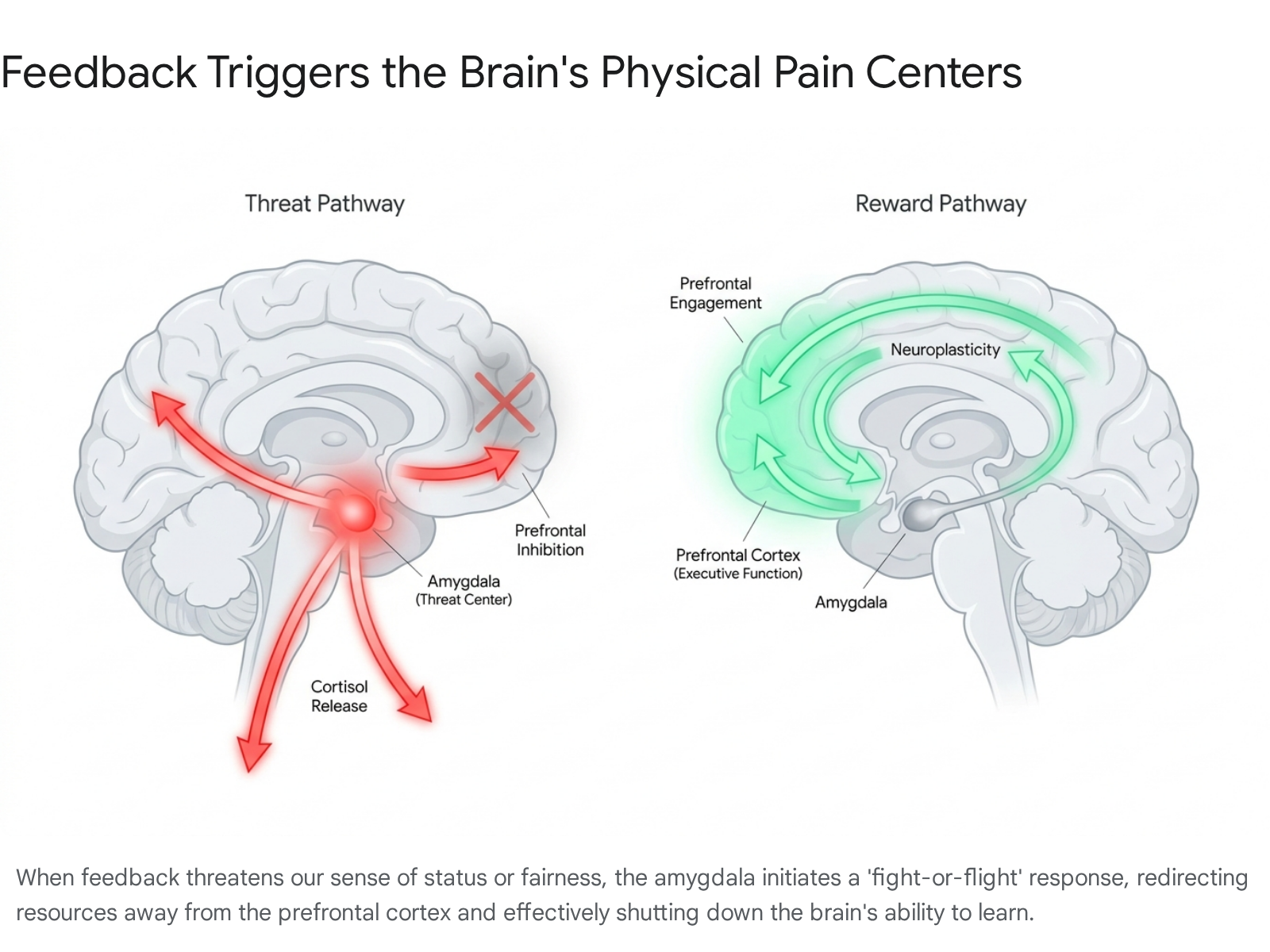
Sympathetic vs. Parasympathetic Learning States
The biological response to feedback extends beyond the immediate moment of the conversation. It dictates whether long-term learning can occur at all. A pervasive myth in performance management is that excellence is achieved by identifying an employee's gaps and aggressively fixing their weaknesses. However, psychological and business research reveals that focusing people heavily on their shortcomings inhibits the neural access required for learning 10.
When an individual receives highly critical, weakness-based feedback, it activates the sympathetic nervous system. This activation invokes cognitive, emotional, and perceptual impairment. Conversely, when conversations focus on an individual's strengths, their future goals, or how they might achieve their dreams, the sympathetic nervous system disengages. What lights up instead is the parasympathetic nervous system, frequently referred to as the "rest and digest" network 10.
The parasympathetic state stimulates neurogenesis and cognitive openness. Brain science indicates that human beings grow the most in the specific areas where they already possess the highest concentration of synaptic connections. Therefore, an individual's existing strengths represent their greatest natural areas for development. Focusing feedback on remediating weaknesses forces the brain to build entirely new neural pathways under stress, whereas strength-based feedback leverages established, high-capacity neural networks to accelerate growth 61011.
The SCARF Model: Mapping the Brain's Social Radar
To understand precisely what specific types of communication trigger the amygdala, neuroscientist Dr. David Rock developed the SCARF model in 2008. The framework provides a neuroscientific lens to explain how invisible social forces shape human behavior in collaborative environments. The model outlines five distinct social domains that the human brain constantly scans for signs of threat or reward 91211415.
When any of these five domains are threatened, the brain reacts as if physical danger is imminent, resulting in the physiological shutdown described above. When these domains are supported or elevated, the brain releases dopamine and engages the prefrontal cortex, creating an environment primed for trust, accountability, and productive collaboration 49121415.
The SCARF domains include Status, which refers to our relative importance and standing compared to others. Unsolicited feedback inherently asserts a hierarchy - implying the giver knows better than the receiver - which immediately threatens the recipient's status. Certainty represents the brain's ability to predict the future. The brain despises ambiguity and will fill information gaps with worst-case scenarios, meaning vague or delayed feedback causes immense anxiety. Autonomy is the innate human need for a sense of control over one's own environment and choices. Being told exactly how to fix a problem micromanages the recipient and strips them of their agency. Relatedness denotes how safe we feel with others, determining whether the brain categorizes a colleague as a friend or a foe. Finally, Fairness represents the perception of just and equitable exchanges between people. Violations of fairness create lasting resentment and actively trigger the anterior insula, the exact brain region associated with the physical sensation of disgust 91211415.
The 2025 "Great Reversal" in Social Drivers
Fascinatingly, the hierarchy of these social needs is not static; it evolves alongside societal and workplace shifts. A foundational research update published by the NeuroLeadership Institute analyzed a dataset of over 15,000 SCARF assessment responses collected between 2024 and 2025. The findings revealed a massive transformation - dubbed "The Great Reversal" - in what employees require to feel safe, motivated, and engaged 1.
| SCARF Domain | Historical Ranking (2012) | Modern Ranking (2025) | Neurological and Cultural Implications |
|---|---|---|---|
| Fairness | #4 | #1 (Top Driver) | Heightened societal focus on equity has made employees highly sensitive to justice. Perceived fair exchanges activate monetary reward circuitry, while unfairness triggers physical disgust 115. |
| Autonomy | #5 (Bottom) | #2 | Driven by remote work and complex tasks. The brain registers the perception of choice as a powerful intrinsic reward that acts as a buffer against high-stress environments 1. |
| Status | #3 | #3 | Remains a steady, consistent driver. However, sensitivity to status is particularly heightened among junior employees and shifts as individuals move into senior leadership 9121. |
| Relatedness | #2 | #4 | While social safety and categorization of "friend vs. foe" remains critical for team cohesion, it has been superseded by the overriding desires for personal agency and equitable treatment 91. |
| Certainty | #1 (Top Driver) | #5 (Bottom) | Constant global instability has transformed certainty into a "hygiene factor." Its absence causes a baseline threat, but its presence is no longer a primary driver of high-level engagement 121. |
This reversal indicates that modern feedback must fundamentally prioritize transparency and agency. Because Fairness is now the apex driver, leaders must meticulously explain the "why" behind their feedback to prevent the disgust response associated with perceived inequity. Furthermore, because Autonomy has skyrocketed in importance, providing "micro-autonomy" - allowing the recipient to choose how to implement the feedback or when to discuss it - can trigger a significant reward response that overrides the inherent status threat of being critiqued 1.
The Psychology of the Sender: The Distortion of Truth
Even if a manager masters the art of bypassing an employee's amygdala, traditional feedback systems suffer from a fatal structural flaw on the sender's side of the equation. We operate under the collective delusion that humans are capable of acting as objective raters of other humans. Decades of psychometric research categorically prove that we are not.
When organizations deploy performance reviews, they assume the feedback generated is a source of truth. However, the data reveals that feedback is often more distortion than reality, which explains why nearly 40% of feedback interventions result in measurably decreased performance and damaged interpersonal relationships 31011.
The Idiosyncratic Rater Effect
The most significant barrier to accurate feedback is a phenomenon known as the idiosyncratic rater effect. When an individual rates a colleague on abstract, complex competencies - such as "strategic thinking," "leadership presence," or "business acumen" - their evaluation is deeply colored by their own subjective definitions. A manager's rating is heavily influenced by their personal understanding of what "good" looks like, their inherent harshness or leniency as a rater, and their own unconscious biases 10.
Research spanning several decades demonstrates that this effect is vast and resilient. More than half of a manager's rating of an employee reflects the specific characteristics of the manager giving the rating, not the actual performance of the employee receiving it. In other words, feedback tells the recipient significantly more about the psychological makeup of the sender than it does about their own work 10. Because recipients instinctively recognize this misalignment, they are forced to struggle through a forest of distortion in search of something they genuinely recognize as themselves.
Compounding the problem is the fact that the idiosyncratic rater effect produces systematic error, rather than random error. In data science, random errors can be smoothed out by increasing the sample size and averaging the inputs. Systematic errors, however, are structural flaws in the measurement tool itself - in this case, the human brain. Therefore, when organizations attempt to solve the bias of a single manager by implementing 360-degree reviews that average the feedback of multiple peers, they do not find the objective truth; they merely magnify the systematic error 10. Humans are reliable raters only of their own feelings and reactions. A manager cannot objectively score an employee's "communication skills," but they can accurately state, "I felt confused during your presentation."
Cognitive Biases and Feedback Loops
The transmission of feedback is further warped by a suite of cognitive biases that act as mental shortcuts but ultimately distort reality 161718.
The halo effect frequently skews evaluations, where a manager's overall positive or negative impression of an employee heavily influences their judgment of specific, unrelated traits 17. The availability heuristic causes evaluators to rely heavily on the most recent or memorable examples of an employee's behavior, ignoring months of consistent performance 16. Furthermore, confirmation bias causes individuals to seek out and interpret information that aligns with their pre-existing beliefs. If a manager unconsciously assumes an employee is unmotivated, they will hyper-focus on instances of tardiness while ignoring late-night project deliveries, creating a negative feedback loop that reinforces faulty assumptions 1617.
Before a feedback conversation even begins, the brain automatically engages in moral typecasting. Drawing on social psychology research, it is evident that during conflicts or critiques, the human brain sorts people into simplified, polarized profiles. We cast ourselves as the "innocent victim" and the person delivering the critique as the "merciless villain." This automatic sorting prevents rational engagement with the material being discussed 7.
Once feedback is delivered, the recipient typically processes it through the SARA model, navigating through stages of Shock, Anger, Resistance, and finally, Acceptance 18. Due to the self-serving bias - the psychological tendency to attribute our successes to our own innate abilities while blaming our failures on uncontrollable external circumstances - many employees get permanently stalled in the "Resistance" phase. They reject critical feedback as a product of unfair external factors, preventing the transition into meaningful acceptance and behavioral change 18.
The Anxiety of the Giver
While much attention is paid to the distress of the recipient, giving feedback is also highly traumatic for the sender. Studies tracking heart rates during mock negotiations reveal that subjects feel equally anxious offering feedback as they do receiving it 19.
This anxiety leads to a massive disconnect in the workplace. A comprehensive study by researchers at Harvard Business School asked participants to rate how much they would want feedback in various hypothetical scenarios, versus how much they believed another person would want feedback in that same scenario. Consistently, individuals rated their own desire for feedback significantly higher than their willingness to give it. People systematically overestimate the negative consequences of providing constructive criticism 2. Because giving feedback creates such intense interpersonal anxiety, managers often default to polite, generalized statements that offer no actionable path for improvement, leading to a situation where 72% of employees state they consider critical feedback vital for their careers, yet only 5% believe their managers actually provide it effectively 192.
The Failure of the "Feedback Sandwich"
To mitigate the deep anxieties of giving and receiving criticism, the corporate world spent decades relying on a specific conversational crutch: the "feedback sandwich." This method involves nestling constructive criticism between an opening compliment and a closing piece of positive reinforcement, theoretically making the negative news more palatable 11322234.
Despite a 2023 survey indicating that 86% of employees have received a feedback sandwich and 95% of managers have given one, psychological and organizational research proves the technique is highly ineffective 2223.
The feedback sandwich fails catastrophically for several structural reasons. First, its predictability undermines its intent. Employees have become wise to the formula; the moment a supervisor begins with a compliment, the recipient immediately tenses up, bracing for the inevitable "but" that will follow. This anticipation triggers the amygdala hijack before the critique is even spoken 1122. Second, it creates deep trust issues regarding positive reinforcement. Employees begin to distrust all praise, wondering if a genuine compliment is merely a manipulative prelude to criticism 2223.
Third, the core message is frequently diluted. Because the manager is already anxious, they often water down the constructive criticism to make it fit seamlessly between the positive bookends, leaving the recipient thoroughly confused about what specific behaviors require adjustment 112223. Finally, the sandwich is fundamentally a one-way communication model. It positions the manager as the sole arbiter of truth delivering a monologue, completely ignoring the dialogic, collaborative interaction required for adult learning 225.
Evidence-Based Alternatives to the Sandwich
To move beyond the limitations of the sandwich, behavioral scientists and leadership experts have developed more direct, actionable frameworks that separate praise from critique, ensuring both are delivered authentically.
| Feedback Framework | Core Methodology | Primary Benefit |
|---|---|---|
| Open-Faced Sandwich | Eliminates the predictable positive feedback at the start. Delivers praise and constructive criticism in entirely separate conversations 22. | Prevents the erosion of trust in positive reinforcement. Allows critique to be direct and praise to be received genuinely without anticipation of a "but" 22. |
| SBI Model | Focuses on specificity by describing the Situation, the observed Behavior, and the Impact of that behavior on the team or project 22. | Removes subjective judgments of character. Focuses entirely on observable facts, significantly reducing recipient defensiveness 22. |
| COIN Model | Builds on SBI by adding a fourth step: Context, Observation, Impact, and Next Steps 22. | Transforms passive observation into an actionable plan, moving the conversation immediately toward future solutions 22. |
| COILED Model | Expands on COIN: Connection, Observation, Impact, Listen, Establish Solution, Definite Agreement 22. | Mandates active listening and two-way dialogue, shifting feedback from a monologue into collaborative problem-solving 22. |
While these structural frameworks help clarify the message, they must be combined with a fundamental shift in the interpersonal dynamic between the sender and the receiver.
Radical Candor: Breaking the False Dichotomy
One of the most effective modern approaches to feedback is the Radical Candor framework, developed by former Apple and Google executive Kim Scott. The framework seeks to solve the friction of feedback by mapping professional communication across two distinct behavioral axes: Caring Personally and Challenging Directly 2627282930.
A common misinterpretation is that Radical Candor is synonymous with "brutal honesty" or using transparency as a license to be cruel. The framework explicitly rejects this. Radical Candor posits that it is entirely possible to break the false dichotomy that forces managers to choose between being perceived as a harsh jerk or an incompetent pushover. The methodology requires building a deep, genuine baseline of human trust and empathy so that when direct challenges are made, they are received as supportive guidance rather than hostile attacks 2627282930.
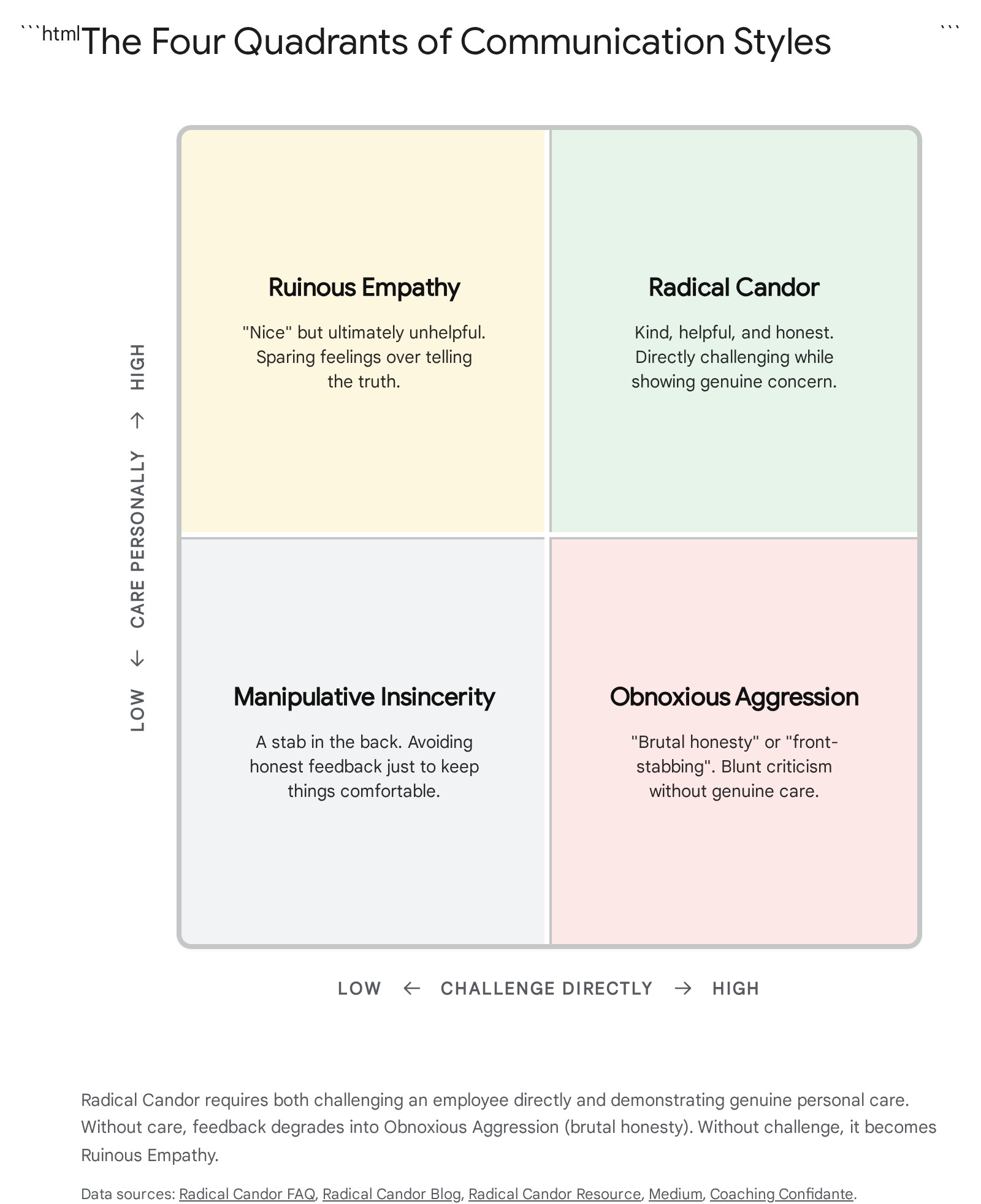
When communication lacks personal care but is highly challenging, it falls into the quadrant of Obnoxious Aggression. This is true brutal honesty; it may occasionally be helpful, but it leaves a trail of damaged relationships and triggers intense amygdala responses. When a manager cares deeply about an employee but avoids challenging them to spare their feelings, they practice Ruinous Empathy. This results in an employee unknowingly failing because they were deprived of the information needed to improve. The most destructive quadrant is Manipulative Insincerity, where communication involves neither care nor challenge, manifesting as passive-aggressive behavior or backstabbing 2627282930. Radical candor succeeds because it utilizes the SCARF domain of Relatedness to buffer the inherent threat of behavioral correction.
Feedforward: Bypassing the Past
While Radical Candor improves the interpersonal dynamic of delivering critique, executive coach Marshall Goldsmith pioneered a methodology called "Feedforward" that solves the temporal problem of feedback. Traditional feedback is fundamentally flawed because it focuses on events that have already occurred. Humans cannot change the past, making discussions about past failures inherently frustrating and defensive 316789.
Feedforward completely abandons the past, focusing entirely on future behaviors, which are within the individual's locus of control. The methodology is remarkably simple but requires strict adherence to specific rules to prevent the brain from slipping into defensive rationalization. First, the recipient must identify one specific behavior they wish to change, such as becoming a better active listener. Second, the person providing the feedforward is strictly forbidden from referencing the past; they cannot critique past listening habits. Third, the provider offers one or two rapid, actionable suggestions for how to exhibit the desired behavior in the future. Finally, the recipient is not allowed to judge, critique, or argue with the suggestions. They must simply listen, accept the ideas as a gift, and say "Thank You" 31679.
The Neuroscience of Motor Control and Feedforward
The psychological pivot from feedback to feedforward is supported by fascinating parallels in the neuroscience of physical motor control. When human beings learn a novel physical task, such as reaching for an object while navigating a new environmental obstacle, the nervous system must acquire two distinct mechanisms: feedback control and feedforward control 101112.
Feedback control involves online error correction - reacting to a mistake while the movement is happening. However, efficient movement relies on feedforward control, where the brain builds an adaptive internal model to predict the necessary motor commands and sensory states before the movement even occurs 101112. Research shows that when feedforward models adapt to new dynamics, the feedback controller automatically becomes smarter and more task-appropriate 12.
In a cognitive and behavioral context, focusing conversations on feedforward equips the brain with a predictive, forward-looking map of success. It allows the individual to visualize and rehearse the precise neural commands required for future excellence, completely bypassing the shame and sympathetic nervous system activation associated with analyzing past errors.
The Power of Asking and Hebbian Learning
Because giving feedback triggers intense stress for both the giver and the receiver, the most profound shift an organization can make is flipping the dynamic entirely. Neuroscience reveals that shifting from a culture where feedback is forcefully given, to one where it is routinely asked for, alters brain chemistry in real-time.
When an employee explicitly asks a colleague or manager for feedback, it creates what Dr. David Rock terms a "micro-yes." This simple invitation establishes immediate psychological safety. Studies indicate that the act of asking for feedback can halve the physiological stress response for everyone involved 2151913. By asking, the recipient inherently retains their Autonomy (they control the timing) and their Status (they are taking charge of their development), transforming the social dynamic from a hierarchy threat into a self-directed reward 11419. With the prefrontal cortex securely engaged, the recipient can utilize mental contrasting - comparing their current performance to their desired future state - without emotional disruption 13.
Breaking the Echo Chamber of Familiarity
The danger of avoiding constructive conversations is explained by the fundamental principles of neural networks. A concept known as Hebbian learning operates on the principle that "neurons that fire together, wire together." A recent study from Northwestern University utilizing theoretical models of Hebbian learning demonstrated how this principle impacts both neural pathways and social systems 14.
The researchers found that while positive reinforcement strengthens existing bonds, it also acts as a barrier to new information. In social networks or neural pathways, sticking exclusively to what is familiar and positive creates a "death spiral" or an "ant mill," where activity is trapped in a tight feedback loop, circling the same ideas continuously 14. For an idea, a new behavior, or a signal to spread efficiently and foster growth, the system must avoid old paths. Interestingly, it is "negative" reinforcement - or the weakening of existing, comfortable connections through constructive challenges - that forces the network's activity to break free and explore new nodes 14. A workplace culture that relies solely on superficial praise traps its employees in a developmental echo chamber; constructive, future-focused disruption is biologically necessary for adaptation.
The Cross-Cultural Collision of Communication
Even with a perfect understanding of the brain's threat responses and the implementation of forward-looking frameworks, feedback mechanisms cannot be universally applied without considering cultural context. What constitutes effective, honest, and respectful feedback in one country may be perceived as deeply offensive or hopelessly vague in another 1516171819.
The reception of feedback is not just a matter of psychological preference; it is biologically tuned by our specific social environments. Research utilizing functional magnetic resonance imaging (fMRI) has shown that the amygdala actually responds differently to facial expressions and emotional cues based on an individual's cultural background 2021222324. For example, studies measuring amygdala responses to fear faces in distinct cultures found that native Japanese individuals and Caucasian Americans showed elevated amygdala activation specifically when viewing fear expressed by members of their own cultural group, providing striking evidence of cultural tuning in automatic neural responses 212324. Furthermore, the duration of an individual's exposure to a new culture directly impacts the intensity of their amygdala activation during emotional processing, highlighting the neurological stress of cultural assimilation 212223.
High-Context vs. Low-Context Feedback
Anthropologist Edward T. Hall's framework of high-context and low-context cultures provides the clearest map for navigating these global divides 151651. The distinction relies on where a culture locates the "truth" of a message.
In low-context cultures - such as the United States, Germany, the Netherlands, and Scandinavia - communication is expected to be explicit, literal, and straightforward. The words spoken are the entirety of the message. In these environments, direct feedback is highly valued. Blunt honesty is viewed as a sign of clarity, efficiency, and respect for the recipient's time, even if the message is temporarily uncomfortable 1516171851.
Conversely, in high-context cultures - such as Japan, China, Indonesia, Brazil, and many Middle Eastern nations - communication is highly nuanced and layered. The message is found not just in the words, but heavily in the context: the tone of voice, body language, strategic silences, and the historical relationship between the speakers. In these cultures, the paramount goal of communication is to maintain group harmony and "save face" by avoiding public embarrassment. Negative feedback is rarely stated explicitly; it is softened, implied, embedded in metaphors, or delivered over a long period of relationship building 151617181951.
When these differing styles collide in a multicultural team, the results can be disastrous. A low-context manager might deliver straightforward criticism to a high-context employee, believing they are being transparent and helpful. The employee, however, will likely perceive the feedback as aggressively arrogant and a deliberate attempt to destroy team harmony, deeply activating their amygdala 15161718. Conversely, when an indirect manager tries to subtly soften a critique to maintain harmony with a direct employee, the employee will likely miss the underlying message entirely, viewing the manager as evasive or incorrectly assuming their performance is flawless 15.
To bridge this neurological and cultural gap, organizations must actively build shared communication norms. For high-context team members, managers should rely on open-ended questions, provide extensive background context, use "downgraders" (softening words like "perhaps" or "slightly"), and reserve negative feedback for private, relaxed settings to preserve status. For low-context team members, managers must dial up clarity, avoid softening the message to the point of ambiguity, and anchor the conversation in documented, observable metrics rather than subtle implications 1516181951.
Bottom line
The traditional corporate model of pulling an employee into a room to critique their past performance directly contradicts millions of years of human evolutionary biology. It reliably triggers an amygdala hijack that mimics physical pain, shutting down the prefrontal cognitive centers required to absorb information and change behavior. To make feedback actually land, organizations must recognize the immense cognitive biases of the sender, abandon the predictable and ineffective "feedback sandwich," and shift toward feedforward frameworks that focus exclusively on future solutions. Ultimately, fostering a culture where employees feel safe actively asking for guidance is the most effective way to disarm the brain's threat radar and enable genuine growth.