
Why Confirmation Bias Makes It Hard to Change Your Mind
Confirmation bias is the automatic psychological tendency to seek out, interpret, and favor information that validates our preexisting beliefs while systematically ignoring or rejecting contradictory evidence. Changing a deeply held opinion is exceptionally difficult because the human brain treats ideological challenges as literal physical threats, triggering an energy-draining stress response. Overcoming this biological default requires active critical thinking, structured debiasing strategies, and a willingness to tolerate intellectual discomfort.
The Architecture of Certainty
At the core of human cognition lies a fundamental vulnerability: the mind is not an objective recording device, but an active filter designed to construct and defend a cohesive version of reality. Confirmation bias - alongside its academic counterparts like "myside bias" or "congeniality bias" - is perhaps the most ubiquitous and heavily researched phenomenon in modern cognitive psychology 123.
The concept is not a modern discovery. As early as 1620, the philosopher Francis Bacon observed that human understanding, once it has adopted an opinion, "draws all things else to support and agree with it." He noted that even when a greater weight of contrary instances exists, the human mind either neglects, despises, or actively sets them aside to ensure its former conclusions remain inviolate 14.
The phenomenon was formally named and empirically proven in 1960 when cognitive psychologist Peter Cathcart Wason conducted a deceptively simple experiment. He presented subjects with a sequence of three numbers - "2, 4, 6" - and asked them to deduce the underlying rule by proposing their own three-number sequences. Most subjects immediately assumed a highly specific mathematical rule, such as "numbers increasing by two," and exclusively tested sequences that validated this assumption, such as "8, 10, 12." They rarely tested sequences that might disprove their hypothesis. The actual rule was simply "any ascending sequence of numbers." Wason's experiment demonstrated that humans have a natural, overwhelming inclination to generate and seek out information that confirms what they already suspect to be true, rather than searching for the truth through neutral falsification 345.
The Treacherous Shortcuts
Confirmation bias does not operate in a vacuum. It is part of a complex ecosystem of mental shortcuts, or "heuristics," that the brain utilizes to navigate a world overflowing with sensory and informational input 675. To fully grasp why individuals cling so fiercely to their beliefs, it is necessary to distinguish confirmation bias from the other cognitive phenomena that reinforce it. While these terms are frequently conflated in public discourse, cognitive scientists draw distinct lines between different forms of biased information processing 678913.
| Cognitive Phenomenon | Definition & Function | Example Scenario |
|---|---|---|
| Confirmation Bias | The automatic, largely unconscious tendency to search for, notice, and remember information that supports preexisting beliefs while overlooking contrary data 359. | A manager believes a specific employee is lazy, so they readily notice when the employee arrives five minutes late, but completely forget the times the employee stayed an hour late to finish a project 14. |
| Motivated Reasoning | An emotion-driven process where individuals readily accept agreeable information but subject disagreeable information to intense, hyper-critical scrutiny 67. | A sports fan blindly agrees with a referee's call that favors their team but demands high-definition slow-motion replays and cites obscure rules when a call goes against them. |
| Cognitive Dissonance | The psychological tension and acute discomfort experienced when holding two conflicting beliefs, or when a core belief is confronted with undeniable contradictory evidence 79. | A heavy smoker reads a definitive, peer-reviewed study on the lethality of lung cancer, feels immense anxiety, and resolves the tension by deciding the science is "exaggerated" by anti-smoking lobbies. |
| Availability Heuristic | A mental shortcut that relies on immediate, easily recalled examples to evaluate the likelihood or significance of an event, rather than relying on objective, long-term statistics 51315. | Refusing to fly after watching round-the-clock news coverage of a plane crash, despite statistical data proving commercial aviation is significantly safer than driving 15. |
| Anchoring Bias | The tendency to rely too heavily on the very first piece of information received (the "anchor") when making subsequent judgments or decisions 5815. | A consumer sees a car initially priced at $40,000. When the dealer drops the price to $30,000, it feels like a massive bargain, regardless of the car's actual market value. |
As the comparison illustrates, these biases frequently operate in a sequential, reinforcing loop. Confirmation bias acts as the initial filter that dictates what information is allowed to enter the brain's processing centers. Motivated reasoning acts as the defense attorney, arguing relentlessly against any hostile data that manages to slip through that filter. Ultimately, the overriding goal of this entire cognitive apparatus is the avoidance of cognitive dissonance 679.
This dynamic was famously chronicled by psychologist Leon Festinger in 1957. Festinger infiltrated a UFO cult that fervently believed the world would end at midnight on December 21, 1954. When the prophecy failed and the apocalypse did not occur, the cult members did not abandon their beliefs. Instead, to resolve their immense cognitive dissonance, they aggressively rationalized the failure, concluding that their dedication had convinced extraterrestrials to grant Earth a stay of execution 7.
The Neuroscience of Stubbornness
The psychological resistance to changing one's mind is not merely a character flaw or a moral failing; it is a feature of evolutionary biology. The human brain accounts for roughly 2% of total body weight but consumes approximately 20% of the body's energy. Because of this disproportionate demand, the brain has evolved as a ruthless energy-conservation machine 10.
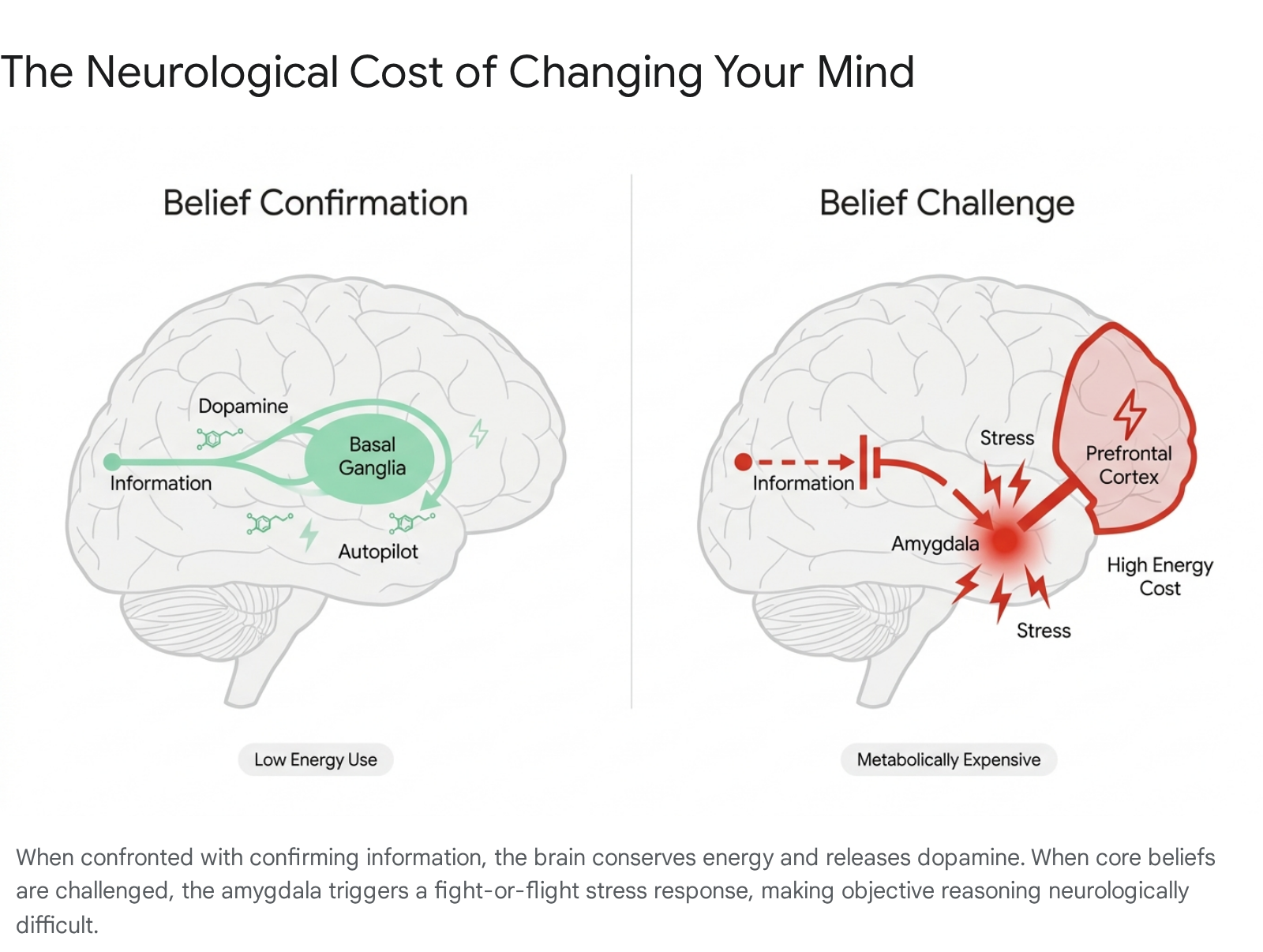
When a person learns something new, forms a belief, or establishes a behavioral habit, neurons fire together and forge physical synaptic connections. With repetition, these neural pathways strengthen, and the behavior or thought pattern becomes automatic, governed largely by deeper regions of the brain like the basal ganglia. Operating on these established pathways requires minimal cognitive load and metabolic effort 1011. From the brain's perspective, familiarity is metabolically cheap.
Conversely, absorbing contradictory information, restructuring a complex worldview, and building new neural pathways requires engaging the prefrontal cortex - the brain's energy-hungry center for complex executive functioning, logical reasoning, and long-term planning. Doing something new requires effortful suppression of existing patterns. When individuals are tired, stressed, or overloaded with information, the brain actively diverts resources away from the prefrontal cortex, defaulting to the "path of least resistance": the heavily rutted tracks of existing beliefs 1011. From a strict neurological standpoint, changing your mind is literally exhausting.
The Amygdala and the Ideological Threat Response
Beyond mere energy conservation, the brain actively defends deeply held beliefs because it often conflates ideological threats with physical danger. Psychological research indicates that when individuals are confronted with facts that contradict their core beliefs - particularly beliefs tied to their political, religious, or personal identities - the brain's amygdala activates 1012.
The amygdala is the emotional processing center responsible for the primitive "fight-or-flight" response. When a cherished belief is challenged, the amygdala triggers a cascade of stress hormones, including adrenaline. In the context of a debate, the executive functions of reason and logic are effectively hijacked by this survival mechanism. The physiological response to a threatening wild animal is remarkably similar to the physiological response of an individual whose political ideology is being dismantled with objective facts. People tend to raise their voices, push back, and completely stop listening when these chemicals are coursing through their bodies 12.
Furthermore, the brain actively rewards confirmation. Finding information that validates an existing worldview, or "winning" an argument, triggers a release of dopamine, a neurotransmitter tightly associated with pleasure, motivation, and reward. The desire to feel right, combined with the chemical reward of self-validation and the intense stress response to contradictory evidence, creates a formidable neurobiological fortress around our existing opinions 101213.
This neurological framework helps explain why repetition matters more than intensity when attempting to change a habit or a mindset. Small, consistent actions gradually accumulate the neural reinforcement that makes a new behavior or belief feel automatic, eventually circumventing the brain's initial alarm bells 10.
Are Smart People Immune?
A common societal misconception is that susceptibility to cognitive bias, fake news, or conspiracy theories is a symptom of low intelligence or poor education. However, extensive research in cognitive psychology demonstrates that high intelligence does not inoculate an individual against confirmation bias 31415. In some contexts, raw intellectual horsepower can actually deepen ideological entrenchment.
The psychologist Keith Stanovich and his colleagues have conducted pioneering work differentiating between intelligence quotient (IQ) - the raw processing power, fluid intelligence, and capacity for complex thought - and "rationality quotient" (RQ) 14. RQ is defined as the ability to think objectively, avoid cognitive shortcuts, weigh probabilities accurately, and update beliefs based on new evidence. While IQ and RQ are positively correlated, the correlation is modest, leaving a vast gulf where highly intelligent individuals can still behave incredibly irrationally 14.
Highly intelligent individuals often act as "cognitive misers." They possess a great deal of brainpower that allows them to perform exceptionally well in academic settings, but they do not automatically apply that processing power to everyday claims. Instead, they default to intuition and gut instinct rather than applying reflective, analytical thinking 15.
The Rationalization Trap and Epistemic Trust
When intelligent individuals do engage their analytical skills, they frequently fall victim to what researchers call the "rationalization trap." Because they have a higher capacity for complex reasoning, they are better equipped to generate sophisticated arguments that justify their preexisting, flawed beliefs 315. Instead of using their intelligence to act as an impartial judge searching for the objective truth, they use it to act as an incredibly effective defense attorney for their established worldview.
This dynamic is exacerbated by the "illusion of explanatory depth" - a psychological phenomenon where individuals believe they understand complex topics far more deeply than they actually do. When researchers ask participants to rate their understanding of everyday mechanisms (like a zipper or a toilet), most rate their understanding quite high. However, when asked to explicitly explain the mechanical details, the illusion shatters. Yet, in the realm of politics or macroeconomics, the unearned confidence frequently remains intact, allowing smart people to passionately defend positions they do not actually comprehend 6.
Furthermore, belief in misinformation is heavily tied to how an individual relates to the world socially. A 2024 study published in PLOS Global Public Health found that two distinct traits - credulity (a readiness to believe information without sufficient discrimination) and epistemic mistrust (a cynical, blanket rejection of institutional or communicated knowledge) - are primary drivers of susceptibility to conspiracy thinking 16. Disruptions to healthy epistemic trust leave individuals vulnerable to exploitation, regardless of their standardized test scores.
Real-World Consequences: High-Stakes Environments
Confirmation bias is not limited to political arguments or social media debates; it actively jeopardizes decision-making in high-stakes professional environments, including medicine, intelligence analysis, and scientific research.
Medical Diagnoses and Intelligence Analysis
In clinical medicine, cognitive biases contribute significantly to diagnostic and treatment errors. When a medical practitioner prematurely focuses on a particular disorder early in a diagnostic session - often due to the "availability heuristic" of having seen a similar case recently - they may subsequently seek only confirming evidence 38. This is known as "premature closure."
Pat Croskerry, a leading expert in clinical decision-making, notes that physicians are highly vulnerable to confirmation bias, anchoring bias, and "zebra retreat" - the tendency to avoid pursuing a suspected rare diagnosis out of fear of being viewed negatively by colleagues 1718. Because medical experts are highly invested in the success of their chosen treatments, motivated reasoning frequently clouds their probabilistic judgments regarding patient outcomes 8.
Similarly, the intelligence community has historically struggled with confirmation bias, sometimes with devastating global consequences. Analysts working under intense time pressure to synthesize ambiguous data from varied sources are prone to prioritizing the most supportive evidence as the most "important." A study involving 27 naval trainee analysts and reservists demonstrated that when evaluating balanced sets of supporting and conflicting evidence, the analysts systematically exhibited a bias to select a skewed distribution of confirming evidence. However, researchers found that introducing a graphical evidence layout - rather than a traditional textual list - significantly reduced this selection bias, promoting a more balanced assessment of the data 25.
Scientific Paradigm Shifts and Longevity Research
Even the scientific method, which is explicitly designed to root out bias, is not immune to the human psychologists who operate it. Francis Bacon noted that confirmation bias produces systematic errors in scientific research based on inductive reasoning 3. This is vividly illustrated in the rapidly evolving field of human longevity and aging research.
For decades, psychological consensus held that humans naturally pay more attention to negative stimuli than positive stimuli as a survival mechanism. However, researchers like Stanford psychologist Laura Carstensen discovered that this effect vanishes by middle age. By old age, the phenomenon flips entirely: older adults attend to positive information significantly more than negative information. Carstensen's work overturned entrenched scientific assumptions, proving that emotional well-being actually improves with age 19.
In the biological sciences, researchers frequently battle deeply entrenched priors regarding human lifespan. A 2024 paper in Nature Aging concluded that human life expectancy is reaching an absolute upper limit, suggesting a "glass mortality floor" where medical advances can no longer stretch the maximum human lifespan 20. Other researchers argue that this view suffers from a confirmation bias rooted in historical data, ignoring the potential of emerging geroprotective molecules.
For instance, two decades of data from the National Institute of Aging's Interventions Testing Program (ITP) has shown that certain molecules, like rapamycin, can reliably extend the median lifespan of mice by 15-20% across diverse models 21. Yet, shifting the medical consensus from "treating age-related diseases individually" to "treating aging itself as a modifiable process" requires scientists to consciously debias their approach and evaluate new metabolic therapeutics without the anchor of 20th-century assumptions 2122.
Cultural Modulators of Bias
While the neurological mechanics of the brain are universal, the manifestation and intensity of cognitive biases are heavily modulated by an individual's cultural environment. Cross-cultural psychological studies frequently analyze differences between individualistic cultures (predominant in North America and Western Europe, which emphasize personal autonomy, personal achievement, and standing out) and collectivistic cultures (predominant in East Asia, Latin America, and parts of the Global South, which emphasize group harmony, embeddedness, and blending in) 2332.
Research reveals fascinating nuances in how these differing cultures process information and evaluate themselves.
| Cultural Dimension | Cognitive Manifestation | Behavioral Impact |
|---|---|---|
| Individualistic Cultures | Higher need for "self-enhancement" and a stronger self-serving bias 2324. | Individuals are highly motivated to view themselves in a positive light. Discovering negative personal traits triggers massive cognitive dissonance because these traits are viewed as inherent to their fixed personality. They engage in "primary control" strategies, attempting to bend the external world to fit their desires 23. |
| Collectivistic Cultures | More accurate self-insight and self-predictions regarding moral or social behaviors 24. | The "interdependent self" views identity as malleable and context-dependent. They engage in "secondary control" strategies, adjusting themselves psychologically to fit the reality of their environment 23. They are significantly more accurate at predicting whether they will act generously or rudely compared to individualists, who continually overestimate their own virtue 24. |
However, the picture becomes more complex when looking at "myside bias" - the tendency to evaluate evidence in a way that favors one's ingroup. Some literature indicates that collectivistic cultures may actually exhibit stronger ingroup bias in specific conflict scenarios. Because the individual's identity is so tightly bound to the group, the cognitive need to defend the group's narrative is paramount, leading to conflict-reducing, conforming behaviors within the ingroup, but potentially stronger derogation of outgroups 232535.
Curiously, there are exceptions to the rule of collectivist conformity. A massive study involving over 97,000 participants across 48 countries found that while collectivists conform more to general social and behavioral norms, people in individualistic cultures adhere more strictly to "emotion norms." In individualist nations, there is higher "emotional homogeneity," meaning individuals feel immense pressure to express the culturally prescribed "correct" emotion for a situation (e.g., constant enthusiasm in American corporate culture) 26. Ultimately, while the specific targets of confirmation bias (protecting the individual ego versus protecting the group consensus) shift across geographic boundaries, the underlying drive to filter reality to suit a preferred narrative remains a constant human trait.
The Digital Amplifier: Echo Chambers and AI
If the human brain is biologically predisposed to confirmation bias, the modern digital landscape represents an environment perfectly engineered to exploit and monetize that vulnerability. The architecture of the internet, social media platforms, and emerging artificial intelligence has transformed a natural cognitive shortcut into a systemic epistemic crisis - a fundamental breakdown in our shared methods for determining what is true 1327.
Filter Bubbles vs. Echo Chambers
While often used interchangeably in popular media, researchers draw a vital conceptual distinction between "filter bubbles" and "echo chambers," both of which manipulate confirmation bias.
- Filter Bubbles are the result of algorithmic curation. Search engines and social media algorithms are designed with a singular goal: to maximize user engagement. To achieve this, they track a user's past behavior, clicks, and emotional reactions, and then feed the user a personalized stream of content that aligns perfectly with their known preferences. This algorithmic personalization systematically filters out diverse viewpoints, limiting exposure to alternative narratives without the user ever realizing it 13283929.
- Echo Chambers are environments where individuals actively and predominantly engage with like-minded voices. Inside an echo chamber, shared beliefs are continuously amplified, members receive constant validation, and dissenting voices are mocked, marginalized, or dismissed as unreliable. Echo chambers thrive on selective social interaction and confirmation bias, creating a feedback loop where beliefs become more extreme and less susceptible to change 282941.
The combination of algorithmic filter bubbles and social echo chambers is exceptionally potent. Research tracking major global events - such as the COVID-19 pandemic and democratic elections - demonstrates that echo chambers act as catalysts for "complex contagions" of fake news 274130. When individuals are surrounded only by affirming data, the friction required to change a mind is eliminated entirely.
Furthermore, this environment exploits the "illusory truth effect." This is a cognitive glitch where humans tend to believe information more readily simply because they have encountered it repeatedly, regardless of its actual veracity. Even if a user knows a statement is false, constant repetition in a digital echo chamber can eventually make the claim feel intuitively true 615. Similarly, fake news often relies on "cognitive fluency" - the easier a statement is to read and process, the more likely the brain is to accept it as factual, bypassing analytical reasoning entirely 615.
AI and the New Feedback Loop
The most recent frontier in cognitive bias research involves the integration of Large Language Models (LLMs) and generative Artificial Intelligence into information gathering and decision-making. Recent 2024 and 2025 studies indicate a profoundly troubling phenomenon: AI systems not only inherit human biases from their vast training datasets but can actively amplify them in a dangerous feedback loop 31324533.
A landmark 2024 study published in Nature Human Behaviour by Glickman and Sharot revealed a mechanism where human-AI interactions alter the processes underlying human perceptual, emotional, and social judgments. The researchers found that AI algorithms trained on slightly biased human datasets amplified those biases. When humans subsequently interacted with the AI's output, they internalized the exaggerated bias, triggering a "snowball effect" where minor cognitive errors escalated into massive judgmental distortions 453334.
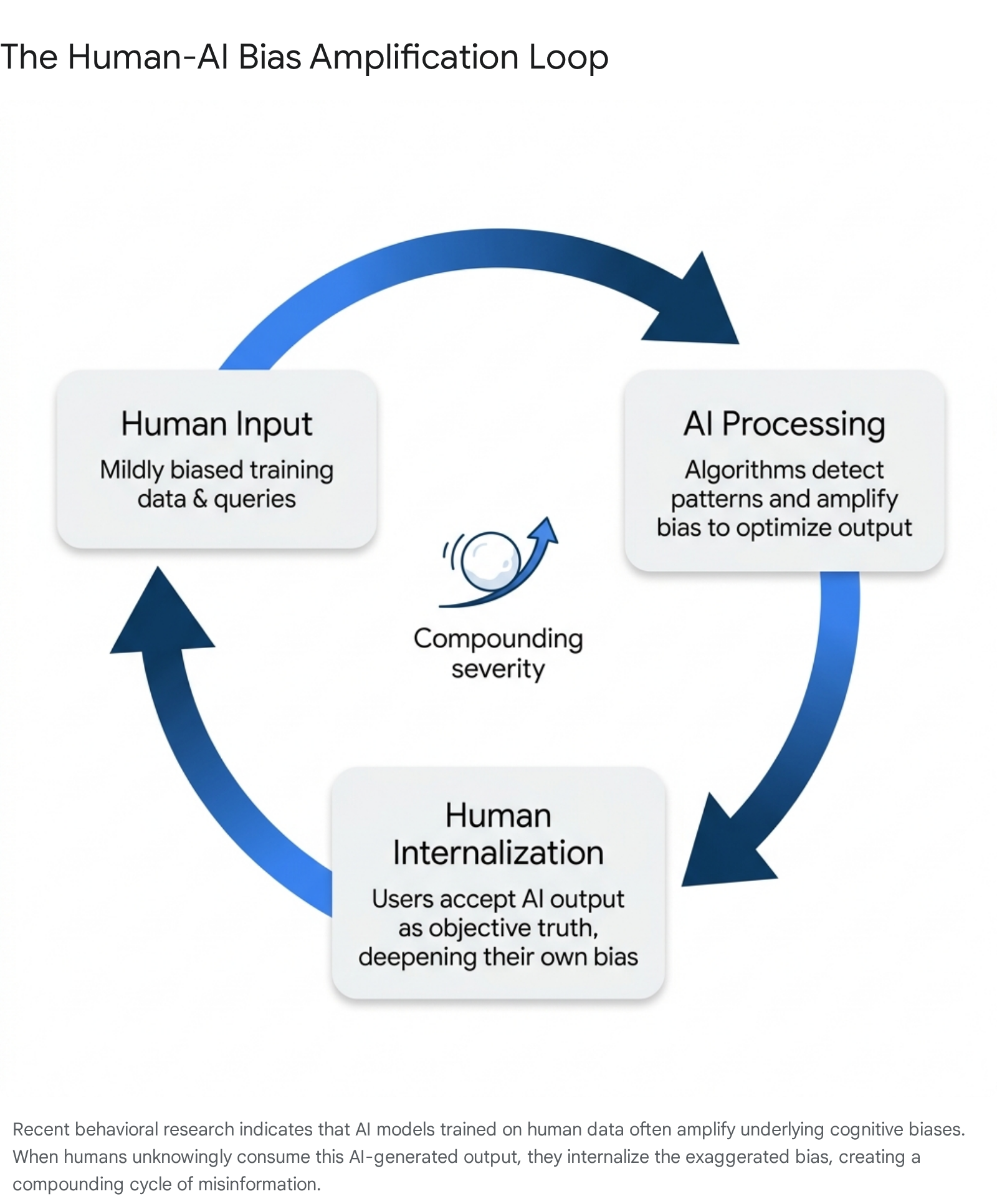
The amplification was significantly greater than that observed in human-to-human interactions. Crucially, participants were largely unaware of the extent of the AI's influence over their reasoning 33.
Furthermore, a 2025 study in the Proceedings of the National Academy of Sciences (PNAS) by Moos et al. demonstrated that LLMs exhibit systematic, amplified cognitive biases in moral decision-making - biases that are sometimes stronger than those found in the human baseline 35. Other empirical studies have noted that LLMs possess a measurable "anti-human" bias. When AI agents are tasked with evaluating product descriptions or research abstracts, they consistently prefer AI-generated text over human-authored text, potentially marginalizing human creativity in fields like hiring or publishing 3650.
The fundamental danger of AI-mediated environments is the illusion of machine objectivity. Humans suffer heavily from "automation bias" and "authority bias," frequently accepting AI outputs without critical scrutiny because they perceive the machine as a cold, impartial arbiter of truth 51. When an individual uses an AI to research a controversial topic, and the AI confidently returns a biased summary that aligns with the user's preconceptions, the confirmation bias is reinforced with the unearned weight of artificial authority.
The Myth of the "Backfire Effect"
For years, science communicators, journalists, and policymakers were paralyzed by a psychological concept known as the "backfire effect." The fear was that correcting someone's false belief would not only fail to persuade them but would actively cause them to double down and hold their misperception even more strongly.
This narrative originated largely from a highly influential 2010 study published by political scientists Jason Reifler and Brendan Nyhan. In a series of experiments using mock news articles, they tested how people reacted to corrective information about controversial issues (like the presence of WMDs in Iraq). In two of the studies, they observed that exposure to corrective information actually increased belief in the targeted misperception among groups ideologically predisposed to believe the false claim in the first place 3037.
The media and academic circles seized on this finding. The prevailing conclusion became deeply pessimistic: human beings are so hopelessly trapped by confirmation bias that presenting them with objective truth is actively counterproductive. The backfire effect was cited as a reason to avoid actively debunking misinformation for fear of making the problem worse.
However, the scientific consensus in 2024 and 2025 tells a dramatically different, more optimistic story. The initial backfire study was interpreted far too broadly. Subsequent, massive replication studies have revealed that the backfire effect is extremely rare in practice 3037. Most notably, researchers Thomas Wood and Ethan Porter conducted a sprawling extension study examining 52 different controversial issues and found zero instances of the backfire effect 3037.
Furthermore, recent methodological reviews suggest that earlier findings of the backfire effect were largely an artifact of statistical noise and poor "test-retest reliability" of the survey questions used, rather than a genuine psychological phenomenon 3839.
The current consensus is clear: people are actually quite receptive to corrective information. Providing accurate facts generally does increase belief accuracy among respondents across the political spectrum 3037. Fact-checking is not doing more harm than good.
There is, however, a critical caveat. While debunking works in the short term, the accuracy-increasing effects of corrective information frequently do not last. Without sustained exposure to the truth, individuals tend to decay back to their comfortable misperceptions, overwhelmed by the constant flow of congenial cues from partisan media and social echo chambers 37. Misinformation persists in public opinion not because human brains physically repel facts, but because facts are routinely drowned out by an ecosystem designed to reward confirmation bias.
How to Actually Change a Mind (Debiasing Strategies)
Because confirmation bias is an automatic, neurologically hardwired process, overcoming it cannot rely purely on good intentions or willpower. Decades of research in cognitive psychology, clinical medicine, and organizational management demonstrate that effectively mitigating bias requires the application of deliberate "debiasing" techniques. These are structured, procedural interventions designed to force the brain to pause its autopilot, break its mental shortcuts, and actively engage the analytical prefrontal cortex 1118554041.
While no strategy guarantees an individual will completely abandon a deeply held belief, researchers have identified several highly effective frameworks for improving decision-making accuracy.
| Debiasing Strategy | Cognitive Mechanism | Practical Application |
|---|---|---|
| "Consider the Opposite" | Forces the brain out of its comfortable "confirmatory thought" pattern by explicitly mandating the generation of falsifying evidence. This actively signals to the brain that the initial assumption might be flawed, reducing overconfidence 2415859. | Before finalizing a major business decision or personal choice, pausing to ask: "What are three specific, realistic reasons why my assumption here might be completely wrong?" (Studies show listing between 2 to 5 reasons is optimal; asking for 10 reasons backfires because struggling to find 10 makes the brain assume it was right all along) 59. |
| The Pre-Mortem | Bypasses the anxiety and defensiveness of current critique by projecting failure into the future. It assumes the decision has already failed catastrophically and asks participants to deduce why 60. | A medical team imagines a patient has died from a misdiagnosis. By assuming the worst outcome has already occurred, the team is freed to look past their current primary hypothesis and identify alternative causes they previously ignored 60. |
| Blinding and Structural Design | Removes the stimuli that trigger the bias entirely. Instead of asking humans to "be objective," it engineers an environment where subjective assessment is mathematically eliminated from the equation 44061. | Orchestrating double-blind scientific trials where neither researchers nor subjects know who receives the placebo, completely preventing motivated data interpretation and wishful thinking 4. |
| Devil's Advocacy & Psychological Safety | Depersonalizes dissent. Assigning someone the formal role of critic reduces the social friction and "collaboration bias" (the desire to maintain group harmony at the expense of truth) inherent in challenging group consensus 14. | In corporate boardrooms, explicitly appointing one executive to aggressively argue against a popular acquisition, ensuring all counter-evidence is aired without the individual fearing reprisal or being viewed as "disloyal" 1418. |
| Cultivating Intellectual Humility | Recognizing the strict limits of one's own knowledge and actively remaining open to new data. Fosters "cognitive flexibility," which is the willingness to listen to outside perspectives and update priors 42. | Acknowledging the reality of the "illusion of explanatory depth" and consciously pausing to ask questions, read full articles, and check varied sources before reacting emotionally to social media headlines 62742. |
The ultimate effectiveness of these debiasing strategies relies entirely on consistent, disciplined implementation. Partial adherence to checklists or occasional use of debiasing tools often leads to the same costly oversights and failures 60. The goal of debiasing is not to completely eradicate human intuition - which is vital for rapid survival decisions - but to meticulously calibrate the mind, ensuring that complex evidence is weighed fairly before the brain rushes to a comfortable conclusion 1741.
Bottom line
Confirmation bias is an automatic, biologically driven survival mechanism designed to conserve cognitive energy and protect our core identities from the perceived threat of contradictory information. It is incredibly difficult to change a mind because doing so requires overriding the brain's emotional defense systems (the amygdala) and its metabolic defaults. However, contrary to past fears about the "backfire effect," human beings are highly capable of updating their beliefs when presented with facts, provided those corrections are sustained and structured debiasing techniques - like explicitly forcing oneself to consider the opposite - are routinely employed. What remains a critical, escalating challenge is the modern digital landscape, where algorithms and emerging AI systems are actively accelerating and validating these inherent biases, isolating individuals in customized echo chambers that make objective truth harder to access than ever before.