Psychology and neuroscience of resistance to change
Introduction to the Status Quo Bias
The human tendency to resist change and maintain the current state of affairs is a pervasive phenomenon that dictates behavior across individual decision-making, organizational adaptation, and societal evolution. In the behavioral sciences, this phenomenon is formally conceptualized as the status quo bias, first distinctly identified in behavioral economics by Samuelson and Zeckhauser in 1988 123. Status quo bias is the cognitive preference for an existing baseline over available alternatives, wherein any deviation from the current state is perceived primarily as a loss or a disproportionate risk 3.
While there are circumstances where maintaining the current state is a rational preference - such as when the existing condition is objectively superior to alternatives or when imperfect information makes change excessively risky - the status quo bias explicitly refers to the non-rational, disproportionate weighting of the default option 34. It operates not through analytical logic, but through psychological inertia, leading individuals to favor doing nothing or maintaining previous modes of behavior even when transitioning would yield a net positive utility 256. This bias manifests across a wide spectrum of human activity, from consumers clinging to outdated financial habits and glitchy software platforms 257, to voters resisting political reforms, to employees obstructing corporate transformations despite obvious systemic inefficiencies 68.
To fully understand why humans actively resist change even when it is beneficial, it is necessary to examine the phenomenon through an interdisciplinary lens. This involves exploring the evolutionary origins that made change-aversion an adaptive survival trait, the psychological frameworks that construct the bias, the neurobiological and metabolic constraints of the human brain, and the cross-cultural variations that modulate its behavioral expression.
Evolutionary Foundations of Cognitive Inertia
The architecture of human cognition is intrinsically biased, but modern evolutionary psychology posits that these cognitive biases are not inherently flaws or defects in reasoning. Instead, they are adaptive features - strategic instincts shaped by millions of years of natural selection in environments defined by radical uncertainty and extreme scarcity 910.
Error Management Theory
The most robust evolutionary explanation for the persistence of cognitive biases, including the status quo bias, is Error Management Theory, developed by Haselton and Buss 91112. Error Management Theory proposes that judgments made under uncertainty inevitably result in errors, which fall into two distinct categories: false positives and false negatives 1112. In ancestral environments, the evolutionary costs of these two types of errors were highly asymmetrical.
For example, when an early human heard a rustling in the grass, assuming the sound was a predator when it was merely the wind constituted a false positive. This required the expenditure of metabolic energy to flee, but the organism survived. Conversely, assuming the sound was the wind when it was actually a predator constituted a false negative, which was frequently fatal 9. Because the cost of a false negative was absolute, natural selection favored a cognitive architecture systematically biased toward the less costly error. This dynamic is often referred to as the smoke-detector principle, operating on the logic that it is biologically preferable to have a system that occasionally triggers false alarms than one that misses a lethal threat 13.
When applied to decision-making and resistance to change, the status quo represents the known environment. It is an established baseline in which the organism has successfully survived up to the present moment. Any departure from the status quo introduces unknown variables and existential risks. In the context of Error Management Theory, the status quo bias functions as a protective heuristic 410. It steers human behavior away from potentially fatal missteps by inherently assuming that the risks of the unknown alternative outweigh the potential benefits, thereby minimizing costly errors over time 1012.
The Threat Management System
Evolutionary models further emphasize that humans evolved a specialized threat management system to cope with physical and social stimuli that pose risks to well-being 14. This system operates constantly in the background, monitoring for disruptions. Because environmental stability allowed ancestral humans to predict resource availability and predator behavior, unpredicted change was processed biologically as a direct survival threat. This system is subdivided into a disease-avoidance mechanism, which recognizes pathogens, and a self-protection mechanism, which anticipates physical danger 14. In ancestral environments characterized by intergroup conflict and coalitional violence, an adaptive conspiracism emerged, causing humans to be highly suspicious of changes introduced by outgroups 14.
In modern settings, this ancient threat management architecture is frequently mismatched to the environment. The modern industrial and digital world demands rapid adaptation to harmless conceptual changes, such as the implementation of new organizational software or policy updates 59. However, the brain's threat management system still processes these sudden shifts as environmental disruptions, triggering anxiety and a withdrawal to the safety of the familiar 14. Thus, the status quo bias is ecologically rational for small-group survival on the savanna, but it frequently results in systematic dysfunction and missed opportunities in modern contexts where the risks of change are rarely fatal 9.
Ecological Rationality and Eristic Decision-Making
To navigate environments where information is scarce and unreliable, cognitive evolution developed an adaptive toolbox of heuristics, which are fast and frugal mental shortcuts 1115. However, when uncertainty becomes extreme, decision-making often shifts from heuristics to eristics. Eristic decision-making is not intendedly rational; rather, it relies on action-triggering shortcuts that draw on hedonic urges and emotional attachments to cope with overwhelming unknowns 1516. The status quo bias acts as a powerful eristic tool in times of extreme uncertainty. By clinging to the default option, individuals satisfy a hedonic desire for psychological comfort, deliberately prioritizing anxiety reduction over the pursuit of an objectively superior but highly uncertain alternative 1516.
Psychological Mechanisms of Resistance
Status quo bias does not operate as a standalone cognitive error. It emerges from the cumulative pressure of interconnected psychological heuristics converging to prioritize safety, familiarity, and loss avoidance 517. Social psychology and behavioral economics have identified a complex matrix of psychological constraints that collectively anchor individuals to their current state.
Loss Aversion and the Endowment Effect
At the core of the status quo bias lies loss aversion, a fundamental principle of Kahneman and Tversky's Prospect Theory 31819. Loss aversion denotes that the psychological pain experienced from losing an asset is significantly greater than the pleasure derived from an equivalent gain 2320. When an individual considers changing the status quo, the transition is evaluated strictly in terms of what will be lost versus what will be gained. Because the value function within the human brain is steeper in the domain of losses, the prospect of losing the familiar vastly outweighs the prospect of gaining an improvement 319.
This phenomenon is inextricably linked to the endowment effect, which states that people attribute greater subjective value to an object, state, or system simply because they already possess it 2122. Consequently, an individual will demand a much higher incentive to give up their current state than they would be willing to pay to acquire it in the first place 321. Together, loss aversion and the endowment effect distort rational cost-benefit analyses, heavily tipping the scales in favor of inaction by inflating the perceived value of the familiar and shrinking the perceived value of change 3521.
Regret Avoidance and the Omission Bias
The anticipation of regret plays a critical role in maintaining the status quo. Regret avoidance dictates that individuals proactively make choices designed to minimize future feelings of remorse 319. Behavioral research indicates that human beings experience significantly higher levels of regret when negative outcomes result from an active decision to change an action, compared to when equally negative outcomes result from maintaining the current state, which constitutes an omission or inaction 22324.
This specific asymmetry is formally known as the omission bias - the tendency to judge harmful actions as significantly worse than equally harmful inactions 15. For example, if a consumer switches from a familiar brand to a new brand and is disappointed, the psychological sting is severe because they bear personal responsibility for the active deviation. If they stick with the familiar brand and its quality degrades, the psychological pain is mitigated by the comfort of having stuck with the default 2. The status quo serves as a psychological shield against the burden of responsibility and potential future regret.
The Ambiguity Effect
Change intrinsically involves moving toward the unknown. Ambiguity aversion, commonly referred to as the ambiguity effect, describes the human tendency to avoid options where the probability of a favorable outcome is unknown, heavily favoring options where the outcome probability is established and understood 72526. It is important to distinguish the ambiguity effect from standard risk aversion. Risk aversion occurs when probabilities are known, but an individual selects a lower-yield, safer option. Ambiguity aversion occurs precisely because the information regarding probability is missing entirely 2226.
The human brain demonstrates a deep intolerance for ambiguity, routinely treating unknown probabilities as direct threats 27. To counteract the psychological stress of profound uncertainty, the brain utilizes narrowed attention, focusing intensely on the familiar while discarding ambiguous options 7. The ambiguity effect continuously reinforces the status quo bias because the existing state represents a known probability distribution of outcomes, while the alternative represents an ambiguous threat 525.
Cognitive Load, Decision Fatigue, and Sunk Costs
Cognitive load and choice overload are powerful catalysts for status quo adherence. Evaluating new alternatives requires significant mental effort, active control, and conscious awareness 1719. When individuals are presented with a high volume of complex choices, decision fatigue rapidly sets in. To escape the psychological strain of computation and choice-making, the mind defaults to the path of least resistance: the status quo 519. In environments plagued by decision fatigue, status quo bias is often less about making a deliberate decision and more about executing a strategy of decision avoidance 19.
Furthermore, the sunk cost fallacy binds individuals to the status quo through prior commitments. When people have invested time, financial resources, or emotional energy into an existing system, process, or relationship, abandoning it feels like a total loss of that accumulated investment 52128. The intrinsic human desire to justify past expenditures keeps people locked into suboptimal software architectures, failing financial investments, and inefficient corporate policies long past their point of utility 523.
System Justification and Mere Exposure
Finally, populations exhibit a strong drive for system justification - the tendency to defend, bolster, and legitimize existing social, economic, and political arrangements, even when they are demonstrably flawed 521. Existing systems create predictability, and humans will actively rationalize the flaws of the current model to avoid the destabilization that systemic change brings 5. This is further compounded by the mere exposure effect, an underlying cognitive bias demonstrating that repeated exposure to neutral stimuli causes individuals to rate them more favorably over time 1726. Because people are continuously exposed to their current baseline, familiarity breeds a non-rational preference for it 17.
To clarify the distinctions and overlapping mechanisms of these cognitive drivers, the following table summarizes the primary psychological biases that construct and reinforce human resistance to change.
| Cognitive Bias | Core Mechanism | Relationship to Status Quo Bias |
|---|---|---|
| Loss Aversion | The psychological pain of loss is weighed much heavier than the pleasure of equivalent gain. | Change is perceived as losing the current state; the fear of this loss outweighs the potential gains of the new state. |
| Endowment Effect | Placing a higher value on an object/state simply because it is already possessed. | Inflates the perceived value of the current baseline, demanding an artificially high threshold to justify a switch. |
| Ambiguity Effect | Avoidance of options where the probability of success is unknown or missing. | New alternatives usually carry unknown variables; the brain penalizes them compared to the known status quo. |
| Omission Bias | Judging harmful outcomes caused by action as worse than harmful outcomes caused by inaction. | Punishes active change. Staying the course (inaction) feels safer than initiating a change (action) that might fail. |
| Sunk Cost Fallacy | Continuing a behavior due to previously invested resources (time, money, effort). | Creates artificial commitment to the existing state to validate past efforts, preventing beneficial transitions. |
| System Justification | Rationalizing and defending existing systems, regardless of their objective flaws. | Generates a psychological defense mechanism against systemic shifts, favoring predictability over improvement. |
Neurobiological Architecture of the Status Quo
While psychological frameworks map the behavioral symptoms of the status quo bias, cognitive neuroscience provides unparalleled insight into the exact neural circuitry and metabolic constraints that physically govern resistance to change. Recent advancements in functional neuroimaging reveal that change aversion is deeply rooted in the brain's architecture, emotional processing centers, and energy conservation protocols 623.
Metabolic Constraints and Cognitive Efficiency
The human brain is an exceptionally metabolically expensive organ. While it constitutes only about two percent of total body weight, it consumes roughly twenty percent of the body's energy at rest 6. Because of this disproportionate metabolic demand, the brain operates on a fundamental biological principle of energy conservation, heavily favoring automaticity, ingrained routines, and habits 6.
The prefrontal cortex, which is responsible for deliberate, analytical decision-making and evaluating novel alternatives, requires massive energy resources to operate 6. By contrast, the basal ganglia, which physically encodes habits and routines through synaptic strengthening, operates with high neurological efficiency. When an individual faces the prospect of change, the brain must shift processing from the efficient basal ganglia back to the energy-intensive prefrontal cortex. Under conditions of cognitive load, mental fatigue, or stress, the brain predictably defaults to the familiar status quo simply to avoid the metabolic cost of deliberation 67. In this sense, cognitive inertia is the biological default state of the human brain.
The Amygdala, Striatum, and Insula
When change is mandated or evaluated, it frequently triggers the brain's emotional and risk-assessment centers. Functional magnetic resonance imaging studies show that the ventral striatum and the ventromedial prefrontal cortex - regions heavily associated with valuation - respond significantly stronger to the prospect of loss than to the prospect of gain 2930. This asymmetry in neural valuation is directly correlated with an individual's degree of behavioral loss aversion 29.
Furthermore, the amygdala, a key structure in the limbic system responsible for processing fear and threat, plays a central role in anchoring behavior to the status quo. Neuroimaging reveals that uncertainty and the prospect of change rapidly activate the amygdala, generating anticipatory anxiety 6. Studies show that emotionally induced changes in the functional connectivity between the amygdala and the ventral striatum are strongly associated with increased loss aversion, particularly in individuals who exhibit low baseline trait anxiety 1831. When a decision environment is framed by negative emotion or uncertainty, the amygdala-striatum circuit exaggerates the neural signals for potential losses, compelling the individual to reject change as a means of self-preservation 18.
The anterior insula is also critically involved, particularly concerning the emotion of regret 624. Behavioral evidence indicates that errors made by rejecting the status quo are felt more acutely than errors made by accepting it. Neuroimaging robustly supports this behavioral observation: erroneous rejections of the status quo generate inflated neurobiological responses in the anterior insula and medial prefrontal cortex 2324. This elevated error-signal effectively trains the brain to avoid deviating from the default in the future, physically embedding the status quo bias as a learned physiological avoidance response 2324.
Prefrontal-Basal Ganglia Dynamics
Overcoming the status quo bias requires the active, conscious suppression of default neural pathways. Researchers utilizing visual detection tasks paired with functional magnetic resonance imaging have discovered that rejecting the status quo in the face of difficult decisions selectively increases activity in the subthalamic nucleus 3233. The subthalamic nucleus is a component of the basal ganglia traditionally associated with the outright suppression of motor responses, functioning as an internal braking mechanism 32.
When a decision is difficult and the brain naturally leans toward the low-energy default option, the inferior frontal cortex must exert an enhanced modulatory influence on the subthalamic nucleus to halt the default acceptance and allow for a cognitive switch away from the status quo 3233. This suggests that choosing an alternative over a familiar default is neurobiologically akin to physically stopping an action that is already in motion; it requires active, resource-heavy neural intervention 32.
Methodological Caveats in Neuroimaging
It is vital to note that modern neuroscience continuously refines its interpretation of functional magnetic resonance imaging signals. Recent research utilizing advanced measurement techniques suggests that in roughly forty percent of observed cases, an increased signal, which tracks blood oxygenation level-dependent responses, may actually be associated with reduced true neural activity 34. Brain regions often meet extra energy demands by extracting oxygen more efficiently from existing local supplies rather than relying solely on increased blood flow 34. While the structural involvement of the amygdala, insula, and subthalamic nucleus in status quo maintenance is well-documented, the exact physiological metabolic dynamics - and whether certain signals denote activation versus highly efficient suppression - remain an evolving area of study that requires calibrated uncertainty 34.
Novelty Seeking and Dopaminergic Pathways
If the brain is inherently wired to conserve energy, avoid the risks of change, and punish deviation through regret signals in the insula, how do humans ever innovate, explore, or break habits? The neurobiological counterweight to the status quo bias lies primarily within the dopaminergic system and the manifestation of the novelty-seeking personality trait.
The Novelty Seeking Trait
In psychology, novelty seeking is defined as a heritable personality trait characterized by an inherent, powerful drive to pursue new experiences, explore unfamiliar environments, and achieve intense emotional stimulation 3536. Individuals exhibiting high levels of novelty seeking are typically more impulsive, more prone to risk-taking behavior, and exhibit a remarkably high tolerance for ambiguity compared to the general population 35. This trait acts as a direct, functional antagonist to the status quo bias. While a high status quo bias tightly correlates with strong harm avoidance and low risk tolerance, novelty seeking inverses this behavioral relationship, placing the desire for exploration and stimulation above the fear of loss 3537.
Dopaminergic Modulation and Value Assignment
The neurotransmitter dopamine is classically linked to the brain's reward system, facilitating associative learning by signaling relationships between predictive cues and subsequent outcomes 383940. However, dopamine is also fundamentally and independently modulated by novelty 394041. Novel stimuli inherently excite dopamine neurons and trigger activation in brain regions receiving dense dopaminergic input 3642.
Research involving the administration of selective dopamine transporter inhibitors, such as GBR-12909, in non-human primates demonstrates that blocking dopamine reuptake - thereby increasing the availability of dopamine in the synaptic cleft - significantly increases the subjects' preference for exploring novel options over exploiting familiar, proven ones 3642. Crucially, enhancing dopaminergic transmission does not alter the subjects' underlying ability to learn which options yield the best long-term rewards, nor does it affect their learning rate; rather, dopamine artificially enhances the initial subjective value assigned to the novel option 3642.
When an individual confronts a potential change, the dopamine system can assign a high, optimistic baseline value to the unknown alternative. If the dopaminergic surge triggered by the prospect of novelty is strong enough, it effectively overrides the risk-averse loss signals generated by the amygdala and insula, providing the neurological momentum required to break away from the status quo 4243. Consequently, individuals with lower densities of dopamine autoreceptors, which normally function to inhibit dopamine release, experience far greater dopamine floods in response to new stimuli, making them highly susceptible to abandoning the status quo in favor of new experiences 38. Even in environments presenting unconditioned aversive stimuli, the introduction of a novel cue can robustly alter dopamine release patterns in the nucleus accumbens core, changing the directionality of dopamine responses and reshaping how threats are processed 3940.
The Zona Incerta
Recent discoveries in neuroanatomy indicate that the drive for novelty may possess its own dedicated neural circuitry, separate from the primary dopaminergic reward centers. Studies demonstrate that the zona incerta, a region located deep within the brain, is directly responsible for controlling novelty-seeking behaviors 44. Zona incerta neurons activate specifically to predict future novel objects and physically direct visual attention toward them. If zona incerta cellular activity is experimentally suppressed, the motivation to search for novel stimuli plummets precipitously 44. This illustrates that the motivation to experience change and novelty can act as an independent biological drive, existing parallel to, and sometimes actively competing with, the threat-avoidance systems that enforce the status quo bias 44.
Cross-Cultural Modulations of the Status Quo Bias
While the neurobiological hardware underlying the status quo bias is universal to the human species, its behavioral manifestation is heavily modulated by cultural software. The degree to which populations resist change, prioritize societal stability, and tolerate environmental ambiguity varies significantly across the cultural spectrum, most notably between individualistic and collectivistic societies 454647.
Individualism versus Collectivism
According to Geert Hofstede's cultural dimensions theory and broader cross-cultural psychology paradigms, individualistic cultures - predominantly Western societies such as the United States, the United Kingdom, and Australia - place profound emphasis on personal freedom, autonomy, uniqueness, and self-sufficiency 4647484950. In these societies, individuals derive their identity primarily from internal attributes and are awarded social status for personal accomplishments, technological innovation, and their ability to stand out from the collective crowd 4647.
Conversely, collectivistic cultures - found frequently across East Asia, parts of Africa, and Latin America - prioritize group harmony, societal embeddedness, loyalty, and strict adherence to tradition 46484951. Identity in collectivistic cultures is fundamentally interdependent, defined strictly by an individual's social roles and continuous relationships within their ingroup 454647.
Self-Enhancement and Social Harmony
The dominant cultural framework dictates the societal acceptability of challenging the status quo. Collectivistic cultures exhibit exceptionally high levels of embeddedness, which emphasizes maintaining the status quo at all costs and restraining actions that might disrupt ingroup solidarity or upend the traditional order 46. Because deviation from the norm risks severe social friction, collectivistic societies tend to display a much stronger psychological bias toward the current state of affairs, exhibiting considerably lower tolerance for individual actions that break established protocols 4651. Furthermore, cultures with a high Power Distance Index - a metric often correlating heavily with collectivism - foster environments where individuals defer automatically to authority figures and established hierarchies, inherently strengthening the persistence of the status quo bias 495253.
By contrast, individualistic cultures actively incentivize the disruption of the status quo. Because social status is inextricably linked to innovation and individual achievement, there is a distinct cultural, non-monetary premium placed on novelty, disruption, and change 46.
This divergence is also starkly evident in self-perception and the manifestation of cognitive biases. In individualistic cultures, there is a pervasive psychological need for self-enhancement - the tendency for individuals to view themselves in an overly positive, often inaccurate light 454654. This self-serving bias is practically non-existent in East Asian collectivistic populations. Instead, these populations demonstrate significantly higher accuracy in self-prediction and display a willingness to be openly self-critical in order to align seamlessly with societal expectations 4554. The individualistic drive for self-enhancement inherently supports risk-taking and challenging the baseline to elevate one's status, whereas the collectivistic focus on accurate, modest self-appraisal supports the uninterrupted maintenance of the existing social fabric 4554.
Additionally, macroscopic systemic factors such as societal inequality play a role in embedding the status quo. In highly unequal societies across the globe, psychological mechanisms such as stereotype ambivalence emerge. This involves viewing one group as competent but cold, and another as warm but incompetent. These ambivalent stereotypes serve to justify the respective positions of differing groups within the socio-economic hierarchy, thereby reinforcing and perpetuating the societal status quo 55. The intersection of culture and neurodivergence also highlights how behaviors challenging the Western status quo - such as atypical eye contact or rhythmic physical movement - are frequently pathologized in individualistic societies, whereas they are integrated or revered in specific African and East Asian traditions 56.
| Cultural Dimension | Primary Identity Focus | Approach to Change & Norms | Manifestation of Status Quo Bias |
|---|---|---|---|
| Individualistic (e.g., US, UK, Australia) | Independent, self-sufficient, defined by unique personal attributes. | Values innovation, personal achievement, and challenging norms. High self-enhancement. | Lower Status Quo Bias. Cultural incentives exist to disrupt the baseline for personal gain or prestige. |
| Collectivistic (e.g., East Asia, parts of Africa) | Interdependent, defined by relationships and ingroup roles. | Values conformity, harmony, loyalty, and tradition. High accuracy in self-perception. | Higher Status Quo Bias. Maintenance of the existing baseline is prioritized to avoid social friction and preserve order. |
Resistance to Change in Organizational Environments
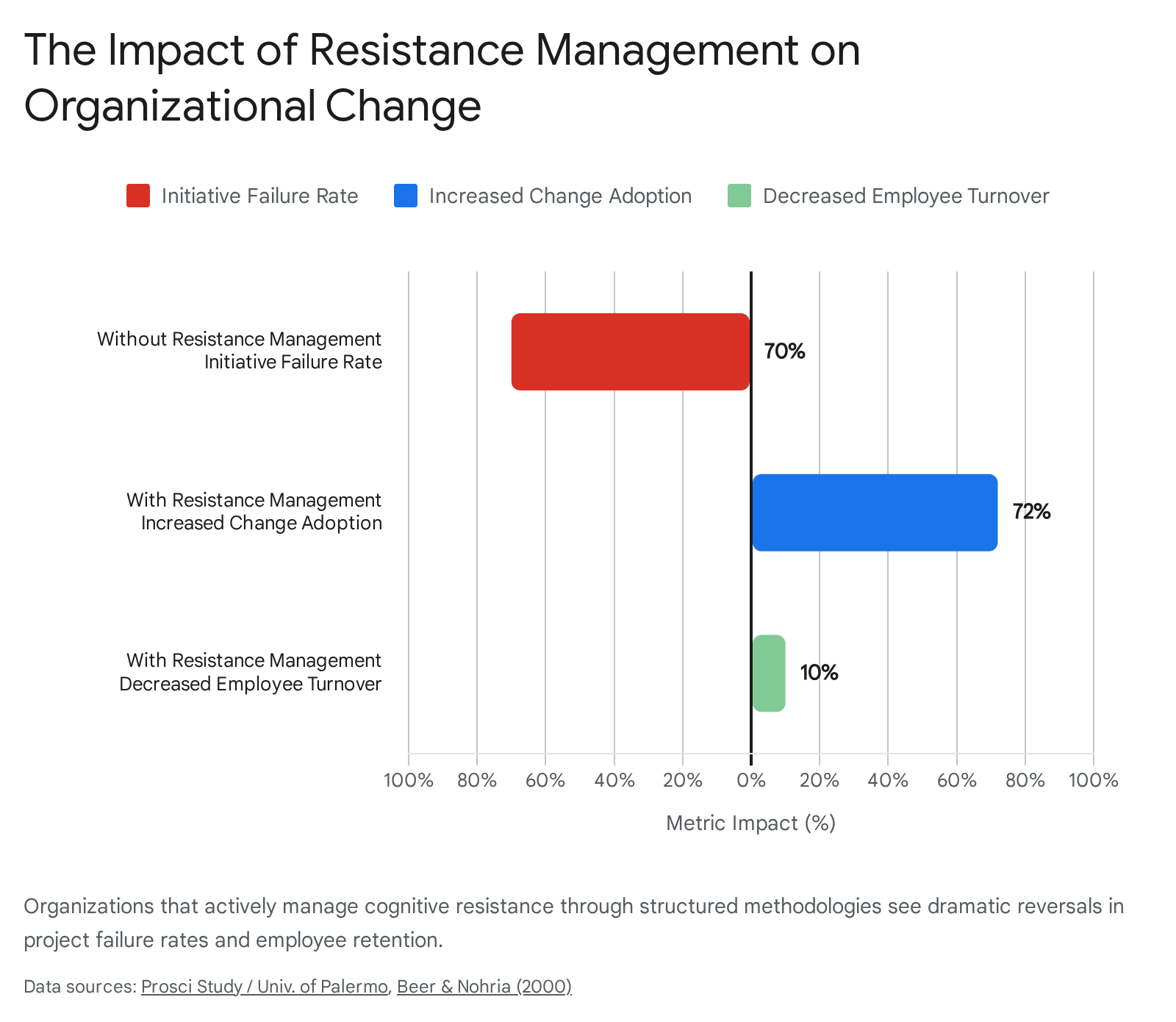
The complex interplay of psychological biases, neurobiological energy conservation, and cultural conditioning converges dramatically in the workplace. In organizational settings, resistance to change is frequently cited as the primary reason for the failure of new initiatives. Broad research indicates that approximately seventy percent of major organizational change programs fail to achieve their stated objectives, a failure rate overwhelmingly attributed to inadequate attention to the human dimension of cognitive inertia 5758.
Individual Triggers in the Workplace
In a purely personal context, the status quo bias operates largely as an internal battle against the fear of regret or the expenditure of cognitive effort. In an organizational context, however, the bias is externalized and massively amplified by systemic factors and team dynamics. Employees rarely resist change simply because they are obstinate; they resist because top-down organizational shifts trigger fundamental psychological defense mechanisms:
- Psychological Reactance and Loss of Control: When change is imposed from upper management without adequate consultation, individuals experience psychological reactance - a defensive, biological pushback against perceived restrictions on their autonomy and freedom of choice 59. The feeling of losing control over one's daily workflow generates immediate resistance, shifting the employee's focus entirely away from the objective merits of the new system toward the defense of their personal agency 85759.
- Amplified Loss Aversion: In the workplace environment, loss aversion translates into highly tangible fears regarding job security, the obsolescence of hard-earned technical expertise, and the potential loss of social status within a functional team 5759. A new software platform or reporting structure is rarely viewed as a systemic efficiency gain; rather, the brain's threat management system processes it as a direct threat to an employee's established competence and livelihood 59.
- Misalignment of Values and Organizational Justice: If employees perceive an imposed change as directly contradicting the organization's previously stated values, or if the distribution of the change's burden appears inherently unfair, it induces severe cognitive dissonance and widespread resentment. This form of resistance is driven by an underlying human desire to maintain systemic integrity and procedural fairness, moving beyond a mere preference for the status quo 859.
The Force-Field Framework and ADKAR Model
To systematically address these overlapping barriers, modern change management relies on structured behavioral methodologies. The Force-Field Framework conceptualizes organizational resistance not as a monolithic, insurmountable barrier, but as a highly dynamic interaction between hindering forces, which include cognitive biases, fear, and organizational inertia, and helping forces, which include effective transformational leadership, transparent communication, and structural support 60.
Kurt Lewin's foundational model of unfreezing, movement, and refreezing remains critical; the unfreezing stage targets the status quo directly by challenging old behaviors and raising awareness of the necessity for change before moving to actual implementation 61. Similarly, the Prosci ADKAR model structures resistance management by guiding individuals sequentially through Awareness, Desire, Knowledge, Ability, and Reinforcement 63. Failure at the foundational awareness or desire stages triggers active avoidance and the building of defensive barriers by employees attempting to protect their routines 63.
The intersection of artificial intelligence and cognitive inertia represents a rapidly emerging challenge in modern organizations. While AI possesses the capability to streamline data analysis, there is significant concern regarding algorithmic amplification of societal inertia. Because AI systems train on existing behavioral data, they have the potential to permanently codify and algorithmically amplify historical status quo biases, presenting deep challenges for AI alignment and organizational agility 64.
Strategies for Mitigating Cognitive Resistance
Overcoming the profound biological, psychological, and cultural programming of the status quo bias requires deliberate, evidence-based intervention strategies. Simply demanding compliance is highly ineffective because it triggers psychological reactance and fails to account for the metabolic constraints of the human brain.
Reframing and Choice Architecture
Because the brain instinctively prioritizes avoiding losses over acquiring gains, change must be cognitively reframed to emphasize what is actively being protected or gained by the transition 2159. Presenting new workflows or sustainable initiatives as a required mechanism to prevent future losses - such as avoiding market obsolescence or preventing environmental decay - aligns the change initiative with the brain's natural loss-aversion hardware rather than fighting against it 2159. Addressing the specific "What's in it for me?" question explicitly engages an individual's personal reward valuation circuitry, potentially triggering dopaminergic pathways to override fear and anxiety 63.
At a policy level, the most efficient method for utilizing the status quo bias is to completely redesign the default options through choice architecture. If the brain naturally defers to the baseline to save metabolic energy and avoid decision fatigue, policymakers and corporate leaders can make the optimal or sustainable choice the new default state 121. Examples include automatically enrolling employees in high-yield retirement plans or defaulting corporate energy consumption to sustainable grids 21. This strategy requires the individual to actively expend cognitive energy to opt-out, effectively reversing the momentum of the bias to work in favor of the desired outcome.
Restoring Autonomy and Reducing Ambiguity
To combat psychological reactance and bypass the ambiguity effect, stakeholders must be deeply involved early in the transition process 585962. Offering individuals structured choices within the overarching change framework - for example, allowing teams to independently select how a mandated new tool is implemented within their specific department - restores their crucial sense of autonomy and control 5961.
Furthermore, transparent, continuous, and highly detailed communication dramatically reduces the ambiguity of the outcome. By providing clear data, comprehensive training programs, and visible milestones, the unknown variables of the new state are systematically transformed into known variables. This cognitive demystification significantly reduces the amygdala's threat response, lowers anticipatory anxiety, and effectively neutralizes the primary drivers of behavioral resistance 25586366. Leveraging peer champions and early adopters as visible role models also establishes new pro-change social norms, utilizing the human drive for system justification to solidify the new baseline 5962.
Conclusion
The human resistance to change, encapsulated comprehensively by the status quo bias, is not a failure of logic, a character flaw, or an act of sheer stubbornness. Rather, it is a highly complex, ecologically rational feature of human evolutionary design. It is driven by a deep-seated psychological aversion to loss and ambiguity, enforced by the strict metabolic energy constraints of the prefrontal cortex, and physically wired into the neural threat-processing circuits of the amygdala, insula, and basal ganglia. While counter-systems driven by dopamine and the zona incerta allow for novelty-seeking and exploration under specific conditions, the default biological state leans heavily toward the safety of the known baseline.
Understanding that resistance to change is a biological and psychological default fundamentally shifts how societal and organizational transformations must be approached. By recognizing the overpowering influence of loss aversion, accommodating the brain's deep intolerance for ambiguity, and proactively designing choice architectures that align with specific cultural values, leaders can successfully bypass the mind's ancient defense mechanisms to foster sustainable adaptation in an increasingly complex world.