
What the Research Says About Brainstorming
Despite its ubiquity in corporate culture, traditional verbal brainstorming is largely ineffective, as decades of research consistently show that individuals working alone generate more and better ideas than interacting groups. However, when organizations replace unstructured meetings with asynchronous, written, or electronic frameworks, they bypass the cognitive bottlenecks and social anxieties that stifle creativity, unlocking a significantly higher volume of implementable solutions.
The Birth of the Brainstorming Myth
In the modern corporate and academic world, "brainstorming" is treated as the default mechanism for innovation and problem-solving. It is standard practice to gather a group of people in a conference room, stand before a whiteboard, and attempt to generate breakthrough ideas through rapid-fire conversation. The concept was first introduced and popularized in 1953 by advertising executive Alex F. Osborn in his seminal book Applied Imagination 12. Osborn, a founding partner at the advertising agency BBDO, was deeply frustrated by traditional business meetings, which he felt actively stifled creative thinking through premature criticism and a phenomenon his associate Charles Clark referred to as "negative conference thinking" 1.
To counter this, Osborn designed a structured group ideation process predicated on separating the generation of ideas from their evaluation. He established four foundational rules that he believed would create a psychological safe space for innovation. First, participants were required to defer judgment, meaning all criticism and evaluation had to be strictly withheld until the idea-generation phase was entirely complete. Second, groups were instructed to go for quantity, operating on the assumption that producing a massive volume of ideas would statistically increase the likelihood of uncovering a brilliant solution. Third, the process actively encouraged wild ideas, pushing participants to think outside the box and propose unconventional, even seemingly absurd, thoughts. Finally, team members were instructed to build on the ideas of others, combining and improving upon existing suggestions to create stronger, synthesized concepts 114.
Osborn claimed that groups following these specific rules would produce significantly more high-quality ideas than individuals working alone. He recommended groups of five to twelve people with varying levels of experience, though he cautioned against mixing hierarchical levels to prevent intimidation 1. For decades, the business world enthusiastically accepted this premise as gospel.
However, empirical science soon painted a vastly different picture. Beginning with early studies at Yale University in 1958 by researchers Taylor, Berry, and Block, behavioral scientists consistently found that Osborn's claims did not hold up under controlled experimental conditions 52. The Yale study introduced the concept of comparing "real groups" (people interacting in a room) to "nominal groups" (the pooled output of individuals working entirely alone). The researchers discovered that nominal groups consistently outperformed interacting brainstorming groups in both the total quantity and the overall quality of ideas 23. When individuals sit in a room together and share ideas aloud, a host of subconscious psychological and mechanical barriers immediately begin to degrade their creative output.
Why Traditional Group Brainstorming Fails
Decades of behavioral science, organizational psychology, and cognitive research have identified three primary "process losses" that occur when humans attempt to generate ideas collectively in real-time. These mechanisms explain why placing highly intelligent people in a room together often results in mediocre creative outcomes.
Production Blocking and the Conversational Bottleneck
The most significant barrier to group creativity is a mechanical and cognitive limitation known as production blocking. In a traditional verbal brainstorming session, only one person can speak at a time. While one team member is articulating an idea, the rest of the group must wait their turn to take the conversational floor 845.
During this waiting period, several highly detrimental cognitive processes occur. First, participants experience memory decay; they simply forget the ideas they were holding in their working memory while waiting for a chance to speak. Second, cognitive interference takes place. Human working memory is limited, and listening to another person speak actively disrupts an individual's own train of thought. It is exceptionally difficult to simultaneously process a colleague's verbalized idea while internally developing a completely new one 511.
Furthermore, production blocking often leads to idea suppression. After hearing someone else's idea, participants frequently discard their own unshared thoughts, mistakenly concluding that their idea is no longer relevant, too similar to what was just said, or simply inferior 511. This dynamic creates a situation known as cognitive inertia or cognitive uniformity, where group members abandon their divergent thoughts and instead pursue the same line of thinking introduced by the dominant speaker, leading to a narrow cluster of similar ideas rather than a broad exploration of the problem space 2.
Production blocking is often compared to a manufacturing bottleneck. No matter how fast the individual machines (the participants' brains) can operate, the final output of the system is constrained by the narrowest point on the assembly line, which in this case is the single conversational floor 84. Because group members are forced to take turns, the collective time spent actually generating ideas is vastly reduced compared to individuals working concurrently.
Evaluation Apprehension and the Fear of Judgment
Osborn's primary rule was to "defer judgment," but the human brain struggles to turn off its social radar. Evaluation apprehension occurs when the fear of negative judgment from peers, subordinates, or superiors prevents individuals from sharing their most original or unconventional ideas 126.
Even if a meeting facilitator explicitly bans criticism at the start of a session, participants still worry about subtle, non-verbal feedback. This includes "silent criticisms" such as raised eyebrows, a lack of enthusiastic response, or the internal tracking of who is contributing "good" versus "bad" ideas 47. This apprehension leads to intense self-censorship, causing individuals to withhold their most novel concepts and instead offer safe, predictable suggestions that they know will be socially acceptable.
The problem of evaluation apprehension is uniquely pronounced in hierarchical settings. If a senior executive or manager is in the room, lower-level employees will often anchor their ideas to the executive's initial suggestions rather than risk proposing a contradictory path. For example, if a team is brainstorming marketing strategies and the boss suggests focusing on a specific demographic, the rest of the group will likely spend the remainder of the session generating minor variations of the boss's idea 15. This anchoring effect completely destroys the divergent thinking that brainstorming is supposed to foster. Studies have shown that even the mere presence of an evaluator or the knowledge that the ideas will be judged later can induce enough physiological arousal and distraction to hinder cognitive performance on complex creative tasks 16.
Social Loafing and the Ringelmann Effect
The third major pillar of brainstorming failure is social loafing, a psychological phenomenon in which individuals exert significantly less effort when working collectively than they would if they were solely responsible for an outcome 817.
This phenomenon was first identified in 1913 by French agricultural engineer Max Ringelmann. Through a series of rope-pulling experiments, Ringelmann observed that as group size increased, the total amount of force exerted by the group was substantially less than the sum of the individuals' maximum capabilities 178. This effect is deeply ingrained in human group dynamics and is driven by a diffusion of responsibility. When multiple people are tasked with solving a problem together, the pressure on any single individual decreases, as their specific contribution is obscured by the collective output 819.
Social loafing is often explained through the Collective Effort Model (CEM), developed by researchers Karau and Williams. The CEM suggests that individuals subconsciously assess two factors: their expectation that their effort will impact the final goal, and the value they place on that goal. In a group brainstorming setting, both factors are often diminished 1720. If a team member believes that the most vocal extroverts in the room will inevitably dominate the session and supply all the required ideas, they will subconsciously withdraw their own effort. This specific behavior is known as "free riding" 21921.
The larger the group, the more pronounced social loafing becomes, as individual accountability drops to near zero. Furthermore, if high-performing individuals notice that their peers are coasting, they may reduce their own effort to avoid feeling like a "sucker" who is carrying the team, leading to a downward spiral of collective motivation 2.
Structured Ideation: Methods That Actually Work
Recognizing the severe flaws in unstructured verbal brainstorming, organizational scientists and innovation experts have developed alternative frameworks designed to capture the benefits of group synergy while mechanically eliminating production blocking, evaluation apprehension, and social loafing.
The Nominal Group Technique (NGT)
The Nominal Group Technique is a highly structured decision-making and ideation method that relies heavily on solitary work. It is designed to ensure equitable participation and prevent dominant personalities from anchoring the group's thought process. A typical NGT session follows a strict, multi-step sequence 229.
The session begins with silent generation. The facilitator presents a clearly defined problem, and team members silently write down their ideas on paper for a set period, completely independently. Because everyone works at the same time, production blocking is eliminated. Because the generation is private, evaluation apprehension is vastly reduced.
Next, the group engages in round-robin recording. Participants take turns sharing one idea at a time from their lists. The facilitator records each idea on a master list visible to the room. Crucially, absolutely no debate or evaluation is allowed during this phase. The round-robin continues until all unique ideas from everyone's private lists have been recorded 229.
Once the master list is complete, the group moves to serial discussion. Here, participants are allowed to discuss the ideas, but strictly for the purpose of clarification, not to champion or critique them. Finally, the session concludes with mathematical voting. Participants independently and silently rank or vote on the best ideas, and the results are mathematically aggregated to form a final group decision 9. Data shows that teams implementing NGT achieve up to a 25% increase in the quality of their solutions compared to traditional brainstorming, and the method boasts an 89% effectiveness rating for generating implementable concepts 229.
Brainwriting and the 6-3-5 Method
Brainwriting takes the principles of NGT a step further by mechanically forcing the combination and improvement of ideas - one of Osborn's original goals that verbal brainstorming fails to achieve.
In the classic 6-3-5 format, six participants sit in a room or around a table. Each person silently writes down three ideas on a piece of paper within five minutes. Once the timer sounds, every participant passes their paper to the person next to them. That person reads the three ideas and uses the next five minutes to add three more ideas to the sheet. These new additions can be entirely original concepts, or they can be modifications and improvements built directly upon the previous ideas 322.
This passing process continues until the papers have made a full circuit. Research indicates that Brainwriting consistently produces 28% more implementable ideas than traditional brainstorming, with a 91% overall effectiveness score 22. Because all participants are writing simultaneously, production blocking is mathematically eliminated. Because the process is entirely silent, extrovert dominance is neutralized, and introverted or junior team members have an equal platform to contribute. Furthermore, the mandatory passing of papers mechanically guarantees that participants read and build upon the thoughts of others, creating true cognitive synergy without conversational interference 5322.
Methodological Comparisons
To understand the operational differences between these approaches, it is helpful to view them side-by-side across the primary psychological barriers.
| Feature / Dynamic | Traditional Brainstorming | Nominal Group Technique (NGT) | Brainwriting (6-3-5) |
|---|---|---|---|
| Communication Mode | Verbal, synchronous | Silent writing, structured sharing | Silent, sequential writing |
| Production Blocking | High (one speaker at a time) | Eliminated during generation phase | Eliminated entirely |
| Evaluation Apprehension | High (vulnerable to facial/verbal cues) | Moderate (ideas are shared publicly later) | Low (silent and often anonymous) |
| Social Loafing | High (easy to hide behind loud peers) | Low (everyone must submit a list) | Low (everyone must fill their paper) |
| Idea Yield | Lowest volume and originality | High volume and high practicality | Highest volume and high synthesis |
| Primary Use Case | Team bonding, energy generation | Complex decision-making, consensus | Maximizing idea volume and variation |
The Cultural Dimensions of Idea Generation
Brainstorming is not a culturally neutral activity. A society's underlying values heavily dictate how individuals behave within group problem-solving environments, largely breaking down along the sociological dimensions of individualism versus collectivism 2410.
Individualism vs. Collectivism
Individualist cultures, such as the United States, Canada, the United Kingdom, and Australia, place a high societal emphasis on personal achievement, self-reliance, personal autonomy, and speaking one's mind 2410. In these environments, standing out and vocalizing unique thoughts is rewarded. Collectivist cultures, such as Taiwan, Japan, China, and many Latin American countries, prioritize social harmony, group cohesion, mutual obligation, and deep respect for hierarchy 2411. In collectivist societies, the needs and stability of the "in-group" supersede individual ambitions, and preserving harmony often comes at the cost of radical honesty 241012.
These fundamental dimensions drastically alter creative output in a business setting. In cross-cultural experimental studies comparing Canadian (individualist) and Taiwanese (collectivist) participants, researchers found distinct, measurable differences in both the volume and the nature of the ideas produced during brainstorming tasks 7.
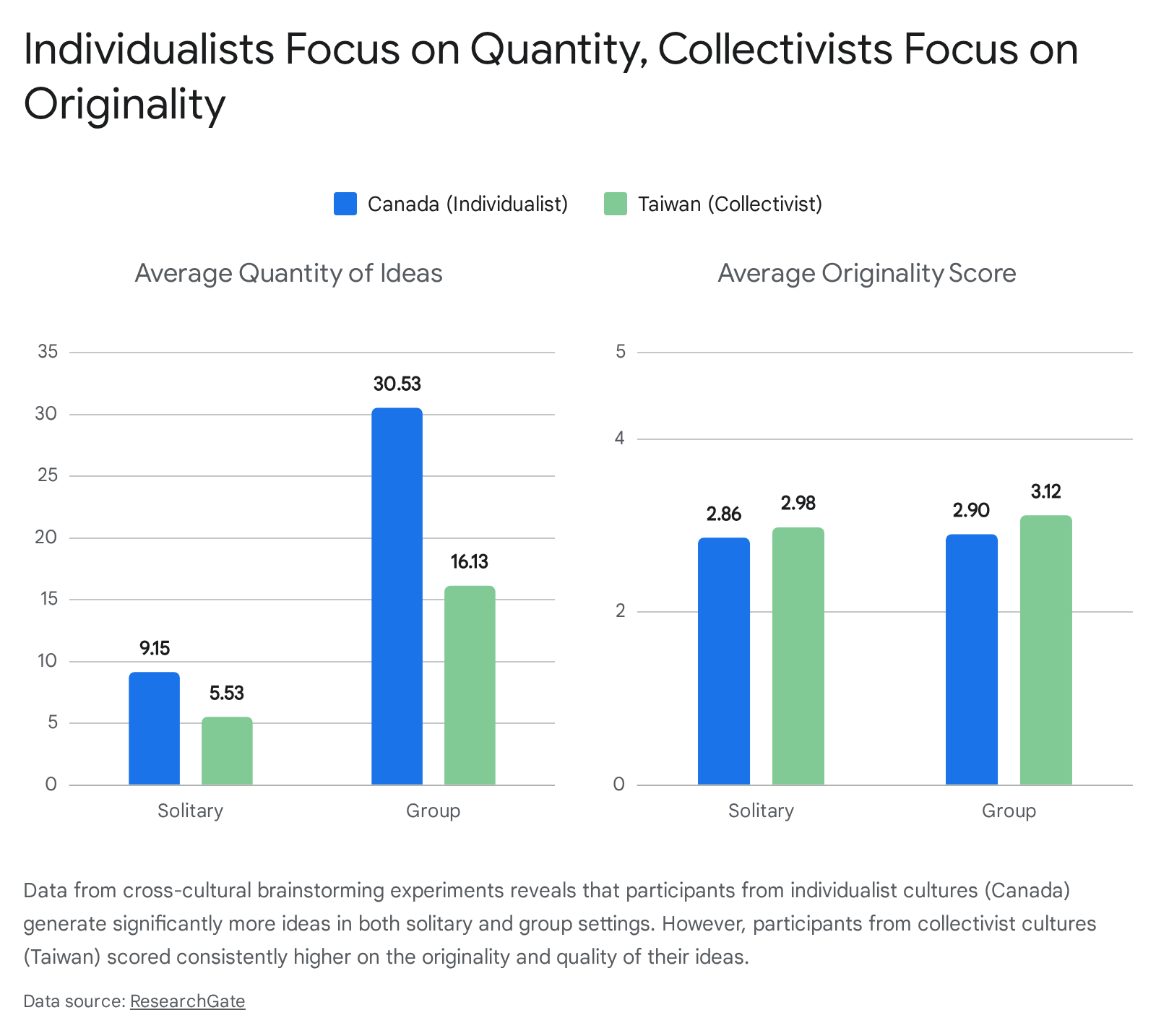
The data reveals that individualists are generally more action-oriented; they focus heavily on "doing" and are comfortable sharing unfiltered, raw thoughts as quickly as they arise. This cultural comfort with risk-taking leads to a massive quantity of ideas. For example, in the study, Canadian groups generated an average of 30.53 ideas compared to 16.13 for the Taiwanese groups 7.
In stark contrast, collectivists value "thinking before doing." They exhibit much greater caution and deliberation, preferring to synthesize the constituent parts of a problem into an integrated, harmonious whole before speaking aloud 7. Furthermore, the burden of evaluation apprehension is vastly amplified in collectivist cultures. Proposing a wild, unfeasible, or highly critical idea carries the severe social risk of losing face, appearing disrespectful, or disrupting group harmony 7. Consequently, collectivist participants filter their thoughts heavily. They withhold their wildest or most chaotic concepts, but ensure that the ideas they do verbalize are highly refined. As a result, while they produce fewer ideas overall, the Taiwanese participants scored higher on independent metrics of originality and quality 7.
These findings have massive implications for global organizations. Managers facilitating multicultural teams must account for these dynamics, recognizing that traditional Western brainstorming norms - which reward aggressive vocalization and rapid-fire interruption - may actively silence collectivist team members 1314. To harness the full creative potential of a diverse team, leaders must utilize structured methods like brainwriting that provide a culturally safe, silent space for idea generation.
The Impact of Remote and Hybrid Work on Innovation
The rapid, global transition to remote and hybrid work environments prompted an urgent question for organizational leaders: Can distributed teams innovate as effectively over video calls as they can in a physical office?
Many executives feared that the loss of spontaneous hallway conversations and physical whiteboarding sessions would destroy their companies' innovative edge, leading to mandates for employees to return to the office 31. However, research indicates that while replicating traditional meetings online is disastrous for creativity, teams that adapt to digital-first innovation frameworks actually gain a competitive advantage 31.
Synchronous Virtual Meetings: The Screen Factor
If an organization attempts to conduct a traditional verbal brainstorming session via a synchronous video conference (e.g., a Zoom or Microsoft Teams call), the results are overwhelmingly negative. In a landmark field and laboratory study conducted by researchers Jonathan Levav at Stanford Graduate School of Business and Melanie Brucks at Columbia Business School, data definitively showed that virtual meetings inhibit creative ideation 1533.
The researchers began with lab experiments where participants were tasked with generating novel uses for everyday objects. They tracked eye movements, language, and idea generation. They then scaled the experiment into the field, analyzing 1,490 engineers at a multinational corporation spread across Europe and Asia. In both settings, the teams meeting in person generated between 15% and 20% more ideas than those meeting via video, and independent judges consistently rated the in-person ideas as highly original 15.
The mechanism behind this creative deficit lies in the intersection of human vision and attention. During a video call, participants feel intensely compelled to keep their gaze fixed squarely on the screen. Looking away, glancing out a window, or staring at the ceiling can signal disinterest, distraction, or unprofessionalism to colleagues on the call 1533. This forced attention creates an artificially narrow visual field. Cognitive science has long established a link between visual scope and mental scope; a narrow visual field naturally triggers narrow, hyper-focused cognition 15.
When people meet in a physical room, their eyes are free to wander. They observe their surroundings, look at their peers, and process peripheral information. This visual wandering promotes "cognitive wandering," allowing the brain's associative memory networks to connect seemingly unrelated concepts. Divergent, disruptive innovation requires exactly this type of broad, unfocused mental connection 15.
Because of this narrowed cognitive state, the ideas generated during video calls often resemble the structure of a "tall and narrow cypress tree" - they are highly linear, representing only minor, incremental variations on a single initial theme. In contrast, in-person teams are more likely to move in entirely novel directions, creating idea structures that resemble a "sprawling oak tree" with widely divergent branches 15.
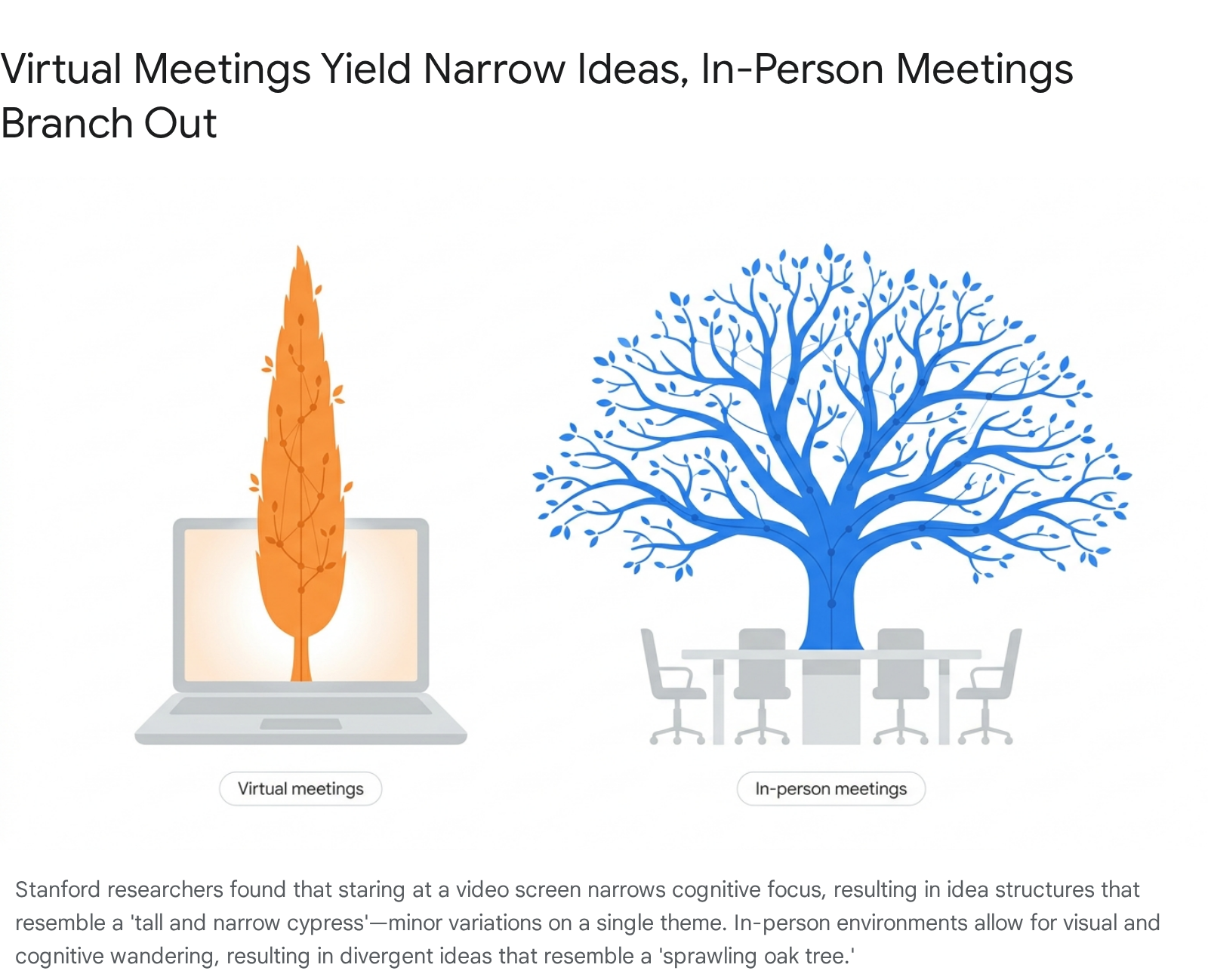
Interestingly, while video conferencing harms the generation of divergent ideas, the same Stanford study found that virtual teams performed just as well, and sometimes slightly better, at evaluating and selecting the best ideas from an existing list. The narrow, focused attention forced by screen-time actively aids the convergent thinking required to analyze and select optimal solutions 15.
Asynchronous Electronic Brainstorming (EBS)
If synchronous video meetings kill creativity, how do remote and distributed teams successfully innovate? The scientifically supported answer is Asynchronous Electronic Brainstorming (EBS) 31.
Modern digital workspaces, utilizing virtual whiteboard tools (like Miro or Figma) or asynchronous communication platforms (like Slack or dedicated project spreadsheets), allow teams to strip away the social friction of the conference room entirely 3416. The most effective best practice for virtual innovation involves establishing a shared digital canvas where team members can input ideas asynchronously over the course of hours or days, rather than forcing everyone to think simultaneously during a one-hour meeting 31.
This method offers several profound, evidence-based advantages over both in-person and video brainstorming:
- True Anonymity and Reduced Apprehension: When submissions to the digital board are completely anonymous to peers, evaluation apprehension drops to near zero. Participants freely submit wild, unconventional ideas without fear of retribution, embarrassment, or losing face. (To prevent social loafing, managers can often track backend participation to ensure accountability, while keeping the front-facing board anonymous) 31.
- Infinite Parallel Input: Digital tools lack the temporal constraints of speech. Ten, fifty, or a hundred people can type and submit ideas simultaneously. This completely cures production blocking, as no one ever has to wait their turn to contribute 17.
- Positive Scaling with Group Size: In traditional verbal brainstorming, larger groups perform significantly worse than smaller groups due to compounding wait times and increased social loafing. However, in Electronic Brainstorming, the dynamic reverses. Research indicates that as EBS group size increases - particularly past 10 people - the relative creative benefit actually increases. The synergy of rapidly reading a massive variety of anonymous ideas triggers new cognitive associations faster than the minimal friction of typing can block them 3118.
To optimize hybrid work, researchers suggest conducting the messy, divergent generation phases asynchronously using EBS tools, and saving the in-person office days for the complex, convergent tasks of debating, selecting, and implementing the best ideas 31.
| Brainstorming Environment | Key Characteristics | Impact on Idea Generation | Impact on Idea Evaluation |
|---|---|---|---|
| In-Person Meetings | Broad visual field, cognitive wandering, high social friction. | High (divergent, "oak tree" ideas) | Moderate |
| Synchronous Video Calls | Narrow visual field, forced eye contact, turn-taking. | Low (linear, "cypress tree" ideas) | High (focused convergent thinking) |
| Asynchronous EBS | Parallel input, anonymity, flexible timing. | Highest (eliminates production blocking) | Moderate to High |
The Neuroscience of Group Creativity
Advancements in neuroimaging have allowed researchers to peer past behavioral observations and observe exactly what happens in the human brain during collaborative ideation.
A recent study utilized functional near-infrared spectroscopy (fNIRS) to monitor the brain activity of groups of four during real-time brainstorming discussions. The researchers were specifically looking for "interbrain coupling" - the phenomenon where team members' neural oscillations synchronize during social interaction 19.
The researchers tracked two specific brain regions: the dorsolateral prefrontal cortex (DLPFC), a region strongly associated with cognitive flexibility, executive function, and generating novel thoughts; and the inferior frontal gyrus (IFG), a region associated with imitation, social conformity, and "herding" behavior 19.
The fNIRS data revealed that during group brainstorming, team members' brains do physically synchronize. However, the location of that neural synchronization dictates the success of the session. Groups that exhibited high interbrain coupling in the left DLPFC generated highly creative, divergent ideas. Their brains were literally syncing up in a state of mutual cognitive flexibility.
Conversely, groups that synchronized strongly in the right IFG produced significantly lower creativity scores. Their brains were locked into a collective mindset of imitation and conformity, focusing on mirroring each other rather than exploring new territory 19. This neurobiological evidence starkly underscores the danger of groupthink: if a meeting environment does not actively encourage cognitive flexibility and psychological safety, human neurobiology naturally defaults to social herding.
Building a Reliable Innovation Ecosystem
For organizations looking to move past the myth of the 90-minute whiteboard session, experts from institutions like Harvard Business School recommend treating ideation not as a singular event, but as a structured, deliberate innovation strategy 20.
Brainstorming for Questions, Not Answers
One proven method to bypass cognitive biases and lower evaluation apprehension is to fundamentally flip the objective of the session. Instead of brainstorming for solutions, teams should brainstorm for questions 40.
Popularized by researchers like Hal Gregersen and sociologist Parker Palmer, this methodology asks participants to generate rapid-fire inquiries about a problem's root cause, unexamined assumptions, or hidden customer needs. By focusing on questions, the team is forced to venture into uncharted territory without the heavy pressure of producing a polished, viable final product. This "question burst" methodology significantly lowers the psychological stakes, encourages broader participation, and frequently reveals entirely new pathways for innovation that solution-focused groups miss 40.
The Chemistry of the Room: Personality and Collaboration
Idea generation is also deeply dependent on the psychological composition of the group. Research from Duke University and Harvard Business School indicates that not all conversations are equally fruitful. In a field experiment analyzing startup founders in the Indian wedding industry, researchers assessed participants using the "Big Five" personality traits and tracked the quality of ideas generated during peer conversations 21.
The data revealed that pairing individuals based on specific personality traits yields statistically better creative outcomes. Specifically, bringing together individuals who score high on openness to experience (those who are less stuck in their ways and eager to entertain radical shifts) with those who score high on extroversion (those who are outgoing, talkative, and willing to vocalize concepts without a filter) creates a highly combustible, productive creative environment 21.
However, managers must be highly strategic with this knowledge. While extroverts may drive the conversation, introverts are often better at developing complex, nuanced ideas internally. To prevent introverts from being overshadowed or suffering from evaluation apprehension, facilitators must actively protect their contributions, either by collecting their ideas asynchronously prior to the meeting or by utilizing highly structured sharing rounds like the Nominal Group Technique 21.
Bottom line
The research data is unequivocal: traditional, unstructured verbal brainstorming is an outdated methodology that actively hinders creativity due to conversational bottlenecks, social loafing, and the universal fear of peer judgment. However, the goal of collaborative ideation remains highly valuable. When organizations replace free-for-all meetings with structured frameworks like brainwriting, leverage anonymous digital tools for asynchronous electronic brainstorming, and strategically compose their teams to foster cognitive flexibility, they can consistently unlock a much higher volume of original, implementable ideas.